
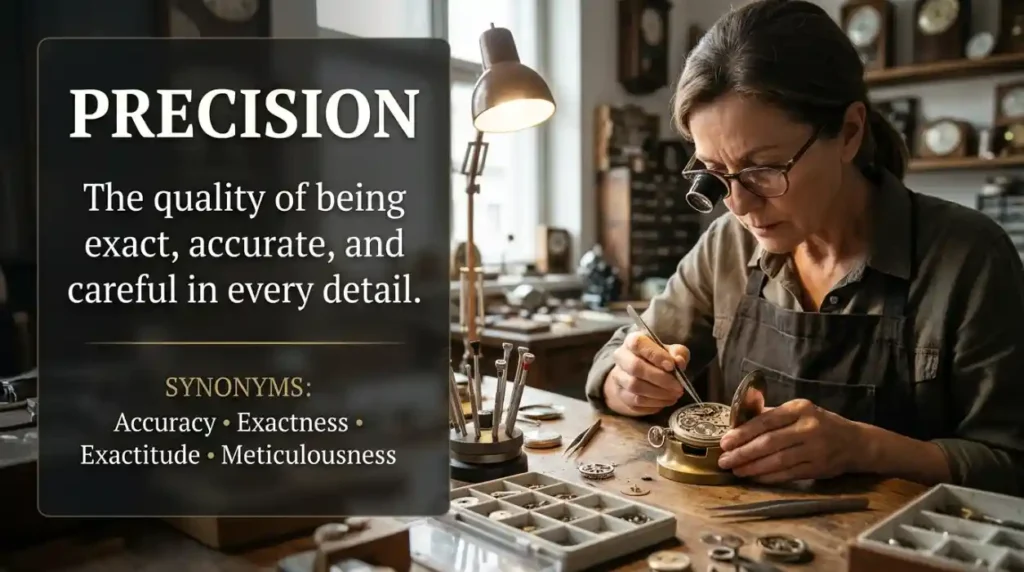
A synonym for precision is a word or expression that conveys exactness, accuracy, or careful attention to detail. Common alternatives include accuracy, exactness, correctness, and exactitude. The best choice depends on whether you mean correct results, consistent measurements, or clearly expressed information.
Have you ever followed a recipe where exact measurements made the difference between a perfect meal and a disappointing result? This shows why precision matters. It helps you get reliable results, avoid mistakes, and complete tasks correctly.
Finding a synonym for precision allows you to express the idea of accuracy in different ways. Words such as exactness, accuracy, and meticulousness can describe different aspects of careful work, depending on the situation.
Students can use these alternatives to strengthen their essays and assignments. Writers and bloggers can make their content more engaging, while professionals can communicate technical details with greater clarity.
Understanding each synonym for precision is especially useful in fields such as science, technology, engineering, and business, where small errors can have significant consequences. Learning the right synonym for precision helps you choose words that fit your intended meaning, improve your vocabulary, and communicate information with confidence.
What Does “Precision” Really Mean?
Precision is a noun that describes the quality of being exact, carefully controlled, or consistent in detail. It can refer to measurements, movements, language, calculations, and other activities that require careful execution.
For example, a scientist needs precision when measuring a chemical substance. A writer needs precision when choosing words. A football player may show precision by sending the ball exactly where intended.
Native English speakers often associate precision with skill, care, and controlled results. In technical contexts, it can describe how closely repeated measurements agree with one another. In communication, it can mean expressing an idea without unnecessary ambiguity.
Precision overlaps with accuracy, but the words are not always interchangeable. Accuracy is about closeness to the correct value. Precision can describe consistency or a high degree of exactness. A measurement can be precise without being accurate if repeated results are consistent but consistently wrong.
Connotative Meaning
Connotation is the emotional, cultural, or implied association a word carries beyond its basic definition.
- Positive tone: Precision can suggest expertise, reliability, professionalism, and excellent performance.
- Negative tone: In some situations, an excessive focus on precision may suggest rigidity, pedantry, or unnecessary attention to tiny details.
- Neutral tone: In science and mathematics, precision often describes a measurable property without expressing approval or criticism.
The word itself is usually positive or neutral. Its effect depends on the situation and the speaker’s intention.
Etymology of Precision
The English noun precision comes through French from Latin praecisio, meaning “a cutting off” or “a curtailment.” It is related to the Latin verb praecidere, meaning “to cut off” or “to cut short.”
The connection with exactness developed over time. The idea of cutting something off can suggest removing what is unnecessary or defining a matter clearly.
Old English (450–1100)
Precision was not an ordinary native Old English word. English speakers expressed related ideas through vocabulary associated with correctness, care, and careful action. The modern technical meaning had not yet developed in its present form.
Middle English (1100–1500)
Following the Norman Conquest, French and Latin influenced English vocabulary. Learned terms entered English through religious, academic, and scholarly writing. Precision emerged in English around the late Middle English period through this French and Latin influence.
Modern English (1500–Present)
The word gradually became established as a term for exactness and careful distinction. Scientific progress expanded its use in measurement and experimentation. Today, it appears in engineering, medicine, mathematics, writing, sports, and everyday conversation.
Pronunciation, Syllables, and Word Formation
US pronunciation: /prɪˈsɪʒən/
UK pronunciation: /prɪˈsɪʒən/
Syllables
pre-ci-sion: 3 syllables.
Part of speech
Noun.
Root and affixation pattern
- Base or related adjective: precise
- Prefix: None in the modern word.
- Suffix: -ion, used to form nouns that express a state, process, or quality.
- Related adjective: precise
- Related adverb: precisely
- Related noun: precision
Examples:
- The engineer worked with precision.
- She gave precise instructions.
- He explained the process precisely.
Synonyms List
The alternatives below are numbered for easy reference. Some are direct synonyms, while others fit particular contexts involving measurements, careful work, or clear communication. Their meanings overlap, but they cannot all replace precision in every sentence.
1. Accuracy (Noun) — US: /ˈækjərəsi/ | UK: /ˈækjərəsi/
Meaning: The quality of being correct or close to a true value.
Tone/Register: Neutral, academic, professional.
Examples:
- The accuracy of the final report impressed the director.
- Check the accuracy of your calculations before handing in the assignment.

2. Exactness (Noun) — US: /ɪɡˈzæktnəs/ | UK: /ɪɡˈzæktnəs/
Meaning: The quality of matching a particular detail, amount, or requirement exactly.
Tone/Register: Neutral, formal.
Examples:
- The recipe requires exactness when measuring each ingredient.
- The builder checked the exactness of every measurement.
3. Correctness (Noun) — US: /kəˈrektnəs/ | UK: /kəˈrektnəs/
Meaning: The quality of being right according to facts, rules, or accepted standards.
Tone/Register: Academic, professional.
Examples:
- The teacher reviewed the correctness of every answer.
- Correctness is essential when quoting figures in a research paper.
4. Exactitude (Noun) — US: /ɪɡˈzæktəˌtuːd/ | UK: /ɪɡˈzæktɪtjuːd/
Meaning: A high degree of exactness in measurement, description, or execution.
Tone/Register: Formal, technical.
Examples:
- The architect measured the structure with remarkable exactitude.
- Her exactitude helped the team avoid expensive errors.
5. Preciseness (Noun) — US: /prɪˈsaɪsnəs/ | UK: /prɪˈsaɪsnəs/
Meaning: The quality of being precise or clearly defined.
Tone/Register: Formal, neutral.
Examples:
- The preciseness of his instructions made the task easier.
- The report needs greater precision in its descriptions.
6. Specificity (Noun) — US: /ˌspesəˈfɪsəti/ | UK: /ˌspesɪˈfɪsɪti/
Meaning: The quality of giving particular details instead of making general statements.
Tone/Register: Academic, professional.
Examples:
- Add more specificity when describing the incident.
- The job advertisement lacked specificity about daily responsibilities.
7. Meticulousness (Noun) — US: /məˈtɪkjələsnəs/ | UK: /məˈtɪkjələsnəs/
Meaning: Extreme care and attention to small details.
Tone/Register: Professional, descriptive.
Examples:
- Her meticulousness showed in every page of the manuscript.
- The tailor’s meticulousness produced a perfectly fitted jacket.
8. Thoroughness (Noun) — US: /ˈθɜːroʊnəs/ | UK: /ˈθʌrənəs/
Meaning: The quality of examining or completing something carefully and completely.
Tone/Register: Professional, academic.
Examples:
- The inspector’s thoroughness revealed a hidden fault.
- Thoroughness matters when reviewing a legal document.
9. Rigor (Noun) — US: /ˈrɪɡər/ | UK: /ˈrɪɡə/
Meaning: Strictness and care in following a method or standard.
Tone/Register: Scientific, academic, professional.
Examples:
- The researchers tested their claims with scientific rigor.
- Academic rigor helped the students develop stronger arguments.
10. Clarity (Noun) — US: /ˈklerəti/ | UK: /ˈklærəti/
Meaning: The quality of expressing information so that it is easy to understand.
Tone/Register: Neutral, academic, professional.
Examples:
- The editor improved the clarity of the instructions.
- Clarity helped the audience follow the speaker’s main point.
11. Correctness of Detail (Noun Phrase) — US: /kəˈrektnəs əv ˈdiːteɪl/ | UK: /kəˈrektnəs əv ˈdiːteɪl/
Meaning: The quality of getting individual facts and small elements right.
Tone/Register: Formal, editorial.
Examples:
- The historian checked the correctness of detail in the biography.
- Correctness of detail made the article more trustworthy.
12. Fidelity (Noun) — US: /fɪˈdeləti/ | UK: /fɪˈdeləti/
Meaning: The degree to which a copy or representation remains faithful to its source.
Tone/Register: Technical, artistic, academic.
Examples:
- The restoration preserved the fidelity of the original painting.
- The translation maintained fidelity to the author’s meaning.
13. Faithfulness (Noun) — US: /ˈfeɪθfəlnəs/ | UK: /ˈfeɪθfəlnəs/
Meaning: The quality of preserving the original meaning, details, or character of something.
Tone/Register: Neutral, literary, formal.
Examples:
- The film showed faithfulness to the events in the novel.
- She checked the faithfulness of the translation against the source text.
14. Consistency (Noun) — US: /kənˈsɪstənsi/ | UK: /kənˈsɪstənsi/
Meaning: The quality of producing similar results or maintaining the same standard over time.
Tone/Register: Neutral, scientific, professional.
Examples:
- The photographer maintained consistency across the entire collection.
- Consistency in the measurements made the results easier to compare.
15. Reliability (Noun) — US: /rɪˌlaɪəˈbɪləti/ | UK: /rɪˌlaɪəˈbɪləti/
Meaning: The quality of producing dependable results under expected conditions.
Tone/Register: Professional, technical.
Examples:
- The laboratory tested the reliability of its new equipment.
- Reliability matters when a team depends on repeated measurements.
16. Carefulness (Noun) — US: /ˈkerfəlnəs/ | UK: /ˈkeəfəlnəs/
Meaning: The habit of taking care to avoid mistakes or damage.
Tone/Register: Neutral, everyday.
Examples:
- Her carefulness prevented the glassware from breaking.
- Carefulness when entering figures can prevent costly corrections.
17. Diligence (Noun) — US: /ˈdɪlɪdʒəns/ | UK: /ˈdɪlɪdʒəns/
Meaning: Steady, attentive effort in completing a task properly.
Tone/Register: Formal, professional.
Examples:
- His diligence helped the team finish the audit on time.
- She checked every reference with diligence before publishing her essay.
18. Attention to Detail (Noun Phrase) — US: /əˈtenʃən tə ˈdiːteɪl/ | UK: /əˈtenʃən tə ˈdiːteɪl/
Meaning: The habit of noticing and checking small but important elements.
Tone/Register: Everyday, professional.
Examples:
- Her attention to detail made the presentation look polished.
- The role requires attention to detail when reviewing records.
19. Exact Measurement (Noun Phrase) — US: /ɪɡˈzækt ˈmeʒərmənt/ | UK: /ɪɡˈzækt ˈmeʒəmənt/
Meaning: A measurement that states a quantity or dimension as precisely as required.
Tone/Register: Technical, practical.
Examples:
- The carpenter took an exact measurement before cutting the wood.
- An exact measurement helped us order the correct replacement part.
20. Precision of Measurement (Noun Phrase) — US: /prɪˈsɪʒən əv ˈmeʒərmənt/ | UK: /prɪˈsɪʒən əv ˈmeʒəmənt/
Meaning: The degree to which repeated measurements agree with one another.
Tone/Register: Scientific, technical.
Examples:
- The lab improved the precision of measurement by standardizing its process.
- Precision of measurement matters when tracking small temperature changes.
21. Trueness (Noun) — US: /ˈtruːnəs/ | UK: /ˈtruːnəs/
Meaning: The degree to which a measured result agrees with an accepted reference value.
Tone/Register: Scientific, technical.
Examples:
- The researchers evaluated the trueness of the instrument’s readings.
- Trueness matters when results are compared with a certified standard.
22. Repeatability (Noun) — US: /rɪˌpiːtəˈbɪləti/ | UK: /rɪˌpiːtəˈbɪləti/
Meaning: The ability to obtain similar results when the same method is repeated under the same conditions.
Tone/Register: Scientific, technical.
Examples:
- The lab tested the repeatability of its new procedure.
- Good repeatability made the test more useful for routine checks.
23. Reproducibility (Noun) — US: /ˌriːprəˌduːsəˈbɪləti/ | UK: /ˌriːprəˌdjuːsəˈbɪləti/
Meaning: The ability to obtain consistent findings when a study or method is repeated, including by other researchers.
Tone/Register: Scientific, academic.
Examples:
- The research team published its methods to support reproducibility.
- Reproducibility strengthened confidence in the study’s conclusions.
24. Granularity (Noun) — US: /ɡrænˈjʊlərəti/ | UK: /ɡrænˈjʊlərɪti/
Meaning: The level of detail used to describe or measure information.
Tone/Register: Technical, business, analytical.
Examples:
- The report provides enough granularity to compare each department.
- Choose the right granularity before organizing the survey data.
25. Resolution (Noun) — US: /ˌrezəˈluːʃən/ | UK: /ˌrezəˈluːʃən/
Meaning: The level of detail that an instrument or image can distinguish.
Tone/Register: Technical, scientific.
Examples:
- The microscope offers higher resolution for examining tiny structures.
- The camera’s resolution helped us inspect the fine markings.
26. Calibration (Noun) — US: /ˌkæləˈbreɪʃən/ | UK: /ˌkælɪˈbreɪʃən/
Meaning: The process of checking or adjusting an instrument against a known standard.
Tone/Register: Technical, scientific.
Examples:
- The technician completed the calibration before taking readings.
- Regular calibration helps the scale produce dependable measurements.
27. Alignment (Noun) — US: /əˈlaɪnmənt/ | UK: /əˈlaɪnmənt/
Meaning: The correct positioning of parts in relation to each other or a reference point.
Tone/Register: Technical, practical.
Examples:
- The mechanic checked the alignment of the car’s wheels.
- Proper alignment kept the machine’s moving parts on track.
28. Objectivity (Noun) — US: /ˌɑːbdʒekˈtɪvəti/ | UK: /ˌɒbdʒekˈtɪvɪti/
Meaning: The quality of judging evidence without allowing personal feelings to distort the assessment.
Tone/Register: Academic, professional.
Examples:
- The reviewer approached the evidence with objectivity.
- Objectivity helped the panel evaluate each application fairly.
29. Impartiality (Noun) — US: /ˌɪmˌpɑːrʃiˈæləti/ | UK: /ˌɪmˌpɑːʃiˈæləti/
Meaning: The quality of treating different sides fairly without favoring one.
Tone/Register: Formal, legal, professional.
Examples:
- The judge demonstrated impartiality throughout the hearing.
- Impartiality is important when reviewing a dispute between colleagues.
30. Discernment (Noun) — US: /dɪˈsɜːrnmənt/ | UK: /dɪˈsɜːnmənt/
Meaning: The ability to judge carefully and recognize important differences.
Tone/Register: Formal, intellectual.
Examples:
- Her discernment helped her identify the strongest argument.
- Good discernment is useful when comparing conflicting reports.
31. Discrimination (Noun) — US: /dɪˌskrɪməˈneɪʃən/ | UK: /dɪˌskrɪmɪˈneɪʃən/
Meaning: The ability to recognize fine distinctions between similar things.
Tone/Register: Formal, academic.
Examples:
- The editor showed discrimination when selecting the most suitable phrase.
- Scientific discrimination helps researchers distinguish signals from noise.
32. Definiteness (Noun) — US: /ˈdefənɪtnəs/ | UK: /ˈdefɪnɪtnəs/
Meaning: The quality of being clearly fixed, determined, or unambiguous.
Tone/Register: Formal, academic.
Examples:
- The contract states the deadlines with definiteness.
- We need greater definiteness before approving the final schedule.
33. Specificity of Language (Noun Phrase) — US: /ˌspesəˈfɪsəti əv ˈlæŋɡwɪdʒ/ | UK: /ˌspesɪˈfɪsɪti əv ˈlæŋɡwɪdʒ/
Meaning: The use of words that communicate particular information rather than vague ideas.
Tone/Register: Academic, editorial.
Examples:
- Specificity of language made the policy easier to understand.
- Improve the specificity of language in your essay’s main argument.
34. Accuracy of Expression (Noun Phrase) — US: /ˈækjərəsi əv ɪkˈspreʃən/ | UK: /ˈækjərəsi əv ɪkˈspreʃən/
Meaning: The quality of choosing words that convey the intended idea correctly.
Tone/Register: Academic, editorial.
Examples:
- Accuracy of expression is important in legal writing.
- She revised the paragraph to improve the accuracy of expression.
35. Verbal Exactness (Noun Phrase) — US: /ˈvɜːrbəl ɪɡˈzæktnəs/ | UK: /ˈvɜːbəl ɪɡˈzæktnəs/
Meaning: The quality of using words that express an idea with little ambiguity.
Tone/Register: Formal, editorial.
Examples:
- Verbal exactness helped the lawyer explain the agreement.
- The instructions needed verbal exactness to prevent confusion.
36. Sharpness (Noun) — US: /ˈʃɑːrpnəs/ | UK: /ˈʃɑːpnəs/
Meaning: The quality of being clearly defined or sharply focused, especially in an image or distinction.
Tone/Register: Neutral, technical.
Examples:
- The lens delivers excellent sharpness around the edges.
- The sharpness of her observations made the discussion more useful.
37. Definition (Noun) — US: /ˌdefəˈnɪʃən/ | UK: /ˌdefɪˈnɪʃən/
Meaning: The degree to which boundaries, shapes, or distinctions are clearly established.
Tone/Register: Technical, visual, general.
Examples:
- The image has excellent definition around the subject.
- Clear definition between the categories reduced confusion.
38. Fineness (Noun) — US: /ˈfaɪnnəs/ | UK: /ˈfaɪnnəs/
Meaning: The quality of being finely detailed or carefully graded.
Tone/Register: Technical, descriptive.
Examples:
- The fineness of the engraving became clear under magnification.
- The technician selected a finer setting to inspect the surface.
39. Refinement (Noun) — US: /rɪˈfaɪnmənt/ | UK: /rɪˈfaɪnmənt/
Meaning: An improvement that makes a method, design, or expression more carefully developed.
Tone/Register: Professional, creative.
Examples:
- A final refinement made the diagram easier to read.
- The writer made a small refinement to strengthen the argument.
40. Particularity (Noun) — US: /pərˌtɪkjəˈlerəti/ | UK: /pəˌtɪkjʊˈlærɪti/
Meaning: Attention to specific details or the quality of being particular about them.
Tone/Register: Formal, literary.
Examples:
- The architect described the building’s features with particularity.
- Her particularity about wording made the instructions easier to follow.

41. Closeness (Noun) — US: /ˈkloʊsnəs/ | UK: /ˈkləʊsnəs/
Meaning: The degree to which a result approaches a target or reference value.
Tone/Register: Neutral, analytical.
Examples:
- The team examined the closeness of each estimate to the final result.
- Closeness to the reference value improved after the adjustment.
42. Control (Noun) — US: /kənˈtroʊl/ | UK: /kənˈtrəʊl/
Meaning: The ability to regulate an action or process so it stays within intended limits.
Tone/Register: Neutral, technical, professional.
Examples:
- The surgeon maintained steady control during the delicate procedure.
- Better temperature control improved the experiment’s consistency.
43. Discipline (Noun) — US: /ˈdɪsəplɪn/ | UK: /ˈdɪsɪplɪn/
Meaning: The habit of following a careful method and maintaining standards.
Tone/Register: Professional, academic.
Examples:
- The analyst used discipline when checking every entry.
- Writing with discipline helped her remove vague statements.
44. Scrupulousness (Noun) — US: /ˈskruːpjələsnəs/ | UK: /ˈskruːpjələsnəs/
Meaning: The quality of being extremely careful and conscientious about details, rules, or honesty.
Tone/Register: Formal, professional.
Examples:
- His scrupulousness kept the financial records in order.
- The editor’s scrupulousness protected the article from factual errors.
45. Clarity of Definition (Noun Phrase) — US: /ˈklerəti əv ˌdefəˈnɪʃən/ | UK: /ˈklærəti əv ˌdefɪˈnɪʃən/
Meaning: The quality of defining a term or category in a clear, unambiguous way.
Tone/Register: Academic, technical.
Examples:
- Clarity of definition helped the students understand the new concept.
- The researcher improved the clarity of definition before collecting responses.
46. Fidelity to Detail (Noun Phrase) — US: /fɪˈdeləti tə ˈdiːteɪl/ | UK: /fɪˈdeləti tə ˈdiːteɪl/
Meaning: Careful preservation of small features in a source or design.
Tone/Register: Formal, artistic, technical.
Examples:
- The restoration showed fidelity to detail in the original painting.
- Fidelity to detail made the historical costume look authentic.
47. Accuracy of Measurement (Noun Phrase) — US: /ˈækjərəsi əv ˈmeʒərmənt/ | UK: /ˈækjərəsi əv ˈmeʒəmənt/
Meaning: The degree to which a measured value agrees with the correct or accepted value.
Tone/Register: Scientific, technical.
Examples:
- The team checked the accuracy of measurement against a certified reference.
- Accuracy of measurement improved after the scale was repaired.
48. Measurement Consistency (Noun Phrase) — US: /ˈmeʒərmənt kənˈsɪstənsi/ | UK: /ˈmeʒəmənt kənˈsɪstənsi/
Meaning: The quality of obtaining similar measurements when the method and conditions remain stable.
Tone/Register: Scientific, technical.
Examples:
- Measurement consistency improved after the team standardized the procedure.
- The technician reviewed measurement consistency across several trials.
49. Precision of Language (Noun Phrase) — US: /prɪˈsɪʒən əv ˈlæŋɡwɪdʒ/ | UK: /prɪˈsɪʒən əv ˈlæŋɡwɪdʒ/
Meaning: The use of words that communicate a specific meaning with little ambiguity.
Tone/Register: Academic, professional, editorial.
Examples:
- Precision of language is important when drafting safety instructions.
- The speaker’s precision of language prevented a misunderstanding.
50. Spot-On Accuracy (Noun Phrase) — US: /ˌspɑːt ɑːn ˈækjərəsi/ | UK: /ˌspɒt ɒn ˈækjərəsi/
Meaning: An informal expression for being exactly right or exceptionally close to the intended result.
Tone/Register: Informal, conversational.
Examples:
- Your estimate was spot-on accurate.
- Her spot-on accuracy made everyone trust her predictions.
Synonyms by Tone
The tone of a synonym affects how your message sounds. A scientific report, a business email, and a casual conversation may require different words.
Positive Alternatives
These words often highlight skill, care, and dependable work:
- Accuracy
- Exactitude
- Meticulousness
- Thoroughness
- Reliability
- Diligence
- Scrupulousness
Example: “Her meticulousness helped the team produce an excellent report.”
Neutral Alternatives
These terms describe exactness or clear information without a strong emotional judgment:
- Exactness
- Correctness
- Specificity
- Clarity
- Consistency
- Definiteness
- Precision of language
Example: “The instructions need greater specificity about the delivery date.”
Negative or Critical Expressions
Precision itself is not normally negative. However, words such as nitpicking, pedantry, and overprecision can describe excessive attention to minor details. These are contextual contrasts, not direct synonyms.
Example: “His nitpicking delayed the meeting over a minor formatting issue.”
Playful and Informal Alternatives
In casual conversation, you may hear expressions such as:
- Spot-on
- Dead-on
- Right on target
- Exactly right
Example: “Your description was spot-on!”
Use informal expressions with friends or colleagues in relaxed settings. In a formal report, accurate or precise is usually a better choice.
Precision vs. Accuracy vs. Exactness
These three words are closely related, but each emphasizes a different idea.
| Word | Main meaning | Best use |
|---|---|---|
| Precision | Exactness, fine control, or consistency | Measurements, skilled movements, technical work |
| Accuracy | Closeness to the correct value or truth | Facts, calculations, research results |
| Exactness | Matching a defined detail or requirement | Instructions, dimensions, wording |
Precision: The machine produced nearly identical readings each time.
Accuracy: The readings were close to the accepted reference value.
Exactness: The instructions specified the required dimensions without ambiguity.
A measurement can be precise without being accurate. For instance, an instrument may repeatedly show the same result while remaining incorrectly calibrated. Understanding this distinction is important in science, engineering, and technical writing.
How to Use a Synonym for Precision in Different Contexts
Daily Conversation
In everyday speech, accuracy, exactness, and carefulness often sound more natural than exactitude or scrupulousness.
Instead of saying, “I appreciate the precision of your directions,” you could say, “Your directions were very clear and accurate.”
Writing and Blogging
Writers use precise language to communicate the intended meaning without unnecessary ambiguity.
For example, “The article gives specific details about the process” is more informative than “The article explains things well.”
For bloggers, specific examples and accurate descriptions help readers understand a topic and assess the information presented.
Professional and Academic Writing
In professional settings, accuracy, consistency, and reliability are useful when discussing results. Rigor fits a strict research method, while specificity is suitable when a description needs more detail.
Example: “The research paper needs greater specificity in its description of the sample.”
Creative and Informal Use
Precision can describe a well-timed movement, a skilled performance, or a carefully chosen phrase.
Example: “The dancer performed every movement with precision.”
In a casual conversation, “She nailed every move” may sound more natural, depending on the audience.
Common Mistakes and Native Usage

Mistake 1: Treating Precision and Accuracy as Identical
The terms overlap, but they do not always mean the same thing. Accuracy concerns closeness to the correct value, while precision concerns consistency between repeated results.
Mistake 2: Choosing a Formal Word for a Casual Situation
Exactitude is correct, but it may sound overly formal in a friendly conversation. “Accuracy” or “getting it right” often sounds more natural.
Mistake 3: Using Related Technical Terms as Direct Synonyms
Calibration, resolution, and repeatability are related to precise work. However, each describes a different property or process. They cannot replace precision in every sentence.
Mistake 4: Confusing Precision With Excessive Detail
A precise sentence is not necessarily long. It includes the details needed to express the intended meaning clearly.
Mistake 5: Replacing Words Without Checking the Meaning
Do not replace precision with clarity if the sentence is about repeated measurements. Clarity concerns understanding, while precision may concern exactness or consistency.
Register Notes
- Formal writing: Exactitude, rigor, specificity, and scrupulousness.
- Everyday English: Accuracy, exactness, carefulness, and clarity.
- Scientific writing: Precision, repeatability, reproducibility, and trueness.
- Business communication: Accuracy, reliability, consistency, and attention to detail.
For related vocabulary, consider linking this article internally to a guide about synonyms for accuracy or clarity.
Real-Life Mini Scenarios
Workplace
A quality-control employee checks product dimensions before shipping. Accuracy helps confirm that each measurement is correct, while consistency helps identify whether repeated measurements agree.
Social Situations
A friend gives exact directions to a meeting place. Specificity helps everyone find the correct entrance without confusion.
Media and Sports
A commentator describes an athlete’s precision when a shot reaches a small target. The word highlights control and the ability to perform a difficult movement.
Writing and Storytelling
A novelist chooses exact words to describe a character’s expression. Precision of language helps readers imagine the scene and understand the character’s feelings.
Practice Exercise
Choose the most suitable answer for each situation. Consider the intended meaning and the context before checking the answer key.
1. A scientist wants repeated readings to agree closely with one another. Which term fits best?
A. Repeatability
B. Popularity
C. Creativity
2. A student checks whether a calculation gives the correct answer. Which word is most suitable?
A. Granularity
B. Accuracy
C. Refinement
3. A writer replaces vague wording with particular facts. What is the main improvement?
A. Specificity
B. Decoration
C. Speed
4. An engineer carefully examines every small component. Which quality does this show?
A. Casualness
B. Meticulousness
C. Uncertainty
5. A research team uses strict methods and careful analysis. Which word fits best?
A. Rigor
B. Humor
C. Informality
6. A camera captures clearly defined edges in a photograph. Which term is most relevant?
A. Diligence
B. Sharpness
C. Impartiality
7. A translator preserves the meaning and details of the original text. Which word is appropriate?
A. Fidelity
B. Resolution
C. Alignment
8. A judge avoids favoring either side in a dispute. Which quality does the judge demonstrate?
A. Fineness
B. Impartiality
C. Granularity
9. A technician adjusts a measuring device against a known standard. What is this process called?
A. Calibration
B. Particularity
C. Definition
10. A teacher wants students to explain a concept in understandable language. Which quality matters most?
A. Clarity
B. Repeatability
C. Alignment
Answer key: 1-A, 2-B, 3-A, 4-B, 5-A, 6-B, 7-A, 8-B, 9-A, 10-A
Reflection Task:
Write two sentences about a task you perform at school, work, or home. Use precision in the first sentence and a suitable alternative in the second. Explain why the two words fit your examples.
Frequently Asked Questions
1. What is the best synonym for precision in academic writing?
The best choice depends on your intended meaning. Accuracy works when you mean correctness, specificity emphasizes particular details, and rigor describes careful research methods. If you are discussing repeated measurements, repeatability may be more appropriate. Choose the word that represents your point accurately rather than selecting an alternative simply to avoid repetition.
2. What is a synonym for precision in mathematics?
In mathematics, accuracy and exactness are common alternatives, but they serve different purposes. Accuracy describes closeness to a correct value. Exactness often refers to a result expressed without approximation. For example, (1/3) is exact, while 0.333 is an approximation when used to represent one-third.
3. What is another word for precision in engineering?
Engineering may use accuracy, repeatability, resolution, and tolerance, depending on the situation. Accuracy concerns closeness to a target value. Repeatability concerns agreement between repeated results. Resolution describes the smallest difference a system can distinguish, while tolerance refers to the permitted range of variation.
4. Is precision the same as attention to detail?
Not exactly. Precision means exactness, fine control, or a high degree of consistency. Attention to detail describes the habit of noticing and checking small elements. Attention to detail can help someone achieve precision, but the expressions have different meanings. You can use both when describing careful work.
5. What is the opposite of precision?
Common opposites include imprecision, inaccuracy, and vagueness. The best antonym depends on context. Use inaccuracy when information is incorrect, imprecision when something lacks exactness, and vagueness when a statement does not provide enough detail. Carelessness describes a lack of sufficient attention.
6. Can precision describe communication skills?
Yes. Precision can describe how clearly and accurately someone communicates an idea. A precise speaker chooses words carefully, avoids unnecessary ambiguity, and provides relevant details. For example, “Her precision made the instructions easy to follow.” Depending on the context, clarity, specificity, or accuracy of expression may also work.
7. What is the difference between precision and exactitude?
Both words refer to exactness, but their usage differs slightly. Precision is common in everyday, technical, and scientific English. Exactitude is more formal and often emphasizes a very high degree of exactness. In ordinary sentences, precision usually sounds more natural, while exactitude can add a formal or literary tone.
Conclusion
Synonyms for precision help you express ideas, measurements, and actions with care. Learning its alternatives allows you to communicate exact meanings without repeating the same word in every sentence.
Words such as accuracy, exactness, clarity, and specificity each offer a different shade of meaning. Choosing carefully makes your writing more natural and your explanations easier to understand.
Students, bloggers, content writers, and everyday English users can all benefit from a stronger vocabulary. The right word helps your message sound clearer, more confident, and more suitable for its audience.
Practice these alternatives in emails, essays, reports, and daily conversations. Start with one new word today, write your own example, and notice how it changes your meaning.
External Sources for Reading
Use these established references to verify definitions, pronunciation, and word history:
- Cambridge Dictionary Precision
- Merriam-Webster Precision
- Oxford Learner’s Dictionaries Precision
- Online Etymology Dictionary Precision

Jameel Hassan is the founder and lead writer at SynonymsCloud.com, a trusted online platform dedicated to English vocabulary and effective communication. He is passionate about helping students, writers, professionals, and lifelong learners discover the right words to express their ideas with clarity, precision, and confidence.
At SynonymsCloud.com, every article is thoroughly researched and carefully written to provide accurate, practical, and easy-to-understand guidance on synonyms, antonyms, word meanings, idioms, and vocabulary. With a strong commitment to quality, real-world usage, and clear explanations, the website helps readers expand their vocabulary, improve their writing, and communicate more effectively in both academic and professional settings.