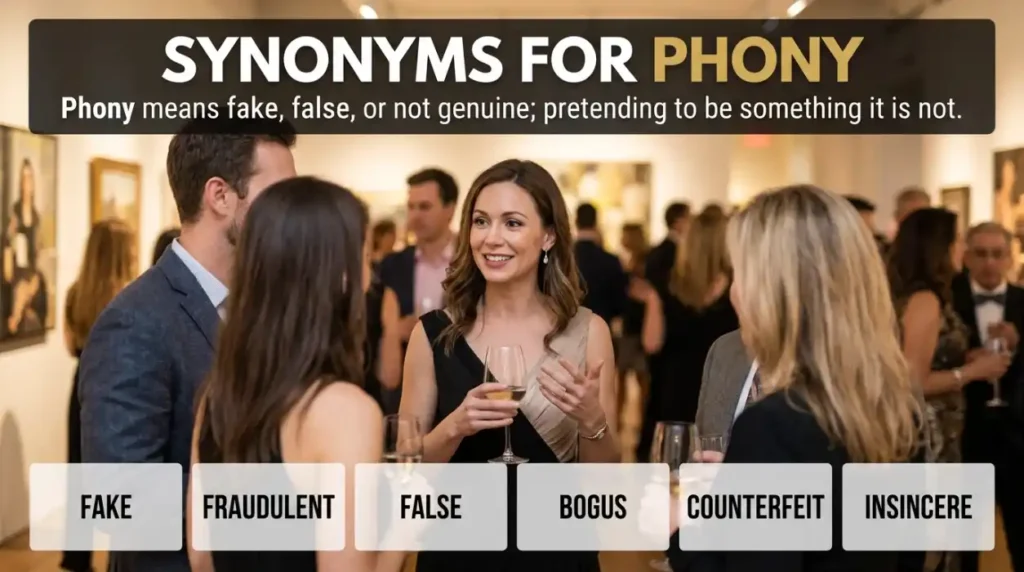
A synonym for phony is a word that describes something fake, false, misleading, or not genuine. Common alternatives include fake, bogus, counterfeit, fraudulent, insincere, and dishonest. The best choice depends on whether you mean an object, a claim, or a person’s behavior.
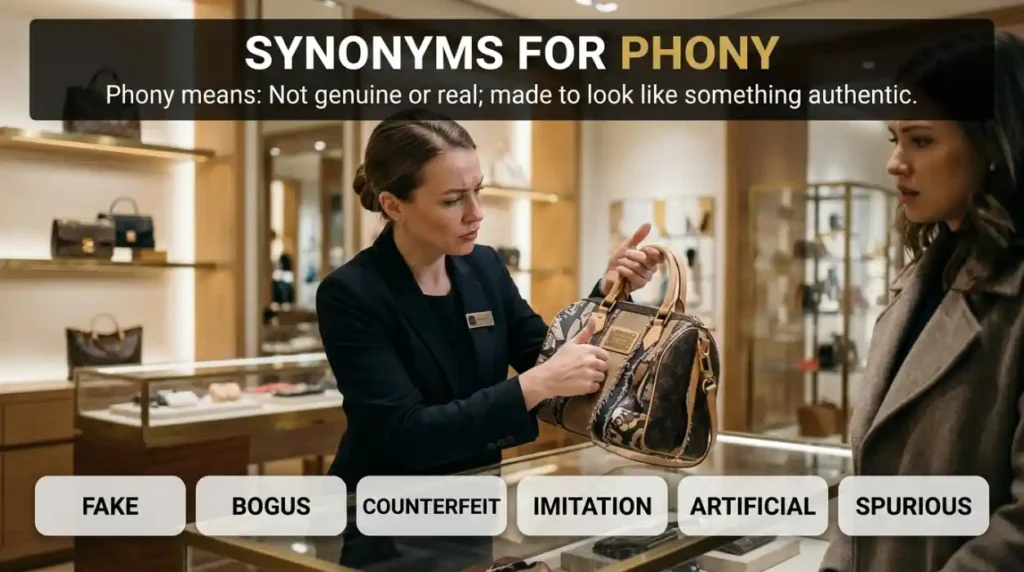
Imagine buying a designer bag that looks authentic but turns out to be an imitation. You might describe it as fake or counterfeit. However, if someone pretends to care about you, insincere may be a more accurate choice.
Learning a synonym for phony helps you describe people, products, and situations that are not genuine. Choosing the right alternative makes your writing clearer, more precise, and less repetitive.
Students can use these words in essays, while bloggers and content writers can create more engaging descriptions. Everyday English learners can also express doubt, disappointment, or criticism more naturally.
Exploring each synonym for phony helps you understand differences in meaning and tone. Some words describe imitation products, while others refer to dishonest claims or people who pretend to have feelings or qualities they do not possess. Understanding these distinctions helps you select the best synonym for phony for any context.
What Does “Phony” Really Mean?
Phony is an adjective and a noun. As an adjective, it describes something fake, false, or not genuine. As a noun, it refers to a person who pretends to be sincere, honest, or authentic.
In simple English, phony means not real or not genuine, especially when something or someone is pretending to be authentic.
Examples:
- The seller offered a phony certificate.
- Everyone realized that his friendly attitude was phony.
- The website displayed phony customer reviews.
Native English speakers often use phony in informal conversation. It can describe fake documents, false excuses, dishonest promises, or people whose behavior seems insincere.
The word usually carries a negative judgment. However, the best alternative depends on what is being described. A counterfeit product is illegally made to imitate a genuine product, while an insincere person does not genuinely mean what they say.
Connotative Meaning
Connotation is the emotional association or feeling a word carries beyond its basic dictionary meaning.
- Positive tone: Phony rarely has a positive meaning. However, a fictional character might jokingly describe an exaggerated performance as phony.
- Negative tone: It often suggests deception, dishonesty, artificial behavior, or an attempt to mislead others.
- Neutral tone: In an informal discussion, someone might use phony to describe a clearly artificial object without making a serious accusation.
Because phony can sound accusatory, use a more precise word in formal writing when possible.
Etymology: Where Does “Phony” Come From?
The word phony emerged in American English during the late nineteenth century. Its precise origin is uncertain. One proposed explanation connects it to fawney, a nineteenth-century term for a ring used in a confidence trick. The historical connection is plausible, but it is not definitively established.
A Short History of the Word
Old English (450–1100): The modern word phony did not exist in Old English. Speakers used other words to describe deception, falsehood, and dishonesty.
Middle English (1100–1500): Phony was not yet part of the established English vocabulary. Related concepts were expressed through words associated with falseness, trickery, and deceit.
Modern English (1500–present): Phony appeared much later, becoming established in American English during the nineteenth century. It developed into a common informal term for fake objects, false claims, and insincere people.
Pronunciation
- US: /ˈfoʊ.ni/
- UK: /ˈfəʊ.ni/
Pronunciation is similar in both varieties, with a difference in the vowel sound.
Syllables
pho-ny
The word has two syllables.
Affixation Pattern
- Root/base: phony
- Prefix: None
- Suffix: None in the base word
- Related forms: phoniness (noun), phonily (adverb, uncommon)
Phony is primarily a standalone adjective. Its related noun, phoniness, describes the quality of being fake or insincere.
50 Synonyms for Phony: Meanings and Examples
The following alternatives cover fake objects, false information, dishonest conduct, and insincere behavior. Some are close synonyms, while others fit only particular situations.
1. Fake (Adjective) — US /feɪk/, UK /feɪk/
Meaning: Not genuine or real; made to look like something authentic.
Tone/Register: Informal, neutral to negative.
Examples:
- The website was selling fake concert tickets.
- She quickly noticed that the signature was fake.
2. False (Adjective) — US /fɔːls/, UK /fɔːls/
Meaning: Not true, accurate, or based on facts.
Tone/Register: Neutral, formal, academic.
Examples:
- The report contained a false statement about the results.
- He apologized for spreading false information online.
3. Bogus (Adjective) — US /ˈboʊ.ɡəs/, UK /ˈbəʊ.ɡəs/
Meaning: Fake or false, especially when intended to deceive.
Tone/Register: Informal, journalistic.
Examples:
- The customer received a bogus payment confirmation.
- Investigators uncovered a bogus charity collecting donations.
4. Counterfeit (Adjective) — US /ˈkaʊn.tɚ.fɪt/, UK /ˈkaʊn.tə.fɪt/
Meaning: Made illegally to imitate a genuine product, document, or currency.
Tone/Register: Formal, legal, commercial.
Examples:
- Customs officers seized counterfeit watches at the border.
- The store trained employees to identify counterfeit banknotes.
5. Fraudulent (Adjective) — US /ˈfrɔː.dʒə.lənt/, UK /ˈfrɔː.djʊ.lənt/
Meaning: Involving deception intended to obtain an unfair or unlawful benefit.
Tone/Register: Formal, legal, financial.
Examples:
- The company was investigated for fraudulent billing.
- She reported a fraudulent transaction on her account.
6. Deceptive (Adjective) — US /dɪˈsep.tɪv/, UK /dɪˈsep.tɪv/
Meaning: Likely to mislead someone or create a false impression.
Tone/Register: Neutral, formal, professional.
Examples:
- The advertisement used deceptive language about the product.
- His calm expression was deceptive because he was extremely worried.
7. Insincere (Adjective) — US /ˌɪn.sɪnˈsɪr/, UK /ˌɪn.sɪnˈsɪə/
Meaning: Not expressing genuine feelings, beliefs, or intentions.
Tone/Register: Neutral, interpersonal, formal.
Examples:
- Her apology sounded insincere after the repeated mistakes.
- He offered an insincere compliment to impress the manager.
8. Dishonest (Adjective) — US /dɪˈsɑː.nɪst/, UK /dɪsˈɒn.ɪst/
Meaning: Unwilling to tell the truth or act fairly.
Tone/Register: Neutral, direct, negative.
Examples:
- The dishonest seller concealed the product’s damage.
- It was dishonest to claim credit for someone else’s work.
9. Spurious (Adjective) — US /ˈspjʊr.i.əs/, UK /ˈspjʊə.ri.əs/
Meaning: False or unsupported, despite appearing convincing or legitimate.
Tone/Register: Formal, academic, analytical.
Examples:
- The article relied on spurious evidence.
- Researchers rejected the spurious connection between the two events.
10. Sham (Adjective) — US /ʃæm/, UK /ʃæm/
Meaning: Presented as genuine or legitimate but actually false or ineffective.
Tone/Register: Formal, journalistic, critical.
Examples:
- Employees complained that the consultation was a sham.
- The company offered a sham guarantee that protected no one.
11. Artificial (Adjective) — US /ˌɑːr.t̬əˈfɪʃ. əl/,UK/ˌɑː.tɪˈfɪʃ.əl/əl/
Meaning: Made or produced by people rather than occurring naturally; sometimes lacking naturalness.
Tone/Register: Neutral, scientific, descriptive.
Examples:
- The room was decorated with artificial flowers.
- His artificial laugh made the conversation uncomfortable.
12. Imitation (Adjective) — US /ˌɪm.əˈteɪ.ʃən/, UK /ˌɪm.ɪˈteɪ.ʃən/
Meaning: Made to resemble something else rather than being the original.
Tone/Register: Neutral, commercial, descriptive.
Examples:
- She bought an imitation leather jacket.
- The market stall displayed imitation jewelry at low prices.
13. Inauthentic (Adjective) — US /ˌɪn.ɔːˈθen.tɪk/, UK /ˌɪn.ɔːˈθen.tɪk/
Meaning: Not genuine or not faithful to the original identity, character, or source.
Tone/Register: Formal, cultural, professional.
Examples:
- The review criticized the restaurant’s inauthentic regional dishes.
- His online profile felt inauthentic and overly polished.
14. Insincere-Looking (Adjective) — US /ˌɪn.sɪnˈsɪr ˈlʊk.ɪŋ/, UK /ˌɪn.sɪnˈsɪə ˈlʊk.ɪŋ/
Meaning: Appearing not to express genuine feelings or intentions.
Tone/Register: Informal, descriptive.
Examples:
- His insincere-looking smile made the apology less convincing.
- The spokesperson gave an insincere-looking response to the question.
15. Pretend (Adjective) — US /prɪˈtend/, UK /prɪˈtend/
Meaning: Imaginary or not real, often created for play or appearance.
Tone/Register: Informal, conversational.
Examples:
- The children built a pretend restaurant in the living room.
- He used a pretend name while playing the detective.
Usage note: Pretend is not always negative. It often describes harmless imaginative play.
16. Fabricated (Adjective) — US /ˈfæb.rɪˌkeɪ.tɪd/, UK /ˈfæb.rɪˌkeɪ.tɪd/
Meaning: Invented or made up, especially to deceive others.
Tone/Register: Formal, journalistic, academic.
Examples:
- The journalist discovered that the quotation was fabricated.
- She denied the fabricated story about her resignation.
17. Fictitious (Adjective) — US /fɪkˈtɪʃ.əs/, UK /fɪkˈtɪʃ.əs/
Meaning: Imaginary or invented rather than real.
Tone/Register: Formal, literary, administrative.
Examples:
- The detective used a fictitious identity during the investigation.
- The invoice listed a fictitious business address.
18. Untrue (Adjective) — US /ʌnˈtruː/, UK /ʌnˈtruː/
Meaning: Not consistent with the facts or reality.
Tone/Register: Neutral, conversational, formal.
Examples:
- The rumor about the school closing was untrue.
- She clarified that the online claim was untrue.
19. Misleading (Adjective) — US /ˌmɪsˈliː.dɪŋ/, UK /ˌmɪsˈliː.dɪŋ/
Meaning: Giving the wrong impression or encouraging an incorrect conclusion.
Tone/Register: Neutral, professional, journalistic.
Examples:
- The headline was misleading because it left out important details.
- The chart gave a misleading picture of the results.
20. Deceitful (Adjective) — US /dɪˈsiːt.fəl/, UK /dɪˈsiːt.fəl/
Meaning: Habitually or deliberately dishonest.
Tone/Register: Formal, strongly negative.
Examples:
- The deceitful agent hid important information from clients.
- His deceitful behavior damaged years of trust.
21. Two-Faced (Adjective) — US /ˌtuːˈfeɪst/, UK /ˌtuːˈfeɪst/
Meaning: Friendly or supportive in someone’s presence but disloyal or hostile behind their back.
Tone/Register: Informal, critical.
Examples:
- She stopped sharing personal details with her two-faced coworker.
- His two-faced behavior became obvious when the messages appeared.
22. Hypocritical (Adjective) — US /ˌhɪp.əˈkrɪt̬.ɪ.kəl/, UK /ˌhɪp.əˈkrɪt.ɪ.kəl/
Meaning: Behaving in a way that contradicts one’s stated beliefs or moral standards.
Tone/Register: Formal, critical, political.
Examples:
- The audience criticized the politician’s hypocritical comments.
- It seemed hypocritical to demand honesty while hiding the facts.
23. Pretentious (Adjective) — US /prɪˈten.ʃəs/, UK /prɪˈten.ʃəs/
Meaning: Trying to appear more important, cultured, or knowledgeable than one really is.
Tone/Register: Informal to formal, critical.
Examples:
- The review called the film pretentious and difficult to follow.
- He sounded pretentious when he used complicated words unnecessarily.
24. Affected (Adjective) — US /əˈfek.tɪd/, UK /əˈfek.tɪd/
Meaning: Deliberately adopted or exaggerated rather than natural.
Tone/Register: Formal, descriptive, critical.
Examples:
- Her affected accent sounded different from her usual speech.
- The actor used an affected manner that suited the character.
25. Artificially Polished (Adjectival Phrase) — US /ˌɑːr.t̬əˈfɪʃ.əl.i ˈpɑː.lɪʃt/, UK /ˌɑː.tɪˈfɪʃ.əl.i ˈpɒl.ɪʃt/
Meaning: Made to look smooth or impressive in a way that feels unnatural.
Tone/Register: Descriptive, professional, critical.
Examples:
- The brand’s artificially polished message lacked a personal touch.
- His artificially polished presentation seemed rehearsed.
26. Hollow (Adjective) — US /ˈhɑː.loʊ/, UK /ˈhɒl.əʊ/
Meaning: Lacking real meaning, feeling, or substance.
Tone/Register: Literary, conversational, critical.
Examples:
- Her promise sounded hollow after months of inaction.
- The speech offered hollow praise without any practical support.
27. Insincere-Sounding (Adjective) — US /ˌɪn.sɪnˈsɪr ˈsaʊn.dɪŋ/, UK /ˌɪn.sɪnˈsɪə ˈsaʊn.dɪŋ/
Meaning: Giving the impression that words are not honestly meant.
Tone/Register: Conversational, descriptive.
Examples:
- His insincere-sounding thanks failed to reassure the team.
- The response felt insincere-sounding because it avoided the main concern.
28. Unconvincing (Adjective) — US /ˌʌn.kənˈvɪn.sɪŋ/, UK /ˌʌn.kənˈvɪn.sɪŋ/
Meaning: Not believable or persuasive.
Tone/Register: Neutral, analytical, conversational.
Examples:
- Her excuse was unconvincing because the dates did not match.
- The actor gave an unconvincing performance as a doctor.
29. Implausible (Adjective) — US /ɪmˈplɔː.zə.bəl/, UK /ɪmˈplɔː.zə.bəl/
Meaning: Unlikely to be true or believable.
Tone/Register: Formal, academic, analytical.
Examples:
- The witness offered an implausible explanation for the missing files.
- The plot depends on an implausible coincidence.
30. Spurious-Looking (Adjective) — US /ˈspjʊr.i.əs ˈlʊk.ɪŋ/, UK /ˈspjʊə.ri.əs ˈlʊk.ɪŋ/
Meaning: Appearing false or unsupported, although further examination may be needed.
Tone/Register: Analytical, descriptive.
Examples:
- The data showed a spurious-looking pattern that needed further testing.
- The claim seemed spurious-looking until the original documents were reviewed.
31. Illegitimate (Adjective) — US /ˌɪl.ɪˈdʒɪt̬.ə.mət/, UK /ˌɪl.ɪˈdʒɪt.ɪ.mət/
Meaning: Not legally or properly authorized, or not recognized as valid.
Tone/Register: Formal, legal, professional.
Examples:
- The court ruled that the procedure was illegitimate.
- The group challenged the illegitimate use of its name.
32. Invalid (Adjective) — US /ɪnˈvæl.ɪd/, UK /ɪnˈvæl.ɪd/
Meaning: Not legally acceptable, logically sound, or officially recognized.
Tone/Register: Formal, technical, legal.
Examples:
- The application was rejected because the permit was invalid.
- The researcher found an invalid assumption in the original argument.
33. Forged (Adjective) — US /fɔːrdʒd/, UK /fɔːdʒd/
Meaning: Falsely made or altered to appear authentic, often to deceive.
Tone/Register: Legal, formal, investigative.
Examples:
- The bank flagged a forged signature on the document.
- Investigators found forged certificates in the application file.
34. Spurious-Claim (Noun Phrase) — US /ˈspjʊr.i.əs kleɪm/, UK /ˈspjʊə.ri.əs kleɪm/
Meaning: A claim that appears valid but lacks reliable support.
Tone/Register: Formal, academic.
Examples:
- The researcher challenged the spurious claim in the published report.
- The article repeated a spurious claim without checking the evidence.
35. Shameless (Adjective) — US /ˈʃeɪm.ləs/, UK /ˈʃeɪm.ləs/
Meaning: Showing no embarrassment or guilt about behavior that others consider wrong.
Tone/Register: Strongly negative, conversational, formal.
Examples:
- His shameless attempt to take credit upset the entire team.
- The article exposed a shameless effort to mislead customers.
36. Phony-Baloney (Adjective) — US /ˌfoʊ.ni bəˈloʊ.ni/, UK /ˌfəʊ.ni bəˈləʊ.ni/
Meaning: An exaggerated, playful expression for something fake or ridiculous.
Tone/Register: Playful, humorous, informal.
Examples:
- The children laughed at the phony-baloney excuse.
- She dismissed the advertisement as phony-baloney nonsense.
37. Fishy (Adjective) — US /ˈfɪʃ.i/, UK /ˈfɪʃ.i/
Meaning: Suspicious or seeming dishonest.
Tone/Register: Informal, conversational.
Examples:
- The seller’s request for extra payment seemed fishy.
- Something felt fishy about the unexpected prize message.
38. Shady (Adjective) — US /ˈʃeɪ.di/, UK /ˈʃeɪ.di/
Meaning: Dishonest, suspicious, or morally questionable.
Tone/Register: Informal, critical.
Examples:
- The company had a shady history of hiding customer complaints.
- He refused to participate in the shady deal.
39. Untrustworthy (Adjective) — US /ʌnˈtrʌstˌwɝː. ði/, UK/ʌnˈtrʌstˌwɜː.ði/ ði/
Meaning: Not deserving of trust because of unreliable or dishonest behavior.
Tone/Register: Neutral, interpersonal, professional.
Examples:
- The reviewer considered the website untrustworthy.
- She stopped relying on an untrustworthy business partner.
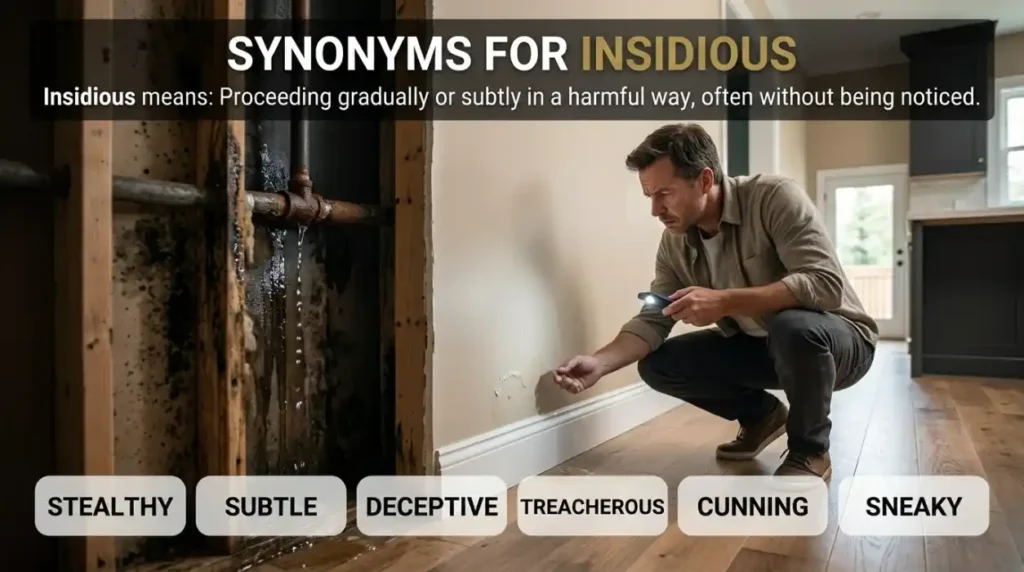
40. Insidious (Adjective) — US /ɪnˈsɪd.i.əs/, UK/ɪnˈsɪd.i.əs/əs/
Meaning: Proceeding gradually or subtly in a harmful way, often without being noticed.
Tone/Register: Formal, literary, serious.
Examples:
- The report warned about the insidious spread of misinformation.
- The novel explores an insidious form of manipulation.
41. Devious (Adjective) — US /ˈdiː.vi.əs/, UK /ˈdiː.vi.əs/
Meaning: Using dishonest or indirect methods to achieve a goal.
Tone/Register: Formal, critical, conversational.
Examples:
- The manager rejected a devious plan to bypass the rules.
- His devious tactics eventually damaged his reputation.
42. Unethical (Adjective) — US /ʌnˈeθ.ɪ.kəl/, UK /ʌnˈeθ.ɪ.kəl/
Meaning: Not consistent with accepted moral principles or professional standards.
Tone/Register: Professional, academic, formal.
Examples:
- The board investigated the unethical treatment of employees.
- Publishing private messages without consent can be unethical.
43. Disingenuous (Adjective) — US /ˌdɪs.ɪnˈdʒen.ju.əs/, UK /ˌdɪs.ɪnˈdʒen.ju.əs/
Meaning: Not candid or straightforward, often while pretending to be sincere.
Tone/Register: Formal, professional, critical.
Examples:
- The spokesperson gave a disingenuous answer about the missing funds.
- It was disingenuous to claim the policy had no drawbacks.
44. Hyped-Up (Adjective) — US /ˌhaɪpt ˈʌp/, UK /ˌhaɪpt ˈʌp/
Meaning: Exaggerated or promoted to seem more impressive than reality supports.
Tone/Register: Informal, media, conversational.
Examples:
- The product failed to meet its hyped-up promises.
- The hyped-up launch left customers disappointed.
45. Overstated (Adjective) — US /ˌoʊ.vɚˈsteɪ.tɪd/, UK /ˌəʊ.vəˈsteɪ.tɪd/
Meaning: Described as greater, more important, or more certain than the facts justify.
Tone/Register: Formal, analytical, professional.
Examples:
- The advertisement made overstated claims about performance.
- The report’s benefits were overstated in the public announcement.
46. Unsubstantiated (Adjective) — US /ˌʌn.səbˈstæn.ʃi.eɪ.tɪd/, UK /ˌʌn.səbˈstæn.ʃi.eɪ.tɪd/
Meaning: Not supported by sufficient evidence.
Tone/Register: Formal, academic, journalistic.
Examples:
- The newspaper refused to publish the unsubstantiated allegation.
- The complaint included several unsubstantiated claims.
47. Spurious-Looking Evidence (Noun Phrase) — US /ˈspjʊr.i.əs ˈlʊk.ɪŋ ˈev.ə.dəns/, UK /ˈspjʊə.ri.əs ˈlʊk.ɪŋ ˈev.ɪ.dəns/
Meaning: Evidence that appears unreliable or misleading but has not yet been fully assessed.
Tone/Register: Analytical, academic.
Examples:
- The team reviewed the spurious-looking evidence before concluding.
- The initial pattern proved unreliable after the data was checked.
48. Counterfeit-Looking (Adjective) — US /ˈkaʊn.tɚ.fɪt ˈlʊk.ɪŋ/, UK /ˈkaʊn.tə.fɪt ˈlʊk.ɪŋ/
Meaning: Appearing to imitate a genuine item without necessarily being confirmed as counterfeit.
Tone/Register: Descriptive, informal to professional.
Examples:
- The collector examined a counterfeit-looking coin under a magnifier.
- The packaging appeared counterfeit-looking, so the buyer requested verification.
49. Insincere in Appearance (Adjectival Phrase) — US /ˌɪn.sɪnˈsɪr ɪn əˈpɪr.əns/, UK /ˌɪn.sɪnˈsɪə ɪn əˈpɪə.rəns/
Meaning: Appearing emotionally false or lacking genuine feeling.
Tone/Register: Descriptive, formal.
Examples:
- His apology was insincere in appearance and lacked any acknowledgment of harm.
- The speaker’s praise seemed insincere in appearance to the audience.
50. Not Aboveboard (Adjectival Phrase) — US /nɑːt əˈbʌvˌbɔːrd/, UK /nɒt əˈbʌvˌbɔːd/
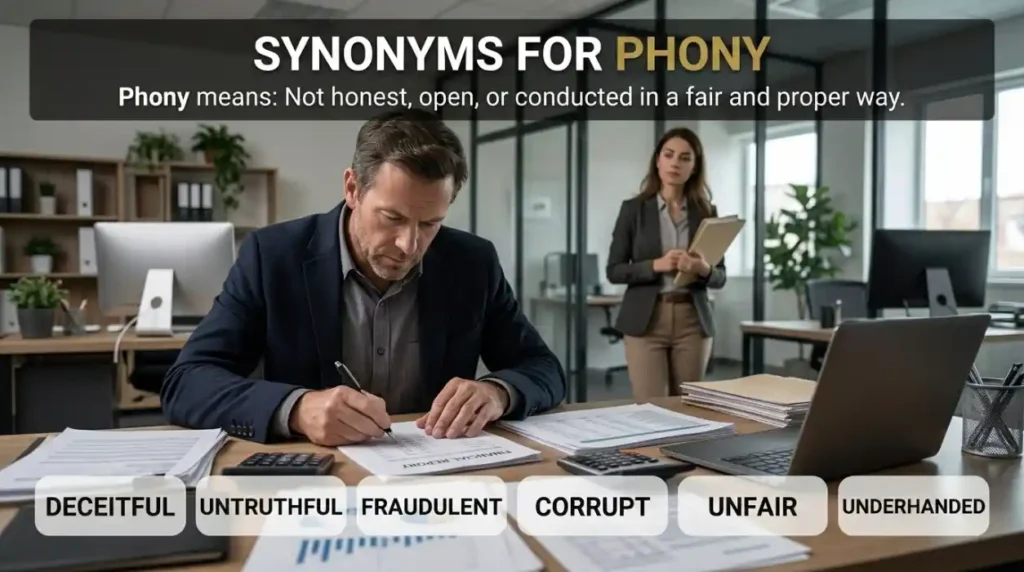
Meaning: Not honest, open, or conducted in a fair and proper way.
Tone/Register: Idiomatic, conversational, professional.
Examples:
- The auditor suspected that the transaction was not aboveboard.
- Their private arrangement did not seem aboveboard to the committee.
Synonyms by Tone
Neutral and Descriptive
- Fake
- False
- Artificial
- Imitation
- Inauthentic
- Untrue
- Invalid
These words describe a lack of genuineness without always accusing a person of deliberate deception.
Strongly Negative
- Fraudulent
- Deceitful
- Dishonest
- Hypocritical
- Two-faced
- Shady
- Disingenuous
Use these terms when the situation involves dishonesty, misleading conduct, or a lack of sincerity.
Formal and Academic
- Spurious
- Fabricated
- Fictitious
- Unsubstantiated
- Misleading
- Unethical
- Illegitimate
These words work well in reports, essays, research, and professional discussions.
Playful or Informal
- Bogus
- Fishy
- Phony-baloney
- Fake
- Shady
These alternatives fit casual conversations, humorous comments, and informal writing. Remember that words such as fishy indicate suspicion rather than confirmed deception.
“Phony” vs. Close Alternatives
| Word | Main meaning | Best use |
|---|---|---|
| Phony | Fake or insincere | Informal descriptions of objects, claims, or behavior |
| Fake | Not genuine | Everyday conversation and broad descriptions |
| Bogus | False or misleading, often intentionally | Dubious claims, offers, and documents |
| Counterfeit | An imitation made to pass as a genuine item | Currency, branded goods, and official items |
| Insincere | Not expressing genuine feelings | Apologies, compliments, and personal interactions |
| Fraudulent | Involving deception for an unfair or unlawful benefit | Financial, legal, and professional contexts |
Which Word Should You Choose?
Use fake for a broad, everyday description. Choose counterfeit for imitation goods or currency made to pass as genuine.
Use insincere when discussing feelings or intentions. Choose fraudulent when deception is part of a dishonest scheme. Bogus is useful when something appears false or unreliable.
How “Phony” Changes by Context
Daily Conversation
People often use phony, fake, bogus, and fishy in casual speech.
For example, “That excuse sounds phony” means the speaker doubts its sincerity. “That offer looks fishy” suggests suspicion but does not establish that it is fraudulent.
Writing and Blogging
Choose the term that best describes the problem. Use fabricated for invented stories, misleading for information that creates a wrong impression, and counterfeit for imitation goods.
This improves clarity and avoids repeating phony throughout an article.
Professional and Academic Writing
Formal writing benefits from precise words. Unsubstantiated describes claims that lack sufficient evidence. Fraudulent describes conduct involving deception, while inauthentic can describe work that lacks genuine character.
Avoid calling a person fraudulent unless the available evidence supports that characterization.
Creative and Informal Writing
Fiction writers may use two-faced, shady, pretentious, or hollow to communicate a character’s personality.
These words create different impressions. A pretentious character tries to appear important, while a two-faced character behaves differently in front of different people.
Common Mistakes and Native Usage
Mistake 1: Using “Counterfeit” for Every Fake Thing
Counterfeit usually refers to something made to imitate an authentic item, often illegally. A fake excuse is not normally a counterfeit excuse.
Mistake 2: Confusing “Phony” with “Insincere”
Phony can describe a fake object or a person’s behavior. Insincere focuses on feelings, statements, or intentions that are not genuine.
Mistake 3: Treating “Fishy” as Proof of Fraud
Fishy means suspicious. It does not prove that someone has committed fraud. Use fraudulent only when the description fits the facts.
Mistake 4: Using Strong Accusations Without Evidence
Calling a person deceitful, fraudulent, or dishonest can imply deliberate misconduct. In formal writing, describe what is known and distinguish suspicion from facts.
Register Notes
Informal: phony, fake, bogus, fishy, shady.
Formal: fraudulent, spurious, fabricated, unsubstantiated.
Interpersonal: insincere, two-faced, hypocritical, disingenuous.
Commercial or legal: counterfeit, forged, invalid, illegitimate.
For related vocabulary practice, explore a guide to synonyms for dishonest or insincere in your vocabulary collection.
Real-Life Mini Scenarios
Workplace
A company advertises benefits that do not exist. The advertisement may be described as misleading or fraudulent, depending on the evidence.
Social Situations
A friend gives compliments only when they want a favor. You might describe the behavior as insincere or two-faced.
Media and Pop Culture
A film character pretends to be wealthy. Another character may call the performance phony or pretentious, depending on what seems false.
Writing and Storytelling
A mystery writer may introduce a fictitious identity or a fabricated alibi. These terms help distinguish an invented identity from a false explanation intended to deceive.
Practice Exercise
1. A shop sells imitation designer bags that falsely use a famous brand’s logo. Which word is most precise?
A. Artificial
B. Counterfeit
C. Insincere
D. Hollow
2. Someone praises a colleague but does not mean what they say. Which word fits best?
A. Insincere
B. Invalid
C. Artificial
D. Fictitious
3. A scientific claim has no reliable supporting evidence. Which word is most suitable?
A. Pretend
B. Spurious
C. Two-faced
D. Shameless
4. An online offer looks suspicious, but no proof of fraud exists. Which informal word fits?
A. Fishy
B. Forged
C. Fraudulent
D. Hypocritical
5. A person acts friendly in public but criticizes the same people privately. Which word describes this behavior?
A. Counterfeit
B. Two-faced
C. Invalid
D. Artificial
6. A document contains a signature that someone copied illegally. Which adjective fits?
A. Hollow
B. Forged
C. Pretentious
D. Untrue
7. A person exaggerates their knowledge to seem impressive. Which word is most appropriate?
A. Pretentious
B. Counterfeit
C. Unsubstantiated
D. Artificial
8. A company deliberately lies to obtain money from customers. Which word is most precise?
A. Insincere
B. Fraudulent
C. Affected
D. Unconvincing
9. A rumor about a school closing turns out not to be true. Which word fits?
A. Untrue
B. Devious
C. Artificial
D. Shady
10. A business presents a meeting as meaningful, but no real decisions can be made. Which phrase may describe the meeting?
A. A sham
B. A counterfeit
C. A fishy
D. A fabrication
Reflection Task
Write a sentence about a fake product, an insincere apology, or a misleading claim.
Answer key:
1-B, 2-A, 3-B, 4-A, 5-B, 6-B, 7-A, 8-B, 9-A, 10-A
Frequently Asked Questions
1. What is the best synonym for phony in formal writing?
The best alternative depends on what you are describing. Fraudulent fits conduct involving deception for an unfair benefit. Fabricated describes invented information, while inauthentic means not genuine. For a claim that lacks reliable evidence, unsubstantiated or spurious may be more precise than the informal word phony.
2. What is a synonym for a phony person?
Insincere, dishonest, two-faced, and disingenuous can describe different kinds of inauthentic behavior. Use insincere when someone’s feelings seem false, two-faced when their behavior changes depending on the audience, and disingenuous when someone appears candid but is not being straightforward. The most accurate word depends on the person’s behavior.
3. Is phony the same as fake?
The words overlap, but their tone and usage can differ. Fake is a broad term for anything that is not genuine. Phony often adds an informal, critical tone and is especially common when describing insincere behavior, false excuses, or something intended to appear authentic. Both can describe objects and claims.
4. What is a professional way to say phony?
In professional writing, choose a word that identifies the specific problem. Inauthentic can describe work that lacks genuine character, misleading describes information that creates a false impression, and fraudulent refers to deceptive conduct. These alternatives sound more precise than phony, particularly in reports, workplace communication, and academic writing.
5. What is the difference between bogus and fraudulent?
Bogus is an informal word for something fake, false, or unreliable. Fraudulent is more formal and generally refers to deception intended to obtain an unfair or unlawful benefit. A suspicious offer might be called bogus, while a proven scheme involving deliberate deception may be described as fraudulent.
6. What word describes fake information on the internet?
False, fabricated, misleading, and unsubstantiated are useful choices. False means the information is not true, fabricated suggests it was invented, and misleading means it creates a wrong impression. Use unsubstantiated when adequate evidence is lacking, even if the claim has not been proven false.
7. Can phony be used as a noun?
Yes. As a noun, phony refers to a person who pretends to be genuine, honest, or sincere. For example, “The audience saw him as a phony.” This use is informal and critical. In formal writing, impostor, fraudster, or insincere person may communicate the intended meaning more precisely.
Conclusion
Choosing a synonym for phony helps you explain whether something is fake, misleading, dishonest, or insincere. Words such as bogus, counterfeit, and disingenuous express different meanings.
Students can improve their essays with precise vocabulary. Bloggers and content writers can create clearer descriptions, while everyday speakers can express doubt without repeating the same word.
The key is to match the word to the situation. A fake item, a fraudulent scheme, and an insincere apology involve different kinds of inauthenticity.
Practice three alternatives today. Write original sentences for an email, an essay, and a daily conversation to build a stronger vocabulary and communicate with confidence.
Recommended external sources
- Cambridge Dictionary Phony: definition, pronunciation, and usage.
- Merriam-Webster Phony: definitions, word history, and example usage
- Online Etymology Dictionary: Phony’s historical origin and development.

Jameel Hassan is the founder and lead writer at SynonymsCloud.com, a trusted online platform dedicated to English vocabulary and effective communication. He is passionate about helping students, writers, professionals, and lifelong learners discover the right words to express their ideas with clarity, precision, and confidence.
At SynonymsCloud.com, every article is thoroughly researched and carefully written to provide accurate, practical, and easy-to-understand guidance on synonyms, antonyms, word meanings, idioms, and vocabulary. With a strong commitment to quality, real-world usage, and clear explanations, the website helps readers expand their vocabulary, improve their writing, and communicate more effectively in both academic and professional settings.