
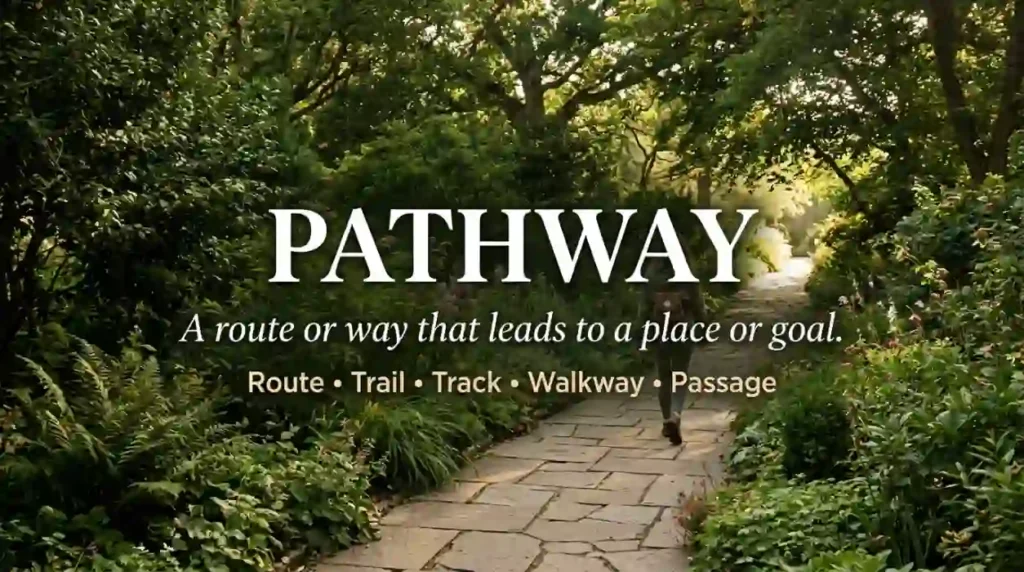
A synonym for pathway is a word such as route, path, trail, way, course, or passage. These alternatives describe a physical walkway, a direction toward a destination, or a process leading to a goal. The best choice depends on the context.
A pathway can lead somewhere in the real world or represent the steps toward a future goal. You might walk along a garden trail, follow a route through a forest, or choose a career course that brings you closer to success. Although these situations differ, each involves moving toward a destination.
Finding the right synonym for pathway makes your writing more precise and interesting. Words such as path, route, trail, and avenue can describe different kinds of journeys. Students, bloggers, content writers, and English learners can use these alternatives to explain ideas clearly and avoid repeating the same word.
The synonyms for pathway have different meanings depending on the context. In academics, it may refer to a route toward earning a degree. In biology, it can describe a chain of related reactions.
Exploring synonyms for pathway helps you understand these differences and choose the right word for each situation. With clear meanings and practical examples, you can expand your vocabulary and express directions, opportunities, and plans with greater confidence.
What Does “Pathway” Really Mean?
A pathway is a route or way that allows someone to move from one place to another. It can also mean a process, series of steps, or set of opportunities that leads to a particular result.
For example, a stone pathway may lead through a park. A career pathway may describe the steps someone takes to reach a professional goal.
Pathway is a noun. Native English speakers use it in both literal and figurative contexts. It often sounds slightly more descriptive or structured than the everyday word way.
Connotative Meaning
Connotation is the emotional feeling or association a word creates beyond its basic dictionary meaning.
- Positive tone: A pathway to success suggests hope, opportunity, and progress.
- Negative tone: A pathway to conflict can suggest an undesirable direction or outcome.
- Neutral tone: A pathway through a forest simply describes a route without expressing an opinion.
The emotional meaning depends on the words surrounding pathway, rather than the noun itself.
Etymology of Pathway
The word pathway combines path and way, two words associated with movement and direction.
- Old English (450–1100): The word path is related to Old English pæþ, meaning a track or beaten route. Way comes from Old English weg, meaning a road, journey, or course.
- Middle English (1100–1500): Forms of path and way continued to describe tracks, roads, and directions. The compound pathway developed from these established words.
- Modern English (1500–present): Pathway became useful for describing physical walkways as well as figurative processes, including educational, professional, biological, and social development.
Pronunciation, Syllables, and Word Structure
- US pronunciation: /ˈpæθ.weɪ/
- UK pronunciation: /ˈpɑːθ.weɪ/
- Syllables: path-way
- Part of speech: Noun
- Root: path and way
- Prefix: None
- Suffix: None in the usual grammatical sense; pathway is a compound noun formed from two complete words.
Synonyms List
The following alternatives cover physical walkways, directions, processes, and routes toward goals. Some words work in several contexts, while others are suitable only for specific situations. Choose the synonym that preserves your intended meaning.
1. Path (Noun) — US: /pæθ/ | UK: /pɑːθ/
Meaning: A way or track that someone follows to reach a place or achieve something.
Tone/Register: Neutral, everyday.
Examples:
- We followed a narrow path through the garden.
- Her path to becoming a teacher began at college.

2. Route (Noun) — US: /ruːt/ | UK: /ruːt/ or /raʊt/
Meaning: A planned or established way of getting from one place to another.
Tone/Register: Neutral, professional.
Examples:
- This route takes us around the busy city center.
- An internship can be a route into the technology industry.
3. Way (Noun) — US: /weɪ/ | UK: /weɪ/
Meaning: A general direction, means of reaching a destination, or method of achieving a result.
Tone/Register: Informal, versatile.
Examples:
- Is there another way to the station?
- Practice is the best way to improve your writing.
4. Trail (Noun) — US: /treɪl/ | UK: /treɪl/
Meaning: A marked or worn path, especially one used for walking in natural areas.
Tone/Register: Neutral, outdoors-oriented.
Examples:
- We discovered a peaceful trail near the lake.
- The hikers followed the trail up the mountain.
5. Track (Noun) — US: /træk/ | UK: /træk/
Meaning: A marked, worn, or established line along which people or vehicles travel.
Tone/Register: Neutral, practical.
Examples:
- A muddy track led to the farmhouse.
- The railway track runs beside the river.
6. Walkway (Noun) — US: /ˈwɔːk.weɪ/ | UK: /ˈwɔːk.weɪ/
Meaning: A designated space or surface for people to walk along.
Tone/Register: Neutral, descriptive.
Examples:
- Keep the walkway clear for other visitors.
- A covered walkway connects the two buildings.
7. Footpath (Noun) — US: /ˈfʊt.pæθ/ | UK: /ˈfʊt.pɑːθ/
Meaning: A path intended mainly for people traveling on foot.
Tone/Register: Neutral, especially common in British English.
Examples:
- The footpath passes several old cottages.
- Please stay on the footpath during your visit.
8. Passage (Noun) — US: /ˈpæs.ɪdʒ/ | UK: /ˈpæs.ɪdʒ/
Meaning: A way through or between places, often within a building or enclosed area.
Tone/Register: Neutral, slightly formal.
Examples:
- We found a narrow passage behind the library.
- The passage leads directly into the courtyard.
9. Passageway (Noun) — US: /ˈpæs.ɪdʒ.weɪ/ | UK: /ˈpæs.ɪdʒ.weɪ/
Meaning: A corridor or connecting space that allows movement between areas.
Tone/Register: Neutral, descriptive.
Examples:
- The passageway links the kitchen to the dining room.
- A dim passageway opened beneath the old building.
10. Corridor (Noun) — US: /ˈkɔːr.ə.dɔːr/ | UK: /ˈkɒr.ɪ.dɔːr/
Meaning: A long, narrow interior space connecting rooms or sections of a building.
Tone/Register: Neutral, architectural.
Examples:
- Students waited quietly in the corridor.
- The corridor connects the hospital’s two wings.
11. Lane (Noun) — US: /leɪn/ | UK: /leɪn/
Meaning: A narrow road or passage, often found in residential or rural areas.
Tone/Register: Neutral, descriptive.
Examples:
- Their cottage stands at the end of a quiet lane.
- We cycled along a tree-lined country lane.
12. Road (Noun) — US: /roʊd/ | UK: /rəʊd/
Meaning: A prepared surface or route used for travel between places.
Tone/Register: Neutral, everyday.
Examples:
- The road leads straight to the coastal village.
- Better training can open the road to new opportunities.
13. Avenue (Noun) — US: /ˈæv.ə.nuː/ | UK: /ˈæv.ə.njuː/
Meaning: A broad street or, figuratively, a possible means of achieving something.
Tone/Register: Neutral to formal.
Examples:
- Tall trees line the avenue near the museum.
- Volunteering offers an avenue for gaining experience.
14. Course (Noun) — US: /kɔːrs/ | UK: /kɔːs/
Meaning: A direction or sequence of development leading toward an outcome.
Tone/Register: Neutral, academic or professional.
Examples:
- Her course of study includes biology and chemistry.
- One honest conversation changed the course of their friendship.
15. Direction (Noun) — US: /dəˈrek.ʃən/ | UK: /daɪˈrek.ʃən/
Meaning: The way toward which someone or something moves or develops.
Tone/Register: Neutral, versatile.
Examples:
- We walked in the direction of the village square.
- The new policy gives the project a clearer direction.
16. Channel (Noun) — US: /ˈtʃæn.əl/ | UK: /ˈtʃæn.əl/
Meaning: A route through which something moves, flows, or becomes possible.
Tone/Register: Professional, technical.
Examples:
- The organization created a channel for community feedback.
- Education can be a channel for social mobility.
17. Approach (Noun) — US: /əˈproʊtʃ/ | UK: /əˈprəʊtʃ/
Meaning: A way of dealing with a problem or working toward a goal.
Tone/Register: Neutral, professional.
Examples:
- We need a practical approach to reducing waste.
- Her approach to learning English is simple and consistent.
18. Method (Noun) — US: /ˈmeθ.əd/ | UK: /ˈmeθ.əd/
Meaning: An organized way of doing something to achieve a particular result.
Tone/Register: Neutral, academic or professional.
Examples:
- This method makes difficult vocabulary easier to learn.
- The team tested a new method for organizing its work.
19. Process (Noun) — US: /ˈprɑː.ses/ | UK: /ˈprəʊ.ses/
Meaning: A series of actions or stages through which something develops or is completed.
Tone/Register: Neutral, professional.
Examples:
- Applying for the scholarship is a simple process.
- Building confidence is a gradual process.
20. Procedure (Noun) — US: /prəˈsiː.dʒɚ/ | UK: /prəˈsiː.dʒə/
Meaning: An established sequence of steps for completing a task correctly.
Tone/Register: Formal, administrative.
Examples:
- Follow the safety procedure before entering the laboratory.
- The approval procedure involves three departments.
21. Progression (Noun) — US: /prəˈɡreʃ.ən/ | UK: /prəˈɡreʃ.ən/
Meaning: A gradual movement from one stage or level to another.
Tone/Register: Academic, professional.
Examples:
- The course supports progression from beginner to advanced English.
- Her progression into management took several years.
22. Journey (Noun) — US: /ˈdʒɝː.ni/ | UK: /ˈdʒɜː.ni/
Meaning: Travel from one place to another, or a personal process of growth and change.
Tone/Register: Neutral, often inspirational.
Examples:
- Our journey through the hills lasted four hours.
- Learning a new language is a rewarding journey.
23. Trajectory (Noun) — US: /trəˈdʒek.tɚ.i/ | UK: /trəˈdʒek.tər.i/
Meaning: The course followed by a moving object or the direction of someone’s development.
Tone/Register: Formal, technical.
Examples:
- Scientists calculated the satellite’s trajectory.
- Early experience helped shape her career trajectory.
24. Line (Noun) — US: /laɪn/ | UK: /laɪn/
Meaning: A direction, course, or connection between places or ideas.
Tone/Register: Neutral, context-dependent.
Examples:
- Follow the dotted line across the map.
- The research follows a promising line of inquiry.
25. Thoroughfare (Noun) — US: /ˈθɝː.oʊ.fer/ | UK: /ˈθʌr.ə.feə/
Meaning: A public road or passage that people can use to travel through an area.
Tone/Register: Formal, urban planning.
Examples:
- The city closed the main thoroughfare for repairs.
- Heavy traffic made the thoroughfare difficult to cross.
26. Byway (Noun) — US: /ˈbaɪ.weɪ/ | UK: /ˈbaɪ.weɪ/
Meaning: A minor road or less-traveled route away from major roads.
Tone/Register: Descriptive, sometimes literary.
Examples:
- We explored a quiet byway through the countryside.
- The village is accessible by several narrow byways.
27. Roadway (Noun) — US: /ˈroʊd.weɪ/ | UK: /ˈrəʊd.weɪ/
Meaning: The part of a road intended for vehicles to travel on.
Tone/Register: Technical, transport-related.
Examples:
- Workers repaired the damaged roadway overnight.
- Never stand in the roadway to take photographs.
28. Highway (Noun) — US: /ˈhaɪ.weɪ/ | UK: /ˈhaɪ.weɪ/
Meaning: A major public road connecting towns, cities, or other destinations.
Tone/Register: Neutral, transport-related.
Examples:
- The highway takes us directly to the airport.
- A new highway improved access to the region.
29. Sidewalk (Noun) — US: /ˈsaɪd.wɔːk/ | UK equivalent: pavement /ˈpeɪv.mənt/
Meaning: A paved area beside a road intended for pedestrians.
Tone/Register: Everyday, especially American English.
Examples:
- The children drew colorful pictures on the sidewalk.
- Please keep your bicycle off the crowded sidewalk.
30. Pavement (Noun) — US: /ˈpeɪv.mənt/ | UK: /ˈpeɪv.mənt/
Meaning: In British English, the paved pedestrian area beside a road; in American English, the hard road surface.
Tone/Register: Everyday, regional.
Examples:
- We walked along the pavement toward the shops.
- Rainwater collected on the uneven pavement.
31. Alley (Noun) — US: /ˈæl.i/ | UK: /ˈæl.i/
Meaning: A narrow passage between or behind buildings.
Tone/Register: Informal, descriptive.
Examples:
- A small café occupies the alley behind the theater.
- The delivery entrance is halfway down the alley.
32. Boardwalk (Noun) — US: /ˈbɔːrd.wɔːk/ | UK: /ˈbɔːd.wɔːk/
Meaning: A raised walkway made of wooden boards, often near a beach or wetland.
Tone/Register: Neutral, recreational.
Examples:
- Couples strolled along the seaside boardwalk.
- The wooden boardwalk protects the marsh plants.
33. Promenade (Noun) — US: /ˌprɑː.məˈneɪd/ | UK: /ˌprɒm.əˈnɑːd/
Meaning: A public walkway designed for leisurely walking, often beside water or in a scenic area.
Tone/Register: Formal, scenic.
Examples:
- Families gathered along the waterfront promenade.
- We enjoyed an evening walk on the promenade.
34. Walk (Noun) — US: /wɔːk/ | UK: /wɔːk/
Meaning: A route for walking or an act of traveling on foot.
Tone/Register: Everyday, informal.
Examples:
- A short walk through the park cleared my mind.
- The riverside walk is popular with residents.
35. Trackway (Noun) — US: /ˈtræk.weɪ/ | UK: /ˈtræk.weɪ/
Meaning: A defined track or route, particularly one used historically or for a specific type of movement.
Tone/Register: Technical, historical.
Examples:
- Archaeologists uncovered an ancient trackway near the settlement.
- The old trackway crossed the valley floor.
36. Crossing (Noun) — US: /ˈkrɔː.sɪŋ/ | UK: /ˈkrɒs.ɪŋ/
Meaning: A designated place or route for moving across a road, railway, river, or other barrier.
Tone/Register: Neutral, practical.
Examples:
- Use the pedestrian crossing to reach the other side.
- The river crossing saved travelers several miles.
37. Access Route (Noun Phrase) — US: /ˈæk.ses ruːt/ | UK: /ˈæk.ses ruːt/
Meaning: A route that provides entry to a location or facility.
Tone/Register: Formal, practical.
Examples:
- The emergency access route must remain unobstructed.
- Staff use the rear access route after closing time.
38. Approach Road (Noun Phrase) — US: /əˈproʊtʃ roʊd/ | UK: /əˈprəʊtʃ rəʊd/
Meaning: A road leading toward a particular building, place, or destination.
Tone/Register: Formal, descriptive.
Examples:
- The approach road winds through a wooded area.
- Construction crews widened the approach road to the hospital.
39. Passage Route (Noun Phrase) — US: /ˈpæs.ɪdʒ ruːt/ | UK: /ˈpæs.ɪdʒ ruːt/
Meaning: A route used to pass through an area or connect separate locations.
Tone/Register: Neutral to technical.
Examples:
- The sailors chose a safer passage route through the islands.
- Maps show the passage route between the two terminals.
40. Plan (Noun) — US: /plæn/ | UK: /plæn/
Meaning: An intended set of actions for reaching a goal.
Tone/Register: Neutral, professional.
Examples:
- She created a plan to finish her degree.
- Our plan includes weekly writing practice.

41. Strategy (Noun) — US: /ˈstræt̬.ə.dʒi/ | UK: /ˈstræt.ə.dʒi/
Meaning: A carefully chosen approach designed to achieve a longer-term objective.
Tone/Register: Professional, business.
Examples:
- The team developed a strategy for reaching new readers.
- Consistent practice is an effective strategy for language learning.
42. Roadmap (Noun) — US: /ˈroʊd.mæp/ | UK: /ˈrəʊd.mæp/
Meaning: A plan that outlines the stages needed to reach a future objective.
Tone/Register: Professional, business.
Examples:
- The manager shared a roadmap for the next six months.
- This study plan provides a roadmap for exam preparation.
43. Sequence (Noun) — US: /ˈsiː.kwəns/ | UK: /ˈsiː.kwəns/
Meaning: An ordered series of events or steps that leads from one stage to another.
Tone/Register: Neutral, academic.
Examples:
- The lesson follows a sequence of simple exercises.
- Each stage in the sequence prepares students for the next.
44. Framework (Noun) — US: /ˈfreɪm.wɝːk/ | UK: /ˈfreɪm.wɜːk/
Meaning: A structured system that guides how something is developed or achieved.
Tone/Register: Formal, academic, professional.
Examples:
- The school introduced a framework for career development.
- This framework helps writers organize their ideas.
45. Pipeline (Noun) — US: /ˈpaɪp.laɪn/ | UK: /ˈpaɪp.laɪn/
Meaning: A series of connected stages through which people, resources, or work progress.
Tone/Register: Professional, technical.
Examples:
- The company built a pipeline for developing future leaders.
- Several new projects are already in the research pipeline.
46. Progression Route (Noun Phrase) — US: /prəˈɡreʃ.ən ruːt/ | UK: /prəˈɡreʃ.ən ruːt/
Meaning: An established route through successive stages of learning, training, or employment.
Tone/Register: Formal, educational.
Examples:
- The college offers a progression route into university.
- Apprenticeships provide a progression route into skilled work.
47. Career Track (Noun Phrase) — US: /kəˈrɪr træk/ | UK: /kəˈrɪə træk/
Meaning: A particular line of professional development or advancement.
Tone/Register: Professional, workplace.
Examples:
- She chose a career track in environmental science.
- The mentoring program supports employees on a management career track.
48. Avenue of Opportunity (Noun Phrase) — US: /ˈæv.ə.nuː əv ˌɑː.pɚˈtuː.nə.ti/ | UK: /ˈæv.ə.njuː əv ˌɒp.əˈtjuː.nə.ti/
Meaning: A possible route toward new experiences, advancement, or success.
Tone/Register: Positive, motivational.
Examples:
- The scholarship opened an avenue of opportunity for rural students.
- Learning digital skills can create new avenues of opportunity.
49. Means (Noun) — US: /miːnz/ | UK: /miːnz/
Meaning: A method or resource through which someone achieves a particular outcome.
Tone/Register: Neutral, formal.
Examples:
- Education is an important means of improving employment prospects.
- Public transport offers a reliable means of reaching the campus.
50. Mechanism (Noun) — US: /ˈmek.ə.nɪ.zəm/ | UK: /ˈmek.ə.nɪ.zəm/
Meaning: A system or process through which an action or result is produced.
Tone/Register: Technical, academic.
Examples:
- The researchers studied the mechanism behind cell growth.
- Feedback is a useful mechanism for improving team performance.
Synonyms by Tone
Word choice affects how readers interpret your message. Use these groups to select an alternative that fits your audience and purpose.
Positive Synonyms
- Journey: Emphasizes personal growth and experience.
- Avenue: Suggests opportunity and possibility.
- Roadmap: Communicates a clear plan for future success.
- Progression: Highlights development and advancement.
- Strategy: Suggests thoughtful planning.
Neutral Synonyms
- Path: A general, flexible alternative.
- Route: Focuses on reaching a destination.
- Way: Works in casual speech and writing.
- Walkway: Describes a physical walking area.
- Course: Describes a direction or sequence of development.
- Process: Emphasizes connected steps.
- Passage: Describes a way through a space.
Negative or Challenging Contexts
These words are not inherently negative. They can describe difficult or undesirable situations when paired with suitable context.
- Trajectory: A downward trajectory can suggest decline.
- Course: A course toward failure indicates an unwanted outcome.
- Route: A dangerous route highlights risk.
- Passage: A difficult passage suggests an obstacle-filled journey.
Playful or Informal Synonyms
- Way: A natural choice in everyday conversation.
- Path: Simple and familiar.
- Trail: Adds an outdoor or adventurous feeling.
- Road: Works in expressions such as “the road to success.”
Tone matters because the right synonym helps readers understand not only the direction or process but also its purpose, setting, and emotional effect.
Pathway vs. Close Alternatives
Although these words share related meanings, they are not always interchangeable. The following comparison explains three common choices.
| Word | Main difference | Best use |
|---|---|---|
| Pathway | Can describe a physical walkway or a structured route toward a goal. | Career development, education, gardens, science |
| Path | Usually a simpler route or figurative course to follow. | Everyday speech, personal growth, nature |
| Route | Emphasizes the direction or way taken to reach a destination. | Travel, navigation, plans |
| Process | Focuses on a series of steps rather than a physical route. | Work, learning, procedures |
Examples of the difference:
- The pathway through the garden is lined with roses. This describes a physical walkway.
- She followed a path toward a teaching career. This emphasizes personal direction.
- The shortest route to the station passes the library. This identifies a way to reach a place.
- The hiring process takes two weeks. This describes a series of steps, not a walkway.
How Pathway Changes by Context
Daily Conversation
In everyday speech, path, way, and route are usually the most natural alternatives. They are familiar and easy to understand.
For example, say, “Which route should we take?” when discussing travel. Use “I am finding my own path” when describing personal decisions.
Writing and Blogging
Writers can use pathway, journey, avenue, and roadmap to make explanations more descriptive.
A travel blogger might describe a peaceful woodland trail. An education blogger might explain a pathway to university admission.
Choose specific nouns rather than replacing every instance of pathway with a different word. Accuracy matters more than variety.
Professional and Academic Writing
Words such as process, progression, framework, trajectory, and channel often fit formal discussions.
For instance, a career adviser may explain a progression route for graduates. A researcher might describe a biological pathway or a mechanism involved in cell development.
In technical writing, check the established terminology of the subject. A biological pathway, for example, is not simply a physical path.
Creative and Informal Use
In storytelling, trail, passage, journey, and byway can establish atmosphere. These choices help readers imagine a setting or follow a character’s development.
A writer might describe a hidden passage beneath an old castle or a character’s difficult journey toward forgiveness.
Common Mistakes Learners Make

Using Every Synonym in the Same Way
A sidewalk is not the same as a career pathway. Similarly, a process is not a physical trail. Check whether your sentence describes a location, a direction, or a series of steps.
Confusing Regional Vocabulary
American English generally uses sidewalk for a pedestrian area beside a road. British English usually uses pavement. Remember that pavement can refer to the road surface in American English.
Choosing Formal Words for Casual Situations
Saying “What is the appropriate progression route to the café?” sounds unnatural. “Which way is the café?” is simpler and more conversational.
Repeating the Same Word Too Often
Repeatedly using pathway can make an article sound monotonous. However, unnecessary synonyms can confuse readers. Repeat the main term when clarity or subject accuracy requires it.
Ignoring Technical Meanings
In science, pathway may refer to a connected series of biochemical reactions or signals. Replacing it with walkway or road would change the meaning completely.
Register Notes: Formal vs. Informal English
Formal English: Use trajectory, progression, framework, procedure, or mechanism when discussing structured systems and professional development.
Informal English: Choose path, way, trail, or road in everyday conversation and simple descriptions.
Spoken English: Prefer familiar words that people can understand immediately.
Written English: More specific alternatives can improve precision, particularly in academic essays, professional reports, and informative blog posts.
Real-Life Mini Scenarios Using Pathway Synonyms
Workplace
A manager explains the team’s roadmap for the next quarter. Employees can see the stages, deadlines, and goals they need to reach.
Social situations
Two friends choose a trail beside a lake. The word creates a clear picture of their outdoor walk.
Media and pop culture
A film character discovers a secret passage beneath a castle. The word builds suspense and suggests hidden possibilities
Writing and storytelling
A novelist uses journey to describe a character’s emotional growth. The word communicates change rather than simply physical movement.
Practice Exercise
Test your understanding of pathway alternatives in realistic situations. Select the word that best fits each sentence.
1. A marked walking route through a forest is best called a:
A. Procedure
B. Trail
C. Framework
D. Pipeline
2. Which word best describes a series of steps for completing a task?
A. Alley
B. Promenade
C. Process
D. Sidewalk
3. You need to ask a friend how to get to the station. Which word sounds natural?
A. Mechanism
B. Way
C. Progression
D. Trajectory
4. A professional plan showing stages toward a future goal is a:
A. Roadmap
B. Footpath
C. Crossing
D. Passageway
5. Which word best describes gradual advancement from one level to another?
A. Lane
B. Pavement
C. Progression
D. Byway
6. A narrow passage between two buildings is an:
A. Avenue of opportunity
B. Alley
C. Highway
D. Strategy
7. Which word best suits a formal report about a satellite’s movement?
A. Journey
B. Walk
C. Trajectory
D. Way
8. A designated area for pedestrians beside a road in American English is a:
A. Sidewalk
B. Course
C. Pipeline
D. Mechanism
9. Which word best describes a structured system that guides a project?
A. Trail
B. Framework
C. Lane
D. Crossing
10. An established set of steps for laboratory safety is a:
A. Promenade
B. Byway
C. Procedure
D. Avenue
Answer key:
1. B · 2. C · 3. B · 4. A · 5. C · 6. B · 7. C · 8. A · 9. B · 10. C
Reflection Task:
Write one original sentence using route, journey, progression, or roadmap. Describe either a real place you want to visit or a personal goal you want to achieve.
Frequently Asked Questions
1. What is the best synonym for pathway in a career context?
The best synonym depends on the career situation. Use career path for someone’s professional direction, progression route for movement between stages of employment, and roadmap for a structured career plan. If you want to emphasize professional growth over time, career trajectory is also a strong choice.
2. What is a good synonym for pathway in education?
Useful educational alternatives include learning path, course, progression route, and educational route. A learning path describes the subjects or skills a student develops over time. A progression route emphasizes how one qualification or stage leads to another, such as moving from college to university.
3. What is the difference between a pathway and an avenue?
A pathway can describe a physical walkway or a process leading toward a goal. An avenue can mean a broad street or a possible means of achieving something. For example, a garden pathway is a physical route, while an avenue of opportunity describes a possibility for advancement. The words overlap mainly in figurative contexts.
4. Which synonym for pathway is most suitable for academic writing?
Process, progression, trajectory, and framework can work well in academic writing, depending on the subject. Use process for connected steps, progression for development across stages, and trajectory for a direction of change. In scientific writing, retain established technical terms when substituting another word would alter the meaning.
5. What is a synonym for pathway in biology?
In biology, biological pathway and metabolic pathway refer to connected biochemical reactions or processes. Depending on the specific subject, related terms may include signaling pathway or molecular pathway. These expressions have specialized meanings, so ordinary alternatives such as trail or walkway are not appropriate substitutes in scientific explanations.
6. How can I avoid repeating the word pathway in an essay?
First, identify what pathway means in each sentence. Replace it with route for direction, process for a sequence of steps, or journey for personal development when the meaning fits. You can also restructure sentences to avoid repetition. Keep pathway when it is the clearest or technically correct term.
7. Is pathway formal or informal English?
Pathway is suitable for both everyday and formal English. It appears in descriptions of physical walkways, education, career planning, and science. In casual conversations, path or way may sound more natural. In professional writing, pathway can communicate a structured route toward a goal without sounding excessively technical.
8. What is the plural form of pathway, and how do I use it?
The plural form is pathways. Add -s to refer to more than one physical walkway or route toward a goal. For example, “The park has several pathways through its gardens.” In education, you could write, “Students can explore different pathways into higher education.”
Conclusion
Learning a synonym for pathway helps you describe routes, plans, and personal growth with greater clarity. Each alternative adds a slightly different meaning to your message.
Whether you write essays, create blog posts, prepare professional emails, or speak with friends, the right word can make your English sound more natural and precise.
Start with familiar words such as path, route, and way. Then practice more specific alternatives such as trajectory, progression, and roadmap as your vocabulary grows.
Make learning enjoyable by using these words in daily conversations, short essays, and emails. Practice one new synonym each day and build confidence through real examples.
Suggested External Sources
For readers who want to explore definitions, pronunciation, and word history in more depth, these established reference sources are useful:
- Cambridge Dictionary: Pathway definitions, pronunciation, and examples.
- Merriam-Webster: Pathway meanings, usage notes, and related vocabulary.
- Online Etymology Dictionary: Pathway word origins and historical development.

Jameel Hassan is the founder and lead writer at SynonymsCloud.com, a trusted online platform dedicated to English vocabulary and effective communication. He is passionate about helping students, writers, professionals, and lifelong learners discover the right words to express their ideas with clarity, precision, and confidence.
At SynonymsCloud.com, every article is thoroughly researched and carefully written to provide accurate, practical, and easy-to-understand guidance on synonyms, antonyms, word meanings, idioms, and vocabulary. With a strong commitment to quality, real-world usage, and clear explanations, the website helps readers expand their vocabulary, improve their writing, and communicate more effectively in both academic and professional settings.