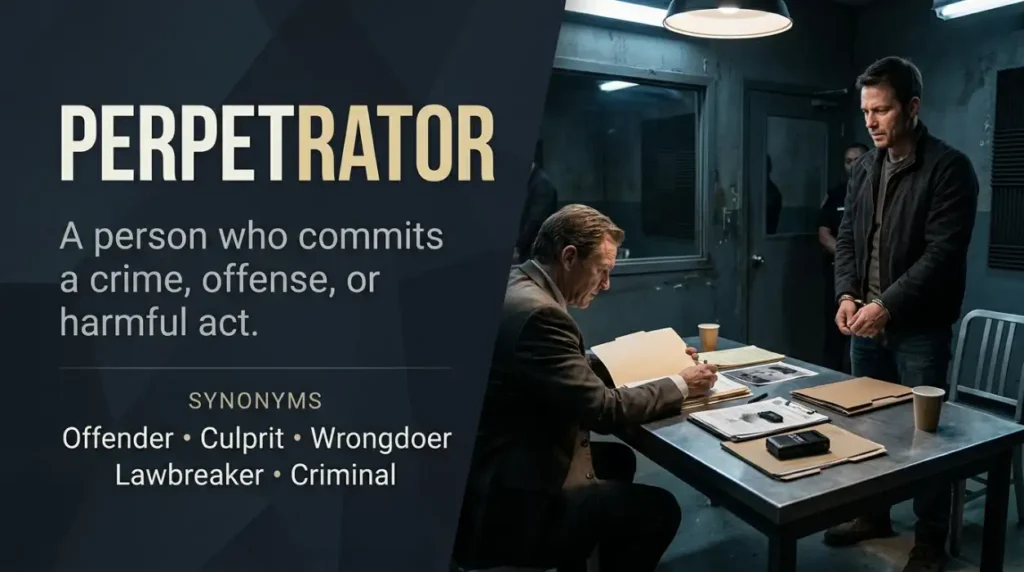
A synonym for perpetrator is a word that describes someone who commits a crime, harmful act, or wrongdoing. Common alternatives include culprit, offender, wrongdoer, criminal, and lawbreaker. The best choice depends on the act, evidence, and context.
Imagine a school discovers that someone has damaged a classroom computer. Once the teacher confirms who caused the damage, they may call that person the perpetrator. In everyday English, culprit is another common term for someone responsible for wrongdoing.
Learning a synonym for perpetrator helps students, bloggers, journalists, and content writers express ideas clearly without repeating the same word. Choosing suitable alternatives makes sentences more natural, engaging, and precise.
The word perpetrator frequently appears in news reports, police investigations, legal discussions, and articles about harmful actions. Exploring each synonym for perpetrator can help readers understand different ways to describe someone responsible for an offense.
However, not every alternative has the same meaning. A suspect is someone who may have committed an offense, while an accomplice knowingly helps another person commit it. Understanding these distinctions helps you select the right synonym for perpetrator and communicate more accurately.
What Does “Perpetrator” Really Mean?
Perpetrator is a noun that refers to a person who commits a crime, harmful act, or other wrongdoing. It is commonly used when discussing criminal investigations, violence, fraud, abuse, and misconduct.
In simple English, a perpetrator is the person responsible for carrying out a wrongful or harmful action.
For example:
- Investigators are trying to identify the perpetrator of the robbery.
- The report explains how the perpetrator damaged the building.
Native English speakers often associate the word with serious wrongdoing. It sounds more formal than culprit or the informal American term perp.
The word does not identify a particular type of crime. It can describe someone responsible for fraud, vandalism, violence, or another harmful act.
Connotative Meaning
Connotation is the emotional association or feeling a word carries beyond its basic dictionary definition.
- Positive tone: The word perpetrator rarely has a positive connotation. A neutral description of someone carrying out a legitimate action would normally use another noun.
- Negative tone: It commonly suggests blame, harm, criminal conduct, or moral responsibility.
- Neutral tone: In news reports and formal investigations, it can be a descriptive term when responsibility has been established or is being discussed carefully.
Important: Calling someone a perpetrator can imply that they committed the act. When the evidence is uncertain, suspect or alleged perpetrator may be more appropriate.
Etymology: Where Does “Perpetrator” Come From?
The word perpetrator entered English in the 1560s. It comes from Late Latin perpetrator, meaning someone who carries something out. It is related to the Latin verb perpetrare, meaning “to perform,” “to accomplish,” or “to carry out.”
A Short History of the Word
Old English (450–1100): The modern word perpetrator was not established in Old English. Speakers used other words and expressions to describe people who performed actions or committed offenses.
Middle English (1100–1500): The related verb perpetrate entered English through Old French and Latin influences during the later Middle English period. It initially carried the broader idea of carrying out an act.
Modern English (1500–present): Perpetrator emerged as a noun for someone who acts. Its meaning became strongly associated with crimes and wrongdoing in English legal and general usage.
Pronunciation
- US: /ˈpɝː.pə.treɪ.tɚ/
- UK: /ˈpɜː.pə.treɪ.tə/
These are broad IPA pronunciations. Accent and dictionary notation may vary slightly. <Cite refs={[“turn505985search4″,”turn505985search6”]}/>
Syllables
per-pe-tra-tor
The word has four syllables.
Affixation Pattern
- Root/base: perpetrat-
- Prefix: per- is part of the historical Latin formation, rather than a freely detachable prefix in modern English.
- Suffix: -or forms an agent noun, describing someone who acts.
- Related words: perpetrate (verb), perpetration (noun), perpetrator (noun).
Synonyms List
The following numbered list includes direct synonyms and context-specific alternatives. Some describe a person’s role, suspected involvement, or specific offense rather than being exact replacements. Use the notes to choose the most accurate word.
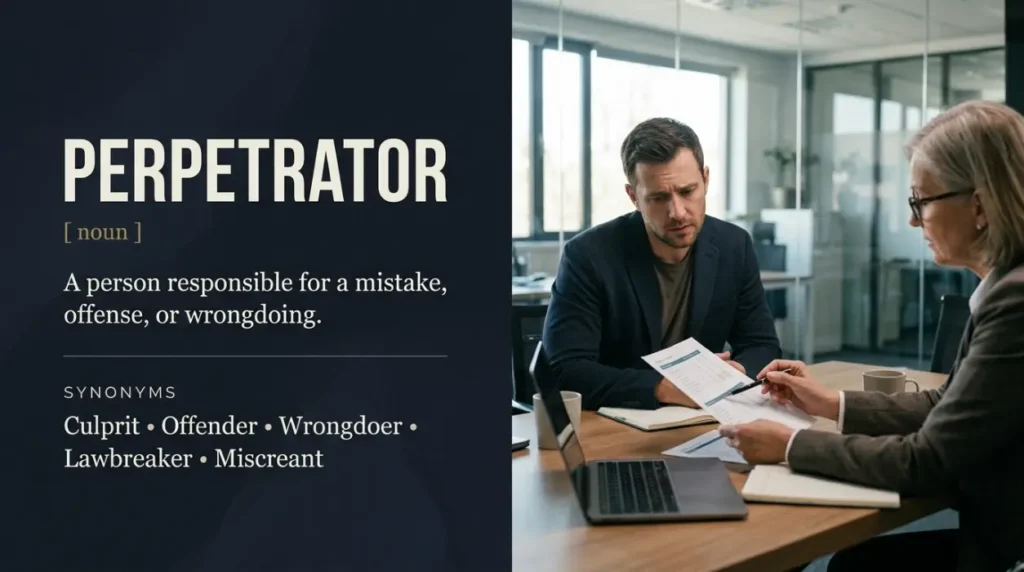
1. Culprit (Noun) — US /ˈkʌl.prɪt/, UK /ˈkʌl.prɪt/
Meaning: A person responsible for a mistake, offense, or wrongdoing.
Tone/Register: Neutral, conversational, journalistic.
Examples:
The culprit left muddy footprints near the door.
We finally discovered the culprit behind the missing files.
2. Offender (Noun) — US /əˈfen.dɚ/, UK /əˈfen.də/
Meaning: A person who commits a crime or breaks a rule.
Tone/Register: Formal, legal, professional.
Examples:
The court ordered the offender to complete community service.
Repeat offenders may face stricter penalties.
3. Wrongdoer (Noun) — US /ˈrɔːŋˌduː.ɚ/, UK /ˈrɒŋˌduː.ə/
Meaning: A person who does something morally or legally wrong.
Tone/Register: Neutral, ethical, formal.
Examples:
The investigation aims to hold the wrongdoer accountable.
The policy protects employees who report serious wrongdoing.
4. Criminal (Noun) — US /ˈkrɪm.ə.nəl/, UK /ˈkrɪm.ɪ.nəl/
Meaning: A person who commits a crime.
Tone/Register: Legal, journalistic, strong.
Examples:
The criminal was convicted after a lengthy trial.
The documentary explores how criminals exploit online systems.
5. Lawbreaker (Noun) — US /ˈlɔːˌbreɪ.kɚ/, UK /ˈlɔːˌbreɪ.kə/
Meaning: Someone who violates a law.
Tone/Register: Neutral, educational, journalistic.
Examples:
Lawbreakers may be subject to fines or imprisonment.
The campaign encourages citizens to report serious violations.
6. Malefactor (Noun) — US /ˈmæl.əˌfæk.tɚ/, UK /ˈmæl.ɪˌfæk.tə/
Meaning: A person who commits a harmful or wrongful act.
Tone/Register: Formal, literary, uncommon.
Examples:
The novel follows a malefactor who tries to escape justice.
The old account describes the malefactor’s actions in detail.
7. Miscreant (Noun) — US /ˈmɪs.kri.ənt/, UK /ˈmɪs.kri.ənt/
Meaning: A person who behaves badly or commits wrongdoing.
Tone/Register: Literary, critical, sometimes humorous.
Examples:
The neighborhood watched for the miscreant who kept damaging fences.
The fictional detective vowed to catch the miscreant.
8. Delinquent (Noun) — US /dɪˈlɪŋ.kwənt/, UK /dɪˈlɪŋ.kwənt/
Meaning: A person, often a young person, who commits offenses or neglects a legal duty.
Tone/Register: Legal, educational, formal.
Examples:
The program helps young offenders avoid becoming repeat delinquents.
The report examines juvenile delinquency in urban areas.
9.Person with Felony Convictions (Noun) — US /ˈpɜːr.sən wɪð ˈfel.ə.ni kənˈvɪk.ʃənz/, UK /ˈpɜː.sən wɪð ˈfel.ə.ni kənˈvɪk.ʃənz/
Meaning: A person convicted of a serious crime classified as a felony, particularly in US law.
Tone/Register: Legal, formal.
Examples:
The law restricts certain rights for people with felony convictions.
The journalist interviewed a former person with felony convictions about rehabilitation.
10. Transgressor (Noun) — US /trænzˈɡres.ɚ/, UK /trænzˈɡres.ə/
Meaning: A person who violates a law, rule, boundary, or moral standard.
Tone/Register: Formal, ethical, literary.
Examples:
The organization disciplines any transgressor who violates its code.
The story portrays the transgressor as a person seeking forgiveness.
11. Violator (Noun) — US /ˈvaɪ.əˌleɪ.tɚ/, UK /ˈvaɪ.əˌleɪ.tə/
Meaning: A person who breaks a law, rule, agreement, or right.
Tone/Register: Legal, administrative, professional.
Examples:
The agency issued a warning to the violator.
The report identifies each violator of the safety policy.
12. Outlaw (Noun) — US /ˈaʊtˌlɔː/, UK /ˈaʊt.lɔː/
Meaning: A person who lives outside the protection of the law or openly defies legal authority.
Tone/Register: Historical, dramatic, informal.
Examples:
The western film follows an outlaw across the desert.
The legend describes the outlaw as both feared and admired.
13. Evildoer (Noun) — US /ˈiː.vəlˌduː.ɚ/, UK /ˈiː.vəlˌduː.ə/
Meaning: A person who deliberately does evil or harmful things.
Tone/Register: Moral, literary, dramatic.
Examples:
The fairy tale ends with the evildoer facing justice.
The hero searches for the evildoer who threatened the kingdom.
14. Villain (Noun) — US /ˈvɪl.ən/, UK /ˈvɪl.ən/
Meaning: A person who causes harm or acts as the antagonist in a story.
Tone/Register: Literary, dramatic, conversational.
Examples:
The film’s villain manipulates everyone around him.
Readers gradually discover why the villain resents the town.
15. Scoundrel (Noun) — US /ˈskaʊn.drəl/, UK /ˈskaʊn.drəl/
Meaning: A dishonest or unscrupulous person.
Tone/Register: Informal, literary, critical.
Examples:
The novel’s scoundrel cheats his business partners.
Her grandfather called the dishonest salesman a scoundrel.
16. Rogue (Noun) — US /roʊɡ/, UK /rəʊɡ/
Meaning: A dishonest or unpredictable person who disregards accepted rules.
Tone/Register: Informal, literary, sometimes playful.
Examples:
The story follows a rogue who steals from wealthy merchants.
The reporter described the official as a political rogue.
17. Crook (Noun) — US /krʊk/, UK /krʊk/
Meaning: An informal term for a dishonest person or criminal.
Tone/Register: Informal, conversational, critical.
Examples:
The detective suspected that the businessman was a crook.
Nobody wanted to trust a crook with the company accounts.
18. Thug (Noun) — US /θʌɡ/, UK /θʌɡ/
Meaning: A violent or intimidating person, often involved in criminal activity.
Tone/Register: Informal, strongly negative.
Examples:
The witness described the attacker as a thug.
The novel features a thug who intimidates local shopkeepers.
19. Hoodlum (Noun) — US /ˈhʊd.ləm/, UK /ˈhʊd.ləm/
Meaning: A person who engages in criminal or disruptive behavior.
Tone/Register: Informal, old-fashioned, critical.
Examples:
The newspaper blamed local hoodlums for the vandalism.
The comedy features a group of mischievous hoodlums.
20. Perp (Noun) — US /pɝːp/, UK /pɜːp/
Meaning: An informal, especially American, shortening of perpetrator.
Tone/Register: Informal, police jargon, crime reporting.
Examples:
The detective asked whether anyone had seen the perp leave.
The television drama follows officers searching for a perp.
21. Suspect (Noun) — US /ˈsʌs.pekt/, UK /ˈsʌs.pekt/
Meaning: A person believed by authorities to possibly have committed an offense.
Tone/Register: Legal, journalistic, neutral.
Examples:
Police questioned a suspect after reviewing the footage.
The suspect has not been charged with a crime.
22. Accused (Noun) — US /əˈkjuːzd/, UK /əˈkjuːzd/
Meaning: A person who has been accused of wrongdoing or formally charged with an offense.
Tone/Register: Legal, formal, journalistic.
Examples:
The accused appeared in court with a lawyer.
The judge reminded the jury to consider the evidence carefully.
23. Defendant (Noun) — US /dɪˈfen.dənt/, UK /dɪˈfen.dənt/
Meaning: A person or organization facing a claim or criminal charge in court.
Tone/Register: Legal, formal.
Examples:
The defendant denied the allegations during the hearing.
The court granted the defendant additional time to prepare.
24. Convict (Noun) — US /ˈkɑːn.vɪkt/, UK /ˈkɒn.vɪkt/
Meaning: A person who has been found guilty of a crime.
Tone/Register: Legal, formal, sometimes stigmatizing.
Examples:
The former convict spoke about rebuilding his life.
The documentary examines the challenges faced by released convicts.
25. Accomplice (Noun) — US /əˈkɑːm.plɪs/, UK /əˈkʌm.plɪs/
Meaning: A person who helps another person commit a crime or wrongful act.
Tone/Register: Legal, journalistic, formal.
Examples:
Investigators believe an accomplice helped arrange the escape.
The main offender and his accomplice were questioned separately.
26. Accessory (Noun) — US /əkˈses.ɚ.i/, UK /əkˈses.ər.i/
Meaning: A person who assists, encourages, or helps conceal a crime under circumstances recognized by law.
Tone/Register: Legal, formal.
Examples:
The court considered whether the driver acted as an accessory.
The investigation examined who helped conceal the stolen property.
27. Abettor (Noun) — US /əˈbet̬.ɚ/, UK /əˈbet.ə/
Meaning: A person who encourages, assists, or supports another person’s wrongdoing.
Tone/Register: Legal, formal, uncommon.
Examples:
The prosecution argued that the adviser was an abettor.
The report distinguishes the main offender from those who assisted.
28. Instigator (Noun) — US /ˈɪn.stəˌɡeɪ.tɚ/, UK /ˈɪn.stɪˌɡeɪ.tə/
Meaning: A person who provokes, initiates, or encourages an action, especially a harmful one.
Tone/Register: Neutral to negative, professional.
Examples:
Witnesses identified the instigator of the confrontation.
The manager addressed the instigator before the argument escalated.
29. Conspirator (Noun) — US /kənˈspɪr.ə.t̬ɚ/, UK /kənˈspɪr.ə.tə/
Meaning: A person who secretly plans an unlawful or harmful act with others.
Tone/Register: Legal, political, dramatic.
Examples:
The investigation uncovered messages exchanged between the conspirators.
The historical novel follows a conspirator plotting against the ruler.
30. Mastermind (Noun) — US /ˈmæs.tɚˌmaɪnd/, UK /ˈmɑː.stə.maɪnd/
Meaning: The person who plans or organizes a complex scheme or operation.
Tone/Register: Journalistic, dramatic, sometimes admiring.
Examples:
Investigators believe the mastermind coordinated the fraud.
The documentary explores how the mastermind recruited other participants.
31. Assailant (Noun) — US /əˈseɪ.lənt/, UK /əˈseɪ.lənt/
Meaning: A person who physically attacks another person.
Tone/Register: Formal, journalistic, legal.
Examples:
The victim gave police a description of the assailant.
The report says the assailant fled before emergency services arrived.
32. Attacker (Noun) — US /əˈtæk.ɚ/, UK /əˈtæk.ə/
Meaning: A person or entity that launches a physical, verbal, or digital attack.
Tone/Register: Neutral, journalistic, technical.
Examples:
The attacker approached the victim outside the station.
Cybersecurity staff traced the attacker’s activity across several accounts.
33. Aggressor (Noun) — US /əˈɡres.ɚ/, UK /əˈɡres.ə/
Meaning: A person or party that initiates hostile action.
Tone/Register: Formal, political, analytical.
Examples:
The mediator asked both sides to identify the aggressor.
The report examines which party initiated the confrontation.
34. Abuser (Noun) — US /əˈbjuː.zɚ/, UK /əˈbjuː.zə/
Meaning: A person who subjects someone to physical, emotional, sexual, or other forms of abuse.
Tone/Register: Serious, social, legal, clinical.
Examples:
The organization provides confidential support for survivors of abuse.
The court issued an order restricting the abuser’s contact with the victim.
35. Bully (Noun) — US /ˈbʊl.i/, UK /ˈbʊl.i/
Meaning: A person who repeatedly intimidates, threatens, or mistreats another person.
Tone/Register: Everyday, educational, negative.
Examples:
The school intervened when a bully repeatedly targeted a new student.
She encouraged her friend to report the bully’s behavior.
36. Harasser (Noun) — US /həˈræs.ɚ/, UK /həˈræs.ə/
Meaning: A person who subjects someone to unwanted, repeated, or intimidating behavior.
Tone/Register: Legal, workplace, social.
Examples:
The employee reported the harasser to the human resources department.
The policy explains how complaints against a harasser are investigated.
37. Fraudster (Noun) — US /ˈfrɔːd.stɚ/, UK /ˈfrɔːd.stə/
Meaning: A person who uses deception to obtain money, property, or another benefit.
Tone/Register: Journalistic, legal, professional.
Examples:
The fraudster created fake invoices to deceive customers.
Investigators traced the stolen payments to accounts controlled by the fraudster.
38. Scammer (Noun) — US /ˈskæm. ɚ/, UK/ˈskæm.ə/ ɚ/, UK/ˈskæm.ə/ɚ/, UK /ˈskæm.ə/
Meaning: A person who deceives others through a dishonest scheme.
Tone/Register: Informal, digital, journalistic.
Examples:
The scammer sent messages pretending to represent a bank.
The website warns users about a scammer targeting job seekers.
39. Thief (Noun) — US /θiːf/, UK /θiːf/
Meaning: A person who steals another person’s property.
Tone/Register: Everyday, legal, neutral to negative.
Examples:
The thief took a bicycle from outside the library.
Security cameras helped investigators identify the suspected thief.
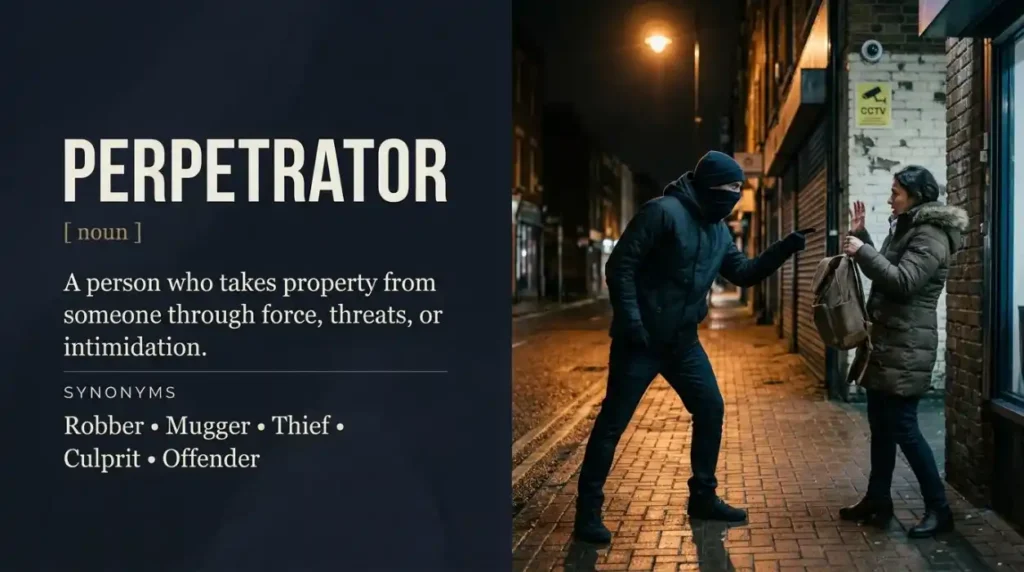
40. Robber (Noun) — US /ˈrɑː.bɚ/, UK /ˈrɒb.ə/
Meaning: A person who takes property from someone through force, threats, or intimidation.
Tone/Register: Everyday, legal, journalistic.
Examples:
The robber threatened the cashier and demanded money.
Witnesses saw the robber leave the store on foot.
41. Burglar (Noun) — US /ˈbɝː.ɡlɚ/, UK /ˈbɜː.ɡlə/
Meaning: A person who illegally enters a building to commit a crime, often theft.
Tone/Register: Legal, everyday, journalistic.
Examples:
The burglar entered the house while the family was away.
Investigators found evidence that the burglar forced open a window.
42. Arsonist (Noun) — US /ˈɑːr.sən.ɪst/, UK /ˈɑː.sən.ɪst/
Meaning: A person who deliberately sets fire to property unlawfully.
Tone/Register: Legal, journalistic, formal.
Examples:
The arsonist targeted an abandoned warehouse.
Fire investigators collected evidence from the damaged building.
43. Vandal (Noun) — US /ˈvæn.dəl/, UK /ˈvæn.dəl/
Meaning: A person who deliberately damages or defaces property.
Tone/Register: Everyday, journalistic, legal.
Examples:
The vandal sprayed paint across the public mural.
Residents asked the council to repair damage caused by the vandal.
44. Killer (Noun) — US /ˈkɪl.ɚ/, UK /ˈkɪl.ə/
Meaning: A person who causes someone’s death, whether intentionally or in another legally relevant circumstance.
Tone/Register: Serious, journalistic, emotional.
Examples:
The novel follows a detective searching for the killer.
The investigation has not yet established who caused the victim’s death.
45. Murderer (Noun) — US /ˈmɝː.dɚ.ɚ/, UK /ˈmɜː.dər.ə/
Meaning: A person who unlawfully and intentionally kills another person under the relevant legal definition of murder.
Tone/Register: Legal, serious, highly negative.
Examples:
The court sentenced the murderer after the trial concluded.
The novel reveals the murderer’s identity in its final chapter.
46. Oppressor (Noun) — US /əˈpres.ɚ/, UK /əˈpres.ə/
Meaning: A person or authority that uses power to treat others cruelly or unjustly.
Tone/Register: Political, social, historical.
Examples:
The speech describes how the community resisted its oppressor.
The history book examines the policies of an oppressive regime.
47. Exploiter (Noun) — US /ɪkˈsplɔɪ.tɚ/, UK /ɪkˈsplɔɪ.tə/
Meaning: A person who unfairly uses others for personal gain.
Tone/Register: Formal, social, business, critical.
Examples:
The report exposes an exploiter who withheld workers’ wages.
The campaign aims to protect vulnerable people from exploiters.
48. Trespasser (Noun) — US /ˈtresˌpæs.ɚ/, UK /ˈtresˌpɑː.sə/
Meaning: A person who enters or remains on property without permission or legal authority.
Tone/Register: Legal, everyday, formal.
Examples:
The guard asked the trespasser to leave the restricted area.
The property owner reported an unauthorized trespasser to the authorities.
49. Scofflaw (Noun) — US /ˈskɔːfˌlɔː/, UK /ˈskɒfˌlɔː/
Meaning: A person who habitually ignores or openly disregards the law.
Tone/Register: Informal, journalistic, especially American.
Examples:
The columnist criticized the scofflaw who repeatedly ignored parking restrictions.
Officials introduced new measures to discourage scofflaws from avoiding fines.
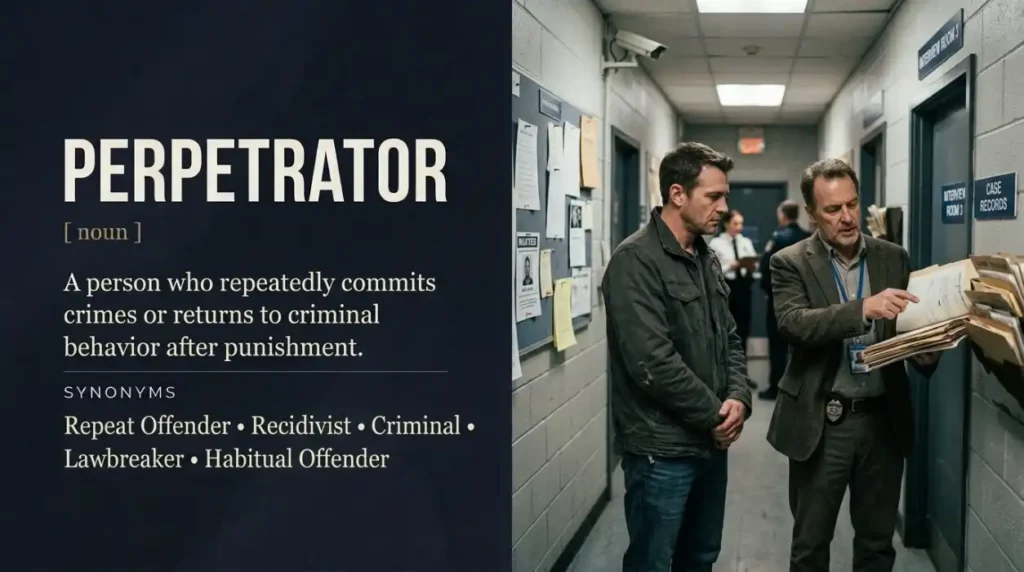
50. Recidivist (Noun) — US /rɪˈsɪd.ə.vɪst/, UK /rɪˈsɪd.ɪ.vɪst/
Meaning: A person who repeatedly commits crimes or returns to criminal behavior after punishment.
Tone/Register: Legal, academic, criminological.
Examples:
The study explores factors associated with repeat offending.
The program aims to reduce recidivism by improving access to education.
Important:
A recidivist is defined by repeated offending, not by a single act.
Synonyms by Tone
Tone helps readers understand whether you are making a legal claim, describing an event, or expressing a moral judgment.
Neutral and Professional
- Offender: Suitable for formal reports and criminal justice contexts.
- Culprit: Useful when identifying who caused a problem.
- Violator: Best for broken laws, policies, or agreements.
- Suspect: Appropriate when involvement is under investigation.
- Attacker: Useful for physical or digital attacks.
Strongly Negative
- Wrongdoer: Emphasizes moral or legal fault.
- Malefactor: A formal word for someone who does wrong.
- Abuser: Appropriate for abusive behavior.
- Fraudster: Identifies someone who commits fraud.
- Oppressor: Describes the abuse of power over others.
Literary or Dramatic
- Villain: Useful for fictional antagonists.
- Scoundrel: Suggests dishonesty or unscrupulous conduct.
- Miscreant: Often sounds literary or old-fashioned.
- Outlaw: Fits historical and dramatic settings.
- Evildoer: Emphasizes moral wrongdoing.
Informal or Conversational
- Crook: An informal term for a dishonest person.
- Thug: Suggests violence or intimidation.
- Hoodlum: Refers to disruptive or criminal behavior.
- Perp: A shortened form common in American crime-related speech.
- Bully: Appropriate for repeated intimidation.
A neutral term is often best when the facts are still being investigated. Stronger labels should match the evidence and the specific behavior being described.
“Perpetrator” vs. Close Alternatives
| Word | Key difference | Best context |
|---|---|---|
| Perpetrator | Person who carries out a harmful or wrongful act | General reporting and investigations |
| Culprit | Person responsible for a problem or offense | Everyday conversation |
| Offender | Person who commits an offense | Legal and professional writing |
| Suspect | Person who may have committed an offense | Ongoing investigation |
| Accomplice | Person who helps another commit an offense | Joint criminal activity |
| Criminal | Person who commits crimes; can imply established criminal conduct | General crime-related discussion |
Which Word Should You Choose?
Use perpetrator when focusing on the person who carried out the act. Choose culprit for a less formal description of responsibility.
Use offender in formal or legal contexts. Choose suspect when guilt has not been established. An accomplice helps another person, while the mastermind may organize the plan.
How “Perpetrator” Changes by Context
Daily Conversation
In casual English, culprit often sounds more natural than perpetrator. For example, a parent might ask who was responsible for breaking a lamp and call that person the culprit.
Avoid using criminal when you simply mean someone made a minor mistake. The word can imply serious wrongdoing.
Writing and Blogging
Bloggers should select terms that reflect the evidence. A post about online fraud might use scammer for a person running a deceptive scheme.
For an article covering an unresolved case, suspect or alleged perpetrator is generally safer than stating that a person committed the crime.
Professional and Academic Writing
Legal and academic texts benefit from precise vocabulary. Offender is common in criminal justice discussions. Violator works when someone breaks a regulation, and recidivist describes repeated offending.
Creative and Informal Writing
Fiction allows more expressive terms. A writer might call a dishonest character a scoundrel or the antagonist a villain.
These choices establish mood. However, they should not replace precise legal terminology in factual reporting.
Common Mistakes and Native Usage
Mistake 1: Treating “Suspect” as “Perpetrator”
A suspect may be innocent. The term describes a person under suspicion, not someone whose responsibility has been proven.
Better: “Police questioned a suspect in connection with the incident.”
Mistake 2: Using “Accomplice” for the Main Actor
An accomplice helps another person commit an act. The term does not necessarily identify the person who led or carried it out.
Better: “Investigators are identifying the main perpetrator and any accomplices.”
Mistake 3: Using “Criminal” for Every Wrongdoing
Not every mistake or harmful act is a crime. Wrongdoer may be more appropriate for unethical behavior that does not necessarily violate criminal law.
Mistake 4: Choosing Dramatic Words in Formal Reports
Words such as villain, scoundrel, and hoodlum may sound biased or emotional. Prefer neutral descriptions in factual or professional writing.
Register Notes
Formal: perpetrator, offender, violator, malefactor, recidivist.
Informal: culprit, crook, perp, thug.
Legal: defendant, accused, suspect, offender, person with felony convictions.
Literary: villain, scoundrel, evildoer, miscreant.
For further vocabulary practice, explore related words such as synonyms for offender and synonyms for wrongdoer in your vocabulary collection.
Real-Life Mini Scenarios
Workplace
An employee deliberately changes financial records. A report may refer to the perpetrator of the misconduct once the evidence supports that description.
Social Situations
Someone repeatedly intimidates a classmate. The word bully is usually more specific and natural than perpetrator in an everyday discussion.
News and Media
During an unresolved investigation, a journalist may write that police are searching for a suspect. After a court establishes responsibility, a more definitive term may be appropriate, depending on the reporting context.
Writing and Storytelling
A mystery writer might call a character the culprit while revealing the person responsible for a theft. A more dramatic story may use villain for the central antagonist.
Practice Exercise
Choose the most appropriate answer for each situation. Complete the questions before checking the answer key.
1. Police are investigating a robbery, but no one has been proven responsible. Which word is most appropriate?
A. Murderer
B. Suspect
C. Convict
D. Person with felony convictions
2. A person helps another individual carry out a crime. Which word fits best?
A. Accomplice
B. Victim
C. Defendant
D. Recidivist
3. A person repeatedly intimidates a classmate. Which word is most natural?
A. Mastermind
B. Bully
C. Trespasser
D. Arsonist
4. A person uses false invoices to obtain money dishonestly. Which word is most specific?
A. Fraudster
B. Outlaw
C. Hoodlum
D. Aggressor
5. A person is formally facing a criminal charge in court. Which legal term fits?
A. Villain
B. Scoundrel
C. Defendant
D. Evildoer
6. A person deliberately damages a public wall with paint. Which term is most appropriate?
A. Vandal
B. Accomplice
C. Recidivist
D. Oppressor
7. A person organizes a complex illegal scheme but may not carry out every step. Which term fits best?
A. Culprit
B. Mastermind
C. Thief
D. Delinquent
8. A person has been convicted of a serious felony under US law. Which word is appropriate?
A. Suspect
B. Defendant
C. Person with felony convictions
D. Instigator
9. A person initiates a hostile confrontation. Which term describes that role?
A. Aggressor
B. Accessory
C. Convict
D. Exploiter
10. A person repeatedly commits crimes after previous punishment. Which term fits?
A. Trespasser
B. Recidivist
C. Scammer
D. Assailant
Reflection Task:
Write one sentence describing a fictional or everyday situation involving wrongdoing. Choose a suitable synonym for perpetrator and explain why it is more accurate than the alternatives.
Answer key:
1-B, 2-A, 3-B, 4-A, 5-C, 6-A, 7-B, 8-C, 9-A, 10-B
Frequently Asked Questions
1. What is the best synonym for perpetrator in a news article?
The best term depends on what investigators have established. Suspect is appropriate when a person’s involvement is being investigated. Offender may fit when an offense has been established, while perpetrator identifies the person responsible for carrying out the act. Journalists should avoid language that presents an allegation as proven fact.
2. What is a synonym for perpetrator of a crime in legal writing?
Offender is often a useful general alternative, while defendant, accused, and suspect refer to specific legal or investigative positions. These terms are not interchangeable. A defendant faces a legal claim or charge, whereas an offender is someone who has committed an offense. Always consider the jurisdiction and procedural stage.
3. What is the difference between a perpetrator and a culprit?
Both words can describe someone responsible for wrongdoing. Perpetrator sounds more formal and is frequently used in crime reports, investigations, and discussions of serious harm. Culprit is more conversational and can also describe the cause of a noncriminal problem. For example, the culprit behind a computer error need not have committed a crime.
4. What is a synonym for an unknown perpetrator?
When the person’s identity or responsibility has not been established, an unknown suspect may be appropriate in an investigation. An unidentified perpetrator is another option when referring to the person who carried out an act but whose identity is unknown. In factual reporting, avoid presenting an unproven theory as a confirmed finding.
5. Can “perpetrator” describe someone who commits cybercrime?
Yes. Perpetrator can describe someone responsible for phishing, unauthorized access, online fraud, or other cybercrime. More specific alternatives include hacker, scammer, and fraudster, but their meanings differ. Not every hacker commits a crime, so choose the label that accurately reflects the person’s actions and the available evidence.
6. What is a gender-neutral word for perpetrator?
Perpetrator, offender, culprit, and wrongdoer are gender-neutral nouns. They can refer to a person of any gender without changing the word. In formal writing, using these terms can also keep attention on the behavior rather than the person’s gender. Select the word according to the act and the context.
7. Is “perp” acceptable in formal English?
Perp is an informal shortening of perpetrator, especially associated with American police language and crime dramas. It can sound natural in dialogue, informal discussion, or some headlines. In academic writing, legal documents, and most professional reports, the full word perpetrator or a more precise legal term is usually preferable.
Conclusion
Learning a synonym for perpetrator helps you describe wrongdoing more precisely. Words such as culprit, offender, and wrongdoer offer different levels of formality and meaning.
Students can strengthen essays with accurate vocabulary. Bloggers and content writers can avoid repetition, while everyday English users can express ideas more clearly and confidently.
The key is to match each word to the facts. A suspect is not automatically guilty, and an accomplice does not necessarily lead the act.
Practice these alternatives in essays, emails, and original sentences. Choose three words from this guide, write your own examples, and notice how each word changes the meaning.
Recommended External Sources
Use these reputable dictionaries to verify definitions, pronunciations, and additional alternatives before publishing:
- Oxford Learner’s Dictionaries: Perpetrator definition, pronunciation, and usage.
- Cambridge Dictionary: Perpetrator meaning and related vocabulary for criminal behavior.
- Online Etymology Dictionary: Perpetrator historical origin and development.

Jameel Hassan is the founder and lead writer at SynonymsCloud.com, a trusted online platform dedicated to English vocabulary and effective communication. He is passionate about helping students, writers, professionals, and lifelong learners discover the right words to express their ideas with clarity, precision, and confidence.
At SynonymsCloud.com, every article is thoroughly researched and carefully written to provide accurate, practical, and easy-to-understand guidance on synonyms, antonyms, word meanings, idioms, and vocabulary. With a strong commitment to quality, real-world usage, and clear explanations, the website helps readers expand their vocabulary, improve their writing, and communicate more effectively in both academic and professional settings.