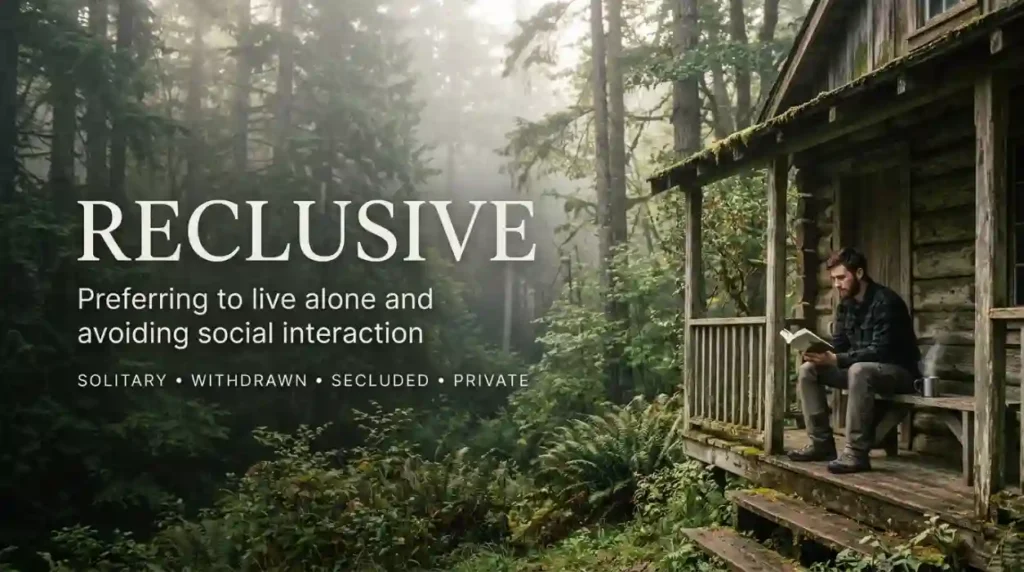
A synonym for reclusive is a word that describes someone who avoids social interaction, prefers solitude, or keeps their personal life private. Common alternatives include withdrawn, secluded, solitary, introverted, private, and unsociable. The best choice depends on whether you mean a preference for privacy or deliberate avoidance of other people.
Imagine a neighbor who rarely attends social gatherings and enjoys weekends alone with books. You might describe this person as reclusive, reserved, or solitary, depending on their personality and behavior.
The word reclusive often appears in biographies, novels, news stories, and everyday conversations. It describes people who prefer limited social contact or maintain distance from public attention and social activities.
Learning a synonym for reclusive helps students improve descriptive writing, bloggers avoid repetition, and content writers create more precise character descriptions. Everyday English users can also express personality traits naturally and clearly.
A person who enjoys solitude is not necessarily unfriendly. Understanding the differences between private, introverted, and withdrawn helps you choose the right synonym for reclusive and describe people respectfully without making unfair assumptions about their feelings.
What Does “Reclusive” Really Mean?
Reclusive is an adjective describing someone who avoids other people, limits social contact, or prefers to live privately and away from public attention.
For example, a reclusive writer may spend most of their time at home and rarely give interviews. A reclusive artist may avoid public events and keep their personal life out of the media.
Native English speakers often use reclusive when describing people who consistently withdraw from social life. The word can suggest a strong preference for privacy or a deliberate effort to avoid interaction.
It is commonly used in biographies, journalism, literature, and discussions about personality. It can describe a lifestyle without necessarily implying that the person is unhappy or unfriendly.
Connotative Meaning
(Connotation is the emotional or cultural association a word carries beyond its literal definition.)
- Positive tone: Reclusive can suggest independence, peaceful solitude, or a commitment to private creative work.
- Negative tone: It may suggest isolation, social avoidance, or excessive withdrawal from others.
- Neutral tone: It can simply describe someone who lives privately and rarely socializes.
The intended meaning depends on context. A reclusive novelist may be admired for protecting their privacy, while a reclusive public official may attract attention because they rarely communicate with others.
Etymology of Reclusive
The word reclusive comes from recluse, which entered English through French from Latin recludere, meaning “to shut up” or “to enclose.” Its development reflects the idea of withdrawing from the outside world.
- Old English (450–1100): The modern word reclusive was not part of ordinary Old English vocabulary. Related ideas were expressed through words describing solitude, withdrawal, or separation.
- Middle English (1100–1500): Recluse became established in English for someone living apart from ordinary society, especially for religious reasons.
- Modern English (1500–present): Reclusive developed as an adjective describing people who avoid social contact or public attention. Its meaning now extends to writers, artists, public figures, and people who prefer a private lifestyle.
Pronunciation
- US: /rɪˈkluːsɪv/
- UK: /rɪˈkluːsɪv/
Syllables
re-clu-sive three syllables.
Affixation Pattern of Reclusive
- Root: recluse
- Prefix: None in the modern word reclusive
- Suffix: -ive, which forms an adjective
- Related words: recluse (noun), reclusively (adverb), reclusiveness (noun)
The suffix -ive helps form an adjective that describes a characteristic or tendency.
Synonyms List
These 50 alternatives describe privacy, solitude, social withdrawal, or limited interaction. They are not all exact substitutes. Some describe personality, while others describe behavior or living conditions. Choose the word that best matches the situation.
1. Withdrawn (Adjective) — US: /wɪðˈdrɔːn/ | UK: /wɪðˈdrɔːn/
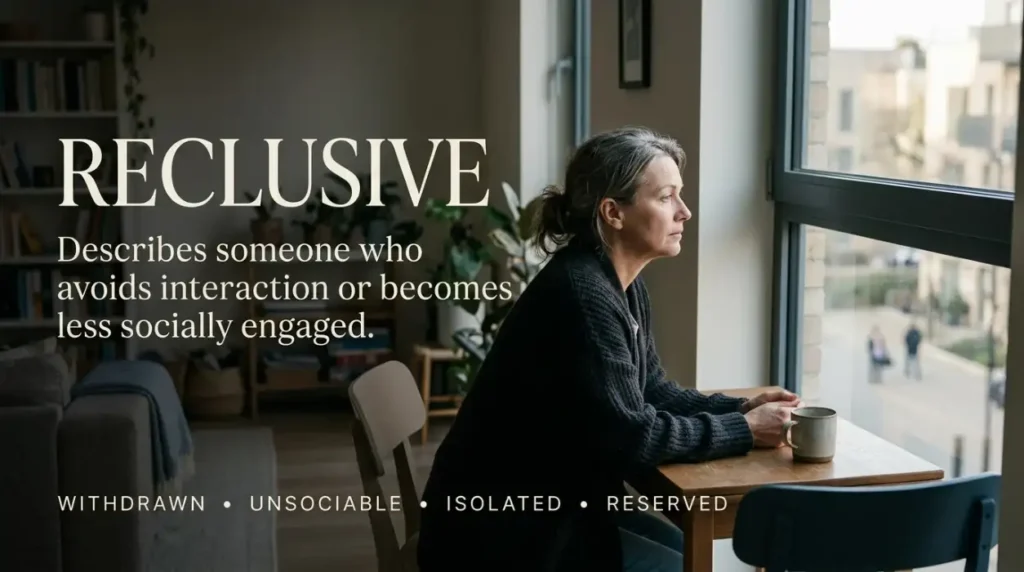
Meaning: Describes someone who avoids interaction or becomes less socially engaged.
Tone/Register: Neutral, psychological, everyday.
Examples:
After moving to a new city, Liam became quiet and withdrawn.
She seemed withdrawn during the family gathering.
2. Solitary (Adjective) — US: /ˈsɑːləˌteri/ | UK: /ˈsɒlətri/
Meaning: Describes someone who spends much of their time alone.
Tone/Register: Neutral, literary, descriptive.
Examples:
The solitary painter worked in a small cabin near the lake.
He enjoyed a solitary morning walk before starting work.
3. Secluded (Adjective) — US: /sɪˈkluːdɪd/ | UK: /sɪˈkluːdɪd/
Meaning: Describes someone or somewhere separated from other people and public activity.
Tone/Register: Neutral, descriptive, literary.
Examples:
The novelist lived in a secluded cottage in the countryside.
They chose a secluded beach for a quiet weekend.
4. Isolated (Adjective) — US: /ˈaɪsəˌleɪtɪd/ | UK: /ˈaɪsəleɪtɪd/
Meaning: Describes someone separated from others, sometimes physically and sometimes socially.
Tone/Register: Neutral to negative, formal.
Examples:
Working remotely left him feeling isolated from his colleagues.
The isolated farmhouse stood several miles from the nearest village.
5. Introverted (Adjective) — US: /ˈɪntrəˌvɜːrtɪd/ | UK: /ˈɪntrəvɜːtɪd/
Meaning: Describes someone who tends to prefer quieter settings and may need time alone to recharge.
Tone/Register: Neutral, psychological, everyday.
Examples:
As an introverted student, Maya preferred small study groups.
He was introverted but enjoyed spending time with close friends.
6. Unsociable (Adjective) — US: /ʌnˈsoʊʃəbəl/ | UK: /ʌnˈsəʊʃəbəl/
Meaning: Describes someone who is unwilling or reluctant to spend time with other people.
Tone/Register: Informal, neutral to negative.
Examples:
His colleagues considered him unsociable because he skipped every office party.
She was not unfriendly, just unsociable after a tiring day.
7. Private (Adjective) — US: /ˈpraɪvət/ | UK: /ˈpraɪvət/
Meaning: Describes someone who prefers to keep personal matters away from public attention.
Tone/Register: Neutral, professional, everyday.
Examples:
The actor is private about his family life.
She keeps a private life despite having a popular online account.
8. Reserved (Adjective) — US: /rɪˈzɜːrvd/ | UK: /rɪˈzɜːvd/
Meaning: Describes someone who does not readily express feelings or speak openly.
Tone/Register: Neutral, formal, polite.
Examples:
Our new manager is reserved during meetings.
Although reserved at first, Daniel becomes talkative around trusted friends.
9. Solitary-minded (Adjective) — US: /ˈsɑːləˌteri ˈmaɪndɪd/ | UK: /ˈsɒlətri ˈmaɪndɪd/
Meaning: Describes someone who naturally prefers independent activities and time alone.
Tone/Register: Descriptive, literary.
Examples:
A solitary-minded researcher may enjoy long hours of independent study.
Her solitary-minded nature made quiet weekends especially appealing.
10. Reclusive-minded (Adjective) — US: /rɪˈkluːsɪv ˈmaɪndɪd/ | UK: /rɪˈkluːsɪv ˈmaɪndɪd/
Meaning: Describes someone inclined toward a private lifestyle with little social contact.
Tone/Register: Descriptive, uncommon.
Examples:
The character is reclusive-minded and avoids unnecessary attention.
His reclusive-minded habits keep his personal affairs out of public discussion.
11. Retiring (Adjective) — US: /rɪˈtaɪərɪŋ/ | UK: /rɪˈtaɪərɪŋ/
Meaning: Describes someone who is shy or prefers to avoid the spotlight.
Tone/Register: Formal, literary, polite.
Examples:
The retiring musician rarely appeared at public events.
Her retiring nature made interviews uncomfortable for her.
12. Introverted by Nature (Adjective Phrase) — US: /ˈɪntrəˌvɜːrtɪd baɪ ˈneɪtʃər/ | UK: /ˈɪntrəvɜːtɪd baɪ ˈneɪtʃə/
Meaning: Describes someone whose natural personality favors quieter environments and limited social stimulation.
Tone/Register: Neutral, conversational, psychological.
Examples:
Introverted by nature, Omar prefers reading to attending large parties.
She is introverted by nature but speaks confidently in small groups.
13. Solitary-living (Adjective) — US: /ˈsɑːləˌteri ˈlɪvɪŋ/ | UK: /ˈsɒlətri ˈlɪvɪŋ/
Meaning: Describes a lifestyle in which someone lives or spends most of their time alone.
Tone/Register: Descriptive, formal.
Examples:
The documentary follows a solitary-living artist in the mountains.
Solitary-living arrangements can offer independence and quiet.
14. Aloof (Adjective) — US: /əˈluːf/ | UK: /əˈluːf/
Meaning: Describes someone who appears emotionally distant or unwilling to become involved with others.
Tone/Register: Neutral to negative, formal.
Examples:
The new neighbor seemed aloof during our first conversation.
His aloof manner made it difficult for coworkers to approach him.
15. Antisocial (Adjective) — US: /ˌæntiˈsoʊʃəl/ | UK: /ˌæntiˈsəʊʃəl/
Meaning: In everyday speech, it describes someone who avoids social activities; in clinical contexts, it can have a different meaning.
Tone/Register: Informal, sometimes negative.
Examples:
I felt antisocial after a long week and stayed home on Friday.
He jokingly called himself antisocial because he declined another party invitation.
16. Hermitic (Adjective) — US: /hɜːrˈmɪtɪk/ | UK: /hɜːˈmɪtɪk/
Meaning: Describes a lifestyle resembling that of a hermit who lives apart from society.
Tone/Register: Literary, uncommon.
Examples:
The biography describes the poet’s hermitic lifestyle in later life.
He adopted a hermitic routine while completing his book.
17. Hermitlike (Adjective) — US: /ˈhɜːrmɪtˌlaɪk/ | UK: /ˈhɜːmɪtˌlaɪk/
Meaning: Resembling a hermit in the preference for living alone and avoiding company.
Tone/Register: Descriptive, informal to literary.
Examples:
After retiring, she developed a hermitlike routine in her woodland home.
His hermitlike habits surprised friends who remembered his active social life.
18. Unsocial (Adjective) — US: /ʌnˈsoʊʃəl/ | UK: /ʌnˈsəʊʃəl/
Meaning: Describes someone or something that does not encourage or involve social interaction.
Tone/Register: Formal, neutral to negative.
Examples:
His unsocial working hours left little time for friends.
The student was labeled unsocial because he rarely joined group activities.
19. Reclusive by Nature (Adjective Phrase) — US: /rɪˈkluːsɪv baɪ ˈneɪtʃər/ | UK: /rɪˈkluːsɪv baɪ ˈneɪtʃə/
Meaning: Describes someone whose usual temperament favors privacy and limited social contact.
Tone/Register: Neutral, descriptive.
Examples:
Reclusive by nature, the novelist rarely attended literary festivals.
She has always been reclusive by nature and enjoys working alone.
20. Self-Isolating (Adjective) — US: /ˌself ˈaɪsəˌleɪtɪŋ/ | UK: /ˌself ˈaɪsəleɪtɪŋ/
Meaning: Describes someone who deliberately separates themselves from others.
Tone/Register: Neutral, contemporary.
Examples:
He became self-isolating after a difficult personal experience.
The character grows increasingly self-isolating as the story progresses.
21. Sequestered (Adjective) — US: /sɪˈkwestərd/ | UK: /sɪˈkwestəd/
Meaning: Describes someone kept or choosing to remain apart from other people.
Tone/Register: Formal, literary.
Examples:
The author spent a month sequestered in a mountain retreat.
The witnesses remained sequestered while the jury considered the case.
22. Withdrawn from Society (Adjective Phrase) — US: /wɪðˈdrɔːn frəm səˈsaɪəti/ | UK: /wɪðˈdrɔːn frəm səˈsaɪəti/
Meaning: Describes someone who has greatly reduced their participation in community or social life.
Tone/Register: Formal, descriptive.
Examples:
After years in public life, the former leader withdrew from society.
The novel follows a man who becomes withdrawn from society after a loss.
23. Solitude-Seeking (Adjective) — US: /ˈsɑːləˌtuː ˌsiːkɪŋ/ | UK: /ˈsɒlɪtjuː ˌsiːkɪŋ/
Meaning: Describes someone who actively seeks time alone.
Tone/Register: Descriptive, contemporary.
Examples:
The solitude-seeking photographer often hikes before sunrise.
Her solitude-seeking habits help her concentrate on complex projects.
24. Self-Contained (Adjective) — US: /ˌself kənˈteɪnd/ | UK: /ˌself kənˈteɪnd/
Meaning: Describes someone who is emotionally independent and does not rely heavily on social interaction.
Tone/Register: Neutral, professional.
Examples:
He is self-contained and rarely asks others to solve his problems.
The self-contained artist prefers managing projects independently.
25. Unsociable by Choice (Adjective Phrase) — US: /ʌnˈsoʊʃəbəl baɪ tʃɔɪs/ | UK: /ʌnˈsəʊʃəbəl baɪ tʃɔɪs/
Meaning: Describes someone who deliberately chooses to avoid most social activities.
Tone/Register: Conversational, descriptive.
Examples:
She is unsociable by choice and enjoys spending holidays alone.
He is unsociable by choice, not because he dislikes his friends.
26. Reclusive Living (Adjective) — US: /rɪˈkluːsɪv ˈlɪvɪŋ/ | UK: /rɪˈkluːsɪv ˈlɪvɪŋ/
Meaning: Describes a lifestyle characterized by privacy and minimal social contact.
Tone/Register: Descriptive, uncommon.
Examples:
The film portrays a reclusive living novelist who avoids publicity.
His reclusive routine keeps distractions to a minimum.
27. Sequestered Away (Adjective Phrase) — US: /sɪˈkwestərd əˈweɪ/ | UK: /sɪˈkwestəd əˈweɪ/
Meaning: Describes someone situated or staying far from other people and ordinary activity.
Tone/Register: Literary, formal.
Examples:
The researcher stayed sequestered away in a remote cabin.
She spent the weekend sequestered away from work messages.
28. Detached (Adjective) — US: /dɪˈtætʃt/ | UK: /dɪˈtætʃt/
Meaning: Describes someone who appears emotionally uninvolved or distant from other people.
Tone/Register: Neutral to negative, professional.
Examples:
His detached response made the discussion feel uncomfortable.
The narrator remains detached from the conflict around him.
29. Uncommunicative (Adjective) — US: /ˌʌnkəˈmjuːnɪkətɪv/ | UK: /ˌʌnkəˈmjuːnɪkətɪv/
Meaning: Describes someone who shares little information or speaks very little with others.
Tone/Register: Formal, neutral to negative.
Examples:
The witness was uncommunicative during the interview.
My normally cheerful colleague became uncommunicative after the meeting.
30. Solitude-Loving (Adjective) — US: /ˈsɑːləˌtuː ˈlʌvɪŋ/ | UK: /ˈsɒlɪtjuː ˈlʌvɪŋ/
Meaning: Describes someone who enjoys being alone and values quiet personal time.
Tone/Register: Positive, descriptive.
Examples:
The solitude-loving gardener spends hours tending plants without company.
As a solitude-loving reader, Nina enjoys quiet evenings at home.
31. Private by Nature (Adjective Phrase) — US: /ˈpraɪvət baɪ ˈneɪtʃər/ | UK: /ˈpraɪvət baɪ ˈneɪtʃə/
Meaning: Describes someone who naturally prefers to keep personal matters confidential.
Tone/Register: Neutral, polite.
Examples:
Private by nature, the professor rarely discusses family matters.
He is private by nature and keeps his social media limited.
32. Introvert (Noun) — US: /ˈɪntrəˌvɜːrt/ | UK: /ˈɪntrəvɜːt/
Meaning: A person who tends to prefer quieter environments or smaller social settings.
Tone/Register: Neutral, everyday, psychological.
Examples:
As an introvert, she prefers coffee with one friend to a crowded party.
The introvert enjoyed the conference more after finding a quiet corner.
33. Recluse (Noun) — US: /rɪˈkluːs/ | UK: /rɪˈkluːs/
Meaning: A person who lives in relative seclusion and avoids other people.
Tone/Register: Neutral, literary, formal.
Examples:
The famous recluse rarely left his country estate.
Neighbors described the older recluse as polite but distant.
34. Hermit (Noun) — US: /ˈhɜːrmɪt/ | UK: /ˈhɜːmɪt/
Meaning: A person who lives alone and avoids ordinary social contact.
Tone/Register: Everyday, literary, sometimes playful.
Examples:
The story features a hermit who lives deep in the forest.
After retirement, he joked that he had become a hermit.
35. Loner (Noun) — US: /ˈloʊnər/ | UK: /ˈləʊnə/
Meaning: A person who prefers doing things alone rather than spending much time in groups.
Tone/Register: Informal, neutral to negative.
Examples:
Everyone knew Marcus as a loner who enjoyed solo cycling trips.
The film’s main character is a loner who trusts very few people.
36. Solitary Person (Noun Phrase) — US: /ˈsɑːləˌteri ˈpɜːrsən/ | UK: /ˈsɒlətri ˈpɜːsən/
Meaning: Someone who spends a large amount of time alone.
Tone/Register: Neutral, descriptive.
Examples:
A solitary person may prefer independent hobbies to group activities.
She was a solitary person who found peace in long walks.
37. Private Individual (Noun Phrase) — US: /ˈpraɪvət ˌɪndɪˈvɪdʒuəl/ | UK: /ˈpraɪvət ˌɪndɪˈvɪdʒuəl/
Meaning: Someone who keeps personal details away from public attention.
Tone/Register: Formal, professional.
Examples:
Despite his fame, the singer remains a private individual.
The scientist is a private individual who rarely gives interviews.
38. Social Avoider (Noun Phrase) — US: /ˈsoʊʃəl əˈvɔɪdər/ | UK: /ˈsəʊʃəl əˈvɔɪdə/
Meaning: An informal description of someone who deliberately avoids social situations.
Tone/Register: Informal, descriptive.
Examples:
He called himself a social avoider after declining three invitations.
The character is a social avoider who prefers online communication.
39. Nonconformist (Noun) — US: /ˌnɑːnkənˈfɔːrmɪst/ | UK: /ˌnɒnkənˈfɔːmɪst/
Meaning: A person who does not follow conventional social expectations or accepted behavior.
Tone/Register: Neutral to positive, cultural.
Examples:
The nonconformist artist rejected fashionable trends and worked alone.
Her reputation as a nonconformist came from her unconventional lifestyle.
40. Independent (Adjective) — US: /ˌɪndɪˈpendənt/ | UK: /ˌɪndɪˈpendənt/
Meaning: Describes someone who prefers to act or work without depending heavily on others.
Tone/Register: Positive, professional, everyday.
Examples:
He is independent and enjoys completing projects on his own.
The independent researcher rarely needs supervision.

41. Self-Sufficient (Adjective) — US: /ˌself səˈfɪʃənt/ | UK: /ˌself səˈfɪʃənt/
Meaning: Describes someone able to manage their needs without relying much on other people.
Tone/Register: Positive, practical, professional.
Examples:
The self-sufficient farmer grows most of his own food.
She became self-sufficient after learning to manage her household independently.
42. Solitary by Choice (Adjective Phrase) — US: /ˈsɑːləˌteri baɪ tʃɔɪs/ | UK: /ˈsɒlətri baɪ tʃɔɪs/
Meaning: Describes someone who willingly chooses to spend much of their time alone.
Tone/Register: Neutral to positive, conversational.
Examples:
He is solitary by choice and enjoys working from a quiet studio.
She remained solitary by choice after moving to the countryside.
43. Seclusion-Seeking (Adjective) — US: /sɪˈkluːʒən ˌsiːkɪŋ/ | UK: /sɪˈkluːʒən ˌsiːkɪŋ/
Meaning: Describes someone who actively looks for privacy and separation from other people.
Tone/Register: Descriptive, formal.
Examples:
The seclusion-seeking writer rented a cabin far from the city.
His seclusion-seeking habits made a remote home especially appealing.
44. Emotionally Distant (Adjective Phrase) — US: /ɪˈmoʊʃənəli ˈdɪstənt/ | UK: /ɪˈməʊʃənəli ˈdɪstənt/
Meaning: Describes someone who appears unwilling to share feelings or form close emotional connections.
Tone/Register: Neutral to negative, psychological.
Examples:
He seemed emotionally distant during conversations about the future.
The character becomes emotionally distant after a painful betrayal.
45. Socially Detached (Adjective Phrase) — US: /ˈsoʊʃəli dɪˈtætʃt/ | UK: /ˈsəʊʃəli dɪˈtætʃt/
Meaning: Describes someone who feels or behaves as though they are separate from other people socially.
Tone/Register: Formal, analytical.
Examples:
The report described residents who felt socially detached from the community.
She appeared socially detached during the group discussion.
46. Seclusive (Adjective) — US: /sɪˈkluːsɪv/ | UK: /sɪˈkluːsɪv/
Meaning: Describes someone who tends to live apart from others or avoid social interaction.
Tone/Register: Formal, uncommon.
Examples:
The biography portrays a seclusive scholar who avoided public appearances.
His reclusive lifestyle allowed him to focus on his research.
47. Reclusive Figure (Noun Phrase) — US: /rɪˈkluːsɪv ˈfɪɡjər/ | UK: /rɪˈkluːsɪv ˈfɪɡə/
Meaning: A person known for avoiding public attention and maintaining a private life.
Tone/Register: Journalistic, formal.
Examples:
The reclusive figure became a subject of public curiosity.
The documentary explores the life of a reclusive figure in the art world.
48. Private Soul (Noun Phrase) — US: /ˈpraɪvət soʊl/ | UK: /ˈpraɪvət səʊl/
Meaning: An informal, expressive description of someone who keeps their thoughts and feelings to themselves.
Tone/Register: Warm, literary, informal.
Examples:
Her friends knew she was a private soul who rarely discussed romance.
He was a private soul who preferred meaningful conversations to public attention.
49. Solitary Spirit (Noun Phrase) — US: /ˈsɑːləˌteri ˈspɪrɪt/ | UK: /ˈsɒlətri ˈspɪrɪt/
Meaning: A descriptive expression for someone who feels comfortable living or working independently.
Tone/Register: Literary, positive.
Examples:
A solitary spirit, the explorer spent months traveling through remote regions.
The novel celebrates a solitary spirit who values freedom over popularity.
50. Socially Withdrawn (Adjective Phrase) — US: /ˈsoʊʃəli wɪðˈdrɔːn/ | UK: /ˈsəʊʃəli wɪðˈdrɔːn/
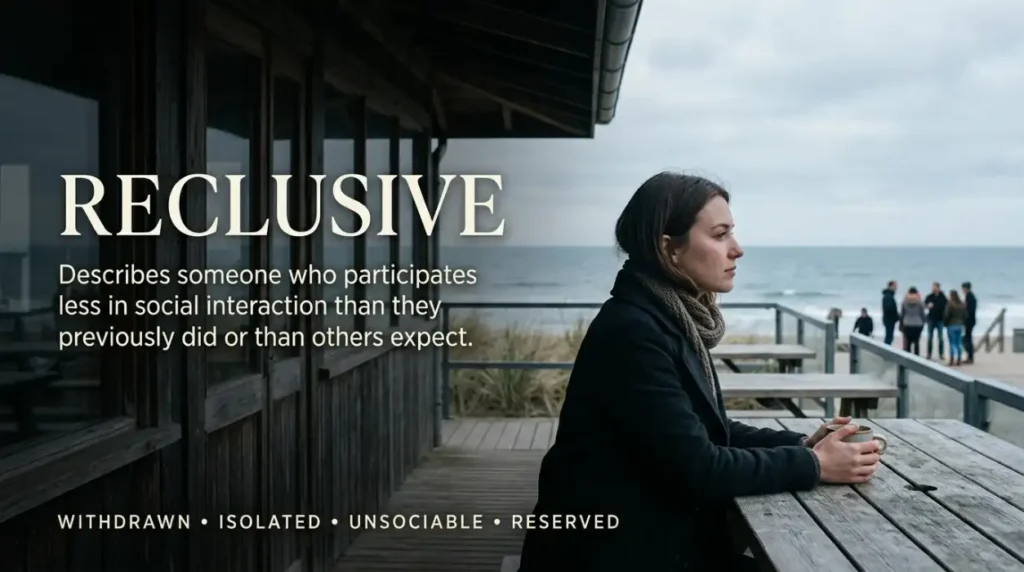
Meaning: Describes someone who participates less in social interaction than they previously did or than others expect.
Tone/Register: Formal, descriptive, psychological.
Examples:
The teenager became socially withdrawn after changing schools.
His socially withdrawn behavior concerned friends who had known him for years.
Usage note:
Some expressions above, such as reclusive-minded, solitary-living, and private soul, are descriptive phrases rather than established dictionary synonyms. For most everyday writing, the strongest choices are withdrawn, solitary, secluded, private, reserved, aloof, recluse, and hermit.
Synonyms by Tone
The emotional tone of a synonym matters because words can describe similar behavior while creating different impressions.
Positive Synonyms
These words emphasize independence, privacy, or a preference for peaceful solitude.
- Solitude-loving: Suggests that someone genuinely enjoys time alone.
- Independent: Highlights self-reliance rather than social avoidance.
- Self-sufficient: Emphasizes the ability to manage life independently.
- Solitary spirit: Creates a thoughtful or literary impression.
- Private: Shows respect for personal boundaries.
Example: “She is independent and enjoys working alone” sounds more positive than “She avoids everyone.”
Neutral Synonyms
These terms describe limited social interaction without automatically judging the person.
- Withdrawn
- Reserved
- Solitary
- Secluded
- Private
- Introverted
- Recluse
- Sequestered
Example: “The reserved professor rarely discusses personal matters” describes behavior without suggesting that anything is wrong.
Negative or Critical Synonyms
These words can suggest emotional distance, unwillingness to interact, or difficulty connecting with others.
- Aloof
- Unsociable
- Uncommunicative
- Emotionally distant
- Socially detached
- Socially withdrawn
Example: “His aloof manner made the new employees hesitant to approach him” suggests a social barrier.
Playful or Informal Alternatives
In casual conversations, people sometimes use expressions such as loner, hermit, or homebody. However, a homebody simply enjoys staying at home and is not necessarily reclusive.
Example: “I’m being a bit of a hermit this weekend” can be a lighthearted way to say you want to stay home.
“Reclusive” vs. Close Alternatives
| Word | Main difference | Best use |
|---|---|---|
| Reclusive | Consistently avoids social contact or public attention | Private lifestyles, biographies, public figures |
| Introverted | Prefers quieter settings or limited social stimulation | Personality descriptions |
| Withdrawn | Shows reduced social engagement or emotional openness | Changes in behavior, character descriptions |
| Aloof | Appears distant or emotionally uninvolved | Describing someone’s manner |
| Solitary | Spends time alone, by preference or circumstance | Independent lifestyles and activities |
Which Word Should You Choose?
Use reclusive when someone deliberately maintains a private lifestyle and avoids much of ordinary social life.
Choose introverted when describing a personality that favors quieter environments. Use withdrawn when someone participates less or seems less communicative, especially compared with their usual behavior.
Choose aloof when someone appears emotionally distant. Use solitary when the main point is spending time alone, without necessarily implying avoidance.
For example:
- “The reclusive author rarely gives interviews.” This emphasizes privacy and avoidance of public attention.
- “The introverted author prefers small gatherings.” This describes a personality preference.
- “The author became withdrawn after the move.” This suggests a change in social behavior.
- “The author seemed aloof at the reception.” This describes an impression of emotional distance.
How Reclusive Changes by Context
Daily Conversation
In everyday English, private, quiet, reserved, and solitary can sound more natural than reclusive.
For example, “My uncle is very private” communicates that he keeps personal matters to himself. “My uncle is reclusive” suggests a stronger pattern of avoiding people.
Writing and Blogging
Writers can use reclusive when discussing people who avoid publicity, public appearances, or social interaction.
A biography might describe an artist as reclusive, while a lifestyle blog might call someone private or solitude-loving. Choose a term that reflects the person’s actual behavior.
Professional and Academic English
In formal writing, socially withdrawn, socially detached, and secluded can be useful when their meanings fit the evidence.
Avoid treating introversion and social withdrawal as identical. Introversion describes a personality tendency, whereas withdrawal can describe behavior that changes over time.
Creative and Informal English
In fiction, the right synonym can help establish a character’s personality.
A hermit may live apart from society. An aloof character may attend every gathering but remain emotionally distant. A loner may simply prefer independent activities.
Common Mistakes and Native Usage
Confusing Introversion With Reclusiveness
An introverted person can have close friendships, attend events, and enjoy social interaction in smaller groups. A reclusive person generally avoids much more social contact or public attention.
Use introverted for a personality preference and reclusive for a more pronounced pattern of withdrawal.
Assuming a Reclusive Person Is Unfriendly
Someone may value privacy without disliking others. Calling them antisocial or aloof can introduce a negative judgment that the facts do not support.
Choose neutral words unless the person’s behavior clearly justifies a stronger description.
Using “Secluded” Only for People
Secluded frequently describes places, such as a secluded cabin or secluded beach. It can describe people in certain contexts, but reclusive is often more natural when the focus is a person’s ongoing behavior.
Overusing Strong Descriptions
Not everyone who declines an invitation is reclusive. A person may simply be busy, tired, or interested in spending one evening alone.
Use stronger vocabulary only when it accurately reflects a consistent pattern.
Register Notes
- Formal: Reclusive, sequestered, socially withdrawn.
- Neutral: Private, solitary, reserved, introverted.
- Informal: Loner, hermit.
- Literary: Hermitlike, solitary spirit, retiring.
For related vocabulary practice, explore other synonym articles on your vocabulary website and compare the differences between words describing personality and behavior.
Real-Life Examples Using Reclusive
Workplace
A writer avoids networking events and prefers completing projects alone. Private may describe a preference for confidentiality, while reclusive suggests a more consistent avoidance of social contact.
Social situations
Someone spends weekends reading instead of attending parties. Solitary or introverted may fit better than reclusive if the person still maintains close friendships.
Media and public figures
A famous musician rarely appears in interviews and keeps personal details secret. Journalists may describe the musician as reclusive or private, depending on the extent of the avoidance.
Writing and storytelling
A fictional character lives in a remote cottage and avoids visitors. Calling him a hermit emphasizes his lifestyle, while aloof would describe his distant manner toward people.
Practice Exercise
Choose the most appropriate answer for each situation. These questions test meaning, tone, and everyday usage.
1. A famous novelist rarely gives interviews and avoids publicity. Which word fits best?
A. Reclusive
B. Talkative
C. Sociable
D. Outgoing
2. Someone prefers small gatherings and needs quiet time to recharge. Which word is most appropriate?
A. Aloof
B. Introverted
C. Uncommunicative
D. Antisocial
3. A colleague seems emotionally distant and difficult to approach. Which word fits best?
A. Self-sufficient
B. Solitary
C. Aloof
D. Independent
4. A person enjoys doing activities alone but still has close friends. Which description fits best?
A. Unfriendly
B. Reclusive
C. Socially detached
D. Solitary
5. Someone keeps family matters away from the media. Which word fits best?
A. Private
B. Unsociable
C. Hermitic
D. Withdrawn
6. A previously outgoing student begins avoiding classmates after moving to a new school. Which word may describe this change?
A. Independent
B. Withdrawn
C. Nonconformist
D. Self-sufficient
7. A person lives alone in a remote forest and rarely meets visitors. What noun might describe them?
A. Benchmark
B. Introvert
C. Hermit
D. Colleague
8. Which word can sound judgmental when someone simply prefers quiet evenings?
A. Private
B. Solitary
C. Reserved
D. Unsociable
9. A person manages daily needs without relying much on others. Which word emphasizes this ability?
A. Self-sufficient
B. Aloof
C. Withdrawn
D. Uncommunicative
10. A character attends parties but does not emotionally engage with anyone. Which word fits best?
A. Secluded
B. Aloof
C. Introverted
D. Hermit
Answer Key:
1-A, 2-B, 3-C, 4-D, 5-A, 6-B, 7-C, 8-D, 9-A, 10-B, 11-C, 12-D.
Reflection Task:
Write one original sentence using reclusive, reserved, solitary, or withdrawn. Explain why your chosen word describes the person or situation accurately.
Frequently Asked Questions
1. What is the closest synonym for reclusive in one word?
Withdrawn is a close alternative when describing someone who avoids social interaction. Solitary works when the emphasis is on spending time alone, while private describes someone who keeps personal matters confidential. The best choice depends on the context. If someone consistently avoids public attention and social contact, reclusive may remain the most accurate word.
2. What is a positive word for someone who likes being alone?
Independent, solitude-loving, and self-sufficient can express positive qualities associated with enjoying time alone. These words emphasize personal choice, independence, or comfort with solitude rather than social avoidance. For example, describing someone as an independent thinker highlights their ability to work alone without suggesting that they dislike other people.
3. What is the difference between reclusive and introverted?
Reclusive describes someone who avoids much social contact or public attention. Introverted describes a personality tendency toward quieter settings or less stimulating social environments. An introverted person can enjoy close friendships and public activities. A reclusive person generally maintains greater distance from social life. The terms can overlap, but they are not interchangeable.
4. What is a good synonym for a reclusive person in literature?
Recluse and hermit are useful nouns for a character who lives apart from society. Solitary works well for a character who spends much of their time alone, while aloof describes someone who seems emotionally distant. Choose the word that reflects the character’s actions, living arrangements, or attitude toward other people.
5. Can reclusive describe a place as well as a person?
Reclusive primarily describes people and their behavior. To describe a place, secluded is usually more natural. For example, you might write, “The reclusive author lived in a secluded cottage.” This sentence distinguishes the author’s private lifestyle from the location’s separation from busy public areas.
6. What is the difference between reclusive and antisocial?
Reclusive generally describes someone who avoids social contact or public attention. Antisocial is often used informally for someone who avoids social activities, but in psychology it can refer to behavior that disregards other people’s rights. Because the word has stronger associations, reclusive, reserved, or private may be more accurate when you simply mean someone prefers being alone.
7. How can I describe a famous person who avoids the public?
You can describe the person as reclusive if they consistently avoid publicity and public appearances. Private is more suitable if they simply protect their personal life. Secluded may describe where they live, while reserved describes their manner. Use factual details about their behavior rather than assuming why they avoid attention.
Conclusion
Choosing the right synonym for reclusive helps you describe personality, privacy, and social behavior accurately. Words such as solitary, reserved, and withdrawn each express a different shade of meaning.
Students can use these alternatives in essays, while bloggers and content writers can make descriptions more engaging. Everyday English users can also communicate their observations more clearly and respectfully.
Remember that preferring solitude does not automatically mean someone is unfriendly. Learning the differences between these words helps you describe people without making assumptions about their feelings or character.
Practice one new synonym each day in emails, essays, and conversations. Write your own examples and notice how each word changes the meaning, tone, and impression of your sentence.
Recommended External Reference
For a reliable definition, pronunciation, and usage examples, consult Merriam-Webster’s Dictionary: Reclusive.
You can also compare related words using Oxford Learner’s Dictionaries. These references help distinguish reclusive from alternatives such as introverted, withdrawn, and solitary.

Jameel Hassan is the founder and lead writer at SynonymsCloud.com, a trusted online platform dedicated to English vocabulary and effective communication. He is passionate about helping students, writers, professionals, and lifelong learners discover the right words to express their ideas with clarity, precision, and confidence.
At SynonymsCloud.com, every article is thoroughly researched and carefully written to provide accurate, practical, and easy-to-understand guidance on synonyms, antonyms, word meanings, idioms, and vocabulary. With a strong commitment to quality, real-world usage, and clear explanations, the website helps readers expand their vocabulary, improve their writing, and communicate more effectively in both academic and professional settings.