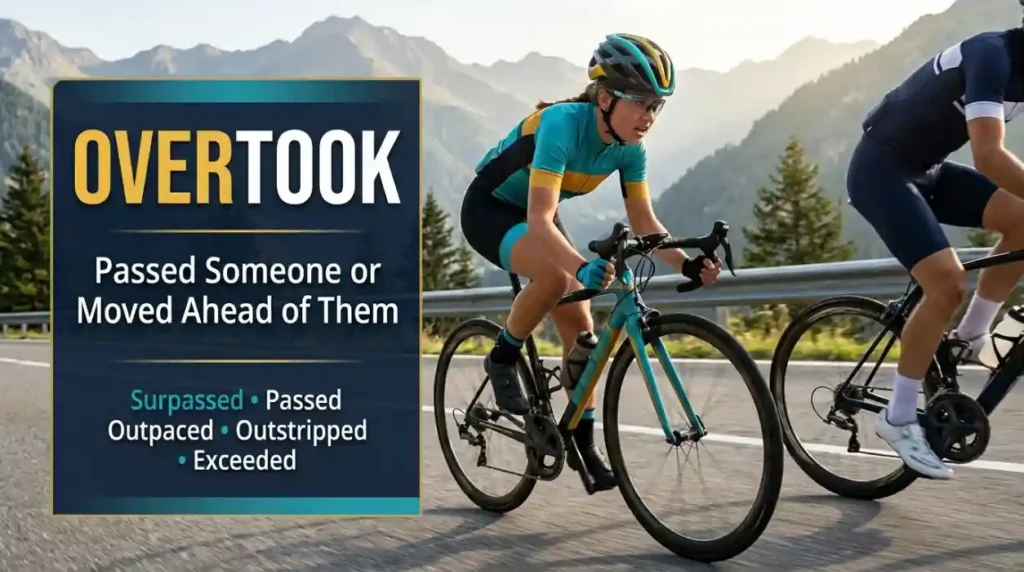
Synonyms for overtook include passed, surpassed, outpaced, exceeded, outperformed, or moved ahead of. These words describe moving past someone, gaining a lead, or outperforming a competitor. The best alternative depends on the context. Use passed for physical movement, surpassed for achievements, and outpaced for faster progress.
A synonym for overtook is a word or phrase that describes passing someone or something, moving ahead of a competitor, or catching up with and surpassing another person or thing. Common alternatives include passed, surpassed, outpaced, exceeded, caught up with, and moved ahead of. The best choice depends on the context.
Imagine a runner passing the person in front during the final seconds of a race. You could say the runner overtook the competitor. You could also use passed or surpassed, depending on the intended meaning.
The synonym for overtook appears in sports, business, travel, education, and everyday conversations. It describes physical movement as well as changes in rankings, performance, and progress.
Learning a synonym for overtook helps students improve essays, bloggers create engaging stories, content writers avoid repetition, and everyday English users express ideas more naturally.
What Does “Overtook” Really Mean?
Overtook is the simple past tense of the verb overtake. It means passed someone or something that was ahead, caught up with another person or thing, or moved ahead in a competition, ranking, or level of achievement.
The word has several common uses:
- Physical movement: A car passed another vehicle on the road.
- Competition: One runner moved ahead of another runner.
- Business: One company exceeded a competitor’s sales.
- Progress: A student moved ahead of classmates in performance.
- Sudden experiences: Fear or exhaustion overwhelmed someone.
Native English speakers understand overtook through context. In a race, it usually means passing a competitor. In business, it often describes becoming more successful or taking the lead.
Part of Speech
Overtook is a verb, specifically the simple past tense of overtake. Its past participle is overtaken.
- Present: The cyclist overtakes the rider.
- Past: The cyclist overtook the rider.
- Past participle: The cyclist has overtaken the rider.
Connotative Meaning
(Connotation means the emotional feeling or association a word carries beyond its basic definition.)
- Positive tone: It can suggest achievement, progress, or winning.
- Negative tone: It can describe a frightening situation, such as being overtaken by panic.
- Neutral tone: It can simply describe one vehicle passing another.
Etymology of Overtook
The verb overtake developed from the combination of over and take. The word reflects the idea of reaching beyond, catching up with, or passing someone or something.
- Old English (450–1100): The elements ofer and tacan have historical connections to the word’s development, although the modern compound should not be treated as a fully established Old English form.
- Middle English (1100–1500): Related forms developed as English adopted and adapted vocabulary through contact with other languages.
- Modern English (1500–present): Overtake became established for passing, catching up with, and surpassing. Its figurative uses expanded into business, competition, and emotional experiences.
Pronunciation, Syllables, and Word Structure
- US pronunciation: /ˌoʊvərˈtʊk/
- UK pronunciation: /ˌəʊvəˈtʊk/
- Syllables: o-ver-took
- Root: take
- Prefix: over-
- Suffix: None in overtook
The prefix over- contributes the idea of going beyond or moving ahead. The form took is the irregular past-tense form of take. Therefore, overtook does not follow the regular pattern of adding -ed.
Synonyms List
The following alternatives cover the main meanings of overtook: passing someone, gaining an advantage, exceeding a competitor, moving ahead, and becoming overwhelmed by an experience. Some are interchangeable only in specific contexts, so check the meaning and tone before using them.
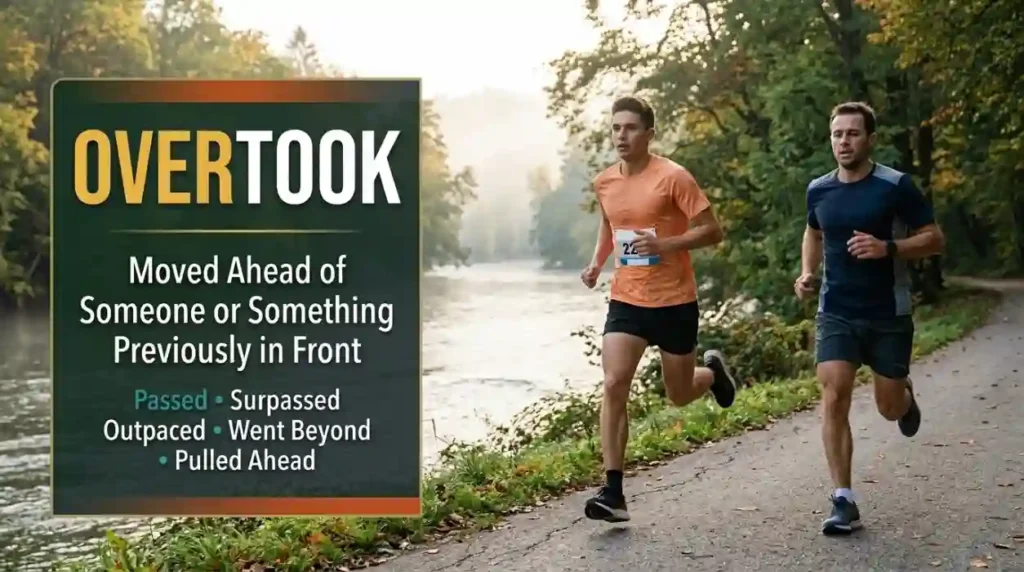
1. Passed (Verb) — US: /pæst/ | UK: /pɑːst/
Meaning: Moved ahead of someone or something that was previously in front.
Tone/Register: Neutral; everyday English.
Examples:
- The blue car passed the truck near the bridge.
- Maya passed two runners before reaching the finish line.
2. Surpassed (Verb) — US: /sərˈpæst/ | UK: /səˈpɑːst/
Meaning: Became greater, better, or more successful than another person or thing.
Tone/Register: Formal; academic; business.
Examples:
- Our latest sales figures surpassed last year’s results.
- Her performance surpassed everyone’s expectations.
3. Outpaced (Verb) — US: /ˌaʊtˈpeɪst/ | UK: /ˌaʊtˈpeɪst/
Meaning: Progressed or moved faster than a competitor.
Tone/Register: Neutral; business; sports.
Examples:
- The small company outpaced its larger rivals.
- Daniel outpaced the other cyclists on the final hill.
4. Outstripped (Verb) — US: /ˌaʊtˈstrɪpt/ | UK: /ˌaʊtˈstrɪpt/
Meaning: Exceeded another person or thing in growth, speed, demand, or performance.
Tone/Register: Formal; business; analytical.
Examples:
- Demand for electric cars outstripped supply.
- The team’s improvement outstripped the coach’s expectations.
5. Exceeded (Verb) — US: /ɪkˈsiːdɪd/ | UK: /ɪkˈsiːdɪd/
Meaning: Went beyond a limit, amount, standard, or expected level.
Tone/Register: Formal; professional; academic.
Examples:
- Attendance exceeded the organizers’ original estimate.
- Her final score exceeded the class average.
6. Overtaken (Verb) — US: /ˌoʊvərˈteɪkən/ | UK: /ˌəʊvəˈteɪkən/
Meaning: Passed or moved ahead of someone, or gained control of a situation; it is the past participle of overtake.
Tone/Register: Neutral; formal or informal.
Examples:
- The defending champion has been overtaken by a younger athlete.
- He was overtaken by worry before the interview.
7. Outdone (Verb) — US: /ˌaʊtˈdʌn/ | UK: /ˌaʊtˈdʌn/
Meaning: Performed better than someone else or achieved a greater result.
Tone/Register: Neutral; conversational.
Examples:
- Priya outdid her previous record in the competition.
- The new restaurant outdid its rivals with better service.
8. Beat (Verb) — US: /biːt/ | UK: /biːt/
Meaning: Defeated a competitor or achieved a better result than someone else.
Tone/Register: Informal; everyday English; sports.
Examples:
- Our school team beat the defending champions.
- The new phone beat its competitors in battery life.
9. Edged Past (Verb Phrase) — US: /ɛdʒd pæst/ | UK: /ɛdʒd pɑːst/
Meaning: Moved slightly ahead of a competitor, often by a small margin.
Tone/Register: Neutral; sports journalism.
Examples:
- The runner edged past his rival in the final seconds.
- The candidate edged past her opponent in the vote count.
10. Pulled Ahead (Verb Phrase) — US: /pʊld əˈhɛd/ | UK: /pʊld əˈhɛd/
Meaning: Gained a lead after being level with or behind others.
Tone/Register: Neutral; conversational; sports.
Examples:
- The red car pulled ahead on the straight road.
- Our team pulled ahead after scoring twice.
11. Moved Ahead (Verb Phrase) — US: /muːvd əˈhɛd/ | UK: /muːvd əˈhɛd/
Meaning: Progressed to a position in front of others or advanced in a process.
Tone/Register: Neutral; professional.
Examples:
- The project moved ahead after the manager approved the plan.
- She moved ahead of the other candidates in the rankings.
12. Got Ahead (Verb Phrase) — US: /ɡɑːt əˈhɛd/ | UK: /ɡɒt əˈhɛd/
Meaning: Reached a more advanced or successful position than someone else.
Tone/Register: Informal; conversational.
Examples:
- Liam got ahead by practicing every evening.
- The startup got ahead of its competitors through faster delivery.
13. Took the Lead (Verb Phrase) — US: /tʊk ðə liːd/ | UK: /tʊk ðə liːd/
Meaning: Became the person or team in the leading position.
Tone/Register: Neutral; sports; business.
Examples:
- Our team took the lead just before halftime.
- The company took the lead in online sales.
14. Forged Ahead (Verb Phrase) — US: /fɔːrdʒd əˈhɛd/ | UK: /fɔːdʒd əˈhɛd/
Meaning: Continued progressing with determination, often despite difficulties.
Tone/Register: Formal; motivational; literary.
Examples:
- Despite early setbacks, the research team forged ahead.
- She forged ahead while others waited for instructions.
15. Advanced Past (Verb Phrase) — US: /ədˈvænst pæst/ | UK: /ədˈvɑːnst pɑːst/
Meaning: Progressed beyond another person or obstacle in a particular process.
Tone/Register: Neutral; formal.
Examples:
- The candidate advanced past the first interview stage.
- The cyclist advanced past two competitors near the summit.
16. Went Beyond (Verb Phrase) — US: /wɛnt bɪˈjɑːnd/ | UK: /went bɪˈjɒnd/
Meaning: Exceeded a boundary, expectation, or previous level.
Tone/Register: Neutral; professional; academic.
Examples:
- The results went beyond our original forecast.
- Her dedication went beyond what the role required.
17. Left Behind (Verb Phrase) — US: /lɛft bɪˈhaɪnd/ | UK: /left bɪˈhaɪnd/
Meaning: Progressed so far ahead that another person or thing could no longer keep up.
Tone/Register: Neutral; informal; sometimes negative.
Examples:
- The leading runner left the rest of the group behind.
- New technology left several outdated systems behind.
18. Pulled Away (Verb Phrase) — US: /pʊld əˈweɪ/ | UK: /pʊld əˈweɪ/
Meaning: Increased a lead or created more distance between oneself and a competitor.
Tone/Register: Neutral; sports; conversational.
Examples:
- The champion pulled away during the final lap.
- Our team pulled away after a strong second half.
19. Outshone (Verb) — US: /ˌaʊtˈʃoʊn/ | UK: /ˌaʊtˈʃəʊn/
Meaning: Attracted more attention or performed more impressively than another person or thing.
Tone/Register: Neutral; expressive; literary.
Examples:
- Her confident presentation outshone the other speeches.
- The young actor outshone several established performers.
20. Eclipsed (Verb) — US: /ɪˈklɪpst/ | UK: /ɪˈklɪpst/
Meaning: Became more impressive, important, or noticeable than someone or something else.
Tone/Register: Formal; literary; journalistic.
Examples:
- The sequel eclipsed the original film’s popularity.
- His latest achievement eclipsed all his previous records.
21. Outperformed (Verb) — US: /ˌaʊtpərˈfɔːrmd/ | UK: /ˌaʊtpəˈfɔːmd/
Meaning: Produced better results or performed more effectively than another person or group.
Tone/Register: Professional; academic; business.
Examples:
- The new sales team outperformed its quarterly target.
- This model outperformed the older version in testing.
22. Excelled (Verb) — US: /ɪkˈsɛld/ | UK: /ɪkˈseld/
Meaning: Performed exceptionally well in a particular activity or field.
Tone/Register: Positive; academic; professional.
Examples:
- Amira excelled in mathematics throughout the semester.
- The company excelled at helping first-time customers.
23. Outranked (Verb) — US: /ˌaʊtˈræŋkt/ | UK: /ˌaʊtˈræŋkt/
Meaning: Held a higher position or ranking than another person or organization.
Tone/Register: Formal; professional; military.
Examples:
- The university outranked its rivals in the latest assessment.
- She outranked the other applicants after the final evaluation.
24. Outgrew (Verb) — US: /ˌaʊtˈɡruː/ | UK: /ˌaʊtˈɡruː/
Meaning: Grew beyond a previous size, stage, capacity, or level of suitability.
Tone/Register: Neutral; conversational.
Examples:
- The business outgrew its original office within two years.
- He outgrew the beginner course and joined the advanced class.
25. Overtook in Popularity (Verb Phrase) — US: /ˌoʊvərˈtʊk ɪn ˌpɑːpjəˈlærəti/ | UK: /ˌəʊvəˈtʊk ɪn ˌpɒpjəˈlærəti/
Meaning: Became more popular than a person, product, or trend.
Tone/Register: Neutral; media; business.
Examples:
- The new series overtook its predecessor in popularity.
- Short videos overtook longer clips in popularity among her followers.
26. Took Over (Verb Phrase) — US: /tʊk ˈoʊvər/ | UK: /tʊk ˈəʊvə/
Meaning: Gained control or responsibility, rather than simply passing someone.
Tone/Register: Neutral; business; conversational.
Examples:
- Nina took over the department after the director retired.
- The larger company took over its smaller competitor.
27. Usurped (Verb) — US: /juːˈsɜːrpt/ | UK: /juːˈsɜːpt/
Meaning: Took a position, power, or authority from someone, often unfairly or without the right to do so.
Tone/Register: Formal; negative; political.
Examples:
- The ambitious official usurped the leader’s authority.
- The new ruler usurped the throne without legal approval.
28. Displaced (Verb) — US: /dɪsˈpleɪst/ | UK: /dɪsˈpleɪst/
Meaning: Replaced someone or something in a role, position, or established place.
Tone/Register: Formal; business; social analysis.
Examples:
- Digital cameras displaced many traditional film cameras.
- The new manager displaced the interim team leader.
29. Replaced (Verb) — US: /rɪˈpleɪst/ | UK: /rɪˈpleɪst/
Meaning: Took the place of a person or thing, whether or not it was better.
Tone/Register: Neutral; everyday English.
Examples:
- The updated software replaced the older system.
- A younger player replaced the injured striker.
30. Superseded (Verb) — US: /ˌsuːpərˈsiːdɪd/ | UK: /ˌsuːpəˈsiːdɪd/
Meaning: Replaced something because a newer version or approach became more useful or authoritative.
Tone/Register: Formal; technical; professional.
Examples:
- The revised policy superseded the previous guidelines.
- Modern equipment superseded the outdated machinery.
31. Gained On (Verb Phrase) — US: /ɡeɪnd ɑːn/ | UK: /ɡeɪnd ɒn/
Meaning: Reduced the distance or difference between oneself and someone ahead.
Tone/Register: Neutral; sports; conversational.
Examples:
- The second runner gained on the leader near the finish.
- Our competitor gained on us during the final quarter.
32. Caught Up With (Verb Phrase) — US: /kɔːt ʌp wɪð/ | UK: /kɔːt ʌp wɪð/
Meaning: Reached someone who had previously been ahead; it does not necessarily mean passing them.
Tone/Register: Neutral; everyday English.
Examples:
- I walked faster until I caught up with my friends.
- The smaller firm caught up with its rival in annual sales.
33. Closed the Gap (Verb Phrase) — US: /kloʊzd ðə ɡæp/ | UK: /kləʊzd ðə ɡæp/
Meaning: Reduced the difference between two people, teams, or results.
Tone/Register: Neutral; analytical; business.
Examples:
- The visiting team closed the gap in the second half.
- Our latest results closed the gap with the market leader.
34. Pulled Level (Verb Phrase) — US: /pʊld ˈlɛvəl/ | UK: /pʊld ˈlevəl/
Meaning: Reached the same score or position as a competitor.
Tone/Register: Neutral; especially common in British sports reporting.
Examples:
- The home side pulled level with a late goal.
- She pulled level with the leader in the final round.
35. Drew Level (Verb Phrase) — US: /druː ˈlɛvəl/ | UK: /druː ˈlevəl/
Meaning: Reached an equal position or score with another competitor.
Tone/Register: Neutral; British English; sports.
Examples:
- The visitors drew level just before the break.
- The two candidates drew level in the latest poll.
36. Beat to the Punch (Idiom) — US: /biːt tə ðə pʌntʃ/ | UK: /biːt tə ðə pʌntʃ/
Meaning: Acted before another person could do the same thing.
Tone/Register: Informal; conversational; business.
Examples:
- We beat our competitor to the punch by launching first.
- She beat me to the punch and asked the question.
37. Got the Upper Hand (Idiom) — US: /ɡɑːt ði ˌʌpər ˈhænd/ | UK: /ɡɒt ði ˌʌpə ˈhænd/
Meaning: Gained an advantage or greater control over another person or situation.
Tone/Register: Neutral; strategic; conversational.
Examples:
- The home team got the upper hand after halftime.
- The negotiator got the upper hand by preparing carefully.
38. Left in the Dust (Idiom) — US: /lɛft ɪn ðə dʌst/ | UK: /left ɪn ðə dʌst/
Meaning: Moved far ahead of competitors or progressed much faster than they did.
Tone/Register: Informal; vivid; sometimes boastful.
Examples:
- The champion left the other runners in the dust.
- The innovative startup left several older brands in the dust.
39. Pulled Clear (Verb Phrase) — US: /pʊld klɪr/ | UK: /pʊld klɪə/
Meaning: Established a clear lead or distance over competitors.
Tone/Register: Neutral; sports; journalism.
Examples:
- The cyclist pulled clear on the steep climb.
- The market leader pulled clear after a successful launch.
40. Broke Away (Verb Phrase) — US: /broʊk əˈweɪ/ | UK: /brəʊk əˈweɪ/
Meaning: Separated from a group or competitors and moved ahead.
Tone/Register: Neutral; sports; storytelling.
Examples:
- One runner broke away from the pack at the halfway point.
- The leading horse broke away from the others.

41. Left in One’s Wake (Idiom) — US: /lɛft ɪn wʌnz weɪk/ | UK: /left ɪn wʌnz weɪk/
Meaning: Advanced while leaving others behind, sometimes with major effects or consequences.
Tone/Register: Literary; journalistic; figurative.
Examples:
- The fast-growing business left several competitors in its wake.
- The storm left damaged roads in its wake.
42. Ran Past (Verb Phrase) — US: /ræn pæst/ | UK: /ræn pɑːst/
Meaning: Ran by someone or something and moved beyond its position.
Tone/Register: Neutral; everyday English.
Examples:
- The child ran past me to greet his father.
- She ran past two competitors near the finish line.
43. Drove Past (Verb Phrase) — US: /droʊv pæst/ | UK: /drəʊv pɑːst/
Meaning: Traveled by a person or vehicle in a car or another motor vehicle.
Tone/Register: Neutral; everyday English.
Examples:
- We drove past the old school on our way home.
- The driver drove past the slower truck safely.
44. Raced Past (Verb Phrase) — US: /reɪst pæst/ | UK: /reɪst pɑːst/
Meaning: Moved quickly past someone or something, often in a competitive situation.
Tone/Register: Neutral; vivid; sports.
Examples:
- The cyclist raced past the final checkpoint.
- A young runner raced past the group near the finish.
45. Went Past (Verb Phrase) — US: /wɛnt pæst/ | UK: /went pɑːst/
Meaning: Moved beyond a person, place, or point without necessarily gaining a competitive advantage.
Tone/Register: Neutral; conversational.
Examples:
- The bus went past our stop before I noticed.
- He went past the other runner during the last lap.
46. Swept Past (Verb Phrase) — US: /swɛpt pæst/ | UK: /swept pɑːst/
Meaning: Moved past someone or something swiftly and confidently.
Tone/Register: Vivid; literary; journalistic.
Examples:
- The racing car swept past its rival on the straight.
- She swept past the reporters without stopping.
47. Rushed Past (Verb Phrase) — US: /rʌʃt pæst/ | UK: /rʌʃt pɑːst/
Meaning: Moved quickly past someone or something, usually in a hurry.
Tone/Register: Informal; everyday English.
Examples:
- He rushed past us to catch the departing train.
- Several students rushed past the classroom door.
48. Was Ahead of (Verb Phrase) — US: /wəz əˈhɛd əv/ | UK: /wəz əˈhed əv/
Meaning: Held a leading position or had progressed further than another person or thing.
Tone/Register: Neutral; everyday and professional English.
Examples:
- Our team led its closest rival by five points.
- She was ahead of schedule by the end of the week.
49. Advanced Beyond (Verb Phrase) — US: /ədˈvænst bɪˈjɑːnd/ | UK: /ədˈvɑːnst bɪˈjɒnd/
Meaning: Progressed beyond a previous stage, level, or point.
Tone/Register: Formal; academic; professional.
Examples:
- The research advanced beyond its original scope.
- He advanced beyond the preliminary stage of the competition.
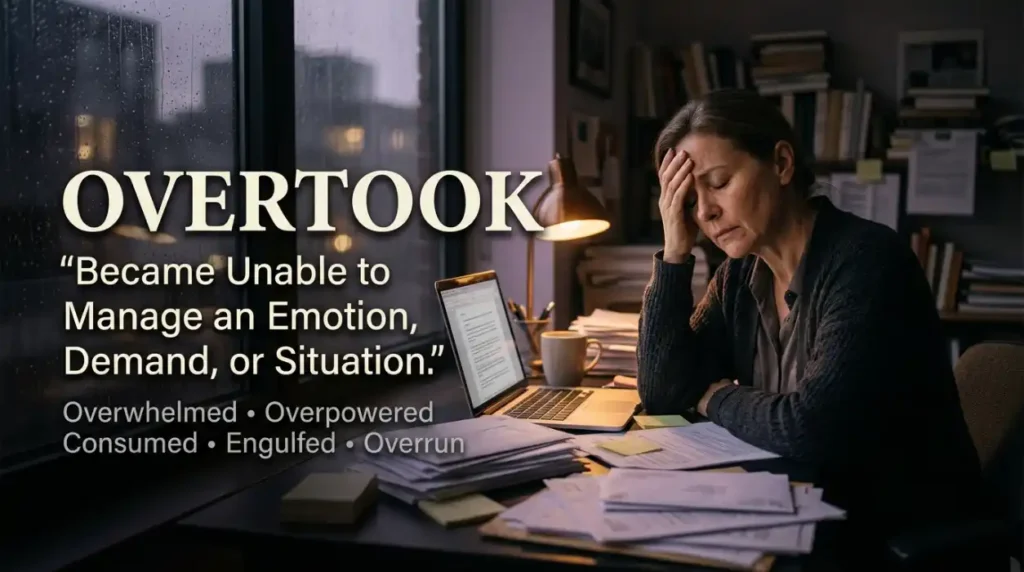
50. Overwhelmed (Verb) — US: /ˌoʊvərˈwɛlmd/ | UK: /ˌəʊvəˈwelmd/
Meaning: Became unable to manage an emotion, demand, or situation; this matches overtook when describing feelings rather than physical movement.
Tone/Register: Neutral; emotional; descriptive.
Examples:
- A sudden wave of relief overwhelmed her after the results arrived.
- Panic overwhelmed the speaker when the lights went out.
Synonyms by Tone
The best alternative depends on the impression you want to create.
Positive Synonyms
Use these when highlighting success, progress, or achievement.
- Surpassed
- Outperformed
- Excelled
- Outdid
- Forged ahead
- Took the lead
- Pulled ahead
Neutral Synonyms
These describe movement, ranking, or progress without a strong emotional judgment.
- Passed
- Outpaced
- Exceeded
- Moved ahead
- Caught up with
- Gained on
- Closed the gap
- Drew level
- Went past
- Advanced beyond
Negative Synonyms
These may imply unfair control, replacement, or an unpleasant experience.
- Usurped
- Displaced
- Left behind
- Superseded
- Overwhelmed
- Eclipsed
Playful or Informal Alternatives
These fit relaxed conversation, sports commentary, or lively storytelling.
- Beat
- Got ahead
- Beat to the punch
- Left in the dust
- Pulled away
- Raced past
- Swept past
Tone matters because the wrong word can change how readers interpret an event. For example, surpassed sounds like an achievement, while usurped suggests taking power improperly.
“Overtook” vs. Close Alternatives
Some words look interchangeable but express different ideas. This comparison helps you select the most accurate alternative.
| Word | Main difference | Best use |
|---|---|---|
| Passed | Moved physically beyond someone or something | Traffic, races, walking |
| Surpassed | Became better or greater than another | Results, achievements, expectations |
| Outpaced | Progressed faster than a competitor | Business, sports, technology |
| Exceeded | Went beyond a limit or measurement | Targets, budgets, scores |
| Caught up with | Reached someone who was ahead | Progress, movement, conversations |
| Overwhelmed | Became unable to manage a feeling or situation | Fear, panic, emotions |
Quick tip: Use passed for movement, surpassed for achievement, outpaced for faster progress, and overwhelmed when an emotion takes control.
How “Overtook” Changes by Context
Daily Conversation
In everyday speech, passed, beat, got ahead of, and caught up with are easy to understand.
For example, “I passed the bus near the station” describes movement. “Our team beat theirs” describes a competition.
Writing and Blogging
Writers can use surpassed, outpaced, eclipsed, and outperformed to make comparisons more precise.
Instead of repeating “the company overtook its rival,” you might write, “The company outpaced its rival in sales growth.” This version identifies the type of advantage.
Professional and Academic English
In reports, research papers, and business documents, exceeded, surpassed, outstripped, and superseded often fit better.
Choose the word that matches the evidence. Use exceeded for a numerical target and surpassed for a broader achievement.
Creative and Informal Writing
Storytellers can use swept past, raced past, pulled away, and left in the dust to create movement and excitement.
For emotional scenes, overwhelmed can express how fear, sadness, or relief suddenly affected a character.
Common Mistakes Learners Make
1. Using every synonym in every situation
“Fear surpassed him” does not normally express the same idea as “Fear overtook him.” The more natural choice is “Fear overwhelmed him” or “Fear overtook him.”
2. Confusing catching up with passing
If a runner catches up with another runner, they reach the same position. They have not necessarily moved ahead. Use passed or overtook when the runner actually moves in front.
3. Confusing physical movement with achievement
“Surpassed the truck” sounds unnatural in ordinary driving situations. Use “passed the truck.” Save surpassed for performance, achievements, or measurable comparisons.
4. Using formal words in casual conversations
“Outstripped my friend while walking” sounds overly formal. “Walked past my friend” is clearer and more natural.
5. Forgetting irregular verb forms
The correct forms are overtake, overtook, and overtaken. Avoid forms such as “overtaked” or “has overtook.”
Native Usage and Register Notes
- Formal writing: surpassed, exceeded, outstripped, superseded.
- Everyday speech: passed, beat, got ahead, caught up with.
- Sports reporting: edged past, pulled clear, drew level.
- Emotional descriptions: overwhelmed, overtaken by fear, overcome by panic.
For more vocabulary practice, you can explore related synonym articles on your website, SynonymsCloud, and compare how similar words change meaning in different contexts.
Real-Life Mini Scenarios Using Overtook
Workplace
A small business overtook a larger competitor in online sales. You could also write that it surpassed the competitor or outpaced its growth.
Social situations
One friend walked faster and overtook the other. In a casual conversation, passed sounds natural and straightforward.
Media and pop culture
A new series overtook an older show in popularity. A writer could say the new series eclipsed its predecessor.
Writing and storytelling
Fear overtook a character before a difficult decision. A more emotionally intense version could say that panic overwhelmed the character.
Practice Exercise
1. A car moves in front of another car on the highway. Which word fits best?
A. Surpassed
B. Passed
C. Usurped
2. A company achieves better results than its rival. Which word is most suitable?
A. Surpassed
B. Rushed past
C. Caught up with
3. A runner reaches the same position as the leader but has not passed them. What happened?
A. Eclipsed the leader
B. Outdid the leader
C. Caught up with the leader
4. Demand becomes greater than the available supply. Which word fits best?
A. Exceeded
B. Outstripped
C. Drew level
5. Someone takes power unfairly from a rightful leader. Which word is most precise?
A. Usurped
B. Excelled
C. Passed
6. A new product becomes more impressive and noticeable than an older one. Which word works best?
A. Caught up with
B. Eclipsed
C. Pulled level
7. A football team moves from a tied score to a leading position. Which phrase fits best?
A. Drew level
B. Took over
C. Pulled ahead
8. A student performs exceptionally well in science. Which verb is most natural?
A. Excelled
B. Displaced
C. Raced past
9. A sudden feeling becomes so powerful that someone cannot think clearly. Which word fits best?
A. Outpaced
B. Overwhelmed
C. Outranked
10. A newer policy officially replaces an older policy. Which word is most precise?
A. Superseded
B. Beat
C. Went past
Reflection Task
Write two sentences using different synonyms for overtook. In the first, describe a person or vehicle moving ahead.
Answer key:
1. Passed | 2. Surpassed | 3. Caught up with the leader | 4. Outstripped | 5. Usurped | 6. Eclipsed | 7. Pulled ahead | 8. Excelled | 9. Overwhelmed | 10. Superseded
Frequently Asked Questions
1. What is the difference between overtook and overtaken?
Overtook is the simple past tense of overtake, while overtaken is its past participle. For example, “The cyclist overtook the leader yesterday” uses the simple past. “The cyclist has overtaken the leader” uses the present perfect. Choosing the correct form depends on the sentence structure and the time relationship being described.
2. What is a synonym for overtook in a sentence about business?
Surpassed, outpaced, outperformed, and exceeded can work in business writing, depending on the intended meaning. Use surpassed when a company becomes more successful than a rival, outpaced when it grows faster, and exceeded when it goes beyond a specific target. These distinctions help reports sound clear and accurate.
3. What is another word for overtook in a driving context?
Passed is usually the most natural alternative when a vehicle moves ahead of another vehicle. Drove past can also describe the movement, but it does not always emphasize a change in relative position. Always consider road safety and traffic rules when describing overtaking maneuvers in real-world driving situations.
4. Can overtook mean that someone was overcome by emotion?
Yes. Overtook can describe an emotion that suddenly affects someone strongly. For example, “A wave of sadness overtook him” means the sadness came over him intensely. Depending on the sentence, overwhelmed, overcame, or was overcome by may also work. The best alternative depends on whether the emphasis is on suddenness, intensity, or difficulty coping.
5. What is the opposite of overtook?
The opposite depends on the context. For physical movement, fell behind or lagged can express the reverse situation. In a competition, lost the lead may be suitable. For comparisons, was surpassed by expresses the opposite relationship. There is no single antonym that fits every meaning of overtook.
6. Is overtook formal or informal English?
Overtook is standard English and works in formal and informal contexts. It appears in everyday conversation, news reporting, sports commentary, academic writing, and business reports. However, some alternatives suit particular registers better. For instance, passed is common in conversation, while outstripped often appears in analytical or professional writing.
7. Which synonym for overtook is best for academic writing?
Surpassed, exceeded, outperformed, and outpaced are useful in academic writing when their meanings match the evidence. Use exceeded for a threshold or numerical value, outperformed for comparative results, and surpassed for a broader achievement. Avoid selecting a sophisticated word simply to sound formal; accuracy and clarity matter more.
Conclusion
Choosing the right synonym for overtook helps you describe movement, competition, achievement, and emotional experiences with greater precision. The best alternative depends on what happened and how you want readers to understand it.
Words such as passed, surpassed, outpaced, and outperformed improve writing by reducing repetition. They also help bloggers, students, and content writers communicate ideas in a more natural and engaging way.
Regular practice builds confidence in speaking and writing. Try using these alternatives in emails, essays, short stories, and daily conversations to understand their subtle differences.
Keep exploring new vocabulary, test yourself with the quiz, and create your own sentences. Small steps in vocabulary practice can lead to clearer communication and stronger English skills.
External Link Resources
For reliable definitions, pronunciation guides, and additional usage examples, consult these established dictionaries:
- Cambridge Dictionary Overtook
- Merriam-Webster Overtook
- Oxford Learner’s Dictionaries

Jameel Hassan is the founder and lead writer at SynonymsCloud.com, a trusted online platform dedicated to English vocabulary and effective communication. He is passionate about helping students, writers, professionals, and lifelong learners discover the right words to express their ideas with clarity, precision, and confidence.
At SynonymsCloud.com, every article is thoroughly researched and carefully written to provide accurate, practical, and easy-to-understand guidance on synonyms, antonyms, word meanings, idioms, and vocabulary. With a strong commitment to quality, real-world usage, and clear explanations, the website helps readers expand their vocabulary, improve their writing, and communicate more effectively in both academic and professional settings.