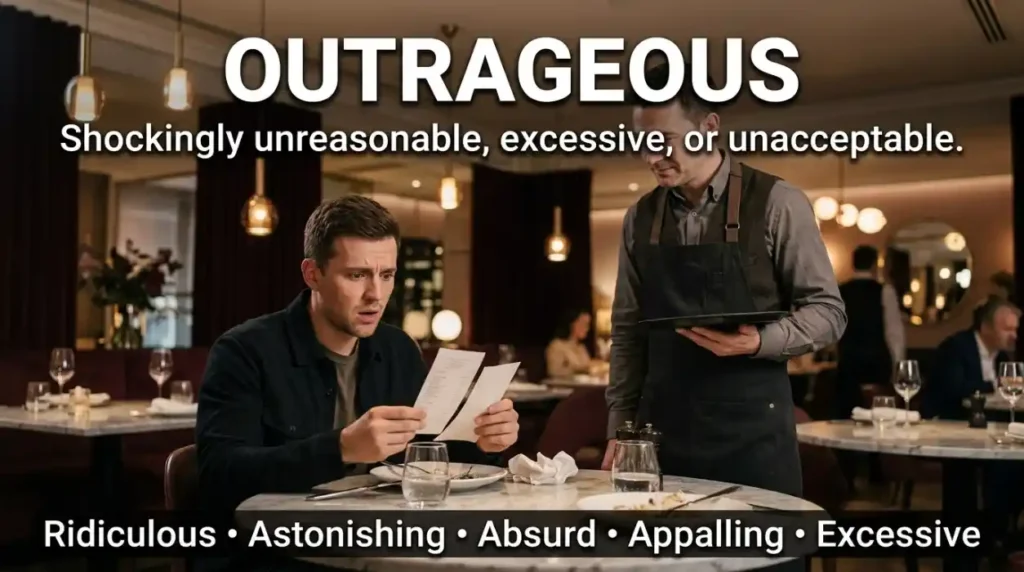
A synonym for outrageous is a word that describes something shocking, extreme, unreasonable, or unacceptable. Common alternatives include shocking, absurd, appalling, ridiculous, scandalous, and unbelievable. The best choice depends on whether you are describing an unfair price, offensive behavior, or an astonishing event.
Imagine receiving a bill that is far higher than expected. You might call the price outrageous. If someone makes a cruel remark, however, appalling or offensive may express your reaction more accurately.
Finding a synonym for outrageous can help you express strong reactions with greater accuracy. Students can improve their essays, while bloggers and content writers can describe events without repeating the same words.
People often use outrageous to describe unfair decisions, shocking news, extreme demands, and behavior that crosses social boundaries. Learning suitable alternatives helps you communicate your exact meaning and choose words that match each situation.
Whether you write articles, prepare assignments, or speak English every day, the right synonym for outrageous makes your message more precise and engaging. Explore these 50 alternatives to discover their meanings, understand their differences, and expand your vocabulary.
What Does “Outrageous” Really Mean?
Outrageous is an adjective that describes something extremely shocking, unreasonable, offensive, or beyond accepted limits. It often expresses a strong reaction to a situation, action, statement, price, or demand.
Native English speakers commonly use this word when something seems far outside what is normal or acceptable. An outrageous price may seem unfairly high. An outrageous claim may sound unbelievable. Outrageous behavior may appear rude or deliberately offensive.
The word is usually negative, but it can also be playful or admiring. An outrageous costume, for example, may be bold and entertaining rather than offensive. The surrounding context tells readers how to understand it.
Connotative Meaning
(Connotation means the feelings, attitudes, or associations a word creates beyond its basic dictionary meaning.)
- Positive tone: In playful contexts, outrageous can describe daring fashion, bold creativity, or entertaining humor.
- Negative tone: It often communicates anger, shock, disapproval, or a belief that something is unfair.
- Neutral tone: In descriptive writing, it may simply identify something unusually extreme, while the speaker’s personal attitude remains unclear.
Etymology of “Outrageous”
Outrageous developed from outrage, which entered English through Anglo-French and Old French forms associated with excess, violence, and conduct that violated accepted limits. The suffix -ous turns the base into an adjective meaning “characterized by” or “full of.”
- Old English (450–1100): The modern word outrageous was not established in Old English. Speakers used other words to express excess, offense, and extreme behavior.
- Middle English (1100–1500): Related forms of outrage entered English through French influence. The word was associated with excessive conduct, injury, or a serious offense.
- Modern English (1500–present): Outrageous developed into a broad adjective for shocking, excessive, unreasonable, or offensive things. It can also describe something daring or amusingly extreme.
Pronunciation and Word Structure
- US pronunciation: /aʊtˈreɪdʒəs/
- UK pronunciation: /aʊtˈreɪdʒəs/
- Syllables: out-ra-geous
- Part of speech: Adjective
Affixation pattern
- Root/base: outrage
- Prefix: None
- Suffix: -ous, which forms an adjective
Examples: “That fee is outrageous.” “His outrageous remark shocked the room.”
Synonyms List
These alternatives cover different shades of outrageous, from shocking and offensive to absurd, excessive, and playfully extreme. Each word has a distinct meaning, so choose one that fits the situation.
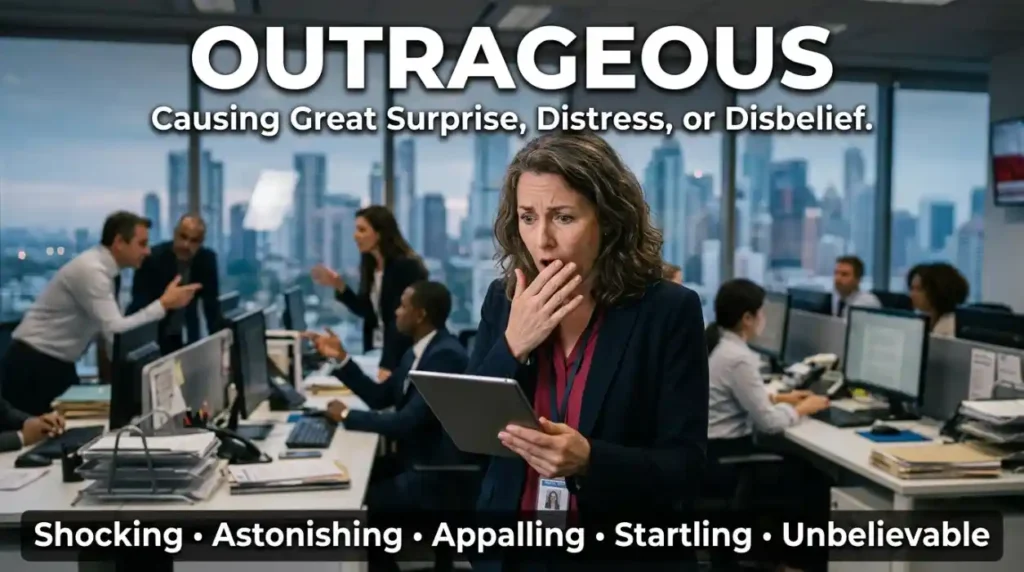
1. Shocking (Adjective) — US / UK: /ˈʃɑːkɪŋ/ / /ˈʃɒkɪŋ/
Meaning: Causing great surprise, distress, or disbelief.
Tone/Register: Neutral to negative; common in conversation and journalism.
Examples:
The announcement about the sudden closure was shocking.
She shared a shocking detail about the investigation.
2. Appalling (Adjective) — US / UK: /əˈpɔːlɪŋ/ / /əˈpɔːlɪŋ/
Meaning: Extremely bad, disturbing, or unacceptable.
Tone/Register: Strongly negative; suitable for formal and informal English.
Examples:
The patients received appalling treatment at the clinic.
The report revealed appalling working conditions.
3. Absurd (Adjective) — US / UK: /əbˈsɝːd/ / /əbˈsɜːd/
Meaning: So unreasonable or illogical that it seems ridiculous.
Tone/Register: Critical; common in discussion, essays, and debate.
Examples:
It is absurd to blame one person for the entire problem.
His absurd explanation made the situation even more confusing.
4. Ridiculous (Adjective) — US / UK: /rɪˈdɪkjələs/ / /rɪˈdɪkjələs/
Meaning: So silly, unreasonable, or extreme that it invites criticism or laughter.
Tone/Register: Informal to neutral; widely used in everyday English.
Examples:
The airline charged a ridiculous amount for one suitcase.
That ridiculous rumor spread throughout the school.
5. Scandalous (Adjective) — US / UK: /ˈskændələs/ / /ˈskændələs/
Meaning: Causing public outrage because something seems immoral or disgraceful.
Tone/Register: Strongly negative; common in news and social commentary.
Examples:
The investigation uncovered a scandalous misuse of public money.
Their scandalous behavior became the main topic at work.
6. Unbelievable (Adjective) — US / UK: /ˌʌnbɪˈliːvəbəl/ / /ˌʌnbɪˈliːvəbəl/
Meaning: So surprising or extreme that it is difficult to believe.
Tone/Register: Neutral; can express amazement, criticism, or praise.
Examples:
The ticket price was unbelievable for such a short journey.
She made an unbelievable recovery after the accident.
7. Astonishing (Adjective) — US / UK: /əˈstɑːnɪʃɪŋ/ / /əˈstɒnɪʃɪŋ/
Meaning: Causing great surprise because something is unexpected or remarkable.
Tone/Register: Neutral to positive; useful in storytelling and reports.
Examples:
The athlete achieved an astonishing result in the final round.
His astonishing demand left the team speechless.
8. Extraordinary (Adjective) — US / UK: /ɪkˈstrɔːrdəneri/ / /ɪkˈstrɔːdənri/
Meaning: Far beyond what is usual or expected.
Tone/Register: Neutral to positive; suitable for formal and informal use.
Examples:
The company made an extraordinary request at the last minute.
Her extraordinary talent impressed the judges.
9. Excessive (Adjective) — US / UK: /ɪkˈsesɪv/ / /ɪkˈsesɪv/
Meaning: Greater in amount, degree, or intensity than is reasonable or necessary.
Tone/Register: Formal to neutral; common in professional writing.
Examples:
The landlord demanded an excessive security deposit.
Excessive spending left the family with little savings.
10. Unreasonable (Adjective) — US / UK: /ʌnˈriːzənəbəl/ / /ʌnˈriːzənəbəl/
Meaning: Not fair, sensible, or appropriate in a particular situation.
Tone/Register: Neutral to negative; useful in workplace discussions.
Examples:
Asking employees to work all night was unreasonable.
The customer made an unreasonable demand for a refund.
11. Offensive (Adjective) — US / UK: /əˈfensɪv/ / /əˈfensɪv/
Meaning: Causing hurt, anger, or resentment through disrespectful words or actions.
Tone/Register: Negative; common in social and professional contexts.
Examples:
His offensive joke upset several people at dinner.
The advertisement included offensive language.
12. Infuriating (Adjective) — US / UK: /ɪnˈfjʊriˌeɪtɪŋ/ / /ɪnˈfjʊəriˌeɪtɪŋ/
Meaning: Making someone extremely angry or frustrated.
Tone/Register: Strongly negative; common in everyday speech.
Examples:
The website kept deleting her work, which was infuriating.
His infuriating habit of interrupting made meetings difficult.
13. Outlandish (Adjective) — US / UK: /aʊtˈlændɪʃ/ / /aʊtˈlændɪʃ/
Meaning: Extremely unusual, strange, or far from what people expect.
Tone/Register: Informal to neutral; often playful or descriptive.
Examples:
He arrived at the party in an outlandish silver suit.
The proposal included several outlandish ideas.
14. Preposterous (Adjective) — US / UK: /prɪˈpɑːstərəs/ / /prɪˈpɒstərəs/
Meaning: So unreasonable or illogical that it is hard to take seriously.
Tone/Register: Emphatic; useful in arguments and commentary.
Examples:
The claim that nobody needed a break was preposterous.
She rejected the preposterous accusation immediately.
15. Inexcusable (Adjective) — US / UK: /ˌɪnɪkˈskjuːzəbəl/ / /ˌɪnɪkˈskjuːzəbəl/
Meaning: So wrong or unacceptable that no reasonable excuse can justify it.
Tone/Register: Strongly negative; suitable for serious situations.
Examples:
Leaving the young children alone was inexcusable.
The manager called the repeated safety violations inexcusable.
16. Disgraceful (Adjective) — US / UK: /dɪsˈɡreɪsfəl/ / /dɪsˈɡreɪsfəl/
Meaning: Deserving strong disapproval because of shameful or unacceptable conduct.
Tone/Register: Strongly negative; common in criticism and formal statements.
Examples:
The players showed disgraceful behavior toward the referee.
The report described a disgraceful failure to protect residents.
17. Egregious (Adjective) — US / UK: /ɪˈɡriːdʒəs/ / /ɪˈɡriːdʒəs/
Meaning: Remarkably bad or offensive, especially in a serious way.
Tone/Register: Formal; common in legal, academic, and professional writing.
Examples:
The audit identified an egregious accounting error.
The official was criticized for an egregious abuse of power.
18. Startling (Adjective) — US / UK: /ˈstɑːrtlɪŋ/ / /ˈstɑːtlɪŋ/
Meaning: Causing sudden surprise or alarm.
Tone/Register: Neutral; useful in reports and storytelling.
Examples:
The report revealed a startling increase in complaints.
A startling noise came from the empty hallway.
19. Flagrant (Adjective) — US / UK: /ˈfleɪɡrənt/ / /ˈfleɪɡrənt/
Meaning: Obviously and seriously wrong, especially when rules are deliberately ignored.
Tone/Register: Formal; common in legal and public criticism.
Examples:
The referee penalized the player for a flagrant foul.
The committee condemned the flagrant disregard for safety rules.
20. Heinous (Adjective) — US / UK: /ˈheɪnəs/ / /ˈheɪnəs/
Meaning: Extremely wicked or morally shocking, especially when describing serious crimes.
Tone/Register: Very strong and formal; reserved for severe wrongdoing.
Examples:
The judge condemned the heinous crime.
The documentary examined a heinous act of violence.
21. Abominable (Adjective) — US / UK: /əˈbɑːmɪnəbəl/ / /əˈbɒmɪnəbəl/
Meaning: Extremely unpleasant, cruel, or unacceptable.
Tone/Register: Strongly negative; somewhat formal or emphatic.
Examples:
The workers endured abominable conditions for months.
The critic described the service as abominable.
22. Horrendous (Adjective) — US / UK: /hɔːˈrendəs/ / /hɒˈrendəs/
Meaning: Extremely bad, frightening, or unpleasant.
Tone/Register: Strongly negative; common in everyday speech and journalism.
Examples:
We faced horrendous traffic on the way to the airport.
The storm caused horrendous damage to nearby homes.
23. Atrocious (Adjective) — US / UK: /əˈtroʊʃəs/ / /əˈtrəʊʃəs/
Meaning: Extremely bad or unpleasant, especially in quality, behavior, or conditions.
Tone/Register: Strongly negative; common in reviews and reports.
Examples:
The hotel received an atrocious review after guests found dirty rooms.
His atrocious manners embarrassed everyone at the table.
24. Inordinate (Adjective) — US / UK: /ɪnˈɔːrdɪnət/ / /ɪnˈɔːdənət/
Meaning: Much greater than is normal, appropriate, or necessary.
Tone/Register: Formal; often used with time, effort, attention, or expense.
Examples:
The application process required an inordinate amount of paperwork.
He spent an inordinate amount of time checking minor details.
25. Extravagant (Adjective) — US / UK: /ɪkˈstrævəɡənt/ / /ɪkˈstrævəɡənt/
Meaning: Excessive or unusually elaborate, especially in spending or display.
Tone/Register: Neutral to negative; can also express admiration for style.
Examples:
They planned an extravagant celebration despite their limited budget.
The designer created an extravagant costume for the show.
26. Immoderate (Adjective) — US / UK: /ɪˈmɑːdərət/ / /ɪˈmɒdərət/
Meaning: Going beyond reasonable limits in amount, behavior, or intensity.
Tone/Register: Formal; more common in careful or analytical writing.
Examples:
The committee warned against immoderate spending.
His immoderate reaction made a small disagreement worse.
27. Unacceptable (Adjective) — US / UK: /ˌʌnəkˈseptəbəl/ / /ˌʌnəkˈseptəbəl/
Meaning: Not suitable or permissible under the relevant rules or standards.
Tone/Register: Neutral to firm; common in workplace and everyday English.
Examples:
Sharing a colleague’s private messages was unacceptable.
The school said bullying would remain unacceptable.
28. Disproportionate (Adjective) — US / UK: /ˌdɪsprəˈpɔːrʃənət/ / /ˌdɪsprəˈpɔːʃənət/
Meaning: Too large or severe compared with what is reasonable for the situation.
Tone/Register: Formal; useful in policy, academic, and professional discussions.
Examples:
The penalty seemed disproportionate to the minor mistake.
The decision placed a disproportionate burden on small businesses.
29. Sensational (Adjective) — US / UK: /senˈseɪʃənəl/ / /senˈseɪʃənəl/
Meaning: Dramatic or shocking, often in a way intended to attract attention.
Tone/Register: Neutral to negative; common in media criticism.
Examples:
The headline used sensational language to attract readers.
The article made a sensational claim without presenting evidence.
30. Provocative (Adjective) — US / UK: /prəˈvɑːkətɪv/ / /prəˈvɒkətɪv/
Meaning: Intended or likely to cause a strong reaction, debate, or anger.
Tone/Register: Neutral to negative; can also describe thought-provoking ideas.
Examples:
The speaker asked a provocative question about online privacy.
Her provocative post started a heated discussion.
31. Controversial (Adjective) — US / UK: /ˌkɑːntrəˈvɝːʃəl/ / /ˌkɒntrəˈvɜːʃəl/
Meaning: Likely to create disagreement or strong public debate.
Tone/Register: Neutral; common in news and academic writing.
Examples:
The school introduced a controversial attendance policy.
The documentary explored a controversial historical claim.
32. Radical (Adjective) — US / UK: /ˈrædɪkəl/ / /ˈrædɪkəl/
Meaning: Involving a major departure from traditional ideas or established practice.
Tone/Register: Neutral; can be positive or negative depending on context.
Examples:
The proposal called for radical changes to the transport system.
Her radical suggestion divided the committee.
33. Extreme (Adjective) — US / UK: /ɪkˈstriːm/ / /ɪkˈstriːm/
Meaning: Far beyond the usual, moderate, or expected level.
Tone/Register: Neutral to negative; widely used in formal and everyday English.
Examples:
The landlord imposed extreme restrictions on visitors.
The hikers prepared carefully for extreme weather.
34. Wild (Adjective) — US / UK: /waɪld/ / /waɪld/
Meaning: Informally describing something very unusual, uncontrolled, or hard to believe.
Tone/Register: Informal; can express criticism, excitement, or admiration.
Examples:
That is a wild amount of money for a used bicycle.
We heard a wild story about their unexpected road trip.
35. Shocking (Adjective) — US / UK: /ˈkreɪzi/ / /ˈkreɪzi/
Meaning: Informally describing something extremely unreasonable, surprising, or intense.
Tone/Register: Informal; common in casual conversation.
Examples:
The queue was shockingly long after the concert.
Paying that much for a plain T-shirt sounds shocking.
36. Bonkers (Adjective) — US / UK: /ˈbɑːŋkərz/ / /ˈbɒŋkəz/
Meaning: Informally describing something completely absurd, surprising, or unbelievable.
Tone/Register: Playful and informal; especially common in British English.
Examples:
The plot twist in the final episode was absolutely bonkers.
The idea of finishing the whole project in one hour is bonkers.
37. Unthinkable (Adjective) — US / UK: /ʌnˈθɪŋkəbəl/ / /ʌnˈθɪŋkəbəl/
Meaning: So extreme or unacceptable that it seems impossible to consider or imagine.
Tone/Register: Strong; suitable for serious and emotional contexts.
Examples:
For many families, abandoning the community was unthinkable.
The team faced an unthinkable setback just before the final.
38. Monstrous (Adjective) — US / UK: /ˈmɑːnstrəs/ / /ˈmɒnstrəs/
Meaning: Extremely cruel, shocking, or enormous in an unpleasant way.
Tone/Register: Strongly negative; often dramatic or literary.
Examples:
The court heard details of a monstrous act of cruelty.
They were shocked by the monstrous size of the repair bill.
39. Inflammatory (Adjective) — US / UK: /ɪnˈflæmətɔːri/ / /ɪnˈflæmətəri/
Meaning: Likely to provoke anger, hostility, or intense disagreement.
Tone/Register: Formal; common in media, politics, and public discussion.
Examples:
The candidate apologized for the inflammatory remarks.
The post used inflammatory language that deepened the argument.
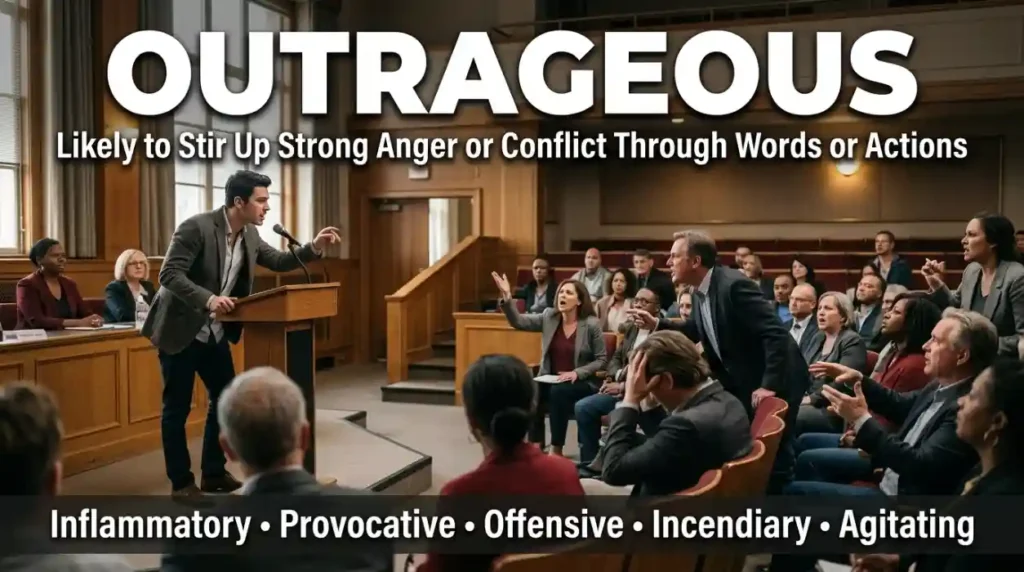
40. Incendiary (Adjective) — US / UK: /ɪnˈsendieri/ / /ɪnˈsendiəri/
Meaning: Likely to stir up strong anger or conflict, especially through words or actions.
Tone/Register: Formal and forceful; common in journalism and political commentary.
Examples:
The article’s incendiary headline sparked a heated debate.
His incendiary speech drew criticism from community leaders.
41. Brazen (Adjective) — US / UK: /ˈbreɪzən/ / /ˈbreɪzən/
Meaning: Bold and shameless, especially when someone ignores rules or social expectations.
Tone/Register: Negative; often used for dishonest or disrespectful behavior.
Examples:
The brazen attempt to cheat was caught on camera.
She was surprised by his brazen refusal to follow the rules.
42. Audacious (Adjective) — US / UK: /ɔːˈdeɪʃəs/ / /ɔːˈdeɪʃəs/
Meaning: Showing daring confidence or a willingness to take significant risks.
Tone/Register: Neutral to positive, though it can imply recklessness.
Examples:
The startup made an audacious bid to enter the global market.
His audacious plan could either succeed brilliantly or fail.
43. Flamboyant (Adjective) — US / UK: /flæmˈbɔɪənt/ / /flæmˈbɔɪənt/
Meaning: Noticeably bold, colorful, or extravagant in style or behavior.
Tone/Register: Neutral to positive; often used for fashion and personality.
Examples:
The singer wore a flamboyant jacket covered in bright patterns.
His flamboyant entrance made him the center of attention.
44. Far-fetched (Adjective) — US / UK: /ˌfɑːr ˈfetʃt/ / /ˌfɑː ˈfetʃt/
Meaning: Difficult to believe because something seems unlikely or unrealistic.
Tone/Register: Informal to neutral; useful when questioning claims or explanations.
Examples:
Her explanation for missing the deadline sounded far-fetched.
The movie’s ending was entertaining but a little far-fetched.
45. Exorbitant (Adjective) — US / UK: /ɪɡˈzɔːrbɪtənt/ / /ɪɡˈzɔːbɪtənt/
Meaning: Much too high, especially when describing a price, fee, or charge.
Tone/Register: Neutral to negative; common in consumer and business writing.
Examples:
The hotel charged an exorbitant fee for parking.
Residents complained about the exorbitant cost of repairs.
46. Unjustifiable (Adjective) — US / UK: /ˌʌndʒʌstɪˈfaɪəbəl/ / /ˌʌndʒʌstɪˈfaɪəbəl/
Meaning: Impossible to defend as reasonable, fair, or acceptable.
Tone/Register: Formal; useful for serious criticism and professional writing.
Examples:
The delay caused an unjustifiable loss of time.
The manager called the breach of trust unjustifiable.
47. Precarious (Adjective) — US / UK: /prɪˈkeriəs/ / /prɪˈkeəriəs/
Meaning: Unstable or dangerously uncertain, rather than outrageous in every context.
Tone/Register: Neutral to negative; common in formal writing.
Examples:
The workers stood on a precarious platform high above the ground.
The company was in a precarious financial position.
48. Perverse (Adjective) — US / UK: /pərˈvɝːs/ / /pəˈvɜːs/
Meaning: Deliberately contrary to what is expected or considered reasonable, sometimes in a troubling way.
Tone/Register: Formal and negative; use when the context supports this specific meaning.
Examples:
There was a perverse pleasure in proving everyone wrong.
The policy created a perverse incentive to hide mistakes.
49. Outrageous (Adjective) — US / UK: /aʊtˈreɪdʒəs/ / /aʊtˈreɪdʒəs/
Meaning: Extremely shocking, excessive, or unacceptable.
Tone/Register: Strong and expressive; common in everyday speech and writing.
Examples:
The company faced criticism for its outrageous cancellation fee.
His outrageous comment interrupted an otherwise friendly dinner.
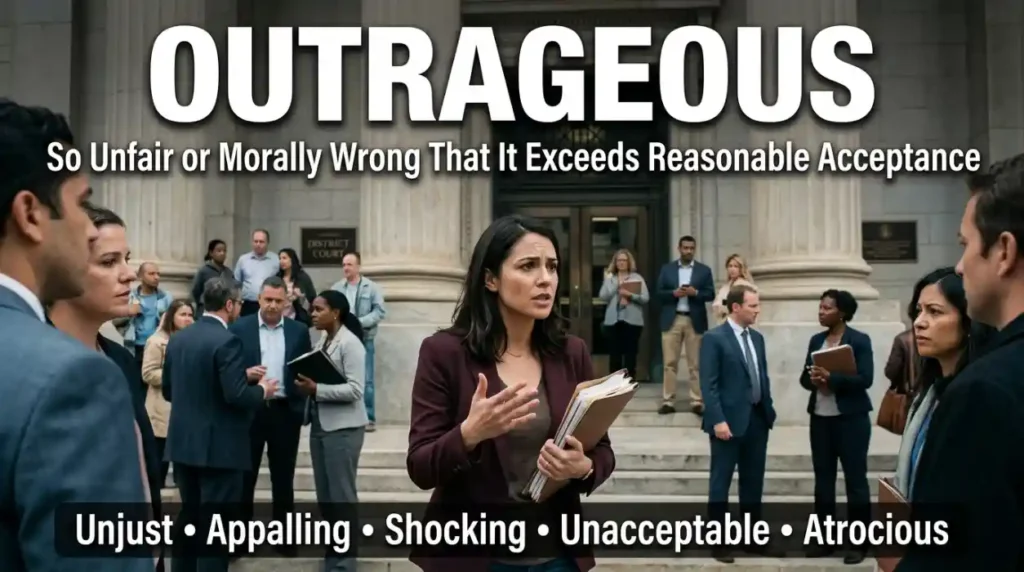
50. Unconscionable (Adjective) — US / UK: /ʌnˈkɑːnʃənəbəl/ / /ʌnˈkɒnʃənəbəl/
Meaning: So unfair or morally wrong that it is beyond what people can reasonably accept.
Tone/Register: Formal and strongly negative; common in ethical, legal, and professional contexts.
Examples:
The charity condemned the unconscionable treatment of vulnerable people.
The contract included an unconscionable penalty for a minor mistake.
Synonyms by Tone
The emotional tone of a word changes how your reader understands the message. Choose a synonym based on whether you want to express admiration, surprise, disapproval, or humor.
Positive or Admiring
These words can describe bold creativity or remarkable achievements when the context is favorable.
- Extraordinary: Remarkable or impressive.
- Astonishing: Amazingly unexpected.
- Audacious: Bold and daring.
- Flamboyant: Dramatic and eye-catching.
- Unbelievable: So impressive or surprising that it is difficult to believe.
Example: Her audacious design was extraordinary and immediately caught everyone’s attention.
Neutral or Descriptive
These words emphasize unusual circumstances without automatically expressing strong moral judgment.
- Extreme: Far beyond the normal level.
- Startling: Unexpected enough to cause surprise.
- Controversial: Likely to prompt disagreement.
- Radical: Involving major change.
- Extraordinary: Outside ordinary expectations.
Example: The proposal included radical changes to the schedule.
Negative or Critical
Use these alternatives when you want to communicate disapproval, unfairness, or serious wrongdoing.
- Appalling: Shockingly bad.
- Unacceptable: Outside accepted standards.
- Egregious: Remarkably serious or offensive.
- Disgraceful: Shameful or deserving criticism.
- Inexcusable: Impossible to justify.
- Excessive: Beyond reasonable limits.
- Offensive: Causing hurt or resentment.
- Scandalous: Causing public outrage.
- Unconscionable: Extremely unfair or morally wrong.
Example: The report exposed unacceptable conditions and an egregious failure to protect staff.
Playful or Informal
These alternatives suit casual conversations, humorous reactions, and entertainment reviews.
- Ridiculous: Silly or unreasonably extreme.
- Shocking: Extremely surprising or intense.
- Bonkers: Completely absurd or unbelievable.
- Wild: Remarkably unusual.
- Outlandish: Strikingly strange.
Example: That was a wild idea, but somehow it worked!
“Outrageous” vs. Close Alternatives
| Word | Main difference | When to use it |
|---|---|---|
| Outrageous | Suggests something extreme, shocking, or unacceptable. | Strong reactions to prices, behavior, or demands. |
| Ridiculous | Emphasizes silliness, absurdity, or a lack of good sense. | Criticizing an unreasonable excuse or idea. |
| Appalling | Emphasizes serious disgust or moral disapproval. | Describing cruel treatment or terrible conditions. |
| Shocking | Focuses on surprise or distress. | Reporting unexpected or disturbing news. |
| Exorbitant | Specifically describes an excessively high price or charge. | Discussing fees, costs, or financial demands. |
Consider these examples:
- “The ticket price is outrageous.” This expresses a strong objection to the price.
- “The explanation is ridiculous.” This suggests that the explanation makes little sense.
- “The treatment was appalling.” This communicates serious disapproval.
- “The result was shocking.” This emphasizes surprise rather than necessarily unfairness.
- “The hotel charged an exorbitant fee.” This specifically criticizes the amount charged.
How “Outrageous” Changes by Context
Daily Conversation
In everyday speech, outrageous often describes unfair prices, rude behavior, or something unbelievable. Informal alternatives such as ridiculous, shocking, and wild may sound more natural among friends.
Example: “That restaurant’s delivery fee is ridiculous.”
Writing and Blogging
Bloggers can use shocking, astonishing, sensational, or unbelievable when describing surprising developments. However, dramatic language should match the facts rather than exaggerate them.
Example: “The survey revealed a startling change in readers’ habits.”
Professional or Academic Writing
Professional writing benefits from precise alternatives. Use excessive for unreasonable quantities, unacceptable for breaches of standards, and disproportionate when a response seems too severe for a situation.
Example: “The committee considered the proposed penalty disproportionate to the violation.”
Creative and Informal Writing
Stories, reviews, and humorous posts may benefit from expressive words such as outlandish, bonkers, flamboyant, or preposterous. These alternatives create a vivid voice when they fit the character and situation.
Example: “The detective followed an outlandish theory that nobody else considered.”
Common Mistakes Learners Make
1. Using Every Synonym as an Exact Replacement
Not all alternatives fit every sentence. Heinous usually describes serious wrongdoing, while far-fetched describes something difficult to believe. Neither is a natural replacement for every use of outrageous.
2. Confusing Surprise With Disapproval
Shocking often emphasizes surprise. Offensive emphasizes hurt or disrespect. Unacceptable communicates that something fails to meet a standard. Choose the word that matches your intended meaning.
3. Using Strong Words for Minor Problems
Calling a small delay heinous or monstrous sounds exaggerated. Reserve these words for serious situations. For a minor inconvenience, annoying or unreasonable may be more suitable.
4. Choosing Formal Vocabulary for Casual Conversation
Words such as egregious, inordinate, and incendiary can sound overly formal in ordinary chats. In casual English, ridiculous, wild, or unbelievable may feel more natural.
5. Treating “Outrageous” as Always Negative
The word often expresses criticism, but it can also describe amusingly bold clothing, daring performances, or extreme creativity. The surrounding sentence reveals the intended meaning.
Register Notes
- Formal writing: Egregious, disproportionate, inordinate, unconscionable.
- Everyday speech: Ridiculous, shocking, unbelievable, unreasonable.
- Strong criticism: Appalling, disgraceful, inexcusable, atrocious.
- Playful descriptions: Wild, bonkers, outlandish, flamboyant.
For more vocabulary practice, explore related word guides on SynonymsCloud and compare each word with examples from real conversations.
Real-Life Examples Using “Outrageous”
Workplace
A manager assigns an employee three people’s workloads without extra time or support. The employee might call the request unreasonable or excessive. If the decision is particularly unfair, outrageous conveys stronger disapproval.
Social Situations
Someone makes an insulting remark during a family dinner. The comment may be offensive. If it crosses a serious social boundary, relatives might describe the behavior as appalling.
Media and Pop Culture
A celebrity wears a wildly colorful outfit to an awards show. A reviewer could call it flamboyant or outlandish. If the outfit is intentionally daring and entertaining, the description might even be positive.
Writing and Storytelling
A novelist creates a villain who makes an impossible demand. Words such as preposterous, brazen, or audacious help describe the demand, the character’s confidence, and the reaction of other characters.
Practice Exercise
Test your understanding of synonyms for outrageous with these 10 practical questions. Read each situation carefully and choose the word that best matches the meaning, tone, and context.
1. A shop charges an unreasonable amount for a basic bottle of water. Which word fits best?
A. Excessive
B. Flamboyant
C. Startling
2. A witness describes a deeply cruel and disturbing crime. Which word is most suitable?
A. Wild
B. Heinous
C. Audacious
3. A claim sounds so unlikely that it is difficult to believe. Which word fits best?
A. Far-fetched
B. Unacceptable
C. Flamboyant
4. A speaker makes remarks likely to provoke anger and conflict. Which word describes them?
A. Incendiary
B. Extraordinary
C. Unbelievable
5. A person wears a colorful, dramatic outfit that attracts attention. Which word is most precise?
A. Egregious
B. Flamboyant
C. Inexcusable
6. A company’s poor hygiene standards deeply disturb its customers. Which word fits best?
A. Appalling
B. Audacious
C. Radical
7. A punishment seems far too severe for a minor mistake. Which word best describes it?
A. Disproportionate
B. Bonkers
C. Sensational
8. A proposal is so illogical that it seems completely unreasonable. Which word fits best?
A. Preposterous
B. Startling
C. Controversial
9. A new policy causes public disagreement but is not necessarily wrong. Which word fits best?
A. Controversial
B. Heinous
C. Inexcusable
10. A person openly ignores rules without showing shame. Which word describes their behavior?
A. Brazen
B. Unbelievable
C. Excessive
Answer Key
- A. Excessive
- B. Heinous
- A. Far-fetched
- A. Incendiary
- B. Flamboyant
- A. Appalling
- A. Disproportionate
- A. Preposterous
- A. Controversial
- A. Brazen
Reflection Task:
Write one original sentence using outrageous, excessive, appalling, or another synonym. Explain why your chosen word fits the situation better than shocking.
Frequently Asked Questions
1. What is the strongest synonym for outrageous?
The strongest synonym depends on the situation. Heinous is powerful when describing extremely wicked acts, while appalling expresses deep shock and disapproval. Preposterous works well for an absurd claim or demand. For something that violates accepted standards, inexcusable can communicate firm moral judgment.
2. What is a polite way to say something is outrageous?
Try unreasonable, excessive, or inappropriate when you want to sound professional rather than angry. For example, instead of saying, “That fee is outrageous,” you could say, “That fee seems excessive for the service provided.” This wording communicates concern while keeping the conversation respectful.
3. What is a synonym for an outrageous price?
Useful alternatives include excessive, unreasonable, ridiculous, exorbitant, and unjustifiable. Use exorbitant when a price is exceptionally high, especially compared with its value or normal cost. Use unreasonable when you want to emphasize that the amount seems unfair rather than simply expensive.
4. Can outrageous be used as a compliment?
Yes. Although outrageous usually expresses criticism, it can describe something bold, daring, or entertaining positively. For example, “The performer wore an outrageous costume” could suggest admiration for a creative design. The surrounding words and the speaker’s attitude determine whether the adjective sounds approving or critical.
5. What is the difference between outrageous and offensive?
Outrageous describes something extremely shocking, excessive, or unacceptable. Offensive specifically describes something that causes hurt, insult, or resentment. An unusually expensive ticket might be outrageous without directly offending anyone. An insulting comment, however, may be offensive because it disrespects another person.
6. What is a good synonym for outrageous behavior?
Unacceptable, disgraceful, appalling, and inexcusable are useful alternatives for criticizing behavior. Choose unacceptable for a clear boundary, disgraceful for shameful conduct, and inexcusable when you believe no reasonable explanation can justify the action. The most accurate choice depends on how serious the behavior is.
7. What are some academic alternatives to outrageous?
Academic and professional writing often benefits from precise words such as excessive, disproportionate, egregious, and unreasonable. These terms identify the problem more clearly than a broad emotional adjective. For instance, disproportionate describes a response that is too severe for the situation, while egregious emphasizes a particularly serious error or violation.
8. What is the opposite of outrageous?
Possible antonyms include reasonable, acceptable, ordinary, moderate, and appropriate. The best choice depends on the intended meaning. Reasonable contrasts with an outrageous demand, acceptable contrasts with outrageous behavior, and ordinary contrasts with something unusually extreme. Choose the opposite that matches the specific context.
Conclusion
Learning a synonym for outrageous helps you describe extreme situations with greater accuracy. The right word can express surprise, unfairness, anger, or even playful admiration.
Students can strengthen essays, bloggers can write more vivid descriptions, and content writers can keep their vocabulary fresh. Everyday speakers also benefit from choosing words that match their meaning.
Practice these alternatives in emails, assignments, reviews, and daily conversations. Notice how each word changes the feeling of a sentence, even when the basic idea remains similar.
Start with three words from this guide and use each in an original sentence today. Small, regular practice can make your English more natural, expressive, and confident.
Suggested External Resource
For reliable definitions, pronunciation, and example sentences, consult the Merriam-Webster Dictionary.
Cambridge Dictionary Outrageous
Yeh source word ki definition, pronunciation, aur real-life example sentences ke liye useful hai.

Jameel Hassan is the founder and lead writer at SynonymsCloud.com, a trusted online platform dedicated to English vocabulary and effective communication. He is passionate about helping students, writers, professionals, and lifelong learners discover the right words to express their ideas with clarity, precision, and confidence.
At SynonymsCloud.com, every article is thoroughly researched and carefully written to provide accurate, practical, and easy-to-understand guidance on synonyms, antonyms, word meanings, idioms, and vocabulary. With a strong commitment to quality, real-world usage, and clear explanations, the website helps readers expand their vocabulary, improve their writing, and communicate more effectively in both academic and professional settings.