A synonym for opposing is a word that expresses disagreement, resistance, or being against someone or something. Common synonyms include against, opposed, contrary, conflicting, resistant, dissenting, adversarial, and antagonistic. The best choice depends on the context, such as expressing a different opinion, challenging a decision, or describing competing sides.
A synonym for opposing describes someone or something that disagrees, resists, or stands against an idea, action, or decision. Useful alternatives include resisting, contrary, conflicting, adversarial, and against. The right word depends on the situation and the message you want to convey.
Imagine a school debate where two students defend different viewpoints. One student may challenge the other’s argument, while their opinions remain conflicting. In another situation, a group might resist a new rule because they believe it is unfair.
Finding a synonym for opposing can help students, bloggers, and content writers communicate their ideas more effectively. It adds variety to essays, strengthens arguments, and makes explanations easier to understand.
You will often encounter opposing in politics, education, business, sports, and everyday conversations. Learning a synonym for opposing allows you to describe disagreement, competition, and resistance accurately while making your English more natural and expressive.
What Does “Opposing” Really Mean?
Opposing means being against something, disagreeing with an idea, resisting an action, or standing in contrast to another person or thing.
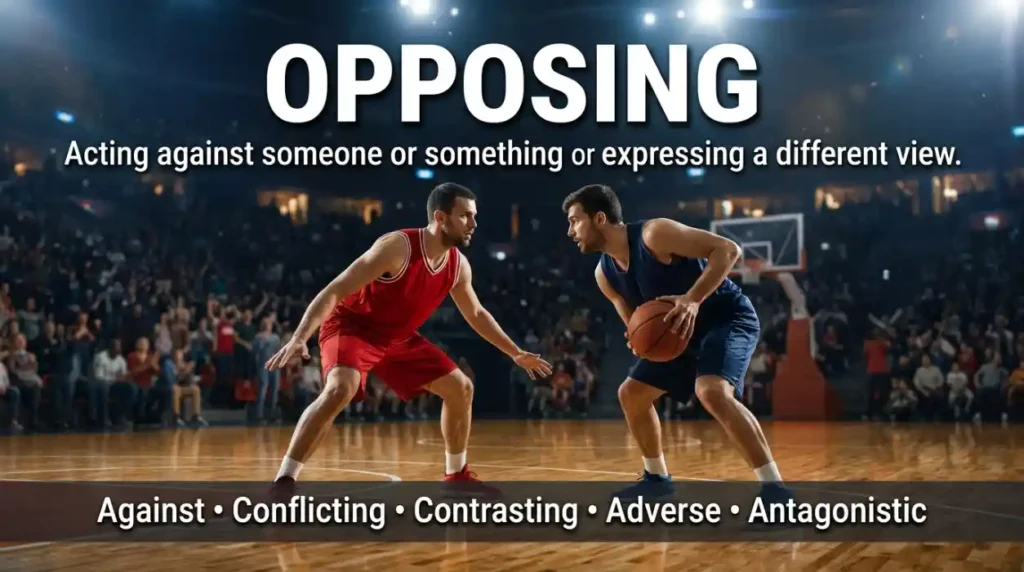
For example, an opposing team competes against another team. An opposing viewpoint disagrees with a particular argument. An opposing force works against a movement or intended result.
Part of speech:
Opposing is commonly used as a verb form (the present participle of oppose) and as an adjective.
- As a verb form: “They are opposing the proposed changes.”
- As an adjective: “The opposing team scored first.”
Native English speakers understand the word through its context. It may describe peaceful disagreement, direct resistance, competition, or two things facing different directions.
Connotative Meaning
Connotation is the emotional feeling or association a word carries beyond its literal meaning.
- Positive tone: Independent or resolute may suggest confidence when someone challenges an unfair decision.
- Negative tone: Hostile or antagonistic can suggest aggression or personal conflict.
- Neutral tone: Contrary, competing, and conflicting can describe differences without automatically assigning blame.
The word opposing is generally neutral. The surrounding words determine whether the situation sounds constructive, competitive, or confrontational.
Etymology of Opposing
The word opposing comes from the verb oppose, which entered English through Old French from Latin opponere, meaning “to set against” or “to place opposite.” It combines Latin elements associated with placing something against another thing.
- Old English period (450–1100): Opposing was not an established everyday English form. Native expressions such as against communicated related ideas.
- Middle English period (1100–1500): Oppose entered English through French and Latin-influenced vocabulary. It developed the sense of resisting or setting one thing against another.
- Modern English period (1500–present): Opposing became widely used in political debate, law, sports, argument, and general descriptions of conflict or contrast.
Pronunciation and Word Structure
- US: /əˈpoʊ.zɪŋ/
- UK: /əˈpəʊ.zɪŋ/
- Syllables: op-pos-ing (3 syllables)
- Root/base verb: oppose
- Prefix: None in opposing
- Suffix: -ing, marking a participle or forming a gerund
The related word opposition is a noun, while opposed often describes a state of disagreement or resistance.
Synonyms List
These 50 alternatives cover disagreement, resistance, competition, and contrast. Some work as direct substitutes for opposing, while others fit only specific contexts. Always check the sentence before choosing a replacement.
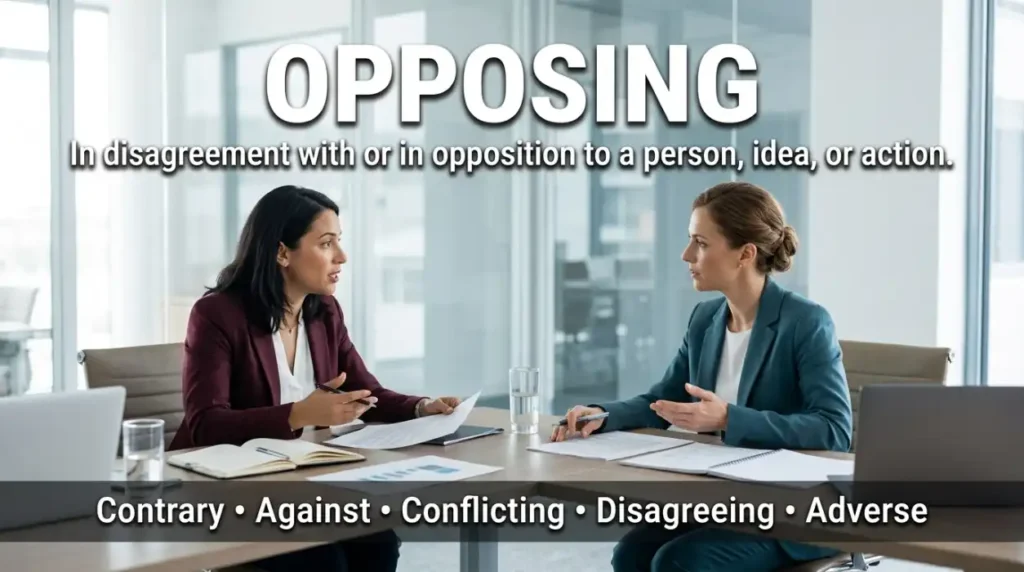
1. Against (Preposition) — US /əˈɡenst/ | UK /əˈɡenst/
Meaning: In disagreement with or in opposition to a person, idea, or action.
Tone/Register: Neutral; everyday.
Examples:
- Most residents are against the proposed road closure.
- She voted against the new school policy.
2. Opposed (Adjective) — US /əˈpoʊzd/ | UK /əˈpəʊzd/
Meaning: Holding a position that disagrees with or resists something.
Tone/Register: Neutral; formal and conversational.
Examples:
- The committee is opposed to cutting library hours.
- My parents were opposed to the expensive purchase.
3. Contrary (Adjective) — US /ˈkɑːn.trer.i/ | UK /ˈkɒn.trə.ri/
Meaning: Opposite in nature, direction, or opinion to something else.
Tone/Register: Formal; academic.
Examples:
- The results were contrary to our expectations.
- His actions seemed contrary to his stated beliefs.
4. Conflicting (Adjective) — US /kənˈflɪk.tɪŋ/ | UK /kənˈflɪk.tɪŋ/
Meaning: Incompatible or opposed because of differences in ideas, interests, or requirements.
Tone/Register: Neutral; professional and academic.
Examples:
- We received conflicting advice about the application.
- The two reports contain conflicting figures.
5. Contradictory (Adjective) — US /ˌkɑːn.trəˈdɪk.tɔːr.i/ | UK /ˌkɒn.trəˈdɪk.tər.i/
Meaning: Involving statements or ideas that cannot both be true in the same sense.
Tone/Register: Formal; academic.
Examples:
- The witness gave contradictory accounts of the incident.
- Those instructions seem contradictory.
6. Resisting (Verb, present participle) — US /rɪˈzɪs.tɪŋ/ | UK /rɪˈzɪs.tɪŋ/
Meaning: Actively trying to prevent, withstand, or refuse something.
Tone/Register: Neutral; practical and formal.
Examples:
- Workers are resisting the sudden change in schedules.
- The material is resisting heat better than expected.
7. Resistant (Adjective) — US /rɪˈzɪs.tənt/ | UK /rɪˈzɪs.tənt/
Meaning: Unwilling to accept something or able to withstand its effects.
Tone/Register: Neutral; scientific and everyday.
Examples:
- Some employees remain resistant to the new system.
- The coating is resistant to water damage.
8. Adversarial (Adjective) — US /ˌæd.vɚˈser.i.əl/ | UK /ˌæd.vəˈseə.ri.əl/
Meaning: Involving opposing sides that challenge or compete against each other.
Tone/Register: Formal; legal and professional.
Examples:
- The meeting became adversarial after the budget discussion.
- An adversarial legal process allows each side to present its case.
9. Antagonistic (Adjective) — US /ænˌtæɡ.əˈnɪs/.tɪk/ | UK /ænˌtæɡ.əˈnɪs.tɪk/
Meaning: Showing active hostility or opposition toward someone or something.
Tone/Register: Strong; formal.
Examples:
- His antagonistic remarks upset the entire team.
- The two groups maintained an antagonistic relationship.
10. Hostile (Adjective) — US /ˈhɑː.stəl/ | UK /ˈhɒs.taɪl/
Meaning: Unfriendly or openly opposed to someone or something.
Tone/Register: Strong; formal and everyday.
Examples:
- The proposal received a hostile response from some residents.
- She faced a hostile audience during the debate.
11. Dissenting (Adjective) — US /dɪˈsen.tɪŋ/ | UK /dɪˈsen.tɪŋ/
Meaning: Expressing disagreement with an accepted opinion or majority decision.
Tone/Register: Formal; political and academic.
Examples:
- One judge issued a dissenting opinion.
- Dissenting voices called for a review of the policy.
12. Disagreeing (Verb, present participle) — US /ˌdɪs.əˈɡriː.ɪŋ/ | UK /ˌdɪs.əˈɡriː.ɪŋ/
Meaning: Having a different opinion or belief from another person.
Tone/Register: Neutral; conversational.
Examples:
- We are disagreeing about how to divide the work.
- They kept disagreeing over the best route home.
13. Disapproving (Adjective) — US /ˌdɪs.əˈpruː.vɪŋ/ | UK /ˌdɪs.əˈpruː.vɪŋ/
Meaning: Showing that you believe something is wrong or unacceptable.
Tone/Register: Neutral to negative; everyday.
Examples:
- Her disapproving look ended the conversation.
- The principal gave a disapproving response to the prank.
14. Objecting (Verb, present participle) — US /əbˈdʒek.tɪŋ/ | UK /əbˈdʒek.tɪŋ/
Meaning: Expressing a reason for disagreeing with or opposing something.
Tone/Register: Neutral; formal and conversational.
Examples:
- Several parents are objecting to the proposed timetable.
- He kept objecting to changes in the original agreement.
15. Protesting (Verb, present participle) — US /prəˈtes.tɪŋ/ | UK /prəˈtes.tɪŋ/
Meaning: Publicly expressing strong disagreement or objection.
Tone/Register: Neutral to strong; civic and political.
Examples:
- Residents are protesting the closure of the local clinic.
- Students were protesting against unfair examination rules.
16. Challenging (Verb, present participle) — US /ˈtʃæl.ɪn.dʒɪŋ/ | UK /ˈtʃæl.ɪn.dʒɪŋ/
Meaning: Questioning the validity, authority, or fairness of something.
Tone/Register: Neutral; academic and professional.
Examples:
- The journalist is challenging the official explanation.
- She is challenging a decision she believes was unfair.
17. Contesting (Verb, present participle) — US /kənˈtes.tɪŋ/ | UK /kənˈtes.tɪŋ/
Meaning: Disputing a decision, claim, result, or right.
Tone/Register: Formal; legal and professional.
Examples:
- The candidate is contesting the election result.
- They are contesting the charges in court.
18. Disputing (Verb, present participle) — US /dɪˈspjuː.tɪŋ/ | UK /dɪˈspjuː.tɪŋ/
Meaning: Arguing that a statement, claim, or decision is incorrect.
Tone/Register: Neutral to formal.
Examples:
- The company is disputing the amount on the invoice.
- Researchers are disputing the report’s conclusions.
19. Defying (Verb, present participle) — US /dɪˈfaɪ.ɪŋ/ | UK /dɪˈfaɪ.ɪŋ/
Meaning: Openly refusing to obey or accept a person, rule, or authority.
Tone/Register: Strong; formal and dramatic.
Examples:
- The protesters are defying the government order.
- He kept defying the team’s agreed rules.
20. Countering (Verb, present participle) — US /ˈkaʊn.t̬ɚ.ɪŋ/ | UK /ˈkaʊn.tər.ɪŋ/
Meaning: Responding to an action, argument, or threat with an opposing action.
Tone/Register: Neutral to formal; strategic.
Examples:
- The lawyer is countering the claim with new evidence.
- The team is countering its rival’s aggressive strategy.
21. Counteracting (Verb, present participle) — US /ˌkaʊn.t̬ɚˈæk.tɪŋ/ | UK /ˌkaʊn.tərˈæk.tɪŋ/
Meaning: Acting to reduce, neutralize, or prevent the effect of something.
Tone/Register: Formal; scientific and professional.
Examples:
- The new policy is counteracting the effects of rising costs.
- Regular breaks can help counteract screen fatigue.
22. Competing (Adjective or verb form) — US /kəmˈpiː.tɪŋ/ | UK /kəmˈpiː.tɪŋ/
Meaning: Seeking the same goal or resource as another person, group, or organization.
Tone/Register: Neutral; business and sports.
Examples:
- Competing businesses introduced similar products.
- The two teams are competing for the championship.
23. Rival (Adjective or noun) — US /ˈraɪ.vəl/ | UK /ˈraɪ.vəl/
Meaning: Describing someone or something that competes against another.
Tone/Register: Neutral; sports and business.
Examples:
- The rival teams met in the final match.
- Her rival candidate presented a different economic plan.
24. Confrontational (Adjective) — US /ˌkɑːn.frənˈteɪ.ʃən.əl/ | UK /ˌkɒn.frʌnˈteɪ.ʃən.əl/
Meaning: Inclined to challenge others directly or aggressively.
Tone/Register: Negative; interpersonal and professional.
Examples:
- His confrontational tone made the meeting uncomfortable.
- A confrontational approach rarely helps settle minor disagreements.
25. Incompatible (Adjective) — US /ˌɪn.kəmˈpæt̬.ə.bəl/ | UK /ˌɪn.kəmˈpæt.ə.bəl/
Meaning: Unable to exist, work, or function together successfully.
Tone/Register: Neutral; technical and everyday.
Examples:
- Their schedules are incompatible this semester.
- The software versions are incompatible with each other.
26. Inconsistent (Adjective) — US /ˌɪn.kənˈsɪs.tənt/ | UK /ˌɪn.kənˈsɪs.tənt/
Meaning: Not in agreement with another statement, standard, or set of facts.
Tone/Register: Neutral to formal; analytical.
Examples:
- His explanation is inconsistent with the available evidence.
- The report contains inconsistent dates.
27. Antithetical (Adjective) — US /ˌæn.tɪˈθet̬.ɪ.kəl/ | UK /ˌæn.tɪˈθet.ɪ.kəl/
Meaning: Directly opposite in nature, meaning, or principle.
Tone/Register: Formal; academic.
Examples:
- Discrimination is antithetical to equal opportunity.
- Her approach is antithetical to the team’s values.
28. Opposite (Adjective) — US /ˈɑː.pə.zɪt/ | UK /ˈɒp.ə.zɪt/
Meaning: Completely different or positioned across from something else.
Tone/Register: Neutral; everyday.
Examples:
- They hold opposite views on public transport.
- The two houses stand on opposite sides of the road.
29. Reverse (Adjective) — US /rɪˈvɝːs/ | UK /rɪˈvɜːs/
Meaning: Going in the opposite direction or representing the contrary side of something.
Tone/Register: Neutral; technical and everyday.
Examples:
- The vehicle moved in the reverse direction.
- The reverse argument focuses on the benefits rather than the risks.
30. Contrasting (Adjective) — US /kənˈtræs.tɪŋ/ | UK /kənˈtrɑː.stɪŋ/
Meaning: Showing clear differences between people, things, ideas, or qualities.
Tone/Register: Neutral; descriptive and academic.
Examples:
- The article presents contrasting views on remote work.
- We compared two contrasting approaches to education.
31. Divergent (Adjective) — US /daɪˈvɝː.dʒənt/ | UK /daɪˈvɜː.dʒənt/
Meaning: Developing or moving in different directions, often in thought or opinion.
Tone/Register: Formal; academic and professional.
Examples:
- The researchers reached divergent conclusions.
- Their divergent priorities delayed the final decision.
32. Different (Adjective) — US /ˈdɪf.ɚ.ənt/ | UK /ˈdɪf.ər.ənt/
Meaning: Not the same as another person, thing, or idea.
Tone/Register: Neutral; everyday.
Examples:
- We have different opinions about the proposal.
- She chose a different route to avoid traffic.
33. At Odds (Adjectival Phrase) — US /æt ɑːdz/ | UK /æt ɒdz/
Meaning: In disagreement or conflict with someone or something.
Tone/Register: Neutral; conversational and journalistic.
Examples:
- The two managers are at odds over the budget.
- His actions are at odds with his promises.
34. In Conflict (Adjectival Phrase) — US /ɪn ˈkɑːn.flɪkt/ | UK /ɪn ˈkɒn.flɪkt/
Meaning: In a state of disagreement, incompatibility, or active struggle.
Tone/Register: Neutral to formal.
Examples:
- The new rules conflict with existing regulations.
- Their personal goals conflict with the team’s priorities.
35. Noncompliant (Adjective) — US /ˌnɑːn.kəmˈplaɪ.ənt/ | UK /ˌnɒn.kəmˈplaɪ.ənt/
Meaning: Failing or refusing to follow a rule, requirement, or standard.
Tone/Register: Formal; legal and regulatory.
Examples:
- The inspection identified several noncompliant products.
- The building remains noncompliant with fire safety regulations.
36. Rebellious (Adjective) — US /rɪˈbel.jəs/ | UK /rɪˈbel.jəs/
Meaning: Resisting authority, rules, or established expectations.
Tone/Register: Strong; informal and descriptive.
Examples:
- The rebellious teenager questioned every household rule.
- The novel follows a rebellious group of young activists.
37. Insubordinate (Adjective) — US /ˌɪn.səˈbɔːr.dən.ət/ | UK /ˌɪn.səˈbɔː.dɪ.nət/
Meaning: Disobedient toward someone in a position of authority.
Tone/Register: Formal; workplace and military.
Examples:
- The supervisor warned him about insubordinate behavior.
- Repeated insubordinate actions led to disciplinary measures.
38. Obstructive (Adjective) — US /əbˈstrʌk.tɪv/ | UK /əbˈstrʌk.tɪv/
Meaning: Deliberately or effectively preventing progress or making an action difficult.
Tone/Register: Negative; professional and formal.
Examples:
- Obstructive behavior slowed the investigation.
- The committee criticized the obstructive tactics used during negotiations.
39. Resistant to (Adjectival Phrase) — US /rɪˈzɪs.tənt tuː/ | UK /rɪˈzɪs.tənt tuː/
Meaning: Unwilling to accept or respond to a particular change, influence, or proposal.
Tone/Register: Neutral; professional and everyday.
Examples:
- The department is resistant to sudden policy changes.
- Some plants are resistant to common garden diseases.
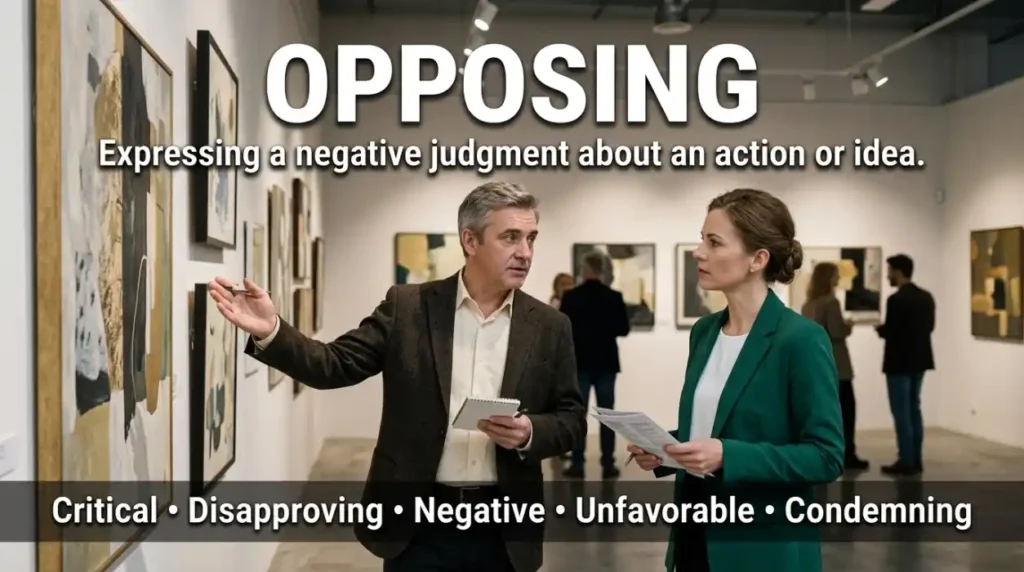
40. Disapproving of (Adjectival Phrase) — US /ˌdɪs.əˈpruː.vɪŋ əv/ | UK /ˌdɪs.əˈpruː.vɪŋ əv/
Meaning: Expressing a negative judgment about an action or idea.
Tone/Register: Neutral to negative; everyday.
Examples:
- Her parents are disapproving of the risky plan.
- The coach was disapproving of the team’s poor sportsmanship.
41. In Opposition to (Prepositional Phrase) — US /ɪn ˌɑː.pəˈzɪʃ.ən tuː/ | UK /ɪn ˌɒp.əˈzɪʃ.ən tuː/
Meaning: Acting or standing against a person, proposal, policy, or movement.
Tone/Register: Formal; political and academic.
Examples:
- Several members spoke in opposition to the motion.
- The group organized a campaign in opposition to the ban.
42. Contrary to (Prepositional Phrase) — US /ˈkɑːn.trer.i tuː/ | UK /ˈkɒn.trə.ri tuː/
Meaning: In a way that conflicts with a statement, expectation, or established rule.
Tone/Register: Formal; academic and professional.
Examples:
- Contrary to expectations, the small team finished first.
- The decision was contrary to the written agreement.
43. Conflicting with (Verb Phrase) — US /kənˈflɪk.tɪŋ wɪð/ | UK /kənˈflɪk.tɪŋ wɪð/
Meaning: Being incompatible with or in disagreement with another thing.
Tone/Register: Neutral; formal and everyday.
Examples:
- The appointment is conflicting with my work schedule.
- Her account conflicts with the recorded evidence.
44. Working Against (Verb Phrase) — US /ˈwɝː.kɪŋ əˈɡenst/ | UK /ˈwɜː.kɪŋ əˈɡenst/
Meaning: Acting in a way that makes success more difficult or prevents a desired result.
Tone/Register: Neutral; conversational and professional.
Examples:
- Poor planning is working against our progress.
- The harsh weather is working against the rescue team.
45. Standing Against (Verb Phrase) — US /ˈstæn.dɪŋ əˈɡenst/ | UK /ˈstæn.dɪŋ əˈɡenst/
Meaning: Publicly or firmly opposing a person, action, or belief.
Tone/Register: Strong; social and political.
Examples:
- Community leaders are standing against discrimination.
- She is standing against the proposed cuts to public services.
46. Pitted Against (Adjectival Phrase) — US /ˈpɪt̬.ɪd əˈɡenst/ | UK /ˈpɪt.ɪd əˈɡenst/
Meaning: Placed in direct competition or conflict with another person or group.
Tone/Register: Descriptive; sports and journalism.
Examples:
- The semifinal has the defending champion pitted against a young challenger.
- The story pits loyalty against personal ambition.
47. Clashing (Adjective or Verb Form) — US /ˈklæʃ.ɪŋ/ | UK /ˈklæʃ.ɪŋ/
Meaning: Strongly disagreeing or being in direct conflict.
Tone/Register: Neutral to strong; conversational and journalistic.
Examples:
- The two leaders have clashing views on education.
- Their clashing priorities created tension during the project.
48. Conflicting with the Interests of (Verb Phrase) — US /kənˈflɪk.tɪŋ wɪð ði ˈɪn.trəsts əv/ | UK /kənˈflɪk.tɪŋ wɪð ði ˈɪn.trəsts əv/
Meaning: Working against what would benefit a person, group, or organization.
Tone/Register: Formal; business and policy.
Examples:
- The proposal is conflicting with the interests of local farmers.
- The decision may conflict with the interests of small businesses.
49. Incompatible with (Adjectival Phrase) — US /ˌɪn.kəmˈpæt̬.ə.bəl wɪð/ | UK /ˌɪn.kəmˈpæt.ə.bəl wɪð/
Meaning: Unable to agree or function together with something else.
Tone/Register: Neutral; technical and formal.
Examples:
- The new proposal is incompatible with our current policy.
- His actions are incompatible with the values he promotes.
50. Antagonizing (Verb, present participle) — US /ænˈtæɡ.ə.naɪ.zɪŋ/ | UK /ænˈtæɡ.ə.naɪ.zɪŋ/
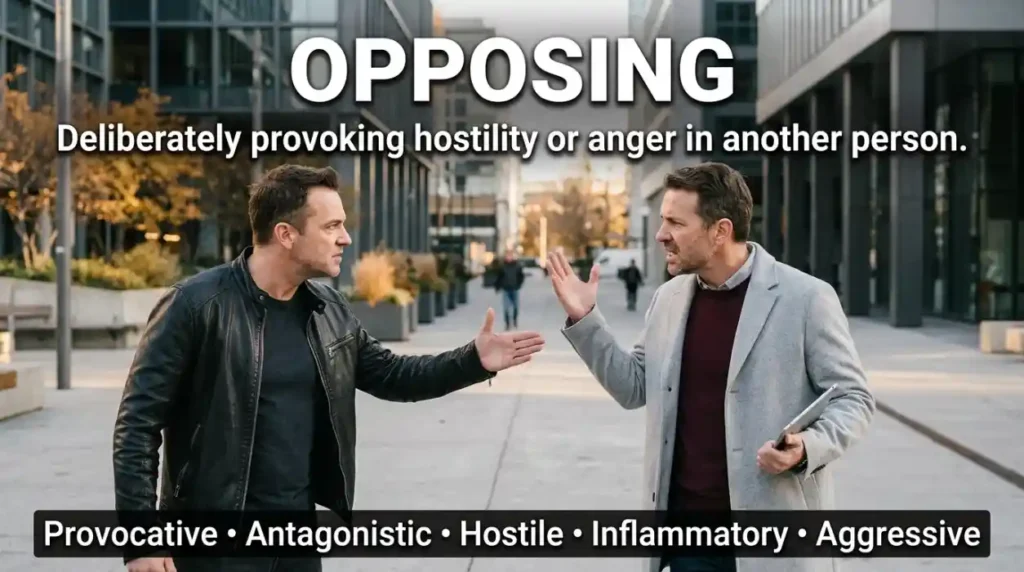
Meaning: Deliberately provoking hostility or anger in another person.
Tone/Register: Negative; interpersonal.
Examples:
- His antagonizing comments turned a calm discussion into an argument.
- She avoided antagonizing her colleagues during the disagreement.
Usage note: Not every item above is a direct grammatical substitute for opposing. For example, antagonizing means provoking someone, while opposing means being against something. Choose the alternative that matches both the sentence structure and intended meaning.
Synonyms by Tone
The right word depends on how strongly someone disagrees and whether the situation involves peaceful debate, competition, or open hostility.
Positive or Constructive Opposition
These words can describe disagreement that supports fairness, independent thinking, or careful evaluation.
- Challenging: Questioning an idea to test its strength.
- Dissenting: Expressing a different opinion from the majority.
- Resisting: Refusing to accept an unwanted change.
- Standing against: Firmly opposing an unfair practice.
- Defying: Refusing to obey an authority or rule, sometimes courageously.
Neutral Opposition
These words describe differences or disagreement without necessarily suggesting hostility.
- Opposed: Holding a position against something.
- Contrary: Going against an idea or expectation.
- Conflicting: Incompatible or inconsistent with something else.
- Disagreeing: Having a different opinion.
- Contrasting: Showing differences between ideas or things.
- At odds: Being in disagreement.
- Competing: Seeking the same goal as another person or group.
Negative or Aggressive Opposition
These alternatives suggest stronger tension, resistance, or hostility.
- Hostile: Openly unfriendly or antagonistic.
- Antagonistic: Showing active hostility.
- Confrontational: Directly challenging others in an aggressive way.
- Obstructive: Preventing progress.
- Insubordinate: Refusing to follow authority.
- Antagonizing: Provoking another person’s anger.
Informal and Conversational Alternatives
These expressions often sound natural in everyday speech.
- Against: “I’m against the idea.”
- At odds: “They are at odds over the decision.”
- Working against: “The weather is working against us.”
- Clashing: “Their opinions are clashing.”
- Standing against: “She is standing against unfair treatment.”
Tone matters because dissenting can describe a thoughtful difference of opinion, while hostile suggests an unfriendly attitude. Choose a word that reflects the actual situation.
“Opposing” vs. Close Alternatives
| Word | Main difference | Best use |
|---|---|---|
| Opposing | Being against someone, something, or a position | General disagreement, sports, politics |
| Conflicting | Being incompatible or inconsistent | Evidence, schedules, ideas, interests |
| Resisting | Actively trying to prevent or withstand something | Change, pressure, authority |
| Contrary | Being opposite to an idea, expectation, or direction | Formal writing and explanations |
| Dissenting | Expressing disagreement with an established or majority view | Courts, committees, academic debates |
Examples in context:
- “The opposing candidate challenged the proposal.” This identifies someone on the other side.
- “The reports contain conflicting information.” This means the reports do not agree.
- “Employees are resisting the changes.” This emphasizes their active response.
- “The result was contrary to expectations.” This highlights an unexpected difference.
- “The judge wrote a dissenting opinion.” This describes formal disagreement with a decision.
How Opposing Changes by Context
Daily Conversation
Use against, opposed, disagreeing, or at odds when discussing personal opinions.
For example, “I’m against changing the meeting time” sounds natural in conversation. “I hold an adversarial position regarding the scheduling adjustment” sounds unnecessarily formal.
Writing and Blogging
In articles and blog posts, contrary, conflicting, opposing, and contrasting can help explain different viewpoints.
For example, a writer might discuss opposing opinions about online education before comparing their advantages and disadvantages.
Professional and Academic Writing
Words such as dissenting, incompatible, adversarial, and contesting are useful when the situation requires precision.
A legal article may discuss a contested decision. A research paper may identify conflicting results. A workplace report may describe resistance to a new policy.
Creative and Informal Writing
In stories, hostile, rebellious, clashing, and defiant can make conflict more vivid.
For example, a novelist might describe two clashing personalities or a rebellious character who refuses to follow tradition.
Common Mistakes and Native Usage
1. Confusing “Opposing” With “Opposite”
Opposing often describes active disagreement or two sides facing each other. Opposite generally describes a position, direction, or quality that is completely different.
- Correct: “The opposing team entered the field.”
- Correct: “The houses are on opposite sides of the street.”
2. Using “Conflicting” for Every Disagreement
Conflicting is especially useful when facts, schedules, interests, or ideas cannot easily agree. For a person’s opinion, disagreeing or opposed may sound more natural.
- Natural: “The two reports contain conflicting figures.”
- Natural: “I disagree with that suggestion.”
3. Confusing “Resisting” With “Objecting”
Objecting means expressing disagreement. Resisting emphasizes an effort to prevent or withstand something.
- “She objected to the proposal.” She expressed her disagreement.
- “She resisted the changes.” She actively opposed their implementation.
4. Using Strong Words for Minor Disagreements
Hostile and antagonistic suggest more tension than opposed or dissenting. Avoid them when people simply hold different views.
Register Notes
- Formal: Adversarial, antithetical, dissenting, incompatible.
- Everyday: Against, opposed, disagreeing, different.
- Strong or confrontational: Hostile, antagonistic, defiant.
- Academic: Contradictory, conflicting, divergent.
For more vocabulary practice, explore related synonym articles on your website and compare the example sentences to learn which words fit each context.
Real-Life Examples Using Opposing
Workplace
Two managers have opposing views on a hiring plan. One wants to expand the team, while the other prefers to reduce costs.
Social situations
Two friends are at odds about where to spend their holiday. They discuss their preferences and look for a compromise.
Sports and media
The opposing teams prepare for an important final. The word identifies competitors on different sides.
Writing and storytelling
A student explains contrasting viewpoints in an essay. This makes the differences between arguments easier to understand.
Practice Exercise
1. The candidate spoke against the proposed law. She was to it.
A. Opposed
B. Compatible
C. Supportive
D. Identical
2. The two reports contain different figures that cannot both be correct.
A. Friendly
B. Conflicting
C. Rebellious
D. Competing
3. The judge disagreed with the majority decision and wrote an opinion.
A. Hostile
B. Rival
C. Dissenting
D. Reverse
4. The workers refused to accept the new policy and actively fought the change.
A. Contrasting
B. Resisting
C. Compatible
D. Opposite
5. The two football teams are for the same trophy.
A. Adversarial
B. Competing
C. Inconsistent
D. Disapproving
6. His explanation was the opposite of what we expected.
A. Contrary
B. Obstructive
C. Insubordinate
D. Antagonizing
7. The employee openly refused to follow the manager’s lawful instruction.
A. Divergent
B. Insubordinate
C. Contrasting
D. Resistant
8. The lawyer challenged the claim by presenting evidence against it.
A. Countering
B. Disapproving
C. Opposite
D. Rival
9. The two friends disagree about their holiday plans. They are.
A. At odds
B. Antithetical
C. Noncompliant
D. Hostile
10. The software cannot run with this operating system because the two are.
A. Dissenting
B. Incompatible
C. Rebellious
D. Contrary
Answer Key:
- A. Opposed
- B. Conflicting
- C. Dissenting
- B. Resisting
- B. Competing
- A. Contrary
- B. Insubordinate
- A. Countering
- A. At odds
- B. Incompatible
Reflection Task:
Write one sentence about a disagreement you have witnessed at school, at work, or in everyday life. Use a synonym for opposing and explain why it fits the situation.
Frequently Asked Questions
1. What is the best synonym for opposing in an argumentative essay?
The best choice depends on your argument. Use contrary when discussing ideas that go against expectations, dissenting when describing disagreement with a majority view, and conflicting when two claims cannot be reconciled. If you simply want to express disagreement, opposed to is usually clear and natural.
2. What is another word for opposing someone without sounding rude?
Use disagreeing with, questioning, or challenging when you want to express a different opinion respectfully. For example, “I disagree with your suggestion” sounds less aggressive than “I oppose everything you say.” The phrase have a different perspective can also help maintain a polite and constructive conversation.
3. What is the difference between opposing and opposed to?
In standard English, use opposing something or opposed to something. For example, “They are opposing the proposal” describes an active action, while “They are opposed to the proposal” describes their position. Avoid opposing to the proposal, because opposing does not take to in that construction.
4. What is a synonym for opposing in politics?
Political alternatives include dissenting, adversarial, resistant, contesting, and in opposition to. An opposing party is a party that challenges the governing party. A dissenting politician disagrees with a particular position, while a protesting group publicly expresses its objections. Choose the word according to the type of political opposition involved.
5. Which synonym for opposing is strongest in meaning?
Hostile and antagonistic suggest strong unfriendliness, while defying emphasizes openly refusing authority. Obstructive highlights behavior that prevents progress. None is automatically the strongest in every context. The most appropriate choice depends on whether you want to emphasize anger, resistance, disobedience, or deliberate interference.
6. What is the difference between opposing and conflicting?
Opposing often describes people, teams, arguments, or forces on different sides. Conflicting usually describes ideas, facts, interests, or requirements that do not agree. For example, opposing teams compete against each other, while conflicting reports provide different accounts of an event. Both words express contrast, but their typical uses differ.
7. Can opposing be used as a noun?
Opposing is not normally used as a standalone noun to mean opposition. It is commonly an adjective, as in “the opposing team,” or a verb form, as in “They are opposing the decision.” Use opposition when you need a noun: “The opposition rejected the proposal.”
Conclusion
Learning a synonym for opposing helps you express disagreement, resistance, and contrasting ideas more clearly. Words such as opposed, conflicting, and dissenting add precision to your writing.
Students, bloggers, and content writers can use these alternatives in essays, articles, reports, and everyday conversations. Choosing the right word makes your message easier to understand.
The key is to match the synonym to the situation. A respectful disagreement needs different language from a hostile confrontation or a competitive match.
Choose three words from this guide and practise using them in emails, essays, or daily conversations. Small steps can build a stronger vocabulary and more confident communication.
Suggested External Resources
Cambridge Dictionary Opposing: Check definitions, pronunciation, and example sentences.
Merriam-Webster Opposing: Explore the meaning and usage of oppose and related expressions.
These trusted dictionaries can help readers confirm meanings and select the most appropriate synonym for each context.

Jameel Hassan is the founder and lead writer at SynonymsCloud.com, a trusted online platform dedicated to English vocabulary and effective communication. He is passionate about helping students, writers, professionals, and lifelong learners discover the right words to express their ideas with clarity, precision, and confidence.
At SynonymsCloud.com, every article is thoroughly researched and carefully written to provide accurate, practical, and easy-to-understand guidance on synonyms, antonyms, word meanings, idioms, and vocabulary. With a strong commitment to quality, real-world usage, and clear explanations, the website helps readers expand their vocabulary, improve their writing, and communicate more effectively in both academic and professional settings.