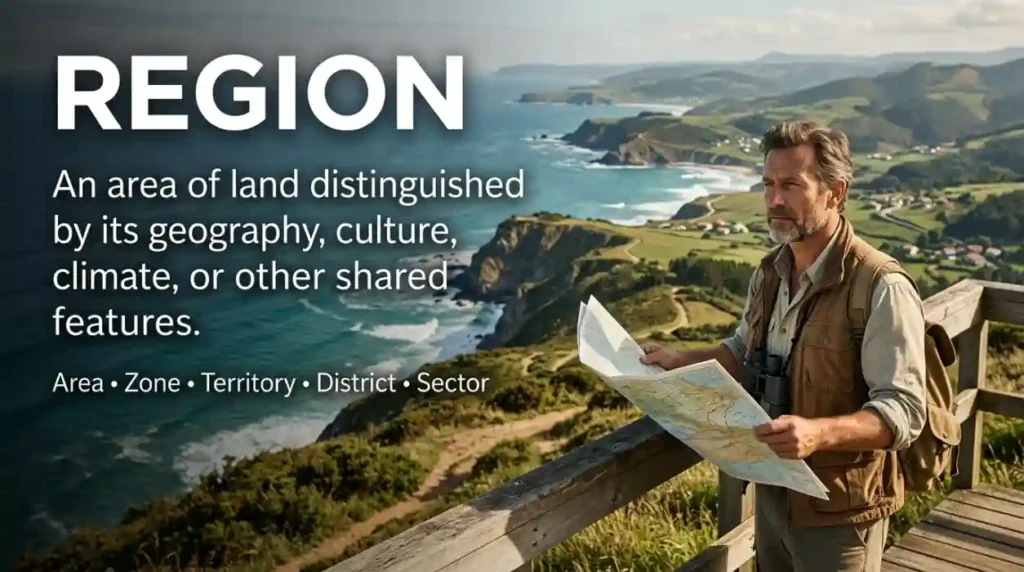
A synonym for region is area, zone, territory, district, sector, locality, or province. The best alternative depends on whether you are describing a geographical place, administrative division, or specific part of a larger area.
A synonym for region describes an area, territory, district, or part of a larger place. Common alternatives include area, zone, territory, district, and sector. The best choice depends on the location, purpose, and context.
Imagine describing a beautiful part of your country in an essay. You might use area in casual conversation, territory in a political discussion, or district when discussing local administration. Each word adds a slightly different meaning.
Synonyms for region help students, bloggers, and content writers avoid repetition. It also makes descriptions more precise and interesting. Learning these alternatives can improve everyday conversations and academic writing.
The word region appears in geography, business, travel, science, and daily English. Choosing the right synonym for region helps you describe places clearly, whether you are discussing a mountain region, a business area, or a specific part of a country.
What Does “Region” Really Mean?
A region is a particular area of land or space that has identifiable features, boundaries, or characteristics. It may be defined by geography, culture, climate, administration, or a specific purpose.
For example, the Middle East is a geographical and cultural region. A school district is an administrative area, while a tropical region is identified by its climate.
Part of speech
Noun
Pronunciation
- US: /ˈriː.dʒən/
- UK: /ˈriː.dʒən/
Syllables:
re-gion (2 syllables)
Affixation pattern
- Root: Region
- Prefix: None
- Suffix: None in the base word
Connotative Meaning
Connotation is the feeling or association a word creates beyond its basic dictionary meaning.
- Positive tone: A region may suggest natural beauty, cultural richness, or a thriving community.
- Negative tone: In certain contexts, it may refer to a conflict-affected or economically disadvantaged area.
- Neutral tone: It commonly identifies a geographical, administrative, or functional part of a larger space.
The word region is generally neutral. Its emotional meaning depends on the surrounding description.
Etymology and History of Region
The English word region comes through Old French region from Latin regio, meaning a direction, boundary, district, or territory. The Latin term is associated with regere, meaning “to guide” or “to rule.”
- Old English period (450–1100): The modern English word region was not an ordinary established term in Old English. Related ideas were expressed through native words for land, territory, and districts.
- Middle English period (1100–1500): The word entered English through Anglo-French and Latin-influenced vocabulary. It was used for a defined area or territory.
- Modern English period (1500–present): Its meaning expanded across geography, science, medicine, business, and general descriptions of space.
Today, region can describe anything from a large part of a continent to a specific part of the body or a computer system.
Synonyms List
The following alternatives are useful in different contexts. Some describe geographical places, while others refer to administrative boundaries, natural features, or specialized areas. Check each word’s meaning before replacing region in a sentence.
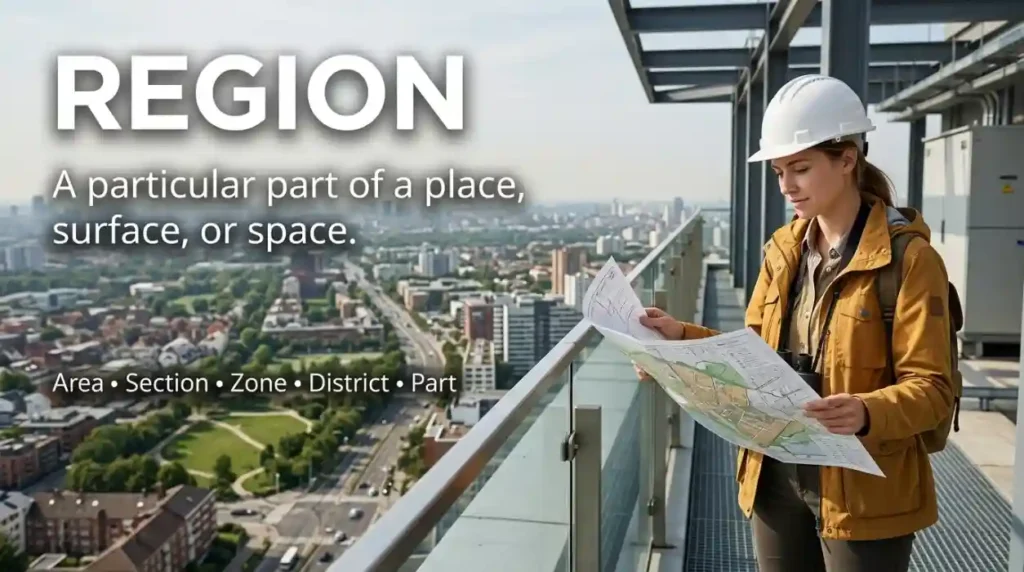
1. Area (Noun) — US /ˈer.i.ə/ | UK /ˈeə.ri.ə/
Meaning: A particular part of a place, surface, or space.
Tone/Register: Neutral; everyday and academic.
Examples:
- This area attracts many tourists during the summer.
- Our school serves families from the surrounding area.
2. Zone (Noun) — US /zoʊn/ | UK /zəʊn/
Meaning: An area designated for a particular purpose or characterized by specific conditions.
Tone/Register: Neutral; technical and administrative.
Examples:
- The city introduced a new parking zone.
- Farmers in this zone receive plenty of rainfall.
3. Territory (Noun) — US /ˈter.ə.tɔːr.i/ | UK /ˈter.ɪ.tər.i/
Meaning: An area of land under a particular authority or associated with a group.
Tone/Register: Formal; political and geographical.
Examples:
- The two countries disputed the territory for decades.
- The explorers mapped unfamiliar territory.
4. District (Noun) — US /ˈdɪs.trɪkt/ | UK /ˈdɪs.trɪkt/
Meaning: An area defined for administrative, commercial, or geographical purposes.
Tone/Register: Neutral to formal.
Examples:
- She works in the financial district downtown.
- The district opened a new public library.
5. Sector (Noun) — US /ˈsek.tɚ/ | UK /ˈsek.tə/
Meaning: A distinct part of a larger area, activity, or system.
Tone/Register: Formal; business and technical.
Examples:
- The northern sector experienced heavy rainfall.
- New investment is transforming the agricultural sector.
6. Locality (Noun) — US /loʊˈkæl.ə.t̬i/ | UK /ləʊˈkæl.ə.ti/
Meaning: A particular place or small geographical area.
Tone/Register: Formal; geographical.
Examples:
- Several rare birds inhabit this locality.
- Residents gathered at a nearby locality for the festival.
7. Place (Noun) — US /pleɪs/ | UK /pleɪs/
Meaning: A particular location or part of the world.
Tone/Register: Neutral; conversational.
Examples:
- This place is famous for its historic buildings.
- We discovered a quiet place near the river.
8. Tract (Noun) — US /trækt/ | UK /trækt/
Meaning: An extensive area of land, often considered as a single unit.
Tone/Register: Formal; geographical and legal.
Examples:
- The family owns a large tract of farmland.
- A vast tract of forest remains untouched.
9. Expanse (Noun) — US /ɪkˈspæns/ | UK /ɪkˈspæns/
Meaning: A wide, continuous stretch of land, water, or another surface.
Tone/Register: Descriptive; literary and neutral.
Examples:
- An endless expanse of desert surrounded the village.
- We watched the sunset over a blue expanse of water.
10. Stretch (Noun) — US /stretʃ/ | UK /stretʃ/
Meaning: A continuous length or portion of land, road, or water.
Tone/Register: Neutral; conversational.
Examples:
- This stretch of coastline is popular with swimmers.
- A quiet stretch of road leads to the village.
11. Part (Noun) — US /pɑːrt/ | UK /pɑːt/
Meaning: One portion of a larger place or whole.
Tone/Register: Neutral; everyday.
Examples:
- The eastern part of the city is growing quickly.
- Heavy snow covered parts of the region.
12. Section (Noun) — US /ˈsek.ʃən/ | UK /ˈsek.ʃən/
Meaning: A distinct portion of a larger area or structure.
Tone/Register: Neutral to formal.
Examples:
- The northern section of the park is closed.
- This section of the coastline has rocky cliffs.
13. Quarter (Noun) — US /ˈkwɔːr.t̬ɚ/ | UK /ˈkwɔː.tə/
Meaning: A part of a town or city, often associated with a particular character or community.
Tone/Register: Neutral; urban and cultural.
Examples:
- Artists gathered in the old quarter of the city.
- The historic quarter attracts visitors throughout the year.
14. Division (Noun) — US /dɪˈvɪʒ.ən/ | UK /dɪˈvɪʒ.ən/
Meaning: A distinct part created by separating a larger area into sections.
Tone/Register: Formal; administrative and technical.
Examples:
- The state is divided into several administrative divisions.
- Each division follows its own planning guidelines.
15. Province (Noun) — US /ˈprɑː.vɪns/ | UK /ˈprɒv.ɪns/
Meaning: A major administrative area within a country.
Tone/Register: Formal; political and geographical.
Examples:
- The province is known for its fertile farmland.
- She moved to another province for university.
16. State (Noun) — US /steɪt/ | UK /steɪt/
Meaning: A constituent political unit within a country, or a defined territorial entity.
Tone/Register: Neutral; political and administrative.
Examples:
- The state introduced new environmental regulations.
- They traveled across the state during their vacation.
17. County (Noun) — US /ˈkaʊn.t̬i/ | UK /ˈkaʊn.ti/
Meaning: An administrative or geographical area within a country or state.
Tone/Register: Neutral; administrative.
Examples:
- The county maintains several rural roads.
- Her family has lived in the county for generations.
18. Borough (Noun) — US /ˈbɝː.oʊ/ | UK /ˈbʌr.ə/
Meaning: A town or urban administrative division, depending on the country’s system.
Tone/Register: Administrative; location-specific.
Examples:
- The borough organized a community cleanup.
- Their apartment is in a lively London borough.
19. Municipality (Noun) — US /mjuːˌnɪs.əˈpæl.ə.t̬i/ | UK /mjuːˌnɪs.ɪˈpæl.ə.ti/
Meaning: A town, city, or local administrative unit with its own governing authority.
Tone/Register: Formal; governmental.
Examples:
- The municipality improved its public transport system.
- Each municipality manages its local services.
20. Precinct (Noun) — US /ˈpriː.sɪŋkt/ | UK /ˈpriː.sɪŋkt/
Meaning: A defined area used for administrative, electoral, or policing purposes.
Tone/Register: Formal; official.
Examples:
- Voters gathered at their assigned precinct.
- Police increased patrols throughout the precinct.
21. Jurisdiction (Noun) — US /ˌdʒʊr.ɪsˈdɪk.ʃən/ | UK /ˌdʒʊə.rɪsˈdɪk.ʃən/
Meaning: An area or domain in which an authority has legal power.
Tone/Register: Formal; legal and governmental.
Examples:
- The case falls under federal jurisdiction.
- The agency operates across several jurisdictions.
22. Domain (Noun) — US /doʊˈmeɪn/ | UK /dəʊˈmeɪn/
Meaning: An area of control, knowledge, activity, or influence; sometimes a territory.
Tone/Register: Formal; academic and technical.
Examples:
- Wildlife conservation remains within the agency’s domain.
- The research explores a new domain of science.
23. Realm (Noun) — US /relm/ | UK /relm/
Meaning: A particular field of activity or an area under a ruler’s control.
Tone/Register: Formal or literary.
Examples:
- The discovery opened new possibilities in the realm of medicine.
- The king expanded his realm through alliances.
24. Sphere (Noun) — US /sfɪr/ | UK /sfɪə/
Meaning: A distinct field of influence, activity, or interest.
Tone/Register: Formal; abstract and academic.
Examples:
- Technology has changed the sphere of education.
- Her influence extends across the sphere of public health.
25. Field (Noun) — US /fiːld/ | UK /fiːld/
Meaning: An area of study, work, or activity, rather than necessarily a physical region.
Tone/Register: Neutral to formal.
Examples:
- He hopes to build a career in the field of medicine.
- Researchers are exploring a new field of genetics.
26. Belt (Noun) — US /belt/ | UK /belt/
Meaning: A broad geographical strip distinguished by a shared feature.
Tone/Register: Geographical; descriptive.
Examples:
- The cotton belt supports many farming communities.
- A green belt separates the town from nearby suburbs.
27. Corridor (Noun) — US /ˈkɔːr.ə.dɔːr/ | UK /ˈkɒr.ɪ.dɔː/
Meaning: A long, narrow area connecting places or providing a route through a larger area.
Tone/Register: Technical; transport and geography.
Examples:
- The railway corridor connects three major cities.
- Wildlife moves through a protected mountain corridor.
28. Basin (Noun) — US /ˈbeɪ.sən/ | UK /ˈbeɪ.sən/
Meaning: A geographical area where water drains toward a common river, lake, or sea.
Tone/Register: Scientific; geographical.
Examples:
- Heavy rain filled the river basin.
- Farmers depend on water from the surrounding basin.
29. Valley (Noun) — US /ˈvæl.i/ | UK /ˈvæl.i/
Meaning: A low area of land between hills or mountains, often containing a river.
Tone/Register: Neutral; geographical.
Examples:
- A small farming community occupies the valley.
- Mist covered the valley before sunrise.
30. Plateau (Noun) — US /plæˈtoʊ/ | UK /ˈplæt.əʊ/
Meaning: An elevated area of relatively flat land.
Tone/Register: Scientific; geographical.
Examples:
- The village stands on a rocky plateau.
- Temperatures drop sharply across the plateau at night.
31. Highlands (Noun) — US /ˈhaɪ.lændz/ | UK /ˈhaɪ.ləndz/
Meaning: An extensive area of elevated or mountainous land.
Tone/Register: Geographical; descriptive.
Examples:
- The Scottish Highlands attract hikers every year.
- Small settlements dot the remote highlands.
32. Lowlands (Noun) — US /ˈloʊ.lændz/ | UK /ˈləʊ.ləndz/
Meaning: Areas of land at relatively low elevations.
Tone/Register: Geographical; descriptive.
Examples:
- Flooding affected several lowland communities.
- Rice grows well across the fertile lowlands.
33. Coast (Noun) — US /koʊst/ | UK /kəʊst/
Meaning: The land along the edge of a sea or ocean.
Tone/Register: Neutral; geographical.
Examples:
- Fishing villages line the southern coast.
- Strong winds battered the coast overnight.
34. Hinterland (Noun) — US /ˈhɪn.t̬ɚ.lænd/ | UK /ˈhɪn.tə.lænd/
Meaning: The inland area behind a coast or surrounding a major town or trading center.
Tone/Register: Formal; geographical and economic.
Examples:
- The port serves farms throughout the hinterland.
- Roads connect remote hinterland communities to the city.
35. Frontier (Noun) — US /frʌnˈtɪr/ | UK /frʌnˈtɪə/
Meaning: A border between territories or the outer edge of settled or explored land.
Tone/Register: Historical; political and descriptive.
Examples:
- Traders crossed the frontier to reach new markets.
- The expedition explored the country’s northern frontier.
36. Borderland (Noun) — US /ˈbɔːr.dɚ.lænd/ | UK /ˈbɔː.də.lænd/
Meaning: An area located near or between political or geographical borders.
Tone/Register: Geographical; historical and descriptive.
Examples:
- The borderland has traditions shared by both countries.
- Merchants once traveled through this remote borderland.
37. Subregion (Noun) — US /ˈsʌbˌriː.dʒən/ | UK /ˈsʌbˌriː.dʒən/
Meaning: A smaller geographical or administrative unit within a larger region.
Tone/Register: Formal; academic and technical.
Examples:
- The study compares rainfall across each subregion.
- This subregion supports several rare plant species.
38. Subdivision (Noun) — US /ˌsʌb.dɪˈvɪʒ.ən/ | UK /ˌsʌb.dɪˈvɪʒ.ən/
Meaning: A smaller part of a larger administrative area or a planned section of land.
Tone/Register: Formal; administrative and real estate.
Examples:
- The subdivision includes several residential streets.
- Officials reviewed the boundaries of the administrative subdivision.
39. Canton (Noun) — US /ˈkæn.tən/ | UK /ˈkæn.tɒn/
Meaning: An administrative territorial unit in certain countries, including Switzerland.
Tone/Register: Formal; political and geographical.
Examples:
- Each Swiss canton has its own constitution.
- The canton supports local schools and transport services.
40. Department (Noun) — US /dɪˈpɑːrt.mənt/ | UK /dɪˈpɑːt.mənt/
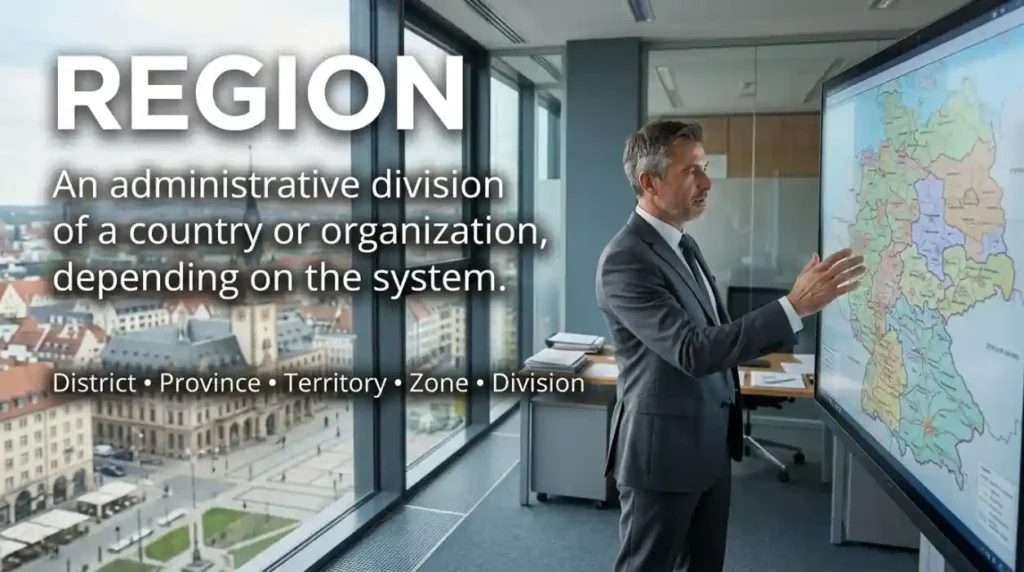
Meaning: An administrative division of a country or organization, depending on the system.
Tone/Register: Formal; administrative.
Examples:
- The French department introduced new transport policies.
- The department coordinates services across the territory.
41. Parish (Noun) — US /ˈper.ɪʃ/ | UK /ˈpær.ɪʃ/
Meaning: A local administrative or ecclesiastical area, depending on the country.
Tone/Register: Formal; religious and administrative.
Examples:
- The parish maintains several historic buildings.
- Residents attended a meeting at the parish hall.
42. Ward (Noun) — US /wɔːrd/ | UK /wɔːd/
Meaning: A division of a city or town used for local administration or elections.
Tone/Register: Administrative; neutral.
Examples:
- The candidate visited every ward before the election.
- A new clinic opened in the eastern ward.
43. Neighborhood (Noun) — US /ˈneɪ.bɚ.hʊd/ | UK /ˈneɪ.bə.hʊd/
Meaning: A local area within a town or city, often associated with a community.
Tone/Register: Neutral; everyday.
Examples:
- The neighborhood holds a street festival every spring.
- A new grocery store opened in our neighborhood.
44. Enclave (Noun) — US /ˈen.kleɪv/ | UK /ˈɒŋ.kleɪv/
Meaning: A distinct area or community surrounded by a different geographical or cultural setting.
Tone/Register: Formal; geographical and cultural.
Examples:
- The historic enclave preserves its traditional architecture.
- The coastal enclave attracts artists and writers.
45. Outskirts (Noun) — US /ˈaʊt.skɝːts/ | UK /ˈaʊt.skɜːts/
Meaning: The outer parts of a town or city.
Tone/Register: Neutral; everyday.
Examples:
- Their new home lies on the outskirts of Lahore.
- Factories occupy much of the city’s outskirts.
46. Countryside (Noun) — US /ˈkʌn.tri.saɪd/ | UK /ˈkʌn.tri.saɪd/
Meaning: Rural land and the areas outside large towns and cities.
Tone/Register: Neutral; descriptive.
Examples:
- The countryside becomes especially green after the monsoon.
- They spent the weekend exploring the peaceful countryside.
47. Landscape (Noun) — US /ˈlænd.skeɪp/ | UK /ˈlænd.skeɪp/
Meaning: An area of land viewed in terms of its visible natural or human-made features.
Tone/Register: Descriptive; geographical and artistic.
Examples:
- Wind turbines have changed the local landscape.
- The desert landscape looks different after rainfall.
48. Terrain (Noun) — US /təˈreɪn/ | UK /təˈreɪn/
Meaning: An area of land considered in terms of its physical features.
Tone/Register: Technical; geographical and outdoor activities.
Examples:
- Mountainous terrain makes travel difficult during winter.
- The team studied the terrain before choosing a route.
49. Provincelet (Noun) — US /ˌprɑː.vɪnsˈlet/ | UK /ˌprɒv.ɪnsˈlet/
Meaning: A rare, nonstandard diminutive that may suggest a small province, but is not a common general synonym for region.
Tone/Register: Rare; avoid in ordinary writing.
Examples:
- The writer invented a tiny provincelet for a fictional kingdom.
- Use province or subregion in standard geographical writing instead.
50. Precincts (Noun, plural) — US /ˈpriː.sɪŋkts/ | UK /ˈpriː.sɪŋkts/
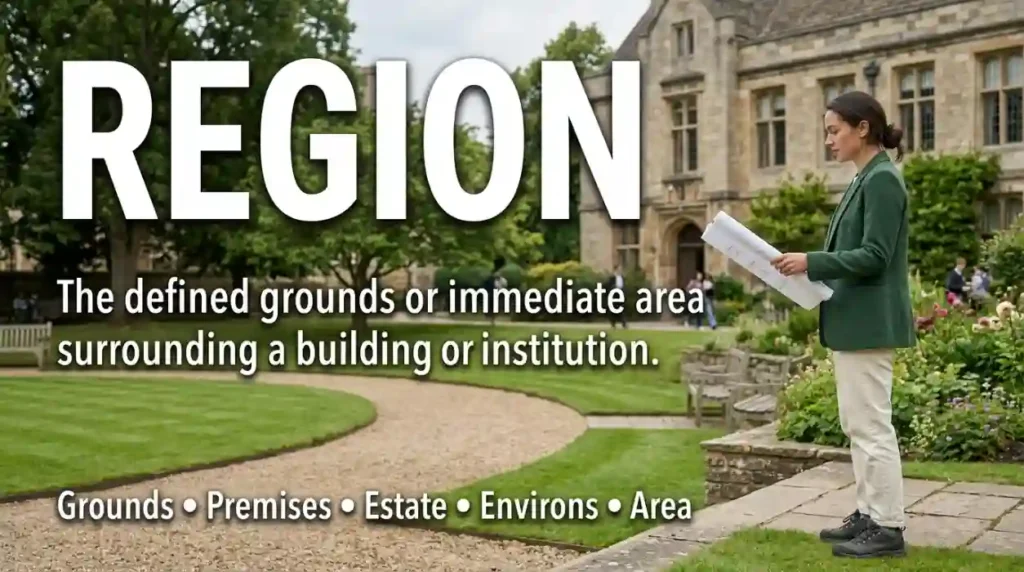
Meaning: The defined grounds or immediate area surrounding a building or institution.
Tone/Register: Formal; institutional and descriptive.
Examples:
- Visitors must remain within the museum precincts.
- Security guards patrol the hospital precincts at night.
Usage note: Provincelet is not a standard, commonly used alternative. It is included to clarify a rare formation, not as a recommended synonym. For practical writing, prefer the other entries and choose alternatives that match the intended meaning.
Synonyms by Tone
The tone of a synonym can change how readers understand a place. Use these groups to select a word that fits your message.
Positive Synonyms
These words can create an appealing or descriptive impression when used in the right context.
- Countryside: Suggests rural beauty and open spaces.
- Landscape: Highlights the visual character of a place.
- Valley: Can evoke peaceful natural surroundings.
- Enclave: May suggest a distinctive community or cultural setting.
- Locality: Can sound precise and professional.
Neutral Synonyms
These words identify places without adding a strong emotional judgment.
- Area: Suitable for everyday conversation.
- Zone: Useful for designated spaces.
- District: Appropriate for administrative divisions.
- Section: Useful for a specific part of a larger place.
- Territory: Suitable for geographical and political descriptions.
- Neighborhood: Ideal for local communities.
- Subregion: Useful in academic and geographical writing.
Negative or Sensitive Contexts
These words are not inherently negative, but they can describe places associated with difficulties or conflict.
- Frontier: May suggest a contested or remote boundary.
- Borderland: Can evoke political tension or cultural divisions.
- Outskirts: May imply distance from a busy city center.
- Hinterland: Can suggest an isolated inland area, depending on context.
- Precinct: May sound official or restrictive in some settings.
Formal and Technical Alternatives
Use these terms when precision matters.
- Jurisdiction: Emphasizes legal authority.
- Municipality: Refers to local government.
- Basin: Identifies a geographical drainage area.
- Sector: Highlights a defined portion of a system.
- Province: Names an administrative unit.
- Terrain: Describes physical land features.
Playful or Informal Alternatives
English does not have many playful words that directly replace region. In casual conversation, use familiar expressions such as part of town, neck of the woods, or around here.
For example, “I grew up in this neck of the woods” sounds friendly and conversational. It is an idiom, not a precise geographical term.
“Region” vs. Close Alternatives
Some synonyms overlap in meaning but cannot be used interchangeably in every sentence.
| Word | Main difference | Best use |
|---|---|---|
| Region | A broad area identified by shared features or boundaries | Geography, climate, culture |
| Area | A general portion of land or space | Everyday conversation and simple descriptions |
| Territory | Land associated with control, ownership, or political boundaries | Government, history, and law |
| District | A defined administrative or functional division | Local government, business, and urban planning |
| Zone | An area designated for a particular purpose | Safety, climate, transport, and planning |
Example comparison
- “The region has a dry climate.” This describes a broad geographical area.
- “The area around my house is quiet.” This identifies a general local place.
- “The territory is disputed.” This emphasizes control or ownership.
- “The district opened a school.” This refers to an administrative unit.
- “The area is a restricted zone.” This highlights a designated purpose.
The best synonym is the one that preserves your intended meaning.
How Region Synonyms Change by Context
Daily Conversation
In everyday English, area, place, part, and neighborhood are usually the most natural choices. They help you describe where you live, shop, work, or travel without sounding overly formal.
Instead of saying, “This region has many restaurants,” you could say, “This area has many restaurants.”
Writing and Blogging
Bloggers often use region, area, district, landscape, and locality to make descriptions more varied. The best word depends on the article’s topic.
A travel blog might describe a beautiful landscape, while a food blog might discuss regional dishes or a particular locality’s cuisine.
Professional and Academic Writing
In reports, research papers, and business documents, sector, jurisdiction, subregion, and territory can offer greater precision.
For example, a climate researcher may compare rainfall across several subregions. A legal report may discuss the limits of a particular jurisdiction.
Creative and Informal Writing
Stories often benefit from descriptive words such as expanse, valley, highlands, and borderland. These words can help readers picture a setting.
In casual dialogue, expressions such as neck of the woods may sound more natural than formal geographical terms.
Common Mistakes Learners Make
Choosing a synonym for region requires more than finding a word with a similar dictionary definition. You must also consider its boundaries, purpose, and tone.
Using territory for every place
Territory often suggests control, ownership, or political boundaries. It may sound incorrect when you simply mean a neighborhood.
Confusing district with zone
A district often has administrative or functional boundaries. A zone is commonly designated for a particular purpose.
Using terrain to mean any location
Terrain describes the physical characteristics of land, not simply a place where people live.
Treating every alternative as interchangeable
A basin is a particular geographical formation. A municipality is a local administrative unit. Neither fits every use of region.
Overusing formal vocabulary:
Replacing every instance of area with jurisdiction or territory can make simple writing harder to understand.
Register Notes: Formal vs. Informal
Formal: Jurisdiction, subregion, municipality, locality, and sector.
Informal or everyday: Area, place, part, and neighborhood.
Spoken English: People commonly use area and part of town in conversation.
Written English: The right word depends on the document. Academic writing may need subregion, while a travel story may work better with landscape.
For additional vocabulary practice, you can explore related synonym pages on your own vocabulary website and compare how different words work in real sentences.
Real-Life Examples Using Region Synonyms
Workplace
A sales manager reviews performance across each district. The word communicates a defined business or administrative area.
Social situations
A new resident explores the neighborhood to find a café and grocery store. This sounds more natural than using territory.
Media and current affairs
A reporter describes tensions in a borderland. The word highlights the area’s position near a border.
Writing and storytelling
A novelist sets a story in a peaceful valley. This specific geographical term creates a clearer mental picture.
Practice Exercise
1. The city created a special area where cars are restricted.
A. Valley
B. Zone
C. Terrain
D. Realm
2. The lawyer explained which court had legal authority over the case.
A. Jurisdiction
B. Landscape
C. Countryside
D. Expanse
3. We moved into a friendly area with parks and local shops.
A. Frontier
B. Basin
C. Neighborhood
D. Sector
4. The river carries water from the entire drainage.
A. Quarter
B. Basin
C. Borough
D. Precinct
5. The company divided its sales map into four businesses.
A. Valleys
B. Coasts
C. Sectors
D. Highlands
6. The hikers crossed a flat, elevated stretch of land.
A. Plateau
B. Municipality
C. Ward
D. Enclave
7. The two countries argued over control of the.
A. Locality
B. Territory
C. Landscape
D. Section
8. The rural area is full of farms and open fields.
A. Jurisdiction
B. Precinct
C. Countryside
D. Corridor
9. The historic part of the city has old shops and narrow streets.
A. Quarter
B. Terrain
C. Basin
D. Sector
10. Researchers divided the larger geographical area into smaller.
A. Frontiers
B. Subregions
C. Outskirts
D. Realms
Answer Key:
- B. Zone
- A. Jurisdiction
- C. Neighborhood
- B. Basin
- C. Sectors
- A. Plateau
- B. Territory
- C. Countryside
- A. Quarter
- B. Subregions
Reflection Task:
Write one sentence about your hometown, a place you visited, or an area you want to explore. Use one synonym for region and explain why it fits your sentence.
Frequently Asked Questions
1. What is the best synonym for region in academic writing?
The best synonym depends on the subject. Use subregion when discussing a smaller geographical unit, territory when examining land and political control, or sector when analyzing a defined part of a system. For general descriptions, area is often the clearest choice. Always select a term that matches your research and preserves the intended meaning.
2. What is another word for a region within a country?
Common alternatives include province, state, county, district, and municipality. The correct choice depends on the country’s administrative structure. For example, provinces are used in Pakistan and Canada, while states are important administrative units in the United States and India. These terms are not interchangeable because each has a specific governmental meaning.
3. What is a synonym for region in geography?
Geographical alternatives include area, territory, zone, basin, valley, plateau, and subregion. Each describes a different kind of place. A basin is defined by drainage patterns, while a plateau is elevated, relatively flat land. For a broad geographical description without a specific landform or boundary, area or territory may be more appropriate.
4. What word describes a region with similar climate or natural features?
The word zone often describes an area with shared environmental conditions, such as a climatic zone or vegetation zone. Belt can describe a broad geographical strip with a common feature, such as a forest belt. The best term depends on whether you are emphasizing climate, vegetation, landforms, or another shared characteristic.
5. What is the difference between a region and a locality?
A region usually refers to a broader area identified by geographical, cultural, climatic, or administrative features. A locality generally means a particular place or smaller geographical area. For example, a country may contain several regions, each with numerous localities. However, the precise size of either area depends on the context.
6. Can I use area instead of region in an essay?
Yes. Area is a useful alternative when you want a simple, natural expression. For example, “The region receives heavy rainfall” can become “The area receives heavy rainfall.” However, if your essay discusses a recognized cultural region or an officially defined administrative unit, retaining region may be more precise.
7. How can I avoid repeating the word region in an article?
First, identify what region means in each sentence. Then choose an alternative that preserves that meaning, such as district for an administrative division, zone for a designated area, or landscape for visible geographical features. You can also restructure sentences to improve flow. Avoid replacing every occurrence mechanically, because natural repetition is sometimes clearer than an inaccurate synonym.
Conclusion
Learning a synonym for region helps you describe places with greater accuracy. Words such as area, district, and territory make your writing clearer and more expressive.
Students, bloggers, and content writers can use these alternatives to improve essays, travel articles, reports, and everyday communication. Each word adds a slightly different meaning.
The best vocabulary choices depend on context. Practice using these synonyms in emails, essays, and daily conversations to develop confidence and express your ideas naturally.
Choose three new words from this guide and write your own sentences today. Regular practice will help you build a stronger vocabulary and communicate more effectively.
Suggested External Resource
For an authoritative definition, pronunciation, and usage examples, consult the Cambridge Dictionary entry for the region: Cambridge Dictionary Region.
Merriam-Webster Dictionary Region: Explore the definition, synonyms, and related word meanings.

Jameel Hassan is the founder and lead writer at SynonymsCloud.com, a trusted online platform dedicated to English vocabulary and effective communication. He is passionate about helping students, writers, professionals, and lifelong learners discover the right words to express their ideas with clarity, precision, and confidence.
At SynonymsCloud.com, every article is thoroughly researched and carefully written to provide accurate, practical, and easy-to-understand guidance on synonyms, antonyms, word meanings, idioms, and vocabulary. With a strong commitment to quality, real-world usage, and clear explanations, the website helps readers expand their vocabulary, improve their writing, and communicate more effectively in both academic and professional settings.