

Common synonyms for chopping include dicing, slicing, mincing, cubing, hacking, severing, cleaving, cutting, and hacking. In cooking, dicing and mincing refer to fine cuts, whereas cleaving or severing usually denotes heavier, full-force cuts through wood or meat.
Synonyms for Chopping expand your active vocabulary by helping you describe cutting actions with clear, vivid detail. Imagine quickly slicing onions while preparing a family dinner.
You might say a chef is dicing vegetables, mincing garlic, or chopping herbs. Exploring synonyms for chopping gives your writing more precise ways to describe movement, speed, tools, and materials.
Using varied action verbs prevents repetitive descriptions in culinary blogs, creative essays, stories, and everyday conversations. Native speakers naturally choose different words depending on the cutting action, object, and level of force involved.
Learning versatile synonyms for chopping can benefit students, bloggers, copywriters, and language learners. These alternatives transform generic sentences into dynamic, precise, and engaging English while making your descriptions sharper and more expressive.
What Does “Chopping” Really Mean?
Chopping refers to cutting something into pieces with repeated sharp blows using an edged tool like a knife, axe, or cleaver. It also describes reducing size, cutting down costs, or making quick downward physical strikes.
Native speakers understand it as a fundamental action in cooking, woodworking, sports, and budgeting contexts. It appears routinely in recipe instructions, news headlines, financial reports, and casual conversations.
Part of Speech: Verb (present participle/gerund) or Noun
Definition: The act of cutting, severing, or dividing something forcefully using a sharp instrument.
Connotative Meaning
Connotation is the emotional tone, cultural association, or secondary feeling a word carries beyond its literal dictionary definition.
- Positive tone: Expresses rhythmic culinary skill, efficiency, prep work, and active craftsmanship.
- Negative tone: Implies violent severing, harsh budget cuts, destruction, or rough damage.
- Neutral tone: States an objective physical task or mechanical processing action without emotion.
Etymology
- Origin: Derived from Middle English choppen or chapen, related to Old French choper (to stumble or strike).
- Old English (450–1100): Early Germanic roots linked to ceorfan (to carve or cut) and heavy striking tools.
- Middle English (1100–1500): Formed choppen, specifically denoting quick, sharp downward hacking strikes.
- Modern English (1500–Present): Expanded from woodcutting to culinary dicing and metaphorical cost reductions.
Syllables
chop-ping
Affixation Pattern
- Root: Chop
- Suffix: ing (present participle/gerund inflection)
Synonyms List
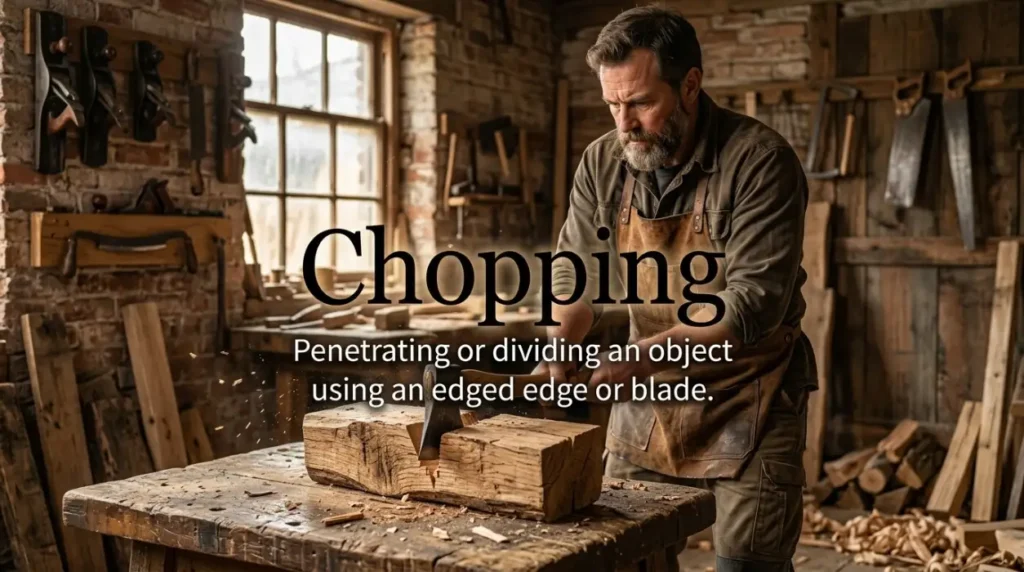
1. Cutting (Verb / Noun)
Meaning: Penetrating or dividing an object using an edged edge or blade.
Tone/Register: General / Universal
Example 1: She is cutting fresh sourdough bread for dinner guests.
Example 2: The gardener spent two hours cutting overgrown rose stalks.
2. Slicing (Verb / Noun)
Meaning: Cutting something into thin, flat, uniform pieces.
Tone/Register: Casual / Practical
Example 1: He was slicing juicy tomatoes for lunch sandwiches.
Example 2: The machine started slicing deli meats at high speed.
3. Dicing (Verb / Noun)
Meaning: Cutting food items into small, uniform square cubes.
Tone/Register: Culinary / Informative
Example 1: The line cook spent thirty minutes dicing yellow onions.
Example 2: Dicing carrots evenly ensures they cook at the same rate.
4. Mincing (Verb / Noun)
Meaning: Cutting or grinding food into tiny, delicate pieces.
Tone/Register: Culinary / Specific
Example 1: She began mincing fresh garlic cloves on a wooden board.
Example 2: Mincing herbs releases intense natural oils for the sauce.
5. Hacking (Verb / Noun)
Meaning: Cutting roughly or heavy-handedly with repeated rough blows.
Tone/Register: Informal / Aggressive
Example 1: The worker kept hacking dense jungle brush with a machete.
Example 2: Someone was hacking dry firewood behind the cabin.
6. Cleaving (Verb / Noun)
Meaning: Splitting or severing something powerfully along a natural grain or structure.
Tone/Register: Formal / Literary
Example 1: The butcher was cleaving heavy bone joints with ease.
Example 2: Lightning split the sky, cleaving the ancient oak in half.
7. Hewing (Verb / Noun)
Meaning: Shaping or felling large timber items using heavy ax strikes.
Tone/Register: Historical / Rustic
Example 1: Early settlers were hewing thick timber logs for cabins.
Example 2: Stonemasons spent months hewing granite blocks for walls.
8. Severing (Verb / Noun)
Meaning: Cutting off or separating with a decisive slice.
Tone/Register: Formal / Dramatic
Example 1: The surgeon worked carefully, severing damaged muscle fibers.
Example 2: Storm winds ended up severing power lines across town.
9. Trimming (Verb / Noun)
Meaning: Cutting away unwanted, irregular, or excess outer parts.
Tone/Register: Practical / Daily
Example 1: He enjoyed trimming hedge branches every spring morning.
Example 2: The butcher was trimming excess fat off beef steaks.
10. Lopping (Verb / Noun)
Meaning: Cutting branches or unwanted parts off trees or plants forcefully.
Tone/Register: Agricultural / Outdoor
Example 1: Landscapers started lopping dead pine limbs near rooflines.
Example 2: She spent Sunday lopping thick brambles along garden paths.
11. Whittling (Verb / Noun)
Meaning: Carving wood into shapes by shaving off small slivers repeatedly.
Tone/Register: Artistic / Leisurely
Example 1: Grandfather sat whittling small pine figurines on the porch.
Example 2: He kept whittling stick ends to sharp points for roasting.
12. Carving (Verb / Noun)
Meaning: Shaping material or slicing cooked meat into artistic portions.
Tone/Register: Culinary / Creative
Example 1: Uncle Mark was carving roasted turkey at holiday dinner.
Example 2: Sculptors enjoy carving soft marble into smooth forms.
13. Julienning (Verb / Noun)
Meaning: Cutting vegetables into long, very thin matchstick strips.
Tone/Register: Culinary / Professional
Example 1: The chef began julienning crisp bell peppers for stir-fry.
Example 2: Julienne carrots takes patience and a sharp chef’s knife.
14. Cubing (Verb / Noun)
Meaning: Cutting food into medium or large square blocks.
Tone/Register: Culinary / Practical
Example 1: Mom was cubing cheddar cheese for afternoon snacks.
Example 2: Try cubing firm tofu before frying it in sesame oil.
15. Chipping (Verb / Noun)
Meaning: Breaking or cutting small fragments off a hard surface.
Tone/Register: Industrial / Descriptive
Example 1: Workers were chipping old paint off iron railings.
Example 2: Hailstones kept chipping tree bark during the ice storm.
16. Slashing (Verb / Noun)
Meaning: Cutting with long, sweeping, violent, or sudden strokes.
Tone/Register: Dramatic / Intense
Example 1: He was slashing through tangled vines along river banks.
Example 2: Retailers are slashing product prices for seasonal sales.
17. Shredding (Verb / Noun)
Meaning: Tearing or cutting material into long, narrow ribbons.
Tone/Register: Universal / Practical
Example 1: The machine was shredding confidential financial records quickly.
Example 2: She started shredding cabbage heads for spicy coleslaw.
18. Snapping (Verb / Noun)
Meaning: Breaking or severing brittle items sharply with sudden pressure.
Tone/Register: Casual / Audible
Example 1: Cooks were snapping woody stems off green asparagus.
Example 2: Children enjoyed snapping dry twigs for bonfire kindling.
19. Splitting (Verb / Noun)
Meaning: Dividing something forcefully into two or more pieces along lines.
Tone/Register: General / Physical
Example 1: He is splitting heavy oak logs for winter fireplace burning.
Example 2: The earthquake began splitting paved roads down the center lines.
20. Truncating (Verb / Noun)
Meaning: Shortening or cutting off top or end sections cleanly.
Tone/Register: Academic / Technical
Example 1: Editors began truncating long paragraphs to fit print limits.
Example 2: Software code is truncating numerical digits past decimals.
21. Pruning (Verb / Noun)
Meaning: Trimming plant stems or branches to improve future growth.
Tone/Register: Horticultural / Caretaking
Example 1: The gardener was pruning fruit trees before late spring blossoms.
Example 2: Pruning weak stems helps bushes grow fuller flowers.
22. Cropping (Verb / Noun)
Meaning: Cutting short or trimming edges off digital images or plants.
Tone/Register: Technical / Visual
Example 1: Designers were cropping background elements off photos.
Example 2: Sheep were cropping lush green grass in mountain pastures.
23. Paring (Verb / Noun)
Meaning: Cutting away thin outer skins or edges off fruits and vegetables.
Tone/Register: Culinary / Precise
Example 1: Grandmother was paring yellow apples for pie filling.
Example 2: The firm is paring operational expenses across all branches.
24. Dissecting (Verb / Noun)
Meaning: Cutting open or dividing body structures or arguments systematically.
Tone/Register: Scientific / Formal
Example 1: Students were dissecting preserved specimens in biology class.
Example 2: Analysts were dissecting quarterly market reports carefully.
25. Slitting (Verb / Noun)
Meaning: Making long, narrow straight cuts in a material surface.
Tone/Register: Practical / Specific
Example 1: Postal workers were slitting paper envelopes open with mail openers.
Example 2: The baker began slitting bread dough tops before baking.
26. Gouging (Verb / Noun)
Meaning: Cutting or scooping deep, deep grooves out forcefully.
Tone/Register: Rough / Physical
Example 1: The chisel was gouging channels into oak timber.
Example 2: Heavy machinery ended up gouging deep ruts in mud.
27. Sashing (Verb / Noun)
Meaning: Cutting or dividing material along decorative panel lines.
Tone/Register: Craft / Niche
Example 1: Quilters were sashing colorful fabric squares together nicely.
Example 2: The carpenter spent hours sashing wooden window frames.
28. Scything (Verb / Noun)
Meaning: Cutting tall grass or grain with long, sweeping curved blade movements.
Tone/Register: Traditional / Agricultural
Example 1: Farmers were scything tall wheat fields under the hot sun.
Example 2: Mowers enjoyed scything overgrown meadow grass manually.
29. Shearing (Verb / Noun)
Meaning: Cutting wool off sheep or slicing metal sheets with heavy blades.
Tone/Register: Agricultural / Industrial
Example 1: Ranchers were shearing thick wool off the flock of sheep.
Example 2: Hydraulic shears started shearing steel plates in factories.
30. Snipping (Verb / Noun)
Meaning: Cutting items with small, light, quick scissor strokes.
Tone/Register: Light / Everyday
Example 1: The florist was snipping stem ends before placing roses in water.
Example 2: Tailors enjoyed snipping loose threads off jacket cuffs.
31. Clipping (Verb / Noun)
Meaning: Fastening or cutting short using shears, clippers, or scissors.
Tone/Register: Everyday / Maintenance
Example 1: The barber was clipping hair short around ear lines.
Example 2: She spent hours clipping newspaper articles for scrapbooks.
32. Nipping (Verb / Noun)
Meaning: Pinching or cutting off small tips quickly with sharp tools.
Tone/Register: Casual / Quick
Example 1: Frost was nipping delicate young tomato plant sprouts.
Example 2: The gardener was nipping dead flower buds off stems.
33. Cleaving off (Verb / Noun)
Meaning: Separating an entire section off through heavy splitting strikes.
Tone/Register: Dramatic / Literary
Example 1: Glacier movement was cleaving off gigantic icebergs into seawater.
Example 2: Axes were cleaving off thick branches from fallen trees.
34. Axing (Verb / Noun)
Meaning: Cancelling projects or cutting staff budgets suddenly and harshly.
Tone/Register: Informal / Corporate
Example 1: Executives were axing underperforming software development projects.
Example 2: Studio bosses started axing budget lines for television shows.
35. Lacerating (Verb / Noun)
Meaning: Tearing or cutting flesh or tissue jaggedly and painfully.
Tone/Register: Clinical / Dramatic
Example 1: Sharp thorns were lacerating his hands during trail maintenance.
Example 2: Broken glass ended up lacerating boot leather surfaces.

36. Mowing (Verb / Noun)
Meaning: Cutting down grass or crops over large areas mechanically.
Tone/Register: Practical / Domestic
Example 1: Neighbors were mowing suburban lawns on Saturday mornings.
Example 2: Tractors started mowing clover fields before summer storms.
37. Chiffonading (Verb / Noun)
Meaning: Shredding leafy green vegetables into ultra-thin ribbon strips.
Tone/Register: Culinary / Specialized
Example 1: The chef was chiffonading fresh basil leaves over warm pasta.
Example 2: Try chiffonading spinach leaves for delicate soup garnishes.
38. Macheteing (Verb / Noun)
Meaning: Clearing paths through dense foliage using broad machete blades.
Tone/Register: Exploratory / Rugged
Example 1: Explorers were macheteing jungle vines toward lost ruins.
Example 2: Field teams started macheteing brush for survey stakes.
39. Butchering (Verb / Noun)
Meaning: Cutting up meat carcasses or ruining something through sloppy work.
Tone/Register: Heavy / Informal
Example 1: Meat cutters were butchering whole sides of beef.
Example 2: The amateur singer was butchering hard opera solos.
40. Quartering (Verb / Noun)
Meaning: Cutting food or items into four equal portions or parts.
Tone/Register: Culinary / Methodical
Example 1: She was quartering juicy lemons for iced lemonade pitchers.
Example 2: Cooks were quartering raw potatoes before roasting them.
41. Halving (Verb / Noun)
Meaning: Dividing something into two halves cleanly.
Tone/Register: Universal / Precise
Example 1: The baker was halving bread dough batches for round loaves.
Example 2: The firm succeeded in halving production energy costs.
42. Sectioning (Verb / Noun)
Meaning: Dividing something systematically into distinct segments or portions.
Tone/Register: Structured / Formal
Example 1: Medical teams were sectioning tissue samples under microscopes.
Example 2: He started sectioning grapefruit segments for breakfast bowls.
43. Splintering (Verb / Noun)
Meaning: Breaking or cutting wood or bone into sharp, tiny fragments.
Tone/Register: Intense / Physical
Example 1: Heavy hammer blows were splintering old wooden crate boards.
Example 2: High winds started splintering thick pine tree trunks.
44. Sawing (Verb / Noun)
Meaning: Dividing wood, metal, or stone using toothed saw blades.
Tone/Register: Construction / Practical
Example 1: The carpenter was sawing wooden studs for room walls.
Example 2: Machinery started sawing thick marble blocks smoothly.
45. Segmenting (Verb / Noun)
Meaning: Separating items into manageable parts, groups, or portions.
Tone/Register: Business / Technical
Example 1: Analysts were segmenting customer data lists for marketing campaigns.
Example 2: Chefs were segmenting sweet orange slices for salads.
46. Splitting up (Verb / Noun)
Meaning: Breaking large groups or tasks into smaller separated units.
Tone/Register: Conversational / Teamwork
Example 1: Study groups were splitting up research chapters among members.
Example 2: Hikers were splitting up gear weight across backpacks.
47. Minced cutting (Verb / Noun)
Meaning: Combining dicing and chopping techniques for ultra-fine food prep.
Tone/Register: Culinary / Descriptive
Example 1: The sous chef was minced cutting fresh ginger root quickly.
Example 2: Fine minced cutting improves herb flavor distribution in broth.
48. Downsizing (Verb / Noun)
Meaning: Cutting company size or staff count to lower corporate expenses.
Tone/Register: Business / Corporate
Example 1: Corporations were downsizing regional offices during economic slumps.
Example 2: Families are downsizing house sizes after children move out.
49. Slash-cutting (Verb / Noun)
Meaning: Making fast diagonal slices across bakery or textile materials.
Tone/Register: Specialized / Action
Example 1: The artisan baker was slash-cutting loaf dough tops quickly.
Example 2: Tailors were slash-cutting pattern edges for custom fits.
50. Whittling down (Verb / Noun)
Meaning: Reducing list lengths or budget totals gradually step by step.
Tone/Register: Conversational / Strategic
Example 1: Committees were whittling down job applicant pools to three.
Example 2: He spent weeks whittling down personal debt balances.
51. Chisel-cutting (Verb / Noun)
Meaning: Carving precise grooves into wood, stone, or cold metal.
Tone/Register: Artisan / Precise
Example 1: Masons were chisel-cutting detailed patterns into stone arches.
Example 2: Woodworkers like chisel-cutting mortise joints by hand.
52. Off-cutting (Verb / Noun)
Meaning: Trimming off unwanted remnant pieces from wood or fabric sheets.
Tone/Register: Workshop / Practical
Example 1: Carpenters were off-cutting excess board lengths at job sites.
Example 2: Save off-cutting scraps for smaller craft projects later.
53. Bisection (Noun / Verb form)
Meaning: Dividing something cleanly into two equal geometric sections.
Tone/Register: Mathematical / Formal
Example 1: Geometry students were practicing bisection on given angles.
Example 2: The highway route is bisecting rural farmland areas.
54. Hack-cutting (Verb / Noun)
Meaning: Making rough, unrefined downward chops without care or precision.
Tone/Register: Informal / Critical
Example 1: Amateurs were hack-cutting tree branches and damaging bark.
Example 2: Stop hack-cutting beef cuts if you want tender steaks.
55. Shred-cutting (Verb / Noun)
Meaning: Processing materials through high-speed rotary cutting blades.
Tone/Register: Technical / Industrial
Example 1: Recycling plants were shred-cutting plastic bottles for processing.
Example 2: Office machines were shred-cutting sensitive files automatically.
56. Cleavering (Verb / Noun)
Meaning: Using heavy meat cleavers to sever dense bones or thick vegetables.
Tone/Register: Culinary / Heavy
Example 1: Butchers were cleavering pork ribs into individual portions.
Example 2: Cooks were cleaving hard squash shells on granite tables.
57. Slicing down (Verb / Noun)
Meaning: Cutting downwards through tall layered items or reducing figures.
Tone/Register: Action / Modern
Example 1: Chefs were slicing down giant stacks of deli ham.
Example 2: Tech firms are slicing down monthly server overhead costs.
58. Thin-slicing (Verb / Noun)
Meaning: Cutting paper-thin slices or making quick judgments from small data.
Tone/Register: Modern / Analytical
Example 1: She began thin-slicing radishes for crisp garden salads.
Example 2: Psychologists talk about thin-slicing human social behavior.
59. Scything down (Verb / Noun)
Meaning: Cutting down massive stands of crops or enemies swiftly.
Tone/Register: Dramatic / Historical
Example 1: Heavy machinery was scything down overgrown corn stalks.
Example 2: Historical artillery was scything down advancing ranks.
60. Cross-cutting (Verb / Noun)
Meaning: Cutting across wood grain directions or alternating film scenes.
Tone/Register: Technical / Cinematic
Example 1: Carpenters were cross-cutting pine boards on miter saws.
Example 2: Directors are cross-cutting two parallel chase scenes together.
Synonyms by Tone
Tone selection dictates whether your description feels like precision culinary art, heavy construction, or corporate restructuring.
| Tone Category | Synonyms for Chopping |
| Positive | Dicing, Julienne, Chiffonade, Carving, Whittling, Pruning |
| Neutral | Cutting, Slicing, Cubing, Trimming, Splitting, Quartering |
| Negative | Hacking, Lacerating, Butchering, Axing, Slashing, Gouging |
| Playful / Informal | Snipping, Nipping, Whittling down, Axing, Hack cutting |
Matching tone prevents confusing readers: describing a chef dicing garlic shows refinement, whereas calling it hacking implies messy work.
Positive Tone
- Dicing
- Julienning
- Chiffonading
- Carving
- Whittling
- Pruning
Neutral Tone
- Cutting
- Slicing
- Cubing
- Trimming
- Splitting
- Quartering
Negative Tone
- Hacking
- Lacerating
- Butchering
- Axing
- Slashing
- Gouging
Playful / Informal Tone
- Snipping
- Nipping
- Whittling down
- Axing
- Hack cutting
Mini Comparison: Close Alternatives
Chopping vs. Dicing vs. Mincing
- Chopping: Focuses on cutting food or wood into bite-sized or random chunks. Tone is practical and energetic.
- Dicing: Focuses on cutting items into neat, uniform, square cubes. Tone is precise and culinary.
- Mincing: Focuses on cutting food into the smallest possible pieces using rapid blade rocks. Tone is delicate and specialized.
When to use: Use chopping for rustic stews or firewood, dicing for neat salsa cubes, and mincing for garlic or fresh herbs.
Context-Based Usage
Daily Conversation
In casual home talks, speakers favor quick, light terms like slicing, cutting, snipping, or splitting.
Example: “Could you help by slicing lemons while I start dinner?”
Writing or Blogging
Food writers and lifestyle bloggers use rich sensory action verbs like dicing, julienning, chiffonading, or carving.
Example: “Start by chiffonading fresh basil over warm tomato soup.”
Professional or Academic Tone
In formal publications or financial reports, use authoritative terms like truncating, downsizing, segmenting, or dissecting.
Example: “The board recommended downsizing administrative expenditure by ten percent.”
Creative or Informal Use
Fiction authors write vivid, intense action scenes using terms like hacking, cleaving, hewing, or slashing.
Example: “The knight was cleaving through fallen timber along the mountain pass.”
Common Mistakes & Native Usage

Misuse Scenarios
- Confusing Mincing with Chopping: Calling rough potato chunks “minced potatoes” confuses cooks. Mincing means making tiny bits, while chopping leaves larger pieces.
- Using Corporate Slang in Fine Dining: Telling a guest you are “axing” onions sounds harsh. Use “dicing” or “chopping” instead.
Register Notes
- Formal Written English: Prefer truncating, dissecting, severing, and segmenting.
- Spoken Casual English: Opt for cutting, chopping, slicing, and snipping.
Expanding your action vocabulary prevents repetitive sentence structures. For instance, swapping simple cutting verbs improves sentence flow immediately.
Real-Life Mini Scenarios
Workplace
A restaurant head chef checks prep stations and reminds line cooks that soup vegetables require uniform dicing rather than rough hacking.
Social Situations
Friends gathering for an outdoor barbecue assist the host by slicing watermelon rounds and snipping fresh mint leaves.
Media / Pop Culture
Financial news anchors discuss major technology firms downsizing staff numbers and axing underperforming software divisions.
Writing & Storytelling
An adventure novelist describes an explorer macheteing tangled jungle vines to reach hidden stone temple ruins.
Conclusion
Building a stronger vocabulary for cutting actions can make your communication more precise and expressive. The right verb helps readers understand exactly how an object is being cut or prepared.
Using synonyms for chopping such as dicing, slicing, mincing, hacking, and cleaving gives your writing greater variety. Each word can highlight a different method, movement, or degree of force.
These useful alternatives can improve recipes, creative stories, blog posts, school assignments, and everyday conversations. Replacing repeated verbs also keeps your sentences fresh and easier to follow.
Make vocabulary practice part of your daily routine by using new cutting terms in sentences. The more you compare their meanings and apply them naturally, the more confidently you can describe actions with accuracy and style.
Practice Exercise
1. Which term describes cutting vegetables into very thin matchstick strips?
A) Hacking
B) Gouging
C) Julienne
D) Mowing
2. What word fits cutting food into tiny, delicate pieces like garlic?
A) Hewing
B) Mincing
C) Shearing
D) Splitting
3. Which informal verb describes corporate budget cancellations?
A) Pruning
B) Snipping
C) Slicing
D) Axing
4. What term describes cutting wool off sheep?
A) Whittling
B) Dicing
C) Gouging
D) Shearing
5. Which word best describes shaping timber logs using heavy axes?
A) Hewing
B) Snipping
C) Mincing
D) Truncating
6. What culinary term means shredding basil into thin ribbons?
A) Halving
B) Gouging
C) Chiffonading
D) Sawing
7. Which verb describes making light scissor cuts on herb stems?
A) Hacking
B) Snipping
C) Cleaving
D) Butchering
8. What technical term means shortening text or numbers cleanly?
A) Scything
B) Macheting
C) Lacerating
D) Truncating
9. Which word describes split-cutting wood forcefully along its grain?
A) Cleaving
B) Nipping
C) Cropping
D) Julienning
10. What verb fits cutting grass over large areas mechanically?
A) Whittling
B) Paring
C) Mowing
D) Dissecting
Answer Key:
1: C | 2: B | 3: D | 4: D | 5: A | 6: C | 7: B | 8: D | 9: A | 10: C
Application Task:
Write one original sentence about cooking or outdoor tasks using either dicing or cleaving.
FAQs
1. What is the most precise culinary synonym for chopping onions into small squares?
The most accurate culinary term for cutting onions into small, uniform squares is dicing. It specifies creating clean geometric cubes, unlike general chopping, which produces varied, rustic pieces.
2. How does “hacking” differ from standard “chopping”?
Hacking implies rough, clumsy, or heavy-handed cutting blows without precision or neatness. In contrast, standard chopping can be controlled, methodical, and neat depending on the tool and user skill.
3. Can “chopping” be used in business and financial contexts?
Yes, “chopping” is frequently used informally in business to describe reducing budgets, cutting staff, or trimming operational expenses, often phrased as “chopping costs” or “chopping positions.”
4. What is the difference between “slicing” and “chopping”?
Slicing involves making broad, flat cuts to produce thin sections of material, whereas chopping involves downward striking blows that break items into shorter chunks or blocks.
5. Which synonym for chopping works best in formal academic papers?
In academic or technical writing, replace casual cutting terms with formal alternatives like truncating, severing, segmenting, dissecting, or bisecting, depending on the specific research discipline.

Jameel Hassan is the founder and lead writer at SynonymsCloud.com, a trusted online platform dedicated to English vocabulary and effective communication. He is passionate about helping students, writers, professionals, and lifelong learners discover the right words to express their ideas with clarity, precision, and confidence.
At SynonymsCloud.com, every article is thoroughly researched and carefully written to provide accurate, practical, and easy-to-understand guidance on synonyms, antonyms, word meanings, idioms, and vocabulary. With a strong commitment to quality, real-world usage, and clear explanations, the website helps readers expand their vocabulary, improve their writing, and communicate more effectively in both academic and professional settings.