
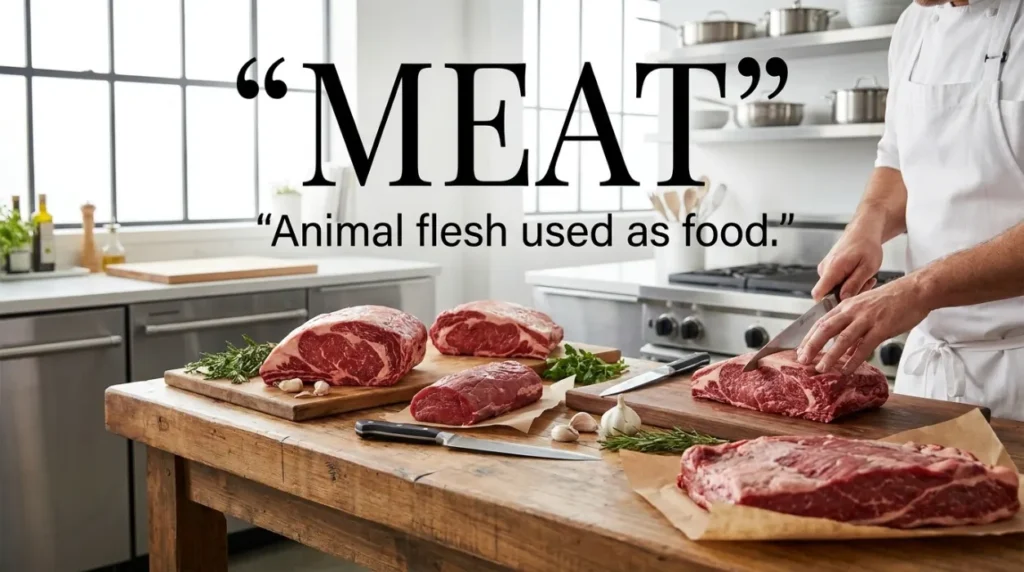
A fresh synonym for meat in dietary contexts is “animal protein” or “mycoprotein” for plant-based alternatives. Beyond traditional culinary cuts or biological terms, contemporary health trends use animal protein to neutrally specify nutrient-dense muscle tissue while distinguishing real livestock from lab-grown or plant-derived protein sources.
Synonyms for meat help you describe animal tissue, food cuts, protein sources, or the central part of an idea with greater clarity and precision.
Imagine ordering a meal at a steakhouse or writing a food blog. Using “meat” repeatedly can sound plain, while terms like “flesh,” “protein,” or “cut” may provide more specific meaning.
Choosing a fresh synonym for meat allows you to describe different culinary types, biological forms, dietary choices, and even metaphorical meanings. The right word makes your writing more accurate and engaging.
Learning a synonym for meat benefits students, food bloggers, fiction writers, and everyday English speakers. Expanding your vocabulary helps you communicate naturally, avoid repetition, and express ideas with sharper clarity and confidence.
What Does “Synonym for Meat” Really Mean?
A “synonym for meat” refers to any noun or descriptive term representing animal flesh eaten as food, edible muscle tissue, or the central core of an idea.
Native speakers use the word “meat” literally in cooking and biology, but they also use it metaphorically to mean the most important part of a speech or book.
Part of Speech: Noun
Simple Definition: The edible flesh of animals used as food, or the solid, essential core part of something.
Connotative Meaning
Connotation is the emotional tone, cultural association, or implied feeling a word carries beyond its literal dictionary definition.
- Positive tone: Highly positive when associated with rich culinary traditions, nourishing meals, hearty feasts, and substantial arguments.
- Negative tone: Used negatively when implying raw physical body tissue, gruesome carnage, slaughter, or heavy, unappealing food.
- Neutral tone: Used neutrally in biology, nutrition science, agricultural trade, and general butcher shop classifications.
Etymology
- Origin: Derived from Old English mete, which originally meant solid food of any kind, not just animal tissue.
- Old English (450–1100): Refers broadly to general nourishment or solid food, distinct from drink (drync).
- Middle English (1100–1500): Spelled mete, gradually narrowing its focus from general food to animal muscle tissue consumed by humans.
- Modern English (1500–Present): Solidified into its primary meaning of edible animal flesh, while retaining its metaphorical sense of “substance.”
Pronunciation
- US: /ˈsɪn.ə.nɪm fɔːr miːt/
- UK: /ˈsɪn.ə.nɪm fɔː miːt/
Syllables
Synonym for meat
Affixation Pattern
- Root: Meat
- Prefix: None
- Suffix: None
Synonyms List
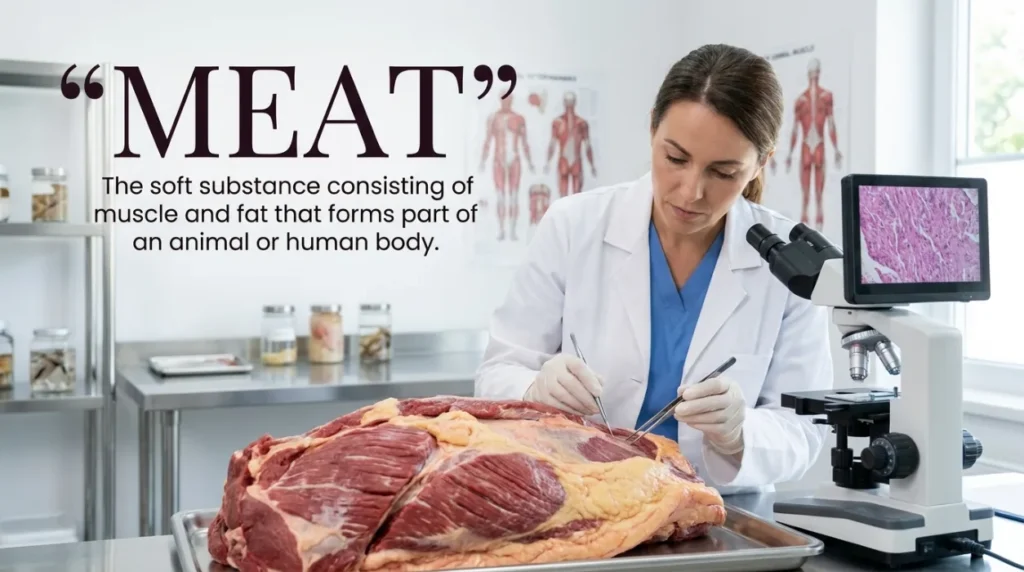
Flesh (Noun) — US: /fleʃ/ | UK: /fleʃ/
Meaning: The soft substance consisting of muscle and fat that forms part of an animal or human body.
Tone/Register: Biological / Descriptive
Example 1: The butcher carefully separated the flesh from the bone.
Example 2: Ripe fruit has soft, sweet flesh under its outer skin.
Protein (Noun) — US: /ˈproʊ.tiːn/ | UK: /ˈprəʊ.tiːn/
Meaning: An essential dietary nutrient found abundantly in animal muscles, legumes, and eggs.
Tone/Register: Scientific / Nutritional
Example 1: Athletes often eat lean protein to rebuild muscle after workouts.
Example 2: The restaurant offers both animal- and plant-based protein options.
Muscle (Noun) — US: /ˈmʌs.əl/ | UK: /ˈmʌs.əl/
Meaning: The contractile body tissue of animals harvested and prepared as culinary meat.
Tone/Register: Technical / Anatomical
Example 1: Tough cuts of muscle require slow cooking to become tender.
Example 2: The chef explained how muscle fibers absorb marinade.
Game (Noun) — US: /ɡeɪm/ | UK: /ɡeɪm/
Meaning: The flesh of wild animals hunted for food, such as deer, pheasant, or wild boar.
Tone/Register: Culinary / Specialized
Example 1: Autumn menus frequently feature roast game served with berry sauces.
Example 2: The local restaurant specializes in serving wild game dishes.
Venison (Noun) — US: /ˈven.ə.sən/ | UK: /ˈven.ɪ.sən/
Meaning: The edible meat harvested specifically from deer.
Tone/Register: Formal / Culinary
Example 1: They enjoyed grilled venison steaks accompanied by roasted vegetables.
Example 2: Venison is known for its lean texture and earthy flavor.
Poultry (Noun) — US: /ˈpoʊl.tri/ | UK: /ˈpəʊl.tri/
Meaning: Meat derived from domesticated birds such as chickens, turkeys, ducks, and geese.
Tone/Register: Commercial / Culinary
Example 1: The grocery store expanded its organic poultry section this week.
Example 2: Proper handling of raw poultry prevents kitchen contamination.
Fowl (Noun) — US: /faʊl/ | UK: /faʊl/
Meaning: Birds, especially wild waterfowl or farm birds, used as a food source.
Tone/Register: Traditional / Agricultural
Example 1: The feast included roasted wild fowl stuffed with herbs.
Example 2: Farmers brought their livestock and domesticated fowl to market.
Pork (Noun) — US: /pɔːrk/ | UK: /pɔːk/
Meaning: The culinary meat harvested specifically from domestic pigs.
Tone/Register: Everyday / Culinary
Example 1: Slow-cooked pulled pork is a popular dish at summer gatherings.
Example 2: She ordered pork chops seasoned with garlic and rosemary.
Beef (Noun) — US: /biːf/ | UK: /biːf/
Meaning: The culinary meat harvested from mature cattle.
Tone/Register: Standard / Culinary
Example 1: The chef prepared a rich beef stew for dinner.
Example 2: Grass-fed beef is appreciated for its distinct taste.
Veal (Noun) — US: /viːl/ | UK: /viːl/
Meaning: The tender meat harvested from young calves.
Tone/Register: Culinary / Specialized
Example 1: Traditional Italian recipes often call for delicate cutlets of veal.
Example 2: The menu listed breaded veal served with lemon slices.
Mutton (Noun) — US: /ˈmʌt.ən/ | UK: /ˈmʌt.ən/
Meaning: The meat of a fully grown, mature sheep.
Tone/Register: Traditional / Culinary
Example 1: Slow roasting brings out the deep flavor of mutton.
Example 2: The traditional curry was prepared using spiced mutton.
Lamb (Noun) — US: /læm/ | UK: /læm/
Meaning: The tender meat harvested from a young sheep under one year of age.
Tone/Register: Everyday / Culinary
Example 1: We ordered roasted leg of lamb with fresh mint sauce.
Example 2: Lamb chops cook quickly over an open grill fire.
Bacon (Noun) — US: /ˈbeɪ.kən/ | UK: /ˈbeɪ.kən/
Meaning: Salt-cured meat taken from the back or sides of a pig.
Tone/Register: Everyday / Casual
Example 1: Crispy bacon is a classic side dish for breakfast.
Example 2: She added chopped bacon to the potato soup.
Ham (Noun) — US: /hæm/ | UK: /hæm/
Meaning: Meat taken from the hind leg of a pig, usually preserved by salting or smoking.
Tone/Register: Everyday / Culinary
Example 1: Glazed ham is a popular centerpiece for holiday meals.
Example 2: He made a quick ham and cheese sandwich for lunch.
Carnage (Noun) — US: /ˈkɑːr.nɪdʒ/ | UK: /ˈkɑː.nɪdʒ/
Meaning: The bloody remains or large-scale destruction of flesh from violent events.
Tone/Register: Dramatic / Literary
Example 1: Historians documented the carnage left behind after the ancient battle.
Example 2: Emergency crews responded swiftly to the site of carnage.
Carrion (Noun) — US: /ˈkær.i.ən/ | UK: /ˈkær.i.ən/
Meaning: The decaying, dead flesh of animals killed by predators or natural causes.
Tone/Register: Biological / Formal
Example 1: Vultures circled high in the sky searching for carrion on the plain.
Example 2: Scavengers play a vital ecosystem role by consuming carrion.
Essence (Noun) — US: /ˈes.əns/ | UK: /ˈes.əns/
Meaning: The core, intrinsic nature, or most important central quality of something.
Tone/Register: Abstract / Intellectual
Example 1: Honesty is the true essence of a strong friendship.
Example 2: The speaker captured the essence of the report in five minutes.
Substance (Noun) — US: /ˈsʌb.stəns/ | UK: /ˈsʌb.stəns/
Meaning: Solid, meaningful content or real physical material as opposed to superficial form.
Tone/Register: Formal / Academic
Example 1: Critics praised the essay for having real substance behind its arguments.
Example 2: The lawyer asked for solid facts and real substance during testimony.
Core (Noun) — US: /kɔːr/ | UK: /kɔː/
Meaning: The central, innermost, or vital part of a topic, object, or organization.
Tone/Register: General / Business
Example 1: We need to address the core problem before making new plans.
Example 2: The core of his theory remains solid after testing.
Pith (Noun) — US: /pɪθ/ | UK: /pɪθ/
Meaning: The essential, central, or most important part of an argument or idea.
Tone/Register: Literary / Academic
Example 1: Her short conclusion captured the pith of the entire lecture.
Example 2: He spoke clearly, reaching the pith of the issue immediately.
Gist (Noun) — US: /dʒɪst/ | UK: /dʒɪst/
Meaning: The main point, general sense, or central theme of a speech or text.
Tone/Register: Conversational / Standard
Example 1: I didn’t catch every detail, but I understood the main gist of the presentation.
Example 2: Could you summarize the gist of the email for the team?
Nitty-gritty (Noun) — US: /ˌnɪt.iˈɡrɪt.i/ | UK: /ˌnɪt.iˈɡrɪt.i/
Meaning: The most basic, practical, or essential details of a task or situation.
Tone/Register: Informal / Workplace
Example 1: Let’s skip the polite intro and get down to the nitty-gritty.
Example 2: She loves handling the nitty-gritty details of event planning.
Heart (Noun) — US: /hɑːrt/ | UK: /hɑːt/
Meaning: The central, vital, or most essential part of a system, story, or matter.
Tone/Register: Figurative / Common
Example 1: Compassion lies at the very heart of their charity work.
Example 2: The team worked hard to get to the heart of the matter.
Kernel (Noun) — US: /ˈkɝː.nəl/ | UK: /ˈkɜː.nəl/
Meaning: A small, central core of truth or essential meaning within a larger idea.
Tone/Register: Literary / Figurative
Example 1: There is a kernel of truth in every old folk tale.
Example 2: He uncovered the kernel of wisdom buried in the old document.
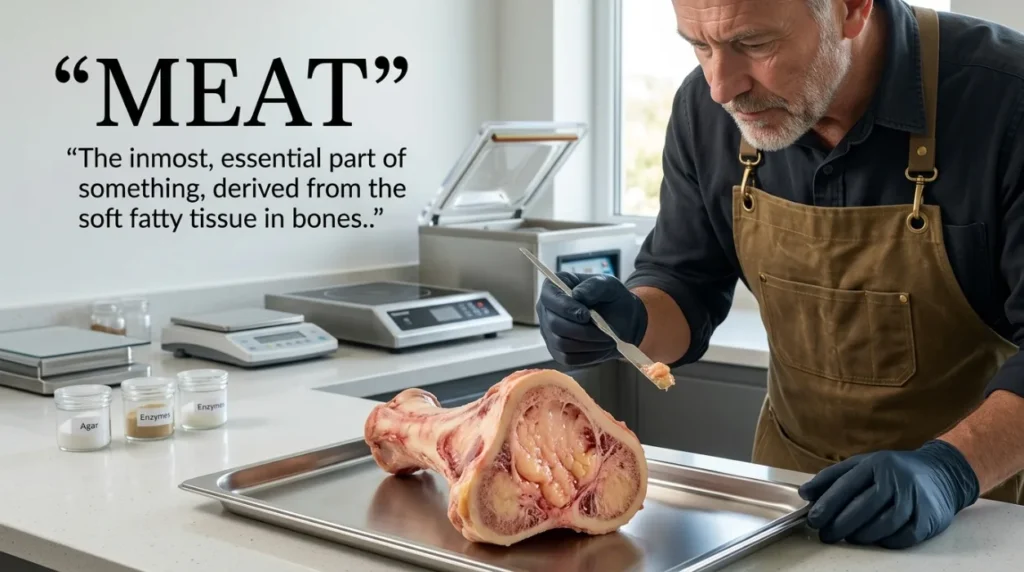
Marrow (Noun) — US: /ˈmær.oʊ/ | UK: /ˈmær.əʊ/
Meaning: The inmost, essential part of something, derived from the soft fatty tissue in bones.
Tone/Register: Elevated / Poetic
Example 1: The cold wind seemed to chill us to the very marrow.
Example 2: Her speech touched the marrow of human emotion.
Meatiness (Noun) — US: /ˈmiː.t̬i.nəs/ | UK: /ˈmiː.ti.nəs/
Meaning: The quality of being substantial, full of flavor, or rich in solid content.
Tone/Register: Informal / Descriptive
Example 1: Readers appreciated the meatiness of the thorough analysis.
Example 2: The chef enhanced the meatiness of the mushroom sauce.
Provisions (Noun) — US: /prəˈvɪʒ.ənz/ | UK: /prəˈvɪʒ.ənz/
Meaning: Supplies of food and drinks needed for a journey or long period.
Tone/Register: Formal / Historical
Example 1: Hikers packed ample provisions before heading into the mountains.
Example 2: The ship carried enough provisions for a three-month voyage.
Victuals (Noun) — US: /ˈvɪt.əlz/ | UK: /ˈvɪt.əlz/
Meaning: Food supplies or edible items prepared for human consumption.
Tone/Register: Archaic / Historical
Example 1: Travelers stopped at the tavern to enjoy hot victuals and rest.
Example 2: The market stalls offered a wide selection of farm victuals.
Rations (Noun) — US: /ˈræʃ.ənz/ | UK: /ˈræʃ.ənz/
Meaning: Fixed, measured daily allowances of food distributed during emergencies or missions.
Tone/Register: Military / Formal
Example 1: Soldiers received their daily food rations at dawn.
Example 2: The disaster response team distributed emergency water and rations.
Foodstuff (Noun) — US: /ˈfuːd.stʌf/ | UK: /ˈfuːd.stʌf/
Meaning: Any substance suitable for use as food in raw or processed form.
Tone/Register: Commercial / Technical
Example 1: The port serves as a major hub for importing basic foodstuffs
Example 2: Inspections ensure all incoming foodstuffs meet national safety standards.
Fare (Noun) — US: /fer/ | UK: /feər/
Meaning: A range of food served in a restaurant or prepared for meals.
Tone/Register: Literary / Hospitality
Example 1: The seaside bistro is famous for its fresh seafood fare.
Example 2: Guests enjoyed simple country fare around the campfire.
Edibles (Noun) — US: /ˈed.ə.bəlz/ | UK: /ˈed.ɪ.bəlz/
Meaning: Items that are safe or intended to be eaten as food.
Tone/Register: General / Technical
Example 1: The shop sold a variety of baked goods and gourmet edibles.
Example 2: Keep non-edible decorative items separate from serving plates.
Sustenance (Noun) — US: /ˈsʌs.tən.əns/ | UK: /ˈsʌs.tɪ.nəns/
Meaning: Food and drink regarded as a source of strength or life support.
Tone/Register: Formal / Serious
Example 1: Clean water and simple food provided needed sustenance to refugees.
Example 2: Traditional farming supplied complete sustenance for the village.
Nourishment (Noun) — US: /ˈnɝː.ɪʃ.mənt/ | UK: /ˈnʌr.ɪʃ.mənt/
Meaning: Substances that provide wholesome health, growth, and bodily energy.
Tone/Register: Warm / Health-focused
Example 1: Fresh vegetables provide vital nourishment for growing children.
Example 2: A warm meal offered comfort and nourishment after the storm.
Feed (Noun) — US: /fiːd/ | UK: /fiːd/
Meaning: Food given to livestock or farm animals, or an informal large meal.
Tone/Register: Agricultural / Casual
Example 1: Farmers stored grain in silos to use as winter feed for cattle.
Example 2: The host prepared a generous feed for all the party guests.
Grub (Noun) — US: /ɡrʌb/ | UK: /ɡrʌb/
Meaning: Slang term for food prepared simply for daily consumption.
Tone/Register: Informal / Slang
Example 1: Let’s stop at the diner and grab some quick grub.
Example 2: Camping trips are always better with good outdoor grub.
Eats (Noun) — US: /iːts/ | UK: /iːts/
Meaning: Casual term referring to snacks, food, or light meals.
Tone/Register: Casual / Informal
Example 1: The food truck court offered great late-night eats.
Example 2: We grabbed some quick eats before watching the game.
Charcuterie (Noun) — US: /ʃɑːrˈkuː.t̬ɚ/.i/ | UK: /ʃɑːˈkuː.tər.i/
Meaning: Prepared cold meats such as bacon, ham, sausage, terrines, and cured cuts.
Tone/Register: Culinary / Sophisticated
Example 1: The party featured an impressive charcuterie board with artisanal cheeses.
Example 2: He studied traditional French methods of preparing charcuterie.
Offal (Noun) — US: /ˈɑː.fəl/ | UK: /ˈɒf.əl/
Meaning: Internal organs and entrails of a butchered animal used as food.
Tone/Register: Culinary / Butchery
Example 1: Traditional dishes often utilize offal like liver, heart, and kidney.
Example 2: The butcher shop prepared fresh offal for specialty sausages.
Cut (Noun) — US: /kʌt/ | UK: /kʌt/
Meaning: A specific piece or section of meat sliced from an animal carcass.
Tone/Register: Culinary / Trade
Example 1: Ribeye is considered a tender and flavorful cut of beef.
Example 2: Ask the butcher which cut works best for slow roasting.
Roast (Noun) — US: /roʊst/ | UK: /rəʊst/
Meaning: A large piece of meat prepared by cooking in an oven or over open heat.
Tone/Register: Everyday / Culinary
Example 1: Sunday dinner included a juicy pot roast with carrots.
Example 2: She seasoned the beef roast with garlic and fresh thyme.
Steak (Noun) — US: /steɪk/ | UK: /steɪk/
Meaning: A high-quality slice of meat, typically beef, cut perpendicular to muscle fibers.
Tone/Register: Everyday / Culinary
Example 1: He ordered a medium-rare steak served with mashed potatoes.
Example 2: Searing the steak over high heat locks in natural juices.
Chops (Noun) — US: /tʃɑːps/ | UK: /tʃɒps/
Meaning: Thick slices of meat, usually pork or lamb, containing a bone section.
Tone/Register: Culinary / Everyday
Example 1: She grilled pork chops topped with an apple glaze.
Example 2: Lamb chops remain a popular choice for fast weekend dinners.
Filet (Noun) — US: /fɪˈleɪ/ | UK: /ˈfɪl.ɪt/
Meaning: A high-grade, boneless strip or cut of meat or fish.
Tone/Register: Culinary / Upscale
Example 1: The waiter recommended the tender beef filet served with reduction sauce.
Example 2: She carefully trimmed the filet before cooking it.
Loin (Noun) — US: /lɔɪn/ | UK: /lɔɪn/
Meaning: Meat taken from the back section of an animal between ribs and hips.
Tone/Register: Culinary / Technical
Example 1: Roasted pork loin makes an elegant centerpiece for dinner parties.
Example 2: The butcher tied the tenderloin roast with twine.
Carcass (Noun) — US: /ˈkɑːr.kəs/ | UK: /ˈkɑː.kəs/
Meaning: The dead body of an animal, especially one dressed for butchering.
Tone/Register: Technical / Agricultural
Example 1: Inspectors evaluated the dressed carcass for health standard compliance.
Example 2: The butcher prepared the carcass for cold storage overnight.
Body (Noun) — US: /ˈbɑː.di/ | UK: /ˈbɒd.i/
Meaning: The physical structure of an animal, or the main bulk of a text.
Tone/Register: General / Objective
Example 1: The body of the argument contained strong supporting data.
Example 2: Soup bones and body cuts add rich flavor to broths.
Meatiness (Metaphorical) (Noun) — US: /ˈmiː.t̬i.nəs/ | UK: /ˈmiː.ti.nəs/
Meaning: Depth of content, intellect, or substance within writing or art.
Tone/Register: Literary / Critical
Example 1: The author’s new novel has an intellectual meatiness missing in modern books.
Example 2: Film critics admired the narrative meatiness of the documentary.
Substantiveness (Noun) — US: /səbˈstæn.tɪv.nəs/ | UK: /səbˈstæn.tɪv.nəs/
Meaning: The quality of possessing real importance, value, or solid ground.
Tone/Register: Formal / Legal
Example 1: The panel praised the proposal for its financial substantiveness.
Example 2: Legal arguments require genuine substantiveness to convince a judge.
Bulk (Noun) — US: /bʌlk/ | UK: /bʌlk/
Meaning: The main mass, majority portion, or primary weight of something.
Tone/Register: General / Standard
Example 1: The bulk of the budget was spent on raw materials.
Example 2: Buying in bulk helps restaurants reduce food spending.
Synonyms by Tone
| Tone Category | Synonyms for Meat |
| Culinary / Specialized | Venison, Poultry, Pork, Beef, Charcuterie |
| Nutritional / Technical | Protein, Muscle, Foodstuff, Provisions, Flesh |
| Informal / Casual | Grub, Eats, Nitty-gritty, Feed, Chops |
| Metaphorical / Intellectual | Essence, Substance, Core, Gist, Pith |
Select your vocabulary according to your audience and context to ensure natural, effective communication.
Culinary / Specialized Tone
- Venison
- Poultry
- Pork
- Beef
- Charcuterie
Nutritional / Technical Tone
- Protein
- Muscle
- Foodstuff
- Provisions
- Flesh
Informal / Casual Tone
- Grub
- Eats
- Nitty-gritty
- Feed
- Chops
Metaphorical / Intellectual Tone
- Essence
- Substance
- Core
- Gist
- Pith
Mini Comparison: “Meat” vs Close Alternatives
| Term | Core Meaning | Tone | Best Context To Use |
| Meat | Edible animal tissue or main substance of an idea. | General / Standard | Daily conversations, cooking, general writing, menus. |
| Protein | Essential macronutrient found in animal/plant foods. | Scientific / Health | Fitness blogs, nutritional guides, medical papers. |
| Flesh | Soft muscle tissue of animals/humans; fruit pulp. | Biological / Descriptive | Biology, literary descriptions, anatomy studies. |
Context-Based Usage
Daily Conversation
In casual settings, native speakers use standard terms like beef, pork, chicken, or casual slang like grub and eats.
Example: “Let’s grab some grub before the concert starts.”
Writing or Blogging
Food bloggers and writers use vivid, specialized culinary terms like charcuterie, venison, fare, or cut.
Example: “The bistro serves authentic French charcuterie alongside local cheeses.”
Professional or Academic Tone
Health specialists and researchers prefer objective, technical terms like protein, substance, provisions, or foodstuff.
Example: “Plant-based sources provide adequate daily protein for athletes.”
Creative or Informal Use
Writers use figurative alternatives like core, gist, pith, or nitty-gritty to describe central ideas.
Example: “Let’s cut through the chatter and get to the nitty-gritty of our plan.”
Common Mistakes & Native Usage

Misuse Scenarios
- Using Biological Terms in Dining: Avoid telling dinner guests you are cooking “animal flesh”; use culinary names like beef, steak, or pork.
- Using Slang in Formal Academic Work: Do not write that a research paper lacks “grub”; use substance, essence, or substantiveness.
Register Notes
- Formal / Academic: Use protein, substance, sustenance, essence, and provisions.
- Spoken / Informal: Use grub, eats, nitty-gritty, gist, and feed.
Real-Life Mini Scenarios
Workplace Scenario
During the quarterly review, the director asked the team to skip introductory slides and dive straight into the nitty-gritty of the budget.
Social Situations
Friends gathered at a backyard barbecue to enjoy grilled chops and cold drinks on a summer afternoon.
Media & Pop Culture
Food critics applauded the new documentary for uncovering the true essence of farm-to-table culinary movements.
Writing & Storytelling
The fantasy author vividly described a royal banquet filled with roasted game, wild fowl, and foreign fruits.
Conclusion
Expanding your vocabulary with precise synonyms for meat helps you describe food, nutrition, and important ideas with greater clarity and accuracy. Learning suitable alternatives strengthens both your speaking and writing skills.
Choosing the right word for each context makes your message clearer and more engaging. Whether you are writing a culinary review, science paper, business report, or everyday message, precise vocabulary helps you communicate with confidence.
Put these new vocabulary choices into practice through emails, essays, conversations, and creative writing. Regular practice improves your fluency, reduces repetition, and helps you express your thoughts naturally, accurately, and confidently.
Practice Exercise
1. Which term best fits a formal nutrition study discussing dietary needs?
A) Grub
B) Eats
C) Protein
D) Nitty-gritty
2. What word specifically refers to edible meat harvested from deer?
A) Pork
B) Venison
C) Veal
D) Mutton
3. Which noun describes the main point or central meaning of a long speech?
A) Gist
B) Carrion
C) Poultry
D) Offal
4. What casual slang word means everyday food or a quick meal?
A) Sustenance
B) Grub
C) Substantiveness
D) Carcass
5. Which term describes domesticated birds raised for meat, such as chickens?
A) Poultry
B) Venison
C) Mutton
D) Game
6. What word refers to decaying flesh eaten by wild scavengers?
A) Fare
B) Carrion
C) Filet
D) Charcuterie
7. Which formal term describes food and drink as a source of strength and life support?
A) Sustenance
B) Eats
C) Grub
D) Cut
8. What specialized culinary word describes cured cold meats like ham and salami?
A) Charcuterie
B) Victuals
C) Offal
D) Rations
9. Which metaphorical word means the innermost core of an idea or argument?
A) Pith
B) Bacon
C) Chops
D) Fare
10. What term describes measured daily food allowances given to military personnel?
A) Rations
B) Eats
C) Gist
D) Filet
Answer Key:
1: C | 2: B | 3: A | 4: B | 5: A | 6: B | 7: A | 8: A | 9: A | 10: A
Application Task:
Write one original sentence using the word gist or substance to describe the central point of a book or presentation you recently saw.
FAQs
1. What is the most accurate scientific synonym for meat?
“Protein” or “muscle tissue” are the most accurate terms in biological and nutritional science.
2. Why do we use French-derived names like beef and pork for meat?
After the Norman Conquest of 1066, French-speaking nobility used terms like bœuf and porc for dining, while English Anglo-Saxon peasants cared for cattle and swine.
3. What is a good metaphorical synonym for meat in writing?
“Core,” “substance,” “gist,” and “essence” serve as excellent metaphorical alternatives when describing the main body of an argument.
4. How does using specific meat synonyms improve culinary writing?
Using exact terms like venison, prosciutto, or tenderloin provides vivid detail and sets clear expectations for readers and diner menus.
5. What is the difference between meat and flesh?
“Meat” usually refers to edible animal tissue prepared as food, whereas “flesh” refers broadly to living or raw muscle tissue on any animal or human body.

Jameel Hassan is the founder and lead writer at SynonymsCloud.com, a trusted online platform dedicated to English vocabulary and effective communication. He is passionate about helping students, writers, professionals, and lifelong learners discover the right words to express their ideas with clarity, precision, and confidence.
At SynonymsCloud.com, every article is thoroughly researched and carefully written to provide accurate, practical, and easy-to-understand guidance on synonyms, antonyms, word meanings, idioms, and vocabulary. With a strong commitment to quality, real-world usage, and clear explanations, the website helps readers expand their vocabulary, improve their writing, and communicate more effectively in both academic and professional settings.