
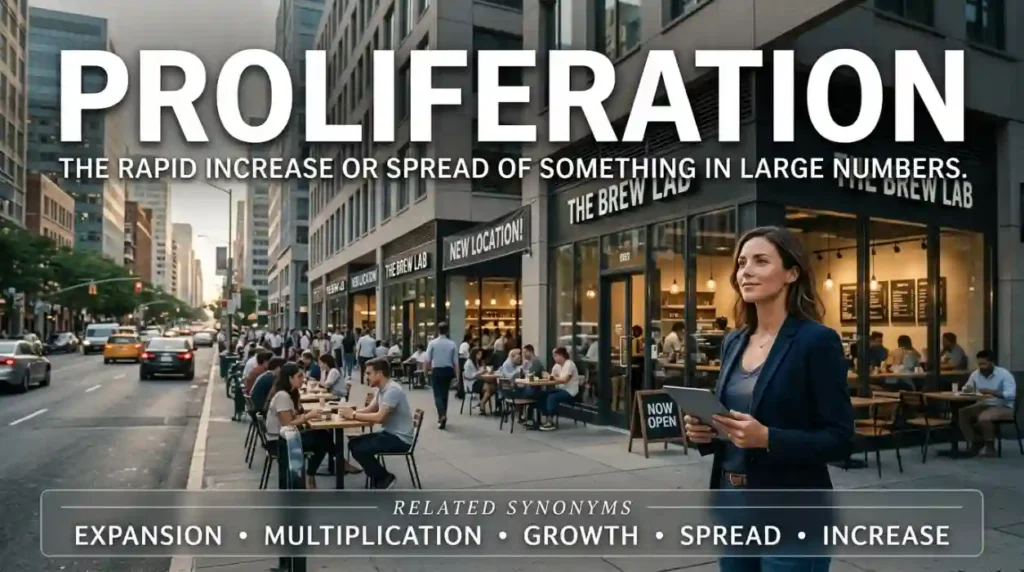
A synonym for proliferation is a word or phrase that describes a rapid increase, growth, multiplication, or spread of something. Common alternatives include expansion, increase, multiplication, surge, upsurge, and propagation. The best choice depends on what is growing and how quickly it is spreading.
Imagine a new technology becoming popular worldwide, with thousands of people adopting it within a short time. You might describe this rapid increase as growth, expansion, or proliferation. The right word helps explain how quickly something spreads or develops.
The word proliferation appears in discussions about business, science, technology, population, and the environment. It describes a significant increase in numbers, quantity, or the spread of something across different areas.
Learning a synonym for proliferation helps students, bloggers, and content writers describe growth in more interesting and precise ways. It also makes everyday communication clearer and reduces unnecessary repetition.
Whether you are discussing expanding businesses, spreading information, or scientific developments, choosing the right synonym for proliferation makes your writing more natural and effective. Explore these 50 alternatives, understand their meanings, and discover how to use them in different contexts.
What Does “Proliferation” Really Mean?
Proliferation means a rapid or substantial increase in the number, amount, or spread of something. It describes a process in which people, objects, ideas, organisms, or activities become more numerous or widespread.
It is a noun. The word often suggests that something is increasing quickly or appearing in many places.
For example:
- The proliferation of smartphones has changed daily communication.
- Scientists are studying the proliferation of certain cells.
- The city has experienced a proliferation of small businesses.
Native English speakers commonly use proliferation in formal, academic, scientific, and journalistic contexts. It can describe positive developments, such as the growth of educational opportunities, or negative developments, such as the spread of misinformation.
The word does not automatically suggest that the increase is good or bad. The surrounding context determines its emotional effect.
Connotative Meaning
Connotation means the emotional feeling or association a word creates beyond its basic dictionary meaning.
- Positive tone: It can suggest opportunity, development, creativity, and the growth of useful ideas or services.
- Negative tone: It may suggest an excessive or difficult-to-control increase, such as the proliferation of weapons or misinformation.
- Neutral tone: In scientific and academic writing, it can simply describe an increase in numbers or the spread of something.
Etymology of Proliferation
The word proliferation comes from proliferate, which is connected to Latin roots. The Latin elements proles means “offspring” or “descendants,” while ferre means “to bear” or “to produce.”
The original idea relates to producing offspring or multiplying. Its modern meaning expanded to describe the rapid increase or spread of many different things.
Old English (450–1100)
The modern word proliferation did not exist in Old English. Speakers used other words and expressions to describe growth, increase, multiplication, and the production of offspring.
Middle English (1100–1500)
The exact modern term was not yet established in everyday Middle English. Related ideas were expressed through words associated with increase, growth, and reproduction. Latin-based vocabulary also influenced later English scientific terminology.
Modern English (1500–Present)
The word developed from the Latin-based proliferare and became established in modern scientific and general English. Its use expanded beyond biological reproduction.
Today, it appears in discussions about technology, population, business, media, weapons, information, and social trends.
Pronunciation (US & UK – IPA)
- US: /prəˌlɪf.əˈreɪ.ʃən/
- UK: /prəˌlɪf.əˈreɪ.ʃən/
Syllables
pro-lif-er-a-tion: 5 syllables
Affixation Pattern of Proliferation
- Root: proliferate
- Prefix: No productive prefix in the modern word.
- Suffix: -ion (with a spelling change from proliferate to proliferation).
The suffix -ion helps form a noun describing an action, process, or result. The related verb is proliferate.
Synonyms List
The following list includes close synonyms and useful context-based alternatives. Some expressions describe a particular kind of increase rather than replacing proliferation in every sentence. Always consider the subject and context.
1. Increase (Noun) — US: /ˈɪn.kriːs/ | UK: /ˈɪŋ.kriːs/
Meaning: A rise in the number, amount, or level of something.
Tone/Register: Neutral, everyday, formal.
Examples:
- The school reported an increase in student enrollment.
- An increase in online orders helped the business grow.

2. Growth (Noun) — US: /ɡroʊθ/ | UK: /ɡrəʊθ/
Meaning: The process of becoming larger, greater, or more developed.
Tone/Register: Neutral, business, academic.
Examples:
- The company experienced steady growth over the past year.
- Population growth has created new demands for housing.
3. Expansion (Noun) — US: /ɪkˈspæn.ʃən/ | UK: /ɪkˈspæn.ʃən/
Meaning: An increase in size, range, reach, or scope.
Tone/Register: Formal, business, academic.
Examples:
- The restaurant announced an expansion into three new cities.
- Internet expansion has improved access to information.
4. Multiplication (Noun) — US: /ˌmʌl.tə.pləˈkeɪ.ʃən/ | UK: /ˌmʌl.tɪ.plɪˈkeɪ.ʃən/
Meaning: The process of increasing in number through repeated reproduction or creation.
Tone/Register: Scientific, mathematical, neutral.
Examples:
- The multiplication of bacteria can happen quickly under suitable conditions.
- Researchers observed the multiplication of cells in the sample.
5. Spread (Noun) — US: /spred/ | UK: /spred/
Meaning: The movement or distribution of something across a wider area or among more people.
Tone/Register: Neutral, everyday, academic.
Examples:
- The spread of digital payments has changed shopping habits.
- Health officials are monitoring the spread of the disease.
6. Surge (Noun) — US: /sɝːdʒ/ | UK: /sɜːdʒ/
Meaning: A sudden and powerful increase in number, level, or activity.
Tone/Register: Neutral, journalistic, business.
Examples:
- The website experienced a surge in visitors after the announcement.
- A surge in demand surprised local retailers.
7. Upsurge (Noun) — US: /ˈʌp.sɝːdʒ/ | UK: /ˈʌp.sɜːdʒ/
Meaning: A noticeable rise in the amount or frequency of something.
Tone/Register: Formal, journalistic.
Examples:
- The city reported an upsurge in tourism.
- An upsurge in interest brought more people to the event.
8. Propagation (Noun) — US: /ˌprɑː.pəˈɡeɪ.ʃən/ | UK: /ˌprɒp.əˈɡeɪ.ʃən/
Meaning: The process of spreading, reproducing, or passing something from one place or generation to another.
Tone/Register: Scientific, technical, formal.
Examples:
- The propagation of plants requires suitable growing conditions.
- Researchers studied the propagation of signals through the material.
9. Reproduction (Noun) — US: /ˌriː.prəˈdʌk.ʃən/ | UK: /ˌriː.prəˈdʌk.ʃən/
Meaning: The biological or mechanical process of producing new organisms or copies.
Tone/Register: Scientific, academic, neutral.
Examples:
- The study examines reproduction among marine animals.
- Successful reproduction helped the species maintain its population.
10. Accumulation (Noun) — US: /əˌkjuː.mjəˈleɪ.ʃən/ | UK: /əˌkjuː.mjʊˈleɪ.ʃən/
Meaning: The gradual gathering or building up of an increasing amount of something.
Tone/Register: Formal, academic, financial.
Examples:
- The accumulation of plastic waste is a serious environmental concern.
- Years of experience led to the accumulation of valuable knowledge.
11. Escalation (Noun) — US: /ˌes.kəˈleɪ.ʃən/ | UK: /ˌes.kəˈleɪ.ʃən/
Meaning: A rapid or significant increase in intensity, seriousness, or scale.
Tone/Register: Formal, business, political.
Examples:
- The escalation of online fraud worried local businesses.
- Officials discussed the escalation of tensions between the groups.
12. Boom (Noun) — US: /buːm/ | UK: /buːm/
Meaning: A period of rapid growth or increased activity.
Tone/Register: Informal, business, journalistic.
Examples:
- The city experienced a housing boom.
- A tourism boom created new jobs for residents.
13. Mushrooming (Noun) — US: /ˈmʌʃ.ruː.mɪŋ/ | UK: /ˈmʌʃ.ruː.mɪŋ/
Meaning: A rapid and widespread increase in the number or amount of something.
Tone/Register: Informal, journalistic.
Examples:
- The mushrooming of online stores has changed retail.
- Residents are concerned about the mushrooming number of billboards.
14. Burgeoning (Noun/Adjective) — US: /ˈbɝː.dʒən.ɪŋ/ | UK: /ˈbɜː.dʒən.ɪŋ/
Meaning: A process of growing or developing quickly.
Tone/Register: Formal, descriptive, positive or neutral.
Examples:
- The burgeoning technology sector is attracting skilled workers.
- She writes about the burgeoning interest in renewable energy.
15. Flourishing (Noun/Adjective) — US: /ˈflɝː.ɪ.ʃɪŋ/ | UK: /ˈflʌr.ɪ.ʃɪŋ/
Meaning: Healthy or successful growth and development.
Tone/Register: Positive, descriptive, formal.
Examples:
- The flourishing arts scene attracts visitors every weekend.
- A flourishing community garden now supplies fresh vegetables.
16. Enlargement (Noun) — US: /ɪnˈlɑːrdʒ.mənt/ | UK: /ɪnˈlɑːdʒ.mənt/
Meaning: The process of making something larger in size or extent.
Tone/Register: Formal, technical, neutral.
Examples:
- The enlargement of the library created more study space.
- The project includes the enlargement of the existing facility.
17. Augmentation (Noun) — US: /ˌɔːɡ.menˈteɪ.ʃən/ | UK: /ˌɔːɡ.menˈteɪ.ʃən/
Meaning: An increase or improvement achieved by adding something.
Tone/Register: Formal, academic, technical.
Examples:
- The augmentation of the team improved project capacity.
- The system allows the augmentation of existing features.
18. Amplification (Noun) — US: /ˌæm.plə.fəˈkeɪ.ʃən/ | UK: /ˌæm.plɪ.fɪˈkeɪ.ʃən/
Meaning: An increase in strength, volume, reach, or effect.
Tone/Register: Technical, scientific, media.
Examples:
- The amplification of the message increased its online reach.
- Scientists measured the amplification of the electrical signal.
19. Acceleration (Noun) — US: /əkˌsel.əˈreɪ.ʃən/ | UK: /əkˌsel.əˈreɪ.ʃən/
Meaning: An increase in the speed or rate at which something develops.
Tone/Register: Formal, scientific, business.
Examples:
- The acceleration of digital innovation is changing workplaces.
- Researchers noticed an acceleration in cell activity.
20. Diffusion (Noun) — US: /dɪˈfjuː.ʒən/ | UK: /dɪˈfjuː.ʒən/
Meaning: The process of spreading or moving through a space, group, or system.
Tone/Register: Scientific, academic, formal.
Examples:
- The diffusion of new technology takes time.
- Researchers examined the diffusion of gas through the membrane.
21. Dissemination (Noun) — US: /dɪˌsem.əˈneɪ.ʃən/ | UK: /dɪˌsem.ɪˈneɪ.ʃən/
Meaning: The act of distributing information, ideas, or knowledge widely.
Tone/Register: Formal, academic, professional.
Examples:
- The dissemination of accurate information is essential during emergencies.
- The organization supports the dissemination of research findings.
22. Distribution (Noun) — US: /ˌdɪs.trəˈbjuː.ʃən/ | UK: /ˌdɪs.trɪˈbjuː.ʃən/
Meaning: The process of spreading or supplying something across different places or people.
Tone/Register: Neutral, business, technical.
Examples:
- The distribution of electric vehicles has increased in the region.
- The company improved the distribution of educational materials.
23. Circulation (Noun) — US: /ˌsɝː.kjəˈleɪ.ʃən/ | UK: /ˌsɜː.kjʊˈleɪ.ʃən/
Meaning: The movement or passing of something among people, places, or systems.
Tone/Register: Neutral, formal, media.
Examples:
- The circulation of digital news has grown rapidly.
- The newspaper increased its circulation among young readers.
24. Prevalence (Noun) — US: /ˈprev.əl.əns/ | UK: /ˈprev.əl.əns/
Meaning: The fact or condition of something being common or widespread.
Tone/Register: Academic, medical, formal.
Examples:
- Researchers measured the prevalence of allergies among children.
- The prevalence of remote work has changed office culture.
25. Abundance (Noun) — US: /əˈbʌn.dəns/ | UK: /əˈbʌn.dəns/
Meaning: A very large quantity or supply of something.
Tone/Register: Neutral, positive, descriptive.
Examples:
- The region has an abundance of natural resources.
- An abundance of online courses gives learners more choices.
26. Profusion (Noun) — US: /prəˈfjuː.ʒən/ | UK: /prəˈfjuː.ʒən/
Meaning: A large or excessive amount of something, often appearing in many forms.
Tone/Register: Formal, literary.
Examples:
- The garden displayed a profusion of colorful flowers.
- A profusion of new apps has entered the market.
27. Plethora (Noun) — US: /ˈpleθ.ər.ə/ | UK: /ˈpleθ.ər.ə/
Meaning: An unusually large number or amount of something.
Tone/Register: Formal, academic, sometimes critical.
Examples:
- Students have a plethora of online learning resources.
- The report identified a plethora of possible explanations.
28. Proliferating (Verb/Adjective) — US: /prəˈlɪf.əˌreɪ.tɪŋ/ | UK: /prəˈlɪf.əˌreɪ.tɪŋ/
Meaning: Increasing or spreading rapidly in number or amount.
Tone/Register: Formal, scientific, academic.
Examples:
- Proliferating online platforms are changing how people communicate.
- The report examines proliferating security concerns.
29. Multiplicity (Noun) — US: /ˌmʌl.təˈplɪs.ə.ti/ | UK: /ˌmʌl.tɪˈplɪs.ɪ.ti/
Meaning: A large number or variety of different things.
Tone/Register: Formal, academic.
Examples:
- The course explores a multiplicity of cultural perspectives.
- A multiplicity of choices can make decisions difficult.
30. Multiplication in number (Noun Phrase) — US: /ˌmʌl.tə.pləˈkeɪ.ʃən ɪn ˈnʌm.bɚ/ | UK: /ˌmʌl.tɪ.plɪˈkeɪ.ʃən ɪn ˈnʌm.bə/
Meaning: An increase in the number of people, objects, or organisms.
Tone/Register: Explanatory, academic.
Examples:
- The multiplication in the number of small businesses surprised analysts.
- The multiplication in the number of digital devices has increased electronic waste.
31. Widespread growth (Noun Phrase) — US: /ˈwaɪd.spred ɡroʊθ/ | UK: /ˈwaɪd.spred ɡrəʊθ/
Meaning: Growth occurring across many places, groups, or sectors.
Tone/Register: Neutral, formal.
Examples:
- Widespread growth in online education has expanded access to learning.
- The region has experienced widespread growth in renewable energy.
32. Rapid increase (Noun Phrase) — US: /ˈræp.ɪd ˈɪn.kriːs/ | UK: /ˈræp.ɪd ˈɪŋ.kriːs/
Meaning: A quick rise in the number or amount of something.
Tone/Register: Neutral, formal, journalistic.
Examples:
- A rapid increase in housing demand affected local prices.
- The study recorded a rapid increase in website traffic.
33. Exponential growth (Noun Phrase) — US: /ˌek.spəˈnen.ʃəl ɡroʊθ/ | UK: /ˌek.spəˈnen.ʃəl ɡrəʊθ/
Meaning: Growth that increases at a rate proportional to the current amount.
Tone/Register: Scientific, mathematical, technical.
Examples:
- The model predicts exponential growth in the user base.
- Some populations can show exponential growth under favorable conditions.
34. Geometric growth (Noun Phrase) — US: /ˌdʒiː.əˈmet.rɪk ɡroʊθ/ | UK: /ˌdʒiː.əˈmet.rɪk ɡrəʊθ/
Meaning: An increase in which a quantity changes by a constant multiplication factor over equal periods.
Tone/Register: Mathematical, scientific.
Examples:
- The lesson explains geometric growth through simple number patterns.
- The population model assumes geometric growth over time.
35. Unchecked growth (Noun Phrase) — US: /ʌnˈtʃekt ɡroʊθ/ | UK: /ʌnˈtʃekt ɡrəʊθ/
Meaning: Growth that continues without effective control or limits.
Tone/Register: Neutral, often negative.
Examples:
- Unchecked growth in traffic is putting pressure on city roads.
- The report warns about unchecked growth in plastic waste.
36. Runaway growth (Noun Phrase) — US: /ˈrʌn.ə.weɪ ɡroʊθ/ | UK: /ˈrʌn.ə.weɪ ɡrəʊθ/
Meaning: Extremely rapid growth that becomes difficult to control.
Tone/Register: Informal, journalistic, negative.
Examples:
- Runaway growth in housing costs has affected young families.
- The company struggled to manage runaway growth in demand.
37. Emergence in large numbers (Noun Phrase) — US: /ɪˈmɝː.dʒəns ɪn lɑːrdʒ ˈnʌm.bɚz/ | UK: /ɪˈmɜː.dʒəns ɪn lɑːdʒ ˈnʌm.bəz/
Meaning: The appearance of many new people, objects, or developments.
Tone/Register: Neutral, descriptive.
Examples:
- The emergence in large numbers of small startups changed the local market.
- The event led to the emergence in large numbers of community projects.
38. Branching (Noun) — US: /ˈbræn.tʃɪŋ/ | UK: /ˈbrɑːn.tʃɪŋ/
Meaning: The development of additional branches, paths, or divisions from an existing structure.
Tone/Register: Technical, descriptive.
Examples:
- The branching of the organization created several regional teams.
- Researchers observed branching in the growing plant structure.
39. Diversification (Noun) — US: /daɪˌvɝː.sə.fəˈkeɪ.ʃən/ | UK: /daɪˌvɜː.sɪ.fɪˈkeɪ.ʃən/
Meaning: The process of developing a wider range of products, activities, or options.
Tone/Register: Business, formal, academic.
Examples:
- The diversification of the company’s services attracted new customers.
- Crop diversification can reduce dependence on one harvest.
40. Replication (Noun) — US: /ˌrep.ləˈkeɪ.ʃən/ | UK: /ˌrep.lɪˈkeɪ.ʃən/
Meaning: The process of making copies or producing additional examples of something.
Tone/Register: Scientific, technical, academic.
Examples:
- The replication of the experiment confirmed the original results.
- Viral replication is an important subject in medical research.

41. Duplication (Noun) — US: /ˌduː.pləˈkeɪ.ʃən/ | UK: /ˌdjuː.plɪˈkeɪ.ʃən/
Meaning: The act or process of making additional copies of something.
Tone/Register: Technical, administrative, neutral.
Examples:
- The duplication of files filled the computer’s storage.
- The system prevents unnecessary duplication of records.
42. Outbreak (Noun) — US: /ˈaʊt.breɪk/ | UK: /ˈaʊt.breɪk/
Meaning: The sudden beginning or rapid spread of an illness, conflict, or other harmful event.
Tone/Register: Medical, journalistic, negative.
Examples:
- Health officials investigated an outbreak of food poisoning.
- The region prepared for a possible outbreak of infection.
43. Epidemic spread (Noun Phrase) — US: /ˌep.əˈdem.ɪk spred/ | UK: /ˌep.ɪˈdem.ɪk spred/
Meaning: The rapid spread of a disease through a population.
Tone/Register: Medical, scientific.
Examples:
- Researchers studied the epidemic spread of the infection.
- Public health measures helped slow epidemic spread.
44. Invasion (Noun) — US: /ɪnˈveɪ.ʒən/ | UK: /ɪnˈveɪ.ʒən/
Meaning: The arrival or spread of a large number of unwanted organisms, people, or things into an area.
Tone/Register: Formal, often negative.
Examples:
- The garden suffered an invasion of destructive insects.
- The island is dealing with an invasion of non-native plants.
45. Infestation (Noun) — US: /ˌɪn.fesˈteɪ.ʃən/ | UK: /ˌɪn.fesˈteɪ.ʃən/
Meaning: The presence and spread of large numbers of pests or unwanted organisms.
Tone/Register: Technical, environmental, negative.
Examples:
- The infestation of termites damaged several wooden buildings.
- Farmers took action against a locust infestation.
46. Saturation (Noun) — US: /ˌsætʃ.əˈreɪ.ʃən/ | UK: /ˌsætʃ.əˈreɪ.ʃən/
Meaning: A condition in which something has spread or filled an area or market to a very high level.
Tone/Register: Business, technical, formal.
Examples:
- Market saturation made it harder for new brands to compete.
- Media saturation can overwhelm audiences with information.
47. Pervasiveness (Noun) — US: /pɚˈveɪ.sɪv.nəs/ | UK: /pəˈveɪ.sɪv.nəs/
Meaning: The quality of being widespread or present throughout many areas of life.
Tone/Register: Formal, academic.
Examples:
- The report examined the pervasiveness of social media.
- The pervasiveness of digital devices has changed family routines.
48. Swelling (Noun) — US: /ˈswel.ɪŋ/ | UK: /ˈswel.ɪŋ/
Meaning: A gradual or noticeable increase in size, number, or amount.
Tone/Register: Neutral, descriptive.
Examples:
- The swelling number of applications delayed the review process.
- The organization struggled to manage its swelling membership.
49. Mounting (Noun/Adjective) — US: /ˈmaʊn.tɪŋ/ | UK: /ˈmaʊn.tɪŋ/
Meaning: A steadily increasing amount, level, or number.
Tone/Register: Formal, journalistic.
Examples:
- Mounting evidence raised questions about the decision.
- The team faced mounting pressure as the deadline approached.
50. Blossoming (Noun/Adjective) — US: /ˈblɑː.səm.ɪŋ/ | UK: /ˈblɒs.əm.ɪŋ/
Meaning: The process of developing or growing successfully, often in a positive or flourishing way.
Tone/Register: Positive, descriptive, literary.
Examples:
- The blossoming creative industry has attracted young talent.
- A blossoming community of readers now supports the local library.
Synonyms by Tone
The tone of an alternative changes how readers interpret an increase. Some words suggest healthy development, while others highlight excessive growth or an unwanted spread.
Positive
These words emphasize progress, opportunity, or successful development:
- Growth
- Expansion
- Flourishing
- Burgeoning
- Diversification
- Blossoming
- Augmentation
Neutral
These alternatives describe an increase or spread without automatically suggesting whether it is good or bad:
- Increase
- Multiplication
- Spread
- Propagation
- Distribution
- Diffusion
- Prevalence
- Accumulation
Negative
These words can suggest excessive, uncontrolled, or harmful growth:
- Escalation
- Runaway growth
- Unchecked growth
- Mushrooming
- Infestation
- Invasion
- Saturation
Playful or Informal
These are more conversational or vivid expressions:
- Boom
- Mushrooming
- Blossoming
- Surge
Tone matters because a boom in small businesses often sounds positive, while a surge in infections can sound alarming. Choose an alternative that matches the situation.
“Proliferation” vs. Close Alternatives
| Word | Meaning difference | Tone | Best use |
|---|---|---|---|
| Increase | A general rise in number or amount. | Neutral | Everyday and professional writing. |
| Expansion | Growth in size, reach, or scope. | Neutral or positive | Business, services, and organizations. |
| Multiplication | An increase through repeated creation or reproduction. | Scientific or mathematical | Cells, organisms, and repeated copies. |
| Spread | Movement across a wider area or group. | Neutral | Diseases, ideas, information, and trends. |
Example comparison:
- The proliferation of online platforms has changed communication.
- The increase in online platforms has created more choices.
- The expansion of digital services has improved access.
- The spread of online information has made communication faster.
These alternatives are related, but each highlights a different part of the process.
How “Proliferation” Changes by Context
Daily Conversation
In everyday English, increase, growth, spread, and boom often sound more natural than proliferation.
For example, you might say, “There has been a huge increase in coffee shops around here.” This is clearer and more conversational than using a formal noun.
Writing or Blogging
In blog posts and articles, alternatives such as expansion, surge, spread, and burgeoning help prevent repetition.
For example, a technology writer might describe the proliferation of mobile applications as the rapid expansion of digital services.
Professional or Academic Tone
Formal writing often uses proliferation, propagation, diffusion, dissemination, and prevalence.
These terms are useful in research papers, business reports, scientific studies, and policy discussions. Select a word that accurately describes the type of increase being measured.
Creative or Informal Use
In storytelling and creative writing, expressions such as mushrooming, blossoming, and boom can make descriptions more vivid.
For example, a writer might describe a small town experiencing a boom in new cafés or a blossoming community of artists.
Common Mistakes Learners Make

Confusing Increase With Proliferation
Increase is a broad term for a rise in amount or number. Proliferation often emphasizes rapid multiplication or widespread growth.
Use increase for a simple change in quantity. Use proliferation when something is multiplying or spreading considerably.
Treating Expansion and Spread as Identical
Expansion often describes something becoming larger in size or scope. Spread focuses on movement across an area or group.
For example, a company may expand its operations, while a disease may spread through a population.
Using Exponential Growth Without Evidence
Exponential growth has a specific mathematical meaning. It should not be used simply to describe any fast increase.
Use rapid growth when you do not know whether the increase follows an exponential pattern.
Confusing Prevalence With Proliferation
Prevalence describes how common something is. Proliferation emphasizes an increase or process of spreading.
A condition can have high prevalence without currently proliferating.
Using Negative Words for Positive Developments
Words such as infestation, invasion, and runaway growth often carry negative associations.
They may be unsuitable when describing the successful growth of a business, educational program, or community project.
Register Notes
- Formal: Proliferation, dissemination, augmentation, prevalence.
- Informal: Boom, surge, mushrooming.
- Scientific: Propagation, reproduction, replication, exponential growth.
- Business: Expansion, growth, diversification, acceleration.
- Academic: Diffusion, accumulation, pervasiveness, multiplicity.
- Journalistic: Upsurge, escalation, widespread growth, outbreak.
For related vocabulary practice, explore alternatives for expansion to understand how growth in size differs from an increase in numbers.
Real-Life Mini Scenarios Using Proliferation
Workplace Scenario
A company begins offering new services in several regions. A business report might describe the development as the expansion of operations or the proliferation of service locations.
Social Situation
A community notices more people using social media platforms. Someone might describe this as the growing prevalence of social media or its rapid spread.
Media and Pop Culture
A news report discusses the proliferation of streaming services. It explains how new platforms have created more entertainment choices for viewers.
Writing and Storytelling
A novelist describes a small village that suddenly fills with shops, cafés, and new residents. The writer might call it a boom in local development or a rapid expansion of the town.
Practice Exercise
Choose the best word for each situation.
1. A business opens many new branches in different cities. Which word fits best?
A. Expansion
B. Decline
C. Reduction
D. Shortage
2. A website suddenly receives many more visitors. Which word describes this quick rise?
A. Surge
B. Pause
C. Decrease
D. Closure
3. Scientists study how plants produce new plants. Which term is most suitable?
A. Propagation
B. Saturation
C. Escalation
D. Distribution
4. A disease spreads rapidly through a population. Which expression fits best?
A. Epidemic spread
B. Diversification
C. Blossoming
D. Augmentation
5. A company develops several different product categories. Which term describes this strategy?
A. Diversification
B. Infestation
C. Replication
D. Outbreak
6. A market has so many similar products that new brands struggle to compete. Which word fits?
A. Saturation
B. Flourishing
C. Multiplication
D. Propagation
7. A large amount of waste gradually builds up in a river. Which word is suitable?
A. Accumulation
B. Expansion
C. Augmentation
D. Blossoming
8. A population increases at a rate proportional to its current size. Which term describes this pattern?
A. Exponential growth
B. Simple distribution
C. Market saturation
D. Slow decline
9. Many new technology companies appear in a short period. Which informal expression fits?
A. Mushrooming
B. Shortage
C. Reduction
D. Disappearance
10. A harmful pest spreads throughout a building. Which word is most accurate?
A. Infestation
B. Diversification
C. Edification
D. Circulation
Answer Key:
1-A | 2-A | 3-A | 4-A | 5-A | 6-A | 7-A | 8-A | 9-A | 10-A
Reflection Task:
Write two original sentences using different alternatives for proliferation. Use one sentence about a positive development, such as business growth, and another about a rapid or unwanted spread, such as misinformation.
FAQs
1. What is the opposite of proliferation?
The opposite depends on the type of increase being described. Words such as decline, decrease, reduction, contraction, and diminution can express the opposite idea. For example, a decline in population means fewer people, while a reduction in online misinformation means less harmful content is spreading.
2. What is the difference between proliferation and prevalence?
Proliferation describes an increase or spreading process. Prevalence describes how common something is within a particular population or area. For example, the proliferation of a disease refers to its spread, while its prevalence describes how many people currently have it.
3. Is proliferation always a negative word?
No. Proliferation is generally neutral. It can describe positive developments, such as the proliferation of educational opportunities, or negative developments, such as the proliferation of harmful misinformation. The surrounding words and subject determine whether the increase sounds beneficial, concerning, or simply factual.
4. What is a good synonym for proliferation in business writing?
Expansion, growth, increase, and diversification are useful alternatives in business writing. Use expansion when a company grows its operations or reaches new markets. Use growth for a general improvement in size or performance. Choose diversification when a business adds new products, services, or activities.
5. What does rapid proliferation mean in simple English?
Rapid proliferation means that something is increasing or spreading very quickly. It may describe the growth of businesses, the multiplication of cells, or the spread of digital platforms. For example, rapid proliferation of online content means that large amounts of new content are appearing in a short time.
6. Can proliferation be used for ideas and information?
Yes. Proliferation can describe the rapid increase or spread of ideas, opinions, information, and online content. For example, “The proliferation of misinformation makes reliable sources more important.” It is especially useful in discussions about media, communication, education, and technology.
7. What is the verb form of proliferation?
The verb form is proliferate. It means to increase or spread rapidly in number or amount. For example, “New online communities continue to proliferate.” The noun proliferation describes the process, while proliferating is the present participle or an adjective describing something that is spreading.
8. When should I use proliferation instead of growth?
Use proliferation when you want to emphasize rapid multiplication or widespread increase, especially when many new examples are appearing. Use growth for a broader and more general idea of development. For instance, the growth of a company may involve higher revenue, while proliferation of branches means more locations are appearing.
Conclusion
Learning a synonym for proliferation helps you describe growth, multiplication, and widespread change with greater accuracy. Each alternative highlights a different part of the process.
Words such as expansion, surge, and propagation can make your writing more precise. They also help you avoid repeating the same expression.
A stronger vocabulary improves essays, blogs, emails, and everyday conversations. It helps you explain business trends, scientific developments, and social changes clearly.
Practice these alternatives in your own sentences. Try using them in essays, emails, and daily conversations to build confidence and communicate more effectively.
Suggested External Sources
Use these trusted references for definitions, pronunciation, and word history:
- Merriam-Webster: Definitions and usage examples.
- Cambridge Dictionary: British and American pronunciation.
- Oxford Learner’s Dictionaries: Learner-friendly definitions and examples.
- Online Etymology Dictionary: Historical word origins.
Editorial note: The list includes direct synonyms and context-specific alternatives. Terms such as outbreak, infestation, exponential growth, and saturation have narrower meanings and should not replace proliferation in every sentence. This distinction helps keep your article linguistically accurate.

Jameel Hassan is the founder and lead writer at SynonymsCloud.com, a trusted online platform dedicated to English vocabulary and effective communication. He is passionate about helping students, writers, professionals, and lifelong learners discover the right words to express their ideas with clarity, precision, and confidence.
At SynonymsCloud.com, every article is thoroughly researched and carefully written to provide accurate, practical, and easy-to-understand guidance on synonyms, antonyms, word meanings, idioms, and vocabulary. With a strong commitment to quality, real-world usage, and clear explanations, the website helps readers expand their vocabulary, improve their writing, and communicate more effectively in both academic and professional settings.