

Synonyms for chaotically include disorderly, haphazardly, wildly, erratically, randomly, and confusedly. These alternatives describe actions or events that happen without order, organization, control, or a clear pattern. The best choice depends on the situation and intended tone.
Imagine entering a room filled with scattered books, misplaced clothes, and people speaking all at once. You might describe the situation as disorderly, disorganized, or arranged chaotically. The right expression helps readers picture the confusion more clearly.
The word chaotically is commonly used to describe messy environments, confusing situations, unpredictable actions, and activities without proper organization. Its meaning can vary depending on the context and the level of disorder involved.
Learning synonyms for chaotically helps students, bloggers, and content writers describe confusion in more interesting and precise ways. It also gives everyday English users better options for expressing disorder without repeating the same word.
In this guide, you will discover 50 synonyms for chaotically, complete with simple meanings, pronunciation guides, and practical examples. You will also learn which alternatives work best in formal writing, casual conversations, and creative descriptions.
What Does “Chaotically” Really Mean?
Chaotically is an adverb that describes something happening in a disorganized, confused, unpredictable, or uncontrolled way. It explains how an action takes place when there is little order, structure, or coordination.
For example:
- The children ran chaotically around the playground.
- Papers were scattered chaotically across the desk.
In both examples, the action or arrangement lacks order.
Part of Speech
- Part of speech: Adverb
- Base adjective: Chaotic
- Noun: Chaos
- Basic meaning: In a disorderly, confused, or uncontrolled manner.
Native English speakers use chaotically in many situations. It can describe physical disorder, confusing conversations, rushed activities, unpredictable movement, or situations that are difficult to manage.
The word does not always suggest something negative. A busy celebration may feel chaotically energetic, while a poorly managed workplace may feel chaotically stressful.
Connotative Meaning
Connotation means the feelings, associations, or attitudes connected with a word beyond its basic dictionary meaning.
Positive tone: In creative or informal contexts, chaotically can suggest lively energy, spontaneity, or exciting unpredictability. For example, a chaotically fun party may be messy but enjoyable.
Negative tone: It often suggests confusion, poor organization, lack of control, or disruption. A project managed chaotically may create frustration.
Neutral tone: In factual descriptions, it can simply explain that something happened without a clear arrangement or pattern.
Etymology of Chaotically
The word chaotically comes from the adjective chaotic, which comes from the noun chaos. The English word chaos entered through Latin chaos and Greek khaos, referring to a vast gap, void, or formless state.
The suffix -ic forms the adjective chaotic. The suffix -ally then forms the adverb chaotically.
Old English (450–1100)
The modern word chaotically was not part of ordinary Old English vocabulary. The English language had other words for confusion and disorder, but this particular form developed much later.
Middle English (1100–1500)
The word chaos entered English through learned and religious writing during the Middle English period. It was associated with the idea of an original, unformed state.
Modern English (1500–Present)
The use of chaos expanded to describe confusion and disorder in everyday life. Later, chaotic developed as an adjective, followed by chaotically as its adverbial form.
Pronunciation (US & UK – IPA)
- US: /keɪˈɑːtɪkli/
- UK: /keɪˈɒtɪkli/
Syllables
cha-o-ti-cal-ly: five syllables.
Affixation Pattern of Chaotically
- Root: Chaos
- Prefix: None
- Adjective-forming suffix: -ic
- Adverb-forming suffix: -ally
Word formation
Chaos → Chaotic → Chaotically
Synonyms List
The following alternatives describe disorder, confusion, unpredictability, or a lack of organization. Some are direct adverbial alternatives, while others are phrases that fit particular contexts. Choose the expression that matches the action you want to describe.
1. Disorderly (Adverb) — US: /dɪsˈɔːrdərli/ | UK: /dɪsˈɔːdəli/
Meaning: In a way that lacks order, organization, or proper arrangement.
Tone/Register: Neutral, descriptive.
Examples:
- The documents were placed disorderly across the table.
- People moved disorderly through the crowded entrance.

2. Haphazardly (Adverb) — US: /hæpˈhæzərdli/ | UK: /hæpˈhæzədli/
Meaning: In a careless or unplanned way without following a clear system.
Tone/Register: Neutral, slightly critical, formal.
Examples:
- She arranged the photographs haphazardly on the wall.
- The team collected information haphazardly without checking its accuracy.
3. Erratically (Adverb) — US: /ɪˈrætɪkli/ | UK: /ɪˈrætɪkli/
Meaning: Unpredictably or irregularly that does not follow a consistent pattern.
Tone/Register: Neutral, analytical, descriptive.
Examples:
- The car moved erratically along the narrow road.
- His work schedule changed erratically throughout the month.
4. Randomly (Adverb) — US: /ˈrændəmli/ | UK: /ˈrændəmli/
Meaning: Without a particular plan, order, or recognizable pattern.
Tone/Register: Neutral, everyday, academic.
Examples:
- The files appeared randomly across the computer screen.
- Students selected their presentation topics randomly.
5. Wildly (Adverb) — US: /ˈwaɪldli/ | UK: /ˈwaɪldli/
Meaning: In an uncontrolled, energetic, or extreme way.
Tone/Register: Informal, expressive.
Examples:
- The excited fans waved their flags wildly.
- The puppy ran wildly around the garden.
6. Frenetically (Adverb) — US: /frəˈnɛtɪkli/ | UK: /frəˈnetɪkli/
Meaning: In a hurried, energetic, and almost uncontrolled manner.
Tone/Register: Descriptive, literary, formal.
Examples:
- The staff worked frenetically before the event began.
- She searched frenetically for her missing passport.
7. Confusedly (Adverb) — US: /kənˈfjuːzɪdli/ | UK: /kənˈfjuːzɪdli/
Meaning: In a way that shows confusion or a lack of clear understanding.
Tone/Register: Neutral, descriptive, somewhat uncommon.
Examples:
- The visitors looked confusedly at the unfamiliar instructions.
- He spoke confusedly when the interviewer changed the subject.
8. Disorganizedly (Adverb) — US: /dɪsˈɔːrɡənaɪzdli/ | UK: /dɪsˈɔːɡənaɪzdli/
Meaning: In a way that lacks planning, structure, or proper coordination.
Tone/Register: Neutral, formal, less common.
Examples:
- The department operated disorganizedly during the transition.
- The notes were disorganizedly arranged in several folders.
9. Hectically (Adverb) — US: /ˈhɛktɪkli/ | UK: /ˈhektɪkli/
Meaning: In a very busy, rushed, and stressful manner.
Tone/Register: Everyday, descriptive.
Examples:
- The nurses worked hectically during the emergency.
- We spent the morning hectically preparing for the guests.
10. Turbulently (Adverb) — US: /ˈtɜːrbjələntli/ | UK: /ˈtɜːbjələntli/
Meaning: In an unstable, disturbed, or unsettled way.
Tone/Register: Formal, descriptive, literary.
Examples:
- The aircraft moved turbulently through the storm.
- The country passed turbulently through a period of political change.
11. Haphazardly and Randomly (Adverbial Phrase) — US: /hæpˈhæzərdli ænd ˈrændəmli/ | UK: /hæpˈhæzədli ænd ˈrændəmli/
Meaning: In a way that combines poor planning with a lack of predictable order.
Tone/Register: Descriptive, neutral.
Examples:
- The supplies were distributed haphazardly and randomly.
- The papers were placed haphazardly and randomly inside the box.
12. In Disarray (Adverbial Phrase) — US: /ɪn ˌdɪsəˈreɪ/ | UK: /ɪn ˌdɪsəˈreɪ/
Meaning: In a state of confusion or disorder rather than a neat arrangement.
Tone/Register: Neutral, formal.
Examples:
- The office was left in disarray after the move.
- The files lay in disarray on the manager’s desk.
13. Without Order (Adverbial Phrase) — US: /wɪˈðaʊt ˈɔːrdər/ | UK: /wɪˈðaʊt ˈɔːdə/
Meaning: In a way that does not follow a clear sequence or arrangement.
Tone/Register: Neutral, explanatory.
Examples:
- The names were listed without order.
- The objects were placed without order on the shelves.
14. Unsystematically (Adverb) — US: /ˌʌnsɪstəˈmætɪkli/ | UK: /ˌʌnsɪstəˈmætɪkli/
Meaning: Without following a consistent method, plan, or organized procedure.
Tone/Register: Academic, formal.
Examples:
- The researcher collected the observations unsystematically.
- The company reviewed customer complaints unsystematically.
15. Incoherently (Adverb) — US: /ˌɪnkoʊˈhɪrəntli/ | UK: /ˌɪnkəʊˈhɪərəntli/
Meaning: In a way that lacks logical connection or clear meaning.
Tone/Register: Formal, analytical.
Examples:
- He explained the problem incoherently during the meeting.
- The speaker answered incoherently when asked about the results.
16. Unpredictably (Adverb) — US: /ˌʌnprɪˈdɪktəbli/ | UK: /ˌʌnprɪˈdɪktəbli/
Meaning: In a way that cannot be easily anticipated or expected.
Tone/Register: Neutral, everyday, analytical.
Examples:
- The weather changed unpredictably during our trip.
- The machine stopped working unpredictably throughout the test.
17. Frantically (Adverb) — US: /ˈfræntɪkli/ | UK: /ˈfræntɪkli/
Meaning: Hurriedly and anxiously, often because of pressure or fear.
Tone/Register: Informal, expressive.
Examples:
- She searched for her phone before leaving.
- The passengers moved frantically toward the exit.
18. Hysterically (Adverb) — US: /hɪˈstɛrɪkli/ | UK: /hɪˈsterɪkli/
Meaning: In an extremely emotional or uncontrolled manner, sometimes involving laughter or crying.
Tone/Register: Informal, expressive.
Examples:
- The audience laughed hysterically at the comedian’s performance.
- The children reacted hysterically when the lights suddenly went out.
19. Uncontrollably (Adverb) — US: /ˌʌnkənˈtroʊləbli/ | UK: /ˌʌnkənˈtrəʊləbli/
Meaning: In a way that cannot be controlled or restrained.
Tone/Register: Neutral, descriptive.
Examples:
- The crowd moved uncontrollably toward the stage.
- She began shaking uncontrollably after the frightening experience.
20. Wildly and Unpredictably (Adverbial Phrase) — US: /ˈwaɪldli ænd ˌʌnprɪˈdɪktəbli/ | UK: /ˈwaɪldli ænd ˌʌnprɪˈdɪktəbli/
Meaning: In an uncontrolled way that is difficult to anticipate.
Tone/Register: Expressive, informal.
Examples:
- The small boat rocked wildly and unpredictably.
- The crowd moved wildly and unpredictably after the announcement.
21. In a Haphazard Manner (Adverbial Phrase) — US: /ɪn ə hæpˈhæzərd ˈmænər/ | UK: /ɪn ə hæpˈhæzəd ˈmænə/
Meaning: In a way that lacks careful planning or organization.
Tone/Register: Formal, explanatory.
Examples:
- The records were stored in a haphazard manner.
- The volunteers distributed the supplies in a haphazard manner.
22. In a Disorderly Fashion (Adverbial Phrase) — US: /ɪn ə dɪsˈɔːrdərli ˈfæʃən/ | UK: /ɪn ə dɪsˈɔːdəli ˈfæʃən/
Meaning: In a manner that lacks order, discipline, or proper arrangement.
Tone/Register: Formal, descriptive.
Examples:
- The visitors entered the hall in a disorderly fashion.
- The equipment was stored in a disorderly fashion.
23. Chaotically and Confusedly (Adverbial Phrase) — US: /keɪˈɑːtɪkli ænd kənˈfjuːzɪdli/ | UK: /keɪˈɒtɪkli ænd kənˈfjuːzɪdli/
Meaning: In a way that combines disorder with visible confusion.
Tone/Register: Descriptive, expressive.
Examples:
- The group moved chaotically and confusedly through the unfamiliar building.
- The instructions were followed chaotically and confusedly.
24. In a Frenzy (Adverbial Phrase) — US: /ɪn ə ˈfrɛnzi/ | UK: /ɪn ə ˈfrenzi/
Meaning: In a state of intense excitement, activity, or agitation.
Tone/Register: Expressive, informal.
Examples:
- Shoppers rushed in a frenzy when the doors opened.
- The newsroom worked in a frenzy before the deadline.
25. In a State of Confusion (Adverbial Phrase) — US: /ɪn ə steɪt əv kənˈfjuːʒən/ | UK: /ɪn ə steɪt əv kənˈfjuːʒən/
Meaning: In circumstances where people cannot understand what is happening or what to do.
Tone/Register: Neutral, formal.
Examples:
- The passengers waited in a state of confusion.
- The team continued working in a state of confusion after the sudden change.
26. Randomly and Irregularly (Adverbial Phrase) — US: /ˈrændəmli ænd ɪˈrɛɡjələrli/ | UK: /ˈrændəmli ænd ɪˈreɡjələli/
Meaning: Without a consistent pattern or predictable sequence.
Tone/Register: Neutral, analytical.
Examples:
- The lights flashed randomly and irregularly.
- The machine produced sounds randomly and irregularly.
27. In a Hectic Way (Adverbial Phrase) — US: /ɪn ə ˈhɛktɪk weɪ/ | UK: /ɪn ə ˈhektɪk weɪ/
Meaning: In a rushed and busy manner, often with little time to organize activities.
Tone/Register: Everyday, descriptive.
Examples:
- We packed our bags in a hectic way before sunrise.
- The staff handled the unexpected orders in a hectic way.
28. In a Frenetic Manner (Adverbial Phrase) — US: /ɪn ə frəˈnɛtɪk ˈmænər/ | UK: /ɪn ə frəˈnetɪk ˈmænə/
Meaning: With intense speed, activity, or nervous energy.
Tone/Register: Formal, literary.
Examples:
- The reporters worked in a frenetic manner during the election.
- The dancers moved in a frenetic manner across the stage.
29. Without Coordination (Adverbial Phrase) — US: /wɪˈðaʊt koʊˌɔːrdɪˈneɪʃən/ | UK: /wɪˈðaʊt kəʊˌɔːdɪˈneɪʃən/
Meaning: Without people or activities working together in an organized way.
Tone/Register: Professional, neutral.
Examples:
- The departments acted without coordination during the project.
- The volunteers moved the equipment without coordination.
30. Without a Plan (Adverbial Phrase) — US: /wɪˈðaʊt ə plæn/ | UK: /wɪˈðaʊt ə plæn/
Meaning: In an unplanned way, without deciding on a clear course of action.
Tone/Register: Everyday, neutral.
Examples:
- We started the road trip without a plan.
- The team approached the assignment without a plan.
31. Aimlessly (Adverb) — US: /ˈeɪmləsli/ | UK: /ˈeɪmləsli/
Meaning: Without a clear purpose, direction, or goal.
Tone/Register: Neutral, descriptive, literary.
Examples:
- He wandered through the shopping center.
- The dog walked aimlessly around the empty field.
32. Haphazardly and Carelessly (Adverbial Phrase) — US: /hæpˈhæzərdli ænd ˈkɛərləsli/ | UK: /hæpˈhæzədli ænd ˈkeələsli/
Meaning: In an unplanned and careless manner, without paying attention to proper arrangement.
Tone/Register: Critical, descriptive.
Examples:
- The boxes were stacked haphazardly and carelessly.
- She handled the documents haphazardly and carelessly.
33. In a Scattered Manner (Adverbial Phrase) — US: /ɪn ə ˈskætərd ˈmænər/ | UK: /ɪn ə ˈskætəd ˈmænə/
Meaning: With items or people spread across different places rather than gathered neatly.
Tone/Register: Neutral, descriptive.
Examples:
- The chairs were arranged in a scattered manner.
- The papers lay in a scattered manner across the floor.
34. Incoordinately (Adverb) — US: /ˌɪnkoʊˈɔːrdɪnətli/ | UK: /ˌɪnkəʊˈɔːdɪnətli/
Meaning: Without smooth coordination or synchronized movement.
Tone/Register: Technical, uncommon.
Examples:
- The group moved incoordinately during the first rehearsal.
- The machine’s parts operated incoordinately after the fault.
35. In a Disjointed Way (Adverbial Phrase) — US: /ɪn ə dɪsˈdʒɔɪntɪd weɪ/ | UK: /ɪn ə dɪsˈdʒɔɪntɪd weɪ/
Meaning: Without smooth connection, continuity, or logical sequence.
Tone/Register: Formal, analytical.
Examples:
- He explained the proposal in a disjointed way.
- The story unfolded in a disjointed way.
36. Impulsively (Adverb) — US: /ɪmˈpʌlsɪvli/ | UK: /ɪmˈpʌlsɪvli/
Meaning: In a sudden way, without carefully thinking about the consequences.
Tone/Register: Neutral, psychological, everyday.
Examples:
- She bought the expensive jacket impulsively.
- He replied impulsively before hearing the full question.
37. Recklessly (Adverb) — US: /ˈrɛkləsli/ | UK: /ˈrekləsli/
Meaning: In a careless way that ignores possible danger or harmful consequences.
Tone/Register: Negative, critical.
Examples:
- The driver behaved recklessly on the busy highway.
- The company spent its resources recklessly.
38. Hurriedly (Adverb) — US: /ˈhɜːrɪdli/ | UK: /ˈhʌrɪdli/
Meaning: In a rushed way, often without enough time for careful organization.
Tone/Register: Informal, descriptive.
Examples:
- She packed hurriedly when the taxi arrived.
- The staff prepared the room hurriedly before the guests entered.
39. In a Rush (Adverbial Phrase) — US: /ɪn ə rʌʃ/ | UK: /ɪn ə rʌʃ/
Meaning: In a hurried manner because there is little time available.
Tone/Register: Everyday, informal.
Examples:
- He completed the form in a rush.
- We left the house in a rush after hearing the news.
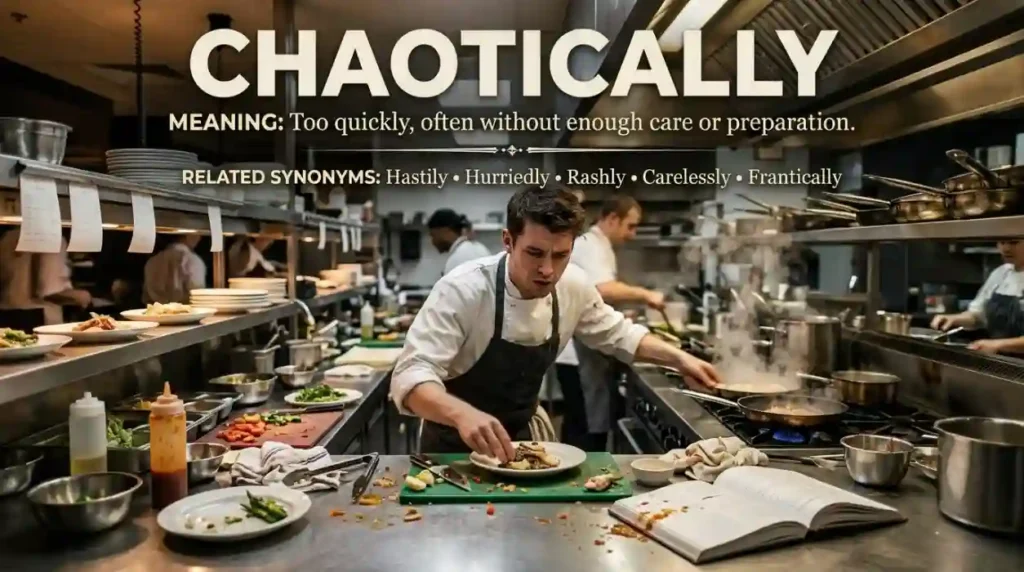
40. Hastily (Adverb) — US: /ˈheɪstɪli/ | UK: /ˈheɪstɪli/
Meaning: Too quickly, often without enough care or preparation.
Tone/Register: Neutral, formal.
Examples:
- The manager made a decision hastily.
- They packed the equipment hastily before the storm arrived.
41. In a Disorganized Way (Adverbial Phrase) — US: /ɪn ə dɪsˈɔːrɡənaɪzd weɪ/ | UK: /ɪn ə dɪsˈɔːɡənaɪzd weɪ/
Meaning: Without a clear structure, arrangement, or method.
Tone/Register: Neutral, explanatory.
Examples:
- The meeting was conducted in a disorganized way.
- The team stored its supplies in a disorganized way.
42. In a Confused Manner (Adverbial Phrase) — US: /ɪn ə kənˈfjuːzd ˈmænər/ | UK: /ɪn ə kənˈfjuːzd ˈmænə/
Meaning: In a way that shows uncertainty or a lack of understanding.
Tone/Register: Neutral, formal.
Examples:
- The witness described the incident in a confused manner.
- The students responded in a confused manner when the instructions changed.
43. Unrulily (Adverb) — US: /ʌnˈruːlɪli/ | UK: /ʌnˈruːlɪli/
Meaning: In a way that is difficult to control or manage, especially when describing people or groups.
Tone/Register: Descriptive, somewhat uncommon.
Examples:
- The children behaved unrulily during the long journey.
- The crowd moved unrulily toward the concert entrance.
44. In a Tumultuous Manner (Adverbial Phrase) — US: /ɪn ə tuːˈmʌltʃuəs ˈmænər/ | UK: /ɪn ə tjuːˈmʌltʃuəs ˈmænə/
Meaning: In a noisy, disorderly, or emotionally disturbed way.
Tone/Register: Formal, literary.
Examples:
- The crowd reacted in a tumultuous manner.
- The debate ended in a tumultuous manner.
45. Boisterously (Adverb) — US: /ˈbɔɪstərəsli/ | UK: /ˈbɔɪstərəsli/
Meaning: In a loud, energetic, and sometimes uncontrolled manner.
Tone/Register: Informal, expressive.
Examples:
- The guests celebrated boisterously after the announcement.
- The children played boisterously in the backyard.
46. In a Whirl (Adverbial Phrase) — US: /ɪn ə wɜːrl/ | UK: /ɪn ə wɜːl/
Meaning: In a state of rapid, confusing activity or movement.
Tone/Register: Literary, expressive.
Examples:
- The kitchen was in a whirl before the dinner party.
- The office went into a whirl when the deadline changed.
47. Higgledy Piggledy (Adverb) — US: /ˌhɪɡəldi ˈpɪɡəldi/ | UK: /ˌhɪɡəldi ˈpɪɡəldi/
Meaning: In a messy, untidy, or irregular arrangement.
Tone/Register: Playful, informal, chiefly British.
Examples:
- The toys were piled higgledy piggledy in the corner.
- The books stood higgledy piggledy on the shelf.
48. Helter-Skelter (Adverb) — US: /ˌhɛltər ˈskɛltər/ | UK: /ˌheltə ˈskeltə/
Meaning: In a hurried, disorderly, or uncontrolled way.
Tone/Register: Informal, expressive.
Examples:
- The shoppers rushed helter-skelter toward the exits.
- The children ran helter-skelter across the playground.
49. Pell-Mell (Adverb) — US: /ˌpɛl ˈmɛl/ | UK: /ˌpel ˈmel/
Meaning: In a confused, hurried, and disorderly manner.
Tone/Register: Literary, old-fashioned, expressive.
Examples:
- The crowd rushed pell-mell down the narrow street.
- The soldiers moved pell-mell toward the shelter.
50. In a State of Disorder (Adverbial Phrase) — US: /ɪn ə steɪt əv dɪsˈɔːrdər/ | UK: /ɪn ə steɪt əv dɪsˈɔːdə/
Meaning: In circumstances where things are poorly arranged or lack organization.
Tone/Register: Neutral, formal.
Examples:
- The storage room remained in a state of disorder.
- The department operated in a state of disorder after the sudden resignation.
Synonyms by Tone
Different alternatives communicate different levels of confusion, urgency, and disorder. Choose one that reflects the situation rather than replacing chaotically with any available synonym.
Neutral and Descriptive
- Disorderly
- Randomly
- Unpredictably
- Unsystematically
- Disorganizedly
- In disarray
- Without order
- In a disorganized way
These expressions describe a lack of organization without necessarily adding strong emotion.
Negative and Critical
- Recklessly
- Carelessly
- Frantically
- Uncontrollably
- Haphazardly
- Incoherently
- Erratically
These words may suggest poor decisions, confusion, danger, or a lack of control.
Energetic and Expressive
- Wildly
- Frenetically
- Hectically
- Boisterously
- Hysterically
- In a frenzy
- Helter-skelter
These alternatives can describe intense movement, excitement, or activity.
Playful and Informal
- Higgledy-piggledy
- Pell-mell
- Helter-skelter
- In a whirl
These expressions add personality and color to informal or creative writing.
Formal and Academic
- Unsystematically
- Incoherently
- Turbulently
- In a disjointed way
- In a tumultuous manner
- Without coordination
These expressions are useful in reports, analysis, academic writing, and professional descriptions.
“Chaotically” vs. Close Alternatives
| Word | Meaning difference | Best use |
|---|---|---|
| Chaotically | In a confused, disorderly, or uncontrolled way | General descriptions of disorder |
| Haphazardly | Without a proper plan or system | Poorly organized tasks or arrangements |
| Erratically | In an irregular or unpredictable pattern | Movement, behavior, or changing conditions |
| Frantically | With extreme urgency or anxiety | Rushed actions under pressure |
| Randomly | Without a deliberate pattern or selection process | Unplanned choices or arrangements |
Chaotically vs. haphazardly
Both suggest disorder. However, haphazardly emphasizes a lack of planning, while chaotically can describe a much broader state of confusion.
Chaotically vs. erratically
Erratically focuses on unpredictable changes or irregular behavior. Chaotically emphasizes a lack of overall order.
Chaotically vs. frantically
Frantically describes urgent or anxious activity. Chaotically does not always involve urgency or emotion.
How Chaotically Changes by Context
Daily Conversation
In everyday speech, chaotically can describe a messy room, a busy morning, or an event where everyone seems confused.
For example:
- Our morning started chaotically because everyone was late.
- The children ran around chaotically after school.
Words such as wildly, randomly, and hectically may sound more natural in relaxed conversations.
Writing and Blogging
Writers use chaotically to help readers imagine disorder. However, more specific alternatives can make descriptions stronger.
For example, haphazardly works well for poorly arranged objects, while erratically is more suitable for unpredictable movement or behavior.
Professional and Academic Writing
Professional writing often requires precise language. Use unsystematically when discussing research methods, without coordination when describing teamwork, and incoherently when discussing unclear communication.
Avoid using informal expressions such as helter-skelter in formal reports unless the tone allows it.
Creative and Informal Writing
Creative writers can use expressive words to build atmosphere. Frenetically creates a sense of urgency, while higgledy-piggledy gives a playful description of a messy arrangement.
Choose words that match the mood of the scene.
Common Mistakes Learners Make

Confusing Disorder with Speed
Not every fast action is chaotic. Hastily means quickly, often without enough care. Chaotically means in a disorganized or uncontrolled way.
A person can work hastily while still following an organized process.
Using Randomly in Every Situation
Randomly means without a deliberate pattern or selection method. It does not always mean confused or disorganized.
For example, a computer may select a number randomly without doing anything chaotically.
Confusing Haphazardly with Erratically
Haphazardly usually describes actions performed without proper planning. Erratically describes irregular or unpredictable behavior.
A person may arrange files haphazardly, while a vehicle may move erratically.
Using Informal Expressions in Formal Writing
Words such as higgledy-piggledy and pell-mell can sound playful or old-fashioned. They may not suit a research paper or business report.
Overusing Strong Adverbs
Words such as frantically, hysterically, and recklessly carry specific meanings. Avoid using them simply because they sound more dramatic than chaotic.
Register Notes: Formal vs. Informal
Formal English: Use unsystematically, incoherently, turbulently, or in a disorganized manner when precision is important.
Neutral English: Choose disorderly, randomly, unpredictably, or haphazardly for general descriptions.
Informal English: Use wildly, hectically, or frantically in everyday conversation when the meaning fits.
Playful English: Expressions such as higgledy-piggledy and helter-skelter add a colorful, conversational feel.
For related vocabulary practice, explore other words that describe confusion, disorder, and unpredictable behavior.
Real-Life Mini Scenarios
Workplace
A project manager notices that employees are completing tasks without a clear schedule. The manager might say, “The project is being handled haphazardly.”
This communicates a lack of planning more precisely than simply saying the work is chaotic.
Social Situations
Imagine arriving at a party where guests are moving around, music is loud, and everyone is talking. You could describe the atmosphere as lively and chaotically energetic.
Media and Pop Culture
A news report may describe a crowd moving frantically after an unexpected announcement. This expression communicates urgency and confusion.
Writing and Storytelling
A novelist describing a storm might write that the wind blew wildly and the branches moved erratically. These alternatives create a clearer picture than repeating chaotically.
Practice Exercise
Choose the most suitable word or phrase for each situation.
1. The files were placed without any plan or system. Which word fits best?
A. Haphazardly
B. Politely
C. Carefully
D. Quietly
2. A car keeps unpredictably changing direction. Which adverb is most suitable?
A. Gently
B. Erratically
C. Gracefully
D. Deliberately
3. A person searches for a missing passport under extreme pressure. Which word fits best?
A. Randomly
B. Calmly
C. Frantically
D. Systematically
4. The children are playing loudly and energetically. Which word describes their behavior?
A. Boisterously
B. Silently
C. Methodically
D. Carefully
5. A researcher collects information without following a consistent method. Which word is appropriate?
A. Politely
B. Unsystematically
C. Gracefully
D. Predictably
6. A person walks around without a clear destination or purpose. Which word fits best?
A. Aimlessly
B. Precisely
C. Efficiently
D. Carefully
7. The toys are scattered in a messy and playful arrangement. Which expression is suitable?
A. Incoherently
B. Higgledy-piggledy
C. Formally
D. Methodically
8. A driver ignores safety rules and creates danger. Which adverb describes the behavior?
A. Recklessly
B. Neatly
C. Randomly
D. Politely
9. A speaker gives an explanation that has no clear logical connection. Which word is suitable?
A. Boisterously
B. Incoherently
C. Hectically
D. Aimlessly
10. Employees are rushing to finish several tasks during a very busy morning. Which word fits best?
A. Hectically
B. Quietly
C. Regularly
D. Patiently
Answer Key:
1-A, 2-B, 3-C, 4-A, 5-B, 6-A, 7-B, 8-A, 9-B, 10-A,
Reflection Task:
Write three short sentences describing a complicated or confusing situation. Use haphazardly, erratically, and frantically in separate sentences. Check whether each word expresses the correct meaning.
FAQs
1. What is the difference between chaotic and chaotically?
Chaotic is an adjective that describes a person, place, or situation as disorganized or confusing. Chaotically is an adverb that explains how an action happens. For example, “The room was chaotic” describes the room, while “The papers were scattered chaotically” explains how they were arranged.
2. What is a simple word for chaotically?
A simple alternative is disorderly or randomly, depending on the sentence. Use disorderly when something lacks proper arrangement. Use randomly when there is no clear pattern or selection process. For everyday speech, wildly may also work when describing uncontrolled movement or activity.
3. What is a more professional way to say chaotically?
Professional alternatives include unsystematically, without coordination, in a disorganized manner, and without a clear structure. The best choice depends on what you are describing. For example, use unsystematically for research or procedures and without coordination for teams that are not working together effectively.
4. What is the opposite of chaotically?
Common opposites include orderly, systematically, methodically, neatly, and efficiently. These words describe actions performed with planning, structure, or control. For example, “The files were arranged systematically” communicates the opposite of “The files were arranged chaotically.”
5. Can chaotically describe a person’s behavior?
Yes. Chaotically can describe behavior that appears confused, disorganized, or difficult to control. For example, someone might move chaotically during a stressful emergency. However, use erratically when you specifically mean unpredictable behavior, and frantically when the person acts with urgency or anxiety.
6. What is the difference between haphazardly and randomly?
Haphazardly usually suggests that something was done carelessly or without proper planning. Randomly means that something happened without a deliberate pattern or selection process. A desk can be arranged haphazardly because someone did not organize it, while names can be selected randomly through a fair selection method.
7. Which synonyms for chaotically are best for creative writing?
Words such as frenetically, wildly, tumultuously, helter-skelter, and higgledy-piggledy can make creative descriptions more vivid. Choose frenetically for intense activity, wildly for uncontrolled movement, and higgledy-piggledy for a playful description of disorder. The right word should support the mood of your scene.
Conclusion
Learning synonyms for chaotically helps you describe confusion, disorder, and unpredictable actions with greater accuracy. Each alternative adds a slightly different meaning and tone.
Words such as haphazardly, erratically, and frantically make your descriptions more specific. They help students, bloggers, and writers express ideas clearly.
A stronger vocabulary improves writing, speaking, and everyday communication. It also helps you understand how native English speakers describe complicated or confusing situations.
Practice these alternatives in emails, essays, and daily conversations. Try writing your own examples and choose words that match the situation naturally.
Suggested External Sources
Choosing reliable dictionaries and language resources can help you understand words more accurately. These references provide useful information about definitions, pronunciation, synonyms, word origins, grammatical usage, and real-life examples.
Use the following trusted sources to explore vocabulary, improve your English, and check the correct meaning of unfamiliar words.
Merriam-Webster is a useful resource for understanding English vocabulary in American English. It provides:
- Clear definitions and alternative word choices.
- Synonyms and antonyms for commonly used words.
- Pronunciation guides and audio recordings.
- Word histories and etymological information.
- Example sentences showing how words work in context.
Best for: Finding accurate definitions, common synonyms, and differences between similar words.
2. Cambridge Dictionary
Cambridge Dictionary is particularly helpful for English learners who want simple explanations and practical examples. It offers:
- British and American English definitions.
- IPA pronunciation and audio.
- Synonyms, related expressions, and grammatical information.
- Example sentences from everyday English.
- Common phrases and collocations.
Best for: Understanding everyday vocabulary, pronunciation, and natural English usage.
3. Oxford Learner’s Dictionaries
Oxford Learner’s Dictionaries helps students understand how English words are used in different situations. Its resources include:
- Simple definitions written for English learners.
- British and American pronunciation.
- Parts of speech and grammatical patterns.
- Synonyms, related words, and usage notes.
- Natural example sentences and common expressions.
Best for: Learning vocabulary, improving sentence construction, and choosing appropriate alternatives.
4. Online Etymology Dictionary
The Online Etymology Dictionary explores the historical development of English words. It helps readers understand how meanings and spellings have changed over time.
You can use it to discover:
- Old English, Middle English, and Latin roots.
- Historical word meanings and origins.
- Changes in spelling and pronunciation.
- Connections between related words.
- How modern vocabulary developed.
Best for: Exploring word origins, historical meanings, and linguistic development.

Jameel Hassan is the founder and lead writer at SynonymsCloud.com, a trusted online platform dedicated to English vocabulary and effective communication. He is passionate about helping students, writers, professionals, and lifelong learners discover the right words to express their ideas with clarity, precision, and confidence.
At SynonymsCloud.com, every article is thoroughly researched and carefully written to provide accurate, practical, and easy-to-understand guidance on synonyms, antonyms, word meanings, idioms, and vocabulary. With a strong commitment to quality, real-world usage, and clear explanations, the website helps readers expand their vocabulary, improve their writing, and communicate more effectively in both academic and professional settings.