
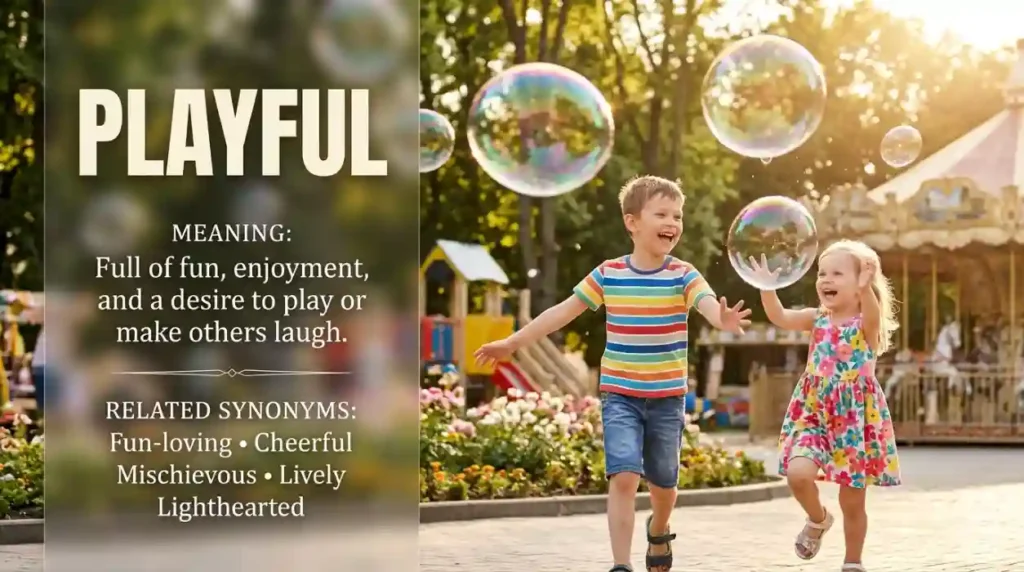
A synonym for playful is a word that describes someone or something as fun, lively, cheerful, humorous, or full of energy. Common alternatives include fun-loving, mischievous, lively, spirited, lighthearted, and teasing. The best choice depends on whether you mean joyful behavior, friendly humor, or harmless mischief.
Think of a child laughing, playing silly games, and making funny faces to entertain others. Words like cheerful, mischievous, and lively can describe such behavior. Each alternative adds a different shade of meaning and helps paint a clearer picture of someone’s personality.
The word playful is commonly used to describe children, pets, friendships, relationships, and fun activities. It can express a lighthearted attitude, a sense of humor, or a natural desire to enjoy amusing moments.
Learning a synonym for playful gives you more ways to describe happiness, humor, and energetic behavior. Alternatives such as witty, spirited, frolicsome, and lighthearted can make your sentences more interesting and meaningful.
Whether you are a student, blogger, content writer, or everyday English learner, exploring a synonym for playful can strengthen your vocabulary. These alternatives help you avoid repetition, improve descriptive writing, and communicate ideas more naturally.
What Does “Playful” Really Mean?
Playful means showing a desire to have fun, joke, laugh, or enjoy an activity in a lighthearted way. It can describe a person, animal, action, expression, comment, or atmosphere.
A playful person often enjoys joking, teasing, laughing, or participating in enjoyable activities. The word usually suggests friendliness and positive energy, although its meaning can change with context.
Native English speakers commonly use playful in several situations:
- Personality: A playful person enjoys humor and fun.
- Children: A playful child likes games, jokes, and imaginative activities.
- Relationships: A playful conversation may include friendly teasing.
- Animals: A playful puppy enjoys running and chasing toys.
- Writing: A playful tone makes a message feel relaxed and humorous.
- Design: Playful colors or shapes create a fun and creative appearance.
Part of Speech
Playful is an adjective. It describes a noun by explaining its qualities or behavior.
Examples:
- She has a playful personality.
- The puppy made a playful jump.
- His playful comment made everyone smile.
The related noun is playfulness, while the adverb is playfully.
Connotative Meaning of Playful
(Connotation means the emotional feeling or association a word creates beyond its basic dictionary meaning.)
Positive tone: Playful usually suggests happiness, friendliness, creativity, humor, and enjoyment.
Example: “Her playful attitude made the family gathering more enjoyable.”
Negative tone: In certain situations, playful behavior can seem immature, distracting, or inappropriate.
Example: “His playful comments interrupted an important meeting.”
Neutral tone: The word can simply describe an activity or appearance without expressing a strong judgment.
Example: “The designer used playful shapes in the children’s book.”
The meaning depends on the situation. Friendly teasing can create a positive connection, but teasing that hurts someone may feel disrespectful.
Etymology and History of Playful
The word playful comes from the English word play combined with the suffix -ful, which means “full of” or “characterized by.”
The word play has roots in Old English plegian, meaning to exercise, frolic, or engage in activity. Over time, it developed into the familiar modern word associated with games, enjoyment, and recreation.
Old English Period (450–1100)
Old English used plegian to describe playing, exercising, or engaging in lively activity. The language also had related forms connected with games and recreation.
The exact modern adjective playful was not yet established in its current form.
Middle English Period (1100–1500)
During Middle English, forms of play became increasingly common. The word was used for games, entertainment, recreation, and enjoyable activities.
The suffix -ful was also used to form adjectives describing qualities or characteristics.
Modern English Period (1500–Present)
The adjective playful developed into its modern form and became widely used to describe cheerful, humorous, lively, or mischievous behavior.
Today, it can describe people, animals, relationships, writing styles, designs, and even colors or visual effects.
Pronunciation of Playful
- US IPA: /ˈpleɪ.fəl/
- UK IPA: /ˈpleɪ.fəl/
Syllables
play-ful: Syllable 2
Affixation Pattern of Playful
- Root: Play
- Prefix: None
- Suffix: -ful
The suffix -ful turns the noun play into the adjective playful. It describes someone or something full of play, fun, or lively behavior.
Related word forms
- Play: Noun or verb
- Playful: Adjective
- Playfully: Adverb
- Playfulness: Noun
Synonyms List
The following words describe different aspects of playfulness, including humor, happiness, energy, friendly teasing, and lighthearted behavior. Some are close synonyms, while others are context-specific alternatives. They are not interchangeable in every sentence.
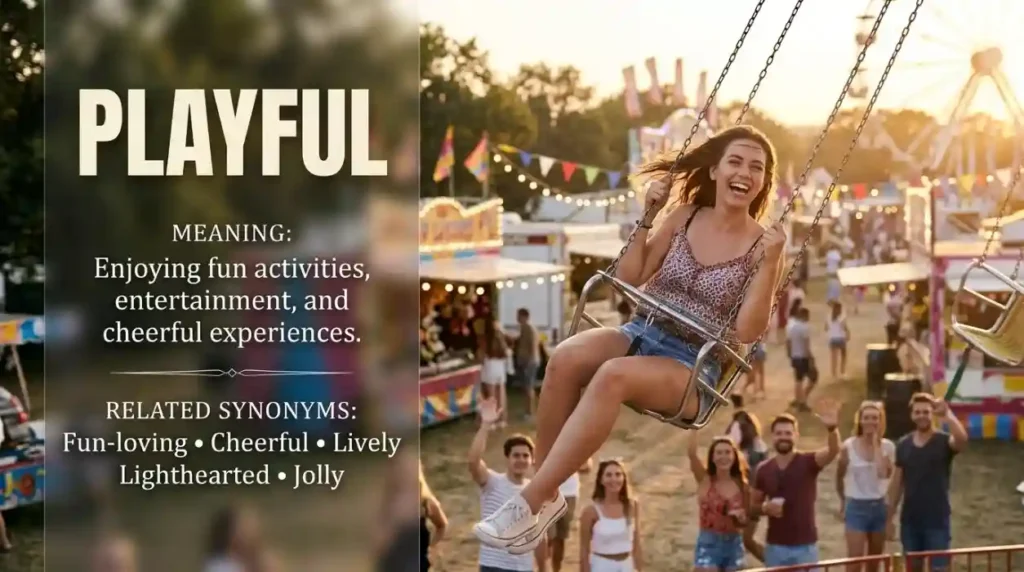
1. Fun-Loving (Adjective) — US: /ˈfʌn ˌlʌv.ɪŋ/ | UK: /ˈfʌn ˌlʌv.ɪŋ/
Meaning: Enjoying fun activities, entertainment, and cheerful experiences.
Tone/Register: Positive, informal, everyday.
Examples:
- My fun-loving cousin always makes family gatherings exciting.
- She is a fun-loving person who enjoys meeting new people.
2. Cheerful (Adjective) — US: /ˈtʃɪr.fəl/ | UK: /ˈtʃɪə.fəl/
Meaning: Showing happiness, optimism, and a pleasant attitude.
Tone/Register: Positive, neutral, everyday.
Examples:
- His cheerful greeting brightened my morning.
- The cheerful children sang together on the bus.
3. Lively (Adjective) — US: /ˈlaɪv.li/ | UK: /ˈlaɪv.li/
Meaning: Full of energy, activity, and enthusiasm.
Tone/Register: Positive, conversational, descriptive.
Examples:
- The party became lively after the music started.
- Her lively personality makes conversations enjoyable.
4. Mischievous (Adjective) — US: /ˈmɪs.tʃə.vəs/ | UK: /ˈmɪs.tʃɪ.vəs/
Meaning: Enjoying harmless tricks, jokes, or small acts of troublemaking.
Tone/Register: Informal, humorous, sometimes disapproving.
Examples:
- The mischievous puppy hid my slippers under the sofa.
- A mischievous smile appeared on his face.
5. Humorous (Adjective) — US: /ˈhjuː.mɚ.əs/ | UK: /ˈhjuː.mər.əs/
Meaning: Making people laugh or showing a sense of humor.
Tone/Register: Neutral, informal to formal.
Examples:
- She added a humorous comment to the presentation.
- His humorous stories made the journey feel shorter.
6. Jolly (Adjective) — US: /ˈdʒɑː.li/ | UK: /ˈdʒɒl.i/
Meaning: Happy, cheerful, and full of good spirits.
Tone/Register: Friendly, informal, slightly traditional.
Examples:
- Our jolly neighbor greets everyone with a smile.
- The children were jolly during the holiday celebration.
7. Spirited (Adjective) — US: /ˈspɪr.ɪ.tɪd/ | UK: /ˈspɪr.ɪ.tɪd/
Meaning: Showing enthusiasm, confidence, and energetic behavior.
Tone/Register: Positive, descriptive, professional.
Examples:
- The spirited debate kept the audience interested.
- She gave a spirited performance at the school event.
8. Bubbly (Adjective) — US: /ˈbʌb.li/ | UK: /ˈbʌb.li/
Meaning: Naturally cheerful, energetic, and enthusiastic.
Tone/Register: Informal, friendly, positive.
Examples:
- Her bubbly personality makes new students feel welcome.
- The bubbly host kept the audience smiling.
9. Lighthearted (Adjective) — US: /ˌlaɪtˈhɑːr.tɪd/ | UK: /ˌlaɪtˈhɑː.tɪd/
Meaning: Relaxed, cheerful, and free from serious worries.
Tone/Register: Positive, conversational, descriptive.
Examples:
- We had a lighthearted conversation after work.
- The movie offers a lighthearted look at family life.
10. Jocular (Adjective) — US: /ˈdʒɑː.kjə.lɚ/ | UK: /ˈdʒɒk.jə.lə/
Meaning: Fond of joking or making humorous remarks.
Tone/Register: Informal to formal, slightly literary.
Examples:
- His jocular manner made the interview more relaxed.
- The coach used a jocular comment to reduce tension.
11. Witty (Adjective) — US: /ˈwɪt̬.i/ | UK: /ˈwɪt.i/
Meaning: Showing quick and clever humor through words or ideas.
Tone/Register: Positive, intelligent, conversational.
Examples:
- Her witty reply made the whole table laugh.
- The writer is known for witty observations about everyday life.
12. Amusing (Adjective) — US: /əˈmjuː.zɪŋ/ | UK: /əˈmjuː.zɪŋ/
Meaning: Entertaining or causing people to smile or laugh.
Tone/Register: Neutral, friendly, descriptive.
Examples:
- The children shared an amusing story about their trip.
- I found his explanation surprisingly amusing.
13. Frolicsome (Adjective) — US: /ˈfrɑː.lɪk.səm/ | UK: /ˈfrɒl.ɪk.səm/
Meaning: Full of energetic, cheerful, and carefree activity.
Tone/Register: Descriptive, literary, informal.
Examples:
- Frolicsome puppies raced across the garden.
- The children enjoyed a frolicsome afternoon at the beach.
14. Carefree (Adjective) — US: /ˈker.friː/ | UK: /ˈkeə.friː/
Meaning: Relaxed and free from worry or responsibility.
Tone/Register: Positive, informal, descriptive.
Examples:
- They spent a carefree afternoon beside the lake.
- Her carefree attitude helped everyone relax.
15. Vivacious (Adjective) — US: /vɪˈveɪ.ʃəs/ | UK: /vɪˈveɪ.ʃəs/
Meaning: Attractive and lively because of strong energy and enthusiasm.
Tone/Register: Positive, expressive, slightly formal.
Examples:
- The vivacious presenter captured everyone’s attention.
- Her vivacious personality made the event memorable.
16. Energetic (Adjective) — US: /ˌen.ɚˈdʒet̬.ɪk/ | UK: /ˌen.əˈdʒet.ɪk/
Meaning: Having or showing a lot of physical or mental energy.
Tone/Register: Neutral, positive, everyday.
Examples:
- The energetic children ran around the playground.
- He remained energetic throughout the long trip.
17. Animated (Adjective) — US: /ˈæn.ə.meɪ.t̬ɪd/ | UK: /ˈæn.ɪ.meɪ.tɪd/
Meaning: Showing excitement through lively speech, gestures, or expressions.
Tone/Register: Neutral, descriptive, conversational.
Examples:
- She became animated while describing her favorite movie.
- Their animated discussion continued over dinner.
18. Exuberant (Adjective) — US: /ɪɡˈzuː.bɚ.ənt/ | UK: /ɪɡˈzjuː.bər.ənt/
Meaning: Showing overflowing happiness, excitement, and energy.
Tone/Register: Positive, expressive, formal.
Examples:
- The exuberant crowd celebrated the team’s victory.
- His exuberant greeting made the guests feel welcome.
19. Impish (Adjective) — US: /ˈɪm.pɪʃ/ | UK: /ˈɪm.pɪʃ/
Meaning: Showing a playful tendency to make harmless trouble or jokes.
Tone/Register: Informal, humorous, descriptive.
Examples:
- The child gave an impish grin before hiding the toy.
- Her impish sense of humor keeps her friends entertained.
20. Teasing (Adjective) — US: /ˈtiː.zɪŋ/ | UK: /ˈtiː.zɪŋ/
Meaning: Making light jokes about someone, usually in a friendly way.
Tone/Register: Informal, conversational, context-dependent.
Examples:
- He gave me a teasing smile when I forgot the lyrics.
- Their teasing remarks showed how comfortable they were together.
21. Frolicsome (Adjective) — US: /ˈfrɑː.lɪk.səm/ | UK: /ˈfrɒl.ɪk.səm/
Meaning: Enjoying lively movement, games, and carefree fun.
Tone/Register: Literary, descriptive.
Examples:
- Frolicsome dolphins followed the boat through the water.
- A frolicsome group of children filled the park with laughter.
22. Impish (Adjective) — US: /ˈɪm.pɪʃ/ | UK: /ˈɪm.pɪʃ/
Meaning: Slightly naughty, charmingly or humorously.
Tone/Register: Informal, affectionate, descriptive.
Examples:
- An impish look crossed his face as he planned the surprise.
- The character has an impish charm that audiences love.
23. Merry (Adjective) — US: /ˈmer.i/ | UK: /ˈmer.i/
Meaning: Happy, cheerful, and full of enjoyment.
Tone/Register: Warm, positive, traditional.
Examples:
- The merry group sang songs around the campfire.
- Everyone shared a merry laugh during the celebration.
24. Joyful (Adjective) — US: /ˈdʒɔɪ.fəl/ | UK: /ˈdʒɔɪ.fəl/
Meaning: Feeling or expressing great happiness and delight.
Tone/Register: Positive, emotional, descriptive.
Examples:
- The joyful children welcomed their parents after school.
- It was a joyful moment when the family reunited.
25. Happy-Go-Lucky (Adjective) — US: /ˌhæp.i.ɡoʊˈlʌk.i/ | UK: /ˌhæp.i.ɡəʊˈlʌk.i/
Meaning: Relaxed and cheerful, with little concern about problems.
Tone/Register: Informal, friendly, conversational.
Examples:
- His happy-go-lucky nature makes him easy to be around.
- She has a happy-go-lucky approach to everyday challenges.
26. Playful-Minded (Adjective) — US: /ˈpleɪ.fəl ˌmaɪn.dɪd/ | UK: /ˈpleɪ.fəl ˌmaɪn.dɪd/
Meaning: Having a tendency to approach ideas or situations with humor and imagination.
Tone/Register: Informal, descriptive.
Examples:
- The playful-minded artist filled the room with unusual ideas.
- A playful-minded approach can make learning more enjoyable.
27. Sportive (Adjective) — US: /ˈspɔːr.tɪv/ | UK: /ˈspɔː.tɪv/
Meaning: Showing a fondness for games, sports, or physical recreation.
Tone/Register: Formal, uncommon, descriptive.
Examples:
- The sportive children organized a friendly race.
- His sportive nature made outdoor activities especially enjoyable.
28. Frolicsome-spirited (Adjective) — US: /ˈfrɑː.lɪk.səm ˈspɪr.ɪ.tɪd/ | UK: /ˈfrɒl.ɪk.səm ˈspɪr.ɪ.tɪd/
Meaning: Showing a lively and carefree enjoyment of fun activities.
Tone/Register: Literary, expressive.
Examples:
- The frolicsome-spirited children danced across the lawn.
- Her writing has a frolicsome-spirited quality.
29. Whimsical (Adjective) — US: /ˈwɪm.zɪ.kəl/ | UK: /ˈwɪm.zɪ.kəl/
Meaning: Playfully unusual, imaginative, or delightfully unpredictable.
Tone/Register: Creative, descriptive, positive.
Examples:
- The illustrator created a whimsical world of talking animals.
- Her whimsical decorations gave the room a magical feeling.
30. Impulsive (Adjective) — US: /ɪmˈpʌl.sɪv/ | UK: /ɪmˈpʌl.sɪv/
Meaning: Acting suddenly without carefully considering the results.
Tone/Register: Neutral to negative, psychological.
Examples:
- His impulsive decision turned a quiet evening into an adventure.
- Avoid impulsive comments during serious discussions.
31. Quirky (Adjective) — US: /ˈkwɝː.ki/ | UK: /ˈkwɜː.ki/
Meaning: Unusually interesting or amusing in a distinctive way.
Tone/Register: Informal, creative, positive.
Examples:
- Her quirky sense of humor makes every conversation different.
- The café has a quirky design with colorful furniture.
32. Zesty (Adjective) — US: /ˈzes.ti/ | UK: /ˈzes.ti/
Meaning: Full of energy, enthusiasm, and lively character.
Tone/Register: Informal, expressive, positive.
Examples:
- The zesty performance brought excitement to the festival.
- He added a zesty touch to the group discussion.
33. Vivaciously Spirited (Adjective Phrase) — US: /vɪˈveɪ.ʃəs.li ˈspɪr.ɪ.tɪd/ | UK: /vɪˈveɪ.ʃəs.li ˈspɪr.ɪ.tɪd/
Meaning: Showing lively enthusiasm and an energetic personality.
Tone/Register: Expressive, descriptive.
Examples:
- The vivaciously spirited performer entertained the audience.
- Her vivaciously spirited personality made the gathering lively.
34. Humorous-Minded (Adjective) — US: /ˈhjuː.mɚ.əs ˈmaɪn.dɪd/ | UK: /ˈhjuː.mər.əs ˈmaɪn.dɪd/
Meaning: Naturally inclined to see or express the funny side of situations.
Tone/Register: Informal, descriptive.
Examples:
- His humorous-minded approach helped the team relax.
- A humorous-minded friend can make an ordinary day memorable.
35. Comical (Adjective) — US: /ˈkɑː.mɪ.kəl/ | UK: /ˈkɒm.ɪ.kəl/
Meaning: Funny or amusing because of unusual actions or appearances.
Tone/Register: Informal, descriptive.
Examples:
- The dog’s comical walk made everyone laugh.
- His comical expression appeared in the family photograph.
36. Droll (Adjective) — US: /droʊl/ | UK: /drəʊl/
Meaning: Amusing in an unusual, dry, or subtle way.
Tone/Register: Literary, sophisticated, understated.
Examples:
- Her droll observations made the interview entertaining.
- He has a droll sense of humor that people appreciate.
37. Facetious (Adjective) — US: /fəˈsiː.ʃəs/ | UK: /fəˈsiː.ʃəs/
Meaning: Treating a serious subject with inappropriate or deliberately exaggerated humor.
Tone/Register: Formal, often negative.
Examples:
- His facetious response was poorly received during the serious meeting.
- Avoid facetious remarks when someone needs genuine help.
38. Tongue-in-Cheek (Adjective) — US: /ˌtʌŋ ɪn ˈtʃiːk/ | UK: /ˌtʌŋ ɪn ˈtʃiːk/
Meaning: Expressing humor or criticism in an intentionally ironic way.
Tone/Register: Informal, witty, conversational.
Examples:
- The article offers a tongue-in-cheek review of office culture.
- Her tongue-in-cheek comment made the group laugh.
39. Bantering (Adjective/Verb) — US: /ˈbæn.tɚ.ɪŋ/ | UK: /ˈbæn.tər.ɪŋ/
Meaning: Exchanging friendly jokes and humorous remarks.
Tone/Register: Informal, social, conversational.
Examples:
- The colleagues were bantering before the presentation.
- Their bantering conversation made the long drive enjoyable.
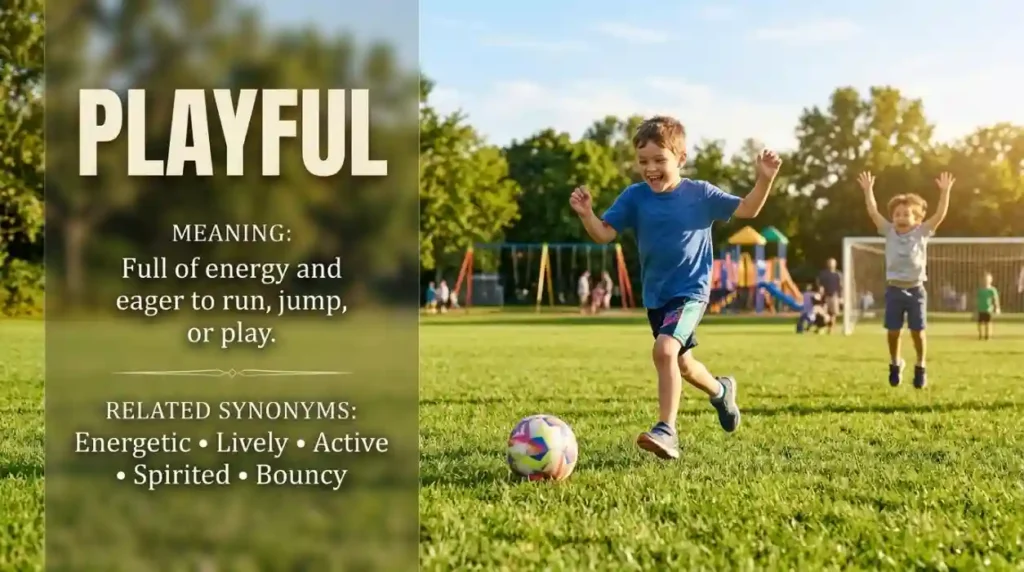
40. Frisky (Adjective) — US: /ˈfrɪs.ki/ | UK: /ˈfrɪs.ki/
Meaning: Full of energy and eager to run, jump, or play.
Tone/Register: Informal, descriptive, often used for animals and children.
Examples:
- The frisky kitten chased a ball across the room.
- The children became frisky after spending time indoors.
41. High-Spirited (Adjective) — US: /ˌhaɪˈspɪr.ɪ.tɪd/ | UK: /ˌhaɪˈspɪr.ɪ.tɪd/
Meaning: Showing lively enthusiasm, excitement, and confidence.
Tone/Register: Positive, descriptive.
Examples:
- The high-spirited students celebrated their success.
- A high-spirited crowd filled the stadium.
42. Vivacious (Adjective) — US: /vɪˈveɪ.ʃəs/ | UK: /vɪˈveɪ.ʃəs/
Meaning: Full of life, energy, and attractive enthusiasm.
Tone/Register: Positive, expressive.
Examples:
- The vivacious dancer impressed the judges.
- Her vivacious personality brought warmth to the event.
43. Frolic (Verb/Noun) — US: /ˈfrɑː.lɪk/ | UK: /ˈfrɒl.ɪk/
Meaning: To play or move around in a lively and carefree way.
Tone/Register: Descriptive, informal to literary.
Examples:
- The lambs frolic in the field every morning.
- We watched the children frolic near the water.
44. Playfully Teasing (Adjective Phrase) — US: /ˈpleɪ.fəl.i ˈtiː.zɪŋ/ | UK: /ˈpleɪ.fəl.i ˈtiː.zɪŋ/
Meaning: Making gentle jokes that are intended to entertain rather than hurt.
Tone/Register: Informal, friendly, social.
Examples:
- Her playfully teasing message made me smile.
- They exchanged playfully teasing comments during lunch.
45. Jovial (Adjective) — US: /ˈdʒoʊ.vi.əl/ | UK: /ˈdʒəʊ.vi.əl/
Meaning: Cheerful, friendly, and full of good humor.
Tone/Register: Positive, slightly formal, descriptive.
Examples:
- The jovial host welcomed everyone with a warm laugh.
- His jovial personality made the celebration more enjoyable.
46. Giddy (Adjective) — US: /ˈɡɪd.i/ | UK: /ˈɡɪd.i/
Meaning: Feeling extremely excited, often in a slightly silly or uncontrolled way.
Tone/Register: Informal, expressive.
Examples:
- The children were giddy with excitement before the trip.
- She felt giddy after receiving the unexpected invitation.
47. Zany (Adjective) — US: /ˈzeɪ.ni/ | UK: /ˈzeɪ.ni/
Meaning: Amusingly unusual, silly, or unpredictable.
Tone/Register: Informal, humorous, creative.
Examples:
- The comedian’s zany performance kept the audience laughing.
- Their zany costumes made the party unforgettable.
48. Sprightly (Adjective) — US: /ˈspraɪt.li/ | UK: /ˈspraɪt.li/
Meaning: Lively, energetic, and cheerful, especially in movement or manner.
Tone/Register: Positive, descriptive, slightly literary.
Examples:
- The sprightly old man danced at the wedding.
- She walked into the room with a sprightly step.
49. Frolicsome (Adjective) — US: /ˈfrɑː.lɪk.səm/ | UK: /ˈfrɒl.ɪk.səm/
Meaning: Cheerfully active and eager to enjoy games or carefree movement.
Tone/Register: Literary, playful, descriptive.
Examples:
- The frolicsome puppies rolled around in the grass.
- A frolicsome mood spread through the group.
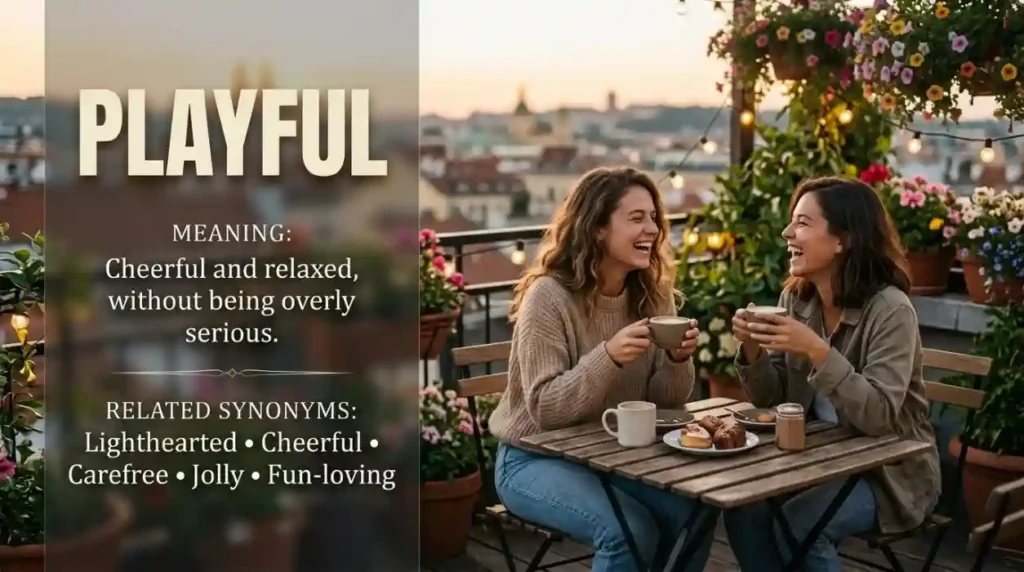
50. Light-Hearted (Adjective) — US: /ˌlaɪtˈhɑːr.tɪd/ | UK: /ˌlaɪtˈhɑː.tɪd/
Meaning: Cheerful and relaxed, without being overly serious.
Tone/Register: Positive, informal to neutral.
Examples:
- We enjoyed a light-hearted discussion about our favorite films.
- The light-hearted message made the stressful day feel easier.
Synonyms by Tone
The best alternative depends on the feeling you want to communicate. A word describing cheerful energy may not fit a sentence about harmless mischief or clever humor.
Positive Alternatives
These words suggest happiness, friendliness, and enjoyable energy:
- Cheerful
- Joyful
- Lively
- Bubbly
- Spirited
- Vivacious
- Exuberant
- Jolly
- Merry
- Lighthearted
Example: Her cheerful personality makes every family gathering more enjoyable.
Neutral Alternatives
These expressions describe humor or energetic behavior without strong emotional judgment:
- Humorous
- Amusing
- Animated
- Energetic
- Teasing
- Bantering
- Comical
- Frisky
Example: The animated discussion continued long after the meeting ended.
Negative or Context-Dependent Alternatives
These words may suggest inappropriate humor, poor judgment, or excessive behavior:
- Facetious
- Impulsive
- Mischievous
- Impish
- Giddy
Example: His facetious comment was inappropriate during the serious discussion.
Playful and Informal Alternatives
These expressions are especially useful in casual conversations and creative descriptions:
- Fun-loving
- Quirky
- Zany
- Happy-go-lucky
- Witty
- Jocular
- Carefree
- Tongue-in-cheek
Example: My quirky friend always comes up with unusual jokes.
Why does tone matter?
Tone changes how readers understand a person’s behavior. Cheerful suggests happiness, mischievous suggests harmless troublemaking, and witty highlights clever humor. Choosing carefully helps you express the exact personality or mood you mean.
Playful vs. Close Alternatives
Some words are close in meaning but have different shades of meaning.
| Word | Meaning difference | Best use |
|---|---|---|
| Playful | Enjoying fun, games, humor, or lighthearted behavior | General descriptions |
| Mischievous | Enjoying harmless tricks or minor troublemaking | Children, pets, and teasing behavior |
| Cheerful | Showing happiness and a positive attitude | Personality and mood |
| Witty | Using clever and amusing language | Conversations and writing |
| Lighthearted | Relaxed and not overly serious | Conversations, stories, and entertainment |
Playful vs. Mischievous
Playful describes fun behavior. Mischievous suggests a person enjoys harmless tricks or small acts of troublemaking.
- Playful: The puppy happily chased its toy.
- Mischievous: The puppy secretly stole a sock and hid it.
Use playful for general fun. Use mischievous when a little troublemaking is involved.
Playful vs. Cheerful
Playful focuses on fun, humor, and games. Cheerful focuses on happiness and a positive mood.
- Playful: He made a funny face to entertain the children.
- Cheerful: He greeted everyone with a warm smile.
Playful vs. Witty
Playful can describe many forms of fun behavior. Witty specifically describes clever humor, especially through language.
- Playful: They enjoyed a friendly game together.
- Witty: She answered the question with a clever joke.
How Playful Changes by Context
Daily Conversation
In everyday English, playful often describes someone’s personality, humor, or behavior.
For example, “My little brother is playful” suggests that he enjoys jokes, games, and fun activities. Words such as cheerful, fun-loving, and mischievous can make the description more specific.
Writing and Blogging
In blog posts, playful can describe a writing style, headline, design, or personality.
Use whimsical when a design or story feels imaginative and unusual. Use lighthearted when the content has a relaxed tone.
Professional and Academic English
Professional writing may use lively, engaging, animated, or humorous to describe communication and activities.
For example, a report might describe a lively classroom discussion or an engaging learning activity. Avoid informal words such as zany in formal reports unless the context supports them.
Creative and Informal English
Creative writing offers more freedom. Words such as impish, whimsical, frolicsome, and zany can make characters and scenes more memorable.
In casual messages, fun-loving, quirky, and happy-go-lucky sound friendly and natural.
Common Mistakes Learners Make
1. Treating Every Alternative as an Exact Synonym
Not every word has the same meaning as playful.
For example, cheerful describes happiness, while mischievous suggests harmless troublemaking. Choose the word that matches the behavior you want to describe.
2. Confusing Playful With Childish
Playful usually suggests enjoyable and lighthearted behavior. Childish often describes behavior that seems immature or inappropriate for someone’s age.
A playful adult can have a good sense of humor without acting irresponsibly.
3. Using Mischievous for Every Funny Person
A funny person is not always mischievous. Someone can make people laugh through clever jokes without playing tricks or breaking rules.
Use witty when the person mainly entertains others through words.
4. Confusing Playful With Flirtatious
A playful comment may be humorous or teasing. A flirtatious comment suggests romantic or personal attraction.
These words can overlap in some situations, but they do not mean the same thing.
5. Using Informal Words in Formal Writing
Words such as zany, jolly, and happy-go-lucky are usually better suited to casual or creative contexts.
For professional writing, consider lively, engaging, or humorous.
Register Notes
- Formal: Vivacious, jocular, facetious, exuberant.
- Informal: Fun-loving, bubbly, zany, quirky, happy-go-lucky.
- Neutral: Cheerful, lively, amusing, energetic, lighthearted.
- Creative: Whimsical, impish, frolicsome, droll.
- Spoken English: Jolly, witty, mischievous, carefree.
- Written English: Humorous, animated, vivacious, tongue-in-cheek.
For related vocabulary practice, explore an article about synonyms for cheerful to learn more ways to describe positive moods and personalities.
Real-Life Mini Scenarios Using Playful
Workplace
A team leader adds a light joke during a meeting to help employees feel relaxed. You could describe the leader’s communication style as playful, humorous, or lighthearted.
Social Situations
Friends exchange funny comments while having lunch. Their conversation is playful and full of friendly banter.
Media and Pop Culture
A cartoon character uses unusual jokes and silly actions to entertain viewers. The character may be described as quirky, mischievous, or zany.
Writing and Storytelling
A writer creates a character who enjoys harmless tricks and clever jokes. Words such as impish, witty, and mischievous help readers imagine the character’s personality.
Practice Exercise
Choose the expression that best matches each situation.
1. A person enjoys games, jokes, and fun activities. Which word describes this personality?
A. Serious
B. Fun-loving
C. Indifferent
D. Strict
2. A child hides a toy as a harmless joke. Which adjective fits best?
A. Mischievous
B. Formal
C. Anxious
D. Quiet
3. Someone greets everyone with a happy smile. Which word best describes their mood?
A. Facetious
B. Cheerful
C. Impulsive
D. Droll
4. A comedian uses clever language to make people laugh. Which adjective is most suitable?
A. Witty
B. Carefree
C. Frisky
D. Protective
5. A puppy runs around the garden with excitement. Which word describes its behavior?
A. Frisky
B. Formal
C. Facetious
D. Reserved
6. A person makes an inappropriate joke during a serious meeting. Which word best describes the comment?
A. Joyful
B. Facetious
C. Supportive
D. Gentle
7. A designer creates an imaginative world with unusual characters and colors. Which word fits best?
A. Whimsical
B. Strict
C. Ordinary
D. Careless
8. Friends exchange friendly jokes during lunch. What is this kind of conversation called?
A. Bantering
B. Arguing
C. Investigating
D. Complaining
9. A person remains relaxed and does not worry much about small problems. Which adjective describes them?
A. Happy-go-lucky
B. Impatient
C. Hostile
D. Formal
10. A lively performer fills the stage with energy and enthusiasm. Which word is most suitable?
A. Vivacious
B. Uninterested
C. Silent
D. Careless
Answer Key:
1-B | 2-A | 3-B | 4-A | 5-A | 6-B | 7-A | 8-A | 9-A | 10-A
Reflection Task:
Write three original sentences using these alternatives. Read your sentences aloud. Check whether each word expresses the exact mood or behavior you want to communicate.
FAQs
1. What is a good synonym for a playful personality?
A playful personality can be described as fun-loving, cheerful, lively, bubbly, or mischievous. Use fun-loving for someone who enjoys activities and entertainment. Choose bubbly for someone with an energetic and cheerful personality. Use mischievous when the person enjoys harmless tricks or jokes.
2. What is a playful word to describe a child?
Words such as mischievous, energetic, lively, frisky, and spirited can describe a playful child. The best choice depends on the child’s behavior. Frisky suggests energetic movement, while mischievous describes harmless troublemaking. Spirited highlights confidence and enthusiasm.
3. What is the difference between playful and flirtatious?
Playful describes fun, humor, and lighthearted behavior. Flirtatious describes behavior intended to show romantic or personal interest. A person can make playful jokes without flirting. However, playful teasing may sometimes become flirtatious when it includes romantic signals or affectionate attention.
4. What is a professional word for playful?
Professional alternatives include lively, engaging, animated, and humorous. These words can describe communication, presentations, teaching methods, or workplace activities. For example, an engaging presentation keeps the audience interested, while a lively discussion encourages active participation. Choose the word that best matches the situation.
5. What is the opposite of playful?
Common opposites include serious, solemn, stern, reserved, and unplayful. The right antonym depends on the context. Serious describes someone who avoids jokes, while stern suggests a strict or firm attitude. Reserved describes someone who does not openly show excitement or emotion.
6. How do I describe playful behavior in writing?
Describe the specific action rather than relying only on the adjective. For example, write, “She winked and made a funny face,” instead of simply saying, “She was playful.” You can also use words such as teasing, mischievous, witty, or lighthearted to create a clearer picture.
7. Can playful describe writing or design?
Yes. Playful can describe a writing style, visual design, color combination, or creative idea. A playful article may use humor and informal language, while playful design may include bright colors, unusual shapes, or imaginative illustrations. The word suggests creativity and a relaxed atmosphere.
8. What is a playful way to say funny?
You can use witty, amusing, humorous, comical, droll, or hilarious, depending on the type of humor. Witty describes clever jokes, while comical describes something that makes people laugh because it looks or behaves strangely. Droll suggests subtle or dry humor.
Conclusion
Learning a synonym for playful helps you describe humor, happiness, energy, and personality with greater precision. The right word makes your message more vivid and natural.
Alternatives such as cheerful, mischievous, witty, and lighthearted express different kinds of fun. Understanding these differences strengthens your vocabulary and communication.
Students, bloggers, and content writers can use these words to make descriptions more engaging. Everyday English users can also express humor and personality with greater confidence.
Practice these alternatives in emails, essays, stories, and daily conversations. Choose three new words today and create your own sentences to build a more expressive vocabulary.
Suggested External Sources
- Cambridge Dictionary Playful
The Cambridge Dictionary is a useful resource for understanding the meaning, pronunciation, and everyday use of playful. It explains how the word describes someone who enjoys having fun or behaves in a humorous, lighthearted way. It also provides British and American pronunciations, definitions, and natural sentence examples. This resource is particularly helpful for learners who want to understand how playful is used in ordinary conversations. - Merriam-Webster Playful
Merriam-Webster provides clear definitions, related synonyms, pronunciation, and historical information about playful. It connects the word with expressions such as frolicsome, sportive, humorous, and jocular. Its synonym suggestions help readers understand different ways to describe someone who enjoys fun, jokes, and lively activities. The dictionary also identifies the word’s first known use in the 13th century. - Oxford Learner’s Dictionaries Playful
Oxford Learner’s Dictionaries helps English learners understand the different meanings and contexts of playful. It describes someone or something as full of fun or wanting to play. It also explains how playful can describe a humorous remark or an action that is not intended to be serious. The dictionary includes pronunciation guidance, grammatical information, and practical examples that help readers use the word naturally.

Jameel Hassan is the founder and lead writer at SynonymsCloud.com, a trusted online platform dedicated to English vocabulary and effective communication. He is passionate about helping students, writers, professionals, and lifelong learners discover the right words to express their ideas with clarity, precision, and confidence.
At SynonymsCloud.com, every article is thoroughly researched and carefully written to provide accurate, practical, and easy-to-understand guidance on synonyms, antonyms, word meanings, idioms, and vocabulary. With a strong commitment to quality, real-world usage, and clear explanations, the website helps readers expand their vocabulary, improve their writing, and communicate more effectively in both academic and professional settings.