
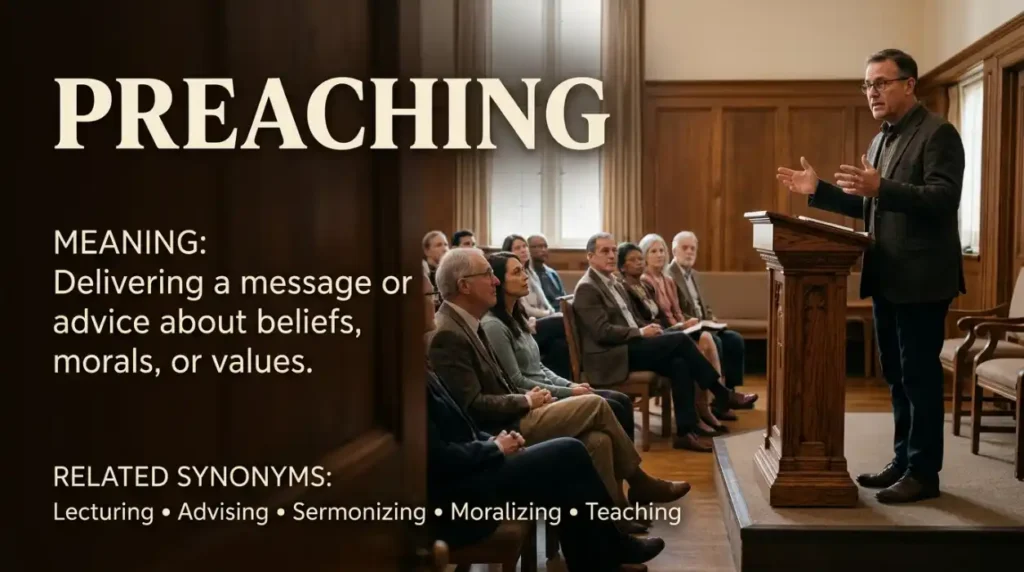
A synonym for preaching is a word or phrase that describes delivering a religious message, teaching moral values, or strongly advising people about how they should behave. Common alternatives include sermonizing, lecturing, exhorting, preaching, and moralizing. The best choice depends on the speaker’s purpose and tone.
Think about a person who constantly tells others what is right, offers unwanted advice, or tries to convince people to follow certain beliefs. You might describe their behavior as lecturing, sermonizing, moralizing, or preaching.
The word preaching has several uses in English. It often refers to delivering a religious message, sharing personal beliefs, or repeatedly advising others about how they should live. Its meaning can change depending on the situation and tone.
Finding the right synonym for preaching allows you to communicate your ideas more effectively. Different alternatives can express religious teaching, persuasive speaking, strong opinions, or unwanted lectures without repeating the same word.
Whether you are preparing an essay, writing a blog post, or improving everyday communication, a suitable synonym for preaching can make your sentences more natural and meaningful. Explore these 50 alternatives with clear definitions and practical examples to expand your vocabulary.
What Does “Preaching” Really Mean?
Preaching means delivering a message about religious beliefs, moral values, or important principles. It often involves encouraging people to believe something or change their behavior.
The word is commonly used as a noun and as the present participle of the verb preach.
For example:
- The minister is preaching about forgiveness.
- My brother keeps preaching about the importance of saving money.
- The speaker gave a passionate sermon about kindness.
In religious settings, preaching usually means communicating spiritual teachings or explaining religious beliefs. In everyday conversation, it can describe someone giving repeated advice or telling others how to live.
Native English speakers understand its tone through context. A church leader may be described as preaching in a respectful way. However, saying someone is “preaching at me” often suggests that their advice feels unwanted or overly forceful.
Connotative Meaning
(Connotation means the feelings, attitudes, or associations a word creates beyond its basic dictionary meaning.)
- Positive tone: Preaching can suggest inspiration, encouragement, spiritual guidance, and the sharing of meaningful values.
- Negative tone: It can suggest lecturing, moralizing, self-righteousness, or giving unwanted advice.
- Neutral tone: In religious or academic discussions, it can simply describe the act of delivering a sermon or religious message.
Etymology of Preaching
The word preaching comes from the verb preach, which entered English through Old French prechier. Its deeper origin is Late Latin praedicare, meaning “to proclaim” or “to declare publicly.”
The word gradually became strongly associated with publicly communicating religious teachings.
Old English (450–1100)
The modern word preach was not commonly established in Old English. English speakers used other expressions to describe teaching, proclaiming, and communicating religious beliefs.
Middle English (1100–1500)
The word entered Middle English through forms influenced by Old French, including preche and prech(e)n. It became increasingly associated with religious instruction and public sermons.
Modern English (1500–Present)
The spelling and use of preach became more standardized. The word developed broader meanings beyond religious settings. Today, it can describe moral instruction, passionate advocacy, and repeated advice.
Pronunciation (US & UK – IPA)
- US: /ˈpriː.tʃɪŋ/
- UK: /ˈpriː.tʃɪŋ/
Syllables
preach-ing: 2 syllables
Affixation Pattern of Preaching
- Root: preach
- Prefix: None
- Suffix: -ing
The suffix -ing forms the present participle of preach. It can also create a gerund, as in “Preaching requires preparation.”
Synonyms List
The alternatives below cover religious teaching, public communication, moral instruction, persuasion, and forceful advice. Some are close synonyms, while others fit only particular contexts. Choose according to the meaning you want to express.
1. Sermonizing (Verb/Noun) — US: /ˈsɝː.məˌnaɪ.zɪŋ/ | UK: /ˈsɜː.məˌnaɪ.zɪŋ/
Meaning: Delivering a sermon or giving lengthy moral advice, often in a way that sounds overly serious.
Tone/Register: Religious, formal, sometimes negative.
Examples:
- The speaker spent the evening sermonizing about personal responsibility.
- She dislikes sermonizing during casual family conversations.

2. Lecturing (Verb/Noun) — US: /ˈlek.tʃɚ.ɪŋ/ | UK: /ˈlek.tʃər.ɪŋ/
Meaning: Speaking to someone at length to teach, criticize, or explain what they should do.
Tone/Register: Neutral, academic, sometimes negative.
Examples:
- My father kept lecturing me about being punctual.
- The professor was lecturing on the history of religion.
3. Exhorting (Verb) — US: /ɪɡˈzɔːr.tɪŋ/ | UK: /ɪɡˈzɔː.tɪŋ/
Meaning: Strongly encouraging someone to take action or follow a particular belief.
Tone/Register: Formal, persuasive, religious.
Examples:
- The leader was exhorting the crowd to remain hopeful.
- The coach kept exhorting the players to work together.
4. Preaching (Verb/Noun) — US: /ˈpriː.tʃɪŋ/ | UK: /ˈpriː.tʃɪŋ/
Meaning: Communicating religious beliefs or strongly promoting a moral idea.
Tone/Register: Religious, neutral, sometimes critical.
Examples:
- He is preaching about compassion at the community gathering.
- Her constant preaching about discipline annoyed her friends.
5. Moralizing (Verb/Noun) — US: /ˈmɔːr.əˌlaɪ.zɪŋ/ | UK: /ˈmɒr.əl.aɪ.zɪŋ/
Meaning: Advising about right and wrong, often in a judgmental or self-righteous way.
Tone/Register: Formal, literary, usually negative.
Examples:
- The article avoids moralizing about people’s personal choices.
- He began moralizing when nobody had asked for advice.
6. Evangelizing (Verb/Noun) — US: /ɪˈvæn.dʒəˌlaɪ.zɪŋ/ | UK: /ɪˈvæn.dʒəˌlaɪ.zɪŋ/
Meaning: Actively spreading religious beliefs or encouraging others to accept a faith.
Tone/Register: Religious, formal.
Examples:
- The group spent the afternoon evangelizing in the neighborhood.
- She enjoys evangelizing about her faith through community work.
7. Proclaiming (Verb) — US: /proʊˈkleɪ.mɪŋ/ | UK: /prəˈkleɪ.mɪŋ/
Meaning: Announcing a belief, message, or statement publicly and confidently.
Tone/Register: Formal, public speaking.
Examples:
- The speaker was proclaiming a message of peace.
- The organization kept proclaiming its commitment to equality.
8. Preaching to (Verb Phrase) — US: /ˈpriː.tʃɪŋ tuː/ | UK: /ˈpriː.tʃɪŋ tuː/
Meaning: Giving advice or expressing beliefs to a particular person or audience.
Tone/Register: Conversational, religious, sometimes critical.
Examples:
- You are preaching to someone who already agrees with you.
- He kept preaching to his colleagues about punctuality.
9. Teaching (Verb/Noun) — US: /ˈtiː.tʃɪŋ/ | UK: /ˈtiː.tʃɪŋ/
Meaning: Sharing knowledge, beliefs, or principles to help others understand or learn.
Tone/Register: Neutral, educational, religious.
Examples:
- The pastor is teaching young people about forgiveness.
- Her teaching encourages students to treat others fairly.
10. Instructing (Verb) — US: /ɪnˈstrʌk.tɪŋ/ | UK: /ɪnˈstrʌk.tɪŋ/
Meaning: Giving directions, information, or guidance about what someone should do.
Tone/Register: Formal, educational, professional.
Examples:
- The trainer was instructing new employees on workplace rules.
- The guide kept instructing visitors to follow safety procedures.
11. Advising (Verb) — US: /ədˈvaɪ.zɪŋ/ | UK: /ədˈvaɪ.zɪŋ/
Meaning: Recommending a course of action or offering suggestions.
Tone/Register: Neutral, professional, conversational.
Examples:
- My mentor was advising me to remain patient.
- The counselor spent the session advising students about their choices.
12. Counseling (Verb/Noun) — US: /ˈkaʊn.səl.ɪŋ/ | UK: /ˈkaʊn.səl.ɪŋ/
Meaning: Offering guidance and support to help someone deal with a problem or decision.
Tone/Register: Professional, supportive, formal.
Examples:
- The counselor was counseling families through a difficult period.
- She provides counseling to people facing personal challenges.
13. Guiding (Verb) — US: /ˈɡaɪ.dɪŋ/ | UK: /ˈɡaɪ.dɪŋ/
Meaning: Helping someone understand a subject or make a suitable decision.
Tone/Register: Neutral, supportive, educational.
Examples:
- The teacher was guiding students through a moral dilemma.
- His experience is guiding the team toward a better decision.
14. Urging (Verb) — US: /ˈɝː.dʒɪŋ/ | UK: /ˈɜː.dʒɪŋ/
Meaning: Strongly encouraging someone to do something.
Tone/Register: Neutral, persuasive, conversational.
Examples:
- The doctor was urging patients to attend regular checkups.
- Community leaders are urging residents to help their neighbors.
15. Advocating (Verb) — US: /ˈæd.vəˌkeɪ.tɪŋ/ | UK: /ˈæd.və.keɪ.tɪŋ/
Meaning: Publicly supporting an idea, cause, or change.
Tone/Register: Formal, professional, social.
Examples:
- The campaign is advocating equal access to education.
- She has spent years advocating for better public services.
16. Preaching at (Verb Phrase) — US: /ˈpriː.tʃɪŋ æt/ | UK: /ˈpriː.tʃɪŋ æt/
Meaning: Speaking to someone in a forceful or moralizing way, often without considering their response.
Tone/Register: Informal, usually negative.
Examples:
- He was preaching at me instead of listening.
- Stop preaching at your friends when they only want a conversation.
17. Orating (Verb) — US: /ˈɔːr.eɪ.tɪŋ/ | UK: /ˈɔː.reɪ.tɪŋ/
Meaning: Delivering a formal or elaborate speech to an audience.
Tone/Register: Formal, rhetorical.
Examples:
- The politician was orating about national unity.
- He enjoys orating at public events.
18. Sermonizing at (Verb Phrase) — US: /ˈsɝː.məˌnaɪ.zɪŋ æt/ | UK: /ˈsɜː.məˌnaɪ.zɪŋ æt/
Meaning: Directing a lengthy moral or religious lecture at someone.
Tone/Register: Formal, often critical.
Examples:
- She was sermonizing at the teenagers about their habits.
- The manager avoided sermonizing at staff during the meeting.
19. Evangelizing for (Verb Phrase) — US: /ɪˈvæn.dʒəˌlaɪ.zɪŋ fɔːr/ | UK: /ɪˈvæn.dʒəˌlaɪ.zɪŋ fə/
Meaning: Actively promoting a religious belief or cause to gain support.
Tone/Register: Religious, persuasive.
Examples:
- The volunteers were evangelizing for their faith.
- He is evangelizing for a more compassionate approach to community life.
20. Testifying (Verb) — US: /ˈtes.təˌfaɪ.ɪŋ/ | UK: /ˈtes.tɪˌfaɪ.ɪŋ/
Meaning: Giving a personal account or speaking publicly about one’s beliefs or experiences, especially in a religious setting.
Tone/Register: Religious, formal, legal.
Examples:
- Several members were testifying about how faith changed their lives.
- The witness was testifying before the committee.
21. Witnessing (Verb) — US: /ˈwɪt.nə.sɪŋ/ | UK: /ˈwɪt.nə.sɪŋ/
Meaning: Sharing one’s religious faith or personal beliefs with others.
Tone/Register: Religious, conversational.
Examples:
- The group was witnessing to people in the local community.
- He believes witnessing should begin with kindness and respect.
22. Prophesying (Verb) — US: /ˈprɑː.fə.saɪ.ɪŋ/ | UK: /ˈprɒf.ɪ.saɪ.ɪŋ/
Meaning: Declaring or predicting something believed to be a message from a divine source.
Tone/Register: Religious, literary.
Examples:
- The ancient figure was prophesying a period of peace.
- The story describes a prophet prophesying about the future.
23. Declaring (Verb) — US: /dɪˈkler.ɪŋ/ | UK: /dɪˈkleə.rɪŋ/
Meaning: Announcing a belief, opinion, or position clearly and firmly.
Tone/Register: Neutral, formal.
Examples:
- The speaker was declaring the importance of honesty.
- She kept declaring her support for the proposal.
24. Advocating for (Verb Phrase) — US: /ˈæd.vəˌkeɪ.tɪŋ fɔːr/ | UK: /ˈæd.və.keɪ.tɪŋ fə/
Meaning: Publicly recommending or supporting a person, group, principle, or cause.
Tone/Register: Professional, persuasive.
Examples:
- The teacher is advocating for fair treatment of every student.
- Residents are advocating for safer streets.
25. Promoting (Verb) — US: /prəˈmoʊ.tɪŋ/ | UK: /prəˈməʊ.tɪŋ/
Meaning: Encouraging acceptance or support of an idea, belief, or activity.
Tone/Register: Neutral, professional, persuasive.
Examples:
- The campaign is promoting kindness in schools.
- He spends his time promoting peaceful communication.
26. Preaching against (Verb Phrase) — US: /ˈpriː.tʃɪŋ əˈɡenst/ | UK: /ˈpriː.tʃɪŋ əˈɡenst/
Meaning: Speaking strongly against a behavior, belief, or practice.
Tone/Register: Religious, formal, sometimes critical.
Examples:
- The speaker was preaching against dishonesty.
- The organization has been preaching against discrimination.
27. Denouncing (Verb) — US: /dɪˈnaʊn.sɪŋ/ | UK: /dɪˈnaʊn.sɪŋ/
Meaning: Publicly criticizing something as wrong, harmful, or unacceptable.
Tone/Register: Formal, forceful, political.
Examples:
- The minister was denouncing violence in his address.
- Community leaders are denouncing the unfair policy.
28. Condemning (Verb) — US: /kənˈdem.ɪŋ/ | UK: /kənˈdem.ɪŋ/
Meaning: Expressing strong disapproval of an action or belief.
Tone/Register: Formal, serious, critical.
Examples:
- The speaker was condemning cruelty toward animals.
- Her article condemns the misuse of authority.
29. Remonstrating (Verb) — US: /ˈrem.ənˌstreɪ.tɪŋ/ | UK: /ˈrem.ənˌstreɪ.tɪŋ/
Meaning: Arguing or protesting against something while explaining why it is wrong.
Tone/Register: Formal, literary.
Examples:
- The parent was remonstrating with the school about its decision.
- He spent the meeting remonstrating against the unfair rule.
30. Admonishing (Verb) — US: /ədˈmɑː.nɪ.ʃɪŋ/ | UK: /ədˈmɒn.ɪ.ʃɪŋ/
Meaning: Warning or correcting someone firmly because of their behavior.
Tone/Register: Formal, corrective.
Examples:
- The supervisor was admonishing employees for ignoring safety rules.
- She gently admonished her son for interrupting others.
31. Rebuking (Verb) — US: /rɪˈbjuː.kɪŋ/ | UK: /rɪˈbjuː.kɪŋ/
Meaning: Speaking sharply to someone to express disapproval of their actions.
Tone/Register: Formal, negative.
Examples:
- The coach was rebuking the team for poor sportsmanship.
- He rebuked his colleague for making an unfair comment.
32. Chastising (Verb) — US: /tʃæsˈtaɪ.zɪŋ/ | UK: /tʃæsˈtaɪ.zɪŋ/
Meaning: Criticizing or reprimanding someone for doing something wrong.
Tone/Register: Formal, critical.
Examples:
- The editor was chastising the writer for missing the deadline.
- Her parents chastised her for breaking the agreement.
33. Exhortation (Noun) — US: /ˌeɡ.zɔːrˈteɪ.ʃən/ | UK: /ˌeɡ.zɔːˈteɪ.ʃən/
Meaning: A strong appeal encouraging someone to take action or follow a principle.
Tone/Register: Formal, persuasive, religious.
Examples:
- The speech included an exhortation to serve the community.
- His final exhortation encouraged everyone to remain hopeful.
34. Homily (Noun) — US: /ˈhɑː.mə.li/ | UK: /ˈhɒm.ɪ.li/
Meaning: A short religious talk that explains a moral or spiritual lesson.
Tone/Register: Religious, formal.
Examples:
- The priest delivered a homily about forgiveness.
- The congregation reflected on the homily after the service.
35. Discourse (Noun) — US: /ˈdɪs.kɔːrs/ | UK: /ˈdɪs.kɔːs/
Meaning: A formal discussion or extended communication about a subject.
Tone/Register: Academic, formal.
Examples:
- The professor gave a discourse on religious traditions.
- Public discourse can influence how people understand social issues.
36. Addressing (Verb) — US: /əˈdres.ɪŋ/ | UK: /əˈdres.ɪŋ/
Meaning: Speaking to an audience about a particular subject or concern.
Tone/Register: Neutral, formal, professional.
Examples:
- The principal was addressing students about respect.
- The speaker addressed the audience on the value of honesty.
37. Proclaiming the faith (Verb Phrase) — US: /proʊˈkleɪ.mɪŋ ðə feɪθ/ | UK: /prəˈkleɪ.mɪŋ ðə feɪθ/
Meaning: Publicly expressing or communicating religious beliefs.
Tone/Register: Religious, formal.
Examples:
- The community gathered for proclaiming the faith.
- The speaker was proclaiming the faith through stories and teachings.
38. Moral instruction (Noun Phrase) — US: /ˈmɔːr.əl ɪnˈstrʌk.ʃən/ | UK: /ˈmɒr.əl ɪnˈstrʌk.ʃən/
Meaning: Teaching people about right and wrong behavior.
Tone/Register: Educational, formal.
Examples:
- The story offers moral instruction without sounding judgmental.
- Parents often provide moral instruction through everyday examples.
39. Religious instruction (Noun Phrase) — US: /rɪˈlɪdʒ.əs ɪnˈstrʌk.ʃən/ | UK: /rɪˈlɪdʒ.əs ɪnˈstrʌk.ʃən/
Meaning: Teaching the beliefs, practices, and principles of a religion.
Tone/Register: Religious, educational.
Examples:
- The school offers religious instruction to interested students.
- Religious instruction was part of the community program.
40. Spiritual guidance (Noun Phrase) — US: /ˈspɪr.ɪ.tʃu.əl ˈɡaɪ.dəns/ | UK: /ˈspɪr.ɪ.tʃu.əl ˈɡaɪ.dəns/
Meaning: Advice or support that helps someone develop or understand their spiritual life.
Tone/Register: Supportive, religious, reflective.
Examples:
- She sought spiritual guidance during a difficult period.
- The mentor offers spiritual guidance to people who request it.

41. Moral lecture (Noun Phrase) — US: /ˈmɔːr.əl ˈlek.tʃɚ/ | UK: /ˈmɒr.əl ˈlek.tʃə/
Meaning: A talk that tells people how they should behave, often in a critical way.
Tone/Register: Informal, usually negative.
Examples:
- I did not need another moral lecture about my choices.
- His apology turned into a moral lecture about responsibility.
42. Religious sermon (Noun Phrase) — US: /rɪˈlɪdʒ.əs ˈsɝː.mən/ | UK: /rɪˈlɪdʒ.əs ˈsɜː.mən/
Meaning: A speech delivered in a religious setting to explain beliefs or encourage spiritual behavior.
Tone/Register: Religious, formal.
Examples:
- The congregation listened to a religious sermon about hope.
- The weekly religious sermon focused on helping others.
43. Advocacy (Noun) — US: /ˈæd.və.kə.si/ | UK: /ˈæd.və.kə.si/
Meaning: Public support for a cause, principle, or group.
Tone/Register: Formal, professional, social.
Examples:
- Her advocacy for equal education has inspired many families.
- The organization supports advocacy for vulnerable communities.
44. Evangelism (Noun) — US: /ɪˈvæn.dʒəˌlɪ.zəm/ | UK: /ɪˈvæn.dʒəˌlɪ.zəm/
Meaning: The practice of spreading or promoting religious beliefs, especially Christianity.
Tone/Register: Religious, formal.
Examples:
- The church organized an evangelism program for volunteers.
- He studies the history of evangelism in different communities.
45. Rhetoric (Noun) — US: /ˈret.ər.ɪk/ | UK: /ˈret.ər.ɪk/
Meaning: Language used effectively or persuasively to influence an audience.
Tone/Register: Academic, formal, political.
Examples:
- The politician’s rhetoric focused on unity and hope.
- Strong rhetoric can influence how an audience views an issue.
46. Persuasion (Noun) — US: /pɚˈsweɪ.ʒən/ | UK: /pəˈsweɪ.ʒən/
Meaning: The act of encouraging someone to accept an idea or change their opinion.
Tone/Register: Neutral, professional, persuasive.
Examples:
- Her persuasion helped the team accept the new plan.
- The campaign relies on clear messages rather than pressure.
47. Advocacy speech (Noun Phrase) — US: /ˈæd.və.kə.si spiːtʃ/ | UK: /ˈæd.və.kə.si spiːtʃ/
Meaning: A speech designed to encourage support for a cause or policy.
Tone/Register: Formal, public speaking.
Examples:
- The student delivered an advocacy speech about clean energy.
- Her advocacy speech encouraged the audience to volunteer.
48. Moral preaching (Noun Phrase) — US: /ˈmɔːr.əl ˈpriː.tʃɪŋ/ | UK: /ˈmɒr.əl ˈpriː.tʃɪŋ/
Meaning: Teaching or promoting ideas about right and wrong behavior.
Tone/Register: Formal, religious, sometimes critical.
Examples:
- The novel explores moral preaching in a small community.
- His moral preaching became tiring during the discussion.
49. Public speaking (Noun Phrase) — US: /ˈpʌb.lɪk ˈspiː.kɪŋ/ | UK: /ˈpʌb.lɪk ˈspiː.kɪŋ/
Meaning: Speaking to a group of people, often to inform, persuade, or inspire them.
Tone/Register: Neutral, professional, educational.
Examples:
- Public speaking allows her to share ideas with a wider audience.
- He improved his public speaking through regular practice.
50. Edification (Noun) — US: /ˌed.ə.fəˈkeɪ.ʃən/ | UK: /ˌed.ɪ.fɪˈkeɪ.ʃən/
Meaning: The process of improving someone’s knowledge, understanding, or moral character.
Tone/Register: Formal, literary, religious.
Examples:
- The discussion was intended for the edification of the group.
- She reads thoughtful books for personal edification.
Synonyms by Tone
The tone of a word affects how readers understand the speaker’s intentions. A supportive expression can make advice sound helpful, while a critical term can suggest that someone is being forceful or judgmental.
Positive
These words emphasize encouragement, support, and constructive teaching:
- Exhorting
- Guiding
- Teaching
- Counseling
- Spiritual guidance
- Edification
- Advising
Neutral
These expressions describe communicating ideas without automatically suggesting approval or criticism:
- Preaching
- Proclaiming
- Instructing
- Addressing
- Discourse
- Public speaking
- Religious instruction
Negative
These words may suggest unwanted advice, judgment, or strong criticism:
- Sermonizing
- Moralizing
- Lecturing
- Admonishing
- Rebuking
- Chastising
- Moral lecture
Playful or Informal
There are no universally playful direct synonyms for preaching. In casual conversation, phrases such as going on about something or getting on someone’s case can describe repetitive advice, although they are not exact synonyms.
“Preaching” vs. Close Alternatives
| Word | Meaning difference | Tone | When to use it |
|---|---|---|---|
| Sermonizing | Giving a sermon or lengthy moral advice. | Often negative | When someone sounds overly serious or judgmental. |
| Lecturing | Speaking at length to teach or criticize. | Neutral or negative | When someone gives a long explanation or reprimand. |
| Exhorting | Strongly encouraging action. | Usually positive or formal | When motivating people to follow a principle or take action. |
| Moralizing | Telling people what is right or wrong. | Often negative | When advice sounds self-righteous or judgmental. |
Example comparison:
- The minister was preaching about forgiveness. This describes a religious message.
- My friend was lecturing me about my spending habits. This suggests a long explanation or criticism.
- The coach was exhorting the team to keep trying. This emphasizes strong encouragement.
- He was moralizing about everyone’s personal choices. This suggests judgmental advice.
How “Preaching” Changes by Context
Daily Conversation
In everyday English, preaching often describes someone who repeatedly gives advice or expresses strong opinions.
For example, “You’re preaching again about healthy eating” may suggest that the listener has heard the same advice many times.
Words such as lecturing, going on about, and moralizing can fit informal conversations.
Writing or Blogging
In articles and blog posts, alternatives such as advocating, promoting, encouraging, and teaching can explain the writer’s purpose more clearly.
For example, a writer may be advocating better education rather than preaching about it. The first expression often sounds more focused on supporting a cause.
Professional or Academic Tone
Formal writing may use exhortation, discourse, advocacy, instruction, or proclamation.
These words are useful when discussing public communication, religious history, leadership, education, or social movements.
Creative or Informal Use
In stories and dialogue, sermonizing, lecturing, and preaching at someone can reveal a character’s attitude.
For example, a character who constantly lectures others may appear controlling or overly serious. A character who offers spiritual guidance may seem caring and thoughtful.
Common Mistakes Learners Make

Confusing Preaching With Teaching
Teaching usually focuses on explaining information and developing understanding. Preaching often involves promoting beliefs, values, or principles.
A teacher may explain how a system works. A religious leader may preach about the importance of faith.
Using Sermonizing as a Positive Word
Sermonizing often carries a critical tone. It can suggest that someone is giving an unnecessarily long or moralistic speech.
Use guiding, advising, or encouraging when you want to describe supportive communication.
Treating Advocacy and Preaching as Identical
Advocacy means publicly supporting a cause or idea. Preaching can involve communicating beliefs or moral lessons.
A person may advocate for equal rights without delivering a sermon or giving moral instruction.
Confusing Exhorting and Admonishing
Exhorting means strongly encouraging someone to act. Admonishing means warning or correcting someone for inappropriate behavior.
For example, a coach may exhort players to keep working, while a manager may admonish an employee for breaking a rule.
Overusing Preaching in Figurative Sentences
Not every strong opinion is preaching. Sometimes explaining, recommending, arguing, or advocating communicates the meaning more accurately.
Register Notes
- Formal: Exhorting, admonishing, discourse, proclamation, edification.
- Informal: Lecturing, preaching at, going on about something.
- Religious: Sermonizing, evangelizing, witnessing, homily.
- Academic: Rhetoric, moral instruction, advocacy, discourse.
- Spoken English: Advising, urging, guiding, lecturing.
- Written English: Advocating, proclaiming, exhortation, religious instruction.
For more vocabulary practice, you can explore related alternatives for rhetoric and learn how persuasive language differs from religious or moral instruction.
Real-Life Mini Scenarios Using Preaching
Workplace Scenario
A manager repeatedly reminds employees to communicate respectfully. Depending on the delivery, colleagues may describe the manager as advising, instructing, or lecturing the team.
Social Situation
A friend keeps telling everyone to exercise regularly. Someone might jokingly say, “You are preaching about fitness again!” The phrase suggests repeated advice.
Media and Public Speaking
A community leader gives a speech encouraging residents to protect the environment. The speech may be described as advocacy, public speaking, or an exhortation to take action.
Writing and Storytelling
A novelist creates a character who constantly tells others how to behave. Describing the character as moralizing or sermonizing can show that the advice feels judgmental.
Practice Exercise
Choose the best answer for each situation.
1. A religious leader delivers a message about forgiveness during a service. What is the best word?
A. Homily
B. Rebuke
C. Chastising
D. Denouncing
2. A person strongly encourages a group to take action. Which word fits best?
A. Exhorting
B. Spoiling
C. Hesitating
D. Ignoring
3. Someone gives repeated advice in a judgmental way. Which word describes this behavior?
A. Guiding
B. Moralizing
C. Counseling
D. Supporting
4. A teacher explains a difficult subject to students. Which word is most suitable?
A. Teaching
B. Denouncing
C. Rebuking
D. Condemning
5. A person publicly supports equal education. Which term best describes this activity?
A. Advocacy
B. Sermonizing
C. Admonishing
D. Chastising
6. A manager firmly corrects an employee for breaking a safety rule. Which word fits?
A. Admonishing
B. Evangelizing
C. Proclaiming
D. Persuasion
7. A speaker announces a message confidently to a large audience. Which word is suitable?
A. Proclaiming
B. Counseling
C. Moralizing
D. Witnessing
8. A person gives someone a long talk about their mistakes. What might the listener call it?
A. Spiritual guidance
B. A moral lecture
C. Public advocacy
D. Edification
9. A religious group shares its faith with people in the community. Which word fits best?
A. Evangelizing
B. Rebuking
C. Chastising
D. Remonstrating
10. A person speaks sharply to express disapproval of someone’s behavior. Which word is most accurate?
A. Guiding
B. Rebuking
C. Advising
D. Promoting
Answer Key:
1-A | 2-A | 3-B | 4-A | 5-A | 6-A | 7-A | 8-B | 9-A | 10-B
Reflection Task:
Write two original sentences using different alternatives for preaching. Use one sentence about a religious message and another about someone advising on everyday life.
FAQs
1. What is a synonym for preaching that does not sound judgmental?
Words such as guiding, advising, teaching, and encouraging can sound less judgmental than preaching. They emphasize helping someone understand an idea or make a decision. For example, “She was guiding the students toward better choices” sounds more supportive than “She was preaching at the students.”
2. What do you call someone who constantly preaches to others?
Depending on the context, you might call that person a preacher, moralizer, or someone who is always lecturing. The word moralizer usually suggests that the person frequently tells others what is right or wrong. In casual conversation, “They are always preaching” is also natural.
3. What is the difference between preaching and evangelizing?
Preaching generally means delivering a religious or moral message. Evangelizing specifically means actively spreading religious beliefs and encouraging others to accept a faith. A person can preach to an existing congregation without evangelizing. Evangelizing usually focuses more directly on sharing a religion with people who may not follow it.
4. What is a synonym for preaching in a non-religious context?
In non-religious situations, alternatives include lecturing, moralizing, advising, advocating, and promoting. The best choice depends on the intention. Use advocating when someone supports a cause, advising when they offer suggestions, and moralizing when their comments sound judgmental.
5. What is the noun form of preaching?
Preaching can already function as a noun. It describes the activity or practice of delivering sermons or communicating moral and religious beliefs. Other related nouns include sermon, sermonizing, exhortation, and proclamation. Their meanings differ slightly, so choose the one that matches the type of message.
6. What is a polite way to say someone is preaching too much?
You can say, “You have made your point,” “I understand your advice,” or “Let’s look at this from another perspective.” These expressions communicate that the discussion has gone on long enough without directly insulting the speaker. In informal English, people may also say, “You’re lecturing me.”
7. Is preaching always related to religion?
No. Although preaching is strongly associated with religious messages, it is also used in everyday English. Someone may be described as preaching about healthy habits, honesty, or environmental responsibility. In these situations, the word often suggests strongly promoting an idea or repeatedly telling others what they should do.
8. How can I use preaching in a sentence naturally?
Use preaching when someone delivers a religious message or strongly promotes a belief or principle. For example, “The minister is preaching about compassion” is a natural religious use. In casual speech, “My brother keeps preaching about saving money” describes someone who repeatedly gives advice.
Conclusion
Learning a synonym for preaching helps you describe religious messages, moral lessons, public speeches, and everyday advice more accurately. Each alternative carries a slightly different tone.
Words such as guiding, exhorting, and advocating can make your writing more precise. Others, like moralizing and sermonizing, express criticism.
A stronger vocabulary improves essays, blogs, emails, and conversations. It also helps you explain beliefs and opinions without repeating the same expressions.
Practice these alternatives in your own sentences and daily conversations. Try using them in an essay, email, or friendly discussion to build confidence.
Suggested External Sources
Use these trusted references for definitions, pronunciation, and word history:
- Merriam-Webster: definitions and usage examples.
- Cambridge Dictionary: British and American pronunciation.
- Oxford Learner’s Dictionaries: learner-friendly meanings and examples.
- Online Etymology Dictionary: word origins and historical development.
Editorial note: The 50 entries include direct synonyms, related nouns, and context-specific expressions. Words such as rhetoric, public speaking, and counseling are related concepts, not exact replacements for preaching in every sentence. This distinction keeps the article linguistically accurate.

Jameel Hassan is the founder and lead writer at SynonymsCloud.com, a trusted online platform dedicated to English vocabulary and effective communication. He is passionate about helping students, writers, professionals, and lifelong learners discover the right words to express their ideas with clarity, precision, and confidence.
At SynonymsCloud.com, every article is thoroughly researched and carefully written to provide accurate, practical, and easy-to-understand guidance on synonyms, antonyms, word meanings, idioms, and vocabulary. With a strong commitment to quality, real-world usage, and clear explanations, the website helps readers expand their vocabulary, improve their writing, and communicate more effectively in both academic and professional settings.