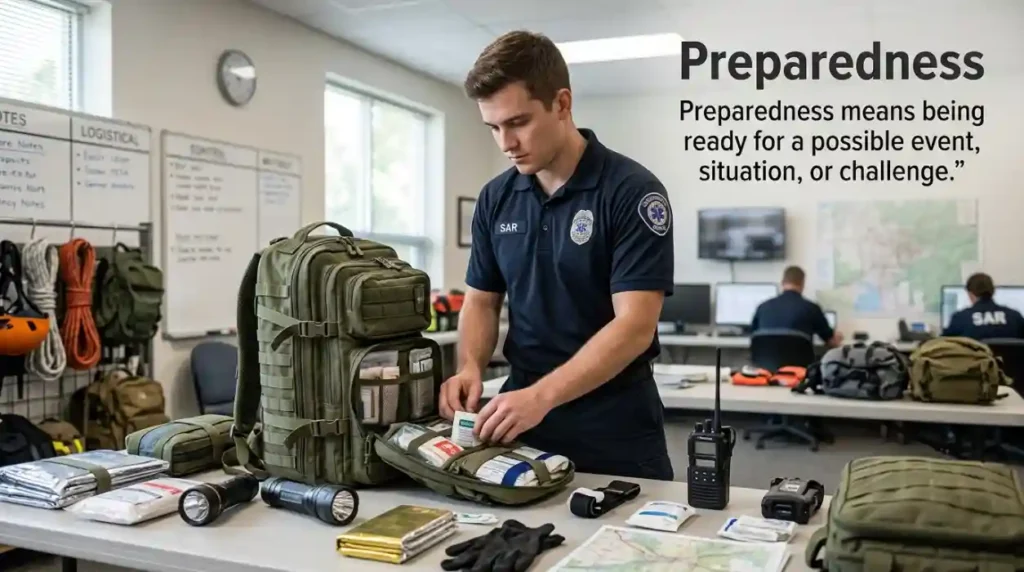
A useful synonym for preparedness is readiness, which means being fully prepared to deal with an event, task, or situation. Other close alternatives include preparation, planning, organization, foresight, alertness, vigilance, and resourcefulness, depending on the context.
A synonym for preparedness can make a simple idea more precise. Imagine a student packing notes, pens, and a calculator before an important exam. That is preparedness in action.
In everyday life, preparedness can mean having a plan before something happens. A family preparing emergency supplies is showing practical readiness.
A synonym for preparedness helps students, bloggers, content writers, and daily English users express preparation without repeating the same word.
The term is common in education, business, emergency planning, leadership, sports, and personal development. Choosing the right alternative makes your writing clearer and more natural.
What Does “Preparedness” Really Mean?
Preparedness is the state of being ready for something that may happen or for something that you know will happen.
In simple English, preparedness means having the knowledge, plans, skills, equipment, or resources needed to handle a situation.
For example:
- A student shows preparedness by studying before an exam.
- A company shows preparedness by creating an emergency plan.
- An athlete shows preparedness through regular training.
- A family shows preparedness by keeping basic supplies for emergencies.
Part of Speech
Preparedness is a noun.
It describes a state, quality, or condition rather than a specific action.
The related verb is prepare, while the adjective is prepared.
How Native Speakers Understand Preparedness
Native speakers usually associate preparedness with being ready before a situation occurs.
The word often suggests deliberate effort.
It can involve:
- Planning
- Training
- Organization
- Practice
- Awareness
- Resources
- Foresight
- Mental readiness
- Physical readiness
- Emergency planning
Preparedness is broader than simply having something ready. It can include the ability to respond effectively when circumstances change.
Connotative Meaning of Preparedness
Connotation (the emotional or implied feeling associated with a word beyond its basic meaning) varies according to context.
Positive Tone
Preparedness usually carries a positive meaning.
It can suggest responsibility, confidence, discipline, reliability, and careful planning.
Example:
“Her preparedness helped the team handle the presentation calmly.”
Negative Tone
The word itself is rarely negative.
However, a lack of preparedness can create negative ideas such as carelessness, poor planning, or vulnerability.
Example:
“The lack of preparedness caused unnecessary delays.”
Neutral Tone
In reports and factual descriptions, preparedness can be completely neutral.
Example:
“The organization reviewed its preparedness before the annual event.”
Etymology of Preparedness
The word preparedness comes from prepare, with the suffix -ness added to form a noun describing a state or quality.
Prepare ultimately traces back through Old French parer and Latin praeparare, meaning “to make ready beforehand.”
The Latin structure combines prae-, meaning “before,” with parare, meaning “to make ready or arrange.”
Old English: 450–1100
The modern word preparedness did not exist in Old English in its present form.
Old English used native words related to readiness, provision, planning, and making something ready.
The underlying idea of getting ready before an event was already part of everyday life.
Middle English: 1100–1500
After the Norman Conquest, French and Latin vocabulary strongly influenced English.
Words related to prepare entered English through French and became increasingly common in formal and practical contexts.
Modern English: 1500–Present
The noun preparedness developed from the broader family of prepare and prepared.
Modern English uses it especially in areas such as emergency management, education, defense, business continuity, public safety, leadership, and personal planning.
Pronunciation of Preparedness
US: /prɪˈper.əd.nəs/
UK: /prɪˈpeər.ɪd.nəs/
Syllables
pre-pared-ness
Affixation Pattern of Preparedness
Root: par / pare associated with making or arranging
Prefix: pre- before
Suffix: -ness forms a noun expressing a state or quality
The -ness ending is important because it changes prepared into the name of a condition or quality: prepared → preparedness.
Synonyms List
The following alternatives cover the main meanings associated with preparedness, including being ready, planning, organizing resources, staying alert, and developing the ability to respond.
1. Readiness (Noun) — US / UK: /ˈred.i.nəs/ /ˈred.i.nəs/
Meaning: Readiness is the state of being prepared to act or respond.
Tone/Register: Neutral, Professional
Examples:
“Her readiness impressed the interview panel.”
“The team checked its readiness before the event.”

2. Preparation (Noun) — US / UK: /ˌprep.əˈreɪ.ʃən/ /ˌprep.əˈreɪ.ʃən/
Meaning: Preparation is the work done to become ready for something.
Tone/Register: Neutral, Academic
Examples:
“Good preparation made the exam less stressful.”
“The chef finished the preparation before lunch.”
3. Planning (Noun) — US / UK: /ˈplæn.ɪŋ/ /ˈplæn.ɪŋ/
Meaning: Planning involves deciding in advance what needs to be done.
Tone/Register: Neutral, Professional
Examples:
“Careful planning kept the project on schedule.”
“We spent the morning planning for the conference.”
4. Organization (Noun) — US / UK: /ˌɔːr.ɡən.əˈzeɪ.ʃən/ /ˌɔː.ɡən.aɪˈzeɪ.ʃən/
Meaning: Organization means arranging people, information, or resources efficiently.
Tone/Register: Professional, Academic
Examples:
“Strong organization helped her manage five assignments.”
“The event required excellent organization.”
5. Foresight (Noun) — US / UK: /ˈfɔːr.saɪt/ /ˈfɔː.saɪt/
Meaning: Foresight is the ability to think about future problems and prepare for them.
Tone/Register: Formal, Professional
Examples:
“His foresight prevented a major scheduling problem.”
“The company showed foresight by creating a backup plan.”
6. Anticipation (Noun) — US / UK: /ænˌtɪs.əˈpeɪ.ʃən/ /ænˌtɪs.ɪˈpeɪ.ʃən/
Meaning: Anticipation involves expecting something and preparing mentally or practically for it.
Tone/Register: Neutral, Professional
Examples:
“Anticipation of heavy traffic changed our departure time.”
“She packed extra supplies in anticipation of rain.”
7. Forethought (Noun) — US / UK: /ˈfɔːr.θɔːt/ /ˈfɔː.θɔːt/
Meaning: Forethought means considering future needs before taking action.
Tone/Register: Formal, Professional
Examples:
“Some forethought would have prevented the confusion.”
“Her forethought made the trip much smoother.”
8. Provision (Noun) — US / UK: /prəˈvɪʒ.ən/ /prəˈvɪʒ.ən/
Meaning: Provision is the act of supplying what may be needed.
Tone/Register: Formal, Business
Examples:
“The shelter made provision for older residents.”
“Extra food was kept as a provision for emergencies.”
9. Alertness (Noun) — US / UK: /əˈlɝːt.nəs/ /əˈlɜːt.nəs/
Meaning: Alertness is the ability to stay aware and notice possible problems quickly.
Tone/Register: Neutral, Professional
Examples:
“Drivers need alertness during long journeys.”
“Her alertness helped her spot the warning sign.”
10. Vigilance (Noun) — US / UK: /ˈvɪdʒ.ə.ləns/ /ˈvɪdʒ.ɪ.ləns/
Meaning: Vigilance means careful and continuous attention to possible danger or problems.
Tone/Register: Formal, Professional
Examples:
“Security staff maintained vigilance throughout the night.”
“Constant vigilance helped protect the equipment.”
11. Awareness (Noun) — US / UK: /əˈwer.nəs/ /əˈweə.nəs/
Meaning: Awareness is knowledge or understanding of a situation and its possible risks.
Tone/Register: Neutral, Academic
Examples:
“Safety awareness can prevent simple accidents.”
“The workshop increased awareness of online risks.”
12. Resourcefulness (Noun) — US / UK: /rɪˈsɔːrs.fəl.nəs/ /rɪˈzɔːs.fəl.nəs/
Meaning: Resourcefulness is the ability to find practical solutions when resources are limited.
Tone/Register: Positive, Professional
Examples:
“Her resourcefulness saved the team during the outage.”
“The campers showed remarkable resourcefulness.”
13. Capability (Noun) — US / UK: /ˌkeɪ.pəˈbɪl.ə.t̬i/ /ˌkeɪ.pəˈbɪl.ə.ti/
Meaning: Capability is the ability or capacity to deal effectively with a task or situation.
Tone/Register: Professional, Academic
Examples:
“The training improved the staff’s emergency capability.”
“The new system increased our response capability.”
14. Competence (Noun) — US / UK: /ˈkɑːm.pə.təns/ /ˈkɒm.pɪ.təns/
Meaning: Competence is the ability to perform a task properly and effectively.
Tone/Register: Professional, Academic
Examples:
“The course builds competence in public speaking.”
“Her competence gave the clients confidence.”
15. Proficiency (Noun) — US / UK: /prəˈfɪʃ.ən.si/ /prəˈfɪʃ.ən.si/
Meaning: Proficiency means having a high level of skill in a particular area.
Tone/Register: Academic, Professional
Examples:
“Regular practice improved his proficiency in coding.”
“Language proficiency helped her communicate clearly.”
16. Training (Noun) — US / UK: /ˈtreɪ.nɪŋ/ /ˈtreɪ.nɪŋ/
Meaning: Training is structured practice or instruction that develops readiness and skill.
Tone/Register: Professional, Educational
Examples:
“The staff completed emergency training.”
“Regular training prepared the athletes for competition.”
17. Practice (Noun) — US / UK: /ˈpræk.tɪs/ /ˈpræk.tɪs/
Meaning: Practice involves repeated activity that improves ability and preparation.
Tone/Register: Neutral, Everyday
Examples:
“Daily practice improved her presentation skills.”
“The team used practice drills before the tournament.”
18. Rehearsal (Noun) — US / UK: /rɪˈhɝː.səl/ /rɪˈhɜː.səl/
Meaning: Rehearsal is a practice session performed before an actual event or performance.
Tone/Register: Creative, Professional
Examples:
“The actors held one final rehearsal.”
“Our presentation rehearsal exposed several weak points.”
19. Contingency Planning (Noun Phrase) — US / UK: /kənˈtɪn.dʒən.si ˈplæn.ɪŋ/ /kənˈtɪn.dʒən.si ˈplæn.ɪŋ/
Meaning: Contingency planning involves preparing alternative actions for unexpected problems.
Tone/Register: Business, Formal
Examples:
“The company updated its contingency planning.”
“Good contingency planning reduced the impact of the delay.”
20. Risk Management (Noun Phrase) — US / UK: /rɪsk ˈmæn.ɪdʒ.mənt/ /rɪsk ˈmæn.ɪdʒ.mənt/
Meaning: Risk management involves identifying and reducing possible threats before they cause harm.
Tone/Register: Business, Professional
Examples:
“Effective risk management protected the project.”
“The manager included risk management in the proposal.”
21. Emergency Planning (Noun Phrase) — US / UK: /ɪˈmɝː.dʒən.si ˈplæn.ɪŋ/ /ɪˈmɜː.dʒən.si ˈplæn.ɪŋ/
Meaning: Emergency planning prepares people and organizations for unexpected crises.
Tone/Register: Formal, Public Safety
Examples:
“The school reviewed its emergency planning.”
“Emergency planning helped staff respond quickly.”
22. Advance Planning (Noun Phrase) — US / UK: /ədˈvæns ˈplæn.ɪŋ/ /ədˈvɑːns ˈplæn.ɪŋ/
Meaning: Planning means organizing something before it is needed.
Tone/Register: Neutral, Professional
Examples:
“Planning made the family trip easier.”
“We avoided delays through planning.”
23. Readiness (Noun) — US / UK: /ˈred.i.nəs/ /ˈred.i.nəs/
Meaning: Readiness specifically emphasizes the condition of being prepared to begin or respond.
Tone/Register: Neutral, Professional
Examples:
“The equipment was checked for operational readiness.”
“Her readiness allowed the team to start immediately.”
24. Preparation State (Noun Phrase) — US / UK: /ˌprep.əˈreɪ.ʃən steɪt/ /ˌprep.əˈreɪ.ʃən steɪt/
Meaning: Preparation state describes the condition of being equipped and organized for what comes next.
Tone/Register: Technical, Formal
Examples:
“The system remained in a preparation state.”
“Staff reviewed their preparation state before deployment.”
25. Conditioning (Noun) — US / UK: /kənˈdɪʃ.ən.ɪŋ/ /kənˈdɪʃ.ən.ɪŋ/
Meaning: Conditioning is repeated training that develops physical or mental readiness.
Tone/Register: Sports, Professional
Examples:
“The runners focused on conditioning before the race.”
“Strong conditioning improved her endurance.”
26. Drilling (Noun) — US / UK: /ˈdrɪl.ɪŋ/ /ˈdrɪl.ɪŋ/
Meaning: Drilling involves repeated practice of procedures so people can respond effectively.
Tone/Register: Professional, Emergency
Examples:
“Regular drilling improved the staff’s response time.”
“The hospital uses drilling to practice emergency procedures.”
27. Familiarity (Noun) — US / UK: /fəˌmɪl.iˈer.ə.t̬i/ /fəˌmɪl.iˈær.ə.ti/
Meaning: Familiarity is knowledge gained through experience that makes handling a situation easier.
Tone/Register: Neutral, Academic
Examples:
“Familiarity with the route reduced travel anxiety.”
“Her familiarity with the software helped the new team.”
28. Knowledge (Noun) — US / UK: /ˈnɑː.lɪdʒ/ /ˈnɒl.ɪdʒ/
Meaning: Knowledge provides information and understanding that can support effective preparation.
Tone/Register: Neutral, Academic
Examples:
“Basic first-aid knowledge can be valuable.”
“His knowledge of the area helped during the hike.”
29. Experience (Noun) — US / UK: /ɪkˈspɪr.i.əns/ /ɪkˈspɪə.ri.əns/
Meaning: Experience develops practical understanding that can help someone handle future situations.
Tone/Register: Neutral, Professional
Examples:
“Her experience prepared her for difficult negotiations.”
“Previous experience helped him stay calm.”
30. Discipline (Noun) — US / UK: /ˈdɪs.ə.plɪn/ /ˈdɪs.ə.plɪn/
Meaning: Discipline is consistent self-control that supports regular preparation and action.
Tone/Register: Neutral, Professional
Examples:
“Daily discipline kept his study plan on track.”
“The athlete’s discipline supported long-term preparation.”
31. Precaution (Noun) — US / UK: /prɪˈkɔː.ʃən/ /prɪˈkɔː.ʃən/
Meaning: A precaution is an action taken beforehand to reduce possible danger or problems.
Tone/Register: Neutral, Professional
Examples:
“As a precaution, we saved a copy of the files.”
“Wearing protective equipment is an important precaution.”
32. Safeguarding (Noun) — US / UK: /ˈseɪf.ɡɑːr.dɪŋ/ /ˈseɪf.ɡɑːr.dɪŋ/
Meaning: Safeguarding involves protecting people, resources, or systems from possible harm.
Tone/Register: Professional, Formal
Examples:
“Data safeguarding was part of the new policy.”
“The school strengthened its safeguarding procedures.”
33. Backup Planning (Noun Phrase) — US / UK: /ˈbæk.ʌp ˈplæn.ɪŋ/ /ˈbæk.ʌp ˈplæn.ɪŋ/
Meaning: Backup planning involves creating alternative options if the original plan fails.
Tone/Register: Informal, Professional
Examples:
“Our backup planning saved the event when rain arrived.”
“The team created a backup plan for equipment failure.”
34. Provisioning (Noun) — US / UK: /prəˈvɪʒ.ən.ɪŋ/ /prəˈvɪʒ.ən.ɪŋ/
Meaning: Provisioning means arranging or supplying the resources needed for a future situation.
Tone/Register: Technical, Business
Examples:
“The team completed provisioning before the launch.”
“Careful provisioning ensured enough supplies were available.”
35. Allocation (Noun) — US / UK: /ˌæl.əˈkeɪ.ʃən/ /ˌæl.əˈkeɪ.ʃən/
Meaning: Allocation is the planned distribution of resources for expected needs.
Tone/Register: Business, Academic
Examples:
“Resource allocation improved emergency response.”
“The budget included an allocation for staff training.”
36. Coordination (Noun) — US / UK: /koʊˌɔːr.dəˈneɪ.ʃən/ /kəʊˌɔː.dɪˈneɪ.ʃən/
Meaning: Coordination involves organizing people or activities so they work together effectively.
Tone/Register: Professional, Business
Examples:
“Good coordination kept the rescue effort organized.”
“The departments improved coordination before the event.”
37. Mobilization (Noun) — US / UK: /ˌmoʊ.bə.ləˈzeɪ.ʃən/ /ˌməʊ.bɪ.laɪˈzeɪ.ʃən/
Meaning: Mobilization is the process of getting people and resources ready for action.
Tone/Register: Formal, Professional
Examples:
“Rapid mobilization helped the response team act quickly.”
“The organization began mobilization after the warning.”
38. Deployment Preparation (Noun Phrase) — US / UK: /dɪˈplɔɪ.mənt ˌprep.əˈreɪ.ʃən/ /dɪˈplɔɪ.mənt ˌprep.əˈreɪ.ʃən/
Meaning: Deployment preparation involves getting people, equipment, or systems ready for use.
Tone/Register: Technical, Professional
Examples:
“Deployment preparation started early in the morning.”
“The engineers completed deployment preparation before testing.”
39. Strategic Planning (Noun Phrase) — US / UK: /strəˈtiː.dʒɪk ˈplæn/.ɪŋ/ /strəˈtiː.dʒɪk ˈplæn.ɪŋ/
Meaning: Strategic planning prepares an organization for future goals, risks, and opportunities.
Tone/Register: Business, Formal
Examples:
“Strategic planning helped the company prepare for growth.”
“The board began strategic planning for the next year.”
40. Due Diligence (Noun) — US / UK: /ˌduː ˈdɪl.ə.dʒəns/ /ˌdjuː ˈdɪl.ɪ.dʒəns/
Meaning: Due diligence is careful investigation performed before making an important decision.
Tone/Register: Business, Legal, Formal
Examples:
“The buyer completed due diligence before signing.”
“Due diligence revealed several contract issues.”

41. Readiness Planning (Noun Phrase) — US / UK: /ˈred.i.nəs ˈplæn.ɪŋ/ /ˈred.i.nəs ˈplæn.ɪŋ/
Meaning: Readiness planning focuses on ensuring people and resources can respond when needed.
Tone/Register: Professional, Formal
Examples:
“The department updated its readiness planning.”
“Readiness planning covered several possible disruptions.”
42. Crisis Preparation (Noun Phrase) — US / UK: /ˈkraɪ.sɪs ˌprep.əˈreɪ.ʃən/ /ˈkraɪ.sɪs ˌprep.əˈreɪ.ʃən/
Meaning: Crisis preparation involves getting ready to manage a serious, unexpected situation.
Tone/Register: Formal, Professional
Examples:
“The hospital strengthened its crisis preparation.”
“Crisis preparation gave employees clearer response steps.”
43. Emergency Readiness (Noun Phrase) — US / UK: /ɪˈmɝː.dʒən.si ˈred.i.nəs/ /ɪˈmɜː.dʒən.si ˈred.i.nəs/
Meaning: Emergency readiness is the ability to respond effectively when an emergency occurs.
Tone/Register: Formal, Public Safety
Examples:
“The town tested its emergency readiness.”
“Emergency readiness depends on regular training.”
44. Operational Readiness (Noun Phrase) — US / UK: /ˌɑː.pəˈreɪ.ʃən.əl ˈred.i.nəs/ /ˌɒp.əˈreɪ.ʃən.əl ˈred.i.nəs/
Meaning: Operational readiness means having people, systems, and resources ready to function.
Tone/Register: Business, Technical
Examples:
“The team checked operational readiness before opening.”
“Operational readiness required equipment inspections.”
45. Mental Readiness (Noun Phrase) — US / UK: /ˈmen.təl ˈred.i.nəs/ /ˈmen.təl ˈred.i.nəs/
Meaning: Mental readiness is the psychological state of being prepared to face a task or challenge.
Tone/Register: Sports, Educational
Examples:
“Mental readiness helped the player stay focused.”
“The speaker practiced to build mental readiness.”
46. Physical Readiness (Noun Phrase) — US / UK: /ˈfɪz.ɪ.kəl ˈred.i.nəs/ /ˈfɪz.ɪ.kəl ˈred.i.nəs/
Meaning: Physical readiness means having the physical condition needed for an activity.
Tone/Register: Sports, Professional
Examples:
“Physical readiness matters before a demanding hike.”
“The coach assessed the team’s physical readiness.”
47. Prepared State (Noun Phrase) — US / UK: /prɪˈperd steɪt/ /prɪˈpeəd steɪt/
Meaning: A prepared state is a condition in which someone or something is ready for action.
Tone/Register: Neutral, Technical
Examples:
“The machine remained prepared.”
“The staff stayed prepared throughout the drill.”
48. Capability Building (Noun Phrase) — US / UK: /ˌkeɪ.pəˈbɪl.ə.ti ˈbɪl.dɪŋ/ /ˌkeɪ.pəˈbɪl.ə.ti ˈbɪl.dɪŋ/
Meaning: Capability building develops the skills and resources needed for future performance.
Tone/Register: Professional, Business
Examples:
“The program focuses on capability building.”
“Capability building improved the team’s response skills.”
49. Advance Preparation (Noun Phrase) — US / UK: /ədˈvæns ˌprep.əˈreɪ.ʃən/ /ədˈvɑːns ˌprep.əˈreɪ.ʃən/
Meaning: Preparation means getting things ready before they are required.
Tone/Register: Neutral, Professional
Examples:
“Preparation made the workshop run smoothly.”
“She completed preparation for the interview.”
50. Preventive Planning (Noun Phrase) — US / UK: /prɪˈven.tɪv ˈplæn.ɪŋ/ /prɪˈven.tɪv ˈplæn.ɪŋ/
Meaning: Preventive planning involves preparing in advance to reduce the chance or impact of future problems.
Tone/Register: Professional, Formal
Examples:
“Preventive planning reduced the risk of service interruptions.”
“The school uses preventive planning for severe weather.”
Synonyms by Tone
Positive and Constructive
These words highlight competence, confidence, planning, and responsible action:
- Readiness
- Foresight
- Forethought
- Resourcefulness
- Competence
- Proficiency
- Capability
- Strategic planning
- Capability building
These are useful when you want to emphasize the benefits of being prepared.
Neutral
These alternatives work in everyday communication:
- Preparation
- Planning
- Organization
- Awareness
- Experience
- Practice
- Training
- Familiarity
They are clear and easy for most readers to understand.
Formal and Professional
These choices are particularly useful in reports and workplace writing:
- Vigilance
- Provision
- Due diligence
- Risk management
- Contingency planning
- Operational readiness
- Emergency readiness
- Preventive planning
They can make writing more precise in professional contexts.
Informal or Conversational
English usually expresses preparedness casually through phrases rather than sophisticated nouns.
Natural choices include:
- Getting ready
- Being ready
- Planning ahead
- Backup plan
- Practice
- Preparation
These sound more natural in everyday speech.
Why Tone Matters When Choosing a Synonym
The word preparedness sounds neutral and professional.
Readiness often sounds more active.
Foresight highlights the ability to think ahead.
Vigilance emphasizes continued attention.
Due diligence suggests careful investigation before a decision.
Preparation focuses on the work done before an event.
Choosing the right word therefore depends on the exact idea you want readers to understand.
“Preparedness” vs Close Alternatives
| Word | Main Meaning | Best Context |
|---|---|---|
| Preparedness | Overall state of being ready | Emergencies, planning, organizations |
| Readiness | Ability or state of being ready to act | Action, events, operations |
| Preparation | Work done to become ready | Exams, meetings, projects |
| Planning | Deciding what to do beforehand | Projects, business, personal tasks |
| Foresight | Thinking about future needs or problems | Leadership, strategy, decision-making |
Preparedness vs Readiness
These words are very close.
Preparedness often describes the broader condition of being ready.
Readiness can sound more immediate.
For example, an organization may improve its emergency preparedness over several months. When an emergency occurs, its readiness determines how quickly it can respond.
Preparedness vs Preparation
Preparation usually describes the process.
Preparedness usually describes the resulting state.
You perform preparation to achieve preparedness.
Preparedness vs Planning
Planning is one part of preparedness.
Preparedness can also include training, supplies, practice, awareness, and response skills.
How “Preparedness” Changes by Context
Daily Conversation
In everyday conversation, ready, preparation, and planning are usually more natural than preparedness.
For example:
“I did some preparation before the trip.”
This sounds more conversational than:
“I improved my preparedness before the trip.”
Still, preparedness is appropriate when discussing safety or serious planning.
Writing and Blogging
Bloggers can use preparedness when explaining habits, personal development, travel safety, education, or emergency planning.
For example:
“Preparedness can make stressful situations easier to manage.”
Writers can then use readiness, planning, and foresight to vary their wording.
Professional and Academic English
Preparedness is especially useful in formal contexts.
Common phrases include:
- emergency preparedness
- disaster preparedness
- organizational preparedness
- operational preparedness
- preparedness planning
- preparedness measures
These expressions are common in reports, research, policies, and professional communication.
Creative and Informal Use
Creative writing often benefits from simpler expressions.
Instead of saying:
“His preparedness was impressive.”
A storyteller might write:
“He had thought of everything.”
This feels more personal and vivid.
Common Mistakes and Native Usage
Mistake 1: Treating Preparedness and Preparation as Identical
They are related but emphasize different things.
Preparation is usually the action or process.
Preparedness is usually the state that results from preparation.
Mistake 2: Using Foresight When You Mean Simple Preparation
Foresight specifically involves thinking about future consequences or needs.
Someone can prepare carefully without necessarily demonstrating foresight.
Mistake 3: Using Vigilance as a General Synonym
Vigilance means staying alert and watching for danger.
It is not a universal replacement for preparedness.
Mistake 4: Using Competence When You Mean Readiness
Competence concerns ability or skill.
Readiness concerns being prepared to act.
Someone may be highly competent but not prepared for a particular unexpected task.
Mistake 5: Overusing Formal Alternatives
Words such as due diligence, contingency planning, and vigilance are useful in specific contexts.
They should not replace preparedness in every sentence.
Register Notes
Formal
- Preparedness
- Vigilance
- Foresight
- Due diligence
- Provision
- Risk management
Academic
- Preparation
- Planning
- Awareness
- Competence
- Proficiency
- Capability
Professional
- Readiness
- Operational readiness
- Strategic planning
- Contingency planning
- Coordination
Everyday
- Getting ready
- Being ready
- Planning ahead
- Preparation
- Practice
For your internal vocabulary content, linking this topic with related words such as readiness can help readers understand subtle differences between preparation-related terms.
Real-Life Mini Scenarios Using Preparedness

Workplace
A project manager creates a backup schedule before launching a major project.
This demonstrates preparedness because the manager has considered possible problems before they occur.
Social Situation
A traveler checks the weather, packs suitable clothes, and saves emergency contact numbers.
That is practical preparedness for an unfamiliar trip.
Media and Public Safety
News reports often discuss emergency preparedness before severe weather.
The phrase helps explain how communities organize supplies, communication systems, and response plans.
Writing and Storytelling
A character who carries a flashlight, extra food, and a map before entering a remote forest demonstrates strong preparedness.
The details can show the character’s personality without directly describing it.
How to Choose the Right Synonym for Preparedness
Ask yourself what kind of preparation you mean. When you mean being ready for something, readiness is a natural alternative.
For work completed before an event or task, preparation is more precise.
When the focus is on thinking ahead and anticipating what may happen, use foresight or forethought.
To describe remaining watchful and attentive, vigilance or alertness may fit better.
When someone is planning for potential problems or unexpected situations, contingency planning is the appropriate term.
For building practical skills and abilities, alternatives such as training, competence, or capability can be more suitable.
This approach gives your writing more precision without forcing unusual synonyms.
Interactive Practice Quiz
1. Which word most directly means the state of being ready?
A. Readiness
B. Allocation
C. Familiarity
D. Provision
2. Which word focuses on thinking about future problems?
A. Practice
B. Foresight
C. Training
D. Coordination
3. A student studies before an exam. What does this mainly show?
A. Preparation
B. Vigilance
C. Mobilization
D. Allocation
4. Which term means preparing alternative plans for unexpected problems?
A. Competence
B. Contingency planning
C. Familiarity
D. Rehearsal
5. Which word describes continuous attention to possible danger?
A. Planning
B. Preparation
C. Vigilance
D. Experience
6. Which word focuses on skill rather than simple readiness?
A. Competence
B. Readiness
C. Provision
D. Awareness
7. A company investigates a business carefully before buying it. Which term fits?
A. Practice
B. Due diligence
C. Conditioning
D. Rehearsal
8. Which synonym is most suitable for physical training before a race?
A. Conditioning
B. Awareness
C. Forethought
D. Allocation
9. A person keeps extra batteries for a possible power outage. This is an example of:
A. Preventive planning
B. Proficiency
C. Familiarity
D. Coordination
10. Which word describes getting resources ready for future use?
A. Provisioning
B. Practice
C. Competence
D. Experience
Reflection Task:
Write one sentence about a time you were well prepared for something. Rewrite it using readiness, foresight, or preparation.
Answer Key:
1-A | 2-B | 3-A | 4-B | 5-C | 6-A | 7-B | 8-A | 9-A | 10-A
Frequently Asked Questions
1. What is the best synonym for preparedness in everyday English?
Readiness is one of the closest everyday synonyms for preparedness. It describes the state of being ready to act or respond. Preparation is also common, but it usually emphasizes the work done before something happens. In casual speech, people may simply say being ready, getting ready, or planning ahead.
2. What is a professional synonym for preparedness?
In professional writing, readiness, contingency planning, operational readiness, risk management, and strategic planning can work well. The correct choice depends on the situation. For example, “operational readiness” focuses on an organization’s ability to function, while “risk management” focuses on identifying and reducing potential problems.
3. What is the difference between preparedness and readiness?
Both words describe being ready, but they can emphasize different aspects. Preparedness often refers to the broader condition created through planning, training, resources, and awareness. Readiness often emphasizes the ability to act immediately. An organization can build preparedness over time and maintain readiness for a specific event.
4. What is another word for emergency preparedness?
Useful alternatives include emergency readiness, emergency planning, crisis preparation, and contingency planning. These terms are related but not identical. Emergency readiness focuses on the ability to respond, while emergency planning focuses more on creating procedures and plans before an emergency occurs.
5. What is a synonym for preparedness in an essay?
For an essay, preparation, readiness, planning, foresight, awareness, and forethought are useful choices. Select the word based on your intended meaning. For example, use “preparation” when discussing study efforts, but use “foresight” when discussing someone’s ability to anticipate future challenges.
6. What is a good synonym for preparedness in business?
Business contexts often use readiness, strategic planning, contingency planning, risk management, operational readiness, and due diligence. Each has a specific function. “Risk management” concerns potential threats, while “due diligence” describes careful investigation before an important business decision.
7. Is preparedness a positive word?
Yes. Preparedness generally has a positive or neutral connotation because it suggests responsibility, planning, awareness, and competence. However, the surrounding context can make it sound more serious, especially when discussing emergencies, disasters, or risks. The word itself does not normally carry a negative emotional meaning.
Suggested External Source:
Cambridge Dictionary preparedness
Conclusion
A strong synonym for preparedness can help you describe readiness, planning, foresight, training, and awareness with greater accuracy and variety.
Words such as readiness, preparation, planning, foresight, vigilance, and resourcefulness each highlight a different part of being ready.
These alternatives can strengthen essays, blog posts, reports, emails, presentations, and everyday conversations while reducing unnecessary repetition.
Practice by using one new synonym in an email, essay, or daily sentence today. Small vocabulary choices can make your English clearer, sharper, and more confident.

Jameel Hassan is the founder and lead writer at SynonymsCloud.com, a trusted online platform dedicated to English vocabulary and effective communication. He is passionate about helping students, writers, professionals, and lifelong learners discover the right words to express their ideas with clarity, precision, and confidence.
At SynonymsCloud.com, every article is thoroughly researched and carefully written to provide accurate, practical, and easy-to-understand guidance on synonyms, antonyms, word meanings, idioms, and vocabulary. With a strong commitment to quality, real-world usage, and clear explanations, the website helps readers expand their vocabulary, improve their writing, and communicate more effectively in both academic and professional settings.