
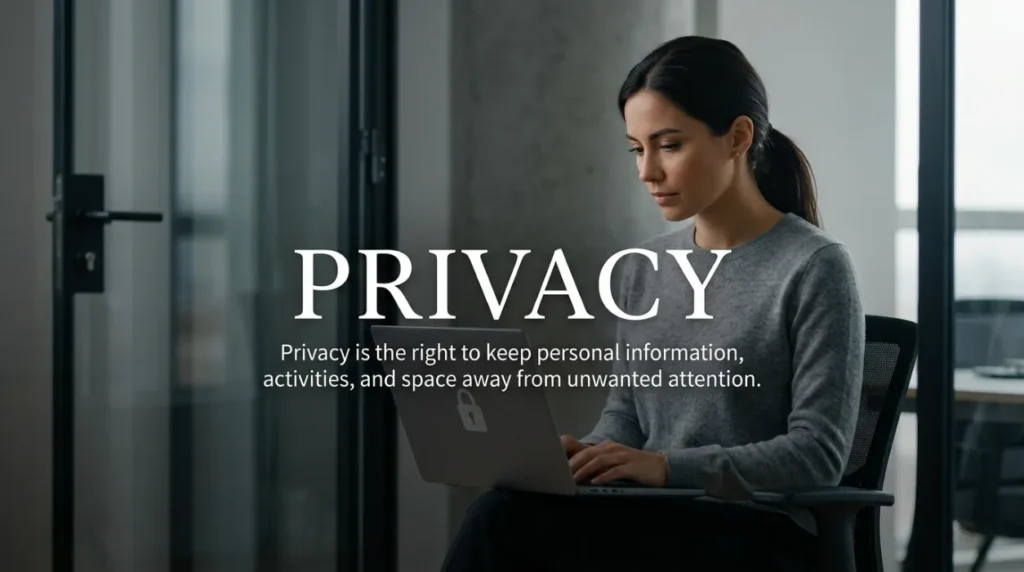
A useful synonym for privacy is seclusion, meaning being away from others and free from unwanted attention. Other close alternatives include confidentiality, secrecy, solitude, discretion, anonymity, personal space, and isolation, depending on the context.
Synonyms for privacy can describe several related ideas, so the best alternative depends on what you mean. If you want freedom from observation, seclusion works well.
When information must remain private or restricted, confidentiality is a more precise term. For situations involving time spent alone or away from others, solitude may be the more suitable choice.
A synonym for privacy is useful because English speakers often need different words for personal space, secret information, private moments, and freedom from attention.
For students, bloggers, content writers, and daily English users, learning these distinctions makes writing clearer and helps avoid repeating the same word.
What Does “Privacy” Really Mean?
Privacy is the state or right of being free from unwanted attention, observation, interference, or access by other people.
In simple English, privacy means having control over what others can see, know, hear, or access about you or your personal life.
For example:
- Closing your bedroom door can give you privacy.
- Keeping a personal conversation private protects privacy.
- A password can help protect digital privacy.
- A person may ask for privacy when they want time away from public attention.
Part of Speech
Privacy is a noun.
The adjective is private.
The related verb is privatize in certain contexts, but it does not mean “to make something personally private” in ordinary conversation.
How Native Speakers Understand Privacy
Native speakers use privacy broadly.
It can refer to:
- Personal space
- Private conversations
- Personal information
- Digital information
- Family matters
- Physical surroundings
- Freedom from observation
- Freedom from unwanted attention
- Confidential records
- Time alone
The exact meaning becomes clear from context.
For example, “I need some privacy” usually means the speaker wants to be alone or left undisturbed.
However, “The company protects customer privacy” usually concerns personal information and data.
Connotative Meaning of Privacy
Connotation (the emotional or implied feeling associated with a word beyond its basic dictionary meaning) can change slightly depending on how privacy is used.
Positive Tone
Privacy often has a positive tone because it can suggest independence, comfort, safety, dignity, and personal freedom.
Example:
“Everyone deserves some privacy after a stressful day.”
Negative Tone
Privacy can sometimes appear in a negative context when someone uses secrecy to hide something or avoid accountability.
Example:
“The unusual secrecy made people question what was happening.”
The negative feeling comes from the surrounding situation, not usually from the word privacy itself.
Neutral Tone
In technology, law, research, and professional communication, privacy is often neutral.
Example:
“The website explains how it handles user privacy.”
Etymology of Privacy
The word privacy developed from private, which ultimately traces back to Latin privatus, meaning “set apart” or “withdrawn from public life.”
The Latin idea was connected with something belonging to an individual rather than the public.
The word later passed through Old French and Middle English before developing into its modern English forms.
Old English: 450–1100
The modern word privacy was not part of Old English in its present form.
Old English had native vocabulary for ideas such as being alone, hidden, separate, or away from others.
The underlying concept existed even though the modern noun developed later.
Middle English: 1100–1500
French and Latin vocabulary strongly influenced English after the Norman Conquest.
Terms related to private, personal ownership, separation, and individual life became increasingly established.
The idea of a private sphere gradually became more closely associated with personal life and separation from public activity.
Modern English: 1500–Present
Privacy became increasingly important as English developed concepts surrounding personal property, private life, confidentiality, and individual rights.
Today, the word appears in everyday conversation as well as law, technology, journalism, business, education, and public policy.
Pronunciation of Privacy
US: /ˈpraɪ.və.si/
UK: /ˈprɪv.ə.si/
Syllables
pri-va-cy
Affixation Pattern of Privacy
Root: priv- related to being separate or private
Prefix: None in the modern English word
Suffix: -acy forms a noun describing a state or condition
The word belongs to the same vocabulary family as private and privately.
Synonyms List
There are not 50 exact one-word synonyms for privacy in every context. The following list therefore combines close synonyms, context-specific alternatives, and natural phrases that express different shades of privacy.
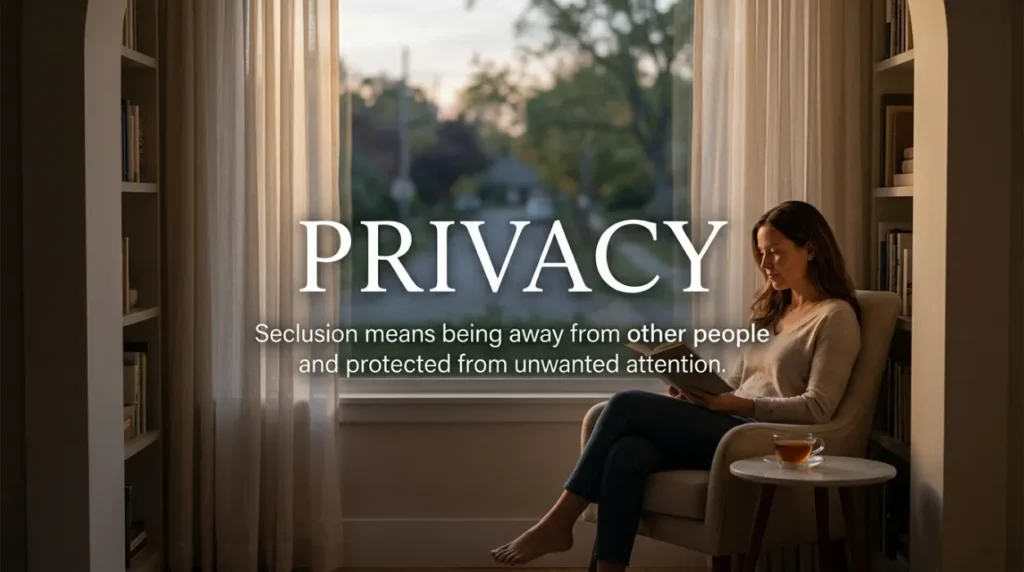
1. Seclusion (Noun) — US / UK: /sɪˈkluː.ʒən/ /sɪˈkluː.ʒən/
Meaning: Seclusion means being away from other people and protected from unwanted attention.
Tone/Register: Neutral, Formal
Examples:
“The cabin offered complete seclusion from the busy city.”
“She wanted a weekend of quiet seclusion.”
2. Confidentiality (Noun) — US / UK: /ˌkɑːn.fə.den.ʃiˈæl.ə.t̬i/ /ˌkɒn.fɪ.den.ʃiˈæl.ə.ti/
Meaning: Confidentiality means keeping sensitive information from unauthorized people.
Tone/Register: Formal, Professional
Examples:
“The lawyer promised complete confidentiality.”
“Medical records require strict confidentiality.”
3. Secrecy (Noun) — US / UK: /ˈsiː.krə.si/ /ˈsiː.krə.si/
Meaning: Secrecy is the practice of keeping information hidden from others.
Tone/Register: Neutral, Formal
Examples:
“The team worked in secrecy before the announcement.”
“The secrecy surrounding the project created curiosity.”
4. Solitude (Noun) — US / UK: /ˈsɑː.lə.tuːd/ /ˈsɒl.ɪ.tjuːd/
Meaning: Solitude is the state of being alone, often by choice.
Tone/Register: Neutral, Literary
Examples:
“She enjoys solitude when writing.”
“He spent the afternoon in peaceful solitude.”
5. Discretion (Noun) — US / UK: /dɪˈskreʃ.ən/ /dɪˈskreʃ.ən/
Meaning: Discretion is careful judgment about what information should be shared.
Tone/Register: Formal, Professional
Examples:
“Please handle the matter with discretion.”
“Her discretion protected the client’s personal details.”
6. Anonymity (Noun) — US / UK: /ˌæn.əˈnɪm.ə.t̬i/ /ˌæn.əˈnɪm.ə.ti/
Meaning: Anonymity means having one’s identity unknown or concealed.
Tone/Register: Neutral, Digital, Formal
Examples:
“The survey allowed participants to maintain anonymity.”
“He preferred anonymity while sharing his opinion online.”
7. Seclusionary Space (Noun Phrase) — US / UK: /sɪˈkluː.ʒən.er.i speɪs/ /sɪˈkluː.ʒən.ər.i speɪs/
Meaning: A seclusionary space is an area designed to provide separation from others.
Tone/Register: Formal
Examples:
“The hotel provides a seclusionary space for guests.”
“She found a quiet seclusionary space to work.”
8. Personal Space (Noun Phrase) — US / UK: /ˈpɝː.sənəl speɪs/ /ˈpɜː.sənəl speɪs/
Meaning: Personal space is the physical or emotional area someone expects others to respect.
Tone/Register: Everyday, Neutral
Examples:
“He prefers plenty of personal space on public transport.”
“She asked her visitors to respect her personal space.”
9. Private Life (Noun Phrase) — US / UK: /ˈpraɪ.vət laɪf/ /ˈpraɪ.vət laɪf/
Meaning: Private life refers to the personal part of someone’s life that is separate from public activities.
Tone/Register: Neutral, Formal
Examples:
“The actor rarely discusses his private life.”
“She keeps her private life separate from work.”
10. Personal Secrecy (Noun Phrase) — US / UK: /ˈpɝː.sənəl ˈsiː.krə.si/ /ˈpɜː.sənəl ˈsiː.krə.si/
Meaning: Personal secrecy refers to keeping private matters hidden from other people.
Tone/Register: Formal
Examples:
“He valued personal secrecy when discussing family matters.”
“The arrangement depended on personal secrecy.”
11. Confidentiality Protection (Noun Phrase) — US / UK: /ˌkɑːn.fə.den.ʃiˈæl.ə.t̬i prəˈtek.ʃən/ /ˌkɒn.fɪ.den.ʃiˈæl.ə.ti prəˈtek.ʃən/
Meaning: Confidentiality protection means measures used to prevent sensitive information from being exposed.
Tone/Register: Professional, Legal
Examples:
“The clinic has strong confidentiality protection.”
“Confidentiality protection is important during interviews.”
12. Non-Disclosure (Noun) — US / UK: /ˌnɑːn.dɪˈs kloʊ.ʒɚ/ /ˌnɒn.dɪˈskləʊ.ʒə/
Meaning: Non-disclosure refers to the decision or requirement not to reveal certain information.
Tone/Register: Legal, Business
Examples:
“The contract included a non-disclosure clause.”
“Non-disclosure protected the company’s sensitive plans.”
13. Withdrawal (Noun) — US / UK: /wɪðˈdrɔː.əl/ /wɪðˈdrɔː.əl/
Meaning: Withdrawal can describe moving away from social contact or public attention.
Tone/Register: Neutral, Formal
Examples:
“After the interview, she chose a period of withdrawal.”
“His withdrawal from social media gave him more quiet time.”
14. Isolation (Noun) — US / UK: /ˌaɪ.səˈleɪ.ʃən/ /ˌaɪ.səˈleɪ.ʃən/
Meaning: Isolation means being separated from others, often with little contact.
Tone/Register: Neutral, Formal
Examples:
“The remote location provided complete isolation.”
“Too much isolation can feel uncomfortable.”
15. Privacy Protection (Noun Phrase) — US / UK: /ˈpraɪ.və.si prəˈtek.ʃən/ /ˈprɪv.ə.si prəˈtek.ʃən/
Meaning: Privacy protection refers to actions that prevent unwanted access to personal information or life.
Tone/Register: Professional, Technical
Examples:
“Privacy protection is important when collecting personal data.”
“The organization strengthened its privacy protection measures.”
16. Personal Protection (Noun Phrase) — US / UK: /ˈpɝː.sənəl prəˈtek.ʃən/ /ˈpɜː.sənəl prəˈtek.ʃən/
Meaning: Personal protection can refer to measures that safeguard someone’s personal information or private life.
Tone/Register: Formal
Examples:
“Personal protection includes careful handling of private records.”
“The policy provides additional personal protection.”
17. Confidentiality (Noun) — US / UK: /ˌkɑːn.fə.den.ʃiˈæl.ə.t̬i/ /ˌkɒn.fɪ.den.ʃiˈæl.ə.ti/
Meaning: Confidentiality specifically emphasizes keeping information restricted to authorized people.
Tone/Register: Professional, Academic
Examples:
“The counselor explained the rules of confidentiality.”
“Employees must respect client confidentiality.”
18. Quiet (Noun/Adjective) — US / UK: /ˈkwaɪ.ət/ /ˈkwaɪ.ət/
Meaning: Quiet can describe a peaceful situation with little disturbance or social interruption.
Tone/Register: Everyday, Informal
Examples:
“I need some quiet after a busy morning.”
“She found a quiet corner to read.”
19. Peace (Noun Phrase) — US / UK: /piːs ænd ˈkwaɪ.ət/ /piːs ænd ˈkwaɪ.ət/
Meaning: Peace refers to freedom from noise, interruption, or disturbance.
Tone/Register: Informal, Everyday
Examples:
“We went outside to enjoy some peace.”
“He wanted a little peace before dinner.”
20. Secludedness (Noun) — US / UK: /sɪˈkluː.dɪd.nəs/ /sɪˈkluː.dɪd.nəs/
Meaning: Secludedness is the quality of being separated from other people or public activity.
Tone/Register: Formal
Examples:
“The secludedness of the village attracted visitors.”
“She appreciated the secludedness of the garden.”
21. Privacy of Information (Noun Phrase) — US / UK: /ˈpraɪ.və.si əv ˌɪn.fɚˈmeɪ.ʃən/ /ˈprɪv.ə.si əv ˌɪn.fəˈmeɪ.ʃən/
Meaning: Privacy of information concerns keeping personal or sensitive information from unwanted access.
Tone/Register: Professional, Academic
Examples:
“Privacy of information matters in online services.”
“The study discusses privacy of information in schools.”
22. Data Confidentiality (Noun Phrase) — US / UK: /ˈdeɪ.t̬ə ˌkɑːn.fə.den.ʃiˈæl.ə.t̬i/ /ˈdeɪ.tə ˌkɒn.fɪ.den.ʃiˈæl.ə.ti/
Meaning: Data confidentiality means preventing unauthorized people from accessing protected information.
Tone/Register: Technical, Professional
Examples:
“Data confidentiality is essential in healthcare.”
“The company trains employees in data confidentiality.”
23. Personal Autonomy (Noun Phrase) — US / UK: /ˈpɝː.sənəl ɔːˈtɑː.nə.mi/ /ˈpɜː.sənəl ɔːˈtɒn.ə.mi/
Meaning: Personal autonomy is the ability to make one’s own choices without unwanted control or interference.
Tone/Register: Academic, Formal
Examples:
“Personal autonomy includes control over personal decisions.”
“The policy aims to protect individual autonomy.”
24. Freedom from Intrusion (Noun Phrase) — US / UK: /ˈfriː.dəm frəm ɪnˈtruː.ʒən/ /ˈfriː.dəm frəm ɪnˈtruː.ʒən/
Meaning: Freedom from intrusion means being protected from unwanted interference or attention.
Tone/Register: Formal, Legal
Examples:
“Residents value freedom from intrusion.”
“The agreement supports freedom from intrusion at home.”
25. Freedom from Observation (Noun Phrase) — US / UK: /ˈfriː.dəm frəm ˌɑːb.zɚˈveɪ.ʃən/ /ˈfriː.dəm frəm ˌɒb.zəˈveɪ.ʃən/
Meaning: Freedom from observation means being able to act without unwanted monitoring or watching.
Tone/Register: Formal
Examples:
“The garden gave visitors freedom from observation.”
“People often value freedom from observation in private spaces.”
26. Personal Confidentiality (Noun Phrase) — US / UK: /ˈpɝː.sənəl ˌkɑːn.fə.den.ʃiˈæl.ə.t̬i/ /ˈpɜː.sənəl ˌkɒn.fɪ.den.ʃiˈæl.ə.ti/
Meaning: Personal confidentiality means keeping an individual’s private information from unauthorized disclosure.
Tone/Register: Professional, Formal
Examples:
“Personal confidentiality is central to the counseling process.”
“The policy explains how personal confidentiality is maintained.”
27. Discretionary Privacy (Noun Phrase) — US / UK: /dɪˈskreʃ.ə.ner.i ˈpraɪ.və.si/ /dɪˈskreʃ.ən.ər.i ˈprɪv.ə.si/
Meaning: Discretionary privacy refers to privacy maintained through careful judgment about what should be shared.
Tone/Register: Formal, Professional
Examples:
“The manager handled the matter with discretionary privacy.”
“Discretionary privacy helped protect the employee’s dignity.”
28. Private Space (Noun Phrase) — US / UK: /ˈpraɪ.vət speɪs/ /ˈpraɪ.vət speɪs/
Meaning: Private space is an area where a person can be away from unwanted contact or observation.
Tone/Register: Everyday, Neutral
Examples:
“Every student needs a private space to concentrate.”
“She turned the spare room into a private space.”
29. Personal Sphere (Noun Phrase) — US / UK: /ˈpɝː.sənəl sfɪr/ /ˈpɜː.sənəl sfɪə/
Meaning: Personal sphere refers to the part of life that belongs to an individual rather than the public.
Tone/Register: Formal, Academic
Examples:
“He keeps his personal sphere separate from his career.”
“The article explores boundaries between public and personal spheres.”
30. Private Domain (Noun Phrase) — US / UK: /ˈpraɪ.vət dəˈmeɪn/ /ˈpraɪ.vət dəˈmeɪn/
Meaning: Private domain refers to an area of life or activity that is not open to the public.
Tone/Register: Formal, Academic
Examples:
“Family matters belong to the private domain.”
“She prefers to keep personal decisions within her private domain.”
31. Confidential Status (Noun Phrase) — US / UK: /ˌkɑːn.fəˈden.ʃəl ˈsteɪ.t̬əs/ /ˌkɒn.fɪˈden.ʃəl ˈsteɪ.təs/
Meaning: Confidential status means that information is officially treated as restricted.
Tone/Register: Legal, Professional
Examples:
“The document has confidential status.”
“Only authorized staff can access information with confidential status.”
32. Restricted Access (Noun Phrase) — US / UK: /rɪˈstrɪk.tɪd ˈæk.ses/ /rɪˈstrɪk.tɪd ˈæk.ses/
Meaning: Restricted access means that only certain people can enter a place or obtain information.
Tone/Register: Professional, Technical
Examples:
“The archive has restricted access.”
“Restricted access protects sensitive records.”
33. Limited Disclosure (Noun Phrase) — US / UK: /ˈlɪm.ə.t̬ɪd dɪˈskloʊ.ʒɚ/ /ˈlɪm.ɪ.tɪd dɪˈskləʊ.ʒə/
Meaning: Limited disclosure means sharing only the information that is necessary or appropriate.
Tone/Register: Formal, Professional
Examples:
“The company follows a policy of limited disclosure.”
“Limited disclosure reduced unnecessary exposure.”
34. Information Control (Noun Phrase) — US / UK: /ˌɪn.fɚˈmeɪ.ʃən kənˈtroʊl/ /ˌɪn.fəˈmeɪ.ʃən kənˈtrəʊl/
Meaning: Information control involves managing who can access or distribute information.
Tone/Register: Technical, Professional
Examples:
“Strong information control protects sensitive documents.”
“The team improved information control after the review.”
35. Boundary (Noun) — US / UK: /ˈbaʊn.dər.i/ /ˈbaʊn.dər.i/
Meaning: A boundary is a limit that defines what others may or may not access.
Tone/Register: Neutral, Everyday
Examples:
“She set a clear boundary about personal questions.”
“Respecting boundaries is important in friendships.”
36. Personal Boundary (Noun Phrase) — US / UK: /ˈpɝː.sənəl ˈbaʊn.dər.i/ /ˈpɜː.sənəl ˈbaʊn.dər.i/
Meaning: A personal boundary is a limit a person sets around their space, information, or relationships.
Tone/Register: Everyday, Psychological
Examples:
“Not answering work calls at night is her personal boundary.”
“He explained his personal boundary calmly.”
37. Private Retreat (Noun Phrase) — US / UK: /ˈpraɪ.vət rɪˈtriːt/ /ˈpraɪ.vət rɪˈtriːt/
Meaning: A private retreat is a place or period used to escape public activity and enjoy personal space.
Tone/Register: Literary, Neutral
Examples:
“The small cottage became her private retreat.”
“He uses the garden as a private retreat.”
38. Secluded Space (Noun Phrase) — US / UK: /sɪˈkluː.dɪd speɪs/ /sɪˈkluː.dɪd speɪs/
Meaning: A secluded space is an area separated from other people and public activity.
Tone/Register: Neutral
Examples:
“The library has a secluded space for quiet study.”
“They found a secluded space for their conversation.”
39. Noninterference (Noun) — US / UK: /ˌnɑːn.ɪn.t̬ɚˈfɪr.əns/ /ˌnɒn.ɪn.təˈfɪə.rəns/
Meaning: Noninterference means avoiding unwanted involvement in another person’s affairs.
Tone/Register: Formal
Examples:
“She asked for noninterference in her personal decisions.”
“The principle emphasizes noninterference in private matters.”
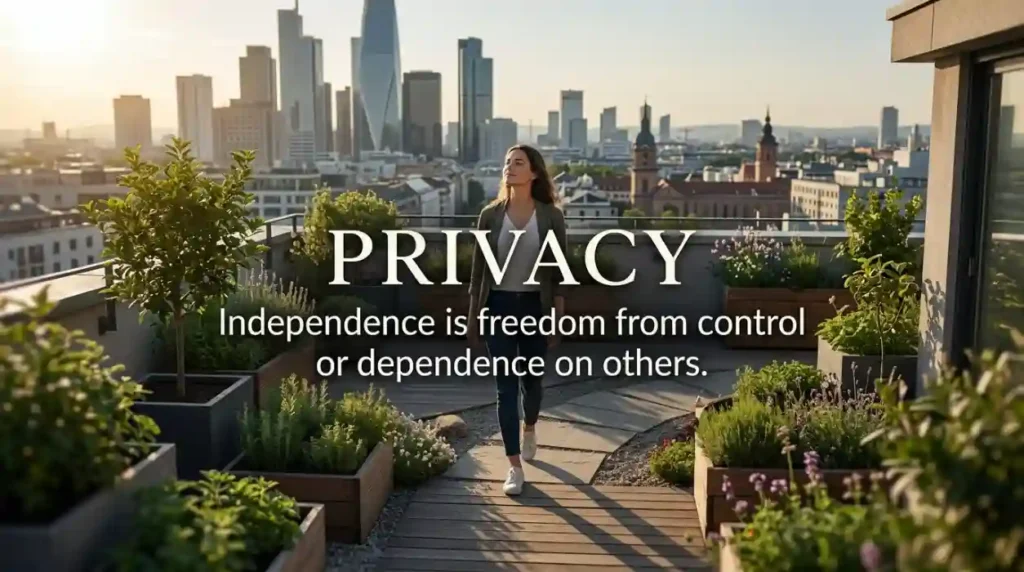
40. Independence (Noun) — US / UK: /ˌɪn.dɪˈpen.dəns/ /ˌɪn.dɪˈpen.dəns/
Meaning: Independence is freedom from control or dependence on others.
Tone/Register: Neutral, Formal
Examples:
“Living alone gave him greater independence.”
“She values independence in her personal life.”
41. Solitary Space (Noun Phrase) — US / UK: /ˈsɑː.lə.ter.i speɪs/ /ˈsɒl.ɪ.tər.i speɪs/
Meaning: Solitary space is an area where someone can remain alone without interruption.
Tone/Register: Neutral, Literary
Examples:
“The studio provides solitary space for artists.”
“She searched for solitary space to finish her work.”
42. Personal Seclusion (Noun Phrase) — US / UK: /ˈpɝː.sənəl sɪˈkluː.ʒən/ /ˈpɜː.sənəl sɪˈkluː.ʒən/
Meaning: Personal seclusion means deliberately staying away from public attention or social contact.
Tone/Register: Formal
Examples:
“The author chose personal seclusion while finishing the book.”
“Personal seclusion helped him focus on recovery.”
43. Privacy of Personal Life (Noun Phrase) — US / UK: /ˈpraɪ.və.si əv ˈpɝː.sənəl laɪf/ /ˈprɪv.ə.si əv ˈpɜː.sənəl laɪf/
Meaning: Privacy of personal life means protection of personal activities and matters from unwanted public attention.
Tone/Register: Formal, Media
Examples:
“Celebrities often request privacy of personal life.”
“The journalist respected her privacy of personal life.”
44. Confidential Treatment (Noun Phrase) — US / UK: /ˌkɑːn.fəˈden.ʃəl ˈtriːt.mənt/ /ˌkɒn.fɪˈden.ʃəl ˈtriːt.mənt/
Meaning: Confidential treatment means handling information so that unauthorized people cannot see it.
Tone/Register: Professional, Legal
Examples:
“The complaint received confidential treatment.”
“The records require confidential treatment.”
45. Restricted Disclosure (Noun Phrase) — US / UK: /rɪˈstrɪk.tɪd dɪˈskloʊ.ʒɚ/ /rɪˈstrɪk.tɪd dɪˈskləʊ.ʒə/
Meaning: Restricted disclosure means limiting who can receive particular information.
Tone/Register: Legal, Professional
Examples:
“The report is subject to restricted disclosure.”
“Restricted disclosure protects sensitive findings.”
46. Personal Confidentiality (Noun Phrase) — US / UK: /ˈpɝː.sənəl ˌkɑːn.fə.den.ʃiˈæl.ə.t̬i/ /ˈpɜː.sənəl ˌkɒn.fɪ.den.ʃiˈæl.ə.ti/
Meaning: Personal confidentiality focuses on protecting information that belongs to an individual.
Tone/Register: Professional, Formal
Examples:
“The counselor explained the importance of personal confidentiality.”
“The policy protects personal confidentiality during consultations.”
47. Private Time (Noun Phrase) — US / UK: /ˈpraɪ.vət taɪm/ /ˈpraɪ.vət taɪm/
Meaning: Private time is time reserved for oneself without social or public demands.
Tone/Register: Informal, Everyday
Examples:
“I need some private time after work.”
“She uses her private time to read and relax.”
48. Time Alone (Noun Phrase) — US / UK: /taɪm əˈloʊn/ /taɪm əˈləʊn/
Meaning: Time alone refers to a period spent without other people.
Tone/Register: Informal, Everyday
Examples:
“Everyone needs some time alone sometimes.”
“He takes time alone to clear his thoughts.”
49. Freedom from Interference (Noun Phrase) — US / UK: /ˈfriː.dəm frəm ˌɪn.t̬ɚˈfɪr.əns/ /ˈfriː.dəm frəm ˌɪn.təˈfɪə.rəns/
Meaning: Freedom from interference means being able to live or act without unwanted involvement from others.
Tone/Register: Formal
Examples:
“She wanted freedom from interference in her family decisions.”
“The agreement protects freedom from interference.”
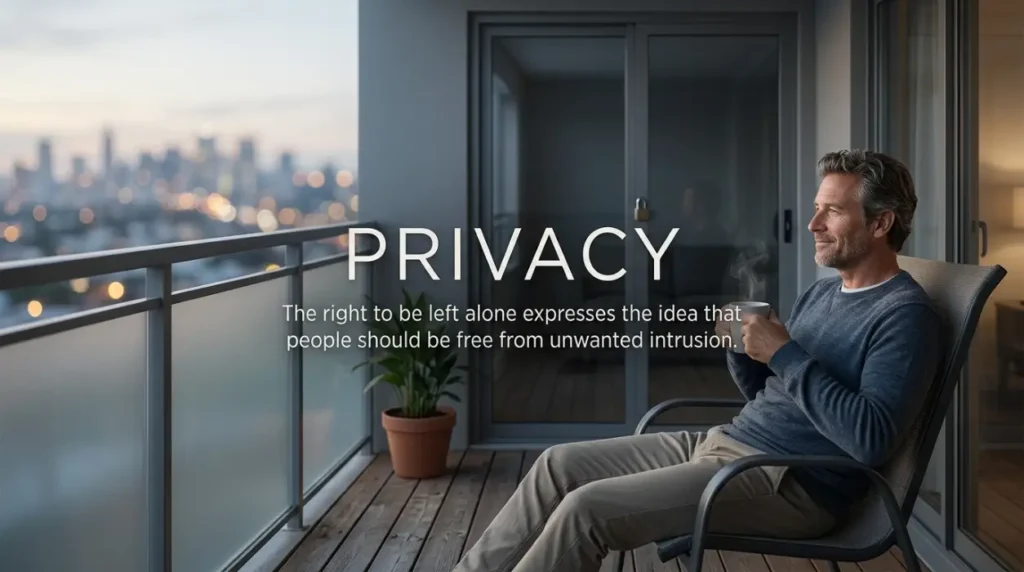
50. Right to Be Left Alone (Noun Phrase) — US / UK: /raɪt tə bi left əˈloʊn/ /raɪt tə bi left əˈləʊn/
Meaning: The right to be left alone expresses the idea that people should be free from unwanted intrusion.
Tone/Register: Formal, Legal, Everyday
Examples:
“Everyone deserves the right to be left alone at home.”
“He politely asked for his right to be left alone.”
Synonyms by Tone
Positive or Protective
These alternatives can suggest safety, independence, comfort, or personal control:
- Seclusion
- Solitude
- Personal space
- Private space
- Personal autonomy
- Independence
- Private retreat
- Time alone
They work well when privacy is presented as something valuable.
Neutral
These words can describe privacy without creating a strong emotional impression:
- Privacy
- Secrecy
- Confidentiality
- Anonymity
- Withdrawal
- Boundary
- Restricted access
- Private life
Formal or Professional
These choices are especially useful in business, legal, academic, or technical writing:
- Confidentiality
- Discretion
- Non-disclosure
- Data confidentiality
- Privacy protection
- Information control
- Limited disclosure
- Restricted disclosure
- Freedom from interference
Informal
Natural conversational alternatives include:
- Personal space
- Quiet
- Peace
- Private time
- Time alone
- Being left alone
English speakers often prefer these phrases in everyday speech.
Why Tone Matters When Choosing a Synonym
Not every synonym for privacy communicates the same feeling.
Seclusion can suggest physical separation.
Solitude often sounds peaceful or reflective.
Secrecy can suggest hidden information and may sometimes sound suspicious.
Confidentiality is appropriate when information must be protected.
Personal space usually refers to physical or emotional boundaries.
Anonymity focuses on hiding identity rather than hiding information.
Choosing the right term helps readers understand exactly what kind of privacy you mean.
“Privacy” vs. Close Alternatives
| Word | Meaning | Best Use |
|---|---|---|
| Privacy | Freedom from unwanted access, attention, or observation | General use |
| Confidentiality | Protection of sensitive information | Work, law, medicine |
| Seclusion | Separation from people or public attention | Places, personal time |
| Secrecy | Keeping information hidden | Hidden plans or facts |
| Solitude | Being alone, often by choice | Reflection, relaxation |
Privacy vs Confidentiality
These words overlap, but they are not interchangeable in every sentence.
Privacy is broader. It can involve your body, home, personal life, conversations, or information.
Confidentiality focuses specifically on information that should not be disclosed to unauthorized people.
For example:
“I want privacy while I change.”
But:
“The doctor must maintain confidentiality.”
Privacy vs Secrecy
Privacy usually describes a legitimate personal boundary.
Secrecy emphasizes deliberately hiding information.
A person may want privacy without having anything secret.
Privacy vs Solitude
Privacy means freedom from unwanted access or intrusion.
Solitude means being alone.
Someone can have privacy while other people are nearby. Someone can also experience solitude without specifically seeking privacy.
How “Privacy” Changes by Context
Privacy in Daily Conversation
In everyday English, people often use privacy to discuss personal space and time.
For example:
“Can I have some privacy?”
This usually means:
“Can you leave me alone for a while?”
Native speakers also commonly say:
“I need some time alone.”
This sounds relaxed and conversational.
Privacy in Writing and Blogging
Bloggers and content writers frequently discuss privacy when writing about social media, personal boundaries, relationships, travel, public figures, or online communication.
A writer might say:
“Protecting your privacy online starts with understanding what information you share.”
In this context, alternatives such as confidentiality, anonymity, and information control can add useful precision.
Privacy in Professional and Academic English
Professional writing often distinguishes between privacy and confidentiality.
For example, a research paper may discuss participant privacy.
A workplace policy may discuss confidentiality.
A legal document may refer to restricted disclosure or personal information protection.
Using the precise term makes formal writing stronger.
Privacy in Creative or Informal English
Creative writing can use more vivid expressions.
Instead of:
“She wanted privacy.”
A writer might say:
“She disappeared into a quiet corner where nobody could find her.”
This creates a stronger image.
Words such as solitude, seclusion, and private retreat can also create a reflective or literary mood.
Common Mistakes Learners Make
Mistake 1: Using Confidentiality for Physical Privacy
Confidentiality normally concerns information.
You would not usually say:
“I need confidentiality while sleeping.”
A better choice is:
“I need privacy.”
Mistake 2: Treating Privacy and Secrecy as Identical
Privacy does not necessarily mean hiding something wrong.
A person can protect private family matters without keeping a secret.
Secrecy usually emphasizes concealment.
Mistake 3: Confusing Privacy with Solitude
Solitude means being alone.
Privacy means having freedom from unwanted access or interference.
They overlap but focus on different ideas.
Mistake 4: Using Isolation Positively Every Time
Isolation often suggests separation that may be unwanted or unhealthy.
If you mean peaceful time alone, solitude is usually more positive.
Mistake 5: Using Anonymity for General Privacy
Anonymity means your identity is unknown or hidden.
It does not automatically mean that all your personal information is private.
Mistake 6: Overusing Formal Expressions
Terms such as non-disclosure, restricted disclosure, and information control are useful in specific contexts.
They can sound unnatural in ordinary conversation.
Register Notes
Formal
- Confidentiality
- Discretion
- Non-disclosure
- Restricted disclosure
- Noninterference
- Freedom from intrusion
Academic
- Personal autonomy
- Personal sphere
- Information control
- Anonymity
- Confidentiality
Professional
- Data confidentiality
- Privacy protection
- Restricted access
- Limited disclosure
- Private domain
Everyday
- Personal space
- Quiet
- Private time
- Time alone
- Peace
- Being left alone
For an internal vocabulary link, a related article about confidentiality can help readers understand the difference between protecting information and protecting personal space.
Real-Life Mini Scenarios Using Privacy
Workplace
An employee asks a coworker not to discuss a personal matter with others.
The employee is asking for privacy, while the coworker’s responsibility to keep the information private may involve confidentiality.
Social Situation
Someone closes their bedroom door after a long day and asks family members not to interrupt.
They are asking for personal space and privacy.
Media and Public Life
A public figure may ask journalists not to report details about family members.
This situation involves privacy, especially the protection of private life from unwanted public attention.
Digital Life
A user checks account settings before sharing personal information online.
The main concern is protecting privacy and controlling personal information.
Writing and Storytelling
A character escapes to a quiet cabin after becoming overwhelmed by public attention.
The writer could describe the cabin as a place of seclusion, solitude, or a private retreat.
How to Choose the Right Synonym for Privacy
Ask what type of privacy you mean.
When referring to being alone or away from others, solitude or seclusion may be the most suitable terms.
For information that should be protected from unauthorized access, confidentiality is more precise.
When information is intentionally kept hidden, secrecy can better express the meaning.
For a person whose identity is concealed, anonymity is the appropriate choice.
When discussing physical or emotional boundaries, personal space can convey the idea more naturally.
If the focus is on avoiding unwanted interference or intrusion, use noninterference or freedom from intrusion.
For time spent away from other people, phrases such as private time or time alone may be more natural.
This simple distinction helps you choose a natural synonym instead of replacing privacy with a word that only partly matches.
Practice Exercise
1. Which word is most closely connected with protecting sensitive information?
A. Solitude
B. Confidentiality
C. Quiet
D. Independence
2. Someone wants to spend the afternoon alone. Which word fits best?
A. Solitude
B. Disclosure
C. Secrecy
D. Anonymity
3. A person does not want others to know their identity online. What do they want?
A. Personal space
B. Anonymity
C. Withdrawal
D. Seclusion
4. Which expression is most natural in casual conversation?
A. Restricted disclosure
B. Information control
C. Personal space
D. Confidential treatment
5. A lawyer promises not to share a client’s information. Which concept applies?
A. Solitude
B. Confidentiality
C. Quiet
D. Independence
6. Which word can sometimes suggest that information is deliberately hidden?
A. Secrecy
B. Personal space
C. Solitude
D. Private time
7. A person wants freedom from unwanted involvement in their decisions. Which phrase fits?
A. Freedom from interference
B. Peace
C. Data confidentiality
D. Secluded space
8. Which word describes a place separated from public activity?
A. Seclusion
B. Anonymity
C. Disclosure
D. Discretion
9. A student asks classmates not to enter a quiet study area. What does the student want?
A. Personal space
B. Secrecy
C. Anonymity
D. Non-disclosure
10. Which term is most suitable for protecting customer information?
A. Solitude
B. Data confidentiality
C. Private retreat
D. Time alone
Reflection Task:
Write one sentence using privacy, then rewrite it with seclusion, confidentiality, solitude, or personal space. Explain how the meaning changes.
Answer Key:
1-B | 2-A | 3-B | 4-C | 5-B | 6-A | 7-A | 8-A | 9-A | 10-B
Frequently Asked Questions
1. What is the closest synonym for privacy?
The closest synonym depends on the meaning. Seclusion is a strong choice when privacy means being away from people. Confidentiality fits when private information must be protected. Solitude works when someone wants to be alone. Personal space is natural when the focus is physical or emotional boundaries.
2. What is a good synonym for privacy in a sentence?
Good alternatives include seclusion, confidentiality, solitude, secrecy, discretion, anonymity, and personal space. Choose the word according to the situation. For example, “She wanted privacy” can become “She wanted solitude” when she wants time alone, but “The information requires confidentiality” is better when discussing sensitive data.
3. What is a formal synonym for privacy?
Confidentiality, discretion, noninterference, restricted access, limited disclosure, and freedom from intrusion can work in formal contexts. The best choice depends on the subject. Legal and professional writing often uses confidentiality for information, while freedom from intrusion focuses on protection from unwanted interference.
4. What is the difference between privacy and confidentiality?
Privacy is a broad concept involving personal space, life, activities, identity, and information. Confidentiality specifically concerns keeping information from unauthorized disclosure. For example, someone may want privacy at home, while a doctor has a professional duty to maintain confidentiality regarding a patient’s information.
5. What is the difference between privacy and secrecy?
Privacy usually describes a person’s right or desire to keep certain parts of life away from public attention. Secrecy emphasizes deliberately hiding information. Privacy does not imply wrongdoing. A person can reasonably want privacy about family matters without keeping a secret.
6. What is a synonym for privacy in relationships?
Depending on the situation, natural alternatives include personal space, boundaries, private time, independence, and time alone. For example, someone who needs time away from a partner may ask for “some personal space.” This usually communicates a need for independence without suggesting that the relationship itself is secret.
7. What is a synonym for online privacy?
For online contexts, useful related terms include data confidentiality, information control, anonymity, restricted access, and privacy protection. These terms highlight different aspects of digital privacy. Anonymity focuses on identity, while data confidentiality focuses on preventing unauthorized access to personal information.
Suggested External Source:
Conclusion
A useful synonym for privacy depends on the exact meaning you want. Seclusion, solitude, confidentiality, and personal space each express a different shade.
Learning these alternatives helps students and writers avoid repetition while making their meaning clearer. Precise vocabulary can also make everyday communication sound more natural.
For bloggers and content writers, the right privacy-related word can improve clarity in articles about relationships, technology, safety, and personal boundaries.
Try using one new synonym in an email, essay, or daily conversation today. Small vocabulary changes can make your English more precise and confident.

Jameel Hassan is the founder and lead writer at SynonymsCloud.com, a trusted online platform dedicated to English vocabulary and effective communication. He is passionate about helping students, writers, professionals, and lifelong learners discover the right words to express their ideas with clarity, precision, and confidence.
At SynonymsCloud.com, every article is thoroughly researched and carefully written to provide accurate, practical, and easy-to-understand guidance on synonyms, antonyms, word meanings, idioms, and vocabulary. With a strong commitment to quality, real-world usage, and clear explanations, the website helps readers expand their vocabulary, improve their writing, and communicate more effectively in both academic and professional settings.