
A synonym for programming depends on the context. In software, common alternatives include coding, software development, computer programming, and software engineering. In scheduling, planning, organizing, arranging, and scheduling may fit. For television or events, program planning, scheduling, and production can be more precise.
The synonym for programming can make a big difference when you write about technology, planning, or media. A developer may say “coding,” while an event planner may say “scheduling.”
Imagine writing a blog about a new app. Using coding instead of programming can make the sentence feel more specific and natural.
The right alternative helps students, bloggers, and content writers avoid repeating the same word. It also makes everyday English sound clearer.
Learning a synonym for programming helps daily English users choose words that match their exact meaning, audience, and situation.
What Does “Programming” Really Mean?
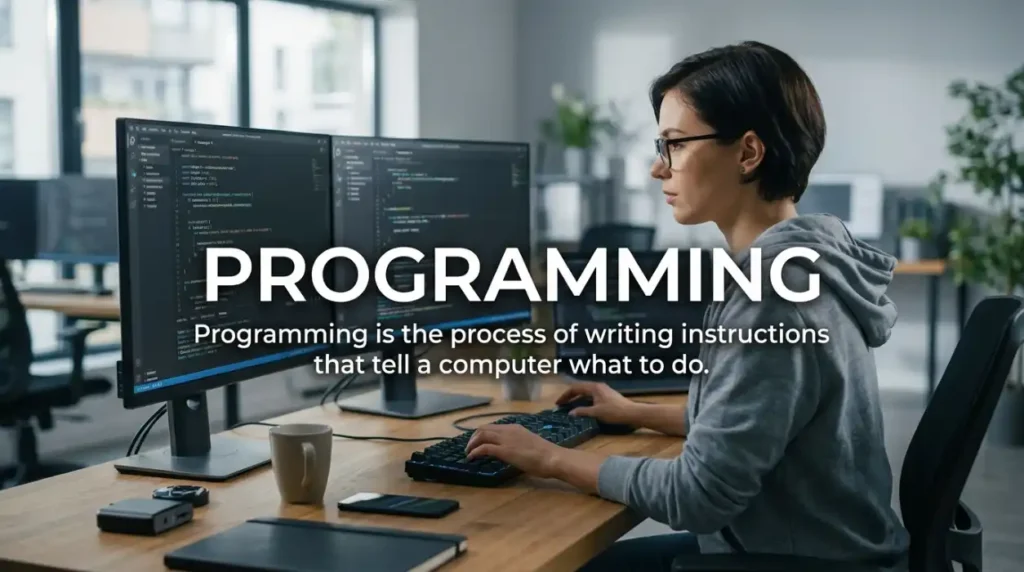
Programming is the process of creating instructions that a computer can follow to perform tasks. In technology, it usually involves writing, testing, changing, and maintaining computer code.
For example, a programmer might create code that tells a website how to display information or tells an application how to respond when a user clicks a button.
The word can also have broader meanings outside computing. Programming may describe planning television content, arranging events, or organizing a sequence of activities.
Part of Speech
Programming is primarily a noun and a present participle/gerund formed from the verb program.
As a noun:
Programming requires careful attention to detail.
As a gerund:
She enjoys programming in her free time.
Simple Definition
Programming means creating, arranging, or organizing instructions or activities according to a planned system.
How Native Speakers Understand It
Native speakers usually understand programming from its context.
In a technology article, it almost always means writing computer code.
In television, radio, or event management, it can mean planning or arranging content and activities.
Common Contexts
You may see programming in:
- Software development
- Web development
- Mobile applications
- Computer science
- Artificial intelligence
- Game development
- Television
- Radio
- Event planning
- Education
- Business planning
Connotative Meaning
Connotation (the emotional or cultural feeling associated with a word beyond its basic dictionary meaning) can change how programming sounds.
Positive Tone
In technology, programming can suggest creativity, problem-solving, innovation, and technical skill.
Programming allows people to turn ideas into working applications.
Neutral Tone
Most uses of programming are neutral and simply describe writing code or organizing content.
The course introduces students to programming basics.
Negative Tone
The word itself is not normally negative. However, a phrase such as “rigid programming” may suggest an inflexible or overly structured process.
Etymology of “Programming”
The modern word programming comes from program, which ultimately traces back to the Greek programma, meaning a written public notice or something written beforehand.
Greek programma came from prographein, meaning “to write before.”
The word passed through Latin and later French before entering English as program.
Old English: 450–1100
The modern word programming did not exist in Old English. The concept of a written plan or announcement was expressed through other vocabulary.
Middle English: 1100–1500
Forms related to program developed in European languages and eventually influenced English vocabulary. The idea centered on a written plan, announcement, or outline.
Modern English: 1500–Present
Program became established in English for plans, schedules, and organized activities. With the growth of computing in the twentieth century, programming developed its modern technological meaning: writing instructions for computers.
Today, the word is strongly associated with software and computer science, although its older planning-related meaning remains useful in media and event contexts.
Pronunciation
Programming
- US: /ˈproʊˌɡræmɪŋ/
- UK: /ˈprəʊˌɡræmɪŋ/
Syllables
pro-gram-ming
Affixation Pattern of “Programming”
Root: program
Prefix: none
Suffix: -ing
The suffix -ing changes the verb program into a form that can function as a noun or describe an ongoing activity.
Synonyms List
Important note: There are not 50 perfect one-word synonyms for programming. The word changes meaning across technology, software development, scheduling, media, and event contexts. The following 50 alternatives are therefore grouped as direct synonyms, close alternatives, and context-specific expressions. This keeps the vocabulary useful without pretending that unrelated words mean the same thing.
1. Coding (Noun) — US /ˈkoʊdɪŋ/ — UK /ˈkəʊdɪŋ/
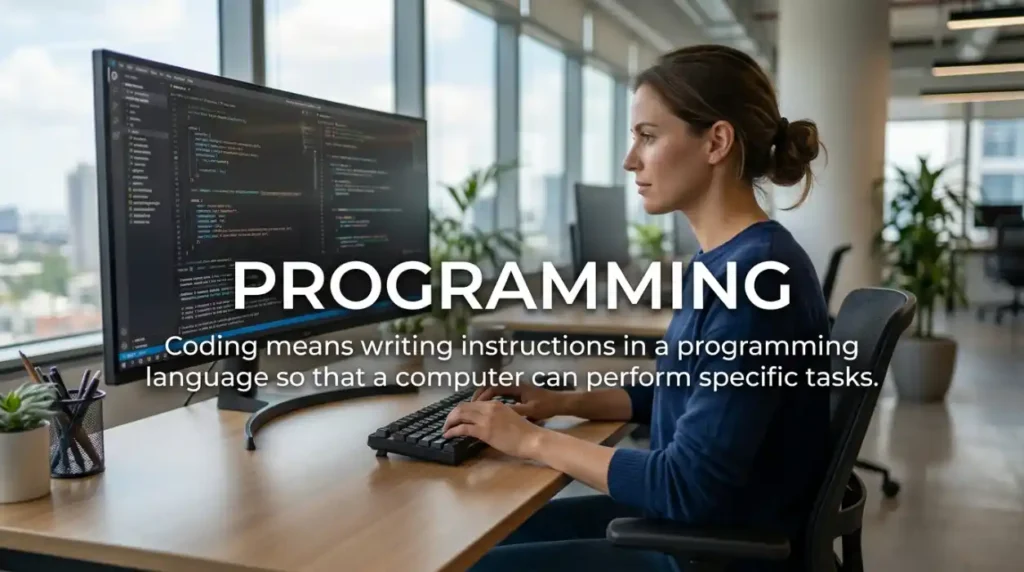
Meaning: Coding means writing instructions in a programming language so that a computer can perform specific tasks.
Tone/Register: Neutral, technical, widely used.
Examples:
She spends evenings coding a small mobile application.
The course teaches basic coding through practical projects.
2. Computer Programming (Noun) — US /kəmˈpjuːtər ˈproʊɡræmɪŋ/ — UK /kəmˈpjuːtə ˈprəʊɡræmɪŋ/
Meaning: Computer programming is the practice of creating instructions that computers execute.
Tone/Register: Academic, technical.
Examples:
He studied computer programming at university.
Computer programming helped her understand how software works.
3. Software Development (Noun) — US /ˈsɔːftwer dɪˈveləpmənt/ — UK /ˈsɒftweə dɪˈveləpmənt/
Meaning: Software development covers the broader process of designing, creating, testing, and maintaining software.
Tone/Register: Professional, technical.
Examples:
She works in software development for a growing company.
Good software development involves more than writing code.
4. Software Engineering (Noun) — US /ˈsɔːftwer ˌendʒəˈnɪrɪŋ/ — UK /ˈsɒftweə ˌendʒɪˈnɪərɪŋ/
Meaning: Software engineering applies systematic methods to building and maintaining reliable software.
Tone/Register: Professional, academic.
Examples:
Software engineering requires careful planning and testing.
He wants to specialize in software engineering.
5. Code Writing (Noun) — US /koʊd ˈraɪtɪŋ/ — UK /kəʊd ˈraɪtɪŋ/
Meaning: Code writing refers specifically to creating computer instructions in a programming language.
Tone/Register: Neutral, technical.
Example:
Her code writing has become faster with practice.
The workshop focuses on clear code writing.
6. Coding Practice (Noun) — US /ˈkoʊdɪŋ ˈpræktɪs/ — UK /ˈkəʊdɪŋ ˈpræktɪs/
Meaning: Coding practice means regularly working with code to develop programming ability.
Tone/Register: Educational, informal.
Examples:
Daily coding practice improved his confidence.
Students need coding practice to build strong skills.
7. Software Creation (Noun) — US /ˈsɔːftwer kriˈeɪʃən/ — UK /ˈsɒftweə kriˈeɪʃən/
Meaning: Software creation describes the process of making software for a particular purpose.
Tone/Register: Neutral, accessible.
Examples:
The team focuses on software creation for schools.
Software creation begins with a clear idea.
8. Application Development (Noun) — US /ˌæpləˈkeɪʃən dɪˈveləpmənt/ — UK /ˌæplɪˈkeɪʃən dɪˈveləpmənt/
Meaning: Application development means creating software applications for computers or mobile devices.
Tone/Register: Professional, technical.
Examples:
She works in application development.
Application development often starts with user needs.
9. Web Development (Noun) — US /web dɪˈveləpmənt/ — UK /web dɪˈveləpmənt/
Meaning: Web development involves creating and maintaining websites and web-based applications.
Tone/Register: Professional, technical.
Examples:
He chose web development as his career path.
Web development combines technical and creative skills.
10. Software Design (Noun) — US /ˈsɔːftwer dɪˈzaɪn/ — UK /ˈsɒftweə dɪˈzaɪn/
Meaning: Software design involves planning how software will function and how its parts will work together.
Tone/Register: Technical, professional.
Examples:
Good software design makes future changes easier.
The team discussed software design before coding began.
11. Code Development (Noun) — US /koʊd dɪˈveləpmənt/ — UK /kəʊd dɪˈveləpmənt/
Meaning: Code development refers to creating and improving computer code.
Tone/Register: Technical, professional.
Examples:
Code development continued throughout the project.
The team reviewed the code during development.
12. Computer Coding (Noun) — US /kəmˈpjuːtər ˈkoʊdɪŋ/ — UK /kəmˈpjuːtə ˈkəʊdɪŋ/
Meaning: Computer coding is the process of writing instructions for computers.
Tone/Register: Neutral, educational.
Examples:
Computer coding can be introduced through simple exercises.
She became interested in computer coding at school.
13. Algorithm Design (Noun) — US /ˈælɡəˌrɪðəm dɪˈzaɪn/ — UK /ˈælɡərɪðəm dɪˈzaɪn/
Meaning: Algorithm design involves creating logical steps that solve a computational problem.
Tone/Register: Academic, technical.
Examples:
Algorithm design is important in computer science.
The students practiced algorithm design with simple problems.
14. Software Construction (Noun) — US /ˈsɔːftwer kənˈstrʌkʃən/ — UK /ˈsɒftweə kənˈstrʌkʃən/
Meaning: Software construction refers to building software through coding, integration, and related development activities.
Tone/Register: Formal, technical.
Examples:
Software construction requires attention to detail.
The course covers software construction methods.
15. Application Coding (Noun) — US /ˌæpləˈkeɪʃən ˈkoʊdɪŋ/ — UK /ˌæplɪˈkeɪʃən ˈkəʊdɪŋ/
Meaning: Application coding means writing code for a specific software application.
Tone/Register: Technical, professional.
Examples:
He enjoys application coding in his free time.
The project includes several weeks of application coding.
16. Script Writing (Noun) — US /skrɪpt ˈraɪtɪŋ/ — UK /skrɪpt ˈraɪtɪŋ/
Meaning: In computing, script writing means creating scripts that automate or control tasks.
Tone/Register: Technical, neutral.
Examples:
Script writing helped automate the repetitive task.
She uses script writing to simplify routine work.
17. Scripting (Noun) — US /ˈskrɪptɪŋ/ — UK /ˈskrɪptɪŋ/
Meaning: Scripting involves writing scripts that perform specific automated or controlled actions.
Tone/Register: Technical, informal-professional.
Examples:
Scripting can save time on repetitive tasks.
He learned scripting for basic automation.
18. Software Coding (Noun) — US /ˈsɔːftwer ˈkoʊdɪŋ/ — UK /ˈsɒftweə ˈkəʊdɪŋ/
Meaning: Software coding means writing the instructions that make software perform its functions.
Tone/Register: Technical, accessible.
Examples:
Software coding takes patience and practice.
She enjoys software coding because it feels creative.
19. Code Creation (Noun) — US /koʊd kriˈeɪʃən/ — UK /kəʊd kriˈeɪʃən/
Meaning: Code creation describes the act of producing new computer code.
Tone/Register: Neutral, technical.
Examples:
The assignment focuses on code creation.
Clear requirements make code creation easier.
20. Software Authoring (Noun) — US /ˈsɔːftwer ˈɔːθərɪŋ/ — UK /ˈsɒftweə ˈɔːθərɪŋ/
Meaning: Software authoring refers to creating software content or applications using structured development methods.
Tone/Register: Formal, technical.
Examples:
Software authoring requires a clear understanding of the intended audience.
The team explored new approaches to software authoring.
21. Development (Noun) — US /dɪˈveləpmənt/ — UK /dɪˈveləpmənt/
Meaning: Development can refer broadly to the process of creating or improving software.
Tone/Register: Neutral, professional.
Examples:
Development continued after the initial design stage.
The company hired developers for the project.
22. Computing (Noun) — US /kəmˈpjuːtɪŋ/ — UK /kəmˈpjuːtɪŋ/
Meaning: Computing is the broader field involving computers, information processing, and computational systems.
Tone/Register: Academic, technical.
Examples:
She plans to study computing next year.
Computing includes many areas beyond programming.
23. Computer Science (Noun) — US /kəmˈpjuːtər saɪəns/ — UK /kəmˈpjuːtə saɪəns/
Meaning: Computer science is the academic field that studies computation, algorithms, software, and information systems.
Tone/Register: Academic.
Examples:
He chose computer science because he enjoys solving problems.
Computer science includes programming but covers much more.
24. Software Work (Noun) — US /ˈsɔːftwer wɜːrk/ — UK /ˈsɒftweə wɜːk/
Meaning: Software work is an informal expression for tasks involved in creating or maintaining software.
Tone/Register: Informal, professional.
Examples:
I have some software work to finish tonight.
Her software work includes testing and maintenance.
25. Coding Work (Noun) — US /ˈkoʊdɪŋ wɜːrk/ — UK /ˈkəʊdɪŋ wɜːk/
Meaning: Coding work refers to practical tasks that involve writing or changing computer code.
Tone/Register: Informal, professional.
Examples:
He completed the coding work before lunch.
Most of the coding work involved fixing errors.
26. Software Building (Noun) — US /ˈsɔːftwer ˈbɪldɪŋ/ — UK /ˈsɒftweə ˈbɪldɪŋ/
Meaning: Software building is an accessible expression for creating software systems.
Tone/Register: Informal, explanatory.
Examples:
Software building starts with a clear purpose.
The course introduces basic ideas behind software building.
27. Computer Development (Noun) — US /kəmˈpjuːtər dɪˈveləpmənt/ — UK /kəmˈpjuːtə dɪˈveləpmənt/
Meaning: Computer development can describe the creation of computer-based applications or systems.
Tone/Register: Technical, less common.
Examples:
The project focuses on computer development for education.
Computer development often involves several specialists.
28. Programming Practice (Noun) — US /ˈproʊɡræmɪŋ ˈpræktɪs/ — UK /ˈprəʊɡræmɪŋ ˈpræktɪs/
Meaning: Programming practice means repeated exercises used to improve programming ability.
Tone/Register: Educational.
Examples:
Regular programming practice builds confidence.
Students need programming practice before tackling complex projects.
29. Code Implementation (Noun) — US /koʊd ˌɪmpləmenˈteɪʃən/ — UK /kəʊd ˌɪmplɪmenˈteɪʃən/
Meaning: Code implementation means turning a planned solution or design into working code.
Tone/Register: Technical, professional.
Examples:
The team began code implementation after approving the design.
Careful code implementation reduced later problems.
30. Software Implementation (Noun) — US /ˈsɔːftwer ˌɪmpləmenˈteɪʃən/ — UK /ˈsɒftweə ˌɪmplɪmenˈteɪʃən/
Meaning: Software implementation is the process of putting a software design or solution into working form.
Tone/Register: Formal, professional.
Examples:
Software implementation required close teamwork.
The implementation phase lasted several weeks.
31. Scheduling (Noun) — US /ˈskedʒuːlɪŋ/ — UK /ˈʃedjuːlɪŋ/
Meaning: Scheduling means deciding when activities, programs, or events will take place.
Tone/Register: Neutral, professional.
Examples:
Scheduling became difficult after the meeting moved.
The manager handles scheduling for the whole team.
32. Planning (Noun) — US /ˈplænɪŋ/ — UK /ˈplænɪŋ/
Meaning: Planning involves deciding what should happen and how it should be organized.
Tone/Register: Neutral, widely used.
Examples:
Careful planning made the event easier to manage.
The project needs more planning before it begins.
33. Organizing (Noun) — US /ˈɔːrɡənaɪzɪŋ/ — UK /ˈɔːɡənaɪzɪŋ/
Meaning: Organizing means arranging people, activities, or resources into a useful structure.
Tone/Register: Neutral, everyday.
Examples:
Organizing the workshop took several days.
She enjoys organizing community events.
34. Arranging (Noun) — US /əˈreɪndʒɪŋ/ — UK /əˈreɪndʒɪŋ/
Meaning: Arranging means putting activities, events, or elements into a planned order.
Tone/Register: Neutral.
Examples:
He is arranging the speakers for the conference.
Arranging the schedule took careful coordination.
35. Coordination (Noun) — US /koʊˌɔːrdəˈneɪʃən/ — UK /kəʊˌɔːdɪˈneɪʃən/
Meaning: Coordination means organizing different activities or people so they work together effectively.
Tone/Register: Professional, formal.
Examples:
Good coordination kept the event on schedule.
The project required coordination between several teams.
36. Organization (Noun) — US /ˌɔːrɡənəˈzeɪʃən/ — UK /ˌɔːɡənaɪˈzeɪʃən/
Meaning: Organization can describe the structured arrangement of activities or information.
Tone/Register: Neutral, professional.
Examples:
The organization of the conference was impressive.
Better organization would make the schedule easier to follow.
37. Program Planning (Noun) — US /ˈproʊɡræm ˈplænɪŋ/ — UK /ˈprəʊɡræm ˈplænɪŋ/
Meaning: Program planning means deciding what content or activities a program will contain and when they will occur.
Tone/Register: Professional, media-related.
Examples:
Program planning begins several months before the festival.
The team discussed program planning during the meeting.
38. Content Planning (Noun) — US /ˈkɑːntent ˈplænɪŋ/ — UK /ˈkɒntent ˈplænɪŋ/
Meaning: Content planning involves deciding what material should be created, presented, or published.
Tone/Register: Professional, digital media.
Examples:
Content planning helps bloggers maintain consistency.
The editor handles monthly content planning.
39. Broadcast Scheduling (Noun) — US /ˈbrɔːdkæst ˈskedʒuːlɪŋ/ — UK /ˈbrɔːdkɑːst ˈʃedjuːlɪŋ/
Meaning: Broadcast scheduling means deciding when television or radio programs will be aired.
Tone/Register: Media, professional.
Examples:
Broadcast scheduling changed because of the live event.
The station announced its new broadcast scheduling plan.
40. Event Planning (Noun) — US /ɪˈvent ˈplænɪŋ/ — UK /ɪˈvent ˈplænɪŋ/
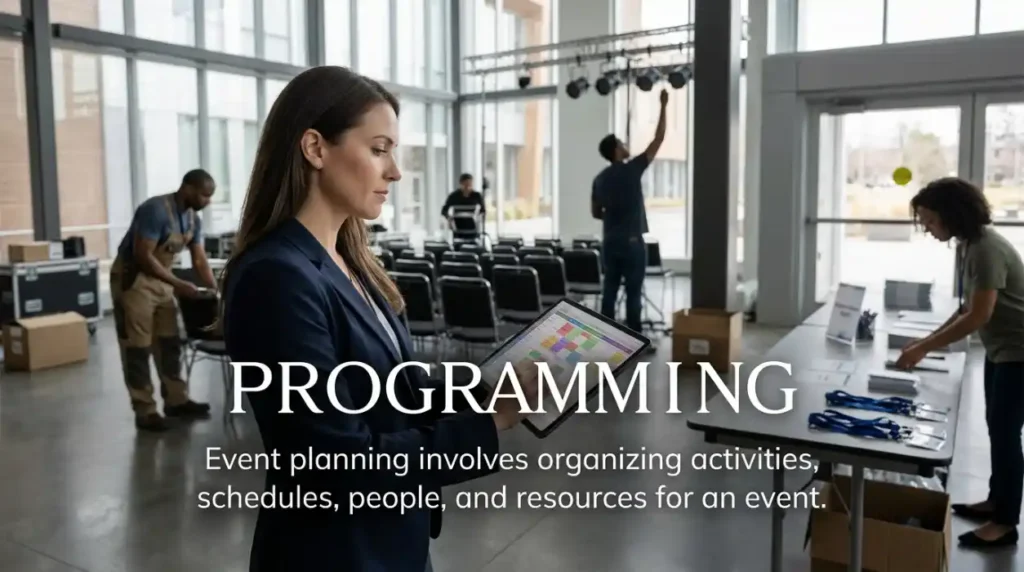
Meaning: Event planning involves organizing activities, schedules, people, and resources for an event.
Tone/Register: Professional, everyday.
Examples:
Event planning requires strong attention to timing.
Her job includes event planning for conferences.
41. Event Programming (Noun) — US /ɪˈvent ˈproʊɡræmɪŋ/ — UK /ɪˈvent ˈprəʊɡræmɪŋ/
Meaning: Event programming means selecting and arranging the activities included in an event.
Tone/Register: Professional, cultural.
Examples:
The festival has an exciting event programming schedule.
Event programming includes talks, performances, and workshops.
42. Content Curation (Noun) — US /ˈkɑːntent kjʊˈreɪʃən/ — UK /ˈkɒntent kjʊəˈreɪʃən/
Meaning: Content curation means selecting and organizing content for a particular audience or purpose.
Tone/Register: Professional, media-related.
Examples:
Content curation helps audiences discover useful material.
The museum uses careful content curation for its online collection.
43. Program Management (Noun) — US /ˈproʊɡræm ˈmænɪdʒmənt/ — UK /ˈprəʊɡræm ˈmænɪdʒmənt/
Meaning: Program management involves coordinating a group of related projects or activities toward shared goals.
Tone/Register: Business, professional.
Examples:
Program management requires clear communication.
She moved into program management after several years in project work.
44. Project Planning (Noun) — US /ˈprɑːdʒekt ˈplænɪŋ/ — UK /ˈprɒdʒekt ˈplænɪŋ/
Meaning: Project planning means deciding the tasks, resources, timing, and goals needed for a project.
Tone/Register: Professional, academic.
Examples:
Project planning helped the team meet its deadline.
We started project planning before assigning tasks.
45. Activity Planning (Noun) — US /ækˈtɪvəti ˈplænɪŋ/ — UK /ækˈtɪvəti ˈplænɪŋ/
Meaning: Activity planning involves deciding which activities will occur and how they will be organized.
Tone/Register: Neutral, educational.
Examples:
Activity planning is useful for classroom lessons.
The teacher completed activity planning before the new term.
46. Agenda Planning (Noun) — US /əˈdʒendə ˈplænɪŋ/ — UK /əˈdʒendə ˈplænɪŋ/
Meaning: Agenda planning means organizing the subjects or activities that will be covered during a meeting or event.
Tone/Register: Professional.
Examples:
Agenda planning kept the meeting focused.
The assistant handled agenda planning for the conference.
47. Lineup Planning (Noun) — US /ˈlaɪnʌp ˈplænɪŋ/ — UK /ˈlaɪnʌp ˈplænɪŋ/
Meaning: Lineup planning means deciding which people, performances, programs, or activities will appear in a scheduled sequence.
Tone/Register: Informal, media-related.
Examples:
The festival started lineup planning early.
Lineup planning helped balance music styles across the weekend.
48. Curriculum Planning (Noun) — US /kəˈrɪkjələm ˈplænɪŋ/ — UK /kəˈrɪkjələm ˈplænɪŋ/
Meaning: Curriculum planning involves deciding what students should learn and how lessons should be organized.
Tone/Register: Academic, educational.
Examples:
Curriculum planning takes student needs into account.
The school began curriculum planning for the next semester.
49. Instruction Design (Noun) — US /ɪnˈstrʌkʃən dɪˈzaɪn/ — UK /ɪnˈstrʌkʃən dɪˈzaɪn/
Meaning: Instruction design involves planning educational experiences and materials to support learning.
Tone/Register: Academic, professional.
Examples:
Instruction design can make complex lessons easier to understand.
She works in instructional design for online education.
50. Program Development (Noun) — US /ˈproʊɡræm dɪˈveləpmənt/ — UK /ˈprəʊɡræm dɪˈveləpmənt/
Meaning: Program development means creating, improving, or expanding an organized program or series of activities.
Tone/Register: Professional, broad.
Examples:
Program development began after the community survey.
The organization focuses on program development for young learners.
Synonyms by Tone
The best alternative depends on the tone and context of your sentence.
Positive or Skill-Focused
These choices can highlight creativity, expertise, or productive work:
- Coding
- Software development
- Software engineering
- Software creation
- Application development
- Code creation
- Web development
For example, software development sounds broader and more professional than simply saying coding.
Neutral
These work well in ordinary explanations:
- Programming
- Computer programming
- Computer coding
- Development
- Planning
- Scheduling
- Organizing
- Arranging
- Coordination
Neutral choices are useful when you want clarity without adding a strong emotional impression.
Negative or Critical
Programming itself is not normally negative. Context creates the negative feeling.
Words such as rigid scheduling, over-structuring, or mechanical planning may criticize a process, but they should not be treated as direct synonyms for programming.
Playful or Informal
In casual technology conversations, people may say:
- Coding
- Coding work
- Software work
- Scripting
- Code writing
These choices sound more conversational than highly academic terms.
Why Tone Matters When Choosing a Synonym
A synonym can change how your sentence feels.
Consider these examples:
I am doing some coding tonight.
This sounds casual and natural.
I am working on software development tonight.
This sounds broader and more professional.
I am handling software engineering tasks.
This suggests a more structured technical role.
The basic idea may overlap, but the register changes. Choosing the right word makes your writing more precise.
“Programming” vs. Close Alternatives
| Word | Main Difference | Best Use |
|---|---|---|
| Programming | Writing instructions that computers execute | General technology discussions |
| Coding | Writing code, often with emphasis on the actual code | Casual and technical conversations |
| Software Development | Broader process involving coding, testing, design, and maintenance | Professional writing |
| Software Engineering | Systematic approach to building reliable software | Academic and professional contexts |
Coding vs Programming
Programming is slightly broader. It can include planning logic, testing, debugging, and maintaining code.
Coding focuses more directly on writing the code itself.
Programming vs Software Development
Software development includes programming but can also involve design, testing, documentation, deployment, and maintenance.
Programming vs Software Engineering
Software engineering emphasizes structured methods, reliability, scalability, and long-term software quality.
How “Programming” Changes by Context
Daily Conversation
In everyday speech, coding is often a natural alternative to programming.
“What are you working on?”
“I am coding a small website.”
The shorter word feels relaxed and conversational.
Writing and Blogging
Bloggers should choose the word that matches the exact topic.
Coding when discussing the act of writing code.
Software development when discussing the wider process of creating software.
Web development when the topic specifically involves websites or web applications.
This distinction makes technology articles clearer for readers.
Professional or Academic Writing
Professional and academic writing often benefits from precise terminology.
For example, software engineering, application development, algorithm design, and software implementation can communicate specific technical ideas.
Avoid replacing every use of programming with a complicated phrase. Precision matters more than sounding technical.
Creative or Informal Use
Casual writing can use coding, scripting, or code writing.
A technology blogger might write:
“I spent Saturday coding a simple game.”
That sentence feels more natural than:
“I spent Saturday engaging in computer programming activities.”
Simple language usually sounds more human.
Common Mistakes Learners Make
Mistake 1: Treating Every Alternative as an Exact Synonym
Coding and programming overlap, but they are not always identical.
Similarly, software development is broader than programming.
Choose the word that describes the actual activity.
Mistake 2: Using “Computer Science” as a Direct Replacement
Computer science is a field of study. Programming is a skill or activity within that field.
Correct: “She studies computer science and practices programming.”
Do not automatically replace one with the other.
Mistake 3: Confusing Programming With Planning
In technology, programming usually means creating computer instructions.
In event or media contexts, programming can relate to selecting and scheduling content.
Always check the surrounding context.
Mistake 4: Overusing Technical Terms
Words such as algorithm design and software engineering sound precise, but they should only appear when they describe the intended meaning.
Using them unnecessarily can make simple writing harder to understand.
Register Notes
Formal
Use:
- Software engineering
- Software development
- Program management
- Software implementation
- Algorithm design
Neutral
Use:
- Programming
- Coding
- Planning
- Scheduling
- Development
- Organizing
Informal
Use:
- Coding
- Coding work
- Software work
- Scripting
Spoken English
Coding is especially natural in casual conversations about technology.
Written English
Programming, software development, and more specific technical terms work well in articles, academic writing, and professional documents.
For related vocabulary pages, you can also use one relevant internal link to connect readers with another synonym guide on your website.
Real-Life Scenarios Using “Programming”

Workplace
A developer tells a colleague:
“I finished the programming for the new feature.”
The colleague could say coding if they mean the actual code-writing work.
Social Situation
Someone asks a friend what they study:
“I study computer science, and I really enjoy programming.”
Here, programming clearly describes the practical activity of creating computer instructions.
Media and Entertainment
A television producer might discuss the week’s programming schedule.
Here, programming refers to planned broadcast content rather than computer code.
Education
A teacher may introduce programming to students through small exercises.
In this context, computer programming makes the meaning especially clear.
Practice Exercise
Choose the best answer for each situation. Do not check the answer key until you finish.
1. Which word best describes writing instructions in Python?
A. Coding
B. Scheduling
C. Coordination
D. Curation
2. Which term is broader than simply writing code?
A. Code writing
B. Software development
C. Scripting
D. Coding
3. A television station decides when each show will air. What is this called?
A. Algorithm design
B. Software engineering
C. Broadcast scheduling
D. Code creation
4. Which term is most appropriate for an academic field involving algorithms and computation?
A. Coding work
B. Computer science
C. Event planning
D. Lineup planning
5. Someone writes scripts to automate repetitive computer tasks. Which term fits best?
A. Scripting
B. Curriculum planning
C. Program management
D. Content curation
6. Which term best describes organizing educational content for students?
A. Code implementation
B. Broadcast scheduling
C. Curriculum planning
D. Software construction
7. Which word sounds natural in a casual sentence about writing code?
A. Coding
B. Program management
C. Instruction design
D. Software implementation
8. Which term emphasizes systematic software creation and reliability?
A. Scheduling
B. Software engineering
C. Arranging
D. Activity planning
9. A company decides what tasks will happen, when they will happen, and who will handle them. What is this?
A. Project planning
B. Coding
C. Scripting
D. Computer science
10. Which term specifically refers to turning a software design into working code?
A. Content planning
B. Code implementation
C. Event programming
D. Organization
Answer Key:
1-A | 2-B | 3-C | 4-B | 5-A | 6-C | 7-A | 8-B | 9-A | 10-B
Reflection Task:
Write one sentence using coding, software development, scheduling, or another alternative from the list. Then explain why that word fits your context better than programming.
FAQs
1. What is the closest synonym for programming in computer science?
The closest everyday synonym is usually coding because both words can refer to creating computer instructions. However, they are not always identical. Programming can include planning, debugging, testing, and maintaining software, while coding often focuses specifically on writing code. In academic or professional contexts, computer programming is also a clear and precise alternative.
2. Is coding the same as programming?
Coding and programming overlap, but they are not the same. Coding usually means writing instructions in a programming language. Programming can describe the broader activity of developing a working solution, including planning logic, testing, debugging, and maintenance. In casual conversation, however, native speakers often use the two terms interchangeably.
3. What can I say instead of programming in a resume?
The best replacement depends on your actual responsibilities. Software development, software engineering, application development, web development, or computer programming may be appropriate when they accurately describe your work. Avoid choosing a more advanced-sounding term simply for impact. A precise description of your real responsibilities is clearer and more professional.
4. What is another word for programming skills?
Depending on the context, you can use phrases such as coding skills, software development skills, computer programming skills, or software engineering skills. The choice should match the ability being discussed. For example, coding skills work well for writing code, while software development skills can include design, testing, and maintenance.
5. What is a synonym for programming in television?
In television, broadcast scheduling, program planning, content planning, or programming schedule may fit depending on the intended meaning. In this context, programming can refer to selecting, arranging, and scheduling shows for an audience. It does not normally refer to writing computer code.
6. What is a simple synonym for programming for students?
Coding is usually the simplest alternative when students are learning to create computer instructions. Computer programming is another clear choice, especially in educational material. If the lesson covers a wider software-development process, terms such as software development may be more appropriate.
7. What is the difference between programming and software development?
Programming mainly involves creating instructions that computers can execute. Software development is broader. It can include requirements, planning, design, programming, testing, deployment, documentation, and maintenance. Therefore, programming can be part of software development, but software development involves more than programming alone.
Suggested External Source:
Cambridge Dictionary is useful for checking definitions, pronunciation, word forms, and usage examples.
Conclusion
Choosing a synonym for programming helps you communicate with greater accuracy. Coding fits casual technology talk, while software development suits broader professional contexts.
The right vocabulary also improves blogs, essays, technical writing, and everyday speech. Small word choices can make your message clearer and more natural.
Practice alternatives such as coding, scripting, scheduling, and software development in real sentences. Notice how each one changes the meaning or tone.
Keep building your vocabulary by using these words in emails, essays, blog posts, and daily conversations. Regular practice makes precise English easier and more natural.

Jameel Hassan is the founder and lead writer at SynonymsCloud.com, a trusted online platform dedicated to English vocabulary and effective communication. He is passionate about helping students, writers, professionals, and lifelong learners discover the right words to express their ideas with clarity, precision, and confidence.
At SynonymsCloud.com, every article is thoroughly researched and carefully written to provide accurate, practical, and easy-to-understand guidance on synonyms, antonyms, word meanings, idioms, and vocabulary. With a strong commitment to quality, real-world usage, and clear explanations, the website helps readers expand their vocabulary, improve their writing, and communicate more effectively in both academic and professional settings.