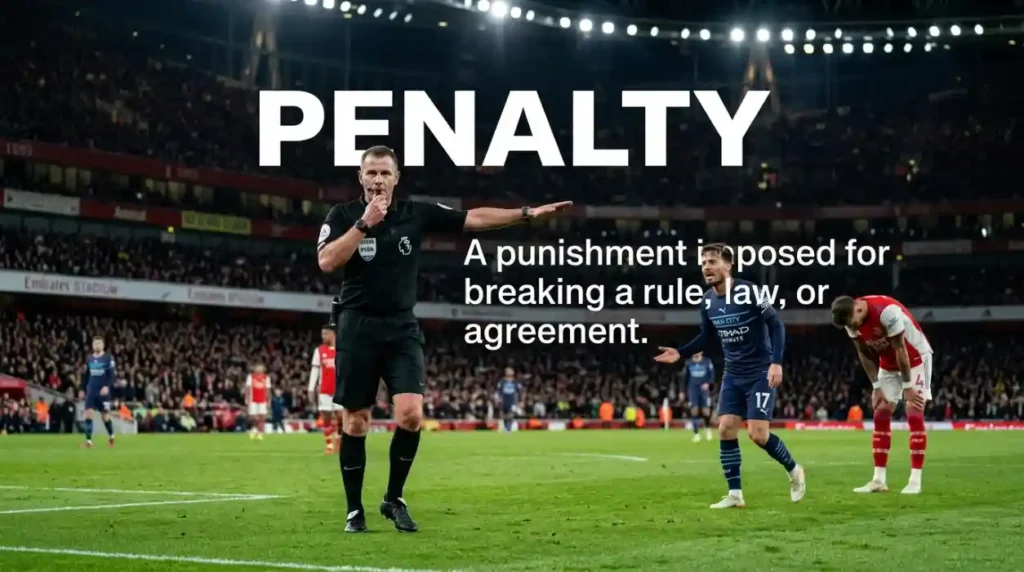
Top synonyms for penalty include fine, punishment, sanction, forfeit, and fee. Choose fine or late fee for monetary charges, sanction for formal legal or political restrictions, forfeit for sports or contract losses, and punishment for general disciplinary consequences. Select the term matching your specific financial, legal, or competitive context.
A synonym for penalty helps you describe legal fines, sports fouls, financial charges, and other consequences with greater precision. Choosing the right alternative can make your writing clearer and more specific.
Imagine a competitive soccer player receiving a red card after a late tackle, leaving the team with one fewer player for the rest of the match. In this context, terms such as punishment, sanction, or infraction may describe different aspects of the situation.
Finding a strong synonym for penalty allows writers, bloggers, and students to explain various consequences without repeating the same familiar phrase. The ideal word depends on the context and intended meaning.
This useful term appears frequently in legal contracts, sports commentary, tax documents, business discussions, and everyday communication. Understanding related words can help you express consequences naturally and confidently.
What Does “Penalty” Really Mean?
The noun penalty refers to a punishment, fine, or disadvantage imposed for breaking a rule, contract, or law.
Native English speakers understand “penalty” across three main settings. In law, it refers to court fines or jail time. In finance, it describes extra fees for late payments. Within sports, it means a disadvantage given to a team for a rule violation.
You will encounter this term in traffic violations, banking agreements, athletic competitions, and corporate compliance documents.
Part of Speech:
Noun
Simple Definition:
A punishment or extra charge imposed for violating a rule, law, or contract.
Connotative Meaning
Connotation refers to the secondary emotional, cultural, or social association attached to a word beyond its strict literal dictionary definition.
- Positive tone: Rarely positive, but can imply justice, order, fair play, or accountability (e.g., “restitution,” “just retribution”).
- Negative tone: Implies harsh financial loss, strict punishment, suffering, or burdensome loss (e.g., “castigation,” “forfeiture”).
- Neutral tone: Refers strictly to standard administrative rules, contractual terms, or game mechanics (e.g., “assessment,” “deduction”).
Etymology
- Origin: Derived from Anglo-French penalite and Medieval Latin poenalitas, coming from Latin poenalis (poena meaning “punishment” or “fine”).
- Old English (450–1100): No direct form existed; Old English speakers used terms like wite (fine or punishment) or scyld (guilt/debt).
- Middle English (1100–1500): Evolved into terms like paine or penance under French legal influence following the Norman Conquest.
- Modern English (1500–Present): Adopted into formal legal and athletic English by the 16th century to denote specific official sanctions.
Pronunciation & Syllables
- US IPA: /ˈpɛnəlti/
- UK IPA: /ˈpɛnl̩ti/
- Syllables: pen-al-ty (3 syllables)
- Affixation Pattern: Root with noun suffix
- Root: penal (punishment)
- Prefix: None
- Suffix: ty (noun suffix denoting state or quality)
Synonyms List
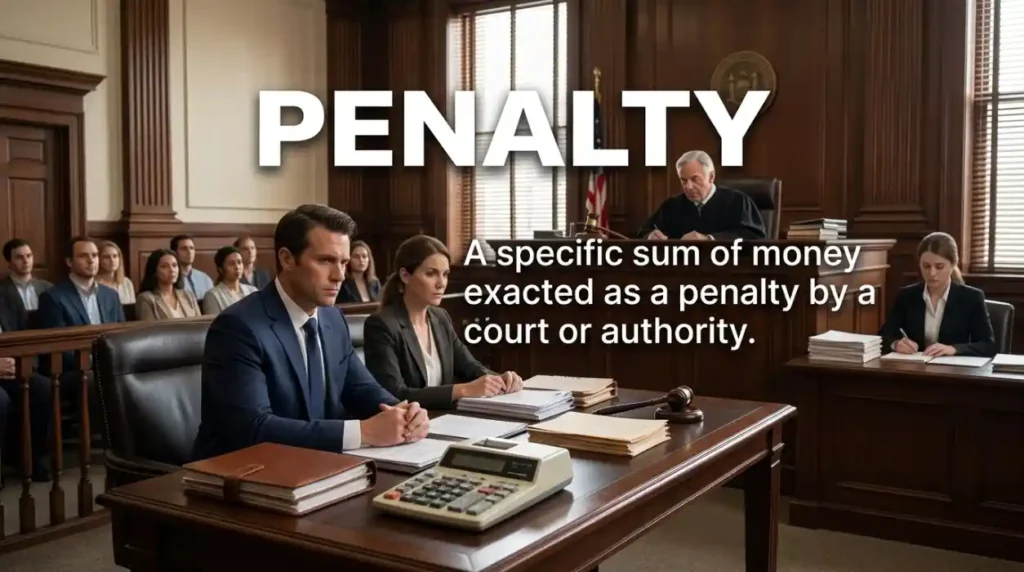
1. Fine (Noun)
Meaning: A specific sum of money exacted as a penalty by a court or authority.
Tone/Register: Legal / Financial
Examples:
- The driver had to pay a heavy fine for parking in front of the fire hydrant.
- The city council imposed a fine on the factory for improper waste disposal.
2. Punishment (Noun)
Meaning: The imposition of an undesirable outcome upon a group or individual for wrongdoing.
Tone/Register: General / Standard
Examples:
- Losing phone privileges was a fair punishment for breaking house rules.
- Courts determine the appropriate punishment based on the severity of the crime.
3. Forfeit (Noun)
Meaning: Something that is lost or surrendered as a penalty for a fault or mistake.
Tone/Register: Formal / Sports
Examples:
- Missing the team weigh in resulted in an immediate forfeit of the match.
- The contractor agreed that losing the deposit was a fair forfeit for delay.
4. Sanction (Noun)
Meaning: A threatened penalty for disobeying a law, rule, or international agreement.
Tone/Register: Formal / Political
Examples:
- International bodies applied trade sanctions against the offending nation.
- The league announced strict sanctions against athletes using banned substances.
5. Fee (Noun)
Meaning: A payment required as a penalty for late submission or breach of agreement.
Tone/Register: Financial / Business
Examples:
- The bank charged a late fee because the mortgage payment arrived behind schedule.
- Homeowners face a cancellation fee if they end the contract early.
6. Loss (Noun)
Meaning: The disadvantage or deprivation resulting from a rule infraction.
Tone/Register: General / Sports
Examples:
- The team suffered a loss of down after committing a false start.
- Careless errors led to the loss of his security clearance at work.
7. Discipline (Noun)
Meaning: Corrective action or punishment administered to maintain order and control.
Tone/Register: Professional / Educational
Examples:
- School administrators handle student discipline according to official policy.
- Military units maintain strict internal discipline through clear regulations.
8. Surcharge (Noun)
Meaning: An additional charge or payment added as a penalty or tax.
Tone/Register: Financial / Business
Examples:
- Passengers paid an extra surcharge for booking tickets at the last minute.
- The utility company added a surcharge for excessive water consumption.
9. Disability(Noun)
Meaning: A disadvantage imposed on a competitor to equalize chances of winning.
Tone/Register: Sports / Gaming
Examples:
- Carrying extra weight served as a disability for the top racehorse.
- The tournament assigned a disability based on previous player rankings.
10. Retribution (Noun)
Meaning: Punishment inflicted on someone as vengeance for a wrong or criminal act.
Tone/Register: Literary / Formal
Examples:
- Victims sought legal retribution for the harm caused by the fraud scheme.
- The story explores themes of moral retribution against greedy villains.
11. Sentence (Noun)
Meaning: The punishment assigned to a defendant found guilty by a court.
Tone/Register: Legal / Formal
Examples:
- The judge handed down a three-year sentence for financial theft.
- He completed his community service sentence over the summer months.
12. Dues (Noun)
Meaning: Required charges or consequences owed as a result of past actions.
Tone/Register: Informal / Figurative
Examples:
- After years of hard labor, he felt he had finally paid his dues.
- Facing public criticism was part of the dues for his mistakes.
13. Castigation (Noun)
Meaning: Severe reprimand, harsh criticism, or formal punishment.
Tone/Register: Academic / Critical
Examples:
- The director faced public castigation after the project failed.
- His harsh castigation of the staff caused low workplace morale.
14. Chastisement (Noun)
Meaning: The act of scolding, rebuking, or punishing someone sternly.
Tone/Register: Formal / Literary
Examples:
- The child received verbal chastisement for running across the busy street.
- Historical records detail physical chastisement used in ancient schools.
15. Reprimand (Noun)
Meaning: A formal expression of disapproval or official rebuke.
Tone/Register: Professional / Business
Examples:
- The manager issued a written reprimand to the tardy employee.
- She received an official reprimand for leaking internal memos.
16. Penalty point (Noun)
Meaning: A mark placed against a driver or competitor for a minor infraction.
Tone/Register: Administrative / Driving
Examples:
- Speeding added three penalty points to his driving license.
- Accumulating too many penalty points leads to a temporary driving suspension.
17. Red card (Noun)
Meaning: A dismissal penalty issued by a referee in sports for serious misconduct.
Tone/Register: Sports / Informal
Examples:
- The defender received a red card for a dangerous tackle near the goal.
- Getting a red card means missing the next upcoming match.
18. Demerit (Noun)
Meaning: A mark awarded against someone for fault, misconduct, or poor work.
Tone/Register: Educational / Administrative
Examples:
- Students receive a demerit for wearing incomplete school uniforms.
- Too many demerits can prevent a student from joining field trips.
19. Assessment (Noun)
Meaning: An amount levied as a fine, tax, or mandatory payment.
Tone/Register: Financial / Legal
Examples:
- Property owners faced a special assessment for street repairs.
- The tax authority issued an additional assessment after the audit.
20. Payment (Noun)
Meaning: A required financial outlay exacted as compensation for an error.
Tone/Register: Business / Neutral
Examples:
- The court ordered a direct payment to cover damage to the vehicle.
- Making a settlement payment resolved the dispute out of court.
21. Deduction (Noun)
Meaning: An amount subtracted from a total score or salary as a penalty.
Tone/Register: Technical / Administrative
Examples:
- Gymnasts face a score deduction for stepping outside the floor area.
- Unexcused absences lead to a pay deduction at the end of the month.
22. Damages (Noun)
Meaning: A sum of money claimed or awarded in court to compensate for harm.
Tone/Register: Legal / Professional
Examples:
- The company paid substantial damages for breaching the supply contract.
- The jury awarded financial damages to the injured party.
23. Amercement (Noun)
Meaning: A discretionary financial penalty imposed by a court in historical law.
Tone/Register: Historical / Legal
Examples:
- Medieval records document the amercement paid by the merchant.
- Courts used amercement to punish minor civil infractions in the past.
24. Penalty fee (Noun)
Meaning: A specific monetary charge applied for violating contractual conditions.
Tone/Register: Business / Financial
Examples:
- The gym charges a penalty fee for breaking a membership contract early.
- You can avoid a penalty fee by paying your bill on time.
25. Cost (Noun)
Meaning: The negative consequence, loss, or price paid for a mistake.
Tone/Register: Everyday / Figurative
Examples:
- The personal cost of his dishonesty was the loss of his best friends.
- High repair fees were the direct cost of ignoring car maintenance.
26. Disadvantage (Noun)
Meaning: An unfavorable condition imposed on a participant due to an infraction.
Tone/Register: General / Competitive
Examples:
- Starting from the back row was a major disadvantage for the driver.
- Late arrival put the team at a distinct disadvantage during debate.
27. Disqualification (Noun)
Meaning: The act of taking away a competitor’s right to participate due to a foul.
Tone/Register: Sports / Official
Examples:
- A false start led to the runner’s immediate disqualification from the sprint.
- Using illegal equipment resulted in complete disqualification.
28. Suspension (Noun)
Meaning: Temporary removal from a job, school, or sport as a punishment.
Tone/Register: Professional / Educational
Examples:
- The player served a two-game suspension for unsportsmanlike conduct.
- The employee faced suspension pending an investigation into missing funds.
29. Expulsion (Noun)
Meaning: The permanent removal of a person from an institution or group as a penalty.
Tone/Register: Formal / Academic
Examples:
- Vandalism on campus resulted in the student’s immediate expulsion.
- The board voted for the expulsion of the corrupt member.
30. Ban (Noun)
Meaning: An official prohibition or bar placed on an individual or activity.
Tone/Register: General / Media
Examples:
- The league issued a lifetime ban on gambling on games.
- Drivers face an automatic ban if caught operating a car while intoxicated.
31. Imposition (Noun)
Meaning: The act of laying on a tax, duty, fine, or burdensome penalty.
Tone/Register: Formal / Legal
Examples:
- Small business owners protested the imposition of new environmental fines.
- The judge justified the imposition of a severe sentence.
32. Rebuking (Noun)
Meaning: An expression of sharp disapproval or official reprimand.
Tone/Register: Formal / Critical
Examples:
- The senator received a public rebuking for inappropriate comments.
- An official rebuking followed the discovery of accounting errors.
33. Penalty charge (Noun)
Meaning: An extra sum of money demanded for failing to follow a rule.
Tone/Register: Commercial / Banking
Examples:
- Parking over the allowed time limit triggers a penalty charge notice.
- The train company levies a penalty charge on passengers without tickets.
34. Tariff (Noun)
Meaning: A tax or prohibitive charge imposed on imported goods as a policy measure.
Tone/Register: Political / Business
Examples:
- The government placed a protective tariff on foreign steel imports.
- High tariff rates act as an economic penalty against rival nations.
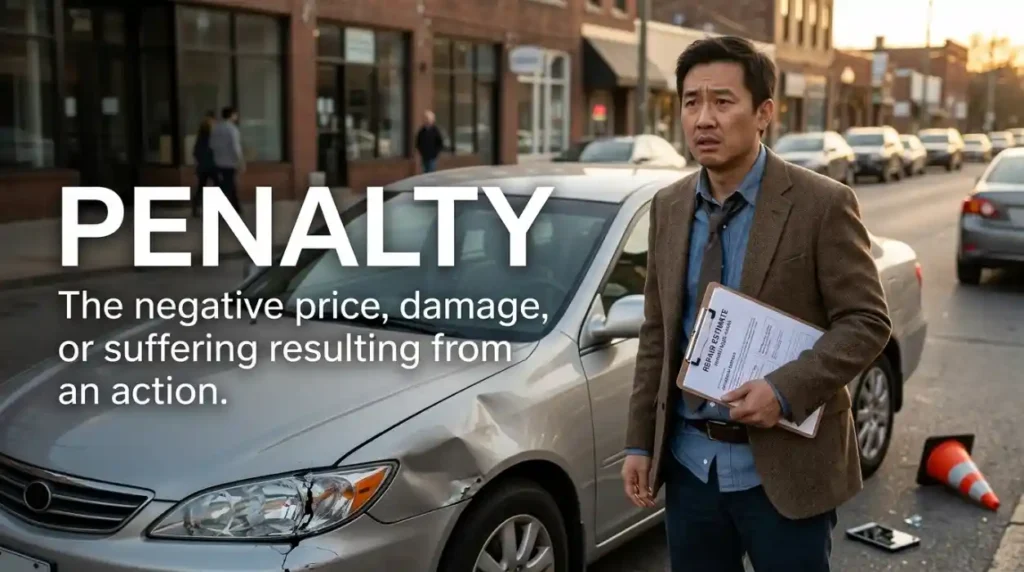
35. Toll (Noun)
Meaning: The negative price, damage, or suffering resulting from an action.
Tone/Register: Descriptive / Media
Examples:
- Long working hours took a heavy emotional toll on his health.
- The economic toll of the storm reached millions of dollars.
36. Loss of privileges (Noun)
Meaning: The removal of special rights or perks as a disciplinary action.
Tone/Register: Educational / Parental
Examples:
- Grounding involved a total loss of privileges for two weeks.
- Misbehavior on the bus led to a loss of privileges for students.
37. Penalty kick (Noun)
Meaning: A free shot at goal awarded in soccer following a foul in the penalty area.
Tone/Register: Sports / Specific
Examples:
- The striker scored easily from the penalty kick in the final minutes.
- A handball inside the box gave the away team a penalty kick.
38. Foul consequence (Noun)
Meaning: The penalty resulting from an illegal move in a sport or game.
Tone/Register: Sports / Informal
Examples:
- Pushing an opponent carries a clear foul consequence in basketball.
- Players must accept the foul consequence when stepping out of bounds.
39. Legal remedy (Noun)
Meaning: The legal order or financial penalty used to enforce a right.
Tone/Register: Legal / Formal
Examples:
- Seeking a legal remedy helped the homeowner recover repair costs.
- Financial compensation served as the primary legal remedy.
40. Restitution (Noun)
Meaning: Recompense for injury or loss paid by an offender to a victim.
Tone/Register: Legal / Formal
Examples:
- The court required full restitution to replace the stolen property.
- Paying restitution allowed the offender to avoid prison time.
41. Compensation charge (Noun)
Meaning: A mandatory payment required to cover damages caused by fault.
Tone/Register: Corporate / Financial
Examples:
- The airline paid a compensation charge for lost baggage.
- Customers received a compensation charge credit after power outages.
42. Penance (Noun)
Meaning: An act performed as a punishment to show repentance for a fault.
Tone/Register: Literary / Religious
Examples:
- Cleaning the community park was his self-imposed penance for rudeness.
- The novel depicts a character performing penance for past errors.
43. Default fee (Noun)
Meaning: A charge imposed when a party fails to fulfill a contractual obligation.
Tone/Register: Banking / Legal
Examples:
- Failing to meet the loan deadline incurred an immediate default fee.
- Credit card companies apply a default fee for returned payments.
44. Overdue fee (Noun)
Meaning: A small fine charged for keeping borrowed items past the due date.
Tone/Register: Casual / Administrative
Examples:
- Returning books late to the library incurs a minor overdue fee.
- The rental company calculates the overdue fee on a daily basis.
45. Cancellation fee (Noun)
Meaning: A charge levied when a reservation or service contract is terminated early.
Tone/Register: Commercial / Everyday
Examples:
- Canceling the hotel booking twenty minutes prior resulted in a cancellation fee.
- The flight ticket included a non-refundable cancellation fee clause.
46. Shortage penalty (Noun)
Meaning: A fine charged when delivered goods fall below promised quantities.
Tone/Register: Logistics / Trade
Examples:
- The supplier paid a shortage penalty for missing delivery targets.
- Contracts specify a shortage penalty to ensure reliable inventory.
47. Stricture (Noun)
Meaning: A severe adverse criticism, restriction, or official censure.
Tone/Register: Formal / Academic
Examples:
- The report contained harsh strictures on government spending habits.
- Professional ethics boards apply strictures to disreputable members.
48. Condemnation (Noun)
Meaning: An expression of strong disapproval or official judicial sentencing.
Tone/Register: Formal / Political
Examples:
- The illegal invasion met with swift international condemnation.
- Public condemnation forced the official to resign from his position.
49. Detriment (Noun)
Meaning: A state of being harmed, damaged, or disadvantaged as a consequence.
Tone/Register: Formal / Professional
Examples:
- Working without rest proved to be a detriment to his health.
- Cheating on tests works to the ultimate detriment of student learning.
50. Tax (Noun)
Meaning: A heavy physical, mental, or financial burden imposed by circumstance.
Tone/Register: Figurative / General
Examples:
- Stress acts as an invisible tax on your immune system.
- Constant travel was a heavy tax on his family life.
51. Penalty box (Noun)
Meaning: An area in ice hockey where players sit to serve penalty time.
Tone/Register: Sports / Specific
Examples:
- The defender spent two minutes in the penalty box for tripping.
- Playing short-handed while a teammate is in the penalty box is tough.
52. Offside penalty (Noun)
Meaning: A distance or possession loss awarded for illegal player positioning.
Tone/Register: Sports / Specific
Examples:
- An offside penalty wiped out the touchdown play in football.
- The linesman flagged the forward, resulting in an offside penalty.
53. Warning point (Noun)
Meaning: An official mark recorded against a player or driver before suspension.
Tone/Register: Administrative / General
Examples:
- Tennis players receive a warning point for racket abuse on court.
- Accruing a second warning point results in losing a game.
54. Correction (Noun)
Meaning: A disciplinary measure intended to fix bad behavior or performance.
Tone/Register: Educational / Administrative
Examples:
- The supervisor offered constructive correction after the error.
- Early correction helps young athletes build proper safety habits.
55. Seizure (Noun)
Meaning: The legal taking of property by police or court order as a penalty.
Tone/Register: Legal / Law Enforcement
Examples:
- Police ordered the seizure of illegal goods at the border.
- Asset seizure remains a common penalty for money laundering.
56. Confiscation (Noun)
Meaning: The act of taking property away permanently as a punishment.
Tone/Register: Official / Legal
Examples:
- Bringing prohibited items into the exam room led to confiscation.
- Customs officials ordered the confiscation of smuggled electronics.
57. Impoundment (Noun)
Meaning: The legal towing and holding of a vehicle for traffic violations.
Tone/Register: Law Enforcement / Legal
Examples:
- Parking in a disability zone without a permit caused vehicle impoundment.
- Owners must pay storage fees to release their car from impoundment.
58. Forfeiture (Noun)
Meaning: The loss of property, rights, or money as a penalty for wrongdoing.
Tone/Register: Legal / Formal
Examples:
- The contract required the total forfeiture of the initial deposit.
- A criminal conviction resulted in the forfeiture of all illegal profits.
59. Execution (Noun)
Meaning: The carrying out of a judicial death sentence or legal decree.
Tone/Register: Legal / Extreme
Examples:
- Historical legal texts document the execution of severe treason laws.
- The court stayed the execution of the property seizure order.
60. Penalty stroke (Noun)
Meaning: An extra score stroke added to a golfer’s tally for a rule infraction.
Tone/Register: Sports / Specific
Examples:
- Hitting the ball into the water hazard incurred a penalty stroke.
- A penalty stroke dropped the golfer down to second place.
Synonyms by Tone
Grouping synonyms by tone ensures your choice fits your communication context perfectly:
Positive / Restorative Tone
- Restitution
- Recompense
- Correction
- Legal remedy
- Rebuilding
Neutral / Financial / Official Tone
- Assessment
- Deduction
- Fee
- Surcharge
- Penalty charge
Legal / Formal / Harsh Tone
- Sanction
- Forfeiture
- Confiscation
- Sentence
- Castigation
Playful / Informal / Sports Tone
- Red card
- Penalty box
- Overdue fee
- Demerit
- Disability
Why Tone Matters:
Choosing the correct tone avoids confusion. Calling a small library late fee a “harsh sanction” sounds overly dramatic, whereas calling a court-ordered fine a “simple fee” understates legal reality!
Mini Comparison
| Word | Core Meaning Focus | Tone & Register | Ideal Usage Context |
| Penalty | Broad punishment, fine, or disadvantage for breaking rules | General / Official | Legal contracts, sports fouls, banking rules |
| Fine | Specific sum of money exacted as punishment by authority | Legal / Financial | Traffic tickets, court judgments, municipal violations |
| Sanction | Formal coercive measure or restriction applied by bodies | Political / Formal | International trade disputes, professional board rulings |
Context-Based Usage
Daily Conversation
In casual speech, stick to relatable terms like fee, red card, fine, or late charge when discussing minor infractions.
Writing or Blogging
Bloggers engage readers by picking vivid words like forfeiture, demerit, toll, or setback.
Professional or Academic Tone
Use formal legal vocabulary such as sanction, assessment, restitution, confiscation, or damages in business documents.
Creative Writing
Authors build dramatic tension using intense descriptive words like retribution, chastisement, castigation, or penance.
Common Mistakes & Native Usage

Misuse Scenarios
- Confusing “Fine” and “Fee”: A fine is a punishment for breaking a rule. A fee is a standard price paid for a service (though late fees bridge both).
- Using Sports Terms in Legal Contexts: Calling a legal injunction a “red card” in a formal court document sounds unprofessional.
- Overusing the Word “Penalty”: Repeating “penalty” multiple times in a single agreement makes writing dry. Rotate with deduction or assessment.
Register Notes
- Use formal terms (sanction, forfeiture) in legal contracts.
- Use direct terms (late fee, overdue charge) in customer correspondence.
- Explore our vocabulary guide on formal business terminology for deeper learning.
Real-Life Mini Scenarios
- Workplace: HR applied a pay deduction after the employee arrived late three consecutive times.
- Social Situations: He paid an overdue fee after returning his rented tuxedo two days late.
- Media / Pop Culture: Sports analysts debated whether the referee’s red card decision changed the outcome of the match.
- Writing & Storytelling: The lawyer demanded full financial restitution for the damages suffered by his client.
Conclusion
Learning a synonym for penalty gives you more precise ways to discuss fines, punishments, sports consequences, financial charges, and legal sanctions. Selecting the right alternative can make your writing clearer and help readers understand the exact situation.
A broader vocabulary is useful when preparing contracts, sports reports, academic essays, financial articles, business documents, or everyday messages. Words such as fine, sanction, punishment, forfeiture, and consequence can carry different meanings, so understanding their context helps you make better word choices.
Practice these alternatives by using two or three new terms in your next email, report, essay, or study session. Regular practice can strengthen your vocabulary, reduce repetition, improve sentence variety, and help you communicate ideas with greater accuracy and confidence.
Practice Exercise
Test your understanding of meaning, tone, and context with these practical questions.
1. Which word refers specifically to a sum of money ordered by a court as punishment?
A) Penalty box
B) Fine
C) Red card
D) Disability
2. What term best describes trade restrictions placed by one country on another?
A) Overdue fee
B) Demerit
C) Penalty kick
D) Sanction
3. Which informal sports term refers to sending a soccer player off the field?
A) Surcharge
B) Restitution
C) Red card
D) Amercement
4. What legal word means taking property away permanently as a penalty?
A) Toll
B) Warning point
C) Assessment
D) Confiscation
5. Which word describes paying money back to a victim to cover their loss?
A) Forfeit
B) Demerit
C) Castigation
D) Restitution
6. What term applies to a score reduction in gymnastics for stepping out of bounds?
A) Deduction
B) Tariff
C) Reprimand
D) Sentence
7. Which commercial term describes an extra charge for paying a bill late?
A) Penance
B) Chastisement
C) Late fee
D) Execution
8. What formal term refers to an official written expression of workplace disapproval?
A) Impoundment
B) Toll
C) Surcharge
D) Reprimand
9. Which word describes taking away a car by police for illegal parking?
A) Restitution
B) Impoundment
C) Demerit
D) Tariff
10. What literary word refers to severe punishment inflicted as vengeance for wrongdoing?
A) Assessment
B) Surcharge
C) Deduction
D) Retribution
Reflection Task:
Write two original sentences describing a sports foul or a business late charge using two new synonyms learned today.
Answer Key:
1B | 2D | 3C | 4D | 5D | 6A | 7C | 8D | 9B | 10D
Frequently Asked Questions
1. What is the most common synonym for penalty?
The most common and versatile synonym for “penalty” is “punishment” in general contexts, “fine” in legal settings, and “fee” or “surcharge” in financial agreements.
2. Is there a difference between a fine and a penalty?
Yes. A “fine” specifically refers to a monetary punishment imposed by a court or governing body, while a “penalty” is a broader term that can include non monetary punishments like loss of privileges, suspensions, or physical forfeits.
3. What is a good casual synonym for penalty in everyday speech?
In daily conversation, simple words like “fine,” “charge,” “extra fee,” or “slap on the wrist” work best, while sports fans often use terms like “foul,” “call,” or “red card.”
4. What word describes a financial penalty in business contracts?
In commercial contracts, financial penalties are usually termed “liquidated damages,” “penalty fees,” “default charges,” or “cancellation fees.”
5. Can “penalty” be used positively?
While “penalty” inherently describes a negative consequence, words like “restitution” or “recompense” emphasize the positive, fair, and restorative outcome of enforcing a penalty.
6. What synonym for penalty should I use in academic or legal writing?
In academic or legal writing, precise terms like “sanction,” “assessment,” “forfeiture,” “restitution,” or “statutory damages” provide maximum clarity and professional authority.

Jameel Hassan is the founder and lead writer at SynonymsCloud.com, a trusted online platform dedicated to English vocabulary and effective communication. He is passionate about helping students, writers, professionals, and lifelong learners discover the right words to express their ideas with clarity, precision, and confidence.
At SynonymsCloud.com, every article is thoroughly researched and carefully written to provide accurate, practical, and easy-to-understand guidance on synonyms, antonyms, word meanings, idioms, and vocabulary. With a strong commitment to quality, real-world usage, and clear explanations, the website helps readers expand their vocabulary, improve their writing, and communicate more effectively in both academic and professional settings.