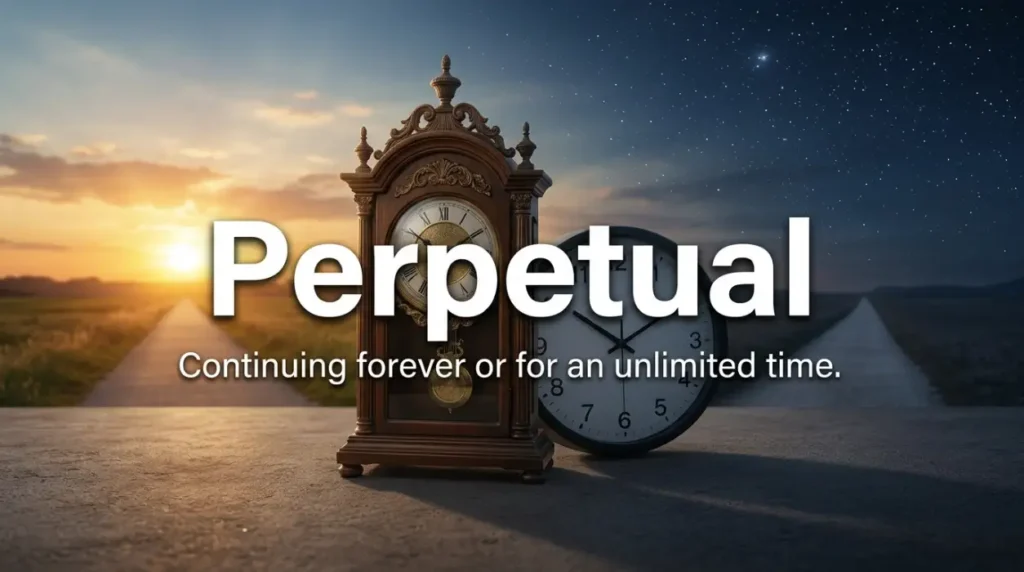
A synonym for perpetual is a word that describes something continuing forever, without ending, or happening repeatedly for a long time. Common alternatives include eternal, everlasting, endless, unending, continual, ceaseless, constant, permanent, and perennial.
A synonym for perpetual can make your writing sound more precise when something seems to continue without an end. Imagine a student facing a perpetual stream of assignments.
A blogger may describe a perpetual trend that keeps returning online. Choosing the right alternative can make the sentence clearer, more natural, and more engaging.
The word perpetual is useful for students, writers, and daily speakers because it describes lasting or repeated situations with strong emphasis.
Learning a synonym for perpetual also helps content writers avoid repetition. Different alternatives can show whether something is endless, continuous, permanent, or recurring.
What Does “Perpetual” Really Mean?
Perpetual is an adjective that describes something continuing forever, lasting indefinitely, or happening again and again.
In simple English, perpetual means never-ending or constantly continuing.
For example:
- The machine requires perpetual maintenance.
- She complained about the perpetual noise.
- Their friendship seemed perpetual.
Native speakers use perpetual in both literal and figurative situations. It can describe time, behavior, conditions, problems, motion, relationships, or repeated events.
The word can sound slightly formal. In casual conversation, speakers may prefer simpler words such as constant, always, or never-ending, depending on the context.
Part of Speech
Perpetual — adjective
Simple definition: Continuing forever, indefinitely, or repeatedly without seeming to stop.
Connotative Meaning
Connotation means the feeling, attitude, or idea that a word suggests beyond its basic dictionary meaning.
Positive Tone
Perpetual can sound positive when it describes something desirable that lasts.
- They shared a sense of perpetual gratitude.
- The garden seemed to offer perpetual beauty.
Negative Tone
It can also suggest annoyance when something happens too often.
- His perpetual complaining frustrated everyone.
- The office was filled with perpetual interruptions.
Neutral Tone
In factual or academic writing, perpetual can simply describe ongoing duration.
- The company created a perpetual archive.
- The law established perpetual rights.
The tone usually depends on the noun or action that follows the word.
Etymology of “Perpetual”
The English word perpetual entered English in the Middle English period. It came through Old French perpetuel and is ultimately connected to Latin perpetuus, meaning continuous or lasting.
The Latin background is associated with the idea of continuity and uninterrupted duration.
Old English: 450–1100
Perpetual was not an established native Old English word. English vocabulary during this period relied heavily on Germanic word roots.
The concept of something lasting forever could be expressed through other constructions rather than the later Latin-derived adjective.
Middle English: 1100–1500
This is the period when perpetual entered English.
The Middle English form was influenced by Old French perpetuel, meaning without end. It also retained a direct connection to Latin forms associated with continuous duration.
Modern English: 1500–Present
Modern English expanded the meaning of perpetual beyond simple everlasting duration.
Today, it can describe something that lasts indefinitely or something that happens repeatedly. Modern examples include perpetual motion, perpetual conflict, perpetual change, and perpetual complaining.
The expression perpetual motion has a long history in English and is commonly used for the idea of continuous movement.
Pronunciation of Perpetual
US: /pɚˈpetʃ.u.əl/
UK: /pəˈpetʃ.u.əl/
Syllables
per-pet-u-al
Affixation Pattern of Perpetual
Root: Latin perpetuus
Historical prefix: per-
Historical base: related to the Latin word family expressing continuity
Modern English suffix: -ual
The modern English word should not be treated as a simple productive combination of an English prefix and suffix. Its form developed historically through Latin, Medieval Latin, Old French, and Middle English.
Synonyms List
The best synonym depends on whether you mean forever, without interruption, repeatedly, or for an indefinite period.
Eternal (adjective) — US / UK: /ɪˈtɝː.nəl/ /ɪˈtɜː.nəl/
Meaning: Lasting forever or having no end.
Tone/Register: Formal, literary, philosophical
Examples:
The poet wrote about eternal love.
Many religions discuss eternal life.

Everlasting (adjective) — US / UK: /ˌev.ɚˈlæs.tɪŋ/ /ˌev.əˈlɑː.stɪŋ/
Meaning: Continuing forever or for an extremely long time.
Tone/Register: Literary, emotional, formal
Examples:
Their friendship became an everlasting memory.
The monument represents everlasting peace.
Endless (adjective) — US / UK: /ˈend.ləs/ /ˈend.ləs/
Meaning: Having no apparent end.
Tone/Register: Neutral, common
Examples:
The road seemed endless.
We had an endless list of tasks.
Unending (adjective) — US / UK: /ʌnˈen.dɪŋ/ /ʌnˈen.dɪŋ/
Meaning: Continuing without reaching an end.
Tone/Register: Neutral, literary
Examples:
She felt trapped in an unending cycle.
The desert appeared to stretch into an unending horizon.
Never-ending (adjective) — US / UK: /ˌnev.ɚˈen.dɪŋ/ /ˌnev.əˈen.dɪŋ/
Meaning: Continuing for a very long time without stopping.
Tone/Register: Informal, conversational
Examples:
The children asked a never-ending series of questions.
The renovation felt like a never-ending project.
Ceaseless (adjective) — US / UK: /ˈsiːs.ləs/ /ˈsiːs.ləs/
Meaning: Continuing without stopping or pausing.
Tone/Register: Formal, literary
Examples:
The ceaseless rain flooded several streets.
Her ceaseless effort eventually paid off.
Unceasing (adjective) — US / UK: /ʌnˈsiː.sɪŋ/ /ʌnˈsiː.sɪŋ/
Meaning: Continuing continuously without stopping.
Tone/Register: Formal, literary
Examples:
The team worked with unceasing determination.
The region suffered from unceasing rainfall.
Incessant (adjective) — US / UK: /ɪnˈses.ənt/ /ɪnˈses.ənt/
Meaning: Continuing without interruption, often in an annoying way.
Tone/Register: Formal, neutral-to-negative
Examples:
The incessant buzzing made it hard to concentrate.
His incessant questions slowed the meeting.
Continual (adjective) — US / UK: /kənˈtɪn.ju.əl/ /kənˈtɪn.ju.əl/
Meaning: Happening repeatedly over time, often with short breaks.
Tone/Register: Neutral, academic
Examples:
Continual updates improved the project.
The device needs continual monitoring.
Continuous (adjective) — US / UK: /kənˈtɪn.ju.əs/ /kənˈtɪn.ju.əs/
Meaning: Continuing without interruption.
Tone/Register: Neutral, technical, academic
Examples:
The machine requires continuous power.
Continuous practice improved her pronunciation.
Constant (adjective) — US / UK: /ˈkɑːn.stənt/ /ˈkɒn.stənt/
Meaning: Continuing or happening regularly without much change.
Tone/Register: Neutral, very common
Examples:
The constant noise disturbed the neighbors.
His constant support helped me continue.
Permanent (adjective) — US / UK: /ˈpɝː.mə.nənt/ /ˈpɜː.mə.nənt/
Meaning: Intended or expected to last indefinitely.
Tone/Register: Neutral, professional
Examples:
She accepted a permanent position.
The museum has a permanent collection.
Perennial (adjective) — US / UK: /pəˈren.i.əl/ /pəˈren.i.əl/
Meaning: Continuing or recurring for a long time, often year after year.
Tone/Register: Formal, academic
Examples:
Traffic is a perennial problem in the city.
The topic remains a perennial favorite among readers.
Enduring (adjective) — US / UK: /ɪnˈdʊr.ɪŋ/ /ɪnˈdjʊə.rɪŋ/
Meaning: Continuing for a long time despite change or difficulty.
Tone/Register: Formal, positive
Examples:
They built an enduring friendship.
Her work left an enduring impression.
Lasting (adjective) — US / UK: /ˈlæs.tɪŋ/ /ˈlɑː.stɪŋ/
Meaning: Continuing for a considerable period.
Tone/Register: Neutral, common
Examples:
The experience had a lasting effect.
Good habits can create lasting change.
Abiding (adjective) — US / UK: /əˈbaɪ.dɪŋ/ /əˈbaɪ.dɪŋ/
Meaning: Continuing for a long time, especially as a feeling or belief.
Tone/Register: Formal, literary
Examples:
She has an abiding respect for her teacher.
His abiding curiosity shaped his career.
Uninterrupted (adjective) — US / UK: /ˌʌnˌɪn.təˈrʌp.tɪd/ /ˌʌnˌɪn.təˈrʌp.tɪd/
Meaning: Continuing without being stopped or disturbed.
Tone/Register: Neutral, professional
Examples:
I need two hours of uninterrupted work.
The broadcast continued uninterrupted.
Unremitting (adjective) — US / UK: /ˌʌn.rɪˈmɪt̬.ɪŋ/ /ˌʌn.rɪˈmɪt.ɪŋ/
Meaning: Continuing without becoming weaker or stopping.
Tone/Register: Formal, literary
Examples:
Her unremitting effort impressed the committee.
The region faced unremitting pressure.
Unabating (adjective) — US / UK: /ˌʌn.əˈbeɪ.tɪŋ/ /ˌʌn.əˈbeɪ.tɪŋ/
Meaning: Continuing at the same strength without becoming less intense.
Tone/Register: Formal
Examples:
The storm continued with unabating force.
Public interest remained unabated.
Interminable (adjective) — US / UK: /ɪnˈtɝː.mə.nə.bəl/ /ɪnˈtɜː.mɪ.nə.bəl/
Meaning: Seemingly endless, especially in a frustrating situation.
Tone/Register: Formal, negative
Examples:
The meeting became interminable.
We waited through an interminable delay.
Infinite (adjective) — US / UK: /ˈɪn.fə.nət/ /ˈɪn.fɪ.nət/
Meaning: Without a limit or end.
Tone/Register: Academic, mathematical, philosophical
Examples:
The universe raises questions about infinite space.
She seemed to have infinite patience.
Immortal (adjective) — US / UK: /ɪˈmɔːr.t̬əl/ /ɪˈmɔː.təl/
Meaning: Not subject to death or lasting forever in memory or reputation.
Tone/Register: Literary, formal
Examples:
The artist hoped to create an immortal work.
The hero became immortal in local stories.
Ageless (adjective) — US / UK: /ˈeɪdʒ.ləs/ /ˈeɪdʒ.ləs/
Meaning: Appearing or remaining unaffected by age.
Tone/Register: Neutral, literary
Examples:
The song has an ageless appeal.
Her advice remains ageless and useful.
Timeless (adjective) — US / UK: /ˈtaɪm.ləs/ /ˈtaɪm.ləs/
Meaning: Not limited by a particular period and continuing to feel relevant.
Tone/Register: Literary, positive
Examples:
The novel contains timeless lessons.
Her simple style looks timeless.
Persistent (adjective) — US / UK: /pɚˈsɪs.tənt/ /pəˈsɪs.tənt/
Meaning: Continuing despite attempts to stop, remove, or change it.
Tone/Register: Neutral, academic
Examples:
He had a persistent cough.
Persistent effort helped her reach the goal.
Recurrent (adjective) — US / UK: /rɪˈkɝː.ənt/ /rɪˈkʌr.ənt/
Meaning: Happening repeatedly, usually at intervals.
Tone/Register: Formal, academic, medical
Examples:
The city has recurrent flooding.
The report identifies recurrent problems.
Sustained (adjective) — US / UK: /səˈsteɪnd/ /səˈsteɪnd/
Meaning: Continuing at a particular level for an extended period.
Tone/Register: Academic, professional
Examples:
The campaign received sustained attention.
The project requires sustained effort.
Long-standing (adjective) — US / UK: /ˌlɔːŋˈstæn.dɪŋ/ /ˌlɒŋˈstæn.dɪŋ/
Meaning: Existing or continuing for a long time.
Tone/Register: Neutral, professional
Examples:
They have a long-standing partnership.
The city faces a long-standing housing issue.
Unbroken (adjective) — US / UK: /ʌnˈbroʊ.kən/ /ʌnˈbrəʊ.kən/
Meaning: Continuing without interruption or being damaged.
Tone/Register: Neutral, literary
Examples:
She enjoyed an unbroken period of concentration.
The tradition has an unbroken history.
Perpetuous (adjective) — US / UK: /pɚˈpetʃ.u.əs/ /pəˈpetʃ.u.əs/
Meaning: Continuing without interruption or end.
Tone/Register: Very rare, archaic/literary
Examples:
The expression appears in older literary writing.
Modern speakers rarely choose this word.
Evermore (adverb) — US / UK: /ˌev.ɚˈmɔːr/ /ˌev.əˈmɔː/
Meaning: Forever or for all future time.
Tone/Register: Literary, poetic
Examples:
Their story will live evermore.
The promise remained with him evermore.
Forever (adverb) — US / UK: /fɚˈev.ɚ/ /fəˈrev.ə/
Meaning: For all future time or for an apparently endless period.
Tone/Register: Common, conversational
Examples:
I could listen to that song forever.
Some memories stay with us forever.
Always (adverb) — US / UK: /ˈɔːl.weɪz/ /ˈɔːl.weɪz/
Meaning: At all times or on every occasion.
Tone/Register: Common, conversational
Examples:
She always keeps her promises.
This café always feels welcoming.
Ever (adverb) — US / UK: /ˈev.ɚ/ /ˈev.ə/
Meaning: At any time or continually in certain literary expressions.
Tone/Register: Neutral, literary
Examples:
He remained ever hopeful.
The river flows ever onward.
Agelong (adjective) — US / UK: /ˈeɪdʒ.lɔːŋ/ /ˈeɪdʒ.lɒŋ/
Meaning: Lasting for a very long time or throughout an age.
Tone/Register: Literary, uncommon
Examples:
The village preserved its agelong traditions.
Their agelong friendship survived many changes.
Dateless (adjective) — US / UK: /ˈdeɪt.ləs/ /ˈdeɪt.ləs/
Meaning: Existing without a specific date or seemingly beyond the limits of time.
Tone/Register: Literary
Examples:
The poem has a dateless quality.
Its message feels almost dateless.
Sempermanent (adjective) — US / UK: /ˌsem.pɚˈmeɪ.nənt/ /ˌsem.pəˈmeɪ.nənt/
Meaning: Intended to remain for a long time but not necessarily forever.
Tone/Register: Informal, technical
Examples:
The workers created a semipermanent shelter.
The installation was designed as a semipermanent structure.
Unalterable (adjective) — US / UK: /ʌnˈɔːl.tɚ.ə.bəl/ /ʌnˈɔːl.tər.ə.bəl/
Meaning: Unable to be changed or altered.
Tone/Register: Formal
Examples:
The agreement contained several unalterable conditions.
The decision was considered unalterable.
Immutable (adjective) — US / UK: /ɪˈmjuː.tə.bəl/ /ɪˈmjuː.tə.bəl/
Meaning: Unable to change or be changed.
Tone/Register: Formal, academic, technical
Examples:
The system treats certain values as immutable.
The law was once considered immutable.
Changeless (adjective) — US / UK: /ˈtʃeɪndʒ.ləs/ /ˈtʃeɪndʒ.ləs/
Meaning: Remaining the same without change.
Tone/Register: Literary
Examples:
The mountains appeared changeless from afar.
Her affection for the place seemed changeless.
Perdurable (adjective) — US / UK: /pɚˈdʊr.ə.bəl/ /pəˈdjʊə.rə.bəl/
Meaning: Able to continue or endure for a very long time.
Tone/Register: Formal, literary
Examples:
The monument became a perdurable symbol.
They hoped to create a perdurable legacy.
Perennialized (adjective) — US / UK: /pəˈren.i.ə.laɪzd/ /pəˈren.i.əlaɪzd/
Meaning: Made lasting or established as something recurring over time.
Tone/Register: Specialized, uncommon
Examples:
The tradition became perennialized within the community.
The practice was gradually perennialized through annual events.
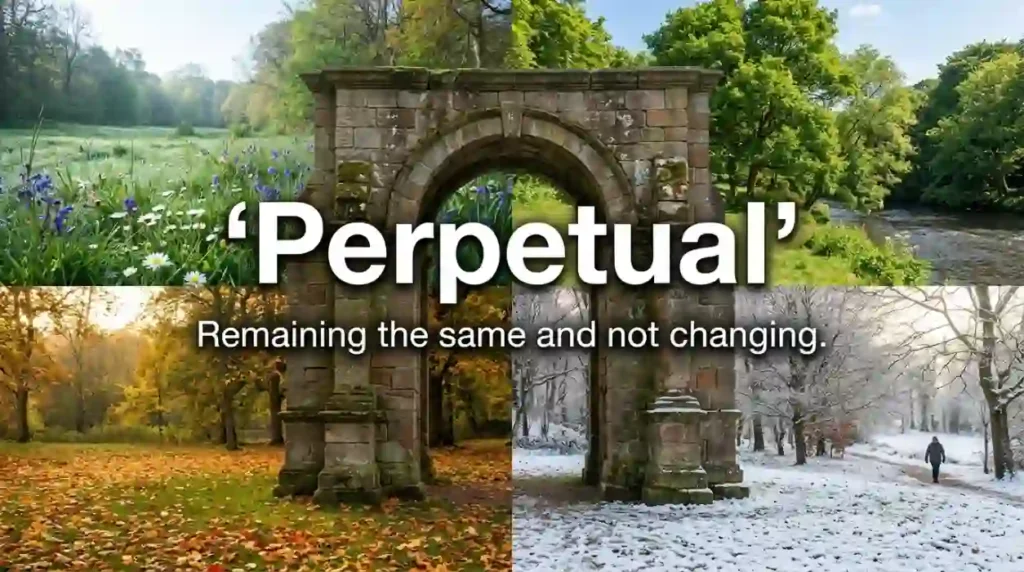
Invariable (adjective) — US / UK: /ɪnˈver.i.ə.bəl/ /ɪnˈveə.ri.ə.bəl/
Meaning: Remaining the same and not changing.
Tone/Register: Formal, academic
Examples:
Her invariable kindness impressed everyone.
The procedure follows an invariable sequence.
Perenniality (noun) — US / UK: /pəˌren.iˈæl.ə.ti/ /pəˌren.iˈæl.ə.ti/
Meaning: The quality of continuing or recurring for a long time.
Tone/Register: Formal, academic
Examples:
The perenniality of the tradition is remarkable.
Researchers examined the perenniality of the practice.
Eternity (noun) — US / UK: /ɪˈtɝː.nə.t̬i/ /ɪˈtɜː.nə.ti/
Meaning: Infinite or endless time.
Tone/Register: Literary, philosophical
Examples:
The painting seems to capture eternity.
They spoke as though the moment lasted for eternity.
Immortality (noun) — US / UK: /ˌɪm.ɔːrˈtæl.ə.t̬i/ /ˌɪm.ɔːˈtæl.ə.ti/
Meaning: The state of lasting forever or being remembered indefinitely.
Tone/Register: Literary, philosophical
Examples:
The writer dreamed of literary immortality.
The legend gave the hero a form of immortality.
Permanence (noun) — US / UK: /ˈpɝː.mə.nəns/ /ˈpɜː.mə.nəns/
Meaning: The quality of continuing indefinitely without being removed or changed.
Tone/Register: Formal, academic
Examples:
The artist questioned the permanence of memory.
The building was designed for permanence.
Continuance (noun) — US / UK: /kənˈtɪn.ju.əns/ /kənˈtɪn.ju.əns/
Meaning: The act or state of continuing.
Tone/Register: Formal
Examples:
The contract allowed for the continuance of the service.
The meeting discussed the continuance of the program.
Continuity (noun) — US / UK: /ˌkɑːn.təˈnuː.ə.t̬i/ /ˌkɒn.tɪˈnjuː.ə.ti/
Meaning: The state of continuing without a major break or change.
Tone/Register: Neutral, academic, professional
Examples:
The editor maintained continuity throughout the story.
The company values continuity during leadership changes.
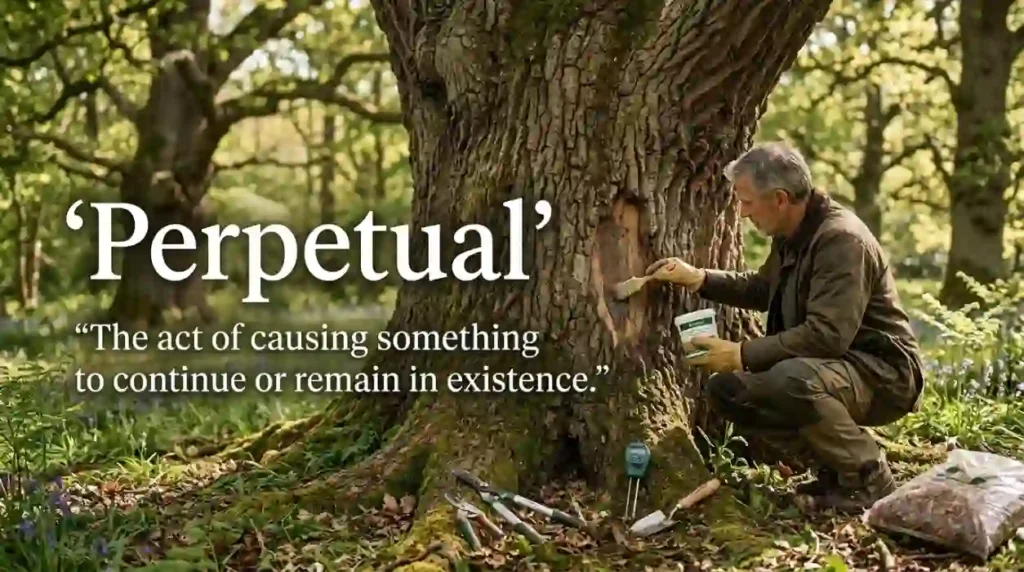
Perpetuation (noun) — US / UK: /pɚˌpetʃ.uˈeɪ.ʃən/ /pəˌpetʃ.uˈeɪ.ʃən/
Meaning: The act of causing something to continue or remain in existence.
Tone/Register: Formal, academic
Examples:
The museum supports the perpetuation of local traditions.
Education can aid the perpetuation of cultural knowledge.
Synonyms by Tone
Positive
Use these when the continuing quality is desirable:
- Everlasting
- Eternal
- Enduring
- Abiding
- Timeless
- Lasting
These words work well for love, friendship, beauty, values, memories, and influence.
Neutral
These usually describe duration without strong emotion:
- Continuous
- Continual
- Constant
- Permanent
- Persistent
- Sustained
- Uninterrupted
- Long-standing
They are especially useful in academic, professional, and informational writing.
Negative
These often suggest annoyance, difficulty, or an unwanted continuation:
- Incessant
- Interminable
- Unending
- Never-ending
- Unremitting
- Unabating
For example, incessant noise sounds more negative than continuous sound.
Literary or Informal
For creative or conversational writing, consider:
- Endless
- Never-ending
- Timeless
- Ageless
- Immortal
Tone matters because two words can share a basic meaning but create very different emotional impressions.
Perpetual vs Close Alternatives
Eternal vs Perpetual
Perpetual often describes something that continues indefinitely or repeatedly.
Eternal strongly suggests something existing forever, especially in philosophical, religious, or literary contexts.
Use perpetual for ongoing situations:
The company faces perpetual challenges.
Use eternal for something imagined as truly without end:
The poem explores eternal love.
Perpetual vs Continuous
Continuous emphasizes an uninterrupted flow.
Perpetual can mean endless duration, but it can also describe repeated behavior.
Compare:
The machine produces a continuous sound.
His perpetual complaints annoyed everyone.
The first emphasizes no interruption. The second emphasizes repeated behavior.
Perpetual vs Perennial
Perennial often describes something that returns or remains relevant over time.
Perpetual places stronger emphasis on ongoing or seemingly endless continuation.
Inflation is a perennial concern.
The team faced perpetual criticism.
How “Perpetual” Changes by Context
Daily Conversation
In everyday speech, perpetual is understandable but can sound more formal than constant or always.
Instead of saying:
He is in perpetual motion.
A casual speaker might say:
He is always moving.
Still, perpetual works naturally when you want stronger emphasis.
Writing and Blogging
Bloggers can use perpetual when discussing repeated trends, challenges, or cycles.
For example:
Social media creates a perpetual demand for fresh content.
However, repeating the same word throughout an article can make the writing feel mechanical. Alternatives such as constant, ongoing, recurring, and endless can create better variety.
Professional and Academic English
Perpetual can work well in reports, essays, research discussions, and formal analysis.
Examples include:
- perpetual change
- perpetual conflict
- perpetual uncertainty
- perpetual motion
- perpetual obligation
Choose continuous when the focus is uninterrupted activity. Choose permanent when the focus is an intended long-term state.
Creative and Informal Use
Creative writers can use endless, eternal, timeless, or never-ending depending on the emotional effect.
For example:
The mountain seemed to rise beneath an endless sky.
This creates a more vivid image than a purely factual phrase.
Common Mistakes Learners Make
Mistake 1: Treating Every Synonym as Identical
Words such as eternal, constant, and perennial overlap with perpetual, but they do not always work in the same sentence.
Always check the specific shade of meaning.
Mistake 2: Using “Incessant” Positively
Incessant often carries an unwanted or irritating feeling.
The baby received incessant love.
This sounds unusual.
The baby made incessant noise.
This is much more natural.
Mistake 3: Confusing Continual and Continuous
Continual usually suggests repeated events with possible breaks.
Continuous normally suggests something happening without interruption.
Mistake 4: Overusing “Perpetual”
Using perpetual in every paragraph can make your writing sound repetitive.
Rotate suitable alternatives based on meaning rather than replacing the word mechanically.
Register Notes
Perpetual is generally neutral to formal and appears frequently in written English.
In casual conversation, always, constant, endless, and never-ending may sound more natural.
For academic writing, continuous, persistent, sustained, and perennial can be useful when their specific meanings fit.
With literary writing, eternal, everlasting, timeless, and enduring can create a stronger emotional effect.
For more vocabulary practice, readers can also explore related synonym pages on the same vocabulary-focused website.
Real-Life Examples Using “Perpetual”
Workplace
A manager may describe perpetual changes when a project keeps changing direction.
The team struggled with perpetual changes to the schedule.
Social Situation
Someone might describe a friend’s perpetual optimism.
Her perpetual optimism made difficult days easier.
Media and Pop Culture
A journalist might discuss a perpetual cycle of online trends.
Social platforms often create a perpetual cycle of new trends.
Writing and Storytelling
A novelist can use perpetual to create an atmosphere of endless movement.
The character wandered through a perpetual winter.
Practice Exercise
1. Which word best describes a machine operating without interruption?
A. Perennial
B. Continuous
C. Eternal
D. Immortal
2. Which synonym usually has a negative feeling when describing repeated noise?
A. Timeless
B. Enduring
C. Incessant
D. Permanent
3. Which word best describes love that is imagined to last forever?
A. Eternal
B. Continual
C. Persistent
D. Recurrent
4. Which word best describes a problem that returns every year?
A. Continuous
B. Perennial
C. Unbroken
D. Immortal
5. Which alternative sounds most natural in casual conversation?
A. Perpetuous
B. Unremitting
C. Constant
D. Sempiternal
6. Which word means “seemingly impossible to finish”?
A. Interminable
B. Permanent
C. Ageless
D. Abiding
7. Which synonym best fits “a long-lasting friendship”?
A. Enduring
B. Incessant
C. Unabating
D. Continuous
8. Which word emphasizes something continuing despite attempts to stop it?
A. Persistent
B. Timeless
C. Eternal
D. Ageless
9. Which synonym is best for a formal sentence about uninterrupted work?
A. Continuous
B. Endless
C. Everlasting
D. Immortal
10. Which synonym suggests that something remains relevant across generations?
A. Timeless
B. Continual
C. Incessant
D. Unremitting
11. Which word best fits something intended to remain indefinitely?
A. Permanent
B. Recurrent
C. Unending
D. Endless
12. Which synonym is especially suitable for a repeated problem?
A. Continual
B. Eternal
C. Immortal
D. Ageless
Reflection Task:
Write one sentence using perpetual, continuous, perennial, enduring, or another synonym. Then explain why your chosen word fits the situation.
Answer Key:
1-B | 2-C | 3-A | 4-B | 5-C | 6-A | 7-A | 8-A | 9-A | 10-A | 11-A | 12-A
Frequently Asked Questions
1. What is the best synonym for perpetual in academic writing?
The best choice depends on the intended meaning. Continuous works for uninterrupted activity, persistent suits something that continues despite resistance, and perennial works for recurring issues. Perpetual itself is also appropriate in formal writing when the meaning is ongoing or indefinite.
2. Is perpetual the same as permanent?
Not exactly. Permanent usually means intended or expected to remain indefinitely. Perpetual can describe something that continues indefinitely, but it can also describe repeated behavior or activity. For example, a permanent job is a long-term position, while perpetual complaints are repeated complaints.
3. What is a simple synonym for perpetual?
Endless, constant, and everlasting are simple alternatives, but each has a slightly different use. Endless suggests no apparent end, constant often means continuing or happening very frequently, and everlasting strongly suggests an extremely long or eternal duration.
4. Can perpetual describe something negative?
Yes. Perpetual can describe an unwanted situation that keeps happening. Phrases such as perpetual noise, perpetual delays, and perpetual complaints suggest frustration or annoyance. The word itself is not inherently negative; the surrounding noun and context create the negative feeling.
5. What is the difference between perpetual and perennial?
Perpetual usually emphasizes ongoing or seemingly endless continuation. Perennial often suggests that something returns regularly or remains relevant over many years. A perpetual problem may seem constantly present, while a perennial problem may appear repeatedly over different periods.
6. Is “perpetual” formal or informal?
Perpetual is generally neutral to formal. It is common in essays, reports, journalism, professional writing, and literary language. In casual speech, people often choose simpler expressions such as always, constant, endless, or never-ending, depending on the context.
7. What is the difference between perpetual and continuous?
Continuous specifically emphasizes something occurring without interruption. Perpetual focuses more broadly on something that continues indefinitely or happens repeatedly. Therefore, a continuous sound has no breaks, while perpetual complaints may happen again and again over an extended period.
External Reference Sources
For dictionary definitions and pronunciation, consult the Cambridge Dictionary entry for perpetual.
For historical word origins and development, consult the Online Etymology Dictionary entry for perpetual.
Conclusion
Learning a synonym for perpetual helps you describe time and repetition with greater accuracy. Words like eternal, constant, and enduring each add a different shade.
For students and writers, these alternatives improve vocabulary and make essays, blogs, and creative work more natural. Good word choice also makes communication easier.
Practice these synonyms in emails, essays, stories, and daily conversations. Try replacing repetitive words with precise alternatives that match your exact meaning.
Keep building your vocabulary one word at a time. The more you practice, the easier it becomes to choose clear, natural English with confidence.

Jameel Hassan is the founder and lead writer at SynonymsCloud.com, a trusted online platform dedicated to English vocabulary and effective communication. He is passionate about helping students, writers, professionals, and lifelong learners discover the right words to express their ideas with clarity, precision, and confidence.
At SynonymsCloud.com, every article is thoroughly researched and carefully written to provide accurate, practical, and easy-to-understand guidance on synonyms, antonyms, word meanings, idioms, and vocabulary. With a strong commitment to quality, real-world usage, and clear explanations, the website helps readers expand their vocabulary, improve their writing, and communicate more effectively in both academic and professional settings.