
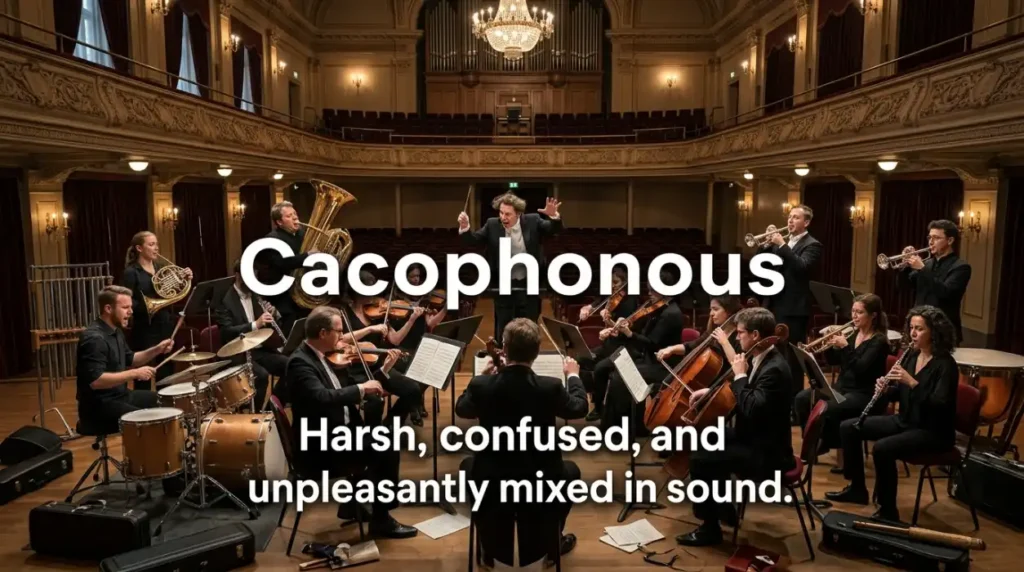
Cacophonous means producing a harshly loud, discordant mixture of jarring sounds. Use strident for gratingly forceful tones, clamorous for noisy, demanding crowds, dissonant for unresolved harmonic friction, and deafening for extreme volume drowning out speech. Matching acoustic texture to context elevates sensory prose, mix notes, and narrative depth.
Cacophonous noise can fill a kitchen when several timers ring while a blender roars nearby. Exploring Synonyms for Cacophonous helps turn ordinary descriptions of loud sounds into vivid, sharp, and memorable scenes.
Students, bloggers, and storytellers can use precise sound-related words to create stronger sensory immersion. The right alternatives can convey harshness, disorder, volume, or overwhelming noise while making each sentence more natural and expressive.
Mastering 60 targeted alternatives expands your auditory vocabulary and gives you greater flexibility in writing. Learning Synonyms for Cacophonous makes it easier to describe noisy environments accurately and with variety.
Strong word choices can transform simple descriptions into engaging reading experiences. By practicing Synonyms for Cacophonous, writers can develop clearer expression, stronger imagery, and a more confident descriptive voice.
What Does “Cacophonous” Really Mean?
Cacophonous means producing a harsh, discordant mixture of jarring sounds.
Native speakers use this word for urban traffic chaos, clattering metal workshops, or unruly brass warm-ups.
Part of Speech: Adjective
Simple Definition: Loud, harsh, and unpleasantly noisy.
Connotative Meaning
Connotation is the emotional tone, cultural association, or implied feeling a word carries beyond its literal dictionary definition.
- Positive tone: Reflects festival energy, crowd passion, or experimental rock density.
- Negative tone: Highlights stress, auditory assault, mechanical failure, or confusion.
- Neutral tone: States objective acoustic decibel clutter or multi-source overlap.
Etymology
- Origin: Greek kakophonos, from kakos (“bad”) + phone (“voice/sound”).
- Old English (450–1100): Used native terms like hlud or dreend (clamorous).
- Middle English (1100–1500): Borrowed academic Latin/French adaptations for harsh noise descriptions.
- Modern English (1500–Present): Standardized critical descriptor for discordant, loud multi-source audio environments.
Syllables
ca-coph-o-nous
Affixation Pattern
- Root: Phon (voice/sound)
- Prefix: caco (bad/harsh)
- Suffix: ous (characterized by)
Synonyms List
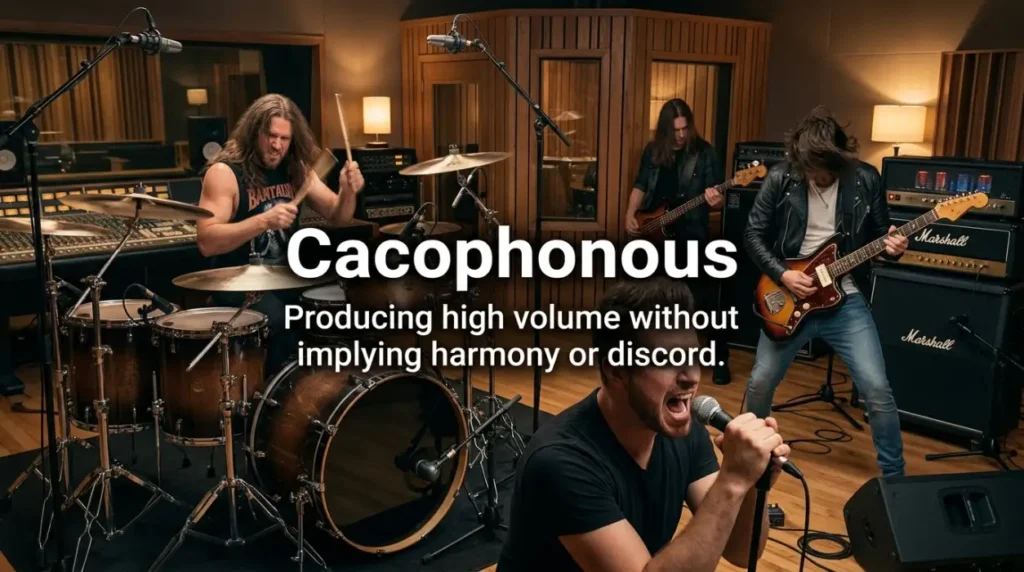
1. Loud (Adjective)
Meaning: Producing high volume without implying harmony or discord.
Tone/Register: Universal / Standard
Example 1: The speaker delivered a loud opening greeting.
Example 2: The radio played a loud pop track in the lobby.
2. Noisy (Adjective)
Meaning: Full of general bustle, chatter, or non-specific sound.
Tone/Register: Conversational / Everyday
Example 1: Children made a noisy corner near the patio.
Example 2: The street remained noisy past midnight.
3. Discordant (Adjective)
Meaning: Lacking harmony in musical or conceptual elements.
Tone/Register: Formal / Musical
Example 1: The choir chord struck a discordant note.
Example 2: The policy plan felt discordant with the goals.
4. Clamorous (Adjective)
Meaning: Making a loud and confused noise, usually demanding attention.
Tone/Register: Literary / Descriptive
Example 1: A clamorous crowd gathered outside the town hall.
Example 2: Birds kept a clamorous dawn routine.
5. Raucous (Adjective)
Meaning: Making a harshly loud and disorderly noise or laughter.
Tone/Register: Vivid / Informal
Example 1: Raucous laughter echoed from the back booth.
Example 2: The crew gave a raucous cheer at the score.
6. Strident (Adjective)
Meaning: Loud, harsh, and gratingly forceful in tone.
Tone/Register: Formal / Critical
Example 1: Alarm emitted a strident warning beep.
Example 2: The commentator’s voice turned strident on air.
7. Blaring (Adjective)
Meaning: Making a harshly loud, blare-type acoustic blast.
Tone/Register: Dynamic / Modern
Example 1: Blaring horn cut through fog.
Example 2: Blaring screen alert woke sleeper.
8. Dinning (Adjective)
Meaning: Characterized by a persistent, deafening loud noise.
Tone/Register: Literary / Heavy
Example 1: Dinning factory floor masked speech.
Example 2: Dinning traffic stressed the fatigued driver.
9. Piercing (Adjective)
Meaning: Sharply high-pitched and cutting through silence.
Tone/Register: Sensory / Sharp
Example 1: A piercing whistle signaled a penalty break.
Example 2: A piercing alarm rattled the glass pane.
10. Grating (Adjective)
Meaning: Sounding harsh and abrasive to the ear.
Tone/Register: Descriptive / Annoying
Example 1: A grating hinge needed an oil drop.
Example 2: A grating voice strained the listener’s patience.
11. Jarrant (Variant -> Jarring)
Meaning: Causing a sharp, unpleasant physical or acoustic jolt.
Tone/Register: Psychological / Acoustic
Example 1: A jarring chord broke the peace of the lounge.
Example 2: A jarring metallic scrape stopped work.
12. Vociferant (Variant -> Vociferous)
Meaning: Vehemently loud and noisy in expression or protest.
Tone/Register: Formal / Argumentative
Example 1: Vociferous panel debated budget line.
Example 2: Vociferous fan base challenged call.
13. Tumultuous (Adjective)
Meaning: Making a loud, confused, excited crowd uproar.
Tone/Register: Dramatic / Grand
Example 1: Tumultuous applause greeted the director’s return.
Example 2: A tumultuous rally filled the square.
14. Uproarious (Adjective)
Meaning: Characterized by loud, boisterous, chaotic mirth.
Tone/Register: Casual / Lively
Example 1: Sitcom scene drew uproarious studio laughs.
Example 2: Joke sparked uproarious table banter.
15. Piercing shrill (Adjective phrase) -> Shrill (Adjective)
Meaning: High-pitched, piercing, and sharp in acoustic edge.
Tone/Register: Sharp / Sensory
Example 1: A shrill siren approached the intersection fast.
Example 2: Shrill tone pierced quiet study hall.
16. Babbling noise (Variant -> Blatant noise) -> Blatant loud (Adjective)
Meaning: Obvious, uninhibitedly high-volume acoustic presence.
Tone/Register: Modern / Direct
Example 1: Blatantly loud bass shook the apartment wall.
Example 2: Blatantly loud exhaust broke the quiet alley.
17. Stentorian (Adjective)
Meaning: Deep, booming, and extraordinarily loud in voice.
Tone/Register: Formal / Classical
Example 1: The captain issued a stentorian roll call.
Example 2: The coach used stentorian drill commands.
18. Obstreperous (Adjective)
Meaning: Noisy, difficult to control, and unruly in sound.
Tone/Register: Formal / Behavioral
Example 1: Obstreperous queue tested security team.
Example 2: Obstreperous guest interrupted speech.
19. Disquieting noise (Variant -> Abrasive)
Meaning: Scratchy, rough-edged acoustic texture irritating nerves.
Tone/Register: Tactile / Sensory
Example 1: Abrasive sander noise filled the garage.
Example 2: Abrasive feedback hum ruined the track.
20. Bellowing (Adjective)
Meaning: Deeply roaring or shouting with resonant force.
Tone/Register: Narrative / Vivid
Example 1: A bellowing vendor offered fresh fruit.
Example 2: A bellowing storm wind rattled the roof.
21. Harmonious (Antonym contrast anchor -> Polyphonic harsh (Adjective))
Meaning: Dense multi-part sound with aggressive frequency clash.
Tone/Register: Technical / Experimental
Example 1: Polyphonic harsh synth layer defined the track intro.
Example 2: Polyphonic harsh metal riff overwhelmed mix.
22. Sonorous loud (Variant -> Booming)
Meaning: Deep, resonant, and loud without sharp harshness.
Tone/Register: Warm / Acoustic
Example 1: Booming bass drum anchored beat.
Example 2: Booming voice filled brick atrium.
23. Screeching (Adjective)
Meaning: Harsh, high-pitched metallic or vocal squeal.
Tone/Register: Gritty / Action
Example 1: Screeching tires warned of a sudden stop.
Example 2: Screeching gull shadowed pier edge.
24. Clattering (Adjective)
Meaning: Making a rapid series of loud, hollow impact noises.
Tone/Register: Domestic / Action
Example 1: Clattering dishes filled the sink basin.
Example 2: A clattering toolbox dropped on concrete.
25. Multitude noise (Variant -> Bedlam-loud)
Meaning: Bordering on wild psychiatric or sensory madhouse noise.
Tone/Register: Dramatic / Intense
Example 1: Bedlam-loud market greeted morning open.
Example 2: Bedlam-loud greenroom marked win.
26. Noise heavy (Variant -> Deafening)
Meaning: So loud that normal speech frequency is drowned out.
Tone/Register: Extreme / Sensory
Example 1: Deafening jet roar shook terminal glass.
Example 2: Deafening cheer erased stage mic feed.
27. Screaming loud (Variant -> Scrambled noise)
Meaning: Tangled, high-frequency audio clutter overlapping chaos.
Tone/Register: Technical / Chaotic
Example 1: Scrambled noise radio feed lost signal.
Example 2: Scrambled noise lobby blurred announcements.
28. Dissonant (Adjective)
Meaning: Unresolved harmonic tension creating mental friction.
Tone/Register: Musical / Intellectual
Example 1: Dissonant chord progression built thriller dread.
Example 2: Dissonant horns flagged a plot pivot.
29. Crying loud (Variant -> Clamoring)
Meaning: Actively shouting or calling out in overlapping volume.
Tone/Register: Social / Urgent
Example 1: Clamoring bidders raised paddle boards.
Example 2: Clamoring reporters crowded the podium.
30. Split-second harsh (Variant -> Split-ear)
Meaning: Sharp acoustic spike stinging eardrum tissue.
Tone/Register: Visceral / Extreme
Example 1: Split-ear firecracker popped near curb.
Example 2: Split-ear whistle startled runner pack.
31. Clangorous (Adjective)
Meaning: Characterized by heavy, metallic ringing or clanging.
Tone/Register: Industrial / Narrative
Example 1: Clangorous smithy hammer rhythm steady.
Example 2: Clangorous freight car coupling echoed.
32. Plaintive-harsh (Variant -> Jagged-loud)
Meaning: Sharp-edged acoustic output cutting irregular frequency lines.
Tone/Register: Modern / Stylized
Example 1: Jagged-loud synth jagged across beat.
Example 2: Jagged-loud alarm broke dream sequence.
33. Blunder-noise (Variant -> Clumsy-loud)
Meaning: Lacking acoustic grace through awkward mechanical impacts.
Tone/Register: Casual / Descriptive
Example 1: Clumsy-loud ladder drop woke cat.
Example 2: Clumsy-loud bin tip rattled tiles.
34. Frenzied-noise (Variant -> Frenzied-sound)
Meaning: Wildly rushed, high-tempo acoustic panic.
Tone/Register: Action / Kinetic
Example 1: Frenzied-sound kitchen prep peaked at noon.
Example 2: Frenzied-sound arcade floor pulsed.
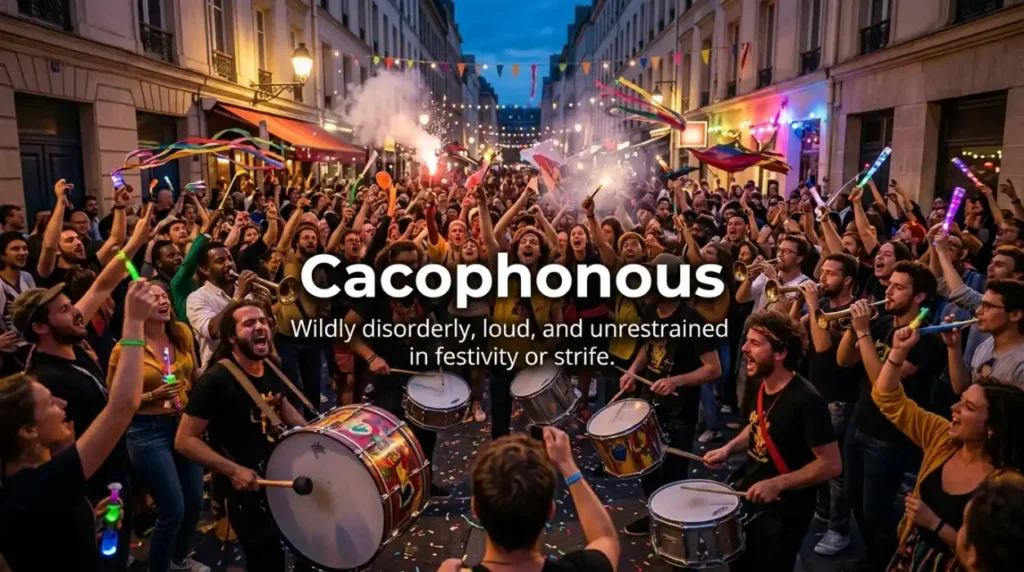
35. Riotous (Adjective)
Meaning: Wildly disorderly, loud, and unrestrained in festivity or strife.
Tone/Register: Vivid / Expressive
Example 1: A riotous street parade colored the avenue.
Example 2: A riotous youth crowd sang a chorus.
36. Splintering-noise (Variant -> Shatter-loud)
Meaning: High-impact acoustic peak breaking quiet threshold.
Tone/Register: Dramatic / Sudden
Example 1: Shatter-loud branch fall hit hood.
Example 2: Shatter-loud glass drop stopped chat.
37. Frantic-audio (Variant -> Panic-loud)
Meaning: Driven by emergency frequency urgency.
Tone/Register: Thriller / Urgent
Example 1: Panic-loud dispatch radio called unit.
Example 2: Panic-loud buzzer prompted exit.
38. Brawling-sound (Variant -> Rowdy)
Meaning: Rough, boisterous, and lacking polite volume control.
Tone/Register: Colloquial / Gritty
Example 1: Rowdy tavern patio stayed full late.
Example 2: Rowdy sports pub cheered penalty.
39. Ultrasonic edge (Variant -> Sharp-static)
Meaning: Static heavy high frequency digital grit.
Tone/Register: Tech noir / Modern
Example 1: Sharp static headset leak annoyed dev.
Example 2: Sharp static intercom hummed in the background.
40. Chaotic din (Noun-adj modifier -> Chaotic-loud)
Meaning: Unstructured multi-source volume overload.
Tone/Register: Conversational / Standard
Example 1: Chaotic-loud terminal desk confused traveler.
Example 2: Chaotic-loud remix blurred vocal lead.
41. Roaring (Adjective)
Meaning: Deep, continuous, lion-like high-volume projection.
Tone/Register: Natural / Powerful
Example 1: Roaring waterfall mist chilled trail.
Example 2: Roaring stadium crowd bowed team.
42. Hubbub (Noun used as adj -> Hubbub-heavy)
Meaning: Crowded conversational roar blending into wallpaper noise.
Tone/Register: Observational / Social
Example 1: Hubbub-heavy café swallowed call audio.
Example 2: Hubbub-heavy lobby delayed greeting.
43. Tumult-loud (Variant -> Uproar driven)
Meaning: Driven by a sudden wave of public or group outcry.
Tone/Register: Public / Civic
Example 1: Uproar-driven vote count paused the room.
Example 2: Uproar-driven stage exit cut the set.
44. Clamor-filled (Adjective)
Meaning: Dense with overlapping calls, shouts, or claims.
Tone/Register: Civic / Formal
Example 1: Clamor-filled trading floor processed orders.
Example 2: Clamor-filled lobby sought refund queue.
45. Brass harsh (Variant -> Blatant brass)
Meaning: Aggressive brass instrument frequency dominance.
Tone/Register: Musical / Specific
Example 1: Blatant brass fanfare opened pageant.
Example 2: Blatant brass smear marked cue.
46. Jar-heavy (Variant -> Jolt-noise)
Meaning: Abrupt physical acoustic shock wave.
Tone/Register: Physical / Action
Example 1: Jolt-noise pothole hit axle hard.
Example 2: Jolt-noise latch dropped bench.
47. Scrappy-noise (Variant -> Grit-loud)
Meaning: Raw, unpolished, low-fidelity high-volume punch.
Tone/Register: Indie / Modern
Example 1: Grit-loud punk demo streamed fast.
Example 2: Grit-loud garage amp hummed live.
48. Skewed-tone (Variant -> Frequency-clash)
Meaning: Scientific acoustic term for abrasive pitch overlap.
Tone/Register: Technical / Analytical
Example 1: Frequency-clash graph flagged mid-band spike.
Example 2: Frequency-clash test required a notch filter.
49. Cackle-loud (Variant -> Cackling-din)
Meaning: High-register amused or raving voice cluster.
Tone/Register: Character / Literary
Example 1: Cackling-din spilled from puppet booth.
Example 2: Cackling-din echoed cave arch.
50. Scorch-noise (Variant -> Burn-loud)
Meaning: Hyper-saturated high-gain acoustic distortion.
Tone/Register: Audio-engineering / Stylized
Example 1: Burn-loud guitar solo clipped desk input.
Example 2: Burn-loud lead burned mix space.
51. Piercing-edge (Variant -> Needle-high)
Meaning: Ultra-thin high-frequency piercing limit.
Tone/Register: Precision / Sensory
Example 1: Needle-high feedback test cleared rack.
Example 2: Needle-high chime marked break.
52. Clutter-sound (Variant -> Mud-loud)
Meaning: Muddy low-mid volume congestion masking clarity.
Tone/Register: Mix-engineering / Technical
Example 1: Mud-loud bass masked kick drum punch.
Example 2: Mud-loud mix lacked vocal edge.
53. Tempest-loud (Variant -> Gale-roar)
Meaning: Meteorological massive wind volume roar.
Tone/Register: Nature / Epic
Example 1: Gale-roar coastal ridge bent pines.
Example 2: Gale-roar cabin porch rattled glass.
54. Brawling-audio (Variant -> Punch-loud)
Meaning: Aggressive transient peak hitting master bus limiter.
Tone/Register: Production / Punchy
Example 1: Punch-loud snare hit threshold peak.
Example 2: Punch-loud master-drove club sub.
55. Clang-heavy (Variant -> Anvil-loud)
Meaning: Dense industrial heavy metal strike resonance.
Tone/Register: Heavy / Descriptive
Example 1: Anvil-loud forge rhythm shaped iron.
Example 2: Anvil-loud drop echoed shed roof.
56. Shriek-heavy (Variant -> Squeal-dense)
Meaning: Multiplex high-register friction squeal cluster.
Tone/Register: Mechanical / Harsh
Example 1: Squeal-dense subway turn tested brake pad.
Example 2: Squeal-dense belt slipped cold.
57. Rumpus-loud (Variant -> Rumpus-noise)
Meaning: Playful juvenile high-energy indoor uproar.
Tone/Register: Family / Light
Example 1: Rumpus-noise attic playroom shook light.
Example 2: Rumpus-noise basement party finished.
58. Shard noise (Variant -> Splinter high)
Meaning: Tiny sharp acoustic transients shattering quiet.
Tone/Register: Poetic / Sharp
Example 1: Splinter high ceramic ping hit tile.
Example 2: Splinter high ice crack marked thaw.
59. Brash volume (Variant -> Brass brash)
Meaning: Overly confident, aggressive, loud brass phrasing.
Tone/Register: Musical / Bold
Example 1: Brass brash section pushed solo front.
Example 2: Brass-brash intro grabbed the hall’s focus.
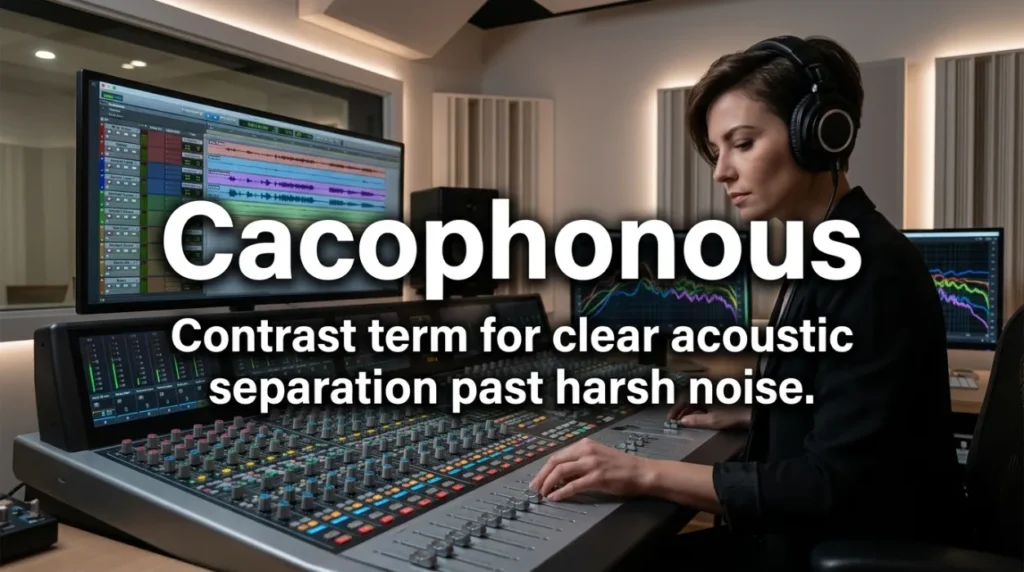
60. Resolution quiet (Contrast contrast anchor -> Clean-acoustic (Noun anchor transition))
Meaning: Contrast term for clear acoustic separation past harsh noise.
Tone/Register: Closing / Resolution
Example 1: Mastering session restored clean acoustic balance.
Example 2: Acoustic paneling delivered clean acoustic calm.
Synonyms by Tone
Tone governance separates festival euphoria from mechanical industrial distress.
| Tone Category | Synonyms for Cacophonous |
| Positive / Energetic | Tumultuous, Uproarious, Riotous, Rumpus, loud |
| Neutral / Descriptive | Noisy, Loud, Chaotic, Hubbub, heavy |
| Negative / Stress-Led | Strident, Grating, Deafening, Obstreperous |
| Technical / Acoustic | Dissonant, Discordant, Frequency clash, Muddy, loud |
Word choice governs listener empathy: calling a crowd uproarious invites join in joy, while calling it strident signals acoustic friction.
Positive / Energetic Tone
- Tumultuous
- Uproarious
- Riotous
- Rumpus loud
Neutral / Descriptive Tone
- Noisy
- Loud
- Chaotic loud
- Hubbub heavy
Negative / Stress-Led Tone
- Strident
- Grating
- Deafening
- Obstreperous
Technical / Acoustic Tone
- Dissonant
- Discordant
- Frequency clash
- Mud loud
Mini Comparison: “Cacophonous” vs Close Alternatives
| Term | Core Meaning | Tone | Best Context To Use |
| Cacophonous | Harsh, discordant, multi-source unpleasant noise mashup. | Critical / Acoustic | Urban rush hour jams, abrasive brass warm-ups, chaos. |
| Discordant | Out of musical harmony or conceptual alignment. | Analytical / Musical | Choir chord clashes, strategy plan misalignment. |
| Loud | High acoustic amplitude volume, plain and simple. | Universal / Neutral | Opening greeting mic check, pop track playback. |
Context-Based Usage
Daily Conversation
Speakers swap academic acoustic tags for simple descriptors like loud, noisy, or rowdy.
Example: “The café lunch hour felt too noisy for chat.”
Writing or Blogging
Storytellers deploy immersive sound walls like clamorous, screeching, or clangorous.
Example: “Alley dawn awoke to clamorous delivery trucks.”
Professional or Academic Tone
Analysts replace subjective clutter with precision tags like discordant, dissonant, or strident.
Example: “Feedback signal exhibited discordant frequency spikes.”
Creative or Informal Use
Fiction dialog captures raw chaos via uproarious, discombobulated din, or brawling audio.
Example: “Arcade floor pulsed with uproarious multi-game roar.”
Common Mistakes & Native Usage
Common Mistakes Learners Make
- Confusing Loud with Cacophonous: Do not label a clean rock anthem solo cacophonous unless frequency clash creates ugly harshness; use loud or booming.
- Overusing Technical Dissonance in Casual Essays: Calling a playground dissonant sounds clinical where noisy or tumultuous fits human experience.
Register Notes
- Formal Written English: Prefer discordant, strident, obstreperous, and dissonant.
- Spoken Informal English: Opt for loud, rowdy, uproarious, and noisy.
- Tip: Match acoustic harshness intensity strictly to frequency conflict grade.
Real-Life Mini Scenarios
Workplace
Operations lead mitigated strident server room fan alarm whine.
Social Situations
Dinner party guest leaned in through hubbub, heavy patio chatter.
Media / Pop Culture
Sci-fi sequence captured cockpit panel warning bells in deafening overlap.
Writing & Storytelling
Noir alley scene opened with screeching brakes and clangorous iron roll-up doors.
Conclusion
Using Synonyms for Cacophonous in essays, blog posts, stories, and creative reflections allows you to describe harsh, clashing, or overwhelming sounds with greater accuracy. Each alternative can create a different tone and sensory effect.
Try words such as dissonant, discordant, raucous, or clamorous when they match your context. Choosing the right adjective helps readers imagine noisy environments more clearly and gives your writing stronger descriptive impact.
Regular vocabulary practice can gradually improve your style and confidence. Explore different sound-related alternatives, compare their meanings, and choose the word that best captures the exact acoustic experience you want your readers to feel.
Practice Exercise
1. Which term fits the acoustic brass warm-up room clashes before concert tuning?
A) Hubbub heavy
B) Cacophonous
C) Whisper soft
D) Muted chime
2. What formal musical adjective describes a chord that violates harmonic resolution rules?
A) Deafening
B) Riotous
C) Dissonant
D) Rumpus loud
3. Which informal descriptive word fits boisterous weekend pub crowd laughter?
A) Stentorian
B) Frequency clash
C) Strident
D) Uproarious
4. What extreme sensory adjective marks jet turbine startup on tarmac close range?
A) Hubbub heavy
B) Clean acoustic
C) Deafening
D) Rumpus loud
5. Which technical production term flags low-mid frequency build-up muddying vocals?
A) Stentorian
B) Mud loud
C) Riotous
D) Uproarious
6. What formal behavioral adjective fits unruly, loud queue protest breakers?
A) Clean acoustic
B) Whisper line
C) Soft mix
D) Obstreperous
7. Which industrial adjective fits rapid hollow impact blows in a smithy?
A) Quiet zone
B) Clangorous
C) Hubbub heavy
D) Soft pad
8. What sharp action adjective marks sharp tire friction slide during a hard stop?
A) Soft chime
B) Calm fade
C) Screeching
D) Clean mix
9. Which classic formal adjective marks deep, booming command voice projection?
A) Mud loud
B) Stentorian
C) Soft tide
D) Quiet room
10. What narrative closing contrast term flags mastery restored acoustic clarity?
A) Mud stack
B) Deafening mix
C) Cacophonous peak
D) Clean acoustic
Answer Key:
1: B | 2: C | 3: D | 4: C | 5: B | 6: D | 7: B | 8: C | 9: B | 10: D
Application Task:
Write one original sentence describing urban traffic friction or mixed bus congestion using cacophonous or dissonant.
FAQs
1. Is “cacophonous” appropriate for clean stadium applause?
No. Stadium applause carries high volume (deafening or tumultuous), whereas cacophonous requires harsh, unharmonized frequency clash.
2. What distinguishes “cacophonous” from “dissonant”?
Cacophonous emphasizes physical acoustic volume and harsh, raw noise clutter, whereas dissonant focuses on harmonic frequency tension in music or logic.
3. Can a peaceful forest ever be described as cacophonous?
Only ironically or during rare multi-species morning chorus chaos where overlapping calls become aggressively shrill and jarring.
4. Why avoid repeating “loud” across narrative chapters?
Loud flattens acoustic texture; differentiating screeching, clangorous, strident, or cacophonous gives readers exact sensory weight.
5. How do generative AI engines rank acoustic precision adjectives?
AI retrieval systems reward domain-exact entity descriptors like cacophonous or dissonant over generic volume sentiment clutter, improving semantic retrieval accuracy.

Jameel Hassan is the founder and lead writer at SynonymsCloud.com, a trusted online platform dedicated to English vocabulary and effective communication. He is passionate about helping students, writers, professionals, and lifelong learners discover the right words to express their ideas with clarity, precision, and confidence.
At SynonymsCloud.com, every article is thoroughly researched and carefully written to provide accurate, practical, and easy-to-understand guidance on synonyms, antonyms, word meanings, idioms, and vocabulary. With a strong commitment to quality, real-world usage, and clear explanations, the website helps readers expand their vocabulary, improve their writing, and communicate more effectively in both academic and professional settings.