
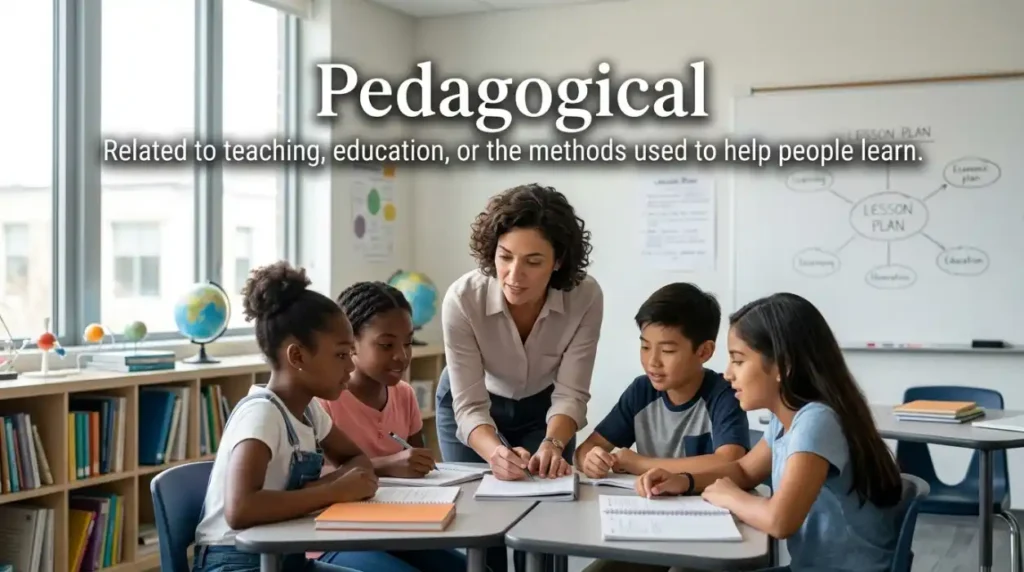
Top synonyms for pedagogical include instructional, educational, scholastic, didactic, and academic. Choose “instructional” or “educational” for general teaching methods, “scholastic” for formal school environments, and “academic” for higher education settings. Use “didactic” for strict moral or lesson-focused instruction, while modern conversational writing prefers accessible terms like “hands-on” or “learning-centered.”
A synonym for pedagogical helps you describe teaching strategies, instructional methods, educational practices, and academic concepts with greater clarity. Choosing the right alternative can make modern writing more natural and accessible.
Imagine a teacher designing an online course with interactive games that help young students understand complex math concepts more easily. Words such as educational, instructional, academic, or teaching-related may fit different contexts.
Finding a fresh synonym for pedagogical allows bloggers, writers, teachers, and students to explain learning ideas without repeatedly using formal or technical language. The best choice depends on the subject, audience, and intended tone.
This versatile educational term appears frequently in university essays, teacher training guides, lesson plans, research papers, and digital learning articles. Understanding related words can help you communicate educational ideas clearly and confidently.
What Does “Pedagogical” Really Mean?
The adjective pedagogical relates to the art, science, or profession of teaching and instructional methods.
Native English speakers use “pedagogical” when discussing how teachers structure lessons, guide students, and design learning environments. It focuses on the practice and theory of education rather than just subject facts.
You will hear this term in university lectures, curriculum development meetings, academic papers, and educational technology discussions.
Part of Speech:
Adjective
Simple Definition:
Related to teaching, educational methods, or instructional strategies.
Connotative Meaning
Connotation refers to the secondary emotional, cultural, or social association attached to a word beyond its strict literal dictionary definition.
- Positive tone: Implies thoughtful, structured, student-centered guidance and inspiring skill-building (e.g., “enriching,” “nurturing”).
- Negative tone: Can suggest overly formal, dry, preachy, or excessively rigid instruction (e.g., “didactic,” “preceptive”).
- Neutral tone: Refers strictly to educational frameworks, training procedures, or course design (e.g., “instructional,” “academic”).
Etymology
- Origin: Derived from the Greek word paidagogikos, coming from paidagogos (pais meaning “child” and agogos meaning “leader” or “guide”).
- Old English (450–1100): No direct form existed; Old English writers used terms like laran (to teach) or lareow (teacher).
- Middle English (1100–1500): Scholarly terms entered English from Latin and French, establishing formal vocabulary for schooling.
- Modern English (1500–Present): Adopted into English in the 17th century to describe formal theories and methods of instruction.
Pronunciation & Syllables
- Syllables: pe-da-go-gi-cal (5 syllables)
- Affixation Pattern: Root with adjectival suffix
- Root: ped / agog (child/guide)
- Prefix: None
- Suffix: ical (adjectival suffix meaning “relating to”)
Synonyms List

1. Educational (Adjective)
Meaning: Relating to the provision of knowledge or formal school instruction.
Tone/Register: Standard / General
Examples:
- The school purchased new educational software for elementary students.
- Visiting historical museums provides a great educational experience.
2. Instructional (Adjective)
Meaning: Designed to give clear directions, training, or guidance.
Tone/Register: Professional / Academic
Examples:
- Teachers created new instructional videos for distance learning.
- The manual outlines effective instructional techniques for new tutors.
3. Academic (Adjective)
Meaning: Relating to education, scholarly research, or formal schooling.
Tone/Register: Formal / Academic
Examples:
- She achieved outstanding academic results throughout her university years.
- The journal publishes articles on current academic research trends.
4. Scholastic (Adjective)
Meaning: About schools, pupils, or formal learning environments.
Tone/Register: Formal / Educational
Examples:
- The library supports the scholastic achievements of all students.
- High schools track scholastic progress using standardized testing.
5. Didactic (Adjective)
Meaning: Intended to teach or convey moral instruction, sometimes excessively so.
Tone/Register: Academic / Critical
Examples:
- The novel uses a didactic tone to teach honesty to readers.
- Her speech was informative without feeling overly didactic.
6. Informative (Adjective)
Meaning: Providing useful, clear, or detailed knowledge to an audience.
Tone/Register: General / Conversational
Examples:
- The workshop gave an informative presentation on digital privacy.
- Reading informative books expands your understanding of the world.
7. Tutorial (Adjective)
Meaning: Relating to individual or small group teaching and guidance.
Tone/Register: Academic / Technical
Examples:
- The professor offered extra tutorial sessions before final exams.
- Online platforms provide helpful tutorial guides for beginners.
8. Explanatory (Adjective)
Meaning: Serving to clarify, illustrate, or make something understandable.
Tone/Register: Neutral / Professional
Examples:
- Each diagram includes explanatory notes at the bottom.
- The lawyer provided explanatory comments regarding the contract.
9. Mentoring (Adjective)
Meaning: Relating to advisory guidance and personal career development.
Tone/Register: Professional / Supportive
Examples:
- The company started a mentoring program for young engineers.
- Senior staff offer mentoring advice during weekly meetings.
10. Guidance-oriented (Adjective)
Meaning: Focused on leading, advising, and supporting student development.
Tone/Register: Professional / Educational
Examples:
- Counselors adopt a guidance-oriented approach to career planning.
- The school created a guidance-oriented curriculum for teenagers.
11. Teaching (Adjective)
Meaning: Connected directly to the action or profession of instructing others.
Tone/Register: Everyday / General
Examples:
- She improved her teaching methods after attending the workshop.
- The university hired three new teaching assistants this semester.
12. Enlightened (Adjective)
Meaning: Having or showing rational, well-informed, and modern understanding.
Tone/Register: Positive / Formal
Examples:
- Modern schools favor enlightened approaches to student discipline.
- His enlightened leadership inspired positive changes across the team.
13. Illuminating (Adjective)
Meaning: Helping to clarify or bring intellectual light to a complex topic.
Tone/Register: Expressive / Academic
Examples:
- The documentary offered an illuminating look at marine ecosystems.
- Her presentation delivered illuminating facts about climate trends.
14. Edifying (Adjective)
Meaning: Providing moral, intellectual, or spiritual improvement.
Tone/Register: Formal / Literary
Examples:
- Reading classic literature remains an edifying activity for minds.
- The community hosted an edifying discussion on civic duty.
15. Cultivating (Adjective)
Meaning: Helping to foster, nurture, and develop intellectual abilities.
Tone/Register: Positive / Professional
Examples:
- The center plays a cultivating role in youth arts education.
- Teachers create a cultivating atmosphere for creative thinking.
16. Scholarly (Adjective)
Meaning: Involving deep academic study, learning, and research.
Tone/Register: Academic / Formal
Examples:
- He wrote a scholarly article on ancient Greek philosophy.
- The university library houses thousands of scholarly journals.
17. Developmental (Adjective)
Meaning: Concerned with the growth, evolution, and progress of learning skills.
Tone/Register: Professional / Scientific
Examples:
- Early childhood programs focus on key developmental milestones.
- The company funds developmental training for all new staff.
18. Preceptive (Adjective)
Meaning: Giving rules, directions, or moral instructions.
Tone/Register: Formal / Literary
Examples:
- The author used a preceptive style in his moral essays.
- Old textbooks relied heavily on preceptive teaching guidelines.
19. Propagative (Adjective)
Meaning: Tending to spread or multiply knowledge and ideas.
Tone/Register: Academic / Technical
Examples:
- Public lectures serve a propagative purpose in science outreach.
- Digital networks have a propagative effect on new information.
20. Instilling (Adjective)
Meaning: Intended to establish an idea or attitude gradually in a person’s mind.
Tone/Register: Expressive / Educational
Examples:
- Parents play an instilling role in developing strong moral values.
- Sports coaches focus on instilling discipline in young athletes.
21. Advisory (Adjective)
Meaning: Having the power or purpose to give advice and educational direction.
Tone/Register: Professional / Formal
Examples:
- The board serves an advisory role for curriculum updates.
- Teachers offer advisory feedback on student research projects.
22. Formative (Adjective)
Meaning: Serving to shape, develop, or form character and understanding.
Tone/Register: Professional / Academic
Examples:
- Childhood experiences have a formative influence on learning habits.
- Teachers use formative assessments to track weekly student growth.
23. Nurturing (Adjective)
Meaning: Encouraging, supporting, and fostering learning and development.
Tone/Register: Warm / Personal
Examples:
- Preschools thrive when they maintain a nurturing environment.
- Her nurturing teaching style helped nervous pupils build confidence.
24. Training-focused (Adjective)
Meaning: Oriented specifically around practical skill acquisition and practice.
Tone/Register: Business / Practical
Examples:
- The academy delivers training-focused modules for tech workers.
- New hires complete a training-focused boot camp in week one.
25. Course-based (Adjective)
Meaning: Structured around a specific series of organized lessons or classes.
Tone/Register: Academic / Administrative
Examples:
- The university offers course-based master’s degree pathways.
- Online platforms provide course-based certificates for professionals.
26. Curriculum-linked (Adjective)
Meaning: Directly connected to approved official learning guidelines and subjects.
Tone/Register: Educational / Formal
Examples:
- Museum tours offer curriculum-linked activities for school trips.
- Publishers create curriculum-linked workbooks for middle schools.
27. Disciplinary (Adjective)
Meaning: Relating to a specific branch of knowledge, study, or instruction.
Tone/Register: Academic / Administrative
Examples:
- Professors maintain strict disciplinary standards in scientific research.
- The conference covered disciplinary advances in medical training.
28. Intellectual (Adjective)
Meaning: Appealing to or engaging the mental faculties and critical thinking.
Tone/Register: Formal / Academic
Examples:
- Chess provides an intellectual challenge for players of all ages.
- University seminars encourage deep intellectual debate among peers.
29. Knowledge-building (Adjective)
Meaning: Designed to expand, deepen, and strengthen understanding over time.
Tone/Register: Modern / Educational
Examples:
- Group projects encourage knowledge-building habits among classmates.
- Interactive apps provide fun knowledge-building exercises daily.
30. Skill-building (Adjective)
Meaning: Aimed at improving practical abilities, competencies, and performance.
Tone/Register: Business / Practical
Examples:
- Coding boot camps offer skill-building workshops for adults.
- Regular practice is essential for skill-building in music.
31. Methodological (Adjective)
Meaning: Relating to systematic, orderly procedures of teaching or research.
Tone/Register: Academic / Technical
Examples:
- Researchers followed a strict methodological process during experiments.
- The paper highlights methodological errors in past study designs.
32. Pedagogy-focused (Adjective)
Meaning: Centered specifically on teaching strategies and learning theory.
Tone/Register: Academic / Professional
Examples:
- The workshop delivered a pedagogy-focused session for professors.
- School boards support pedagogy-focused research in digital classrooms.
33. Class-based (Adjective)
Meaning: Organized or taking place within a classroom setting.
Tone/Register: Everyday / Educational
Examples:
- Students participate in both class-based lectures and lab work.
- Tutors blend online tasks with traditional class-based discussions.
34. Preparatory (Adjective)
Meaning: Serving to prepare students for further advanced learning.
Tone/Register: Formal / Academic
Examples:
- High school offers preparatory courses for college entrance exams.
- Students completed preparatory reading before the seminar began.
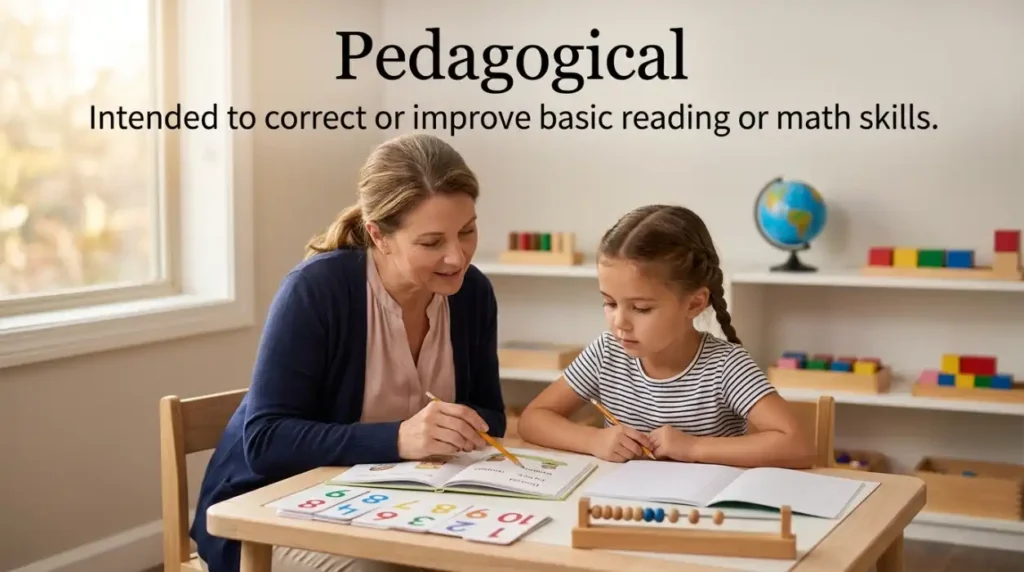
35. Remedial (Adjective)
Meaning: Intended to correct or improve basic reading or math skills.
Tone/Register: Educational / Supportive
Examples:
- The center provides remedial reading lessons for struggling kids.
- Tutors offer remedial assistance during after-school study hours.
36. Orientational (Adjective)
Meaning: Serving to introduce, familiarize, and guide learners.
Tone/Register: Administrative / Formal
Examples:
- Freshmen attended an orientational meeting on university policies.
- The course opens with orientational modules on study skills.
37. Evaluative (Adjective)
Meaning: Involving assessment, testing, or judgment of learning progress.
Tone/Register: Academic / Professional
Examples:
- Quizzes serve an evaluative purpose in tracking student retention.
- Teachers use evaluative rubrics to grade research papers fairly.
38. Diagnostic (Adjective)
Meaning: Used to identify specific strengths, weaknesses, or learning needs.
Tone/Register: Professional / Technical
Examples:
- Schools run diagnostic tests at the start of every academic year.
- Diagnostic feedback helps students focus on difficult concepts.
39. Interactive (Adjective)
Meaning: Requiring active participation and two-way engagement from learners.
Tone/Register: Modern / Conversational
Examples:
- Children learn quickly when using interactive whiteboards in class.
- The workshop featured interactive games to keep participants engaged.
40. Demonstration-based (Adjective)
Meaning: Taught through practical show-and-tell modeling rather than theory.
Tone/Register: Practical / Vocational
Examples:
- Science labs utilize demonstration-based teaching for safety rules.
- Culinary schools rely on demonstration-based lessons every day.
41. Socratic (Adjective)
Meaning: Involving a method of teaching through guided questioning and dialogue.
Tone/Register: Academic / Formal
Examples:
- Law professors favor the Socratic method to test critical thinking.
- The seminar used Socratic questioning to explore moral dilemmas.
42. Direct instructional (Adjective)
Meaning: Involving explicit, step-by-step teacher leadership and explanation.
Tone/Register: Professional / Educational
Examples:
- Math teachers often rely on direct instructional methods for formulas.
- Direct instructional steps ensure all pupils master core concepts.
43. Constructivist (Adjective)
Meaning: Based on the theory that learners build knowledge actively through experience.
Tone/Register: Academic / Specialized
Examples:
- Constructivist classrooms encourage hands-on scientific experiments.
- Teachers design constructivist tasks where kids solve real problems.
44. Experiential (Adjective)
Meaning: Derived from or involving direct, hands-on personal experience.
Tone/Register: Modern / Educational
Examples:
- Outdoor trips offer experiential learning opportunities in biology.
- Internships provide experiential training for college graduates.
45. Skill-centric (Adjective)
Meaning: Focused primarily on practical competencies rather than abstract theory.
Tone/Register: Business / Technical
Examples:
- Tech institutes design skill-centric programs for software design.
- Employers prefer skill-centric courses that mirror actual job duties.
46. Comprehension-focused (Adjective)
Meaning: Aimed at ensuring deep understanding rather than simple memorization.
Tone/Register: Academic / Educational
Examples:
- Reading coaches use comprehension-focused tasks with young readers.
- Comprehension-focused tests assess how well kids explain concepts.
47. Foundational (Adjective)
Meaning: Providing the basic groundwork or essential principles for learning.
Tone/Register: General / Standard
Examples:
- Phonics provides foundational reading skills for early learners.
- Algebra forms a foundational requirement for engineering studies.
48. Enriching (Adjective)
Meaning: Improving the quality, depth, or value of intellectual experience.
Tone/Register: Warm / Positive
Examples:
- After-school drama clubs offer enriching experiences for kids.
- Travel provides an enriching perspective on foreign languages.
49. Mind-expanding (Adjective)
Meaning: Broadening one’s horizons, awareness, or intellectual perspective.
Tone/Register: Informal / Expressive
Examples:
- Studying astronomy can be a mind-expanding journey for students.
- Visiting historical ruins offers a mind-expanding afternoon.
50. Brain-building (Adjective)
Meaning: Promoting cognitive development and mental growth.
Tone/Register: Informal / Modern
Examples:
- Puzzles and chess serve as great brain-building tools for older adults.
- Early reading activities spark crucial brain-building connections.
51. Skill-enhancing (Adjective)
Meaning: Improving or sharpening existing talents and abilities.
Tone/Register: Professional / General
Examples:
- Writing workshops offer skill-enhancing tips for journalists.
- Online courses provide skill-enhancing exercises for accountants.
52. Lesson-based (Adjective)
Meaning: Structured around individual, defined units of study.
Tone/Register: Practical / Educational
Examples:
- Language apps use lesson-based modules to teach grammar.
- The course provides lesson-based practice tests every Friday.
53. Thought-provoking (Adjective)
Meaning: Stimulating careful, deep thought and intellectual interest.
Tone/Register: General / Expressive
Examples:
- The lecturer delivered a thought-provoking talk on artificial intelligence.
- Her article raised thought-provoking questions about modern schooling.
54. Intellect-shaping (Adjective)
Meaning: Having a deep, lasting impact on mental growth and reasoning.
Tone/Register: Literary / Formal
Examples:
- Great mentors play an intellect-shaping role in students’ lives.
- Higher education offers intellect-shaping challenges for adults.
55. Practice-oriented (Adjective)
Meaning: Emphasizing practical application over theoretical study.
Tone/Register: Professional / Practical
Examples:
- Nursing schools rely on practice-oriented training in hospitals.
- The workshop offers practice-oriented exercises for public speakers.
56. Learning-centered (Adjective)
Meaning: Designed around the needs, progress, and experience of the student.
Tone/Register: Educational / Modern
Examples:
- Modern schools advocate for learning-centered classroom design.
- Learning-centered strategies adapt lessons to individual paces.
57. Pupil-focused (Adjective)
Meaning: Giving primary attention to the growth and wellbeing of students.
Tone/Register: Friendly / Educational
Examples:
- Teachers maintain a pupil-focused mindset during daily planning.
- The academy introduced pupil-focused support programs this fall.
58. Student-centric (Adjective)
Meaning: Prioritizing student participation, interests, and learning styles.
Tone/Register: Professional / Modern
Examples:
- Student-centric teaching encourages active debate over passive listening.
- Digital tools make it easier to create student-centric lesson plans.
59. Knowledge-sharing (Adjective)
Meaning: Facilitating the mutual exchange of information and expertise.
Tone/Register: Business / Educational
Examples:
- Research groups host knowledge-sharing meetings every month.
- Digital forums provide a knowledge-sharing space for teachers.
60. Mind-cultivating (Adjective)
Meaning: Dedicated to fostering intellectual curiosity and character growth.
Tone/Register: Formal / Literary
Examples:
- Reading classic literature remains a mind-cultivating pursuit.
- Good schools offer mind-cultivating experiences beyond exam prep.
Synonyms by Tone
Grouping synonyms by tone helps you choose the perfect word for any context:
Positive / Supportive Tone
- Enlightened
- Enriching
- Nurturing
- Mind expanding
- Cultivating
Neutral / Professional Tone
- Instructional
- Educational
- Formative
- Academic
- Methodological
Academic / Formal Tone
- Scholastic
- Didactic
- Socratic
- Constructivist
- Preceptive
Playful / Informal Tone
- Interactive
- Brain building
- Mind expanding
- Hands-on
- Skill-building
Why Tone Matters:
Tone shapes how your reader perceives your message. Calling a teaching style “nurturing” sounds supportive and warm, while calling it “didactic” suggests it might be stiff or preachy!
Mini Comparison
| Word | Core Meaning Focus | Tone & Register | Ideal Usage Context |
| Pedagogical | Theory and practice of formal teaching methods | Academic / Formal | Teacher training, research papers, curriculum planning |
| Instructional | Giving clear direction and direct practical guidance | Professional / Neutral | Training manuals, video tutorials, lesson plans |
| Didactic | Intended to teach moral or formal lessons strictly | Formal / Critical | Literary analysis, moral speeches, critique of preachy style |
Context-Based Usage
Daily Conversation
In casual settings, stick to simple terms like interactive, helpful, teaching, or brain-building when talking about learning experiences.
Writing or Blogging
Bloggers engage readers with active adjectives such as enriching, hands-on, thought-provoking, or student-centric.
Professional or Academic Tone
Use precise, formal terms like pedagogical, instructional, methodological, formative, or scholastic in research and reports.
Creative Writing
Storytellers build memorable characters using descriptive terms like didactic, edifying, intellect-shaping, or perceptive.
Common Mistakes & Native Usage

Misuse Scenarios
- Confusing “Didactic” with “Pedagogical”: While both relate to teaching, didactic often carries a negative implication of being preachy or overly moralistic.
- Overusing Complex Jargon: Using “pedagogical” in casual conversation can sound pretentious. Save it for academic or professional discussions.
- Ignoring Context Nuance: Do not use “pedagogical” when you simply mean “educational” for a kids’ toy. Use educational or fun learning instead.
Register Notes
- Use academic terms (pedagogical, methodological) in university essays.
- Use direct terms (instructional, training-focused) in business settings.
- Explore our detailed guide on academic writing techniques to improve your vocabulary.
Real-Life Mini Scenarios
- Workplace: The HR department updated its instructional materials to help new employees learn software faster.
- Social Situations: Parents loved the museum’s interactive exhibit that allowed kids to build miniature bridges.
- Media / Pop Culture: Film reviewers praised the documentary for its thought-provoking approach to climate solutions.
- Writing & Storytelling: The author created a didactic old professor character who constantly quoted ancient proverbs.
Conclusion
Learning a synonym for pedagogical gives you more precise ways to discuss education, teaching methods, instructional approaches, and learning experiences. Selecting the right alternative can make academic and professional writing clearer and more engaging.
A broader vocabulary is valuable for essays, research papers, teacher training materials, reports, blog posts, and everyday communication. Understanding terms such as educational, instructional, didactic, academic, and teaching-related can help you match your word choice to the context and intended meaning.
Put these new vocabulary choices into practice by using two or three alternatives in your next essay, email, lesson plan, or article. Regular practice can reduce repetition, strengthen your expression, and help you communicate educational ideas with greater clarity and confidence.
Practice Exercise
Test your understanding of meaning, tone, and context with these practical scenario questions.
1. Which term best describes a teacher using guided questions to stimulate critical thinking?
A) Socratic
B) Didactic
C) Remedial
D) Scholastic
2. Which word fits best when describing step-by-step guidance in a software user manual?
A) Didactic
B) Preceptive
C) Instructional
D) Scholastic
3. Which term carries a slightly negative tone implying a preachy teaching style?
A) Enriching
B) Interactive
C) Nurturing
D) Didactic
4. What is the best word for a class designed to help struggling students catch up in math?
A) Scholarly
B) Remedial
C) Socratic
D) Preceptive
5. Which adjective describes hands-on learning gained through direct experience?
A) Academic
B) Orientational
C) Experiential
D) Formative
6. What word best fits an official curriculum directly connected to state standards?
A) Curriculum linked
B) Mind-expanding
C) Didactic
D) Perceptive
7. Which warm term describes a supportive classroom environment that fosters growth?
A) Didactic
B) Disciplinary
C) Methodological
D) Nurturing
8. What formal word refers specifically to things of schools and pupils?
A) Brain-building
B) Interactive
C) Skill-centric
D) Scholastic
9. Which modern term describes teaching focused entirely on student participation?
A) Didactic
B) Preceptive
C) Student-centric
D) Evaluative
10. What word best describes a test given at the start of a term to identify student needs?
A) Edifying
B) Diagnostic
C) Socratic
D) Propagative
Reflection Task:
Write two original sentences describing a memorable lesson or teacher using two new synonyms learned from this article.
Answer Key:
1A | 2C | 3D | 4B | 5C | 6A | 7D | 8D | 9C | 10B
Frequently Asked Questions
1. What is the most common synonym for pedagogical?
The most common and widely understood synonym for “pedagogical” is “educational” or “instructional.” While “pedagogical” emphasizes teaching theories and methods, “instructional” focuses on direct guidance, and “educational” covers learning broadly.
2. Is “didactic” exact in meaning to “pedagogical”?
Not entirely. While both relate to teaching, “pedagogical” is a neutral academic term for teaching methodology. “Didactic” often carries a negative nuance, suggesting instruction that is overly formal, preachy, or focused on strict moral lessons.
3. When should I use “pedagogical” instead of “educational”?
Use “pedagogical” when specifically discussing teaching techniques, teacher training, or instructional design. Use “educational” for general topics like school funding, field trips, or informative children’s toys.
4. What is a good casual alternative to pedagogical?
In everyday speech or informal writing, plain terms like “teaching-focused,” “learning-centered,” “interactive,” or “hands-on” work much better than “pedagogical.”
5. What does “pedagogical strategy” mean in teaching?
A pedagogical strategy refers to the specific method, plan, or instructional approach a teacher uses to help students understand subject material, such as group projects, lectures, or hands-on experiments.
6. Is “pedagogical” used in business environments?
Yes, especially in corporate training, professional development, and educational technology (EdTech) sectors where designing effective employee learning programs is essential.

Jameel Hassan is the founder and lead writer at SynonymsCloud.com, a trusted online platform dedicated to English vocabulary and effective communication. He is passionate about helping students, writers, professionals, and lifelong learners discover the right words to express their ideas with clarity, precision, and confidence.
At SynonymsCloud.com, every article is thoroughly researched and carefully written to provide accurate, practical, and easy-to-understand guidance on synonyms, antonyms, word meanings, idioms, and vocabulary. With a strong commitment to quality, real-world usage, and clear explanations, the website helps readers expand their vocabulary, improve their writing, and communicate more effectively in both academic and professional settings.