
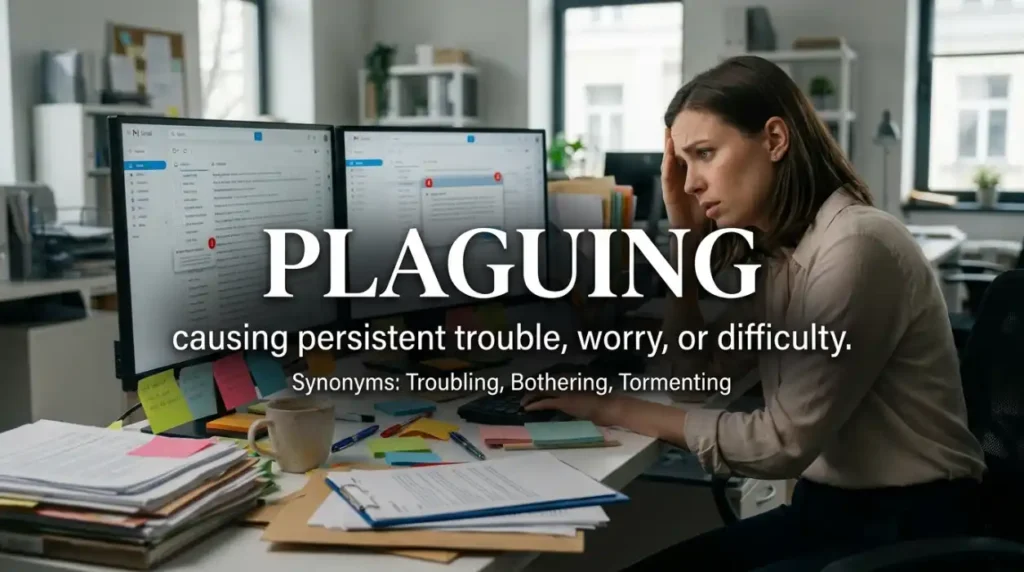
Synonym for plaguing includes words such as troubling, afflicting, bothering, hampering, and tormenting. The best choice depends on whether the problem causes worry, suffering, annoyance, or ongoing difficulty.
Synonyms for plaguing become useful when the same word appears repeatedly in your writing. A student describing exam stress, for example, can replace repeated uses of plaguing with more precise alternatives.
Imagine a blogger writing about delays that keep affecting a business. Instead of repeating “plaguing,” words like hampering or hindering can show exactly how those delays affect progress.
The word is common because it describes problems that continue over time. Students, bloggers, content writers, and daily English users can use its alternatives to sound clearer.
Learning a synonym for plaguing also improves vocabulary. The right alternative can make an essay more formal, a conversation more natural, or a story more emotionally powerful.
What Does “Plaguing” Really Mean?
Plaguing means repeatedly causing worry, pain, difficulty, suffering, or annoyance to someone or something.
The word comes from the verb plague. Cambridge defines the verb as causing worry, pain, or difficulty over a period of time. It can also describe repeatedly annoying someone, especially through repeated questions or requests.
For example:
“Financial problems are plaguing the company.”
This means financial problems continue to create difficulty for the company.
Another example is:
“Doubts were plaguing her before the interview.”
Here, plaguing suggests that the doubts repeatedly troubled her.
Native speakers usually associate plaguing with an unwanted situation that continues or keeps returning. It is stronger than the neutral word affecting in many contexts.
Simple Definition
Plaguing: repeatedly causing trouble, pain, worry, suffering, or difficulty.
Part of Speech
Plaguing is the present participle and -ing form of the verb plague.
It commonly appears in structures such as:
- Problems are plaguing the company.
- Doubts have been plaguing him.
- Delays continue to plague the project.
- She is being plagued by anxiety.
Connotative Meaning
Connotation (the emotional feeling or association connected with a word) helps explain why plaguing often sounds negative.
Positive Tone
The word itself is rarely positive because it describes something unwanted.
A positive context can appear when the problem is finally solved:
“The team solved the issue that had been plaguing them.”
The positive feeling comes from the solution, not from plaguing.
Negative Tone
This is the most common tone.
“Constant doubts were plaguing the new employee.”
The sentence suggests continuing emotional difficulty.
Neutral Tone
In factual, academic, or professional writing, plaguing can sound relatively neutral.
“Several errors are plaguing the current system.”
The writer is identifying a recurring problem rather than expressing strong emotion.
Etymology of “Plaguing”
The history of plaguing comes from the verb plague.
The noun plague appeared in English in the late 14th century as plage, meaning an affliction, calamity, evil, scourge, severe trouble, or vexation. It came through Old French from Late Latin plaga, meaning an affliction, destruction, or slaughter.
The verb plague appeared in the late 15th century. It came from Middle Dutch plaghen, meaning to afflict with disease or another calamity. The broader sense of vexing, harassing, bothering, or annoying appeared later.
Old English: 450–1100
The modern word plague was not established in English during the Old English period. English speakers used other native words for sickness, suffering, trouble, and affliction.
Therefore, it would be inaccurate to claim that plague was an Old English word in its modern form.
Middle English: 1100–1500
The word entered English during the Middle English period through French and Dutch influence.
The noun developed meanings connected with affliction, calamity, disease, and serious trouble. The verb later developed the idea of causing such suffering.
Modern English: 1500–Present
During Modern English, plague gained wider uses.
It could refer to disease, widespread trouble, serious difficulty, or persistent annoyance. The figurative meaning of something troublesome became increasingly common.
Today, plaguing is widely used for problems involving business, education, technology, health, society, emotions, and everyday life.
Pronunciation of “Plaguing”
The base verb plague is pronounced /pleɪɡ/ in both British and American English.
For plaguing:
- US: /ˈpleɪɡɪŋ/
- UK: /ˈpleɪɡɪŋ/
Syllables
plague-ing
The word has two syllables.
Affixation Pattern of “Plaguing”
Root: plague
Prefix: none
Suffix: -ing
The spelling changes when the suffix is added:
plague + ing → plaguing
The final silent e is removed before -ing.
Synonyms List
The alternatives below are numbered for easy reference. They are not interchangeable in every sentence. Each one highlights a particular shade of meaning.
1. Troubling (Verb) — US / UK: /ˈtrʌblɪŋ/
Meaning: Causing worry, concern, or emotional discomfort.
Tone/Register: Neutral, everyday, professional.
Examples:
The sudden drop in sales is troubling the store owner.
Recent reports are troubling many residents.

2. Afflicting (Verb) — US / UK: /əˈflɪktɪŋ/
Meaning: Causing serious physical, emotional, or practical suffering.
Tone/Register: Formal, medical, academic.
Examples:
A chronic illness is afflicting thousands of patients.
The drought is afflicting farming communities across the region.
3. Bothering (Verb) — US / UK: /ˈbɑːðərɪŋ/
Meaning: Causing annoyance, discomfort, or minor concern.
Tone/Register: Informal, conversational.
Examples:
The loud music is bothering my neighbors.
A strange noise has been bothering me since yesterday.
4. Hampering (Verb) — US / UK: /ˈhæmpərɪŋ/
Meaning: Making progress or activity more difficult.
Tone/Register: Professional, academic, neutral.
Examples:
A lack of funding is hampering the research project.
Heavy traffic was hampering emergency workers.
5. Hindering (Verb) — US / UK: /ˈhɪndərɪŋ/
Meaning: Slowing or preventing progress.
Tone/Register: Formal, academic.
Examples:
Poor communication is hindering the team’s performance.
Limited access to data is hindering further research.
6. Tormenting (Verb) — US / UK: /tɔːrˈmentɪŋ/
Meaning: Causing severe and prolonged mental or physical suffering.
Tone/Register: Strong, emotional, literary.
Examples:
The memory of the accident was tormenting him.
Persistent pain kept tormenting the injured athlete.
7. Vexing (Verb) — US / UK: /ˈveksɪŋ/
Meaning: Causing repeated irritation, frustration, or difficulty.
Tone/Register: Formal, literary, professional.
Examples:
A minor error was vexing the entire research team.
The unexplained result remained vexing for the scientists.
8. Annoying (Verb) — US / UK: /əˈnɔɪɪŋ/
Meaning: Causing irritation or impatience.
Tone/Register: Everyday, informal.
Examples:
Those constant alerts are annoying everyone in the office.
The dripping tap has been annoying us all morning.
9. Pestering (Verb) — US / UK: /ˈpestərɪŋ/
Meaning: Repeatedly bothering someone, often by asking for something.
Tone/Register: Informal, conversational.
Examples:
The children kept pestering their mother for another snack.
He was pestering his colleague for an immediate response.
10. Nagging (Verb) — US / UK: /ˈnæɡɪŋ/
Meaning: Repeatedly worrying, criticizing, or reminding someone.
Tone/Register: Informal.
Examples:
A nagging doubt made her reconsider the decision.
His nagging concerns about the plan turned out to be valid.
11. Hounding (Verb) — US / UK: /ˈhaʊndɪŋ/
Meaning: Pursuing or pressuring someone persistently.
Tone/Register: Informal, journalistic.
Examples:
Reporters were hounding the actor for an explanation.
Debt collectors kept hounding him about the unpaid balance.
12. Dogging (Verb) — US / UK: /ˈdɑːɡɪŋ/
Meaning: Continually troubling or following someone or something.
Tone/Register: Informal, journalistic.
Examples:
Injuries have been dogging the footballer this season.
Repeated delays continued to dog the construction project.
13. Besetting (Verb) — US / UK: /bɪˈsetɪŋ/
Meaning: Continually surrounding or troubling someone or something.
Tone/Register: Formal, literary.
Examples:
The company faced several risks besetting the industry.
Doubt was besetting her before the important meeting.
14. Beleaguering (Verb) — US / UK: /bɪˈliːɡərɪŋ/
Meaning: Continually causing difficulty or pressure.
Tone/Register: Formal, journalistic.
Examples:
Officials discussed the shortages beleaguering rural hospitals.
The report examined the problems beleaguering the education system.
15. Burdening (Verb) — US / UK: /ˈbɜːrdənɪŋ/
Meaning: Placing an unwanted responsibility, cost, or difficulty on someone.
Tone/Register: Neutral, formal.
Examples:
Higher taxes are burdening low-income families.
Extra paperwork is burdening the small business.
16. Oppressing (Verb) — US / UK: /əˈpresɪŋ/
Meaning: Causing severe hardship or maintaining harsh control over people.
Tone/Register: Strong, political, formal.
Examples:
The regime was accused of oppressing vulnerable communities.
Generations suffered under a system that was oppressing workers.
17. Distressing (Verb) — US / UK: /dɪˈstresɪŋ/
Meaning: Causing sadness, anxiety, pain, or emotional suffering.
Tone/Register: Formal, emotional.
Examples:
The news was distressing families across the city.
The uncertainty became increasingly distressing for the students.
18. Besieging (Verb) — US / UK: /bɪˈsiːdʒɪŋ/
Meaning: Overwhelming someone with persistent demands, questions, or pressure.
Tone/Register: Formal, figurative.
Examples:
Customers were besieging the help desk with complaints.
Journalists were besieging the politician with difficult questions.
19. Assailing (Verb) — US / UK: /əˈseɪlɪŋ/
Meaning: Attacking someone or something repeatedly, especially with criticism.
Tone/Register: Formal, journalistic.
Examples:
Critics were assailing the proposal from every direction.
The new policy was assailed by opposition groups.
20. Attacking (Verb) — US / UK: /əˈtækɪŋ/
Meaning: Causing harm through a physical, verbal, or strategic attack.
Tone/Register: Neutral, broad.
Examples:
Cybercriminals were attacking the company’s network.
Opponents kept attacking the proposal during the debate.
21. Hurting (Verb) — US / UK: /ˈhɜːrtɪŋ/
Meaning: Causing physical or emotional pain.
Tone/Register: Everyday, simple.
Examples:
The injury is hurting his ability to train.
Her harsh words were hurting their relationship.
22. Harming (Verb) — US / UK: /ˈhɑːrmɪŋ/
Meaning: Causing injury, damage, or negative effects.
Tone/Register: Neutral, formal.
Examples:
Plastic waste is harming marine animals.
Poor decisions are harming the organization’s reputation.
23. Damaging (Verb) — US / UK: /ˈdæmɪdʒɪŋ/
Meaning: Causing physical, financial, practical, or reputational damage.
Tone/Register: Neutral, professional.
Examples:
False information is damaging the company’s image.
Water leaks are damaging the walls of the building.
24. Undermining (Verb) — US / UK: /ˌʌndərˈmaɪnɪŋ/
Meaning: Gradually weakening confidence, authority, success, or effectiveness.
Tone/Register: Professional, academic, political.
Examples:
Constant criticism is undermining her confidence.
Poor communication is undermining trust within the team.
25. Disrupting (Verb) — US / UK: /dɪsˈrʌptɪŋ/
Meaning: Interrupting normal activity or operations.
Tone/Register: Neutral, business, academic.
Examples:
Power failures are disrupting online lessons.
Road construction is disrupting traffic throughout the area.
26. Impairing (Verb) — US / UK: /ɪmˈperɪŋ/
Meaning: Reducing the quality, ability, strength, or effectiveness of something.
Tone/Register: Formal, medical, academic.
Examples:
Lack of sleep is impairing his concentration.
The injury was impairing her ability to move freely.
27. Impeding (Verb) — US / UK: /ɪmˈpiːdɪŋ/
Meaning: Slowing movement, development, or progress.
Tone/Register: Formal, academic.
Examples:
Outdated laws are impeding economic development.
Heavy snow was impeding rescue operations.
28. Saddling (Verb) — US / UK: /ˈsædlɪŋ/
Meaning: Burdening someone with an unwanted responsibility or problem.
Tone/Register: Informal, journalistic.
Examples:
The new rule is saddling small businesses with extra costs.
The mistake left her saddled with additional work.
29. Inflicting (Verb) — US / UK: /ɪnˈflɪktɪŋ/
Meaning: Deliberately causing pain, suffering, or damage.
Tone/Register: Formal, serious.
Examples:
The conflict is inflicting severe damage on local communities.
The attack inflicted lasting emotional harm on survivors.
30. Persecuting (Verb) — US / UK: /ˈpɜːrsɪkjuːtɪŋ/
Meaning: Repeatedly treating someone cruelly because of identity, beliefs, or other characteristics.
Tone/Register: Serious, political, historical.
Examples:
The government was accused of persecuting a religious community.
The historical record shows communities being persecuted for their beliefs.
31. Ravaging (Verb) — US / UK: /ˈrævɪdʒɪŋ/
Meaning: Causing severe and widespread destruction.
Tone/Register: Strong, dramatic, journalistic.
Examples:
Floodwaters were ravaging villages near the river.
The disease was ravaging crops across the valley.
32. Devastating (Verb) — US / UK: /ˈdevəsteɪtɪŋ/
Meaning: Causing extremely serious physical, emotional, or social damage.
Tone/Register: Strong, emotional.
Examples:
The earthquake was devastating several coastal towns.
The sudden loss was devastating to the entire family.
33. Blighting (Verb) — US / UK: /ˈblaɪtɪŋ/
Meaning: Spoiling or damaging the development, quality, or appearance of something.
Tone/Register: Formal, literary.
Examples:
Abandoned buildings are blighting the neighborhood.
Long-term unemployment is blighting many young lives.
34. Marring (Verb) — US / UK: /ˈmɑːrɪŋ/
Meaning: Spoiling the quality, beauty, or success of something.
Tone/Register: Formal, literary.
Examples:
A few mistakes were marring an otherwise strong presentation.
Construction noise was marring the peaceful atmosphere.
35. Infecting (Verb) — US / UK: /ɪnˈfektɪŋ/
Meaning: Spreading disease or, figuratively, spreading a harmful influence.
Tone/Register: Medical, formal, figurative.
Examples:
The virus was infecting computers across the network.
Fear was infecting conversations throughout the community.
36. Infesting (Verb) — US / UK: /ɪnˈfestɪŋ/
Meaning: Spreading throughout a place in large numbers and causing damage or unpleasant conditions.
Tone/Register: Negative, environmental.
Examples:
Cockroaches were infesting the abandoned restaurant.
Insects were infesting the stored grain.
37. Overrunning (Verb) — US / UK: /ˌoʊvərˈrʌnɪŋ/
Meaning: Spreading across something excessively or taking over in large numbers.
Tone/Register: Neutral to strong.
Examples:
Weeds were overrunning the neglected garden.
Spam messages were overrunning the company’s inbox.
38. Preying on (Verb Phrase) — US / UK: /ˈpreɪɪŋ ɑːn/
Meaning: Taking advantage of someone’s weakness or vulnerability.
Tone/Register: Strong, figurative, journalistic.
Examples:
Scammers were preying on older residents.
Fear was preying on her mind before the examination.
39. Weighing on (Verb Phrase) — US / UK: /ˈweɪɪŋ ɑːn/
Meaning: Creating continuing emotional worry or pressure.
Tone/Register: Everyday, emotional.
Examples:
The unpaid bills were weighing on his mind.
The difficult choice has been weighing on her for days.
40. Hanging over (Verb Phrase) — US / UK: /ˈhæŋɪŋ ˈoʊvər/
Meaning: Remaining as a continuing threat, worry, or concern.
Tone/Register: Conversational, neutral.
Examples:
The possibility of layoffs is hanging over the department.
An unresolved dispute was hanging over the negotiations.

41. Consuming (Verb) — US / UK: /kənˈsuːmɪŋ/
Meaning: Taking up someone’s thoughts or attention almost completely.
Tone/Register: Emotional, literary.
Examples:
Worry about the future was consuming her thoughts.
His concern about the result became increasingly consuming.
42. Overwhelming (Verb) — US / UK: /ˌoʊvərˈwelmɪŋ/
Meaning: Becoming so intense or numerous that someone struggles to cope.
Tone/Register: Neutral, emotional, professional.
Examples:
The growing workload was overwhelming the small team.
Too many messages were overwhelming him during the event.
43. Aggravating (Verb) — US / UK: /ˈæɡrəveɪtɪŋ/
Meaning: Making an existing problem, pain, or irritation worse.
Tone/Register: Formal, medical, everyday.
Examples:
Running is aggravating her knee injury.
The delay is aggravating an already difficult situation.
44. Oppressing (Verb) — US / UK: /əˈpresɪŋ/
Meaning: Subjecting people to severe hardship or unjust control.
Tone/Register: Strong, political, formal.
Examples:
The authorities were accused of oppressing vulnerable citizens.
The system had been oppressing workers for decades.
45. Chafing (Verb) — US / UK: /ˈtʃeɪfɪŋ/
Meaning: Causing irritation, frustration, or discomfort through continued pressure.
Tone/Register: Figurative, literary, conversational.
Examples:
The strict rules were chafing the independent-minded students.
Constant supervision was chafing him at work.
46. Harassing (Verb) — US / UK: /həˈræsɪŋ/
Meaning: Repeatedly disturbing, intimidating, or pressuring someone.
Tone/Register: Serious, legal, social.
Examples:
The caller kept harassing the customer with unwanted messages.
Several employees reported being harassed at work.
47. Afflicting (Verb) — US / UK: /əˈflɪktɪŋ/
Meaning: Causing serious suffering or hardship.
Tone/Register: Formal, serious.
Examples:
Severe poverty is afflicting families in the region.
The condition has been afflicting patients for years.
48. Plaguing Alternatives: Weighing Upon (Verb Phrase) — US / UK: /ˈweɪɪŋ əˈpɑːn/
Meaning: Creating a persistent emotional or mental burden.
Tone/Register: Formal, literary.
Examples:
The unresolved dispute was weighing upon his conscience.
Financial uncertainty was weighing upon the entire family.
49. Burdening (Verb) — US / UK: /ˈbɜːrdənɪŋ/
Meaning: Giving someone or something a heavy responsibility or difficulty.
Tone/Register: Neutral, formal.
Examples:
Rising energy prices are burdening local businesses.
The extra responsibilities were burdening the new manager.
50. Permeating (Verb) — US / UK: /ˈpɜːrmieɪtɪŋ/
Meaning: Spreading throughout something so that it strongly affects the whole situation.
Tone/Register: Formal, academic.
Examples:
A sense of uncertainty was permeating the organization.
Distrust was permeating the team’s daily discussions.
Editorial note: Some alternatives above overlap in meaning but are not exact substitutes. For example, persecuting implies targeted mistreatment, while hampering specifically focuses on obstructing progress. Use the word that matches the intended meaning rather than replacing plaguing mechanically.
Synonyms by Tone
Neutral Synonyms
For ordinary explanations, these are useful:
- troubling
- bothering
- harming
- damaging
- disrupting
- hindering
- burdening
- impairing
- hampering
These choices are clear and suitable for general readers.
Negative or Strong Synonyms
When the problem causes serious suffering, consider:
- afflicting
- tormenting
- distressing
- ravaging
- devastating
- inflicting
- oppressing
- persecuting
These words create a stronger emotional effect.
Formal and Academic Synonyms
For essays, reports, and research, useful options include:
- impeding
- impairing
- undermining
- beleaguering
- besetting
- afflicting
- hampering
- permeating
Informal Synonyms
For casual speech, these sound more natural:
- bothering
- annoying
- pestering
- nagging
- hounding
- dogging
Figurative Synonyms
For thoughts, emotions, or abstract problems, consider:
- weighing on
- hanging over
- preying on
- consuming
- undermining
- permeating
Tone matters because two words can describe a similar problem while creating very different impressions.
“Plaguing” vs Close Alternatives
Troubling vs Plaguing
Plaguing usually suggests a repeated or continuing problem.
Troubling focuses more strongly on worry or concern.
“Technical problems are plaguing the website.”
This suggests recurring technical problems.
“The results are troubling researchers.”
This focuses on the researchers’ concern.
Plaguing vs Bothering
Bothering is lighter and more conversational.
Plaguing usually sounds more persistent or serious.
“The noise is bothering me.”
This sounds natural in daily speech.
“Noise pollution is plaguing the neighborhood.”
This presents the problem as more serious and ongoing.
Plaguing vs Hampering
Plaguing means repeatedly causing difficulty.
Hampering specifically means making progress harder.
“Technical errors are plaguing the system.”
The system repeatedly experiences problems.
“Technical errors are hampering development.”
The errors are specifically slowing progress.
How “Plaguing” Changes by Context
Daily Conversation
In everyday English, plaguing can describe a recurring personal problem.
“This headache has been plaguing me all morning.”
However, bothering may sound more natural in casual speech.
“This headache has been bothering me all morning.”
Both are correct. The second sounds lighter.
Writing and Blogging
Bloggers can use plaguing to describe a recurring issue.
“These mistakes are plaguing new writers.”
The word is especially useful when discussing common problems, challenges, or persistent mistakes.
Professional Writing
In business writing, plaguing can describe continuing organizational problems.
“Supply shortages have been plaguing the company.”
If you want to emphasize slowed progress, hampering or impeding may be more precise.
Academic Writing
Academic writers can use plaguing for persistent weaknesses.
“Several limitations continue to plague existing research.”
A more restrained alternative is:
“Several limitations continue to affect existing research.”
The second option is more neutral.
Creative Writing
In storytelling, plaguing can create emotional intensity.
“Memories of the accident kept plaguing him.”
For greater emotional force, tormenting could be used instead.
Common Mistakes Learners Make
Using “Plaguing” for a Positive Situation
The word normally describes something unwanted.
Incorrect:
“Her success was plaguing the company.”
Better:
“Her success was benefiting the company.”
Using It for a Very Short Problem
Plaguing normally suggests persistence.
Less natural:
“The rain plagued us for five minutes.”
More natural:
“Heavy rain plagued the region for several days.”
Confusing “Plaguing” With “Affecting”
Affecting is much broader.
“The decision affected everyone.”
This statement can be neutral.
“The decision plagued the organization.”
This suggests that the decision created continuing difficulty.
Using “Harassing” Too Casually
Harassing can describe repeated unwanted behavior toward a person.
Do not use it simply because something is mildly inconvenient.
For ordinary irritation, bothering is usually more appropriate.
Using “Tormenting” for Minor Problems
Tormenting is emotionally strong.
A slow internet connection may be bothering you.
A serious emotional struggle may be tormenting you.
Repeating “Plaguing” Too Often
Repeated use can make an article sound mechanical.
Instead of:
“Errors are plaguing the system. Delays are plaguing the team. Costs are plaguing the project.”
Try:
“Errors are disrupting the system. Delays are hampering the team. Rising costs are burdening the project.”
This gives each problem a more precise description.
Native Usage Notes
Native speakers frequently use plague with continuing problems.
Common structures include:
- be plagued by problems
- be plagued with errors
- be plagued by doubts
- be plagued by delays
- problems plague the industry
- issues continue to plague the organization
The passive structure “be plagued by” is particularly common in formal and journalistic writing.
For example:
“The industry has been plagued by shortages.”
The active form is also natural:
“Shortages have plagued the industry for years.”
Both constructions communicate persistent difficulty.
Real-Life Mini Scenarios

Workplace
A project manager notices repeated delays.
“Staff shortages are plaguing the project.”
If the focus is on slower progress:
“Staff shortages are hampering the project.”
Social Situation
Someone receives unwanted messages every day.
“The messages are bothering her.”
If the messages become threatening or persistent:
“The messages are harassing her.”
The second sentence is much more serious.
Media and Pop Culture
A celebrity repeatedly faces controversy.
“The controversy has been plaguing the actor for months.”
A journalist could use dogging when emphasizing that the controversy continues to follow the person.
Writing and Storytelling
A character cannot stop thinking about a mistake.
“The memory kept plaguing him.”
For stronger emotional language:
“The memory kept tormenting him.”
How to Choose the Right Synonym
Ask what the problem actually does.
When something creates worry or concern, troubling is often the most suitable choice.
For situations that cause annoyance or irritation, consider bothering or annoying.
When the meaning involves serious suffering or distress, afflicting conveys the idea more strongly.
For intense emotional pain or ongoing anguish, tormenting is a more precise alternative.
If something slows progress or makes an activity difficult, hampering or impeding works well.
When a person, action, or problem weakens confidence, influence, or authority, undermining may be the better term.
For physical harm, loss, or practical damage, harming or damaging provides a clearer meaning.
When a problem creates mental pressure or persistent concern, the phrase weighing on can sound more natural.
In cases involving persistent pressure, harassment, or repeated pursuit, hounding may be appropriate.
Where the meaning suggests unfair or targeted treatment, persecuting is the more specific choice. If it involves unfair targeted treatment, use persecuting.
This method is more useful than choosing a synonym simply because it appears in a thesaurus.
Practice Exercise
Choose the best answer for each situation.
1. Which word best describes a recurring technical problem?
A. Praising
B. Plaguing
C. Celebrating
D. Improving
2. Which alternative sounds most natural in casual conversation?
A. Impeding
B. Bothering
C. Afflicting
D. Ravaging
3. Which word means making progress more difficult?
A. Hampering
B. Praising
C. Entertaining
D. Rewarding
4. Which alternative suggests severe emotional suffering?
A. Bothering
B. Tormenting
C. Helping
D. Supporting
5. Which word best describes persistent pressure from reporters?
A. Hounding
B. Marring
C. Improving
D. Permeating
6. Which word fits formal academic writing?
A. Pestering
B. Impeding
C. Bugging
D. Fussing
7. Which word means gradually weakening confidence or authority?
A. Undermining
B. Celebrating
C. Repairing
D. Encouraging
8. Which word can describe a harmful virus spreading through a system?
A. Infecting
B. Praising
C. Editing
D. Supporting
9. Which phrase describes a continuing emotional worry?
A. Weighing on
B. Dressing up
C. Looking after
D. Turning off
10. Which word suggests extremely serious damage?
A. Annoying
B. Devastating
C. Bothering
D. Asking
Reflection Task:
Write one sentence using plaguing. Then rewrite it with one more precise synonym, such as troubling, hampering, bothering, undermining, or tormenting.
Answer Key:
1-B | 2-B | 3-A | 4-B | 5-A | 6-B | 7-A | 8-A | 9-A | 10-B
Frequently Asked Questions
1. What is the best synonym for plaguing in formal writing?
There is no single best formal replacement. Afflicting, hampering, impeding, undermining, impairing, and beleaguering can all work. Choose according to the exact meaning. Use hampering when something slows progress, undermining when something weakens confidence or effectiveness, and afflicting when suffering is the central idea.
2. What is a simple synonym for plaguing?
Bothering is one of the simplest everyday alternatives. Troubling is another useful choice when something causes worry or concern. For example, “The noise is bothering me” sounds natural in conversation. However, plaguing often suggests a problem that is more persistent or serious than an ordinary annoyance.
3. What is a synonym for plaguing someone with questions?
Pestering, hounding, and harassing can describe repeated questioning, but their strength differs. Pestering is common for annoying repeated questions. Hounding suggests persistent pressure. Harassing is much stronger and may imply serious unwanted behavior, so it should not be used for every minor questioning situation.
4. Can plaguing describe emotional problems?
Yes. Plaguing commonly describes anxiety, doubt, fear, guilt, regret, and other emotional difficulties. “Self-doubt has been plaguing her” means that the doubt has continued to trouble her. Alternatives such as tormenting, troubling, weighing on, and preying on can also work, depending on how intense the emotional situation is.
5. Is plaguing stronger than affecting?
Usually, yes. Affecting is broad and can describe positive, negative, or neutral influence. Plaguing normally describes an unwanted and continuing problem. “Traffic affected the schedule” is neutral, while “Traffic plagued the project” suggests that traffic repeatedly created significant difficulty.
6. What is the difference between plaguing and hampering?
Plaguing means repeatedly causing trouble or difficulty. Hampering specifically means making progress or action more difficult. A company can be plagued by technical problems, while those same problems can hamper its ability to launch a product. Therefore, hampering is more precise when obstruction or slower progress is the main idea.
7. What is a good synonym for plaguing in an essay?
Useful formal alternatives include troubling, afflicting, hampering, hindering, impairing, undermining, and impeding. The strongest choice depends on the sentence. Avoid choosing an uncommon word simply to sound academic. A precise, familiar synonym is usually clearer and more effective for readers.
8. What is the difference between plaguing and tormenting?
Plaguing describes a continuing problem, annoyance, worry, or difficulty. Tormenting is much stronger and focuses on severe mental or physical suffering. For example, repeated delays may plague a project, while painful memories may torment a person. The second word creates a much more emotional image.
Conclusion
Learning a synonym for plaguing helps you describe continuing problems with greater precision. Words like troubling, hampering, and afflicting each add a different shade.
Strong vocabulary makes writing clearer and more natural. Instead of repeating one word, you can choose an alternative that matches the exact situation and tone.
These choices also improve speaking and communication. Practice using them in emails, essays, blog posts, and everyday conversations.
Keep building your vocabulary through real examples. Write three sentences today with different synonyms and notice how each word changes the meaning.
Recommended external sources
For factual verification and an external reference section, you can use:
Cambridge Dictionary: plague definition, usage, examples, and meanings.
Online Etymology Dictionary: plague historical origin and development of the noun and verb.

Jameel Hassan is the founder and lead writer at SynonymsCloud.com, a trusted online platform dedicated to English vocabulary and effective communication. He is passionate about helping students, writers, professionals, and lifelong learners discover the right words to express their ideas with clarity, precision, and confidence.
At SynonymsCloud.com, every article is thoroughly researched and carefully written to provide accurate, practical, and easy-to-understand guidance on synonyms, antonyms, word meanings, idioms, and vocabulary. With a strong commitment to quality, real-world usage, and clear explanations, the website helps readers expand their vocabulary, improve their writing, and communicate more effectively in both academic and professional settings.