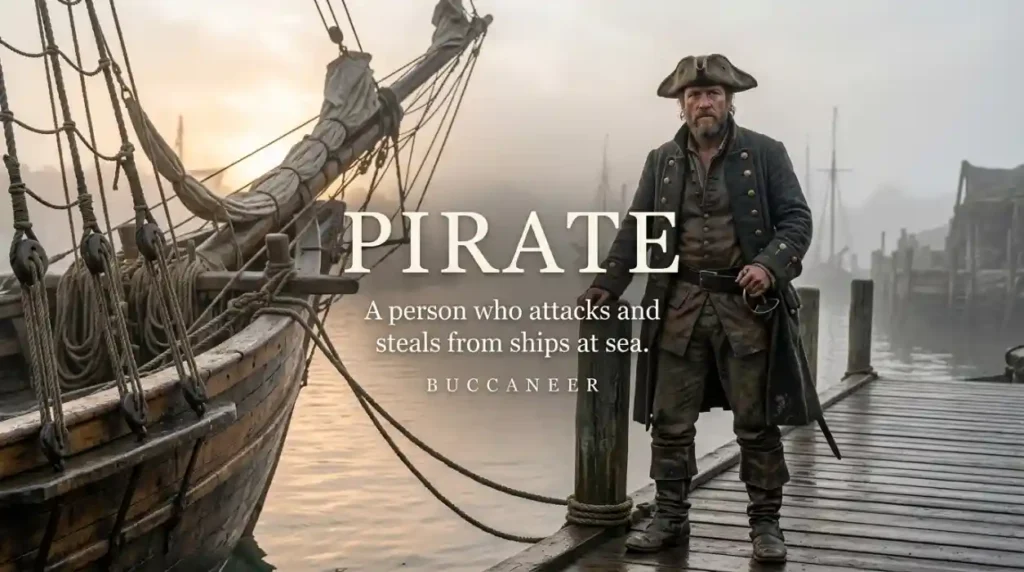
A synonym for pirate can be buccaneer, corsair, freebooter, sea robber, sea raider, or plunderer, depending on context. For historical writing, privateer may also fit, but it specifically refers to someone authorized by a government to attack enemy ships.
A synonym for pirate becomes useful when a story describes a dangerous sailor without repeating the same word. Imagine a novel where a ruthless sea robber boards a merchant ship.
A writer might call that character a buccaneer, corsair, or sea raider. Each alternative creates a slightly different historical or descriptive feeling.
Learning a synonym for pirate helps students, bloggers, and content writers make descriptions more vivid. Daily English users also gain better vocabulary for books, films, and history.
The word is common in history, fiction, movies, gaming, and discussions of copyright. Knowing its different meanings helps you choose the right alternative.
What Does “Pirate” Really Mean?
A pirate is a person who attacks ships or boats and steals from them, usually without legal authority. The word is strongly associated with maritime robbery and historical sea raiding. Cambridge also records a modern meaning for someone who illegally copies and sells music, films, software, or other copyrighted material.
In simple English, a pirate is someone who illegally attacks or takes property from ships at sea.
The word can also work as a verb. To pirate something means to copy or reproduce it illegally, especially copyrighted material.
Native speakers usually connect the noun pirate with historical sea robbers, fictional characters, treasure hunts, ships, and adventure stories. In technology and business contexts, however, pirate can refer to someone who illegally copies software, films, music, or other protected material.
Part of speech: Noun and verb
Simple noun definition: A person who attacks ships and steals from them.
Simple verb definition: To copy or use protected material illegally.
Connotative Meaning
Connotation (the feeling or association a word carries beyond its basic dictionary meaning) can change the effect of pirate.
Positive Tone
In children’s stories, adventure novels, games, and entertainment, pirate can sound exciting, bold, adventurous, rebellious, or independent.
Negative Tone
In historical or legal contexts, the word usually suggests violence, theft, lawlessness, danger, and criminal behavior.
Neutral Tone
In academic history, pirate can simply identify a person who engaged in piracy without adding an emotional judgment.
The context matters. A child saying “pirate ship” may imagine adventure. A historian discussing attacks on merchant vessels may focus on crime and violence.
Etymology of “Pirate”
The word pirate has a long history connected with Greek, Latin, French, and English.
Etymonline traces modern English pirate to Old French pirate and Medieval Latin pirata, ultimately from Greek peirates, meaning “brigand” or “pirate.” The Greek term was connected with peiran, meaning to attack, attempt, or make a hostile attempt.
Old English: 450–1100
The modern word pirate did not yet exist in Old English. An Old English expression for a pirate was sæsceaða, meaning roughly “sea-scather” or a person who caused harm at sea.
Another Old English expression for a pirate ship was ðeofscip, meaning “thief-ship.”
Middle English: 1100–1500
Pirate entered English around the beginning of the 14th century. It referred to a sea robber or sea plunderer who attacked ships without legitimate authority.
The related noun piracy appeared in the early 15th century for robbery at sea.
Modern English: 1500–Present
By the late 15th century, pirate gained a broader figurative sense connected with a plunderer or despoiler. Later, the word developed meanings connected with unauthorized copying.
The verb pirate meaning “to rob on the high seas” dates to the 16th century. Its copyright-related sense developed later, referring to unauthorized reproduction of literary, artistic, musical, and other protected works.
Pronunciation
US: /ˈpaɪrət/
UK: /ˈpaɪrət/
Syllables
pi-rate
Affixation Pattern of “Pirate”
Root: pirat-
Prefix: None
Suffix: None in the modern English noun
The word entered English as a borrowed term rather than being formed from a modern English prefix and suffix.
Synonyms List
There are not 50 perfect one-word synonyms for pirate. The strongest direct alternatives include buccaneer, corsair, freebooter, picaroon, and plunderer. Cambridge specifically lists these among words related to pirate.
The remaining entries below are useful close alternatives, historical terms, descriptive phrases, and context-specific expressions.
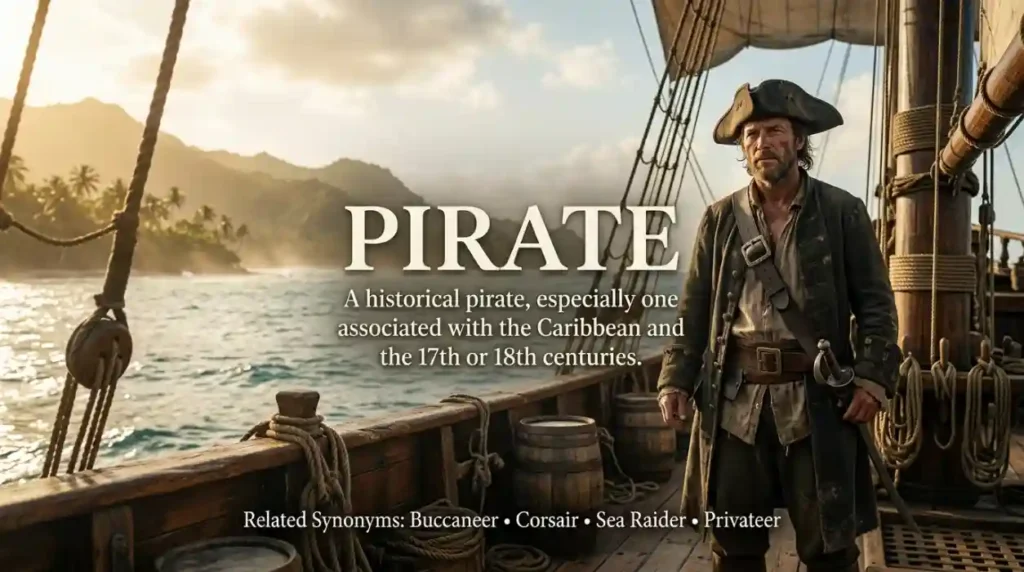
1. Buccaneer (Noun) — US /ˌbʌkənɪr/ | UK /ˌbʌkənɪə/
Meaning: A historical pirate, especially one associated with the Caribbean and the 17th or 18th centuries.
Tone/Register: Historical, adventurous.
Examples: The novel follows a daring buccaneer across the Caribbean.
The buccaneer captured several merchant ships.
2. Corsair (Noun) — US /ˈkɔːrser/ | UK /ˈkɔːseə/
Meaning: A pirate, especially one historically associated with the Mediterranean and sometimes authorized to attack enemy ships.
Tone/Register: Historical, formal.
Examples:
The corsair sailed along the North African coast.
His crew became feared by merchant vessels.
3. Freebooter (Noun) — US /ˈfriːˌbuːtər/ | UK /ˈfriːˌbuːtə/
Meaning: A person who takes goods or wealth by force, especially a pirate or plunderer.
Tone/Register: Historical, literary.
Examples:
The captain was known as a ruthless freebooter.
His crew searched every captured ship for valuables.
4. Picaroon (Noun) — US /ˌpɪkəˈruːn/ | UK /ˌpɪkəˈruːn/
Meaning: A pirate or sea robber, especially in historical or literary writing.
Tone/Register: Archaic, literary.
Examples:
The old tale describes a clever picaroon.
He escaped before the navy arrived.
5. Plunderer (Noun) — US /ˈplʌndərər/ | UK /ˈplʌndərə/
Meaning: Someone who takes valuable property by force.
Tone/Register: Neutral to negative.
Examples:
The plunderer emptied the merchant vessel.
The crew discovered the theft at dawn.
6. Sea Robber (Noun Phrase) — US /siː ˈrɑːbər/ | UK /siː ˈrɒbə/
Meaning: A person who robs ships or people at sea.
Tone/Register: Clear, descriptive.
Examples:
The museum exhibit explains the life of a sea robber.
The display includes maps and old weapons.
7. Sea Raider (Noun Phrase) — US /siː ˈreɪdər/ | UK /siː ˈreɪdə/
Meaning: Someone who attacks ships or coastal locations from the sea.
Tone/Register: Historical, neutral.
Examples:
The sea raider attacked the harbor before sunrise.
Local ships quickly moved inland.
8. Sea Rover (Noun Phrase) — US /siː ˈroʊvər/ | UK /siː ˈrəʊvə/
Meaning: A person who travels the seas, especially a pirate or maritime adventurer.
Tone/Register: Literary, adventurous.
Examples:
The story introduces a mysterious sea rover.
He spends years moving between distant islands.
9. Sea Wolf (Noun Phrase) — US /siː wʊlf/ | UK /siː wʊlf/
Meaning: A tough or experienced sailor, sometimes used for a pirate or sea raider.
Tone/Register: Informal, figurative.
Examples:
The old sea wolf knew every dangerous channel.
He warned the younger sailors about the reef.
10. Sea Looter (Noun Phrase) — US /siː ˈluːtər/ | UK /siː ˈluːtə/
Meaning: A person who steals goods from ships or coastal locations.
Tone/Register: Descriptive, negative.
Examples:
The sea looter targeted small trading vessels.
The attacks frightened local merchants.
11. Marauder (Noun) — US /məˈrɔːdər/ | UK /məˈrɔːdə/
Meaning: Someone who roams around attacking and stealing from others.
Tone/Register: Formal, historical.
Examples:
Marauders approached the port at night.
The town prepared for a possible attack.
12. Looter (Noun) — US /ˈluːtər/ | UK /ˈluːtə/
Meaning: A person who steals valuable property, often during disorder or an attack.
Tone/Register: Neutral to negative.
Examples:
The looters took supplies from the abandoned ship.
Authorities later recovered some of the stolen goods.
13. Pillager (Noun) — US /ˈpɪlɪdʒər/ | UK /ˈpɪlɪdʒə/
Meaning: Someone who takes goods by force, especially during raids or conflict.
Tone/Register: Formal, historical.
Examples:
The pillagers raided several coastal settlements.
Villagers hid their valuables before the attack.
14. Despoiler (Noun) — US /dɪˈspɔɪlər/ | UK /dɪˈspɔɪlə/
Meaning: A person who violently or unlawfully takes possessions or damages valuable places.
Tone/Register: Formal, literary.
Examples:
The despoiler left the harbor in ruins.
Historians later recorded the damage.
15. Robber (Noun) — US /ˈrɑːbər/ | UK /ˈrɒbə/
Meaning: A person who steals from others, sometimes by force.
Tone/Register: Everyday, broad.
Examples:
The robber threatened the crew.
The sailors refused to surrender the cargo.
16. Thief (Noun) — US /θiːf/ | UK /θiːf/
Meaning: Someone who steals property without permission.
Tone/Register: Everyday, broad.
Examples:
The thief slipped aboard the ship after dark.
The crew noticed the missing supplies later.
17. Bandit (Noun) — US /ˈbændɪt/ | UK /ˈbændɪt/
Meaning: An armed criminal who attacks or robs people, usually outside normal law enforcement.
Tone/Register: Historical, general.
Examples:
The story compares the pirate crew with a bandit gang.
Both groups survive by taking from others.
18. Brigand (Noun) — US /ˈbrɪɡənd/ | UK /ˈbrɪɡənd/
Meaning: An armed robber or outlaw, especially in historical writing.
Tone/Register: Formal, historical.
Examples:
The historian describes him as a coastal brigand.
His attacks became legendary.
19. Marauding Sailor (Noun Phrase) — US /məˈrɔːdɪŋ ˈseɪlər/ | UK /məˈrɔːdɪŋ ˈseɪlə/
Meaning: A sailor who travels around attacking and stealing from others.
Tone/Register: Descriptive, literary.
Examples:
The film opens with a marauding sailor entering the port.
His arrival creates immediate tension.
20. Sea Bandit (Noun Phrase) — US /siː ˈbændɪt/ | UK /siː ˈbændɪt/
Meaning: An informal description of a criminal who robs people at sea.
Tone/Register: Informal, accessible.
Examples:
The children called the villain a sea bandit.
His black ship appeared on the horizon.
21. Ocean Raider (Noun Phrase) — US /ˈoʊʃən ˈreɪdər/ | UK /ˈəʊʃən ˈreɪdə/
Meaning: A person who attacks vessels or coastal targets from the ocean.
Tone/Register: Descriptive, historical.
Example: The ocean raider disappeared before the navy arrived.
No one knew where his ship had gone.
22. Maritime Raider (Noun Phrase) — US /ˈmærɪtaɪm ˈreɪdər/ | UK /ˈmærɪtaɪm ˈreɪdə/
Meaning: A person who conducts attacks or raids at sea.
Tone/Register: Academic, formal.
Examples:
Researchers studied maritime raiders’ activities.
Their attacks disrupted regional trade.
23. Maritime Robber (Noun Phrase) — US /ˈmærɪtaɪm ˈrɑːbər/ | UK /ˈmærɪtaɪm ˈrɒbə/
Meaning: A person who commits robbery at sea.
Tone/Register: Formal, descriptive.
Examples:
The report describes the group as maritime robbers.
Their main targets were cargo vessels.
24. Sea Thief (Noun Phrase) — US /siː θiːf/ | UK /siː θiːf/
Meaning: A simple descriptive term for someone who steals at sea.
Tone/Register: Informal, vivid.
Examples:
The children’s book calls the villain a sea thief.
He steals treasure from passing ships.
25. Ship Raider (Noun Phrase) — US /ʃɪp ˈreɪdər/ | UK /ʃɪp ˈreɪdə/
Meaning: Someone who attacks and robs ships.
Tone/Register: Descriptive.
Examples:
The ship raider waited near the busy trade route.
He chose a smaller vessel as his target.
26. Ship Robber (Noun Phrase) — US /ʃɪp ˈrɑːbər/ | UK /ʃɪp ˈrɒbə/
Meaning: A person who steals from ships.
Tone/Register: Plain, descriptive.
Examples:
The ship robber escaped with valuable cargo.
The crew reported the crime immediately.
27. Coastal Raider (Noun Phrase) — US /ˈkoʊstəl ˈreɪdər/ | UK /ˈkəʊstəl ˈreɪdə/
Meaning: Someone who attacks coastal settlements or ships near the shore.
Tone/Register: Historical, academic.
Examples:
Coastal raiders often targeted small trading towns.
The attacks changed local defenses.
28. Outlaw (Noun) — US /ˈaʊtlɔː/ | UK /ˈaʊtlɔː/
Meaning: A person who operates outside the law.
Tone/Register: Broad, historical.
Examples:
The authorities treated the pirate as an outlaw.
A reward was offered for information about him.
29. Marauding Outlaw (Noun Phrase) — US /məˈrɔːdɪŋ ˈaʊtlɔː/ | UK /məˈrɔːdɪŋ ˈaʊtlɔː/
Meaning: An outlaw who moves around attacking and stealing from others.
Tone/Register: Literary, dramatic.
Examples:
The novel portrays the captain as a marauding outlaw.
His crew fears nothing.
30. Plunderer of the Seas (Noun Phrase) — US /ˈplʌndərər əv ðə siːz/ | UK /ˈplʌndərər əv ðə siːz/
Meaning: A vivid descriptive phrase for someone who steals from ships at sea.
Tone/Register: Literary, dramatic.
Examples:
The legend calls him a plunderer of the seas.
His reputation spread across distant ports.
31. Sea Marauder (Noun Phrase) — US /siː məˈrɔːdər/ | UK /siː məˈrɔːdə/
Meaning: A person who travels by sea while attacking and robbing others.
Tone/Register: Historical, literary.
Examples:
The sea marauder attacked merchant ships.
His crew vanished before the authorities arrived.
32. Raider (Noun) — US /ˈreɪdər/ | UK /ˈreɪdə/
Meaning: Someone who makes sudden attacks to seize property or achieve a military goal.
Tone/Register: Neutral, broad.
Examples:
The raider approached the vessel under cover of darkness.
The crew raised the alarm quickly.
33. Plunderer at Sea (Noun Phrase) — US /ˈplʌndərər ət siː/ | UK /ˈplʌndərər ət siː/
Meaning: A person who steals property through attacks at sea.
Tone/Register: Formal, descriptive.
Examples:
The chronicle mentions several plunderers at sea.
They targeted heavily loaded merchant ships.
34. Sea Rover (Noun) — US /siː ˈroʊvər/ | UK /siː ˈrəʊvə/
Meaning: A wandering sailor or raider who travels widely across the sea.
Tone/Register: Literary, adventurous.
Examples:
The sea rover sailed from island to island.
He knew dozens of hidden coves.
35. Privateer (Noun) — US /ˌpraɪvəˈtɪr/ | UK /ˌpraɪvəˈtɪə/
Meaning: A person or ship authorized by a government to attack enemy vessels, especially during wartime.
Tone/Register: Historical, formal.
Examples:
The privateer received official permission to attack enemy ships.
His activities were different from those of an unauthorized pirate.
36. Buccaneering Adventurer (Noun Phrase) — US /ˌbʌkənɪrɪŋ ədˈventʃərər/ | UK /ˌbʌkənɪərɪŋ ədˈventʃərə/
Meaning: An adventurous person associated with the world of historical buccaneers.
Tone/Register: Literary, romanticized.
Examples:
The film presents him as a buccaneering adventurer.
He sails toward an unknown island.
37. Rogue Sailor (Noun Phrase) — US /roʊɡ ˈseɪlər/ | UK /rəʊɡ ˈseɪlə/
Meaning: A sailor who behaves dishonestly, independently, or outside accepted rules.
Tone/Register: Informal, literary.
Examples:
The rogue sailor refused to follow the captain’s orders.
His actions caused trouble at the port.
38. Rogue Mariner (Noun Phrase) — US /roʊɡ ˈmærənər/ | UK /rəʊɡ ˈmærɪnə/
Meaning: A sailor who operates outside accepted authority or rules.
Tone/Register: Literary, formal.
Example: The novel introduces a mysterious rogue mariner.
Nobody knows his true identity.
39. Sea Outlaw (Noun Phrase) — US /siː ˈaʊtlɔː/ | UK /siː ˈaʊtlɔː/
Meaning: An outlaw who operates on the sea.
Tone/Register: Informal, historical.
Examples:
The sea outlaw hid his ship inside a narrow bay.
Local fishermen knew the place well.
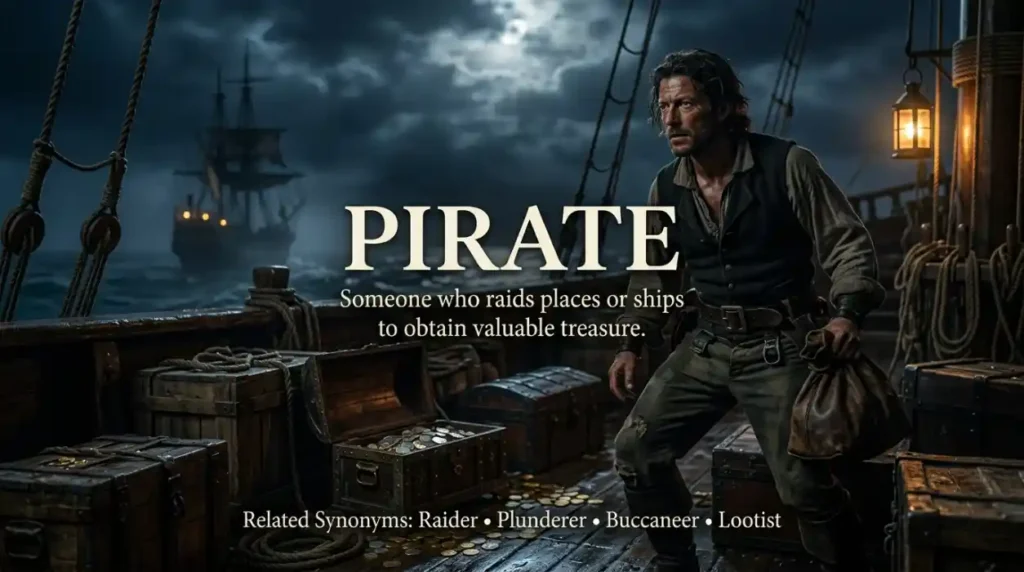
40. Treasure Raider (Noun Phrase) — US /ˈtrɛʒər ˈreɪdər/ | UK /ˈtreʒə ˈreɪdə/
Meaning: Someone who raids places or ships to obtain valuable treasure.
Tone/Register: Adventure, informal.
Examples:
The treasure raider searched the wreck for gold.
He ignored the warnings on the old map.
41. Cargo Raider (Noun Phrase) — US /ˈkɑːrɡoʊ ˈreɪdər/ | UK /ˈkɑːɡəʊ ˈreɪdə/
Meaning: Someone who attacks ships to steal their cargo.
Tone/Register: Modern, descriptive.
Examples:
The cargo raider targeted merchant vessels.
The valuable shipment attracted unwanted attention.
42. Shipboard Plunderer (Noun Phrase) — US /ˈʃɪpbɔːrd ˈplʌndərər/ | UK /ˈʃɪpbɔːd ˈplʌndərər/
Meaning: A person who steals goods from ships.
Tone/Register: Descriptive, literary.
Examples:
The story features a shipboard plunderer.
He takes control of the cargo deck.
43. Pirate Raider (Noun Phrase) — US /ˈpaɪrət ˈreɪdər/ | UK /ˈpaɪrət ˈreɪdə/
Meaning: A descriptive phrase emphasizing the raiding behavior of a pirate.
Tone/Register: Dramatic, descriptive.
Examples:
The pirate raider attacked at dawn.
The merchant crew escaped to shore.
44. Copyright Pirate (Noun Phrase) — US /ˈkɑːpiraɪt ˈpaɪrət/ | UK /ˈkɒpiraɪt ˈpaɪrət/
Meaning: A person who illegally copies or distributes protected creative work.
Tone/Register: Legal, modern.
Examples:
The copyright pirate distributed unauthorized recordings.
The company reported the activity.
45. Software Pirate (Noun Phrase) — US /ˈsɔːftwer ˈpaɪrət/ | UK /ˈsɒftweə ˈpaɪrət/
Meaning: A person who illegally copies or distributes software.
Tone/Register: Technical, legal.
Examples:
The software pirate shared unauthorized copies online.
The company strengthened its licensing controls.
46. Media Pirate (Noun Phrase) — US /ˈmiːdiə ˈpaɪrət/ | UK /ˈmiːdiə ˈpaɪrət/
Meaning: A person who illegally copies or distributes films, music, or other media.
Tone/Register: Modern, legal.
Examples:
The media pirate uploaded copyrighted films without permission.
The studio removed the unauthorized files.
47. Content Pirate (Noun Phrase) — US /ˈkɑːntent ˈpaɪrət/ | UK /ˈkɒntent ˈpaɪrət/
Meaning: Someone who copies or distributes another person’s digital content without permission.
Tone/Register: Modern, digital.
Examples:
The content pirate copied articles from several websites.
The original writers requested that the material be removed.
48. Unauthorized Copier (Noun Phrase) — US /ʌnˈɔːθəraɪzd ˈkɑːpiər/ | UK /ʌnˈɔːθəraɪzd ˈkɒpiə/
Meaning: A person who reproduces material without the necessary permission.
Tone/Register: Formal, legal.
Examples:
The publisher identified an unauthorized copier.
The copied material had appeared elsewhere without consent.
49. Illegal Copyist (Noun Phrase) — US /ɪˈliːɡəl ˈkɑːpiɪst/ | UK /ɪˈliːɡəl ˈkɒpiɪst/
Meaning: A person who makes unauthorized copies of protected material.
Tone/Register: Formal, legal.
Examples:
The investigation focused on an illegal copyist.
The company documented every unauthorized reproduction.
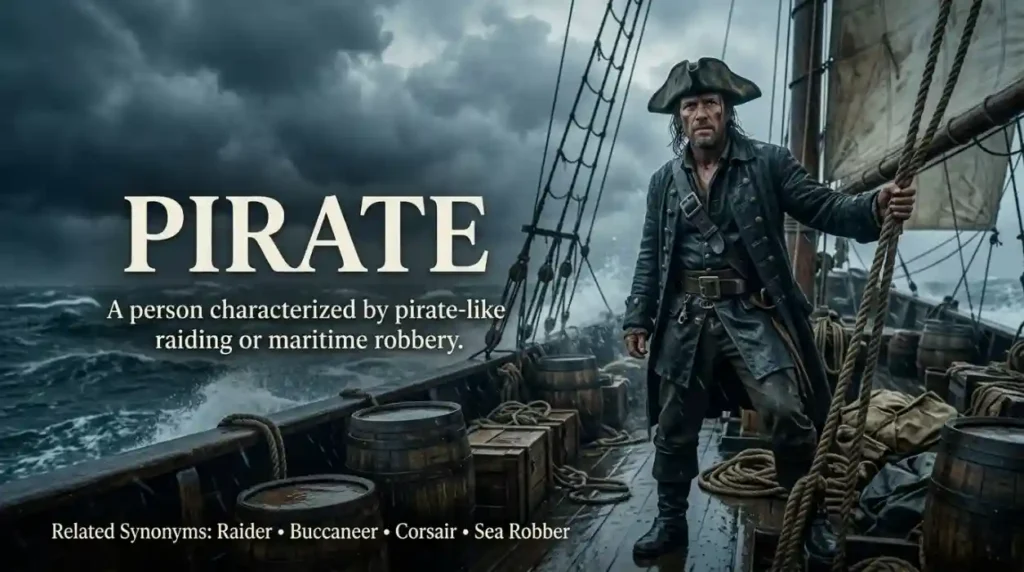
50. Piratical Raider (Noun Phrase) — US /paɪˈrætɪkəl ˈreɪdər/ | UK /paɪˈrætɪkəl ˈreɪdə/
Meaning: A person characterized by pirate-like raiding or maritime robbery.
Tone/Register: Formal, literary.
Examples:
The historian described the fleet as a piratical raiding force.
Its attacks disrupted coastal trade.
Synonyms by Tone
Positive or Romanticized
In fiction and entertainment, these alternatives can sound adventurous rather than purely criminal:
- Buccaneer
- Sea rover
- Sea wolf
- Buccaneering adventurer
- Sea raider
- Rogue sailor
These words often appear in adventure stories where the character is portrayed as bold, independent, or rebellious.
Neutral
These terms can describe pirate-like activity without strongly romanticizing it:
- Pirate
- Sea robber
- Sea raider
- Maritime raider
- Maritime robber
- Raider
- Ship robber
- Coastal raider
They work well in historical, educational, and explanatory writing.
Negative
These choices emphasize theft, violence, or lawlessness:
- Plunderer
- Looter
- Pillager
- Despoiler
- Robber
- Thief
- Bandit
- Brigand
- Sea outlaw
- Sea thief
Formal or Historical
These are useful when discussing specific historical groups or periods:
- Corsair
- Privateer
- Picaroon
- Freebooter
- Peregrine-style historical terms such as sea rover
Be careful with privateer. It is not a perfect synonym for pirate. A privateer had government authorization to attack enemy ships, particularly during wartime.
Modern Digital Context
When pirate means someone who illegally copies protected material, use terms that clearly identify the context:
- Software pirate
- Copyright pirate
- Media pirate
- Content pirate
- Unauthorized copier
- Illegal copyist
Cambridge explicitly recognizes pirate as a noun for someone who illegally copies and sells music, films, computer programs, and similar material.
Pirate vs. Close Alternatives
Buccaneer vs Pirate
A pirate is a broad term for someone who commits piracy at sea.
A buccaneer is more historical and is strongly associated with Caribbean sea raiders, particularly those active during the 17th and 18th centuries. Cambridge defines a buccaneer as someone who attacked and stole from ships, especially during that historical period.
Use pirate for general modern English.
Use buccaneer when you want historical or adventure-story flavor.
Pirate vs. Privateer
A pirate operates without lawful authorization.
A privateer was authorized by a government to attack enemy ships. This distinction is important in historical writing.
Calling every privateer a pirate can therefore make a historical sentence inaccurate.
Pirate vs. Corsair
A corsair is a historical term for a pirate, particularly one associated with the Mediterranean and sometimes authorized by a government to attack enemy ships.
Corsair sounds more historical and specific than the everyday word pirate.
How “Pirate” Changes by Context
Daily Conversation
In ordinary conversation, pirate is the easiest and most natural word.
For example:
“The movie is about a pirate who searches for buried treasure.”
You usually do not need a more specialized term unless you want to emphasize a particular historical period or style.
Writing and Blogging
Bloggers can use alternatives to avoid repeating pirate.
For example, a historical article might alternate between pirate, sea raider, buccaneer, and maritime raider when each description fits the subject.
However, avoid replacing every occurrence mechanically. Accuracy is more important than variation.
Professional or Academic Writing
Academic writing often benefits from specific historical terms.
Corsair may fit a Mediterranean context.
Privateer is appropriate when government authorization matters.
Maritime raider can work as a broader descriptive phrase.
Pirate remains the clearest general term when the person was an unauthorized sea robber.
Creative and Informal Use
Creative writing allows more colorful expressions such as:
- Sea wolf
- Sea rover
- Sea outlaw
- Rogue sailor
- Buccaneer
- Freebooter
These terms can create atmosphere without repeating pirate.
Common Mistakes and Native Usage
Mistake 1: Treating privateer as an exact synonym
A privateer is not simply another word for pirate.
The key difference is authorization. Privateers operated under government authority, while pirates generally did not.
Mistake 2: Calling every sailor a pirate
A sailor is simply someone who works or travels on a ship.
A pirate specifically engages in unauthorized robbery or attacks at sea.
Mistake 3: Using “buccaneer” for every modern pirate
Buccaneer has a strong historical association with Caribbean piracy and the 17th and 18th centuries.
It can sound strange in a modern maritime crime report.
Mistake 4: Confusing pirate and piracy
Pirate usually refers to the person.
Piracy refers to the practice or act.
For example:
The pirate attacked the ship.
The authorities investigated piracy.
Mistake 5: Ignoring the digital meaning
Modern English also uses pirate for people who illegally copy or distribute protected media and software.
Therefore, context is essential.
Register Notes
Pirate: neutral and widely used
Buccaneer: historical or adventurous
Corsair: historical and formal
Freebooter: literary and historical
Picaroon: archaic or literary
Privateer: specific historical/legal meaning
Sea robber: descriptive
Plunderer: formal and negative
Sea rover: literary
Software pirate: modern and technical
Copyright pirate: legal and modern
For an internal vocabulary link, related words such as raider, outlaw, plunderer, sailor, and robber can help readers explore connected vocabulary.
Real-Life Mini Scenarios
Workplace Scenario
A history writer is preparing a report about maritime crime.
Instead of repeating “pirate” in every paragraph, the writer can use sea raider, maritime robber, and plunderer when those descriptions remain accurate.
Social Situation
A friend talks about a pirate-themed costume party.
In this casual context, words such as buccaneer, sea rover, and sea wolf can make the conversation more playful.
Media and Pop Culture
Adventure films often use pirate, buccaneer, and corsair to create different historical or fictional moods.
A fantasy character may be called a sea outlaw when the writer wants a dramatic, rebellious image.
Writing and Storytelling
A novelist might introduce a character as a sea rover before revealing that he is actually a pirate.
This technique can create suspense while avoiding immediate repetition.
Practice Exercise
1. Which word is the most general term for someone who attacks ships and steals from them?
A. Pirate
B. Sailor
C. Privateer
D. Navigator
2. Which term is strongly associated with historical Caribbean pirates?
A. Corsair
B. Buccaneer
C. Copyist
D. Raider
3. Which word describes someone authorized by a government to attack enemy ships?
A. Pirate
B. Thief
C. Privateer
D. Looter
4. Which term sounds most literary and old-fashioned?
A. Picaroon
B. Robber
C. Raider
D. Thief
5. Which alternative emphasizes stealing valuable goods?
A. Plunderer
B. Sailor
C. Mariner
D. Captain
6. Which phrase describes someone who illegally copies software?
A. Sea rover
B. Software pirate
C. Sea wolf
D. Coastal raider
7. Which word can describe an armed historical robber on land or near the coast?
A. Brigand
B. Navigator
C. Merchant
D. Sailor
8. Which phrase sounds playful and adventurous?
A. Unauthorized copier
B. Sea rover
C. Illegal copyist
D. Maritime robber
9. Which word focuses on the act of stealing rather than the person’s occupation?
A. Piracy
B. Pirate
C. Sailor
D. Captain
10. Which alternative is best for a formal historical discussion of attacks at sea?
A. Maritime raider
B. Fun sailor
C. Sea guy
D. Adventurer
Answer Key:
1-A | 2-B | 3-C | 4-A | 5-A | 6-B | 7-A | 8-B | 9-A | 10-A
Reflection Task:
Write one sentence using pirate, buccaneer, corsair, or sea raider. Then rewrite the sentence with another alternative and explain how the tone changes.
Frequently Asked Questions
1. What is the best synonym for pirate in English?
The best synonym depends on the context. Buccaneer, corsair, freebooter, privateer, and sea robber are strong alternatives for the historical sea-robber meaning. For a general sentence, however, pirate remains the most natural choice. Use privateer only when the person had government authorization to attack enemy vessels.
2. What is a synonym for pirate that sounds more formal?
Corsair, freebooter, maritime raider, and plunderer can sound more formal or historical than pirate. Corsair is especially useful for historical discussions of Mediterranean piracy. Maritime raider is broader and works well in academic descriptions when the exact historical label is uncertain.
3. Is buccaneer the same as pirate?
Not completely. Buccaneer is a type of historical pirate strongly associated with Caribbean sea raiders, especially in the 17th and 18th centuries. In fictional writing, it can be used more broadly for an adventurous pirate character. In precise historical writing, its period and regional associations should be respected.
4. What is the difference between a pirate and a privateer?
A pirate generally attacks ships without lawful authorization. A privateer operated with government permission, usually under a commission allowing attacks against enemy vessels during wartime. This legal distinction makes a privateer a poor substitute when you simply mean an unauthorized sea robber.
5. What is another word for pirate in a story?
For creative writing, buccaneer, sea rover, sea wolf, freebooter, corsair, and sea outlaw can add variety. Choose based on the character. Buccaneer feels adventurous, corsair feels historical, and sea outlaw emphasizes rebellion and lawlessness.
6. What is a synonym for pirate in the digital world?
For illegal copying, useful context-specific terms include software pirate, copyright pirate, media pirate, and content pirate. These expressions make it clear that the word refers to unauthorized copying or distribution rather than maritime robbery. Cambridge recognizes this modern meaning of pirate in connection with software, films, music, and other media.
7. What is an old-fashioned word for pirate?
Picaroon and freebooter are useful old-fashioned or literary alternatives. Corsair is also strongly historical, while buccaneer carries a distinctive historical association with Caribbean piracy. These terms work especially well in historical fiction and period descriptions.
8. Can “raider” be used as a synonym for pirate?
Yes, but raider is broader. A raider can attack ships, towns, military targets, or other locations and does not necessarily commit piracy. Sea raider or maritime raider makes the connection with piracy clearer. Use pirate when unauthorized maritime robbery is the central meaning.
Conclusion
Choosing the right synonym for pirate can make historical writing, stories, essays, and descriptions more precise. Words like buccaneer and corsair add useful historical detail.
Alternatives such as sea robber, plunderer, and maritime raider help writers describe criminal behavior clearly without unnecessary repetition or loss of meaning.
A stronger vocabulary also helps students, bloggers, and content writers create vivid descriptions. It makes storytelling more engaging and everyday communication more precise.
Practice these alternatives in essays, emails, stories, and conversations. Notice each word’s tone, then choose the one that best matches your meaning and context.
Suggested External Sources
For reliable definitions, pronunciation, usage examples, and related vocabulary, consult Cambridge Dictionary Pirate and Cambridge Thesaurus Pirate.
For word history and etymology, Etymonline Pirate is a useful reference.

Jameel Hassan is the founder and lead writer at SynonymsCloud.com, a trusted online platform dedicated to English vocabulary and effective communication. He is passionate about helping students, writers, professionals, and lifelong learners discover the right words to express their ideas with clarity, precision, and confidence.
At SynonymsCloud.com, every article is thoroughly researched and carefully written to provide accurate, practical, and easy-to-understand guidance on synonyms, antonyms, word meanings, idioms, and vocabulary. With a strong commitment to quality, real-world usage, and clear explanations, the website helps readers expand their vocabulary, improve their writing, and communicate more effectively in both academic and professional settings.