

A synonym for pressing is a word that expresses urgency, importance, insistence, or the act of applying pressure, depending on the context. Common alternatives include urgent, critical, crucial, immediate, compelling, and insistent. Choosing the right word makes your message clearer and more natural.
Imagine your manager says, “We have a pressing deadline.” You could describe it as an urgent deadline or a critical deadline. Each option communicates importance, but the exact emphasis changes slightly.
The word pressing is common in conversations, business emails, news reports, and academic writing. It helps people describe problems, needs, and responsibilities that require attention.
Learning a synonym for pressing helps students write stronger essays, bloggers avoid repetition, content writers improve clarity, and everyday English users express urgency more precisely.
The best synonym for pressing depends on what you mean. A pressing issue may be urgent, while a pressing argument may be compelling. Understanding these differences helps you choose words confidently.
What Does “Pressing” Really Mean?
Pressing has several related meanings. It can describe something that needs immediate attention, something extremely important, an insistent request, or the physical act of pushing against a surface.
As an adjective, pressing usually describes an urgent matter or an important need. For example, “We must discuss a pressing concern before the meeting ends.”
As a verb form, pressing can describe applying force. For example, “She is pressing the button to open the gate.”
Native English speakers understand the intended meaning from the surrounding words. A pressing problem needs attention, while pressing a shirt means smoothing it with an iron.
The word commonly appears in workplace communication, public discussions, personal requests, journalism, and everyday conversations.
Connotative Meaning
(Connotation is the feeling, attitude, or association a word communicates beyond its basic dictionary meaning.)
- Positive tone: A pressing opportunity can suggest a meaningful chance that deserves prompt action.
- Negative tone: A pressing problem may communicate stress, danger, or an urgent challenge.
- Neutral tone: Pressing a key simply describes a physical action without a strong emotional meaning.
The emotional effect depends on the context. The adjective often signals urgency, while the verb can remain entirely neutral.
Etymology of Pressing
The word pressing comes from the verb press, which entered English through Old French presser, ultimately deriving from Latin pressare, meaning to press or squeeze repeatedly. The adjective developed the sense of something urgent or insistent.
Old English period (450–1100)
The modern word pressing was not established in its current form. English used native words such as preatian for pressing or urging and other expressions for physical force.
Middle English period (1100–1500)
Forms related to press entered English through French influence. The word developed physical and figurative uses.
Modern English period (1500–present)
Pressing expanded to describe urgent needs, important questions, and matters demanding attention.
Pronunciation, Syllables, and Word Structure
- US IPA: /ˈprɛs.ɪŋ/
- UK IPA: /ˈprɛs.ɪŋ/
- Syllables: press-ing
- Part of speech: Adjective and verb form (present participle/gerund)
Affixation pattern
- Root: press
- Prefix: None
- Suffix: -ing
The suffix -ing forms the present participle of press and can also create a gerund. In adjective use, pressing describes something urgent or demanding attention.
Synonyms List
The following alternatives cover the main meanings of pressing: urgent, important, demanding attention, persuasive, insistent, and physically applying pressure. Not every word fits every sentence, so check the meaning and register before replacing the original word.
1. Urgent (Adjective) — US /ˈɝː.dʒənt/ | UK /ˈɜː.dʒənt/
Meaning: Requiring immediate attention or action because a delay could cause a problem.
Tone/Register: Neutral, professional, business.
Examples:
The hospital received an urgent request for additional supplies.
Please respond to this urgent email before noon.

2. Critical (Adjective) — US /ˈkrɪt̬.ɪ.kəl/ | UK /ˈkrɪt.ɪ.kəl/
Meaning: Extremely important to a decision, outcome, or situation.
Tone/Register: Formal, academic, professional.
Examples:
Clear communication is critical during an emergency.
The team reached a critical stage in the project.
3. Crucial (Adjective) — US /ˈkruː.ʃəl/ | UK /ˈkruː.ʃəl/
Meaning: So important that success or failure may depend on it.
Tone/Register: Neutral, formal, academic.
Examples:
Your final review is crucial to the proposal’s success.
Sleep plays a crucial role in maintaining concentration.
4. Immediate (Adjective) — US /ɪˈmiː.di.ət/ | UK /ɪˈmiː.di.ət/
Meaning: Needing to happen or be dealt with without delay.
Tone/Register: Neutral, professional.
Examples:
The damaged equipment requires immediate attention.
We need an immediate response from the supplier.
5. Imperative (Adjective) — US /ɪmˈper.ə.tɪv/ | UK /ɪmˈper.ə.tɪv/
Meaning: Necessary or essential under the circumstances.
Tone/Register: Formal, academic, authoritative.
Examples:
Protecting customer information is imperative.
Everyone must follow the safety rules.
6. Essential (Adjective) — US /ɪˈsen.ʃəl/ | UK /ɪˈsen.ʃəl/
Meaning: Completely necessary for a particular purpose or result.
Tone/Register: Neutral, professional, academic.
Examples:
Accurate records are essential for the investigation.
Water is essential for healthy plant growth.
7. Vital (Adjective) — US /ˈvaɪ.t̬əl/ | UK /ˈvaɪ.təl/
Meaning: Extremely important or necessary for continued success, health, or survival.
Tone/Register: Neutral, formal, emphatic.
Examples:
Public trust is vital to the organization’s reputation.
Quick access to clean water is vital after a disaster.
8. Paramount (Adjective) — US /ˈper.ə.maʊnt/ | UK /ˈpær.ə.maʊnt/
Meaning: More important than anything else in a particular situation.
Tone/Register: Formal, academic, professional.
Examples:
Patient safety remains paramount in the clinic.
Fairness should be paramount when making the final decision.
9. Pressing (Adjective) — US /ˈpres.ɪŋ/ | UK /ˈpres.ɪŋ/
Meaning: Requiring attention soon because the matter cannot reasonably be postponed.
Tone/Register: Neutral, professional, journalistic.
Examples:
The committee discussed the town’s pressing housing needs.
Finding a reliable replacement became a pressing concern.
10. Demanding (Adjective) — US /dɪˈmæn.dɪŋ/ | UK /dɪˈmɑːn.dɪŋ/
Meaning: Requiring considerable effort, attention, or resources.
Tone/Register: Neutral, professional, sometimes negative.
Examples:
Preparing the annual report is a demanding task.
Her new role requires demanding work under tight deadlines.
11. Time-Sensitive (Adjective) — US /ˌtaɪmˈsen.sə.tɪv/ | UK /ˌtaɪmˈsen.sɪ.tɪv/
Meaning: Needing action within a particular period because its usefulness or validity may decrease.
Tone/Register: Professional, business, technical.
Examples:
The team handles time-sensitive customer complaints first.
This offer contains time-sensitive information that may soon change.
12. Immediate-Action (Adjective Phrase) — US /ɪˈmiː.di.ət ˈæk.ʃən/ | UK /ɪˈmiː.di.ət ˈæk.ʃən/
Meaning: Calling for action straight away rather than at a later time.
Tone/Register: Instructional, operational.
Examples:
The warning identified an immediate-action requirement.
The supervisor issued an immediate-action notice after the inspection.
13. Acute (Adjective) — US /əˈkjuːt/ | UK /əˈkjuːt/
Meaning: Extremely serious or intense, often describing a problem or shortage.
Tone/Register: Formal, medical, analytical.
Examples:
The region is experiencing an acute shortage of housing.
An acute staffing problem delayed the clinic’s opening.
14. Urgent-Need (Noun Phrase) — US /ˈɝː.dʒənt niːd/ | UK /ˈɜː.dʒənt niːd/
Meaning: A requirement that must be met quickly to prevent difficulty or harm.
Tone/Register: Neutral, formal, humanitarian.
Examples:
The shelter has an urgent need for warm blankets.
The report highlights an urgent need for better road safety.
15. Important (Adjective) — US /ɪmˈpɔːr.tənt/ | UK /ɪmˈpɔː.tənt/
Meaning: Having considerable value, influence, or significance.
Tone/Register: Neutral, universal.
Examples:
We have an important matter to discuss this afternoon.
Her feedback made an important difference to the final draft.
16. Significant (Adjective) — US /sɪɡˈnɪf.ɪ.kənt/ | UK /sɪɡˈnɪf.ɪ.kənt/
Meaning: Important enough to have a noticeable effect or meaning.
Tone/Register: Academic, formal, analytical.
Examples:
The survey revealed a significant gap in student support.
The new policy brought significant changes to daily operations.
17. Consequential (Adjective) — US /ˌkɑːn.səˈkwen.ʃəl/ | UK /ˌkɒn.sɪˈkwen.ʃəl/
Meaning: Likely to produce important results or lasting effects.
Tone/Register: Formal, academic.
Examples:
The board faced a consequential decision about expansion.
One consequential mistake changed the course of the investigation.
18. Momentous (Adjective) — US /moʊˈmen.təs/ | UK /məʊˈmen.təs/
Meaning: Extremely important because it marks a major event or change.
Tone/Register: Formal, literary, emphatic.
Examples:
The signing ceremony marked a momentous day for the community.
Graduation felt like a momentous step toward independence.
19. Pivotal (Adjective) — US /ˈpɪv.ə.t̬əl/ | UK /ˈpɪv.ə.təl/
Meaning: Playing a central role in determining what happens next.
Tone/Register: Professional, academic, analytical.
Examples:
Her testimony was pivotal to the court case.
That conversation became a pivotal moment in their friendship.
20. Weighty (Adjective) — US /ˈweɪ.t̬i/ | UK /ˈweɪ.ti/
Meaning: Important and deserving serious thought or consideration.
Tone/Register: Formal, literary.
Examples:
The council must consider several weighty questions.
He paused before answering such a weighty request.
21. Compelling (Adjective) — US /kəmˈpel.ɪŋ/ | UK /kəmˈpel.ɪŋ/
Meaning: Strong enough to attract attention, persuade someone, or create a powerful reason to act.
Tone/Register: Professional, academic, persuasive.
Examples:
The researcher presented compelling evidence for the claim.
Her story gave readers a compelling reason to care.
22. Imperious (Adjective) — US /ɪmˈpɪr.i.əs/ | UK /ɪmˈpɪə.ri.əs/
Meaning: Expressing authority in a demanding way that expects obedience.
Tone/Register: Formal, often negative.
Examples:
His imperious tone made the discussion uncomfortable.
She rejected the manager’s imperious demand for an instant answer.
23. Insistent (Adjective) — US /ɪnˈsɪs.tənt/ | UK /ɪnˈsɪs.tənt/
Meaning: Continuing to ask for or demand something firmly.
Tone/Register: Neutral to negative, conversational or formal.
Examples:
The caller was insistent about speaking to the director.
Her insistent questions encouraged the team to investigate further.
24. Persistent (Adjective) — US /pɚˈsɪs.tənt/ | UK /pəˈsɪs.tənt/
Meaning: Continuing for a long time or refusing to give up despite difficulty.
Tone/Register: Neutral, positive or negative depending on context.
Examples:
Persistent complaints eventually led to a policy review.
The persistent ringing made it difficult to concentrate.
25. Relentless (Adjective) — US /rɪˈlent.ləs/ | UK /rɪˈlent.ləs/
Meaning: Continuing intensely without stopping or easing.
Tone/Register: Emphatic, journalistic, often negative.
Examples:
The relentless deadlines left the staff exhausted.
Relentless public pressure pushed officials to explain their decision.
26. Peremptory (Adjective) — US /pəˈremp.tɔːr.i/ | UK /pəˈremp.tər.i/
Meaning: Expressing an order or demand in a way that allows little discussion or refusal.
Tone/Register: Formal, authoritative, usually negative.
Examples:
The director gave a peremptory instruction to leave the room.
His peremptory reply ended the negotiation abruptly.
27. Insistent-Need (Noun Phrase) — US /ɪnˈsɪs.tənt niːd/ | UK /ɪnˈsɪs.tənt niːd/
Meaning: A need that repeatedly demands recognition or attention.
Tone/Register: Formal, descriptive.
Examples:
The community’s insistent need for safer streets shaped the campaign.
An insistent need for answers dominated the public meeting.
28. Imperious-Need (Noun Phrase) — US /ɪmˈpɪr.i.əs niːd/ | UK /ɪmˈpɪə.ri.əs niːd/
Meaning: A need described as commanding attention, though this wording is uncommon in everyday English.
Tone/Register: Literary, unusual.
Examples:
The novel portrays an imperious need for recognition.
The phrase suggests a demand that seems impossible to ignore.
29. Compulsive (Adjective) — US /kəmˈpʌl.sɪv/ | UK /kəmˈpʌl.sɪv/
Meaning: Driven by a strong urge that is difficult to control.
Tone/Register: Psychological, descriptive, sometimes negative.
Examples:
He felt a compulsive urge to check every notification.
Her compulsive need for perfection slowed the project.
30. Urgent-Matter (Noun Phrase) — US /ˈɝː.dʒənt ˈmæt̬.ɚ/ | UK /ˈɜː.dʒənt ˈmæt.ə/
Meaning: A subject that needs to be dealt with promptly.
Tone/Register: Business, formal.
Examples:
The receptionist directed urgent matters to the department head.
Please mark the message if it concerns an urgent matter.
31. Pressing (Verb Form) — US /ˈpres.ɪŋ/ | UK /ˈpres.ɪŋ/
Meaning: Applying force to something, often by pushing against it.
Tone/Register: Neutral, everyday.
Examples:
He is pressing the elevator button again.
She kept pressing the dough into the baking tin.
32. Pushing (Verb Form) — US /ˈpʊʃ.ɪŋ/ | UK /ˈpʊʃ.ɪŋ/
Meaning: Applying force to move something away or forward.
Tone/Register: Neutral, conversational.
Examples:
The movers are pushing the sofa through the doorway.
She was pushing the shopping cart toward the exit.
33. Squeezing (Verb Form) — US /ˈskwiː.zɪŋ/ | UK /ˈskwiː.zɪŋ/
Meaning: Applying pressure from different sides to compress something.
Tone/Register: Neutral, everyday.
Examples:
He was squeezing fresh lemons into a glass.
The crowded passengers were squeezing past one another.
34. Compressing (Verb Form) — US /kəmˈpres.ɪŋ/ | UK /kəmˈpres.ɪŋ/
Meaning: Pressing something together to reduce its size or volume.
Tone/Register: Technical, academic, neutral.
Examples:
The machine is compressing the cardboard into compact bundles.
The software is compressing the video before upload.
35. Depressing (Verb Form) — US /dɪˈpres.ɪŋ/ | UK /dɪˈpres.ɪŋ/
Meaning: Pushing something downward or forcing it into a lower position.
Tone/Register: Technical, instructional.
Examples:
Depressing the lever releases the safety lock.
She started the engine by depressing the clutch pedal.
36. Applying Pressure (Verb Phrase) — US /əˈplaɪ.ɪŋ ˈpreʃ.ɚ/ | UK /əˈplaɪ.ɪŋ ˈpreʃ.ə/
Meaning: Using physical force or trying to influence someone to act.
Tone/Register: Neutral, professional.
Examples:
The technician is applying pressure to test the seal.
The residents are applying pressure on officials to repair the road.
37. Exerting (Verb Form) — US /ɪɡˈzɝː.tɪŋ/ | UK /ɪɡˈzɜː.tɪŋ/
Meaning: Using physical force, effort, or influence to achieve an effect.
Tone/Register: Formal, scientific, professional.
Examples:
The athlete is exerting force against the resistance band.
The committee is exerting influence over the final decision.
38. Forcing (Verb Form) — US /ˈfɔːr.sɪŋ/ | UK /ˈfɔː.sɪŋ/
Meaning: Making something move or happen through physical force or strong influence.
Tone/Register: Neutral to negative.
Examples:
He was forcing the jammed drawer open.
The unexpected delay is forcing us to change the schedule.
39. Pinning (Verb Form) — US /ˈpɪn.ɪŋ/ | UK /ˈpɪn.ɪŋ/
Meaning: Holding someone or something firmly against a surface or in a fixed position.
Tone/Register: Neutral, physical, sometimes dramatic.
Examples:
The strong wind was pinning the tent against the fence.
The wrestler is pinning his opponent to the mat.
40. Bearing Down (Verb Phrase) — US /ˌber.ɪŋ ˈdaʊn/ | UK /ˌbeə.rɪŋ ˈdaʊn/
Meaning: Applying strong force or concentrating intensely on a task.
Tone/Register: Conversational, descriptive.
Examples:
She was bearing down on the handle to loosen the lid.
With the deadline approaching, the team is bearing down on the final edits.

41. Oppressive (Adjective) — US /əˈpres.ɪv/ | UK /əˈpres.ɪv/
Meaning: Uncomfortably heavy, restrictive, or difficult to endure.
Tone/Register: Negative, literary, social commentary.
Examples:
The oppressive heat made the afternoon unbearable.
Workers spoke out against the oppressive rules.
42. Overwhelming (Adjective) — US /ˌoʊ.vɚˈwel.mɪŋ/ | UK /ˌəʊ.vəˈwel.mɪŋ/
Meaning: So intense or extensive that it is difficult to manage or resist.
Tone/Register: Neutral to negative, emphatic.
Examples:
The overwhelming workload forced the team to reorganize.
She felt overwhelmed by the number of decisions awaiting her.
43. Demanding (Adjective) — US /dɪˈmæn.dɪŋ/ | UK /dɪˈmɑːn.dɪŋ/
Meaning: Requiring a great deal of attention, effort, or compliance.
Tone/Register: Neutral to negative, workplace.
Examples:
The demanding client wanted every detail checked twice.
Their demanding schedule left little room for breaks.
44. Forceful (Adjective) — US /ˈfɔːrs.fəl/ | UK /ˈfɔːs.fəl/
Meaning: Expressing an idea or using physical power with strength and confidence.
Tone/Register: Professional, persuasive, sometimes aggressive.
Examples:
Her forceful argument changed several people’s minds.
The coach gave a forceful reminder about team discipline.
45. Heavy (Adjective) — US /ˈhev.i/ | UK /ˈhev.i/
Meaning: Intense, difficult, or burdensome in a particular context.
Tone/Register: Informal, neutral to negative.
Examples:
The office is under heavy pressure to finish the launch.
He faced a heavy burden after taking over the family business.
46. Intense (Adjective) — US /ɪnˈtens/ | UK /ɪnˈtens/
Meaning: Extremely strong in degree, feeling, activity, or concentration.
Tone/Register: Neutral, emphatic, academic.
Examples:
The negotiations entered an intense final stage.
She worked with intense focus before the examination.
47. High-Priority (Adjective) — US /ˌhaɪ praɪˈɔːr.ə.t̬i/ | UK /ˌhaɪ praɪˈɒr.ə.ti/
Meaning: Deserving attention before less important tasks.
Tone/Register: Business, administrative, technical.
Examples:
The security update is a high-priority assignment.
Customer safety remains a high-priority concern for the company.
48. Nonnegotiable (Adjective) — US /ˌnɑːn.nɪˈɡoʊ.ʃi.ə.bəl/ | UK /ˌnɒn.nɪˈɡəʊ.ʃi.ə.bəl/
Meaning: Not open to discussion, compromise, or change.
Tone/Register: Business, firm, sometimes confrontational.
Examples:
Meeting the legal requirements is nonnegotiable.
For our team, respectful communication is a nonnegotiable standard.
49. Unavoidable (Adjective) — US /ˌʌn.əˈvɔɪ.də.bəl/ | UK /ˌʌn.əˈvɔɪ.də.bəl/
Meaning: Impossible or very difficult to prevent or escape.
Tone/Register: Neutral, formal.
Examples:
The storm caused an unavoidable delay in delivery.
Given the budget cuts, some changes became unavoidable.
50. Imperative (Adjective) — US /ɪmˈper.ə.tɪv/ | UK /ɪmˈper.ə.tɪv/
Meaning: So necessary that it must be done or addressed.
Tone/Register: Formal, emphatic.
Examples:
It is imperative to verify the figures before publication.
The team agreed that protecting the data was imperative.
Synonyms by Tone
Different alternatives communicate different levels of urgency, importance, and force. Choose a word that matches the situation instead of automatically replacing pressing with the first synonym you find.
Positive or Constructive
- Crucial: Emphasizes how much success depends on something.
- Vital: Highlights an essential need or condition.
- Pivotal: Suggests an opportunity or event that can shape future results.
- Compelling: Makes a reason or argument sound convincing.
- Forceful: Describes confident, strong communication.
Neutral
- Urgent: Communicates a need for prompt action.
- Immediate: Emphasizes that there should be no delay.
- Important: Highlights significance without necessarily suggesting a deadline.
- Significant: Focuses on an effect or meaningful difference.
- Time-sensitive: Indicates that timing affects the outcome.
Negative or Strongly Demanding
- Relentless: Suggests pressure that continues without relief.
- Oppressive: Describes pressure that feels unfair or difficult to endure.
- Imperious: Suggests an arrogant demand for obedience.
- Peremptory: Describes an abrupt order that discourages discussion.
- Overwhelming: Emphasizes pressure that feels difficult to manage.
Playful or Informal
- A big deal: An informal way to describe something important.
- A must: A conversational way to describe something considered essential.
- Can’t-wait: An informal expression for something that needs attention soon.
These informal expressions are not exact replacements in every sentence. For example, “a pressing issue” sounds natural in a work email, while “a big deal” is more conversational.
“Pressing” vs. Close Alternatives
| Word | Main emphasis | Best use |
|---|---|---|
| Pressing | Needs attention soon | Problems, concerns, needs |
| Urgent | Requires quick action | Messages, requests, deadlines |
| Crucial | Greatly affects an outcome | Decisions, evidence, steps |
| Critical | Extremely important or serious | Safety, situations, analysis |
| Compelling | Persuasive or powerful | Arguments, reasons, evidence |
| Insistent | Repeatedly demands attention | Requests, questions, people |
Example comparison:
- “We have a pressing issue.” The issue needs attention soon.
- “We have an urgent issue.” Quick action is especially important.
- “We have a crucial issue.” The issue may have a major effect on the outcome.
Although these sentences overlap, the emphasis changes. Urgent focuses on timing, crucial focuses on importance, and pressing often combines importance with the need for prompt attention.
How “Pressing” Changes by Context
Daily Conversation
In everyday speech, pressing often appears in questions about priorities and personal needs.
Example: “Is there anything pressing we need to discuss tonight?”
You could also say, “Is there anything urgent we need to discuss?” The second version is simpler and more direct in casual conversation.
Writing and Blogging
Writers use pressing to introduce problems, concerns, and topics that deserve attention. It works well in explanatory articles, opinion pieces, and informative blog posts.
Example: “Access to clean drinking water remains a pressing concern in many communities.”
Depending on the article, serious concern, urgent issue, or critical challenge may communicate the idea more precisely.
Professional and Academic English
In professional communication, choose alternatives based on the action required. Use urgent for fast responses, critical for high-impact matters, and essential for requirements.
Example: “The department must address this urgent request before the review.”
In academic writing, significant and crucial can be useful, but avoid exaggerating the importance of every finding.
Creative and Informal English
In storytelling, the right alternative can create tension or reveal a character’s attitude.
Example: “An urgent knock interrupted the quiet evening.”
For a more dramatic effect, a writer might describe a relentless demand or an overwhelming problem. Informal phrases such as a big deal work better in dialogue than in formal reports.
Common Mistakes Learners Make
Using “Important” When You Mean “Urgent”
An important task may not need immediate attention. An urgent task does.
- Less precise: “Please handle this important email immediately.”
- Clearer: “Please handle this urgent email immediately.”
Using “Critical” for Every Serious Situation
Critical can mean extremely important, but it can also describe a dangerous condition or a detailed evaluation. Use it when the context supports that stronger meaning.
Confusing “Compelling” With “Urgent”
A compelling argument is convincing. An urgent argument is not a typical way to describe persuasive reasoning. Use compelling for evidence and arguments, and urgent for matters requiring quick action.
Treating “Pressing” as Always Negative
A pressing concern is often serious, but the word does not automatically indicate danger or failure. The sentence determines its emotional tone.
Replacing Physical “Pressing” With an Urgency Synonym
In “She is pressing the switch,” words such as urgent and crucial do not fit. Use physical-action alternatives such as pushing, depressing, or applying pressure, depending on the movement.
Overusing the Same Alternative
Repeating urgent throughout an article can make writing monotonous. However, do not replace it with a word that changes the meaning. Vary your vocabulary only when the context supports it.
Register Notes
- Formal: imperative, paramount, consequential, peremptory.
- Professional: urgent, critical, time-sensitive, high-priority.
- Everyday: important, immediate, demanding.
- Physical action: pushing, squeezing, compressing, depressing.
- Spoken versus written: Urgent is direct in speech and email. Pressing often sounds natural in thoughtful discussion and formal writing.
For further vocabulary practice, explore related synonym topics on your website and compare how each alternative works in a complete sentence.
Real-Life Scenarios Using Pressing Synonyms
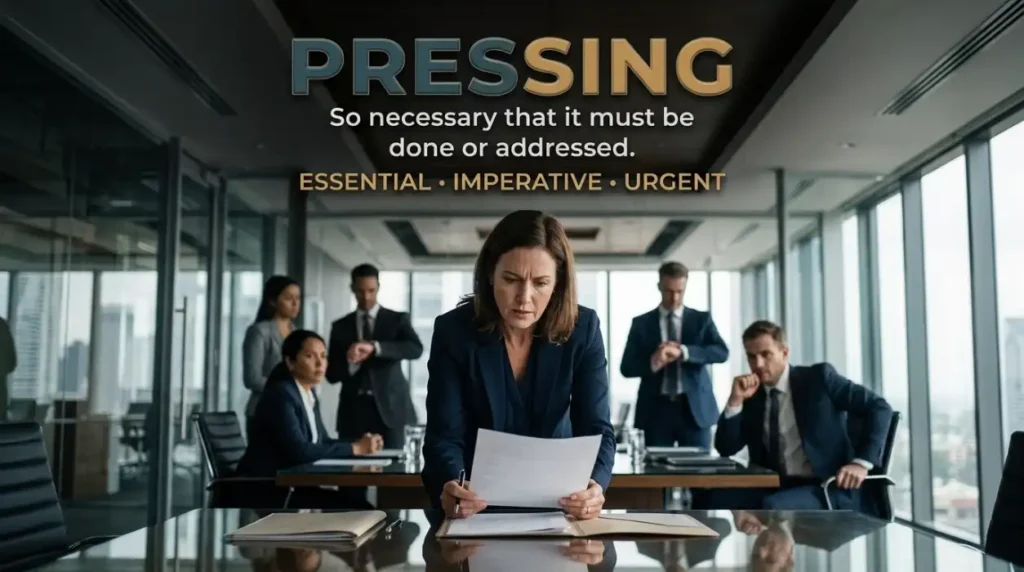
Workplace: A manager needs a report before a meeting. Calling it an urgent task communicates the deadline clearly, while a crucial report emphasizes its importance to a decision.
Social situations: A friend needs help resolving a difficult problem. Describing it as a pressing concern shows that the issue deserves attention without making the message unnecessarily dramatic.
Media and public discussion: A journalist might describe housing shortages as a pressing issue. The phrase signals that the topic deserves public attention.
Writing and storytelling: A character may face a relentless demand from a powerful employer. This wording creates a stronger sense of continuing pressure than simply calling the demand important.
Practice Exercise
Test your understanding by choosing the best alternative for each situation. Focus on meaning, tone, and context.
1. The fire department needs supplies without delay. Which word fits best?
A. Momentous
B. Urgent
C. Compelling
D. Weighty
2. The evidence strongly persuades the jury. Which word is most accurate?
A. Immediate
B. Insistent
C. Compelling
D. Time-sensitive
3. A decision will determine the project’s success. Which word fits best?
A. Crucial
B. Pushing
C. Oppressive
D. Persistent
4. Someone repeatedly demands an answer. Which adjective describes the person?
A. Vital
B. Insistent
C. Significant
D. Acute
5. A button is being pushed downward. Which verb form fits?
A. Consequential
B. Imperative
C. Depressing
D. Momentous
6. A task must be completed before a deadline expires. Which phrase is most precise?
A. Time-sensitive
B. Weighty
C. Compulsive
D. Pivotal
7. A rule is necessary for safety. Which adjective fits?
A. Relentless
B. Imperative
C. Insistent
D. Forceful
8. A problem continues without relief. Which word emphasizes this?
A. Immediate
B. Essential
C. Relentless
D. Significant
9. A research finding has a measurable effect. Which word is suitable?
A. Significant
B. Imperious
C. Squeezing
D. Peremptory
10. A person gives an abrupt order that allows little discussion. Which word fits?
A. Compelling
B. Vital
C. Peremptory
D. Pivotal
Reflection Task:
Write two original sentences using different alternatives for pressing. Use one word for an urgent situation and another for an important decision. Check whether each word expresses the intended meaning.
Answer key:
1-B, 2-C, 3-A, 4-B, 5-C, 6-A, 7-B, 8-C, 9-A, 10-C
Frequently Asked Questions
1. What is the best synonym for pressing in a formal email?
The best alternative depends on what the email needs to communicate. Use urgent when someone must act quickly, critical when the matter could affect an important outcome, and essential when something is necessary. For example, “Your urgent response is required” communicates a clear time expectation. Choose the word that accurately describes the situation rather than using overly dramatic language.
2. What is another way to say “pressing issue” in an essay?
You can use urgent concern, critical problem, significant challenge, or important matter. Each phrase has a slightly different emphasis. An urgent concern needs timely attention, while a significant challenge has a meaningful effect. In academic writing, explain why the issue matters and support your claim with evidence. This makes your wording more convincing and prevents unnecessary exaggeration.
3. Is pressing stronger than important?
Usually, yes, when pressing describes a problem or need. Important communicates significance but does not necessarily suggest a deadline. Pressing commonly adds the idea that attention should not be delayed. For example, an important question can wait until tomorrow, while a pressing question may need an answer today. Context determines the strength of the distinction.
4. What is the difference between pressing and demanding?
Pressing often describes something that requires attention soon. Demanding describes something that requires considerable effort, time, or attention. A pressing deadline may be approaching quickly, whereas a demanding assignment may be difficult even when there is plenty of time. The words sometimes overlap, but they emphasize different aspects of a situation.
5. What is a synonym for pressing when describing physical action?
For physical action, alternatives include pushing, squeezing, compressing, and depressing. The best choice depends on the movement. You might push a door, squeeze a sponge, compress a box, or depress a button. These words cannot usually replace the adjective pressing in a phrase such as “a pressing concern,” because that phrase describes urgency rather than physical force.
6. Can pressing be used as a noun?
Pressing can function as a gerund, which is a verb form used as a noun. For example, “Pressing the reset button solved the problem.” Here, pressing names the action. It can also be a present participle, as in “She is pressing the button.” Its grammatical role depends on how the word functions in the sentence.
7. How can I avoid repeating pressing in an article?
First, identify the intended meaning each time the word appears. Replace it with urgent when timing matters, crucial when the outcome depends on it, or compelling when describing persuasive evidence. You can also restructure sentences to avoid repetition. Do not force variety where the same technical meaning must remain consistent.
Conclusion
Learning a synonym for pressing helps you express urgency, importance, and physical action with greater precision. The right word makes your message clearer and helps readers understand what matters most.
Students can improve essays, bloggers can create more engaging articles, and content writers can avoid unnecessary repetition. Everyday English users can also communicate needs and deadlines more confidently.
Remember that urgent, crucial, compelling, and insistent are not interchangeable in every situation. Pay attention to meaning, tone, and context before choosing an alternative.
Practice these words in emails, essays, and daily conversations. Write a sentence with one new synonym today, then try another tomorrow to build a stronger and more natural English vocabulary.
Suggested External Resources
For additional learning and reliable definitions, consult these established English-language references:
Cambridge Dictionary definitions, pronunciation, and example sentences.
Merriam-Webster meanings, word histories, and usage information.
Oxford Learner’s Dictionaries learner-friendly definitions, pronunciation, and grammar guidance.
Use these references to verify subtle differences between alternatives and select words that fit your intended meaning.

Jameel Hassan is the founder and lead writer at SynonymsCloud.com, a trusted online platform dedicated to English vocabulary and effective communication. He is passionate about helping students, writers, professionals, and lifelong learners discover the right words to express their ideas with clarity, precision, and confidence.
At SynonymsCloud.com, every article is thoroughly researched and carefully written to provide accurate, practical, and easy-to-understand guidance on synonyms, antonyms, word meanings, idioms, and vocabulary. With a strong commitment to quality, real-world usage, and clear explanations, the website helps readers expand their vocabulary, improve their writing, and communicate more effectively in both academic and professional settings.