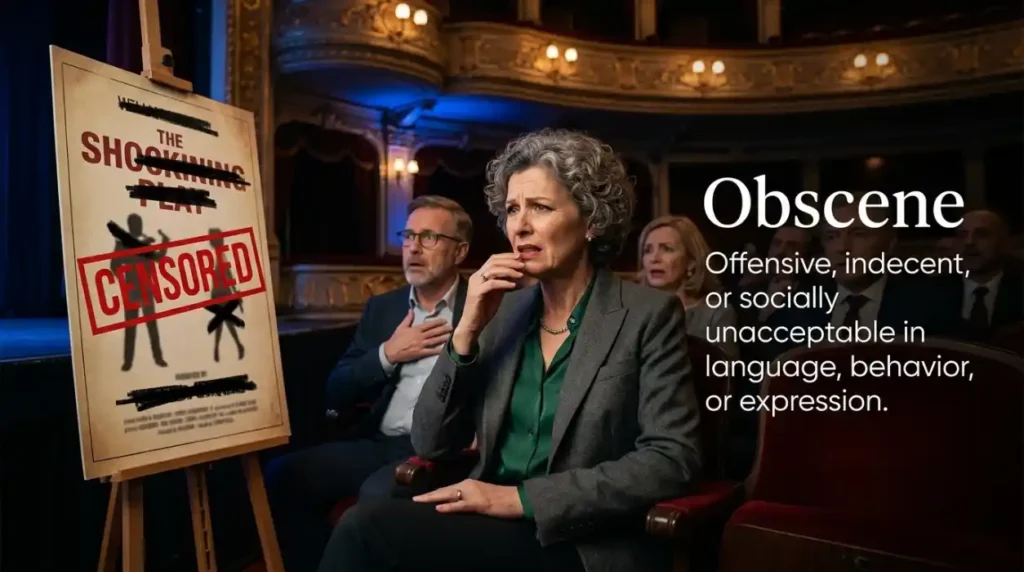
Top synonyms for obscene vary by context and intent. For explicit or offensive behavior, choose lewd, vulgar, indecent, or profane. When describing wildly excessive prices, wealth, or waste, use exorbitant, outrageous, or astronomical. For morally repulsive or shocking acts, select vile, abhorrent, heinous, or repugnant.
A synonym for obscene helps writers describe vulgar, offensive, indecent, or shocking ideas with greater precision. Choosing the right alternative can make your writing clearer and more expressive.
For example, an extremely high coffee price might be called “obscene” because it seems shockingly excessive. In other contexts, words like vulgar, crude, lewd, or indecent may describe inappropriate language or behavior.
Learning a synonym for obscene can expand your vocabulary and help you avoid repeating the same word. Each alternative has a slightly different meaning, tone, and level of intensity.
Students, bloggers, content writers, and everyday speakers can explore synonyms for obscene to create stronger essays, engaging articles, and natural conversations. Understanding these alternatives makes it easier to choose the right expression for every context.
What Does “Obscene” Really Mean?
The word obscene describes something deeply offensive to moral standards, disgustingly vulgar, or outrageously excessive in scale.
The word “obscene” can carry different meanings depending on the context. It may describe sexually explicit or indecent material when discussing morality or public standards. It can also refer to vulgar language, crude behavior, or something considered offensive in social situations. In financial discussions, “obscene” is sometimes used figuratively to describe an extremely large or unreasonable amount, especially when talking about wealth, profits, or spending.
You will encounter this word in news reports, legal censorship cases, economic critiques, literature, and everyday casual debates about fairness.
Part of Speech:
Adjective
Simple Definition:
Offensively indecent, morally disgusting, or outrageously excessive.
Connotative Meaning
Connotation is the secondary emotional, cultural, or social association a word carries beyond its literal dictionary definition.
- Positive tone: Rarely positive, though informally used in modern slang to express mind-blowing scale or skill (e.g., “obscene talent”).
- Negative tone: Strongly negative; carries feelings of moral outrage, disgust, profanity, vulgarity, or extreme social unfairness.
- Neutral tone: Used in legal, regulatory, or academic contexts to classify explicit media or non-permissible content (e.g., “obscene material laws”).
Etymology
- Origin: Derived from the Latin word obscaenus (or obscenus), meaning ill-omened, repulsive, offensive, or foul.
- Old English (450–1100): Not present in Old English; writers used words like ful (foul) or uncleanne (unclean).
- Middle English (1100–1500): Entered Middle English during the late 15th century via Middle French obscène and Latin roots.
- Modern English (1500–Present): Shifted from describing unlucky theatrical omens to defining offensive speech, indecency, and extreme financial excess.
Pronunciation & Syllables
- US: /əbˈsiːn/
- UK: /əbˈsiːn/
- Syllables: ob-scene (2 syllables)
- Affixation Pattern: Root word with Latin prefix
- Root: scene (from Latin caenum meaning filth, or scaena meaning stage)
- Prefix: ob- (against, thoroughly)
- Suffix: None
Synonyms List

1. Vulgar (Adjective)
Meaning: Lacking good taste, refinement, or moral decency.
Tone/Register: General / Conversational
Examples:
- His vulgar jokes made everyone at the dinner table uncomfortable.
- She disliked the movie because of its constant vulgar humor.
2. Lewd (Adjective)
Meaning: Crude and offensive in a sexual way.
Tone/Register: Formal / Legal
Examples:
- The officer arrested the suspect for making lewd gestures in public.
- Security guards removed the man after he made lewd comments.
3. Indecent (Adjective)
Meaning: Not conforming to accepted standards of moral behavior or modesty.
Tone/Register: Formal / Standard
Examples:
- The broadcaster received fines for airing indecent content during family hours.
- Wearing such clothing to a solemn ceremony was considered indecent.
4. Crude (Adjective)
Meaning: Offensively coarse or unrefined in language and behavior.
Tone/Register: Casual / Everyday
Examples:
- He drew a crude sketch on the back of his notebook.
- Avoid using crude language when speaking to customers.
5. Gross (Adjective)
Meaning: Repulsively coarse, vulgar, or unrefined in appearance or behavior.
Tone/Register: Informal / Conversational
Examples:
- The kitchen floor was covered in a gross, sticky residue.
- Leaving trash behind in the park is simply gross behavior.
6. Outrageous (Adjective)
Meaning: Shockingly bad, offensive, or wildly excessive in degree.
Tone/Register: Expressive / General
Examples:
- The hotel charged an outrageous fee for basic wireless internet.
- Her outrageous claims surprised everyone in the courtroom.
7. Shocking (Adjective)
Meaning: Causing intense surprise, disgust, or moral indignation.
Tone/Register: General / Journalistic
Examples:
- The news report revealed shocking evidence of financial fraud.
- It was shocking to see how poorly the historic site was maintained.
8. Scandalous (Adjective)
Meaning: Disgraceful and offensive to public moral standards.
Tone/Register: Dramatic / Media
Examples:
- The tabloid published a scandalous article about the politician’s private life.
- Misusing charity funds is a scandalous betrayal of public trust.
9. Exorbitant (Adjective)
Meaning: Unreasonably or outrageously high in price or cost.
Tone/Register: Business / Financial
Examples:
- Ticket prices for the championship game reached exorbitant levels.
- The contractor demanded an exorbitant price for minor repairs.
10. Profane (Adjective)
Meaning: Showing disrespect or contempt for sacred things through offensive speech.
Tone/Register: Formal / Religious
Examples:
- The speaker was scolded for using profane language in church.
- Ancient manuscripts were protected from profane handling.
11. Improper (Adjective)
Meaning: Not in accordance with accepted rules of modesty, ethics, or behavior.
Tone/Register: Professional / Standard
Examples:
- The committee investigated the manager for improper financial conduct.
- Using company resources for personal gain is highly improper.
12. Offensive (Adjective)
Meaning: Causing anger, resentment, or moral disgust.
Tone/Register: General / Standard
Examples:
- The comedian apologized for making offensive remarks about the audience.
- Please remove any offensive pictures from the bulletin board.
13. Coarse (Adjective)
Meaning: Rough, harsh, or lacking refinement in manner or speech.
Tone/Register: Descriptive / General
Examples:
- His coarse manners turned away potential business partners.
- The sailor spoke in a coarse voice after years at sea.
14. Repulsive (Adjective)
Meaning: Arousing intense disgust or strong aversion.
Tone/Register: Strong / Expressive
Examples:
- The smell of spoiled milk floating from the fridge was repulsive.
- Cruelty toward defenseless animals is completely repulsive.
15. Abhorrent (Adjective)
Meaning: Inspiring disgust and hatred; deeply repugnant.
Tone/Register: Formal / Serious
Examples:
- Discrimination of any kind is abhorrent to modern society.
- The judge called the criminal act abhorrent before handing down the sentence.
16. Disgusting (Adjective)
Meaning: Causing strong dislike, nausea, or moral disapproval.
Tone/Register: Everyday / Informal
Examples:
- The restaurant was shut down due to disgusting kitchen conditions.
- Throwing trash into the ocean is a disgusting habit.
17. Foul (Adjective)
Meaning: Grossly offensive to the senses or moral sensibilities.
Tone/Register: General / Descriptive
Examples:
- A foul odor drifted from the polluted river bank.
- He received a penalty for using foul words against the referee.
18. Filthy (Adjective)
Meaning: Disgustingly dirty, morally corrupt, or vulgarly explicit.
Tone/Register: Casual / Strong
Examples:
- Wash your hands thoroughly after working in that filthy basement.
- The executive amassed a filthy fortune through illegal insider trading.
19. Smutty (Adjective)
Meaning: Offensively crude or vulgar, especially regarding sexual matters.
Tone/Register: Informal / Critical
Examples:
- The magazine was criticized for printing smutty jokes.
- He hid his stack of smutty paperbacks under the mattress.
20. Ribald (Adjective)
Meaning: Referring to sexual matters in an amusingly rude or irreverent way.
Tone/Register: Literary / Historical
Examples:
- The Renaissance play featured ribald songs that made the audience laugh.
- Characters in the novel exchanged ribald banter at the tavern.
21. Salacious (Adjective)
Meaning: Conveying undue interest in sexual matters; lustful or sensational.
Tone/Register: Academic / Media
Examples:
- The reporter focused on salacious details rather than facts.
- Rumors of a salacious nature spread rapidly through the office.
22. Licentious (Adjective)
Meaning: Promiscuous and unprincipled in sexual behavior.
Tone/Register: Formal / Literary
Examples:
- Historical records described the ruler’s licentious lifestyle in detail.
- The preacher warned the congregation against leading a licentious life.
23. Lascivious (Adjective)
Meaning: Revealing an overt or offensive sexual desire.
Tone/Register: Formal / Legal
Examples:
- The witness described the suspect’s lascivious behavior at the party.
- He cast a lascivious glance across the room before leaving.
24. Indelicate (Adjective)
Meaning: Lacking tact, sensitivity, or artistic refinement.
Tone/Register: Polite / Formal
Examples:
- Asking about someone’s salary in public is considered indelicate.
- She made an indelicate comment about her co-worker’s outfit.
25. Bawdy (Adjective)
Meaning: Indecently humorous or coarse in a theatrical context.
Tone/Register: Literary / Theater
Examples:
- Shakespearean comedies often feature bawdy humor and clever puns.
- The tavern was filled with laughter from bawdy sea shanties.
26. Explicit (Adjective)
Meaning: Stated or shown clearly and directly, often referring to graphic content.
Tone/Register: Formal / Technical
Examples:
- The movie poster carried a clear warning about explicit violence.
- Teachers provided explicit instructions for completing the lab report.
27. Unseemly (Adjective)
Meaning: Not proper or appropriate for a particular social situation.
Tone/Register: Formal / Polite
Examples:
- Arguments over money at a funeral are deeply unseemly.
- The politician showed unseemly haste in celebrating his victory.
28. Unbecoming (Adjective)
Meaning: Not fitting or appropriate for a person’s status or position.
Tone/Register: Formal / Professional
Examples:
- Such childish behavior is completely unbecoming of a university professor.
- Shouting at employees is unbecoming conduct for an executive.
29. Extravagant (Adjective)
Meaning: Lacking restraint in spending money or using resources excessively.
Tone/Register: General / Financial
Examples:
- They threw an extravagant party that cost millions of dollars.
- Buying five luxury sports cars seems extravagant to ordinary people.
30. Immoderate (Adjective)
Meaning: Not sensible or restrained; exceeding reasonable limits.
Tone/Register: Formal / Academic
Examples:
- Immoderate alcohol consumption can lead to serious health problems.
- The judge warned against immoderate reactions during court trials.
31. Monstrous (Adjective)
Meaning: Outrageously evil, cruel, or shockingly huge in scale.
Tone/Register: Dramatic / Expressive
Examples:
- Building a toxic waste dump near a playground is a monstrous decision.
- The company posted monstrous profits while cutting worker salaries.
32. Heinous (Adjective)
Meaning: Utterly odious, wicked, or reprehensible in nature.
Tone/Register: Legal / Serious
Examples:
- The court convicted the criminal for his heinous war crimes.
- Kidnapping innocent citizens is a heinous violation of human rights.
33. Atrocious (Adjective)
Meaning: Extremely bad, wicked, or shockingly poor in quality.
Tone/Register: Expressive / Casual
Examples:
- The team played an atrocious game and lost by thirty points.
- Weather conditions during the winter storm were downright atrocious.
34. Abominable (Adjective)
Meaning: Causing moral revulsion or intense disgust.
Tone/Register: Formal / Dramatic
Examples:
- The captives were forced to live in abominable sanitation conditions.
- Cruelty toward children is an abominable crime in every culture.
35. Vile (Adjective)
Meaning: Extremely unpleasant, morally bad, or wicked.
Tone/Register: General / Strong
Examples:
- He spewed vile insults at the driver who cut him off in traffic.
- The villain concocted a vile scheme to poison the city’s water supply.

36. Shameful (Adjective)
Meaning: Worthy of severe disapproval, disgrace, or moral regret.
Tone/Register: Moral / General
Examples:
- Cheating on a final exam is a shameful act that damages your integrity.
- The city council acknowledged the shameful state of public housing.
37. Disgraceful (Adjective)
Meaning: Shockingly unacceptable and bringing dishonor or shame.
Tone/Register: Critical / Standard
Examples:
- Leaving pet waste on the sidewalk is disgraceful public behavior.
- The company’s failure to pay its workers on time was disgraceful.
38. Dishonorable (Adjective)
Meaning: Lacking integrity or moral principles; bringing dishonor.
Tone/Register: Formal / Historical
Examples:
- Breaking a solemn promise is considered a dishonorable act.
- The officer received a dishonorable discharge from military service.
39. Unscrupulous (Adjective)
Meaning: Having or showing no moral principles or fairness.
Tone/Register: Business / Professional
Examples:
- Unscrupulous landlords often refuse to return security deposits to tenants.
- Scammers target older citizens with unscrupulous phone calls.
40. Off-color (Adjective)
Meaning: Slightly indecent, inappropriate, or tasteless in humor.
Tone/Register: Conversational / Casual
Examples:
- The manager was reprimanded for telling off-color jokes at work.
- Her off-color remarks ruined the formal dinner party.
41. Mind-boggling (Adjective)
Meaning: Overwhelmingly huge, complex, or surprising in scale.
Tone/Register: Informal / Expressive
Examples:
- The CEO earned a mind-boggling bonus despite losing money for shareholders.
- Distances between galaxies in space are truly mind-boggling.
42. Obnoxious (Adjective)
Meaning: Extremely unpleasant, annoying, or offensively loud.
Tone/Register: Casual / Everyday
Examples:
- The obnoxious tourist shouted at the hotel staff for no good reason.
- Playing loud music late at night is obnoxious to your neighbors.
43. Repugnant (Adjective)
Meaning: Incompatible with good taste or moral principles; disgusting.
Tone/Register: Formal / Legal
Examples:
- The idea of selling fake medicine to sick people is morally repugnant.
- Racist ideology is repugnant to anyone who values human equality.
44. Loathsome (Adjective)
Meaning: Causing feelings of intense hatred, disgust, or revulsion.
Tone/Register: Literary / Strong
Examples:
- The corrupt dictator was remembered as a loathsome figure in history.
- Slugs are often viewed as loathsome creatures by home gardeners.
45. Detestable (Adjective)
Meaning: Deserving intense dislike or moral condemnation.
Tone/Register: Formal / Serious
Examples:
- Lying under oath in a court of law is a detestable crime.
- She found his arrogant attitude completely detestable.
46. Depraved (Adjective)
Meaning: Morally corrupt, perverted, or lacking all moral standards.
Tone/Register: Legal / Dramatic
Examples:
- The serial killer showed a depraved mind during his police interview.
- Society must protect vulnerable citizens from depraved criminals.
47. Corrupt (Adjective)
Meaning: Having or showing a willingness to act dishonestly in return for money.
Tone/Register: Political / Professional
Examples:
- Corrupt officials siphoned public funds into offshore bank accounts.
- The entire system was so corrupt that honest police officers were fired.
48. Degenerate (Adjective)
Meaning: Having lost the physical, mental, or moral qualities considered normal or desirable.
Tone/Register: Critical / Formal
Examples:
- The emperor spent his final years engaging in degenerate behavior.
- Critics dismissed the movie as a degenerate piece of entertainment.
49. Scurrilous (Adjective)
Meaning: Making or spreading scandalous claims about someone to damage their reputation.
Tone/Register: Legal / Media
Examples:
- The politician sued the newspaper for publishing scurrilous lies.
- Online trolls posted scurrilous attacks on the author’s social media page.
50. Dirty (Adjective)
Meaning: Unclean, morally tainted, or offensively crude in tone.
Tone/Register: Everyday / Casual
Examples:
- Keep your dirty shoes outside on the porch mat.
- Playing dirty tricks on rivals won’t win you true respect.
51. Nasty (Adjective)
Meaning: Highly unpleasant, spiteful, or offensive to the senses.
Tone/Register: Casual / Conversational
Examples:
- She left a nasty comment under her rival’s blog post.
- Wear boots because the weather outside has turned nasty.
52. Unprincipled (Adjective)
Meaning: Not guided by or showing good moral rules or ethics.
Tone/Register: Business / Academic
Examples:
- Unprincipled salesmen trick buyers into signing unfair contracts.
- He made a fortune through unprincipled stock market manipulation.
53. Astronomical (Adjective)
Meaning: Exceedingly or impossibly high in financial cost or quantity.
Tone/Register: General / Financial
Examples:
- The cost of buying a house in the city center has become astronomical.
- Medical bills for the complex surgery reached astronomical figures.
54. Steep (Adjective)
Meaning: Unreasonably high in price; demanding excessive effort or money.
Tone/Register: Informal / Business
Examples:
- Charging fifty dollars for parking seems a bit steep.
- The entrance fee for the music festival was far too steep for students.
55. Over-the-top (Adjective)
Meaning: Excessive, exaggerated, or outrageously beyond normal limits.
Tone/Register: Informal / Expressive
Examples:
- His over-the-top reaction to a minor mistake startled everyone in the room.
- The action movie featured over-the-top explosions and wild stunts.
56. Sordid (Adjective)
Meaning: Involving ignoble, dirty, or morally distasteful motives and actions.
Tone/Register: Literary / Investigative
Examples:
- The investigative reporter uncovered the sordid details of the bribery scandal.
- He wanted no part in their sordid scheme to cheat older voters.
57. Tasteless (Adjective)
Meaning: Lacking aesthetic judgment, sensitivity, or social decorum.
Tone/Register: Casual / Critical
Examples:
- Making fun of someone’s physical disability is tasteless and cruel.
- The room was decorated with expensive but tasteless furniture.
58. Unacceptable (Adjective)
Meaning: Not pleasing or welcome; failing to meet basic acceptable standards.
Tone/Register: Professional / Standard
Examples:
- Arriving two hours late for an interview is completely unacceptable.
- Customer service at the airline has dropped to unacceptable levels.
59. Unchaste (Adjective)
Meaning: Not virtuous; engaging in immoral or indecent sexual behavior.
Tone/Register: Archaic / Formal
Examples:
- Historical novels often portray royal courts as unchaste and corrupt.
- Victorian society severely judged anyone considered unchaste.
60. Impure (Adjective)
Meaning: Mixed with undesirable elements; morally unwholesome or dirty.
Tone/Register: Religious / Philosophical
Examples:
- The filter removed all impure minerals from the well water.
- He struggled to keep impure thoughts from clouding his judgment.
Synonyms by Tone
Grouping synonyms by tone helps you pick the right word for every situation:
Positive / Slang Tone
- Mind-boggling
- Over the top
- Astronomical (when describing incredible scale or success)
Neutral / Technical Tone
- Explicit
- Exorbitant
- Immoderate
- Extravagant
- Steep
- Unacceptable
Negative / Moral Outrage Tone
- Vulgar
- Lewd
- Indecent
- Profane
- Abhorrent
- Repulsive
- Heinous
- Abominable
- Vile
- Sordid
Playful / Informal Tone
- Gross
- Crude
- Smutty
- Off color
- Nasty
- Dirty
Why Tone Matters:
Choosing the right word prevents embarrassing misunderstandings. Calling an expensive phone price “astronomical” sounds completely normal. Calling that same price “lewd” makes no sense!
Mini Comparison
| Word | Core Meaning Focus | Tone & Register | Ideal Usage Context |
| Obscene | Offensively explicit, morally abhorrent, or outrageously excessive | Strong / Outraged | Legal cases, moral critiques, outrageous prices or corporate greed |
| Vulgar | Lacking good taste, refinement, or social modesty | General / Casual | Crude jokes, bad manners, tasteless decor or loud behavior |
| Exorbitant | Unreasonably or outrageously high in price or cost | Professional / Financial | Overpriced goods, high interest rates, excessive fees |
Context-Based Usage
Daily Conversation
Use friendly, everyday words like gross, nasty, steep, or off color when discussing high prices or bad manners with friends.
Writing or Blogging
Bloggers keep readers engaged by choosing vivid, punchy terms like shocking, scandalous, over the top, or outrageous.
Professional or Academic Tone
Stick to formal terms such as exorbitant, improper, unseemly, explicit, or abhorrent in business reports and essays.
Creative Writing
Storytellers build suspense and moral tension using evocative literary terms like bawdy, sordid, vile, ribald, or loathsome.
Common Mistakes & Native Usage

Misuse Scenarios
- Using Sexual Words for Prices: Avoid calling an expensive item “lewd” or “lascivious.” Use exorbitant or astronomical instead.
- Confusing Vulgar and Obscene: Vulgar means bad taste or crude manners. Obscene implies a far stronger moral offense or outrage.
- Overusing the Focus Keyword: Repeating “obscene” too many times weakens your argument. Rotate through semantic variants like unseemly or outrageous.
Register Notes
- Use formal legal terms (indecent, heinous) in official documents.
- Use informal terms (gross, off-color) in spoken English.
- For deeper lessons on tone in academic writing, explore our comprehensive guide on formal vocabulary choices.
Real-Life Mini Scenarios
- Workplace: The auditor discovered an improper use of corporate funds by top executives.
- Social Situations: Guests felt uncomfortable after he made an off-color joke during dinner.
- Media / Pop Culture: Viewers voiced outrage over exorbitant subscription price increases for streaming apps.
- Writing & Storytelling: The author described the villain’s sordid past to explain his motives.
Conclusion
Mastering synonyms for obscene gives you useful vocabulary for describing excessive behavior, shocking prices, vulgar language, and indecent content with greater precision. Selecting the right word helps you express your meaning clearly while maintaining the appropriate tone and context in your writing.
Expanding your vocabulary can strengthen communication across college essays, professional reports, creative stories, blog posts, and everyday conversations. Understanding how related words differ in meaning, tone, and intensity allows you to avoid repetition and create more natural, engaging, and effective sentences.
Try using two new alternatives from this guide in your next journal entry, essay, email, or conversation. Regular practice can strengthen your vocabulary, improve your writing style, sharpen your word choice, and build confidence as a clear communicator.
Practice Exercise
Test your understanding of meaning, tone, and usage with this scenario-based quiz.
1. Which term best describes an outrageously high price?
A) Lewd
B) Lascivious
C) Exorbitant
D) Bawdy
2. What word is most appropriate for crude humor in a Shakespearean play?
A) Astronomical
B) Bawdy
C) Steep
D) Exorbitant
3. Which word carries a legal register when describing explicit adult material?
A) Steep
B) Mind-boggling
C) Off color
D) Indecent
4. What casual synonym fits best when describing a sticky, dirty kitchen counter?
A) Licentious
B) Heinous
C) Gross
D) Scurrilous
5. Which word best describes severe war crimes in a legal sentence?
A) Indelicate
B) Steep
C) Off color
D) Heinous
6. What term describes a mild joke that crosses social boundaries slightly?
A) Monstrous
B) Off color
C) Abhorrent
D) Depraved
7. Which financial term best describes CEO bonuses that shock the public?
A) Ribald
B) Unchaste
C) Coarse
D) Exorbitant
8. What word best describes behavior that is completely improper for a judge?
A) Smutty
B) Crude
C) Unbecoming
D) Impure
9. Which formal word describes conduct that inspires deep moral revulsion?
A) Steep
B) Over the top
C) Off color
D) Abhorrent
10. What literary term describes dirty, dishonest motives behind a scandal?
A) Astronomical
B) Indelicate
C) Sordid
D) Explicit
Reflection Task:
Write two original sentences describing an overpriced product or an inappropriate movie scene using two new synonyms learned today.
Answer Key:
1C | 2B | 3D | 4C | 5D | 6B | 7D | 8C | 9D | 10C
Frequently Asked Questions
1. What is the most common formal synonym for obscene?
The most common formal synonyms for obscene are “indecent,” “abhorrent,” or “heinous” when referring to moral offenses, and “exorbitant” or “immoderate” when referring to financial excess.
2. Can I use obscene to describe high prices?
Yes! Native speakers frequently use “obscene” to describe shocking prices, extreme greed, or outrageously high salaries (e.g., “an obscene amount of profit”).
3. What is the difference between vulgar and obscene?
“Vulgar” refers to a lack of good taste, crude manners, or low refinement. “Obscene” is much stronger, describing things that are deeply offensive, indecent, or outrageously excessive.
4. What is a good casual synonym for obscene?
In everyday casual English, good synonyms include “gross,” “shocking,” “outrageous,” “nasty,” or “over the top,” depending on whether you mean dirty, rude, or expensive.
5. What does the word exorbitant mean compared to obscene?
“Exorbitant” specifically refers to prices, fees, or demands that are unreasonably high. “Obscene” can also mean expensive, but it carries a stronger emotional tone of moral outrage.
6. Is smutty considered a formal word?
No. “Smutty” is an informal word used to describe crude, vulgarly explicit, or sexually indecent jokes, books, or pictures in casual speech.

Jameel Hassan is the founder and lead writer at SynonymsCloud.com, a trusted online platform dedicated to English vocabulary and effective communication. He is passionate about helping students, writers, professionals, and lifelong learners discover the right words to express their ideas with clarity, precision, and confidence.
At SynonymsCloud.com, every article is thoroughly researched and carefully written to provide accurate, practical, and easy-to-understand guidance on synonyms, antonyms, word meanings, idioms, and vocabulary. With a strong commitment to quality, real-world usage, and clear explanations, the website helps readers expand their vocabulary, improve their writing, and communicate more effectively in both academic and professional settings.