

Synonyms for nose vary by context. For animals, choose snout, muzzle, or proboscis. For birds, use beak or bill. Informal human slang includes schnoz, snoot, and hooter. Anatomically, refer to the nasal organ or nostrils, while prow or nosecone describes the leading front edge of any large moving vehicle.
A Synonym for Nose can make your writing clearer, more varied, and descriptive. While “nose” is a common term, different situations may require more specific words. Choosing the right alternative can help readers understand your meaning easily.
For example, words like “snout,” “muzzle,” and “beak” can describe different facial or animal features. A writer describing an old detective might use words like “crooked” or “prominent” to create a vivid image.
A Synonym for Nose can also describe the front or projecting part of certain objects, vehicles, or machines. Context is important because not every alternative works naturally in every sentence or situation.
Students, bloggers, writers, and English learners can explore a Synonym for Nose to expand vocabulary, avoid repetition, improve descriptions, and communicate ideas more naturally in everyday English.
What Does “Nose” Really Mean?
The word nose refers to the prominent facial organ above the mouth used for breathing and smelling, as well as the forward protruding tip of a vehicle or object.
Native English speakers understand “nose” in three distinct ways. Anatomically, it is the primary organ of smell and respiration. Structurally, it refers to the front tip of an aircraft, ship, or car. Metaphorically, it represents intuition or inquisitive prying (e.g., “a nose for news”).
You will encounter this word frequently in medical literature, animal biology, creative fiction, automotive design, and everyday casual chatter.
Part of Speech:
Noun / Verb
Simple Definition:
The facial feature used for smelling and breathing, or the front tip of an object.
Connotative Meaning
Connotation is the emotional, cultural, or secondary meaning that a word carries beyond its literal dictionary definition.
- Positive tone: Expresses keen intuition, sharp perception, curiosity, or affection (e.g., “flair,” “instinct,” “nuzzle”).
- Negative tone: Implies unwanted prying, intrusiveness, snobbery, or an unsightly appearance (e.g., “snoot,” “snoop,” “pry”).
- Neutral tone: Refers strictly to anatomical features, biological structures, or physical front tips (e.g., “olfactory organ,” “nostrils,” “prow”).
Etymology
- Origin: Derived from Proto-Germanic naso and Proto-Indo-European nas, both referring to the facial organ of smell.
- Old English (450–1100): Spelled nosu, meaning the human facial organ and animal sniffing apparatus.
- Middle English (1100–1500): Evolved into nose, expanding to describe the spouts of vessels and protruding landscape features.
- Modern English (1500–Present): Retained its anatomical definition while acquiring technical uses in aviation and idiomatic expressions regarding intuition.
Pronunciation & Syllables
- US: /noʊz/
- UK: /nəʊz/
- Syllables: nose (1 syllable)
- Affixation Pattern: Root word without affixation
- Root: Nose
- Prefix: None
- Suffix: None
Synonyms List
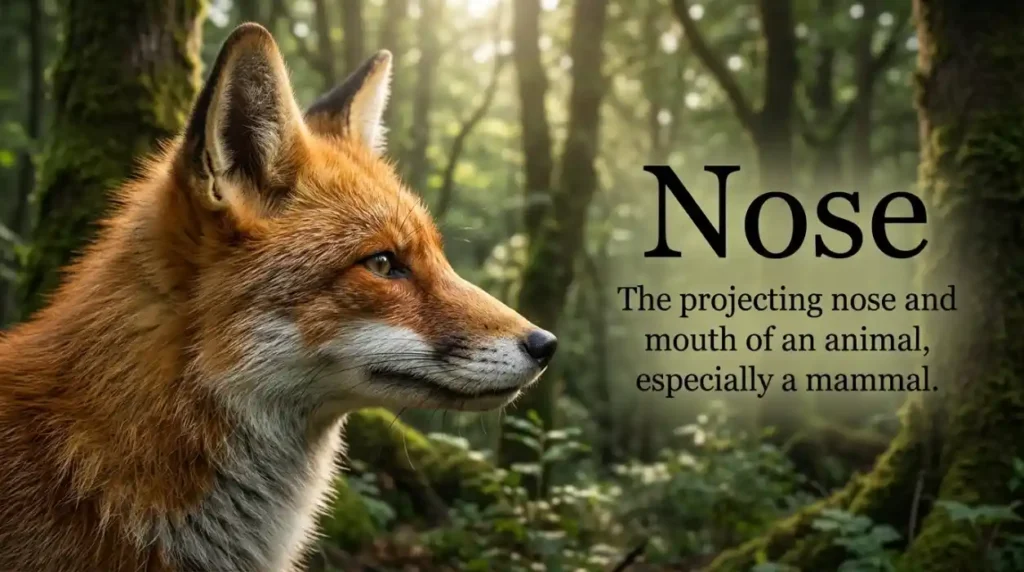
1. Snout (Noun)
Meaning: The projecting nose and mouth of an animal, especially a mammal.
Tone/Register: Informal / Animal Biology
Examples:
- The curious pig pushed its snout through the wooden garden fence.
- Mud covered the dog’s wet snout after digging in the yard.
2. Muzzle (Noun)
Meaning: The projecting jaw and nose area of an animal such as a dog or horse.
Tone/Register: Neutral / Veterinary
Examples:
- The horse rested its warm muzzle gently against the trainer’s shoulder.
- Gray fur appeared around the older hound’s muzzle.
3. Beak (Noun)
Meaning: A bird’s hard protruding mouth structure, or informally, a large human nose.
Tone/Register: General / Informal
Examples:
- The eagle held a fresh fish securely in its sharp beak.
- He adjusted his reading glasses on the bridge of his prominent beak.
4. Bill (Noun)
Meaning: The horny projecting mouth structure of a bird or platypus.
Tone/Register: Neutral / Biological
Examples:
- The duck dipped its broad bill under the calm pond water.
- Yellow markings distinguished the seabird’s sturdy bill.
5. Proboscis (Noun)
Meaning: An elongated nose or trunk of a mammal, or an insect’s long feeding tube.
Tone/Register: Formal / Scientific
Examples:
- The butterfly inserted its long proboscis deep into the colorful flower blossom.
- Tapirs possess a flexible proboscis that helps them gather leaves.
6. Trunk (Noun)
Meaning: The long, muscular, flexible nose of an elephant used for grabbing and smelling.
Tone/Register: General / Nature
Examples:
- The elephant sprayed cool river water over its back using its trunk.
- The mother elephant wrapped her trunk around her young calf.
7. Snoot (Noun)
Meaning: An informal or playful word for a nose, often associated with a snobbish expression.
Tone/Register: Informal / Casual
Examples:
- The cat turned up its snoot and refused to eat the cheap food.
- He got booped right on his fluffy snoot during playtime.
8. Schnoz (Noun)
Meaning: A humorous slang word for a large or noticeable human nose.
Tone/Register: Informal / Slang
Examples:
- The comedian made self-deprecating jokes about his own large schnoz.
- Sunscreen was slathered thickly across his big schnoz at the beach.
9. Schnozzle (Noun)
Meaning: A playful variant of schnoz used to describe a prominent nose.
Tone/Register: Informal / Humorous
Examples:
- He wore a fake disguise featuring a gigantic plastic schnozzle.
- Cold winter wind turned her schnozzle bright red.
10. Hooter (Noun)
Meaning: An informal British slang term for a human nose.
Tone/Register: Informal / Regional
Examples:
- He blew his red hooter loudly into a white handkerchief.
- A pair of dark sunglasses sat right on top of his hooter.
11. Conk (Noun)
Meaning: An older slang term for a person’s nose or head.
Tone/Register: Informal / Archaic Slang
Examples:
- The stray baseball hit him right on the conk during practice.
- He pulled his woolen scarf up high to cover his cold conk.
12. Neb (Noun)
Meaning: A dialect or traditional word for a bird’s beak or a person’s nose.
Tone/Register: Regional / Literary
Examples:
- The small bird poked its sharp neb out of the birdhouse.
- He poked his neb into business that was not his own.
13. Smeller (Noun)
Meaning: A casual term for the nose, highlighting its ability to detect odors.
Tone/Register: Informal / Casual
Examples:
- Freshly baked cinnamon rolls instantly tickled my smeller.
- The bloodhound used its expert smeller to track the trail.
14. Olfactory organ (Noun phrase)
Meaning: The formal biological structure responsible for processing the sense of smell.
Tone/Register: Academic / Medical
Examples:
- Microscopic receptors inside the olfactory organ detect airborne chemical signals.
- Damage to the olfactory organ can result in a loss of odor perception.
15. Nasal organ (Noun phrase)
Meaning: The upper respiratory anatomical structure that filters and warms incoming air.
Tone/Register: Medical / Scientific
Examples:
- Dust particles were trapped safely inside the outer nasal organ.
- The physician examined the patient’s internal nasal organ for blockage.
16. Scent organ (Noun phrase)
Meaning: The sensory structure animals use to detect pheromones and scents.
Tone/Register: Biological / Technical
Examples:
- Insects rely heavily on a specialized scent organ to locate mates.
- The predator’s keen scent organ picked up traces of prey miles away.
17. Nares (Noun)
Meaning: The technical medical term for the nostrils or external nasal passages.
Tone/Register: Formal / Medical
Examples:
- The doctor inspected both nares for signs of inflammation.
- Oxygen was administered gently through a tube placed near the nares.
18. Nostrils (Noun)
Meaning: The two external openings of the nose that admit air for breathing.
Tone/Register: General / Everyday
Examples:
- The racehorse flared its wide nostrils as it sprinted toward the finish line.
- Cold air stung her nostrils as she stepped out into the blizzard.
19. Sniffer (Noun)
Meaning: A casual word for the nose or a device used to detect gases.
Tone/Register: Informal / Conversational
Examples:
- Give that soup a smell with your sniffer to see if it needs salt.
- The rescue dog used its sharp sniffer to find lost hikers.
20. Front (Noun)
Meaning: The forward-facing part or leading surface of an object or vehicle.
Tone/Register: General / Functional
Examples:
- Raindrops splattered against the front of the speeding train.
- Damage was concentrated mainly along the front of the vehicle.
21. Prow (Noun)
Meaning: The pointed front part of a ship or boat cutting through water.
Tone/Register: Maritime / Descriptive
Examples:
- Ocean waves crashed dramatically against the steel prow of the ship.
- A wooden carving was mounted on the vessel’s forward prow.
22. Bow (Noun)
Meaning: The forward end or front structural tip of a ship or boat.
Tone/Register: Nautical / Standard
Examples:
- Passengers gathered at the bow to watch dolphins jump in the wake.
- The anchor was lowered smoothly over the starboard bow.
23. Tip (Noun)
Meaning: The end or pointed extremity of a physical structure.
Tone/Register: General / Practical
Examples:
- A tiny droplet of rain hung from the tip of her nose.
- The airplane’s wing tip glowed brightly in the evening sky.
24. Point (Noun)
Meaning: The tapered or sharp leading edge of an object or landmass.
Tone/Register: Descriptive / Spatial
Examples:
- The narrow point of the peninsula extends far into the bay.
- He carefully sharpened the lead point of his pencil.
25. Peak (Noun)
Meaning: A prominent projecting point or highest tip of a structure or surface.
Tone/Register: General / Visual
Examples:
- Sunlight illuminated the rocky peak of the snow-capped mountain.
- The roof features a decorative peak above the main entryway.
26. Projection (Noun)
Meaning: Something that extends, juts out, or protrudes from a main surface.
Tone/Register: Technical / Neutral
Examples:
- The wall features a stone projection designed to hold a lantern.
- Radar detected an unusual projection on the front hull.
27. Protuberance (Noun)
Meaning: A rounded swelling or bulge projecting outward from a flat body.
Tone/Register: Academic / Formal
Examples:
- A strange wooden protuberance stuck out from the ancient tree trunk.
- Doctors examined the small bony protuberance on the patient’s joint.
28. Promontory (Noun)
Meaning: A high point of land jutting out into a body of water or low area.
Tone/Register: Geographic / Literary
Examples:
- A historic lighthouse stands high on the rocky coastal promontory.
- We looked down at the ocean waves from the windy promontory.
29. Spur (Noun)
Meaning: A projecting ridge or pointed structure extending from a main body.
Tone/Register: Technical / Geographic
Examples:
- Hikers followed a narrow mountain spur to reach the summit.
- A steel spur projected outward from the front of the gate.
30. Forefront (Noun)
Meaning: The leading, most prominent, or frontmost position of a structure.
Tone/Register: Formal / Abstract
Examples:
- The company remains at the forefront of modern medical technology.
- Leaders stood at the forefront of the marching crowd.
31. Nosecone (Noun)
Meaning: The cone-shaped front section of a rocket, missile, or high-speed aircraft.
Tone/Register: Aerospace / Technical
Examples:
- Engineers inspected the ceramic nosecone after the spacecraft landed.
- The rocket’s sharp nosecone reduced air resistance during launch.
32. Snout end (Noun phrase)
Meaning: The front terminal end of a mechanical pipe, tool, or device.
Tone/Register: Industrial / Functional
Examples:
- Water poured rapidly out of the metal snout end of the hose.
- Attach the rubber nozzle directly to the snout end of the pipe.
33. Nozzle (Noun)
Meaning: A projecting spout or terminal pipe used to direct fluid flow.
Tone/Register: Practical / Mechanical
Examples:
- Adjust the hose nozzle to create a fine mist for the garden.
- Fuel flowed smoothly through the pump nozzle into the tank.
34. Spout (Noun)
Meaning: A projecting tube or lip through which liquid is poured or discharged.
Tone/Register: General / Household
Examples:
- Steam rose steadily from the curved spout of the tea kettle.
- Hot chocolate trickled down the side of the pitcher spout.
35. Lip (Noun)
Meaning: The projecting rim or outer edge of a vessel, container, or opening.
Tone/Register: Practical / General
Examples:
- Be careful not to spill juice over the outer lip of the glass.
- The bucket has a raised lip that prevents splashing.

36. Rim (Noun)
Meaning: The circular outer edge of a raised structural surface or container.
Tone/Register: General / Neutral
Examples:
- Salt coated the circular rim of the cold drink glass.
- Rainwater collected around the metal rim of the barrel.
37. Beak head (Noun)
Meaning: An architectural carving or decorative projection shaped like a beak.
Tone/Register: Architectural / Historic
Examples:
- Ancient stone arches were decorated with detailed beak head carvings.
- The historic church features a famous beak head design above the doorway.
38. Rostrum (Noun)
Meaning: A beak-like projection on an animal, ancient ship prow, or platform.
Tone/Register: Scientific / Historical
Examples:
- The fossilized sawfish skeleton revealed a long serrated rostrum.
- Speakers stepped up to the wooden rostrum to address the crowd.
39. Rhinarium (Noun)
Meaning: The hairless, moist skin surrounding the nostrils of many mammals.
Tone/Register: Biological / Veterinary
Examples:
- A dog’s wet rhinarium helps gather airborne scent particles effectively.
- Biologists checked the tiger’s rhinarium during a health examination.
40. Sense of smell (Noun phrase)
Meaning: The sensory capability or faculty used to perceive aromas and odors.
Tone/Register: General / Informational
Examples:
- Bears possess an extraordinarily powerful sense of smell to find food.
- A temporary cold can weaken your natural sense of smell.
41. Intuition (Noun)
Meaning: The instinctive ability to perceive or understand something without reasoning.
Tone/Register: Expressive / Psychology
Examples:
- Her sharp intuition warned her that something was wrong with the plan.
- Trust your inner intuition when making difficult life choices.
42. Instinct (Noun)
Meaning: An inherent natural aptitude or knack for sensing opportunities or danger.
Tone/Register: General / Analytical
Examples:
- The experienced investor had a sharp instinct for successful startups.
- Survival instinct urged the animals to move away from the fire.
43. Flair (Noun)
Meaning: A natural talent or intuitive ability for recognizing quality or value.
Tone/Register: Positive / Business
Examples:
- The editor has a great flair for discovering talented young authors.
- She displayed a natural flair for interior decoration and design.
44. Knack (Noun)
Meaning: A special intuitive skill or talent for handling situations effortlessly.
Tone/Register: Casual / Conversational
Examples:
- He has an amazing knack for remembering people’s names and faces.
- Finding cheap travel deals requires a bit of practical knack.
45. Scent (Noun)
Meaning: An intuitive track, trail, or subtle clue followed during an investigation.
Tone/Register: Figurative / Descriptive
Examples:
- Detectives picked up a fresh scent that led to new evidence.
- The journalist followed the scent of a major breaking news story.
46. Feel (Noun)
Meaning: An intuitive understanding or perceptive grasp of a situation or art form.
Tone/Register: Informal / Expressive
Examples:
- She quickly developed a good feel for market trends.
- Learning guitar requires getting a natural feel for the rhythm.
47. Spy (Verb)
Meaning: To observe secretively or inspect inquisitive details closely.
Tone/Register: General / Dramatic
Examples:
- He tried to spy on his neighbor’s new home renovations.
- Neighbors saw someone trying to spy through the curtain gap.
48. Pry (Verb)
Meaning: To inquire too closely or intrusively into private personal affairs.
Tone/Register: Negative / Conversational
Examples:
- It is polite not to pry into other people’s private financial matters.
- She disliked reporters who tried to pry into her family life.
49. Snoop (Verb)
Meaning: To look around secretively in order to find out private information.
Tone/Register: Informal / Playful
Examples:
- The nosy kid tried to snoop around for hidden birthday presents.
- Please do not snoop through my private desk drawers.
50. Nuzzle (Verb)
Meaning: To touch, push, or rub gently with the nose or face affectionately.
Tone/Register: Warm / Expressive
Examples:
- The friendly horse leaned down to nuzzle my coat pocket for treats.
- The toddler liked to nuzzle against her mother’s shoulder.
51. Poke (Verb)
Meaning: To thrust or push a pointed object forward into a space.
Tone/Register: Casual / Everyday
Examples:
- Do not poke your nose into arguments that do not concern you.
- The groundhog began to poke its head out from the underground burrow.
52. Edge (Noun/Verb)
Meaning: The leading sharp border of a structure or moving forward cautiously.
Tone/Register: General / Spatial
Examples:
- The ship began to edge its way slowly into the narrow harbor.
- Park your car close to the outer edge of the driveway.
53. Head (Noun)
Meaning: The forwardmost or leading portion of an advancing object or craft.
Tone/Register: Technical / Organizational
Examples:
- The parade head reached the city hall square right on schedule.
- Place the leading head of the tape into the player slot.
54. Lead (Noun)
Meaning: The forward position or frontmost element in a moving formation.
Tone/Register: General / Competitive
Examples:
- The red sports car took the lead right after the first turn.
- Our company held the market lead throughout the entire year.
55. Fore (Noun/Adjective)
Meaning: The front part or forward section of a vehicle or structure.
Tone/Register: Nautical / Formal
Examples:
- Crew members gathered at the fore to inspect the heavy rigging.
- The fore section of the aircraft housed advanced navigation sensors.
56. Frontage (Noun)
Meaning: The front portion, boundary, or facing side of a building or property.
Tone/Register: Real Estate / Legal
Examples:
- The commercial property offers excellent street frontage for retail shops.
- Their house features a wide lake frontage with a private dock.
57. Facade (Noun)
Meaning: The principal front face of a building or decorative structure.
Tone/Register: Architectural / Design
Examples:
- Restoration workers cleaned the historic brick facade of the museum.
- The building’s glass facade reflected the bright morning sunlight.
58. Anterior (Adjective/Noun)
Meaning: Located near or toward the front surface in anatomical terms.
Tone/Register: Medical / Academic
Examples:
- The anterior region of the skull protects delicate facial structures.
- Surgeons created a small incision along the anterior wall.
59. Ventral (Adjective)
Meaning: About the front or lower abdominal side of an organism.
Tone/Register: Biological / Zoological
Examples:
- The whale displayed white markings across its ventral surface.
- Scales on the snake’s ventral side aid in forward movement.
60. Forepart (Noun)
Meaning: The initial, front, or forward section of an object or animal.
Tone/Register: Literary / Descriptive
Examples:
- Dark stripes covered the forepart of the zebra’s body.
- The forepart of the vessel sank beneath the icy waves.
Synonyms by Tone
Select synonyms based on emotional tone to suit your narrative context:
Positive Tone
- Instinct
- Flair
- Intuition
- Nuzzle
- Scent
Neutral Tone
- Olfactory organ
- Nasal organ
- Nostrils
- Nares
- Rhinarium
- Nosecone
- Prow
Negative / Intrusive Tone
- Snoop
- Pry
- Spy
- Snoot
- Beak (when derogatory)
Playful / Informal Tone
- Schnoz
- Schnozzle
- Hooter
- Conk
- Smeller
- Sniffer
Why Tone Matters:
Matching word choices with intended emotion prevents tone mismatches. Calling a dog’s nose a “snout” is natural, whereas calling a human’s nose a “snout” can sound insulting unless intended as playful banter.
Mini Comparison
| Word | Core Meaning Focus | Tone & Register | Ideal Usage Context |
| Nose | The human facial feature, animal smelling organ, or vehicle tip | General / Everyday | General description, medical basics, everyday conversations |
| Snout | The projecting nose and jaw area of an animal | Informal / Biological | Animal descriptions, wildlife writing, farm contexts |
| Proboscis | An elongated animal trunk or insect feeding tube | Formal / Scientific | Zoology, entomology, academic biology papers |
Context-Based Usage
Daily Conversation
Stick to casual, friendly terms like nostrils, sniffer, or schnoz when chatting about everyday situations or mild cold symptoms.
Writing or Blogging
Bloggers paint vivid pictures for readers using engaging terms like flair, intuition, or snout to keep narratives lively.
Professional or Academic Tone
Use formal biological and technical terms such as olfactory organ, nares, nosecone, or anterior in scientific writing.
Creative Writing
Storytellers create atmosphere and character traits using evocative terms like promontory, prow, beak, or nuzzle.
Common Mistakes & Native Usage

Misuse Scenarios
- Confusing Human and Animal Terms: Avoid calling a human nose a “snout” in polite company unless writing intentional comedy.
- Misapplying Technical Words: Using “proboscis” in casual conversation sounds overly clinical and out of place.
- Overusing the Word: Avoid repeating “nose” multiple times in a short paragraph. Use semantic variants like nostrils or feature.
Register Notes
- Use formal medical terms (nares, olfactory organ) in healthcare contexts.
- Use playful terms (schnoz, hooter) in casual spoken English.
- For more vocabulary tips on anatomical and descriptive terms, check out our guide on synonyms for physical traits.
Real-Life Mini Scenarios
- Workplace: The lead investigative journalist relied on her sharp intuition to uncover corporate wrongdoing.
- Social Situations: Everyone laughed playfully when the comedian poked fun at his own large schnoz.
- Media / Pop Culture: Space agency livestreams highlighted the sleek heat-resistant nosecone of the rocket.
- Writing & Storytelling: The author described the golden retriever placing its wet muzzle on the child’s lap.
Conclusion
Mastering a synonym for nose helps you describe facial features, animal snouts, and the projecting parts of objects with greater precision and creativity. Instead of repeating the same familiar word, you can choose alternatives that match the subject and context. This makes descriptions clearer, more natural, and easier for readers to visualize.
Using varied vocabulary can also strengthen essays, blog posts, stories, conversations, and everyday communication. Learning related terms helps students, writers, bloggers, and English learners express physical details without making their sentences sound repetitive. It also encourages you to understand subtle differences between words and select the most suitable option for each situation.
Try practicing two or three new alternatives from this guide in your next conversation or writing project. Regular practice can expand your vocabulary, improve sentence variety, and make your English expression more confident, precise, and engaging.
Practice Exercise
Test your understanding of meaning, tone, and anatomical context with this scenario-based quiz.
1. Which term best fits a scientific research paper describing an insect’s feeding organ?
A) Schnoz
B) Hooter
C) Proboscis
D) Conk
2. What informal word best describes a pig’s protruding snout in farm writing?
A) Nosecone
B) Snout
C) Facade
D) Nares
3. Which medical term refers specifically to the nostrils?
A) Prow
B) Spur
C) Neb
D) Nares
4. Which word describes the forward pointed tip of an ocean-going vessel?
A) Rhinarium
B) Muzzle
C) Prow
D) Snoot
5. What playful slang word humorously describes a very large human nose?
A) Rostrum
B) Schnoz
C) Ventral
D) Frontage
6. Which word carries a negative tone implying unwanted curiosity into private lives?
A) Nuzzle
B) Flair
C) Peak
D) Snoop
7. What formal biological term refers to the moist skin around a mammal’s nostrils?
A) Spout
B) Rhinarium
C) Promontory
D) Facade
8. Which phrase describes the front cone-shaped tip of a rocket or missile?
A) Nosecone
B) Beak head
C) Scent organ
D) Neb
9. What warm verb describes an animal pressing its nose affectionately against you?
A) Pry
B) Spy
C) Nuzzle
D) Edge
10. Which word refers to an intuitive talent for recognizing business talent?
A) Nares
B) Flair
C) Rostrum
D) Muzzle
Reflection Task:
Write two original sentences describing a favorite animal or vehicle using two new synonyms learned in this guide.
Answer Key:
1C | 2B | 3D | 4C | 5B | 6D | 7B | 8A | 9C | 10B
Frequently Asked Questions
1. What is the most common formal synonym for nose?
In formal or biological contexts, the most common synonyms for “nose” are “olfactory organ,” “nasal organ,” or “nares” (when referring specifically to the nostrils).
2. Can “snout” be used to describe a person’s nose?
While “snout” strictly refers to animal jaws and noses, native speakers sometimes use it informally or humorously to describe a human nose, though it can sound rude if used improperly.
3. What is the difference between “proboscis” and “trunk”?
Both refer to elongated noses. “Trunk” specifically refers to an elephant’s muscular nose, while “proboscis” is a broader scientific term used for insects, tapirs, or elephant seals.
4. What word describes the front tip of an airplane or rocket?
The front tip of an aircraft or rocket is formally called a “nosecone,” “prow,” or simply the “front tip.”
5. What does the idiom “a nose for news” mean?
“A nose for news” is an idiomatic phrase meaning an intuitive talent, flair, or knack for discovering interesting or important information.
6. Is “schnoz” considered formal English?
No. “Schnoz” is an informal slang word used in casual or humorous spoken English to describe a prominent human nose.

Jameel Hassan is the founder and lead writer at SynonymsCloud.com, a trusted online platform dedicated to English vocabulary and effective communication. He is passionate about helping students, writers, professionals, and lifelong learners discover the right words to express their ideas with clarity, precision, and confidence.
At SynonymsCloud.com, every article is thoroughly researched and carefully written to provide accurate, practical, and easy-to-understand guidance on synonyms, antonyms, word meanings, idioms, and vocabulary. With a strong commitment to quality, real-world usage, and clear explanations, the website helps readers expand their vocabulary, improve their writing, and communicate more effectively in both academic and professional settings.