
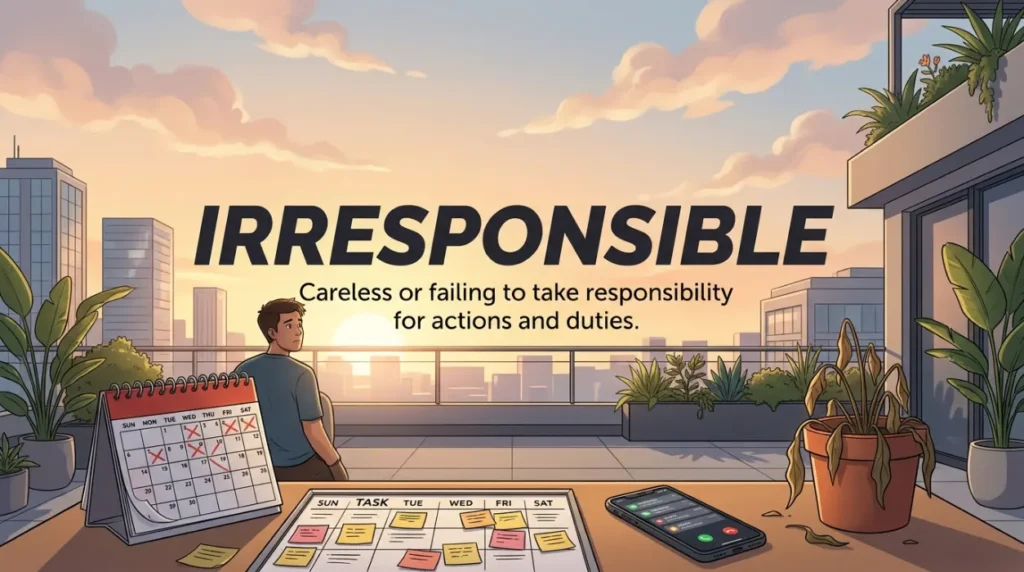
The word irresponsible describes a person or behavior that fails to show proper care, thought, or regard for consequences. Depending on the context, common synonyms range from careless or unreliable for everyday lapses to reckless for dangerous actions and negligent for professional or legal failures.
Synonyms for irresponsible choices can completely transform how you write and speak. A driver leaving a car unlocked with keys on the seat shows careless behavior. That simple action instantly highlights the true meaning of the word.
A manager ignores a crucial project deadline to go on vacation. This clear real-life situation demonstrates reckless behavior in the workplace. Using precise vocabulary makes your descriptions vivid and accurate.
Learning a synonym for irresponsible helps you avoid repeating the same word constantly. Expanding your word bank adds depth to your writing and daily communication. Fresh vocabulary keeps your reader fully engaged.
This guide helps students, bloggers, content writers, and daily English speakers choose better words. You will express nuance effortlessly in essays, posts, and conversations. Strong word choices make your message far more impactful.
What Does “Irresponsible” Really Mean?
The word describes a person or action that lacks sense, care, or regard for consequences. It refers to someone who fails to fulfill duties or obligations. Native speakers view it as a direct critique of someone’s judgment or reliability.
You will often hear it in workplace discussions, legal contexts, parenting chats, and news reports. As an adjective, it modifies nouns like behavior, decisions, drivers, or leaders.
- Simple Definition: Not showing proper care, thought, or responsibility.
Connotative Meaning
Connotation means the emotional feeling or idea that a word carries beyond its literal definition.
- Positive tone: Virtually none. The word carries an inherently critical edge.
- Neutral tone: Rarely used neutrally, though it can describe a factual lack of legal accountability.
- Negative tone: Strong. It implies untrustworthiness, carelessness, and potential danger to others.
Etymology
The word combines the Latin prefix in- (meaning “not”) with responsible. The root comes from the Latin respondere, meaning “to promise in return” or “to answer.”
- Old English (450–1100): The core Latin components were not yet part of the Germanic English dialect.
- Middle English (1100–1500): Anglo-Norman French introduced the root word responsible into legal texts.
- Modern English (1500–Present): The prefix ir- was added in the 17th century to describe actions lacking accountability.
Pronunciation
- US: /ˌɪr.əˈspɑːn.sə.bəl/
- UK: /ˌɪr.ɪˈspɒn.sə.bəl/
Syllables & Structure
ir-re-spon-si-ble (5 syllables)
- Prefix: ir- (variant of in-, meaning “not”)
- Root: respond (from Latin respondere)
- Suffix: -ible (meaning “capable of being” or “inclined to”)
Synonyms List
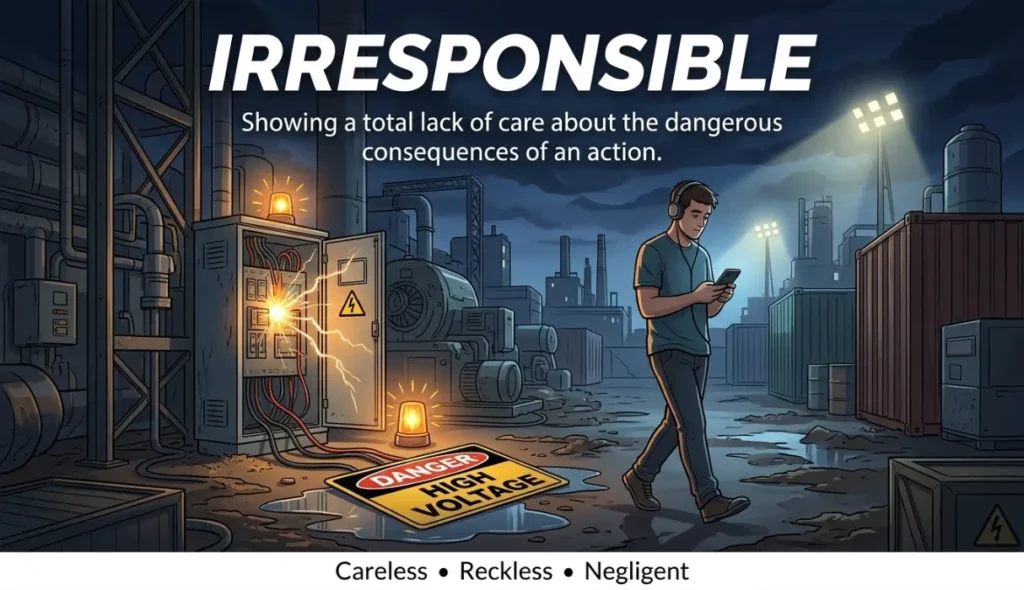
Reckless (Adjective) — US: /ˈrek.ləs/ | UK: /ˈrek.ləs/
- Meaning: Showing a total lack of care about the dangerous consequences of an action.
- Tone/Register: Neutral to Informal
- Example 1: Driving through a busy red light is a reckless decision.
- Example 2: She made a reckless choice by spending her rent money on a vacation.
Careless (Adjective) — US: /ˈker.ləs/ | UK: /ˈkeə.ləs/
- Meaning: Done without sufficient thought, attention, or effort.
- Tone/Register: Informal / Everyday
- Example 1: He made a few careless errors on his math test.
- Example 2: Leaving your phone on the bus was very careless.
Thoughtless (Adjective) — US: /ˈθɑːt.ləs/ | UK: /ˈθɔːt.ləs/
- Meaning: Lacking consideration for how actions affect other people.
- Tone/Register: Everyday / Conversational
- Example 1: Leaving his trash on the table was a thoughtless move.
- Example 2: She made a thoughtless remark that hurt her friend’s feelings.
Heedless (Adjective) — US: /ˈhiːd.ləs/ | UK: /ˈhiːd.ləs/
- Meaning: Paying no attention to warnings, advice, or potential harm.
- Tone/Register: Formal / Literary
- Example 1: The hikers walked into the woods, heedless of the storm warnings.
- Example 2: He ran across the busy street, heedless of the oncoming traffic.
Inconsiderate (Adjective) — US: /ˌɪn.kənˈsɪd.ɚ.ət/ | UK: /ˌɪn.kənˈsɪd.ər.ət/
- Meaning: Thoughtlessly causing hurt or inconvenience to others.
- Tone/Register: Neutral
- Example 1: Playing loud music at midnight is extremely inconsiderate to neighbors.
- Example 2: It was inconsiderate of him to leave without saying goodbye.
Remiss (Adjective) — US: /rɪˈmɪs/ | UK: /rɪˈmɪs/
- Meaning: Lacking care or attention to duty; negligent in performance.
- Tone/Register: Formal / Professional
- Example 1: I would be remiss if I did not thank our volunteers today.
- Example 2: The manager was remiss in checking the final financial safety report.
Negligent (Adjective) — US: /ˈneɡ.lə.dʒənt/ | UK: /ˈneɡ.lɪ.dʒənt/
- Meaning: Failing to take proper care in doing something required by duty or law.
- Tone/Register: Formal / Legal
- Example 1: The property owner was found negligent after the deck collapsed.
- Example 2: A negligent employee forgot to lock the main entrance overnight.
Derelict (Adjective) — US: /ˈder.ə.lɪkt/ | UK: /ˈder.ə.lɪkt/
- Meaning: Shamefully negligent in carrying out required duties or obligations.
- Tone/Register: Formal
- Example 1: The guard was derelict in his duty for falling asleep on watch.
- Example 2: They were derelict in their duty to care for the historic building.
Feckless (Adjective) — US: /ˈfek.ləs/ | UK: /ˈfek.ləs/
- Meaning: Lacking initiative, strength of character, or vitality; irresponsible.
- Tone/Register: Literary / Slightly Informal
- Example 1: The feckless youth spent all afternoon complaining instead of looking for work.
- Example 2: She was tired of dealing with her feckless business partner.
Shiftless (Adjective) — US: /ˈʃɪft.ləs/ | UK: /ˈʃɪft.ləs/
- Meaning: Characterized by laziness, lack of ambition, and inefficiency.
- Tone/Register: Informal / Critical
- Example 1: His uncle was a shiftless worker who never held a job for long.
- Example 2: They warned her about making deals with shiftless contractors.
Imprudent (Adjective) — US: /ˌɪm.prəˈden.ʃəl/ | UK: /ˌɪm.pruːˈden.ʃəl/
- Meaning: Lacking wisdom, discretion, or good judgment in practical affairs.
- Tone/Register: Formal
- Example 1: Investing all your savings into a single risky stock is imprudent.
- Example 2: The committee made an imprudent decision regarding budget cuts.
Imprudent (Adjective) — US: /ɪmˈpruː.dənt/ | UK: /ɪmˈpruː.dənt/
- Meaning: Not showing care for the consequences of an action; rash.
- Tone/Register: Formal / Academic
- Example 1: It would be imprudent to leave the house during a severe blizzard.
- Example 2: She admitted that her hasty public statement was imprudent.
Injudicious (Adjective) — US: /ˌɪn.dʒuːˈdɪʃ.əs/ | UK: /ˌɪn.dʒuːˈdɪʃ.əs/
- Meaning: Showing very poor judgment or lack of sensible foresight.
- Tone/Register: Formal
- Example 1: His injudicious remarks at the dinner table created an awkward silence.
- Example 2: The firm suffered severe losses due to an injudicious expansion plan.
Unwise (Adjective) — US: /ʌnˈwaɪz/ | UK: /ʌnˈwaɪz/
- Meaning: Lacking sensible judgment or good sense.
- Tone/Register: Everyday / Neutral
- Example 1: It is unwise to quit your job before securing a new one.
- Example 2: Making major purchases on a credit card without a plan is unwise.
Foolhardy (Adjective) — US: /ˈfuːl.hɑːr.di/ | UK: /ˈfuːl.hɑː.di/
- Meaning: Boldly rash or foolishly adventurous without considering safety.
- Tone/Register: Neutral / Expressive
- Example 1: Attempting to climb the icy mountain without gear was foolhardy.
- Example 2: His foolhardy attempt to fix the wiring caused a power outage.
Rash (Adjective) — US: /ræʃ/ | UK: /ræʃ/
- Meaning: Acting or done quickly without considering the possible risks or results.
- Tone/Register: Informal / Everyday
- Example 1: Don’t make any rash decisions while you are feeling angry.
- Example 2: Leaving the team mid-season was a rash move.
Impulsive (Adjective) — US: /ɪmˈpʌl.sɪv/ | UK: /ɪmˈpʌl.sɪv/
- Meaning: Acting suddenly without thinking or planning.
- Tone/Register: Neutral
- Example 1: She bought an expensive jacket on an impulsive shopping trip.
- Example 2: An impulsive personality can lead to exciting but risky situations.
Hasty (Adjective) — US: /ˈheɪ.sti/ | UK: /ˈheɪ.sti/
- Meaning: Done or acting with excessive speed or urgency; hurried.
- Tone/Register: Everyday / Neutral
- Example 1: They made a hasty departure when the weather turned bad.
- Example 2: Drawing conclusions based on one rumor is always hasty.
Wild (Adjective) — US: /waɪld/ | UK: /waɪld/
- Meaning: Uncontrolled, untamed, or completely lacking restraint.
- Tone/Register: Informal
- Example 1: The teenagers engaged in wild behavior over the weekend.
- Example 2: He came up with a wild plan to cross the ocean in a rowboat.
Untrustworthy (Adjective) — US: /ʌnˈtrʌstˌwɝː.ði/ | UK: /ʌnˈtrʌstˌwɜː.ði/
- Meaning: Not reliable or dependable; unable to be trusted with responsibility.
- Tone/Register: Neutral
- Example 1: The salesman proved to be untrustworthy after lying about the car.
- Example 2: Leaving your keys with an untrustworthy person is a big risk.
Unreliable (Adjective) — US: /ˌʌn.rɪˈlaɪ.ə.bəl/ | UK: /ˌʌn.rɪˈlaɪ.ə.bəl/
- Meaning: Not able to be relied upon to perform or work well.
- Tone/Register: Everyday / Neutral
- Example 1: The public transit system in this town is notoriously unreliable.
- Example 2: An unreliable assistant will make your workday chaotic.
Undependable (Adjective) — US: /ˌʌn.dɪˈpen.də.bəl/ | UK: /ˌʌn.dɪˈpen.də.bəl/
- Meaning: Lacking the qualities needed to be depended upon by others.
- Tone/Register: Everyday / Neutral
- Example 1: My old car became too undependable for long highway trips.
- Example 2: An undependable partner makes planning events very difficult.
Unstable (Adjective) — US: /ʌnˈsteɪ.bəl/ | UK: /ʌnˈsteɪ.bəl/
- Meaning: Lacking emotional control, predictability, or steadiness.
- Tone/Register: Neutral / Clinical
- Example 1: His unstable mood swings made colleagues hesitant to approach him.
- Example 2: Building a house on an unstable foundation is disastrous.
Unpredictable (Adjective) — US: /ˌʌn.prɪˈdɪk.tə.bəl/ | UK: /ˌʌn.prɪˈdɪk.tə.bəl/
- Meaning: Behaving in ways that cannot be anticipated or foretold.
- Tone/Register: Neutral
- Example 1: The weather around these mountains is completely unpredictable.
- Example 2: An unpredictable manager creates stress for the entire department.
Erratic (Adjective) — US: /ɪˈræt̬.ɪk/ | UK: /ɪˈræt.ɪk/
- Meaning: Not even or regular in pattern or movement; unpredictable.
- Tone/Register: Formal / Clinical
- Example 1: The driver was pulled over for erratic movements across lanes.
- Example 2: Her erratic work schedule made it hard to attend evening classes.
Flighty (Adjective) — US: /ˈflaɪ.t̬i/ | UK: /ˈflaɪ.ti/
- Meaning: Frivolous, fickle, or irresponsible in interest or behavior.
- Tone/Register: Informal
- Example 1: She is too flighty to manage a complex corporate project.
- Example 2: His flighty attitude meant he changed hobbies every few weeks.
Giddy (Adjective) — US: /ˈɡɪd.i/ | UK: /ˈɡɪd.i/
- Meaning: Having a sensation of whirling, often causing silly or lightheaded behavior.
- Tone/Register: Informal
- Example 1: The winning team felt giddy with excitement after the game.
- Example 2: Her giddy choices at the mall drained her entire allowance.
Lightheaded (Adjective) — US: /ˌlaɪtˈhed.ɪd/ | UK: /ˌlaɪtˈhed.ɪd/
- Meaning: Thinking or acting in a thoughtless, superficial, or careless manner.
- Tone/Register: Informal / Colloquial
- Example 1: The young tourists showed lightheaded behavior near the cliff edge.
- Example 2: Making lightheaded decisions during crisis meetings helps no one.
Scatterbrained (Adjective) — US: /ˈskæt̬.ɚ.breɪnd/ | UK: /ˈskæt.ə.breɪnd/
- Meaning: Disorganized and incapable of serious, connected thought.
- Tone/Register: Informal / Conversational
- Example 1: A scatterbrained approach leads to missed deadlines and forgotten keys.
- Example 2: She felt scatterbrained after working three night shifts in a row.
Inattentive (Adjective) — US: /ˌɪn.əˈten.t̬ɪv/ | UK: /ˌɪn.əˈten.tɪv/
- Meaning: Not paying close attention to something that requires focus.
- Tone/Register: Neutral / Educational
- Example 1: An inattentive driver can easily cause a serious accident.
- Example 2: The teacher noticed the student was inattentive during lecture.

Neglectful (Adjective) — US: /nɪˈɡlek.t.fəl/ | UK: /nɪˈɡlekt.fəl/
- Meaning: Failing to care for someone or something properly.
- Tone/Register: Neutral / Serious
- Example 1: The court found the pet owner guilty of neglectful behavior.
- Example 2: Being neglectful with home maintenance causes costly repairs.
Lax (Adjective) — US: /læks/ | UK: /læks/
- Meaning: Not sufficiently strict, severe, or careful about standards or discipline.
- Tone/Register: Neutral / Professional
- Example 1: The airport was criticized for its lax security policies.
- Example 2: Lax enforcement of rules leads to chaos in schools.
Slack (Adjective) — US: /slæk/ | UK: /slæk/
- Meaning: Characterized by a lack of effort, discipline, or care.
- Tone/Register: Informal
- Example 1: His slack performance at work led to a formal warning.
- Example 2: Business was slack during the winter months.
Slack-jawed (Adjective) — US: /ˈslæk.dʒɑːd/ | UK: /ˈslæk.dʒɔːd/
- Meaning: Figuratively used to describe someone acting aimlessly or stupidly unaware.
- Tone/Register: Informal / Figurative
- Example 1: The slack-jawed onlookers stood by while the boat drifted away.
- Example 2: Don’t sit around looking slack-jawed when there is work to do.
Slipshod (Adjective) — US: /ˈslɪp.ʃɑːd/ | UK: /ˈslɪp.ʃɒd/
- Meaning: Characterized by a lack of care, thought, or organization.
- Tone/Register: Informal / Critical
- Example 1: The builders did a slipshod job on the kitchen cabinets.
- Example 2: Writing a research paper in a slipshod way guarantees bad grades.
Sloppy (Adjective) — US: /ˈslɑː.pi/ | UK: /ˈslɒp.i/
- Meaning: Careless, untidy, or lacking precision.
- Tone/Register: Informal
- Example 1: Her handwriting was so sloppy that no one could read it.
- Example 2: Sloppy preparation before an interview leaves a bad impression.
Short-sighted (Adjective) — US: /ˌʃɔːrtˈsaɪ.t̬ɪd/ | UK: /ˌʃɔːtˈsaɪ.tɪd/
- Meaning: Lacking foresight, long-term planning, or cautious judgment.
- Tone/Register: Neutral / Business
- Example 1: Cutting research funds was a short-sighted cost-saving plan.
- Example 2: Selling your long-term assets for fast cash is short-sighted.
Immature (Adjective) — US: /ˌɪm.əˈtʊr/ | UK: /ˌɪm.əˈtʃʊər/
- Meaning: Showing emotional or intellectual development typical of a child.
- Tone/Register: Neutral
- Example 1: Screaming when you lose a game is immature behavior.
- Example 2: His immature comments alienated most of his coworkers.
Juvenile (Adjective) — US: /ˈdʒuː.və.nəl/ | UK: /ˈdʒuː.vən.aɪl/
- Meaning: Childish, silly, or appropriate only for young people.
- Tone/Register: Neutral / Critical
- Example 1: Pulling pranks in a corporate office is completely juvenile.
- Example 2: The board dismissed his complaints as juvenile whining.
Childish (Adjective) — US: /ˈtʃaɪl.dɪʃ/ | UK: /ˈtʃaɪl.dɪʃ/
- Meaning: Silly and immature; lacking adult reason and restraint.
- Tone/Register: Everyday / Informal
- Example 1: Refusing to share equipment with classmates is childish.
- Example 2: Stop making childish excuses for forgetting your homework.
Puerile (Adjective) — US: /ˈpjʊr.əl/ | UK: /ˈpjʊə.raɪl/
- Meaning: Silly and trivial in a childish or unpleasantly immature way.
- Tone/Register: Formal / Academic
- Example 1: The review dismissed the movie’s humor as puerile and offensive.
- Example 2: Engaging in puerile arguments on social media wastes time.
Babyish (Adjective) — US: /ˈbeɪ.bi.ɪʃ/ | UK: /ˈbeɪ.bi.ɪʃ/
- Meaning: Suitable for or characteristic of a baby; excessively childish.
- Tone/Register: Informal / Critical
- Example 1: Crying over a minor inconvenience seemed a bit babyish.
- Example 2: He dropped his babyish habits when he joined the army.
Offhanded (Adjective) — US: /ˌɑːfˈhæn.dɪd/ | UK: /ˌɒfˈhæn.dɪd/
- Meaning: Ungracious, casual, or showing a lack of proper interest or care.
- Tone/Register: Neutral
- Example 1: She made an offhanded remark about quitting her job tomorrow.
- Example 2: His offhanded treatment of the valuable antique was shocking.
Casual (Adjective) — US: /ˈkæʒ.u.əl/ | UK: /ˈkæʒ.ju.əl/
- Meaning: Showing a lack of seriousness or special care; unconcerned.
- Tone/Register: Neutral
- Example 1: His casual attitude toward safety guidelines alarmed the inspector.
- Example 2: She took a casual approach to studying for the final exam.
Nonchalant (Adjective) — US: /ˌnɑːn.ʃəˈlɑːnt/ | UK: /ˌnɒn.ʃəˈlɒnt/
- Meaning: Feeling or appearing casually calm and relaxed; disinterested.
- Tone/Register: Neutral
- Example 1: He was completely nonchalant about losing his passport abroad.
- Example 2: She walked in late with a nonchalant smile on her face.
Insouciant (Adjective) — US: /ɪnˈsuː.si.ənt/ | UK: /ɪnˈsuː.si.ənt/
- Meaning: Free from worry, care, or concern; carefree and unconcerned.
- Tone/Register: Formal / Literary
- Example 1: He strolled through the park with an insouciant disregard for time.
- Example 2: Her insouciant charm masked a deep lack of responsibility.
Unconcerned (Adjective) — US: /ˌʌn.kənˈsɝːnd/ | UK: /ˌʌn.kənˈsɜːnd/
- Meaning: Showing a lack of worry, interest, or emotional involvement.
- Tone/Register: Neutral
- Example 1: The executive appeared unconcerned about the drops in market stock.
- Example 2: They remained unconcerned despite warnings of an impending storm.
Disregardful (Adjective) — US: /ˌdɪs.rɪˈɡɑːrd.fəl/ | UK: /ˌdɪs.rɪˈɡɑːd.fəl/
- Meaning: Treating someone or something with a lack of attention or respect.
- Tone/Register: Formal
- Example 1: He was disregardful of the established rules in the laboratory.
- Example 2: Being disregardful of local customs can offend abroad.
Carefree (Adjective) — US: /ˈker.friː/ | UK: /ˈkeə.friː/
- Meaning: Free from anxiety or responsibility; lighthearted and relaxed.
- Tone/Register: Neutral / Positive
- Example 1: They spent a carefree weekend camping near the river.
- Example 2: Her carefree attitude was refreshing to her busy friends.
Happy-go-lucky (Adjective) — US: /ˌhæp.i.ɡoʊˈlʌk.i/ | UK: /ˌhæp.i.ɡəʊˈlʌk.i/
- Meaning: Cheerful and unconcerned about the future or potential troubles.
- Tone/Register: Informal
- Example 1: His happy-go-lucky nature made him popular, but he rarely saved money.
- Example 2: She took a happy-go-lucky approach to planning her road trip.
Easygoing (Adjective) — US: /ˌiː.ziˈɡoʊ.ɪŋ/ | UK: /ˌiː.ziˈɡəʊ.ɪŋ/
- Meaning: Relaxed and tolerant in approach or manner; not easily upset.
- Tone/Register: Informal / Positive
- Example 1: An easygoing boss makes the office environment pleasant.
- Example 2: He has an easygoing personality that adapts to any change.
Devil-may-care (Adjective) — US: /ˌdev.əl.meɪˈker/ | UK: /ˌdev.əl.meɪˈkeə/
- Meaning: Cheerful, reckless, and unconcerned about consequences or danger.
- Tone/Register: Idiomatic / Expressive
- Example 1: He flashed a devil-may-care smile before jumping off the high dock.
- Example 2: Her devil-may-care attitude to spending caught up with her fast.
Wildcat (Adjective) — US: /ˈwaɪld.kæt/ | UK: /ˈwaɪld/.kæt/
- Meaning: Sounding financially risky, unsafe, or unauthorized by authority.
- Tone/Register: Business / Historical
- Example 1: They lost millions by investing in wildcat oil drilling schemes.
- Example 2: Workers started a wildcat strike without union approval.
Unprincipled (Adjective) — US: /ʌnˈprɪn.sə.pəld/ | UK: /ʌnˈprɪn.sə.pəld/
- Meaning: Not acting in accordance with moral principles or standards.
- Tone/Register: Formal / Moral
- Example 1: The unprincipled politician accepted bribes from developers.
- Example 2: Selling defective goods to customers is entirely unprincipled.
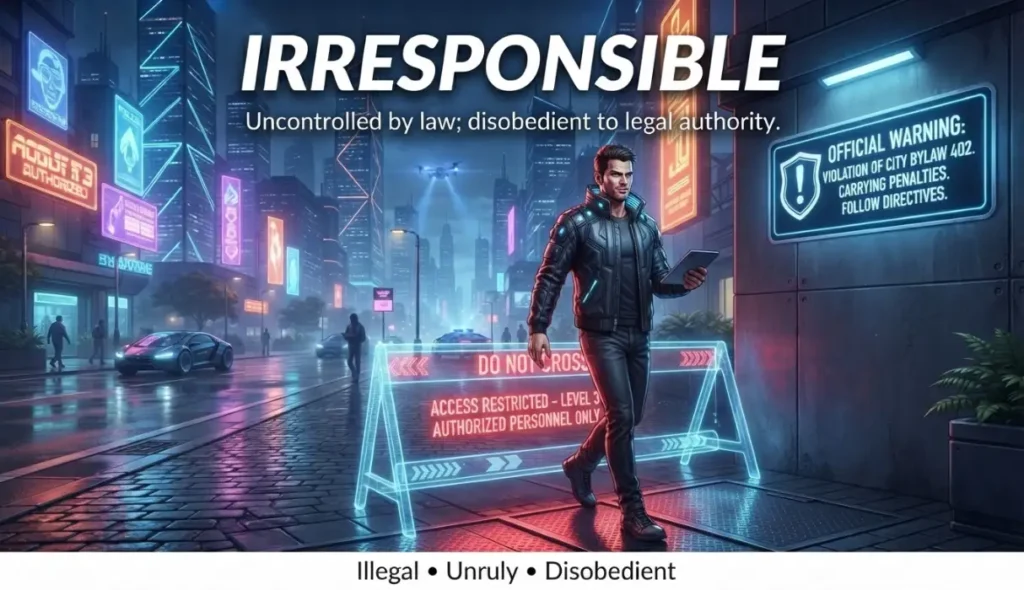
Lawless (Adjective) — US: /ˈlɑː.ləs/ | UK: /ˈlɔː.ləs/
- Meaning: Uncontrolled by law; disobedient to legal authority.
- Tone/Register: Serious / Political
- Example 1: The town descended into lawless confusion after the collapse of order.
- Example 2: A lawless group ran illegal street races through downtown.
Synonyms by Tone
Tone plays a vital role when choosing a word. Select terms carefully depending on your situation:
- Positive (Carefree context): Carefree, Happy-go-lucky, Easygoing.
- Neutral (General context): Careless, Unwise, Impulsive, Casual, Hasty, Short-sighted.
- Negative (Critical context): Reckless, Negligent, Derelict, Slipshod, Untrustworthy, Feckless.
- Playful/Informal: Flighty, Scatterbrained, Devil-may-care, Sloppy.
Using the right tone ensures your audience understands your intent clearly. Calling a co-worker “reckless” sounds severe, whereas describing them as “scatterbrained” feels milder and more forgiving.
Mini Comparison: “Irresponsible” vs. Close Alternatives
Irresponsible vs. Reckless
- Meaning Difference: Irresponsible means failing to fulfill duties or show normal care. Reckless specifically implies taking dangerous risks while disregarding obvious harm.
- Tone Difference: Irresponsible is critical and duty-focused. Reckless sounds more urgent and intense.
- When to Use: Use irresponsible for missed deadlines or unfulfilled promises. Use reckless for dangerous driving or wild financial gambles.
Irresponsible vs. Negligent
- Meaning Difference: Irresponsible is a general term for bad choices. Negligent means failing to meet a legal, professional, or ethical standard of care.
- Tone Difference: Irresponsible is everyday language. Negligent is formal and often carries legal weight.
- When to Use: Use irresponsible in casual chats or general writing. Use negligent in professional reports, legal documents, or formal critiques.
Context-Based Usage
Daily Conversation
Stick to everyday, accessible terms like careless, unwise, or thoughtless.
“It was careless to leave the window open in the rain.”
Writing or Blogging
Use vivid, descriptive words such as reckless, short-sighted, or foolhardy to keep narrative flow dynamic.
“The protagonist made a foolhardy decision to enter the cave alone.”
Professional or Academic Tone
Rely on formal, precise words like negligent, imprudent, derelict, or injudicious.
“The board made an imprudent financial decision during the third quarter.”
Creative Storytelling
Experiment with colorful or personality-driven words like feckless, devil-may-care, flighty, or insouciant.
“He possessed a devil-may-care attitude that charmed some and infuriated others.”
Common Mistakes & Native Usage
Learners often mistake words with similar meanings by ignoring context.
- Confusing Tone: Using a legal term like negligent in a casual conversation about forgotten groceries sounds overly dramatic.
- Overusing “Reckless”: Not all irresponsible acts involve physical danger or speed. Forgetting to reply to an email is careless, not reckless.
- Misassembling Synonyms: Carefree has a positive connotation (relaxed, happy), whereas irresponsible is negative. Describing an employee who skips work as “carefree” distorts your message.
Register notes help you determine when to write versus speak a word. Words like puerile or derelict belong primarily in written, formal English. Conversely, sloppy and scatterbrained fit best in natural, spoken conversations.
Real-Life Mini Scenarios
- Workplace: A team leader forgets to review safety protocols before operating machinery. HR files a report citing negligent oversight.
- Social Situations: A friend promises to bring drinks to a picnic but forgets entirely. You playfully call them scatterbrained.
- Media / Pop Culture: An action hero rides a motorcycle through crowded streets without a helmet. Critics describe the stunt as reckless.
- Writing & Storytelling: A prince ignores warnings from his advisors and declares war without preparation. The narrative characterizes his command as foolhardy.
Conclusion
Mastering synonyms lets you express precise shades of meaning, adjust your tone according to your audience, and keep your audience engaged. It prevents repetitive writing and builds natural fluency for speaking, blogging, and academic tasks.
Building a versatile English vocabulary takes consistent practice and curiosity. Expanding your word bank allows you to paint clearer pictures with your words and express subtle nuances effortlessly.
Try incorporating a new synonym for irresponsible into your daily writing today. Use these terms in your emails, essays, and conversations to see how much stronger your communication becomes.
Developing precise expression transforms you into a more confident writer and speaker. Keep practicing, stay curious about language nuances, and watch your vocabulary grow day by day!
Practice Exercise
Test your understanding by picking the best word for each situation below:
- A driver speeds through a school zone at twice the speed limit. What fits best?
A) Easygoing
B) Reckless
C) Remiss
D) Inattentive - A lawyer forgets to file court papers before the strict deadline. Which formal word fits?
A) Sloppy
B) Flighty
C) Negligent
D) Happy-go-lucky - A friend forgets their umbrella on a cloudy day. Which mild term fits best?
A) Lawless
B) Derelict
C) Careless
D) Unprincipled - An executive cuts safety testing budgets to save quick cash. What is this decision?
A) Short-sighted
B) Easygoing
C) Puerile
D) Insouciant - A teenager rolls their eyes and throws a tantrum when asked to clean up.
A) Imprudent
B) Immature
C) Lawless
D) Remiss - Someone takes a spontaneous, fun weekend trip without stressing over work.
A) Derelict
B) Reckless
C) Carefree
D) Negligent - A worker does messy, poor-quality repair work on a fence.
A) Slipshod
B) Injudicious
C) Inattentive
D) Lawless - An advisor gives bad advice without considering the obvious risks.
A) Injudicious
B) Scatterbrained
C) Slack
D) Easygoing - A guard leaves their post unlocked overnight.
A) Insouciant
B) Derelict
C) Giddy
D) Casual - A child refuses to share toys and pouts in the corner.
A) Childish
B) Imprudential
C) Reckless
D) Lawless
Reflection Task:
Write two sentences about a time you made a minor mistake. Use one formal synonym (like imprudent) and one informal synonym (like careless).
Answer Key:
1: B | 2: C | 3: C | 4: A | 5: B | 6: C | 7: A | 8: A | 9: B | 10: A
FAQs
What is the most common synonym for irresponsible?
The most common synonym is careless. It is widely used across casual conversations, academic writing, and everyday contexts. Other popular choices include reckless for dangerous situations and unreliable for people who fail to deliver on promises.
Can irresponsible have a positive meaning?
No, irresponsible carries an inherently negative connotation. However, words like carefree, happy-go-lucky, or easygoing focus on the relaxed, stress-free side of ignoring worries without implying harmful intent.
What is the difference between irresponsible and reckless?
Irresponsible means failing to show care or carry out duties. Reckless goes further by implying active disregard for dangerous consequences. For example, leaving your homework at home is irresponsible, but driving at high speeds in heavy rain is reckless.
Which synonym for irresponsible is best for professional writing?
In professional or legal settings, use words like negligent, imprudent, remiss, or injudicious. These terms clearly convey serious mistakes without using slang or overly casual language.
Is feckless a synonym for irresponsible?
Yes, feckless is an accurate synonym. It means lacking character, initiative, or responsibility. It is often used in literary writing or formal commentary to describe people who consistently fail to take charge of their lives.

Jameel Hassan is the founder and lead writer at SynonymsCloud.com, a trusted online platform dedicated to English vocabulary and effective communication. He is passionate about helping students, writers, professionals, and lifelong learners discover the right words to express their ideas with clarity, precision, and confidence.
At SynonymsCloud.com, every article is thoroughly researched and carefully written to provide accurate, practical, and easy-to-understand guidance on synonyms, antonyms, word meanings, idioms, and vocabulary. With a strong commitment to quality, real-world usage, and clear explanations, the website helps readers expand their vocabulary, improve their writing, and communicate more effectively in both academic and professional settings.