
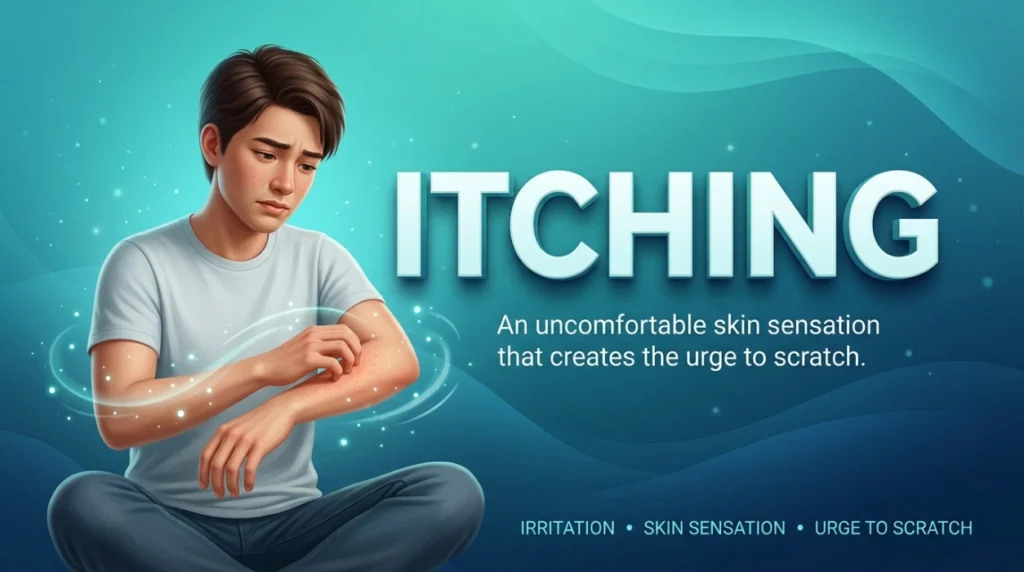
Synonyms for itching include pruritic for medical contexts, prickly, tingling, or scratchy for physical skin discomfort, and eager, restless, or dying (to) for figurative impatience or strong desire. Selecting the right term depends on whether you are describing physical skin irritation or enthusiastic anticipation.
Synonym for itching is a search term many writers use when they want to express physical discomfort or strong desire. Imagine sitting in a warm room, suddenly feeling a persistent tickle on your skin that makes you want to scratch instantly. This everyday sensation happens to everyone, yet relying on the same word over and over can make your writing feel repetitive.
Understanding a synonym for itching helps you describe feelings more accurately in stories, blog posts, and daily talks. Using diverse words prevents repetitive language and makes your messaging far more engaging for your target audience. A varied vocabulary instantly raises the quality of your writing and shows a strong command of the English language.
Native speakers regularly use different terms depending on whether they mean physical skin irritation or a deep psychological urge. Words like pruritic, tingling, eager, or restless each carry distinct meanings that fit specific situations perfectly. Learning these variations transforms simple ideas into rich, descriptive prose.
This guide is useful for students writing essays, bloggers creating posts, content writers optimizing articles, and daily English learners. Expanding your word choice allows you to communicate exact feelings with clarity and confidence. Let us explore the rich spectrum of words that can replace this common phrase today.
What Does “Itching” Really Mean?
Itching refers to an uncomfortable sensation on the skin that creates an intense desire to scratch. In everyday English, native speakers also use it figuratively to describe a strong, restless desire or eagerness to do something.
The word carries a neutral to slightly negative emotional tone when describing physical discomfort. When used figuratively, it often conveys excitement, impatience, or positive anticipation.
- Part of Speech: Verb (present participle) / Noun / Adjective
- Simple Definition: A tingling feeling on the skin that makes you want to scratch, or a strong urge to do something.
Connotative Meaning
Connotation is the emotional or cultural association that a word carries beyond its literal definition.
- Positive tone: Eager, enthusiastic, dying (to do something), keen.
- Negative tone: Irritated, prickly, inflamed, agitated.
- Neutral tone: Pruritic, tingling, ticklish, scratchy.
Etymology
The word originates from the Old English word ġiccan, meaning “to itch.” It shares Germanic roots with the Middle Dutch word jeuken.
- Old English (450–1100): Spelled ġiccan, describing the physical skin sensation.
- Middle English (1100–1500): Evolved into icchen, gaining broader regional use across Britain.
- Modern English (1500–Present): Became “itching,” expanding to include figurative senses like impatience or strong desire.
Pronunciation (US & UK)
- US: /ˈɪtʃ.ɪŋ/
- UK: /ˈɪtʃ.ɪŋ/
Syllables & Structure
- Syllables: itch-ing
- Root: itch
- Prefix: None
- Suffix: -ing
Synonyms List
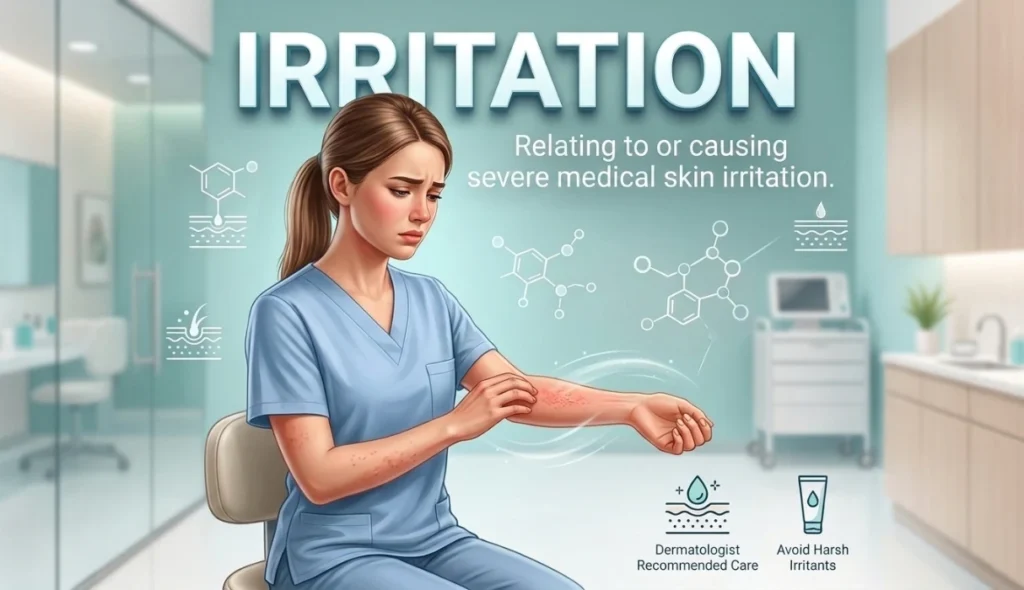
Pruritic (Adj) — US: /pruːˈrɪt.ɪk/ | UK: /prʊəˈrɪt.ɪk/
- Meaning: Relating to or causing severe medical skin irritation.
- Tone/Register: Medical, Formal
- Example 1: The doctor examined the pruritic rash on his arm.
- Example 2: She applied a soothing cream to calm her pruritic skin.
Tingling (Adj) — US: /ˈtɪŋ.ɡəl.ɪŋ/ | UK: /ˈtɪŋ.ɡl̩.ɪŋ/
- Meaning: Experiencing a slight prickling or stinging sensation.
- Tone/Register: Neutral, Informal
- Example 1: A tingling feeling spread across her fingers in the cold.
- Example 2: He felt a tingling sensation right before the rash appeared.
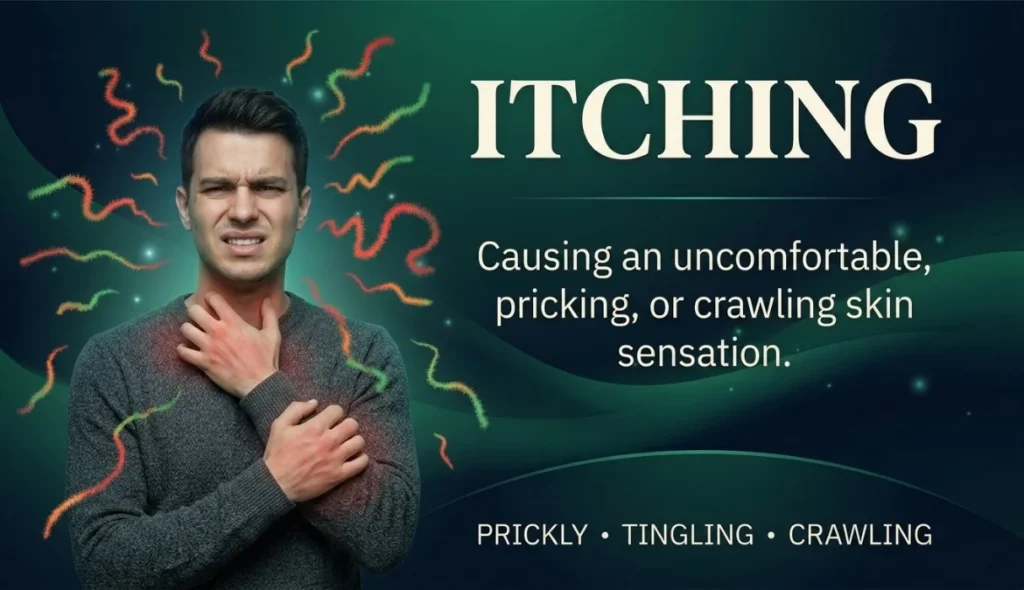
Prickly (Adj) — US: /ˈprɪk.li/ | UK: /ˈprɪk.li/
- Meaning: Having a sensation of small sharp points piercing the skin.
- Tone/Register: Informal, Everyday
- Example 1: This wool sweater feels extremely prickly on my neck.
- Example 2: Heat rash caused a prickly sensation all over his back.
Scratchy (Adj) — US: /ˈskrætʃ.i/ | UK: /ˈskrætʃ.i/
- Meaning: Causing a rough feeling that makes one want to rub or scratch.
- Tone/Register: Informal, Conversational
- Example 1: The dry air left her throat feeling scratchy.
- Example 2: He hated the scratchy label inside his new shirt.
Eager (Adj) — US: /ˈiː.ɡɚ/ | UK: /ˈiː.ɡər/
- Meaning: Feeling strong desire or enthusiasm to do something.
- Tone/Register: Neutral, General
- Example 1: She was eager to start her new job on Monday.
- Example 2: The team was eager to showcase their latest design.
Impatient (Adj) — US: /ɪmˈpeɪ.ʃənt/ | UK: /ɪmˈpeɪ.ʃənt/
- Meaning: Restless and unwilling to wait for an event or outcome.
- Tone/Register: Neutral, Everyday
- Example 1: He grew impatient while sitting in the traffic jam.
- Example 2: The crowd was impatient for the concert to begin.
Restless (Adj) — US: /ˈrest.ləs/ | UK: /ˈrest.ləs/
- Meaning: Unable to stay still due to anxiety, boredom, or desire.
- Tone/Register: Neutral, General
- Example 1: She felt restless after sitting at her desk all day.
- Example 2: The long flight made the passengers feel restless.
Irritated (Adj) — US: /ˈɪr.ə.teɪ.t̬ɪd/ | UK: /ˈɪr.ɪ.teɪ.tɪd/
- Meaning: Showing physical inflammation or emotional annoyance.
- Tone/Register: Neutral, General
- Example 1: Washing dishes made her skin red and irritated.
- Example 2: He spoke in an irritated voice after being interrupted.
Stinging (Adj) — US: /ˈstɪŋ.ɪŋ/ | UK: /ˈstɪŋ.ɪŋ/
- Meaning: Causing a sharp, burning prick or pain on the skin.
- Tone/Register: Neutral, Everyday
- Example 1: Ocean water caused a stinging sensation in his cut.
- Example 2: Cold wind left a stinging feeling on her cheeks.
Burning (Adj) — US: /ˈbɝː.nɪŋ/ | UK: /ˈbɜː.nɪŋ/
- Meaning: Producing a painful sensation of heat or inflammation.
- Tone/Register: Neutral, Descriptive
- Example 1: The sunburn gave him a burning sensation across his shoulders.
- Example 2: She applied aloe to relieve the burning feeling on her face.
Crawling (Adj) — US: /ˈkrɑː.lɪŋ/ | UK: /ˈkrɔː.lɪŋ/
- Meaning: Feeling as if insects are moving slowly over the skin.
- Tone/Register: Informal, Descriptive
- Example 1: A weird crawling feeling on his leg made him look down.
- Example 2: Fear gave her a creepy crawling sensation on her arms.
Ticklish (Adj) — US: /ˈtɪk.əl.ɪʃ/ | UK: /ˈtɪk.l̩.ɪʃ/
- Meaning: Sensitive to light touches that cause laughter or twitching.
- Tone/Register: Informal, Casual
- Example 1: The feather felt ticklish against his bare foot.
- Example 2: She tried to sit still, but the light brush felt too ticklish.
Agitated (Adj) — US: /ˈædʒ.ə.teɪ.t̬ɪd/ | UK: /ˈædʒ.ɪ.teɪ.tɪd/
- Meaning: Feeling disturbed, nervous, or physically restless.
- Tone/Register: Formal, Academic
- Example 1: The noisy room made the patient feel agitated.
- Example 2: He became agitated while waiting for the test results.
Yearning (Adj/Verb) — US: /ˈjɝː.nɪŋ/ | UK: /ˈjɜː.nɪŋ/
- Meaning: Experiencing an intense, compassionate, or painful longing.
- Tone/Register: Literary, Formal
- Example 1: She felt a yearning heart as she looked at old photos.
- Example 2: He was yearning to return to his hometown after years away.
Longing (Adj/Noun) — US: /ˈlɑːŋ.ɪŋ/ | UK: /ˈlɒŋ.ɪŋ/
- Meaning: Having a strong, persistent desire for something distant or lost.
- Tone/Register: Literary, Expressive
- Example 1: A longing look passed over her face during the song.
- Example 2: He felt a deep longing for quiet time in nature.
Keen (Adj) — US: /kiːn/ | UK: /kiːn/
- Meaning: Highly enthusiastic, eager, or mentally sharp.
- Tone/Register: Business, British English
- Example 1: She is very keen to learn new software skills.
- Example 2: The manager was keen on expanding the team project.
Dying (to) (Idiomatic) — US: /ˈdaɪ.ɪŋ/ | UK: /ˈdaɪ.ɪŋ/
- Meaning: Wanting to do or have something extremely badly.
- Tone/Register: Informal, Spoken
- Example 1: I am dying to try that new restaurant downtown.
- Example 2: She was dying to share the good news with her family.
Aching (Adj) — US: /ˈeɪ.kɪŋ/ | UK: /ˈeɪ.kɪŋ/
- Meaning: Showing a continuous dull pain or emotional urge.
- Tone/Register: Neutral, Expressive
- Example 1: His muscles were aching after the heavy workout.
- Example 2: She had an aching desire to travel the world.
Fidgety (Adj) — US: /ˈfɪdʒ.ə.t̬i/ | UK: /ˈfɪdʒ.ɪ.ti/
- Meaning: Making small, restless movements continuously.
- Tone/Register: Informal, Casual
- Example 1: The long meeting made everyone feel fidgety.
- Example 2: Children often get fidgety when seated for hours.
Animated (Adj) — US: /ˈæn.ə.meɪ.t̬ɪd/ | UK: /ˈæn.ɪ.meɪ.tɪd/
- Meaning: Full of movement, excitement, and lively energy.
- Tone/Register: Neutral, Professional
- Example 1: She gave an animated speech that captivated the audience.
- Example 2: His animated expressions showed his genuine passion.
Chafed (Adj) — US: /tʃeɪft/ | UK: /tʃeɪft/
- Meaning: Sore or damaged from continuous friction or rubbing.
- Tone/Register: Neutral, Physical
- Example 1: Tight shoes left his heels red and chafed.
- Example 2: Running in wet clothes caused chafed skin on his thighs.
Inflamed (Adj) — US: /ɪnˈfleɪmd/ | UK: /ɪnˈfleɪmd/
- Meaning: Red, swollen, and hot as a result of inflammation or allergy.
- Tone/Register: Medical, Formal
- Example 1: The doctor treated her inflamed eczema with salve.
- Example 2: His skin looked inflamed after contact with the plant.
Irritable (Adj) — US: /ˈɪr.ə.t̬ə.bəl/ | UK: /ˈɪr.ɪ.tə.bəl/
- Meaning: Easily annoyed or physically sensitive to stimulation.
- Tone/Register: Neutral, Everyday
- Example 1: Lack of sleep makes most people irritable.
- Example 2: The lotion calmed her irritable skin instantly.
Sensitive (Adj) — US: /ˈsen.sə.t̬ɪv/ | UK: /ˈsen.sɪ.tɪv/
- Meaning: Easily damaged, hurt, or reacted upon by external elements.
- Tone/Register: Neutral, Professional
- Example 1: Use fragrance-free soap if you have sensitive skin.
- Example 2: His eyes are sensitive to bright sunlight.
Smarting (Adj/Verb) — US: /ˈsmɑːr.t̬ɪŋ/ | UK: /ˈsmɑː.tɪŋ/
- Meaning: Experiencing a sharp, sting-like physical or emotional pain.
- Tone/Register: Literary, British English
- Example 1: His skin was smarting after he spent hours in the sun.
- Example 2: Her pride was smarting after the public criticism.
Raw (Adj) — US: /rɑː/ | UK: /rɔː/
- Meaning: Having the surface skin rubbed off or painful to touch.
- Tone/Register: Informal, Everyday
- Example 1: Continuous wiping left the skin around her nose raw.
- Example 2: The rough rope scraped his hands raw.
Sore (Adj) — US: /sɔːr/ | UK: /sɔː/
- Meaning: Painful or aching as a result of injury or overuse.
- Tone/Register: Everyday, General
- Example 1: My throat feels sore after singing at the concert.
- Example 2: He had sore feet from walking around the city.
Excited (Adj) — US: /ɪkˈsaɪ.t̬ɪd/ | UK: /ɪkˈsaɪ.tɪd/
- Meaning: Feeling eager, enthusiastic, and energized about an upcoming event.
- Tone/Register: General, Everyday
- Example 1: The kids were excited about going to the theme park.
- Example 2: She received an excited call from her best friend.
Avid (Adj) — US: /ˈæv.ɪd/ | UK: /ˈæv.ɪd/
- Meaning: Showing keen interest, enthusiasm, or dedication.
- Tone/Register: Formal, Written
- Example 1: He is an avid reader who finishes two books a week.
- Example 2: She remains an avid supporter of local art galleries.
Passionate (Adj) — US: /ˈpæʃ.ən.ət/ | UK: /ˈpæʃ.ən.ət/
- Meaning: Showing strong, intense belief, emotion, or enthusiasm.
- Tone/Register: General, Expressive
- Example 1: He gave a passionate talk on environmental conservation.
- Example 2: She is passionate about teaching young children.
Ambitious (Adj) — US: /æmˈbɪʃ.əs/ | UK: /æmˈbɪʃ.əs/
- Meaning: Having a strong determination to achieve success or goals.
- Tone/Register: Business, Professional
- Example 1: The company set ambitious targets for the new year.
- Example 2: She launched an ambitious plan to start her own business.
Hypersensitive (Adj) — US: /ˌhaɪ.pɚˈsen.sə.t̬ɪv/ | UK: /ˌhaɪ.pəˈsen.sɪ.tɪv/
- Meaning: Abnormally or excessively sensitive to physical triggers.
- Tone/Register: Scientific, Medical
- Example 1: His skin is hypersensitive to synthetic dyes.
- Example 2: Allergy tests revealed she was hypersensitive to pollen.
Scratching (Verb/Noun) — US: /ˈskrætʃ.ɪŋ/ | UK: /ˈskrætʃ.ɪŋ/
- Meaning: Rubbing skin with nails to relieve a physical tickle.
- Tone/Register: Everyday, General
- Example 1: Continuous scratching only makes the bug bite worse.
- Example 2: The dog kept scratching its ear under the table.
Tweaking (Verb/Noun) — US: /ˈtwiːk.ɪŋ/ | UK: /ˈtwiːk.ɪŋ/
- Meaning: Feeling a slight twist, twitch, or sharp sensation.
- Tone/Register: Informal, Casual
- Example 1: He felt a slight tweaking pain in his lower knee.
- Example 2: A quick adjustment fixed the tweaking sensation.
Excoriated (Adj) — US: /ɪkˈskɔːr.i.eɪ.t̬ɪd/ | UK: /ɪkˈskɔː.ri.eɪ.tɪd/
- Meaning: Having skin worn off or abraded by rubbing or scratching.
- Tone/Register: Medical, Academic
- Example 1: The dermatologist noted excoriated patches on the arm.
- Example 2: Excessive picking left the surrounding skin excoriated.
Tender (Adj) — US: /ˈten.dɚ/ | UK: /ˈten.dər/
- Meaning: Painful or sensitive when pressed or touched.
- Tone/Register: General, Everyday
- Example 1: The bruised area was still soft and tender.
- Example 2: Her gums felt tender after the dental cleaning.
Twitchy (Adj) — US: /ˈtwɪtʃ.i/ | UK: /ˈtwɪtʃ.i/
- Meaning: Given to sudden jerky movements or nervous restlessness.
- Tone/Register: Informal, Spoken
- Example 1: Too much coffee made him feel twitchy and alert.
- Example 2: The nervous driver had a twitchy hand on the wheel.
Prompted (Adj/Verb) — US: /ˈprɑːmp.tɪd/ | UK: /ˈprɒmp.tɪd/
- Meaning: Moved or urged into immediate action.
- Tone/Register: Business, Formal
- Example 1: Curiosity prompted her to open the strange email.
- Example 2: High interest rates prompted buyers to wait.
Pricked (Adj) — US: /prɪkt/ | UK: /prɪkt/
- Meaning: Feeling tiny, sharp punctures on skin surfaces.
- Tone/Register: Neutral, Physical
- Example 1: Her thumb felt pricked by the rose bush thorn.
- Example 2: A pricked sensation made him pull his hand away.
Thirsting (Verb/Adj) — US: /ˈθɝː.stɪŋ/ | UK: /ˈθɜː.stɪŋ/
- Meaning: Having a strong, desperate desire for something.
- Tone/Register: Literary, Dramatic
- Example 1: The dry land was thirsting for seasonal rain.
- Example 2: He was thirsting for knowledge in his new field.
Hungry (Adj) — US: /ˈhʌŋ.ɡri/ | UK: /ˈhʌŋ.ɡri/
- Meaning: Having a strong physical appetite or mental drive.
- Tone/Register: Everyday, General
- Example 1: The young team was hungry for a championship win.
- Example 2: She felt hungry for creative success in her career.
Impelled (Adj/Verb) — US: /ɪmˈpeld/ | UK: /ɪmˈpeld/
- Meaning: Driven or forced by strong internal urges.
- Tone/Register: Formal, Academic
- Example 1: Honor impelled him to speak the truth to everyone.
- Example 2: She felt impelled to assist the stranded motorists.
Motivated (Adj) — US: /ˈmoʊ.t̬ə.veɪ.t̬ɪd/ | UK: /ˈməʊ.tɪ.veɪ.tɪd/
- Meaning: Provided with a strong incentive or reason to act.
- Tone/Register: Business, General
- Example 1: Highly motivated employees achieve better results.
- Example 2: She stayed motivated throughout the training period.
Pining (Verb/Adj) — US: /ˈpaɪ.nɪŋ/ | UK: /ˈpaɪ.nɪŋ/
- Meaning: Suffering a mental decline from longing or grief.
- Tone/Register: Literary, Romantic
- Example 1: He was pining for his family while living abroad.
- Example 2: The poem captured a pining heart seeking peace.
Expectant (Adj) — US: /ɪkˈspek.tənt/ | UK: /ɪkˈspek.tənt/
- Meaning: Having or showing an excited feeling that something will happen.
- Tone/Register: Formal, Written
- Example 1: An expectant crowd waited for the speaker to arrive.
- Example 2: She had an expectant look as she opened the package.
Aglow (Adj) — US: /əˈɡloʊ/ | UK: /əˈɡləʊ/
- Meaning: Shining with warmth, excitement, or physical warmth.
- Tone/Register: Literary, Expressive
- Example 1: Her face was aglow with excitement after the news.
- Example 2: The sky was aglow with vivid orange twilight.
Burning (to) (Idiomatic) — US: /ˈbɝː.nɪŋ/ | UK: /ˈbɜː.nɪŋ/
- Meaning: Experiencing an overwhelming, urgent need to do something.
- Tone/Register: Informal, Expressive
- Example 1: He was burning to share his discovery with the world.
- Example 2: She was burning to ask a question during the seminar.
Solicitous (Adj) — US: /səˈlɪs.ə.t̬əs/ | UK: /səˈlɪs.ɪ.təs/
- Meaning: Showing great care, attention, or anxious concern.
- Tone/Register: Formal, Academic
- Example 1: The hotel staff was solicitous regarding guest comfort.
- Example 2: He offered a solicitous inquiry about her recovery.
Urticant (Adj) — US: /ˈɝː.t̬ə.kənt/ | UK: /ˈɜː.tɪ.kənt/
- Meaning: Producing stinging or itching sensations like nettles.
- Tone/Register: Scientific, Specialized
- Example 1: The caterpillar possesses protective urticant hairs.
- Example 2: Direct contact with urticant plants causes severe hives.
Dermic (Adj) — US: /ˈdɝː.mɪk/ | UK: /ˈdɜː.mɪk/
- Meaning: Relating specifically to the skin or dermis.
- Tone/Register: Technical, Medical
- Example 1: The clinic treats various dermic conditions daily.
- Example 2: She used a specialized dermic ointment for relief.
Scaly (Adj) — US: /ˈskeɪ.li/ | UK: /ˈskeɪ.li/
- Meaning: Dry and peeling skin that creates physical discomfort.
- Tone/Register: Neutral, Descriptive
- Example 1: Winter weather caused scaly patches on his legs.
- Example 2: Use heavy lotion to smooth out dry, scaly areas.
Flaky (Adj) — US: /ˈfleɪ.ki/ | UK: /ˈfleɪ.ki/
- Meaning: Coming off in small, thin, dry pieces.
- Tone/Register: Everyday, Descriptive
- Example 1: The shampoo helps reduce a dry, flaky scalp.
- Example 2: Her sunburn turned flaky after a few days.
Chafing (Verb/Noun) — US: /ˈtʃeɪ.fɪŋ/ | UK: /ˈtʃeɪ.fɪŋ/
- Meaning: Irritation caused by skin rubbing against skin or fabric.
- Tone/Register: General, Physical
- Example 1: Cyclists often use cream to prevent severe chafing.
- Example 2: Rough denim created uncomfortable chafing on her knees.
Pinprick (Noun/Adj) — US: /ˈpɪn.prɪk/ | UK: /ˈpɪn.prɪk/
- Meaning: A tiny, localized stinging or prickling sensation.
- Tone/Register: General, Descriptive
- Example 1: He felt a small pinprick when the needle touched.
- Example 2: A sudden pinprick sensation startled her arm.
Biting (Adj) — US: /ˈbaɪ.t̬ɪŋ/ | UK: /ˈbaɪ.tɪŋ/
- Meaning: Causing a sharp, stinging, or piercing discomfort.
- Tone/Register: Literary, General
- Example 1: The biting frost made their faces sting immediately.
- Example 2: Insects caused a biting sensation across his ankles.
Synonyms by Tone
| Tone Group | Synonyms Included | Why Tone Matters |
| Positive | Eager, Excited, Keen, Passionate, Ambitious, Motivated, Aglow, Expectant | Using positive synonyms highlights excitement and healthy motivation rather than physical annoyance or distress. |
| Neutral | Tingling, Prickly, Scratchy, Restless, Ticklish, Fidgety, Pinprick, Scaly, Flaky | Neutral terms provide accurate physical or behavioral descriptions without adding strong emotional judgment. |
| Negative | Pruritic, Irritated, Stinging, Burning, Agitated, Inflamed, Raw, Chafed, Hypersensitive, Excoriated, Urticant | Negative words convey physical distress, medical severity, or intense emotional discomfort clearly to readers. |
| Playful / Informal | Dying (to), Crawling, Twitchy, Burning (to), Tweaking | Informal terms create a warm, relatable atmosphere in casual conversations or lighthearted narrative writing. |
Tone matters deeply because picking the wrong word alters your sentence’s intent. Describing a job applicant as “itching for work” sounds informal, whereas calling them “eager for work” sounds professional and respectful.
Mini Comparison: “Itching” vs Close Alternatives
Itching vs. Pruritic
- Meaning Difference: Itching is the general term for skin irritation or metaphorical impatience. Pruritic is a strict medical term reserved specifically for clinical skin conditions.
- Tone Difference: Itching is informal and everyday. Pruritic is formal, medical, and clinical.
- When to Use Each: Use itching in casual talks or creative stories. Use pruritic when writing medical papers, charts, or health articles.
Itching vs. Eager
- Meaning Difference: Itching implies a restless, almost uncomfortable desire to act. Eager describes positive, controlled enthusiasm.
- Tone Difference: Itching (in its figurative sense) is informal and figurative. Eager is neutral and universally appropriate.
- When to Use Each: Use itching when someone cannot sit still to start something. Use eager in business emails, essays, or formal discussions.
How “Itching” Changes by Context
- Daily Conversation: Native speakers frequently use the phrase figuratively to show impatience. You will hear phrases like “I am itching to go on vacation” during casual lunch breaks.
- Writing & Blogging: Authors use physical variants like prickly or scratchy to build sensory detail. It grounds the reader in the character’s physical experience.
- Professional or Academic Tone: In professional environments, swap figurative uses for keen, eager, or motivated. Replace physical uses with clinical terms like pruritic or dermatological reaction.
- Creative or Informal Use: Creative writing allows idioms like “dying to know” or sensory images like a “crawling feeling.” These choices add color and personality to narrative prose.
Common Mistakes & Native Usage
Mistakes Learners Make
- Confusing physical and figurative contexts: Using medical terms like pruritic to describe impatience sounds unnatural. Saying “I am pruritic to play tennis” is incorrect.
- Overusing the focus keyword: Repeating “itching” multiple times in one paragraph makes text feel monotonous. Swap in eager or tingling to maintain rhythm.
- Ignoring register boundaries: Using informal slang like “dying to” in an academic paper lowers your writing standard.
Register Notes
- Spoken English: Lean into conversational alternatives like scratchy, twitchy, or dying to.
- Written English: Prefer precise descriptors such as prickly, restless, keen, or inflamed. (For more vocabulary guides on sensory descriptions, check our language learning index).
Real-Life Mini Scenarios
- Workplace: “After working three years in customer support, Sarah was eager to transition into project management.” (Eager works best here for professional drive.)
- Social Situations: “Mark was dying to tell his friends about his engagement during dinner.” (Dying captures informal excitement.)
- Media / Pop Culture: “The movie audience felt restless as the delayed premiere pushed past midnight.” (Restless fits public impatience.)
- Storytelling: “The dry wool blanket felt scratchy against his shoulders as he tried to sleep.” (Scratchy builds sensory scene details.)
Conclusion
Learning a versatile synonym for itching transforms how clearly you express physical discomfort and emotional eagerness. Expanding your vocabulary gives you the exact tools needed to tailor your voice for any audience.
Practicing these new terms in daily emails, creative stories, and blog posts will permanently sharpen your communication skills. Consistent word choices build writer confidence and instantly command respect from readers.
Start incorporating these rich word variations into your conversations and writing tasks today to watch your vocabulary grow naturally!
Practice Exercise
Test your understanding of these synonyms by selecting the correct option for each scenario.
- Which word best fits a medical report about a skin allergy?
a) Twitchy
b) Pruritic
c) Dying to
d) Fidgety - Choose the most appropriate word for a professional job cover letter:
a) Itching to start
b) Dying to work
c) Eager to contribute
d) Twitchy to join - “The rough burlap sack felt __________ against her bare arm.”
a) Eager
b) Prickly
c) Solicitous
d) Ambitious - Identify the synonym that conveys a positive tone:
a) Inflamed
b) Excoriated
c) Enthusiastic
d) Raw - Which term describes a skin irritation caused by friction during running?
a) Chafing
b) Pining
c) Keen
d) Expectant - What is the best literary word for longing deeply for a distant home?
a) Scaly
b) Yearning
c) Flaky
d) Dermic - Choose the informal term used in casual conversation:
a) Hypersensitive
b) Urticant
c) Dying to
d) Solicitous - Which word best describes a person who cannot sit still due to nerves?
a) Pruritic
b) Fidgety
c) Raw
d) Scaly - “After hours in the blazing sun, his shoulders were __________ red.”
a) Keenly
b) Inflamed
c) Ambitiously
d) Solicitously - What part of speech is the word “itching” in: “An itching sensation woke him up”?
a) Noun
b) Adjective
c) Adverb
d) Preposition
Application Task:
Write one short sentence about a hobby you enjoy using one of the positive synonyms listed above (e.g., eager, keen, or passionate).
Answer Key:
1-b, 2-c, 3-b, 4-c, 5-a, 6-b, 7-c, 8-b, 9-b, 10-b
FAQs
1. What is the most formal medical synonym for itching?
The most formal medical term is pruritus (noun) or pruritic (adjective). Doctors and dermatologists use these terms in clinical reports to describe severe skin sensations that provoke the desire to scratch.
2. Can I use “itching” to describe excitement in formal business writing?
It is best to avoid “itching” in formal business documents. Instead, use professional alternatives like eager, keen, or highly motivated to express enthusiasm in a polished way.
3. What is the difference between “itching” and “tickling”?
An itching sensation creates an irritating urge to scratch the skin. A tickling sensation is lighter, often triggers involuntary laughter or twitching, and does not typically stem from skin inflammation.
4. How can learning synonyms for itching help my SEO writing?
Using semantic variations like prickly, restless, or pruritic helps search engines understand your topic’s context. It improves content depth and prevents keyword stuffing penalties under modern AI guidelines.
5. What are the best adjectives to describe itchy skin in descriptive story writing?
Great choices for descriptive fiction include scratchy, prickly, stinging, crawling, and raw. These sensory words help readers feel the exact physical sensation your character is experiencing.

Jameel Hassan is the founder and lead writer at SynonymsCloud.com, a trusted online platform dedicated to English vocabulary and effective communication. He is passionate about helping students, writers, professionals, and lifelong learners discover the right words to express their ideas with clarity, precision, and confidence.
At SynonymsCloud.com, every article is thoroughly researched and carefully written to provide accurate, practical, and easy-to-understand guidance on synonyms, antonyms, word meanings, idioms, and vocabulary. With a strong commitment to quality, real-world usage, and clear explanations, the website helps readers expand their vocabulary, improve their writing, and communicate more effectively in both academic and professional settings.