
A synonym for print depends on the meaning you intend. Common alternatives include publish, reproduce, imprint, stamp, issue, type, and display. Use publish for making written work available, reproduce for creating copies, and stamp for marking a surface.
Imagine preparing a school report, publishing an article, or creating a document for work. Choosing the right synonym for print helps you express your ideas clearly and describe your intended action more accurately.
The word print appears in books, newspapers, photographs, office documents, and digital publishing. Students, bloggers, content writers, and English learners use it in many everyday situations.
Learning a synonym for print can also make your writing more engaging. Instead of repeating the same word, you can use alternatives such as publish, reproduce, imprint, or issue, depending on the context and intended meaning.
Whether you are writing an essay, discussing printed materials, or describing a publishing process, choosing the right words improves clarity. Explore these alternatives to expand your vocabulary and communicate more confidently in everyday English.
What Does “Print” Really Mean?
The word print has several meanings. It can refer to producing text or images on paper, creating copies of a document, publishing written material, or leaving a visible mark on a surface.
As a noun, print can mean printed text, a physical copy, a photograph, a distinctive pattern, or a mark left by an object. For example, a newspaper contains print, while a muddy shoe may leave a print on the floor.
As a verb, print commonly describes producing a physical copy of a digital document. It can also refer to publishing a book, reproducing an image, or marking something with letters or designs.
Native English speakers understand the intended meaning from context. In an office, print usually means producing a paper copy. In publishing, it may refer to making written material available to readers.
Connotative Meaning
(Connotation means the feelings, associations, or impressions a word creates beyond its basic dictionary meaning.)
- Positive tone: Print can suggest creativity, professional presentation, or the lasting value of a physical book.
- Negative tone: It may suggest waste when someone prints unnecessary documents or uses excessive paper.
- Neutral tone: In everyday instructions, print usually describes a practical action without expressing an opinion.
Etymology of Print
The English word print entered English through Middle French preinte and related forms associated with an impression or mark. It is connected to the idea of pressing a mark into or onto a surface.
The word became increasingly important after printing technology spread through Europe during the fifteenth century.
Old English (450–1100)
The modern word print was not an established everyday English term in its later printing-related sense. People used other words to describe writing, marks, and impressions.
Middle English (1100–1500)
Related French forms entered English as printing developed. The word became associated with marks and impressions.
Modern English (1500–present):
The meaning expanded with printing presses, books, newspapers, photographs, office printers, and digital documents.
Pronunciation
- US: /prɪnt/
- UK: /prɪnt/
Syllables
Print is one syllable.
Affixation Pattern of Print
- Root: print
- Prefix: None in the base word.
- Suffix: None in the base word.
Common derived forms include printed, printing, and printer. These forms add grammatical or meaning-related information to the original word.
Synonyms List
The best synonym for print depends on whether you mean producing a document, publishing written work, reproducing an image, or leaving a mark. The following 50 alternatives cover these meanings. Some work only in specific contexts, so choose the word that fits your sentence.
1. Reproduce (Verb) — US: /ˌriːprəˈduːs/ | UK: /ˌriːprəˈdjuːs/
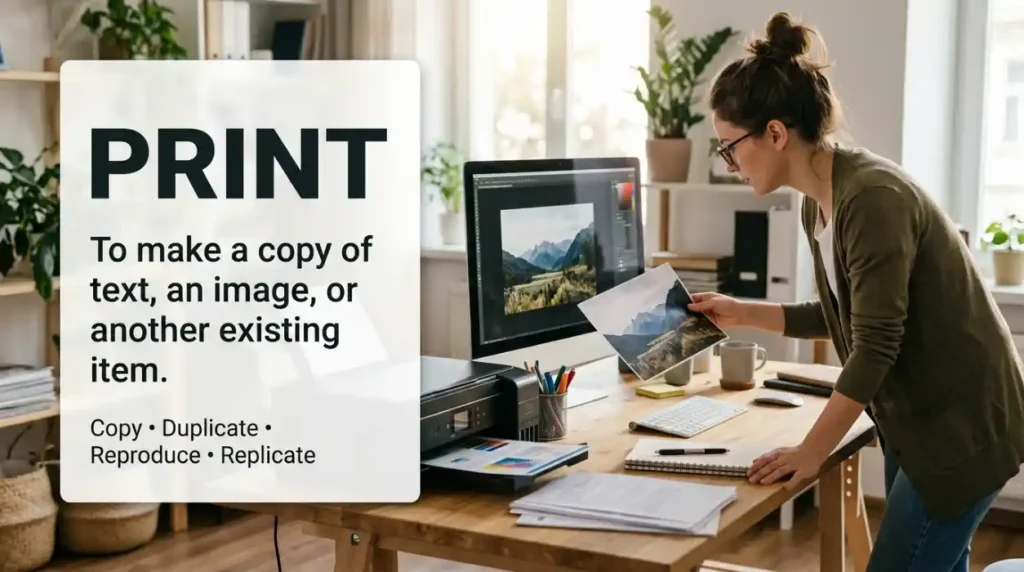
Meaning: To make a copy of text, an image, or another existing item.
Tone/Register: Neutral, technical, professional.
Examples:
- The studio can reproduce the photograph in several sizes.
- Please reproduce the original document without changing its layout.
2. Copy (Verb) — US: /ˈkɑːpi/ | UK: /ˈkɒpi/
Meaning: To create another version of something that already exists.
Tone/Register: Neutral, everyday, academic.
Examples:
- Can you copy these notes before class begins?
- I copied the report so every team member could read it.
3. Duplicate (Verb) — US: /ˈduːplɪkeɪt/ | UK: /ˈdjuːplɪkeɪt/
Meaning: To create an additional version that matches an original.
Tone/Register: Neutral, formal, business.
Examples:
- Duplicate the form for each new employee.
- The office duplicated the handouts for tomorrow’s meeting.
4. Photocopy (Verb) — US: /ˈfoʊtoʊˌkɑːpi/ | UK: /ˈfəʊtəʊˌkɒpi/
Meaning: To make a paper copy of a document using a photocopier.
Tone/Register: Neutral, everyday, office.
Examples:
- I need to photocopy my passport before the appointment.
- She photocopied the contract for her records.
5. Replicate (Verb) — US: /ˈrɛplɪˌkeɪt/ | UK: /ˈrɛplɪkeɪt/
Meaning: To create a close or exact copy of an existing item or design.
Tone/Register: Technical, formal, academic.
Examples:
- The designer replicated the original poster for the exhibition.
- Researchers replicated the chart to check its accuracy.
6. Copy out (Phrasal verb) — US: /ˈkɑːpi aʊt/ | UK: /ˈkɒpi aʊt/
Meaning: To write or type something again from an existing source.
Tone/Register: Neutral, educational, conversational.
Examples:
- Please copy out the quotation in your notebook.
- He copied out the address before closing the email.
7. Transcribe (Verb) — US: /trænˈskraɪb/ | UK: /trænˈskraɪb/
Meaning: To convert spoken words or handwritten material into written or typed text.
Tone/Register: Formal, academic, professional.
Examples:
- The assistant transcribed the interview for the research team.
- I transcribed the handwritten letter into a digital document.
8. Typeset (Verb) — US: /ˈtaɪpˌsɛt/ | UK: /ˈtaɪpˌsɛt/
Meaning: To arrange text for publication in a suitable printed or digital layout.
Tone/Register: Professional, publishing, technical.
Examples:
- The publisher typeset the novel before sending it to press.
- We typeset the headings to make the report easier to read.
9. Output (Verb) — US: /ˈaʊtˌpʊt/ | UK: /ˈaʊtˌpʊt/
Meaning: To produce text, images, or other information through a computer or device.
Tone/Register: Technical, business, neutral.
Examples:
- The machine outputs the completed labels in neat rows.
- This program can output the report in a printable format.
10. Hard-copy (Noun or adjective) — US: /ˈhɑːrd ˌkɑːpi/ | UK: /ˌhɑːd ˈkɒpi/
Meaning: A physical paper version of a digital document; it is a related term rather than a direct verb synonym.
Tone/Register: Professional, office, technical.
Examples:
- Please bring a hard copy of your application.
- I keep a hard-copy version of important records.
11. Publish (Verb) — US: /ˈpʌblɪʃ/ | UK: /ˈpʌblɪʃ/
Meaning: To make written, visual, or other content available to the public or a specific audience.
Tone/Register: Professional, academic, media.
Examples:
- The author plans to publish her first book next spring.
- Our school publishes a newsletter every month.
12. Issue (Verb) — US: /ˈɪʃuː/ | UK: /ˈɪsjuː/
Meaning: To release an official document, statement, or publication for people to receive.
Tone/Register: Formal, official, business.
Examples:
- The department will issue the final report on Monday.
- The magazine issued a special edition for its anniversary.
13. Release (Verb) — US: /rɪˈliːs/ | UK: /rɪˈliːs/
Meaning: To make a book, report, image, or other work available to an audience.
Tone/Register: Neutral, professional, media.
Examples:
- The publisher released the new guide in September.
- The newspaper released its annual review yesterday.
14. Circulate (Verb) — US: /ˈsɜːrkjəˌleɪt/ | UK: /ˈsɜːkjʊleɪt/
Meaning: To distribute a document or publication among a group of people.
Tone/Register: Formal, business, academic.
Examples:
- Please circulate the revised agenda before the meeting.
- The editor circulated the draft among the writers.
15. Disseminate (Verb) — US: /dɪˈsɛməˌneɪt/ | UK: /dɪˈsɛmɪneɪt/
Meaning: To spread information or written material widely among an audience.
Tone/Register: Formal, academic, institutional.
Examples:
- The organization disseminates educational material to local schools.
- Researchers disseminated their findings through a public report.
16. Distribute (Verb) — US: /dɪˈstrɪbjuːt/ | UK: /dɪˈstrɪbjuːt/
Meaning: To give copies of a document or publication to several people.
Tone/Register: Neutral, professional, educational.
Examples:
- Volunteers distributed printed guides at the event.
- The teacher distributed worksheets before the lesson.
17. Circulation (Noun) — US: /ˌsɜːrkjəˈleɪʃən/ | UK: /ˌsɜːkjʊˈleɪʃən/
Meaning: The distribution or number of copies of a newspaper, magazine, or other publication.
Tone/Register: Formal, publishing, media.
Examples:
- The newspaper increased its circulation this year.
- The magazine reports its circulation figures every quarter.
18. Reprint (Verb or noun) — US: /ˌriːˈprɪnt/ | UK: /ˌriːˈprɪnt/
Meaning: To print another edition or additional copies of material that has already been printed.
Tone/Register: Publishing, professional, neutral.
Examples:
- The publisher decided to reprint the popular textbook.
- The library ordered a reprint of the historical article.
19. Republish (Verb) — US: /ˌriːˈpʌblɪʃ/ | UK: /ˌriːˈpʌblɪʃ/
Meaning: To publish material again, often in a new edition or on another platform.
Tone/Register: Professional, editorial, digital.
Examples:
- The website republished the article with updated information.
- The author plans to republish her earlier essays.
20. Imprint (Verb or noun) — US: /ɪmˈprɪnt/ | UK: /ɪmˈprɪnt/
Meaning: As a verb, to leave a mark or press a design onto a surface; as a noun, it can also refer to a publisher’s brand.
Tone/Register: Formal, technical, literary.
Examples:
- The company imprinted its emblem on the notebook cover.
- The publisher released the book under its educational imprint.
21. Stamp (Verb or noun) — US: /stæmp/ | UK: /stæmp/
Meaning: To press a mark, symbol, or design onto a surface.
Tone/Register: Neutral, practical, business.
Examples:
- The clerk stamped the date on the application.
- She stamped her initials on the back of the card.
22. Engrave (Verb) — US: /ɪnˈɡreɪv/ | UK: /ɪnˈɡreɪv/
Meaning: To cut words, patterns, or designs into a hard surface.
Tone/Register: Craft, formal, artistic.
Examples:
- The jeweler engraved a short message inside the ring.
- They engraved the award with the winner’s name.
23. Emboss (Verb) — US: /ɪmˈbɔːs/ | UK: /ɪmˈbɒs/
Meaning: To create a raised design or lettering on a surface.
Tone/Register: Technical, decorative, professional.
Examples:
- The designer embossed the logo on the leather cover.
- The invitation has embossed flowers along its border.
24. Mark (Verb or noun) — US: /mɑːrk/ | UK: /mɑːk/
Meaning: To make a visible sign on a surface or indicate something with a symbol.
Tone/Register: Neutral, everyday, technical.
Examples:
- Mark the correct answer on your worksheet.
- The wet paint marked the edge of the paper.
25. Inscribe (Verb) — US: /ɪnˈskraɪb/ | UK: /ɪnˈskraɪb/
Meaning: To write, carve, or place words on a surface, often as a permanent record or dedication.
Tone/Register: Formal, literary, commemorative.
Examples:
- The artist inscribed a dedication inside the book.
- Workers inscribed the date on the stone plaque.
26. Label (Verb or noun) — US: /ˈleɪbəl/ | UK: /ˈleɪbəl/
Meaning: To attach or produce a tag containing identifying information.
Tone/Register: Neutral, business, practical.
Examples:
- Please label each folder before filing the documents.
- The factory labels every package with its batch number.
27. Brand (Verb or noun) — US: /brænd/ | UK: /brænd/
Meaning: To mark or identify something with a distinctive name, symbol, or design.
Tone/Register: Business, marketing, professional.
Examples:
- The company branded its packaging with a simple symbol.
- The team branded the event materials with matching colors.
28. Decorate (Verb) — US: /ˈdɛkəˌreɪt/ | UK: /ˈdɛkəreɪt/
Meaning: To make something more attractive by adding designs, patterns, or other visual details.
Tone/Register: Neutral, creative, informal.
Examples:
- We decorated the paper bags with colorful patterns.
- She decorated the invitation with small floral images.
29. Pattern (Verb or noun) — US: /ˈpætərn/ | UK: /ˈpætən/
Meaning: As a verb, to create or cover something with a repeated design; this use is more specialized than print.
Tone/Register: Creative, technical, descriptive.
Examples:
- The machine patterned the fabric with tiny stars.
- The designer patterned the wrapping paper with geometric shapes.
30. Mark out (Phrasal verb) — US: /ˈmɑːrk aʊt/ | UK: /ˈmɑːk aʊt/
Meaning: To indicate an area, boundary, or shape with visible lines or marks.
Tone/Register: Neutral, practical, informal.
Examples:
- The designer marked out the margins before laying out the page.
- Use a pencil to mark out the shape on the card.
31. Develop (Verb) — US: /dɪˈvɛləp/ | UK: /dɪˈvɛləp/
Meaning: To process photographic film or create a finished photograph from it.
Tone/Register: Technical, photographic, neutral.
Examples:
- My grandfather developed his photographs in a darkroom.
- The studio develops film for local photographers.
32. Expose (Verb) — US: /ɪkˈspoʊz/ | UK: /ɪkˈspəʊz/
Meaning: In photography, to allow light to reach film or a light-sensitive surface to create an image.
Tone/Register: Technical, photographic.
Examples:
- The photographer exposed the film for a few seconds.
- Incorrect settings can expose the image too brightly.
33. Render (Verb) — US: /ˈrɛndər/ | UK: /ˈrɛndə/
Meaning: To generate a visual image or representation, especially through computer software.
Tone/Register: Technical, digital, professional.
Examples:
- The software rendered the illustration in high resolution.
- The designer rendered a preview before preparing the final artwork.
34. Generate (Verb) — US: /ˈdʒɛnəˌreɪt/ | UK: /ˈdʒɛnəreɪt/
Meaning: To create text, images, or other output, often automatically through a system.
Tone/Register: Technical, neutral, professional.
Examples:
- The program generated a page of sample labels.
- The system generates a printable summary after each session.
35. Transfer (Verb) — US: /trænsˈfɜːr/ | UK: /trænsˈfɜː/
Meaning: To move an image or design from one medium or surface to another, sometimes using a printing process.
Tone/Register: Technical, artistic, practical.
Examples:
- She transferred the design onto the fabric.
- The artist transferred the image to a sheet of paper.
36. Screen-print (Verb) — US: /ˈskriːn ˌprɪnt/ | UK: /ˈskriːn ˌprɪnt/
Meaning: To apply ink to a surface through a mesh screen.
Tone/Register: Technical, artistic, commercial.
Examples:
- The studio screen-printed the design on cotton bags.
- We screen-printed team names onto the practice shirts.
37. Lithograph (Verb or noun) — US: /ˈlɪθəˌɡræf/ | UK: /ˈlɪθəɡrɑːf/
Meaning: To produce an image through lithography, a specialized printing process.
Tone/Register: Artistic, technical, historical.
Examples:
- The artist lithographed a detailed city scene.
- The museum displayed a lithograph from the nineteenth century.
38. Photoprint (Noun or verb) — US: /ˈfoʊtoʊˌprɪnt/ | UK: /ˈfəʊtəʊˌprɪnt/
Meaning: A photographic image produced as a physical print; the verb form is specialized.
Tone/Register: Photographic, technical.
Examples:
- She framed a photoprint of the family celebration.
- The archive preserved each photoprint in a protective sleeve.
39. Proof (Noun or verb) — US: /pruːf/ | UK: /pruːf/
Meaning: In publishing, to check a proof is to review a preliminary version for errors before final printing.
Tone/Register: Professional, editorial, publishing.
Examples:
- Please proof the brochure before it goes to press.
- The editor approved the final proof after checking every heading.
40. Publish online (Verb phrase) — US: /ˈpʌblɪʃ ˌɑːnˈlaɪn/ | UK: /ˈpʌblɪʃ ˌɒnˈlaɪn/
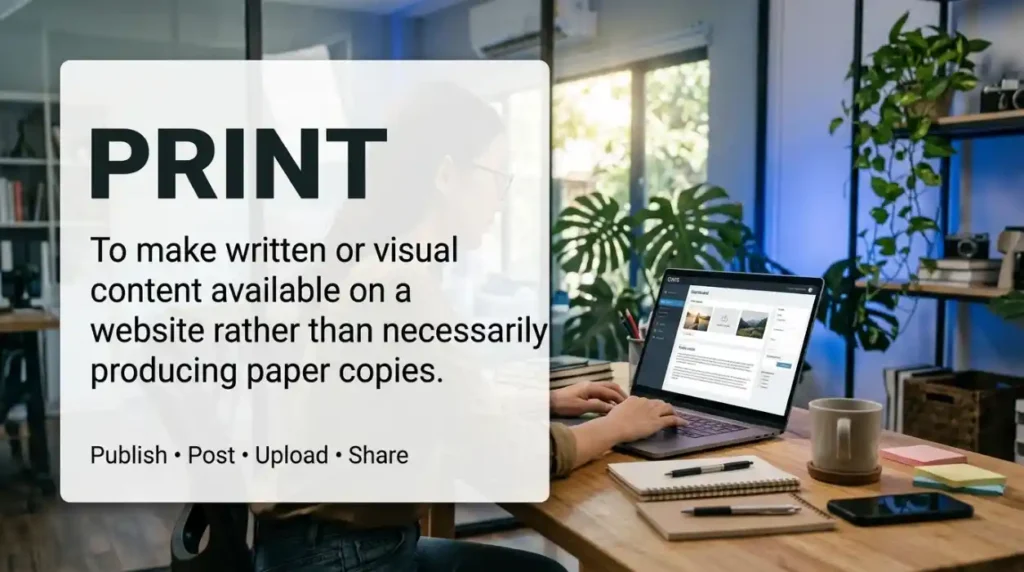
Meaning: To make written or visual content available on a website rather than necessarily producing paper copies.
Tone/Register: Digital, professional, everyday.
Examples:
- The teacher published the reading list online.
- Our team publishes new learning materials on its website.
41. Set (Verb) — US: /sɛt/ | UK: /sɛt/
Meaning: In typography, to arrange or prepare text for printing, as in set the type.
Tone/Register: Technical, publishing, traditional.
Examples:
- The compositor set the type for the newspaper.
- The team set the headings before preparing the page layout.
42. Letterpress (Verb or noun) — US: /ˈlɛtərˌprɛs/ | UK: /ˈletəpres/
Meaning: To print using raised surfaces that press ink onto paper.
Tone/Register: Traditional, technical, artistic.
Examples:
- The workshop letterpressed the invitations on thick paper.
- The artist used letterpress to create a textured design.
43. Overprint (Verb or noun) — US: /ˌoʊvərˈprɪnt/ | UK: /ˌəʊvəˈprɪnt/
Meaning: To print additional text or imagery over material that has already been printed.
Tone/Register: Technical, publishing, design.
Examples:
- The designer overprinted a small title on the background image.
- The printer used overprint settings to control the color overlap.
44. Underprint (Verb or noun) — US: /ˌʌndərˈprɪnt/ | UK: /ˌʌndəˈprɪnt/
Meaning: To print an underlying layer beneath other text or imagery.
Tone/Register: Technical, specialist.
Examples:
- The designer underprinted a pale pattern beneath the lettering.
- The packaging used an underprint to strengthen the background color.
45. Flexograph (Verb or noun) — US: /ˈflɛksoʊˌɡræf/ | UK: /ˈfleksəʊɡrɑːf/
Meaning: A specialized term associated with flexography, a printing method that uses flexible relief plates.
Tone/Register: Industrial, technical.
Examples:
- The specialist used flexography to produce the packaging design.
- The plant selected a flexographic process for its label production.
46. Silkscreen (Verb or noun) — US: /ˈsɪlkˌskriːn/ | UK: /ˈsɪlkskriːn/
Meaning: To produce a design using a screen-printing process, or a print made with that process.
Tone/Register: Artistic, technical, informal.
Examples:
- The artist silkscreened a bold image onto the poster.
- Each silkscreen had slightly different ink textures.
47. Reproduce mechanically (Verb phrase) — US: /ˌriːprəˈduːs məˈkænɪkli/ | UK: /ˌriːprəˈdjuːs məˈkænɪkli/
Meaning: To create copies using a machine or mechanical process rather than by hand.
Tone/Register: Formal, technical.
Examples:
- The workshop reproduced the original drawing mechanically.
- The archive reproduced the pages mechanically to preserve the source.
48. Issue in print (Verb phrase) — US: /ˈɪʃuː ɪn prɪnt/ | UK: /ˈɪsjuː ɪn prɪnt/
Meaning: To make a publication available in a physical printed edition.
Tone/Register: Formal, publishing.
Examples:
- The publisher will issue the guide in print next month.
- The report is available online and will soon be issued in print.
49. Put into print (Verb phrase) — US: /ˌpʊt ˌɪntuː ˈprɪnt/ | UK: /ˌpʊt ˌɪntə ˈprɪnt/
Meaning: To prepare or publish written material as a printed work.
Tone/Register: Neutral, editorial, literary.
Examples:
- The author finally put her travel notes into print.
- The editor helped the student put his research into print.
50. Make a hard copy (Verb phrase) — US: /ˌmeɪk ə ˈhɑːrd ˌkɑːpi/ | UK: /ˌmeɪk ə ˈhɑːd ˌkɒpi/
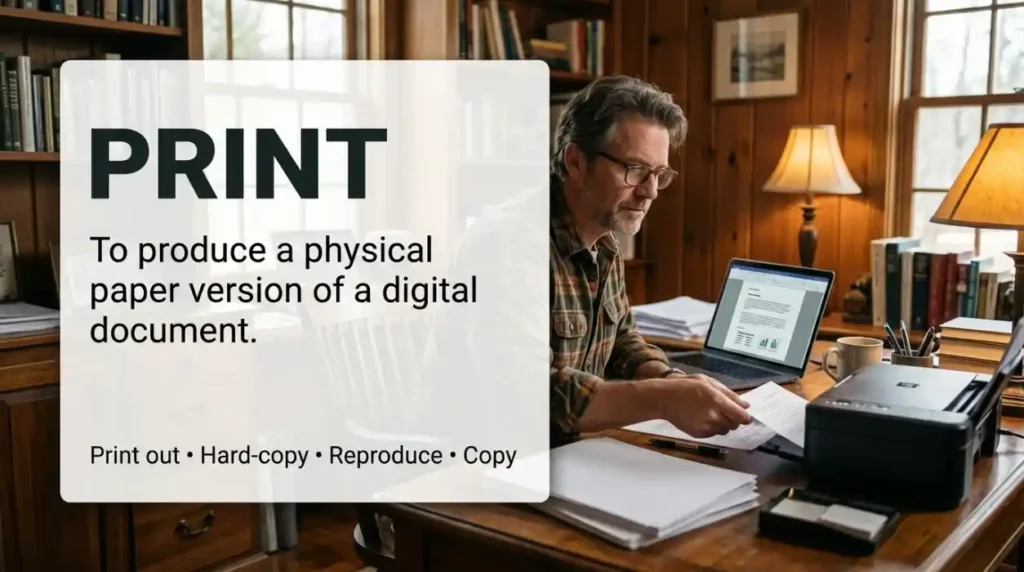
Meaning: To produce a physical paper version of a digital document.
Tone/Register: Everyday, office, professional.
Examples:
- I made a hard copy of the schedule for the noticeboard.
- Please make a hard copy of the receipt for your files.
Synonyms by Tone
The tone of a synonym affects how your sentence sounds. A technical term may suit a workplace report, while a familiar word may feel more natural in conversation.
Positive or Creative
- Reproduce: Emphasizes accurate copying or preserving an original.
- Replicate: Suggests close attention to detail.
- Engrave: Often suggests craftsmanship or a lasting dedication.
- Emboss: Highlights decorative detail and texture.
- Publish: Can suggest sharing valuable knowledge or creative work.
Neutral and Everyday
- Copy: Best for ordinary duplication.
- Photocopy: Specific to making paper copies with a photocopier.
- Print: The standard general-purpose term.
- Duplicate: Useful for creating matching documents.
- Output: Appropriate when discussing computers and devices.
- Distribute: Focuses on giving copies to other people.
Formal and Professional
- Disseminate: Suitable for spreading information to a wide audience.
- Circulate: Common when sharing drafts and reports within a group.
- Issue: Often used for official documents and publications.
- Typeset: Appropriate for preparing text for publication.
- Transcribe: Useful when converting spoken or handwritten content into text.
Informal and Conversational
- Copy out: Useful for rewriting text from a source.
- Make a hard copy: A natural way to describe producing a paper document.
- Put into print: A familiar phrase for publishing written work.
- Release: Common when announcing new content or a publication.
Why Tone Matters
Consider the sentence, “Please print the report.” In an office, it is clear and natural. “Please reproduce the report” sounds more technical and may suggest copying its appearance. “Please disseminate the report” means sharing it with an audience, not necessarily producing paper copies.
Choose a synonym based on the action, audience, and setting. A word that sounds professional in a report may feel unnecessarily formal in a casual conversation.
“Print” vs. Close Alternatives
| Word | Main difference | Best context |
|---|---|---|
| Produce text or images on a surface or through a printer | Documents, photos, labels | |
| Publish | Make content available to readers | Books, articles, websites |
| Copy | Create another version of existing material | Notes, files, documents |
| Reproduce | Create a copy, often with attention to fidelity | Artwork, records, designs |
| Stamp | Press a mark or symbol onto a surface | Forms, packages, official papers |
| Typeset | Arrange text for a finished publication | Books, magazines, formal documents |
Remember: You can print a report without publishing it, publish an article without printing it, and copy a file without producing a paper version.
How a Synonym for Print Changes by Context
Daily Conversation
In everyday English, print, copy, and photocopy are among the most useful options. They describe familiar tasks without sounding overly formal.
For example, “Could you print the tickets?” is natural when asking someone to produce paper tickets. “Could you copy the tickets?” may mean making duplicates instead.
Writing and Blogging
Bloggers and content writers often use publish, release, and republish when discussing online content. These terms describe making an article available rather than sending it to a physical printer.
For example, “We published the article yesterday” clearly communicates that readers can access it. “We printed the article yesterday” normally suggests a physical printing process.
Professional and Academic English
In business and academic settings, duplicate, reproduce, circulate, and disseminate can communicate more specific actions.
Use circulate when sharing a draft among colleagues. Choose disseminate when distributing findings to a broad audience. Use transcribe when converting an interview into written text.
Creative and Informal English
Creative work may call for engrave, emboss, screen-print, or imprint. These terms help describe how artists, designers, and craftspeople place images or words on different materials.
For instance, an artist might screen-print a design on a T-shirt or engrave a message on a gift. These verbs create a clearer picture than the general word print.
Common Mistakes Learners Make
1. Using “Publish” When You Mean “Print”
Incorrect: “I published the worksheet on my home printer.”
Better: “I printed the worksheet on my home printer.”
Publish usually means making content available to an audience, while print describes producing a physical copy.
2. Treating “Copy” and “Print” as Identical
Incorrect: “I copied the document,” when you specifically mean that you sent it to a printer.
Better: “I printed the document.”
Copy can mean duplicating a file or text. It does not always mean producing paper.
3. Using Technical Words in Simple Situations
A sentence such as “Please reproduce the shopping list” sounds unnecessarily formal if you simply want someone to print it again.
In ordinary conversation, prefer familiar words unless the technical meaning matters.
4. Confusing “Stamp” With “Print”
A stamp creates a mark, symbol, or impression. It does not normally describe producing a complete document with a printer.
Use stamp when describing a date mark, official seal, or impression on a surface.
5. Ignoring the Noun and Verb Forms
Print can function as both a noun and a verb. So can several alternatives, but not all of them work naturally in the same grammatical position.
For example, “The print looks clear” uses print as a noun. “Please print this page” uses it as a verb. Always check the grammatical role before replacing the word.
Register Notes: Formal vs. Informal
- Formal: disseminate, transcribe, replicate, typeset.
- Neutral: print, copy, duplicate, reproduce.
- Technical: overprint, underprint, screen-print, lithograph.
- Conversational: copy out, make a hard copy, put into print.
Spoken English generally favors short, familiar words. Written English can use more specialized terms when they improve accuracy.
For further vocabulary practice, explore other synonym guides on SynonymsCloud and compare how similar words change meaning across contexts.
Real-Life Examples Using Print and Its Synonyms
Workplace
An employee prints a meeting agenda, duplicates a form for the team, and circulates the final report by email. Each verb describes a different action.
Social and educational settings
A student photocopies notes for a classmate and copies a quotation into a notebook. The correct verb makes the task easy to understand.
Media and publishing
An editor checks a proof, approves the final layout, and helps publish the magazine. These stages have different names for a reason.
Creative work and storytelling
An artist screen-prints a design on a tote bag and engraves a dedication on a wooden keepsake. Specific verbs bring the scene to life.
Practice Exercise
Test your understanding with these real-life questions. Select the word that best fits each situation.
1. You want to produce a paper copy of a digital report. What should you do?
A. Publish it
B. Print it
C. Disseminate it
D. Engrave it
2. A writer makes an article available to the public. Which verb fits best?
A. Stamp
B. Photocopy
C. Publish
D. Emboss
3. You need another version of an existing form. Which word is most suitable?
A. Duplicate
B. Release
C. Engrave
D. Transcribe
4. A clerk presses an official date mark onto a document. What does the clerk do?
A. Typeset
B. Republish
C. Render
D. Stamp
5. You convert an interview recording into written text. Which verb should you use?
A. Transcribe
B. Screen-print
C. Emboss
D. Circulate
6. An editor shares a draft with several colleagues. Which verb fits best?
A. Engrave
B. Circulate
C. Stamp
D. Expose
7. A designer creates raised lettering on a card. Which verb describes the process?
A. Distribute
B. Transcribe
C. Emboss
D. Publish
8. A publisher produces more copies of a previously printed book. What does the publisher do?
A. Reprint
B. Inscribe
C. Output
D. Label
9. A computer creates a visual image from a digital design. Which verb is appropriate?
A. Photocopy
B. Circulate
C. Engrave
D. Render
10. You want to describe cutting a message into a metal plaque. Which verb is correct?
A. Release
B. Engrave
C. Duplicate
D. Disseminate
Answer Key:
- B. Print it
- C. Publish
- A. Duplicate
- D. Stamp
- A. Transcribe
- B. Circulate
- C. Emboss
- A. Reprint
- D. Render
- B. Engrave
Reflection Task:
Write one sentence using print, publish, reproduce, or engrave. Explain why your chosen word is more suitable than another alternative.
Frequently Asked Questions
1. What is the best synonym for print in academic writing?
The best alternative depends on the action you want to describe. Use publish when making research available to readers, reproduce when creating an accurate copy of a figure or document, and disseminate when sharing findings widely. In academic writing, precision matters more than choosing a sophisticated word. Keep print when you mean producing a physical copy.
2. What is a synonym for print in computer terminology?
In computing, output can describe information produced by a device or program. Render is useful when software generates a visual representation, while reproduce describes making a copy of existing material. If you mean sending a document to a physical printer, however, print remains the clearest and most widely understood term.
3. What is the difference between print and hard copy?
Print can describe the action of producing a physical document or the resulting printed material. A hard copy specifically means a physical version of information that may also exist digitally. For example, you print a PDF to create a hard copy. The terms are closely related, but they serve different grammatical roles and meanings.
4. Which synonym for print is best for publishing an article online?
Use publish when you make an article available on a website. You can also use release when emphasizing the launch of new content or republish when making previously published material available again. Avoid using print unless you mean producing a physical copy or are discussing a particular print edition.
5. What is a synonym for print when describing designs on clothing?
Screen-print is a suitable verb when ink is applied to clothing through a mesh screen. Silkscreen is another term associated with this technique. For a design transferred using a different process, transfer may be more accurate. Choose the word that describes the actual method rather than using print for every decorative technique.
6. Can print be used as both a noun and a verb?
Yes. As a verb, print describes producing text or images on a surface or through a printer. As a noun, it can refer to printed material, a physical copy, a photograph, or a mark. For example, “Please print the form” uses the word as a verb, while “The print is clear” uses it as a noun.
7. How can I avoid repeating the word print in an essay?
First, identify what print means in each sentence. Replace it with publish for making content available, copy for duplication, stamp for applying a mark, or reproduce for creating a faithful copy. Do not change words simply to avoid repetition. Reusing print is better than selecting an inaccurate synonym.
Conclusion
Choosing the right synonym for print makes your English more precise. Words such as copy, publish, and reproduce express different actions and help readers understand your message.
For students, bloggers, and content writers, a stronger vocabulary creates clearer essays, more engaging articles, and better everyday communication. Small word choices can make a meaningful difference.
Practice these alternatives in emails, school assignments, blog posts, and daily conversations. Pay attention to context, tone, and the action each word describes.
Keep exploring new vocabulary and create your own example sentences each day. With regular practice, you will choose words more confidently and express your ideas with greater clarity.
External Learning Source
For a reliable reference, consult the Cambridge Dictionary to check the meanings, pronunciations, and example sentences for print and its alternatives.
Cambridge Dictionary: Print definition and usage
Explore Collins Dictionary to learn more synonyms for print, understand their meanings, and see how they are used in different contexts.
Collins Thesaurus: Synonyms for Print

Jameel Hassan is the founder and lead writer at SynonymsCloud.com, a trusted online platform dedicated to English vocabulary and effective communication. He is passionate about helping students, writers, professionals, and lifelong learners discover the right words to express their ideas with clarity, precision, and confidence.
At SynonymsCloud.com, every article is thoroughly researched and carefully written to provide accurate, practical, and easy-to-understand guidance on synonyms, antonyms, word meanings, idioms, and vocabulary. With a strong commitment to quality, real-world usage, and clear explanations, the website helps readers expand their vocabulary, improve their writing, and communicate more effectively in both academic and professional settings.