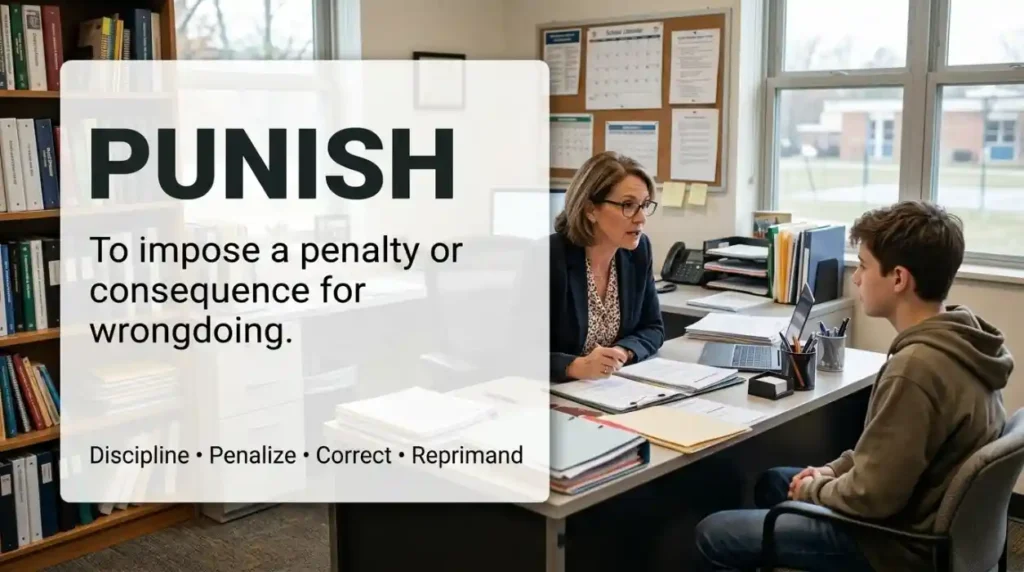
The strongest formal synonym for “punish” is “penalize” (for official penalties) or “castigate” (for harsh verbal criticism). For everyday writing, “discipline” and “reprimand” work best. Explore all 50 synonyms with example sentences below.
A synonym for punish is a word that expresses imposing a penalty or consequence for wrongdoing. Common alternatives include penalize, discipline, sanction, reprimand, and fine. Each word carries a different level of severity and formality, so the best choice depends on the situation.
Imagine a student breaking a classroom rule or an employee ignoring workplace policies. A teacher or manager might reprimand the person, impose a penalty, or take corrective action, depending on the seriousness of the behavior.
The word punish is commonly used in schools, workplaces, legal settings, books, and everyday conversations. It describes imposing consequences on someone for breaking rules, violating laws, or acting improperly.
Learning a synonym for punish helps you express different types of consequences more precisely. Words such as discipline, penalize, reprimand, and chastise offer useful alternatives for students, bloggers, content writers, and English learners.
Choosing the right synonym for punish depends on the situation and tone. Some alternatives suit formal or legal writing, while others describe criticism, correction, or financial penalties. Understanding each word helps you communicate clearly and expand your vocabulary.
What Does “Punish” Really Mean?
Punish means to impose a penalty or unpleasant consequence on someone for breaking a rule, violating a law, or doing something considered wrong. The purpose may be to discourage future misconduct, enforce rules, or express disapproval.
Punish is primarily a verb. Its noun-related forms include punishment and punisher, although the latter is less common.
Native English speakers use the word in many situations. Parents may punish a child for breaking an important rule. A court may punish a person who has committed an offense. A sports official may penalize a player for a rule violation.
The word often carries a negative emotional tone because it involves an undesirable consequence. However, the exact meaning depends on context. A legal penalty, a classroom consequence, and a harsh personal response are not necessarily the same.
Connotative Meaning
(Connotation means the emotional associations or feelings connected with a word beyond its basic dictionary definition.)
- Positive tone: Words such as correct or reform may suggest improvement, guidance, or learning rather than suffering.
- Negative tone: Words such as torment or persecute suggest severe suffering, cruelty, or unfair treatment.
- Neutral tone: Words such as penalize and sanction can describe official consequences without necessarily expressing personal anger.
Etymology of Punish
The English word punish came through Anglo-French and Old French forms related to Latin punire, meaning “to penalize” or “to inflict a penalty.” Its history reflects the long-standing connection between wrongdoing and consequences.
Old English (450–1100)
The modern form punish was not an established Old English word. English speakers used other terms to describe penalties, correction, and consequences.
Middle English (1100–1500)
Forms related to Old French punir entered English and developed into the familiar verb punish.
Modern English (1500–present)
The word expanded across legal, educational, social, and figurative contexts. Today, it can describe anything from a formal fine to a personal consequence.
Pronunciation
- US: /ˈpʌnɪʃ/
- UK: /ˈpʌnɪʃ/
Syllables
pun-ish: two syllables.
Affixation Pattern of Punish
- Root: punish
- Prefix: None in the base word.
- Suffix: None in the base word.
Common derived forms include punished, punishing, and punishment. The verb changes according to tense, while the noun names the consequence or process.
Synonyms List
Not every alternative to punish has the same meaning. Some describe official penalties, while others refer to criticism, discipline, correction, or cruel treatment. Choose the word that accurately reflects the action and its severity.
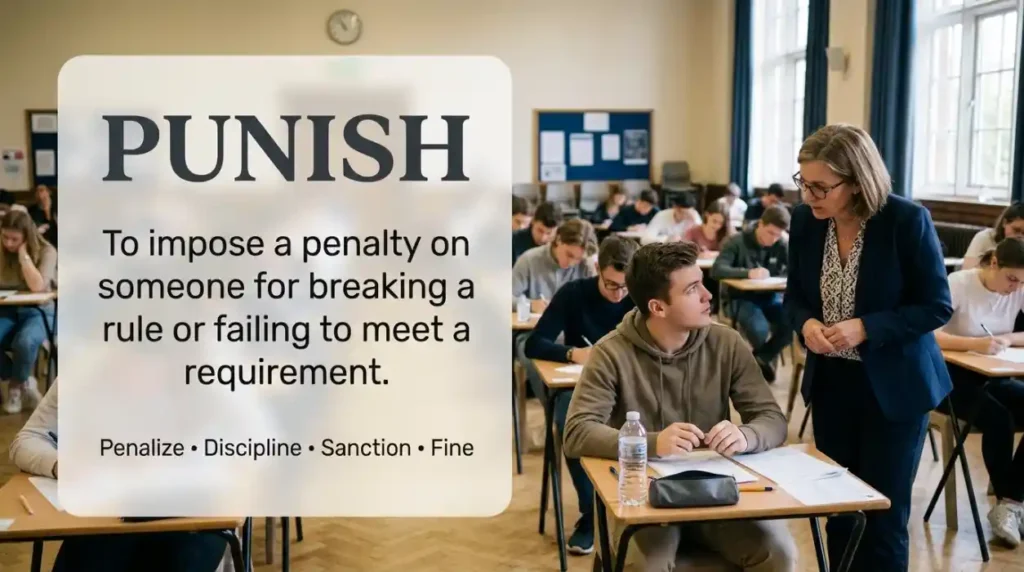
1. Penalize (Verb) — US: /ˈpiːnəˌlaɪz/ | UK: /ˈpiːnəlaɪz/
Meaning: To impose a penalty on someone for breaking a rule or failing to meet a requirement.
Tone/Register: Formal, academic, legal, business.
Examples:
- The referee penalized the team for an illegal move.
- The school may penalize students who submit their work late.
2. Discipline (Verb) — US: /ˈdɪsəˌplɪn/ | UK: /ˈdɪsɪplɪn/
Meaning: To correct or control behavior through rules and appropriate consequences.
Tone/Register: Educational, professional, neutral.
Examples:
- The coach disciplined the player for repeatedly ignoring instructions.
- Parents should explain why they discipline their children.
3. Reprimand (Verb) — US: /ˈrɛprəˌmænd/ | UK: /ˈrɛprɪmɑːnd/
Meaning: To express strong disapproval of someone’s behavior, usually through an official or serious verbal warning.
Tone/Register: Formal, professional, authoritative.
Examples:
- The manager reprimanded the employee for sharing confidential information.
- The officer received a reprimand for ignoring the procedure.
4. Sanction (Verb) — US: /ˈsæŋkʃən/ | UK: /ˈsæŋkʃən/
Meaning: To impose or authorize a penalty against a person, group, or organization.
Tone/Register: Formal, legal, political.
Examples:
- The governing body sanctioned the club for violating competition rules.
- Officials sanctioned the organization after its investigation.
5. Fine (Verb) — US: /faɪn/ | UK: /faɪn/
Meaning: To require someone to pay money as a penalty for an offense.
Tone/Register: Legal, official, everyday.
Examples:
- The city fined the driver for parking in a restricted area.
- The agency may fine businesses that ignore safety regulations.
6. Penalise (Verb) — US: /ˈpiːnəˌlaɪz/ | UK: /ˈpiːnəlaɪz/
Meaning: The British English spelling of penalize, meaning to impose a penalty for an offense or failure.
Tone/Register: Formal, British English, legal.
Examples:
- The referee penalised the player for a dangerous tackle.
- The school penalised late submissions according to its policy.
7. Punish severely (Verb phrase) — US: /ˈpʌnɪʃ səˈvɪrli/ | UK: /ˈpʌnɪʃ sɪˈvɪəli/
Meaning: To impose a particularly harsh penalty or consequence.
Tone/Register: Strong, serious, neutral to negative.
Examples:
- The court decided to punish the offender severely.
- The organization promised to punish serious misconduct firmly.
8. Chastise (Verb) — US: /tʃæˈstaɪz/ | UK: /tʃæsˈtaɪz/
Meaning: To criticize or rebuke someone strongly for their behavior.
Tone/Register: Formal, literary, authoritative.
Examples:
- The coach chastised the team for ignoring the game plan.
- Her supervisor chastised her for missing an important deadline.
9. Rebuke (Verb) — US: /rɪˈbjuːk/ | UK: /rɪˈbjuːk/
Meaning: To express sharp disapproval of someone’s words or actions.
Tone/Register: Formal, serious, professional.
Examples:
- The director rebuked the staff member for making a disrespectful comment.
- The judge rebuked the lawyer for interrupting the witness.
10. Admonish (Verb) — US: /ədˈmɑːnɪʃ/ | UK: /ədˈmɒnɪʃ/
Meaning: To warn or reprimand someone firmly because their behavior is inappropriate.
Tone/Register: Formal, educational, authoritative.
Examples:
- The teacher admonished the class for disrupting the lesson.
- Her supervisor admonished her to follow the safety rules.
11. Censure (Verb) — US: /ˈsɛnʃər/ | UK: /ˈsɛnʃə/
Meaning: To formally express strong disapproval of someone’s conduct.
Tone/Register: Formal, political, institutional.
Examples:
- The committee censured the official for unethical conduct.
- The council voted to censure the member after the inquiry.
12. Reproach (Verb) — US: /rɪˈproʊtʃ/ | UK: /rɪˈprəʊtʃ/
Meaning: To express disappointment or disapproval toward someone because of their actions.
Tone/Register: Formal, emotional, literary.
Examples:
- Her friend reproached her for breaking a promise.
- He reproached himself for failing to speak up.
13. Rebuke formally (Verb phrase) — US: /rɪˈbjuːk ˈfɔːrməli/ | UK: /rɪˈbjuːk ˈfɔːməli/
Meaning: To communicate official or serious disapproval of someone’s conduct.
Tone/Register: Formal, workplace, institutional.
Examples:
- The board rebuked the director during the official meeting.
- The supervisor formally rebuked the employee for misconduct.
14. Correct (Verb) — US: /kəˈrɛkt/ | UK: /kəˈrekt/
Meaning: To address a mistake or behavior so that it improves or becomes acceptable.
Tone/Register: Neutral, educational, professional.
Examples:
- The instructor corrected the student’s behavior with a clear explanation.
- The manager corrected the repeated errors in the team’s process.
15. Discipline formally (Verb phrase) — US: /ˈdɪsəˌplɪn ˈfɔːrməli/ | UK: /ˈdɪsɪplɪn ˈfɔːməli/
Meaning: To apply an established disciplinary procedure in response to misconduct.
Tone/Register: Formal, workplace, institutional.
Examples:
- The company disciplined the employee under its conduct policy.
- The committee formally disciplined the member after reviewing the complaint.
16. Penalize financially (Verb phrase) — US: /ˈpiːnəˌlaɪz faɪˈnænʃəli/ | UK: /ˈpiːnəlaɪz faɪˈnænʃəli/
Meaning: To impose a financial disadvantage or monetary penalty for a violation.
Tone/Register: Business, legal, formal.
Examples:
- The contract allows the client to penalize repeated delays financially.
- The regulator penalized the company financially for breaking the rules.
17. Dock (Verb) — US: /dɑːk/ | UK: /dɒk/
Meaning: To deduct money, points, or another benefit as a penalty.
Tone/Register: Workplace, sports, informal to professional.
Examples:
- The employer docked his pay for an unauthorized absence, in accordance with the applicable policy.
- The referee docked the competitor points for a rule violation.
18. Suspend (Verb) — US: /səˈspɛnd/ | UK: /səˈspend/
Meaning: To temporarily remove someone’s permission to participate, work, or attend an institution.
Tone/Register: Formal, educational, professional, legal.
Examples:
- The school suspended the student after a serious safety violation.
- The league suspended the player for breaking its conduct rules.
19. Expel (Verb) — US: /ɪkˈspɛl/ | UK: /ɪkˈspel/
Meaning: To officially remove someone from a school, organization, or group.
Tone/Register: Formal, severe, institutional.
Examples:
- The university expelled the student after a formal disciplinary hearing.
- The club expelled a member for repeated serious misconduct.
20. Evict (Verb) — US: /ɪˈvɪkt/ | UK: /ɪˈvɪkt/
Meaning: To legally require someone to leave a property; it is a consequence in certain situations, not a general synonym for punish.
Tone/Register: Legal, formal, housing.
Examples:
- The landlord began legal proceedings to evict the tenant for unpaid rent.
- The court reviewed whether the eviction complied with local law.
21. Confine (Verb) — US: /kənˈfaɪn/ | UK: /kənˈfaɪn/
Meaning: To restrict someone to a particular place or area, sometimes as a formal penalty.
Tone/Register: Formal, legal, restrictive.
Examples:
- The authorities confined the prisoner to a secure unit.
- The rules confined the athlete to the designated training area.
22. Detain (Verb) — US: /dɪˈteɪn/ | UK: /dɪˈteɪn/
Meaning: To keep someone in official custody or prevent them from leaving for a period.
Tone/Register: Legal, official, formal.
Examples:
- Police detained the suspect while they investigated the incident.
- The officer explained why the individual had been detained.
23. Incarcerate (Verb) — US: /ɪnˈkɑːrsəˌreɪt/ | UK: /ɪnˈkɑːsəreɪt/
Meaning: To imprison someone as part of a legal sentence or detention.
Tone/Register: Formal, legal, academic.
Examples:
- The court may incarcerate an offender for a serious crime.
- The article examines how long-term incarceration affects families.
24. Imprison (Verb) — US: /ɪmˈprɪzən/ | UK: /ɪmˈprɪzən/
Meaning: To put someone in prison or keep them confined as a legal penalty.
Tone/Register: Formal, legal, serious.
Examples:
- The judge decided to imprison the convicted offender.
- The report discusses people who were imprisoned for years.
25. Sentence (Verb) — US: /ˈsɛntəns/ | UK: /ˈsentəns/
Meaning: To formally decide a legal punishment for a person convicted of a crime.
Tone/Register: Legal, formal, official.
Examples:
- The judge sentenced the defendant after reviewing the evidence.
- The court sentenced him to community service rather than prison.
26. Convict (Verb) — US: /kənˈvɪkt/ | UK: /kənˈvɪkt/
Meaning: To find someone guilty of a crime through a legal process; conviction may lead to punishment but is not itself the punishment.
Tone/Register: Legal, formal.
Examples:
- The jury convicted the defendant after considering the evidence.
- A court should not convict anyone without sufficient proof.
27. Prosecute (Verb) — US: /ˈprɑːsɪˌkjuːt/ | UK: /ˈprɒsɪkjuːt/
Meaning: To bring legal proceedings against someone accused of an offense, rather than directly impose a punishment.
Tone/Register: Legal, formal.
Examples:
- The authorities decided to prosecute the company for fraud.
- Prosecutors presented the evidence during the court proceedings.
28. Exact retribution (Verb phrase) — US: /ɪɡˈzækt ˌrɛtrɪˈbjuːʃən/ | UK: /ɪɡˈzækt ˌretrɪˈbjuːʃən/
Meaning: To seek or impose a penalty in return for a perceived wrong.
Tone/Register: Formal, literary, serious.
Examples:
- The ruler sought to exact retribution against those who betrayed him.
- The story follows a family determined to exact retribution for a past injustice.
29. Avenge (Verb) — US: /əˈvɛndʒ/ | UK: /əˈvendʒ/
Meaning: To respond to a wrong or injury by seeking justice or retaliation, often on behalf of someone else.
Tone/Register: Emotional, literary, dramatic.
Examples:
- The hero vowed to avenge his brother’s death.
- The novel follows a detective trying to avenge a family tragedy.
30. Retaliate (Verb) — US: /rɪˈtæliˌeɪt/ | UK: /rɪˈtælieɪt/
Meaning: To respond to an attack, insult, or harmful act with a counteraction.
Tone/Register: Negative, political, interpersonal.
Examples:
- She refused to retaliate after the unfair accusation.
- The two groups retaliated against each other for several weeks.
31. Get back at (Phrasal verb) — US: /ɡɛt ˈbæk æt/ | UK: /ɡet ˈbæk æt/
Meaning: To do something unpleasant to someone because they previously harmed or upset you.
Tone/Register: Informal, conversational, negative.
Examples:
- He wanted to get back at his friend for the practical joke.
- She chose to discuss the disagreement instead of getting back at her coworker.
32. Take revenge on (Verb phrase) — US: /teɪk rɪˈvɛndʒ ɑːn/ | UK: /teɪk rɪˈvendʒ ɒn/
Meaning: To deliberately harm or disadvantage someone in response to a perceived wrong.
Tone/Register: Negative, emotional, dramatic.
Examples:
- The character planned to take revenge on the rival who betrayed him.
- He decided not to take revenge on the person who insulted him.
33. Torment (Verb) — US: /ˈtɔːrˌmɛnt/ | UK: /tɔːˈment/
Meaning: To cause someone severe mental or physical suffering.
Tone/Register: Strongly negative, emotional, literary.
Examples:
- The bully tormented the younger student with repeated insults.
- Guilt continued to torment him long after the argument ended.
34. Torture (Verb) — US: /ˈtɔːrtʃər/ | UK: /ˈtɔːtʃə/
Meaning: To inflict extreme physical or psychological suffering, often deliberately.
Tone/Register: Extremely serious, legal, strongly negative.
Examples:
- The investigation examined allegations that guards tortured prisoners.
- The character was tortured by memories of the terrible event.
35. Persecute (Verb) — US: /ˈpɜːrsɪˌkjuːt/ | UK: /ˈpɜːsɪkjuːt/
Meaning: To subject a person or group to persistent unfair treatment because of identity, beliefs, or other characteristics.
Tone/Register: Strongly negative, social, political, historical.
Examples:
- The regime persecuted people who openly opposed its policies.
- History records communities that were persecuted for their beliefs.
36. Oppress (Verb) — US: /əˈprɛs/ | UK: /əˈpres/
Meaning: To exercise cruel or unjust control over people, restricting their freedom or rights.
Tone/Register: Political, social, strongly negative.
Examples:
- The novel describes a ruler who oppressed the local population.
- Laws should protect people rather than oppress vulnerable communities.
37. Harass (Verb) — US: /həˈræs/ | UK: /ˈhærəs/
Meaning: To repeatedly bother, intimidate, or mistreat someone; it is not a fair or appropriate synonym for lawful punishment.
Tone/Register: Negative, legal, interpersonal.
Examples:
- The supervisor warned the team not to harass their colleague.
- Repeated threatening messages can amount to harassment.
38. Abuse (Verb) — US: /əˈbjuːz/ | UK: /əˈbjuːz/
Meaning: To treat someone cruelly or use power in a harmful way.
Tone/Register: Strongly negative, legal, social.
Examples:
- A responsible leader should never abuse authority to punish critics.
- The organization investigated allegations that a caregiver abused a resident.
39. Humiliate (Verb) — US: /hjuːˈmɪliˌeɪt/ | UK: /hjuːˈmɪlieɪt/
Meaning: To make someone feel deeply embarrassed or lose dignity in front of others.
Tone/Register: Negative, emotional, interpersonal.
Examples:
- The teacher corrected the mistake without humiliating the student.
- He apologized for trying to humiliate his colleague in public.
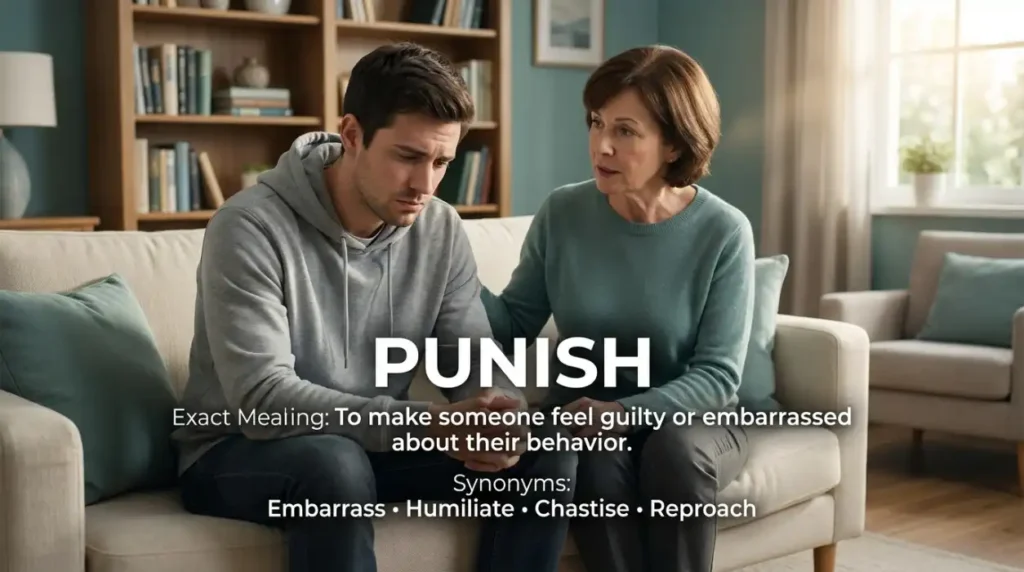
40. Shame (Verb) — US: /ʃeɪm/ | UK: /ʃeɪm/
Meaning: To make someone feel guilty or embarrassed about their behavior.
Tone/Register: Emotional, social, negative.
Examples:
- The campaign aimed to shame businesses that ignored environmental standards.
- Parents can address harmful behavior without trying to shame a child.
41. Denounce (Verb) — US: /dɪˈnaʊns/ | UK: /dɪˈnaʊns/
Meaning: To publicly condemn a person, action, or policy as wrong.
Tone/Register: Formal, political, public.
Examples:
- The mayor denounced the violent behavior at the event.
- Several organizations denounced the policy as unfair.
42. Condemn (Verb) — US: /kənˈdɛm/ | UK: /kənˈdem/
Meaning: To express strong disapproval of wrongdoing or, in legal contexts, to impose a sentence in certain circumstances.
Tone/Register: Formal, serious, moral or legal.
Examples:
- The committee condemned the employee’s dishonest conduct.
- The community condemned the attack and called for accountability.
43. Relegate (Verb) — US: /ˈrɛləˌɡeɪt/ | UK: /ˈrelɪɡeɪt/
Meaning: To move someone or something to a lower position, rank, or division, sometimes as a consequence of poor performance.
Tone/Register: Formal, professional, sports.
Examples:
- The club was relegated after finishing at the bottom of the league.
- The organization relegated the project to a lower priority.
44. Forfeit (Verb) — US: /ˈfɔːrfɪt/ | UK: /ˈfɔːfɪt/
Meaning: To lose or surrender a right, possession, or opportunity because of a breach of rules or an obligation.
Tone/Register: Formal, legal, sports.
Examples:
- The player forfeited the match after breaking the competition rules.
- Participants may forfeit their deposit if they violate the agreed terms.
45. Deprive (Verb) — US: /dɪˈpraɪv/ | UK: /dɪˈpraɪv/
Meaning: To prevent someone from having something they need or are entitled to, sometimes as a consequence.
Tone/Register: Formal, serious, legal.
Examples:
- The policy should not deprive students of fair access to education.
- The court ruled that officials had unlawfully deprived him of his rights.
46. Restrict (Verb) — US: /rɪˈstrɪkt/ | UK: /rɪˈstrɪkt/
Meaning: To limit someone’s freedom, activity, or access, sometimes as a disciplinary measure.
Tone/Register: Neutral, formal, institutional.
Examples:
- The school restricted access to the laboratory after the safety breach.
- The coach restricted the player’s practice time following repeated rule violations.
47. Revoke (Verb) — US: /rɪˈvoʊk/ | UK: /rɪˈvəʊk/
Meaning: To officially withdraw a permission, license, privilege, or right.
Tone/Register: Formal, legal, administrative.
Examples:
- The authority revoked the license after repeated violations.
- The organization revoked his access privileges after the investigation.
48. Withdraw (Verb) — US: /wɪðˈdrɔː/ | UK: /wɪðˈdrɔː/
Meaning: To remove or take back a benefit, permission, or offer, sometimes as a consequence of misconduct.
Tone/Register: Neutral, formal, professional.
Examples:
- The committee withdrew the award after discovering false information.
- The organizers withdrew the invitation following the code-of-conduct violation.
49. Hold accountable (Verb phrase) — US: /hoʊld əˈkaʊntəbəl/ | UK: /həʊld əˈkaʊntəbəl/
Meaning: To require someone to explain their actions and accept responsibility for the consequences.
Tone/Register: Professional, ethical, formal.
Examples:
- The board promised to hold leaders accountable for their decisions.
- Parents can hold children accountable while helping them learn from mistakes.
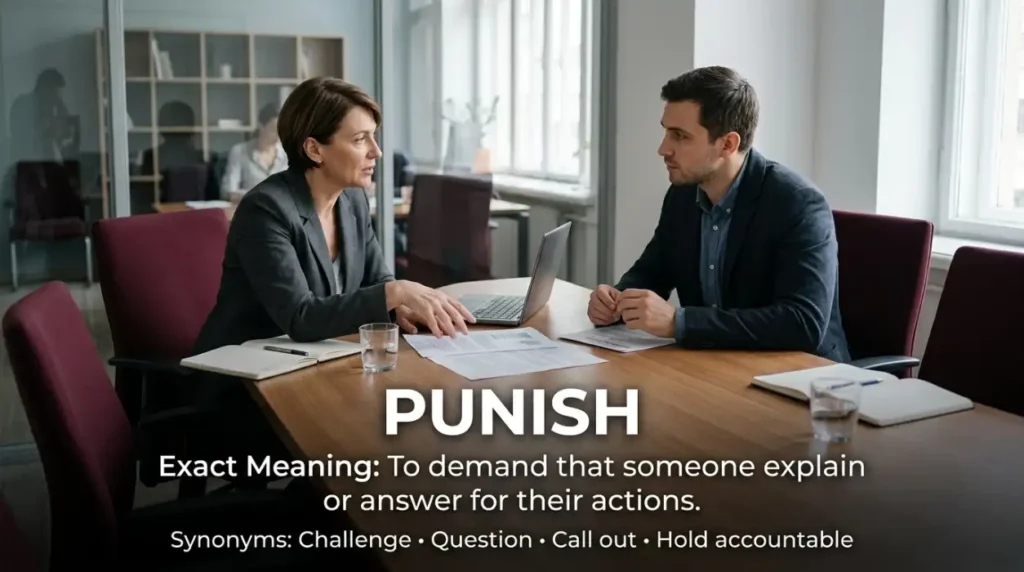
50. Call to account (Verb phrase) — US: /kɔːl tə əˈkaʊnt/ | UK: /kɔːl tə əˈkaʊnt/
Meaning: To demand that someone explain or answer for their actions.
Tone/Register: Formal, literary, institutional.
Examples:
- The inquiry called the officials to account for their decisions.
- Voters called the council to account for its handling of public funds.
Synonyms by Tone
Choosing a synonym based on tone helps you express the right level of seriousness. A word used in a legal document may sound too formal in a family conversation.
Positive or Constructive Tone
These words focus on learning, responsibility, and improvement rather than causing suffering.
- Discipline: Establishes boundaries and consequences.
- Correct: Focuses on improving behavior or fixing a mistake.
- Hold accountable: Emphasizes responsibility for one’s actions.
Neutral or Official Tone
These terms describe formal actions without automatically suggesting cruelty or personal anger.
- Penalize: Impose a penalty for a rule violation.
- Fine: Require payment for an offense.
- Sanction: Apply an official penalty.
- Suspend: Temporarily remove access or participation.
- Revoke: Withdraw a license, privilege, or permission.
- Restrict: Limit an activity or access.
Negative or Harsh Tone
These words suggest intense criticism, suffering, or unfair treatment.
- Torment: Cause severe distress.
- Torture: Inflict extreme suffering.
- Persecute: Repeatedly mistreat a person or group.
- Oppress: Exercise cruel or unjust control.
- Humiliate: Damage someone’s dignity.
- Harass: Repeatedly intimidate or mistreat someone.
Informal or Conversational Tone
These expressions often appear in everyday speech, stories, or discussions of personal conflict.
- Get back at: Seek personal retaliation.
- Take revenge on: Respond to a perceived wrong with retaliation.
- Shame: Make someone feel guilty or embarrassed.
- Call to account: Demand an explanation, although this expression is more formal than conversational.
Why tone matters: Punishing someone, correcting a mistake, and seeking revenge are different actions. The right word helps readers understand whether a response is official, constructive, emotional, or harmful.
“Punish” vs. Close Alternatives
| Word | Meaning difference | When to use it |
|---|---|---|
| Punish | Impose an unpleasant consequence for wrongdoing | General situations |
| Discipline | Correct behavior through rules and consequences | Parenting, schools, workplaces |
| Penalize | Apply a specific penalty for a violation | Sports, contracts, regulations |
| Reprimand | Express strong verbal disapproval | Workplace or school misconduct |
| Sanction | Impose an official penalty or restriction | Legal, political, organizational contexts |
| Retaliate | Respond to harm with a counteraction | Conflict, disputes, personal revenge |
For example, a referee penalizes a player for breaking a rule. A coach may reprimand the player for ignoring instructions. The league may sanction the player after reviewing the incident.
These words describe different actions within the same situation. They are related, but they are not interchangeable.
How a Synonym for Punish Changes by Context
Daily Conversation
In everyday speech, punish and discipline are common when discussing behavior and consequences. Fine is appropriate when someone must pay money for an offense.
Example: “My parents disciplined me for ignoring the house rules.”
Writing and Blogging
Bloggers and content writers can use penalize, reprimand, condemn, or hold accountable to explain rules, policies, and consequences.
Example: “The policy allows the organization to penalize repeated violations.”
Choose the verb that accurately describes the action. Avoid using dramatic words simply to make an article sound more powerful.
Professional and Academic English
Formal writing often uses sanction, censure, penalize, and revoke. These terms are especially useful when discussing official decisions, workplace conduct, or institutional rules.
Example: “The committee censured the official for failing to disclose a conflict of interest.”
In academic writing, explain whether a measure is intended to deter misconduct, correct behavior, or enforce a rule.
Creative and Informal Use
Stories may use avenge, retaliate, torment, or reproach to convey conflict and emotion. Each word creates a different impression.
Example: “The character wanted to avenge the betrayal, but later chose forgiveness.”
In casual conversations, get back at sounds natural when someone wants revenge. It should not be used to describe a fair, official penalty.
Common Mistakes Learners Make
Confusing Punishment With Correction
Correct focuses on fixing a mistake or improving behavior. Punish emphasizes the consequence imposed for wrongdoing.
Instead of saying, “The teacher punished the spelling error,” say, “The teacher corrected the spelling error.” Use punish when a consequence is imposed for misconduct.
Using “Revenge” as a Formal Penalty
Revenge is personal retaliation, not necessarily a fair or lawful consequence. A court may sentence an offender, but it does not ordinarily sentence someone to revenge.
Use penalize or sanction for formal consequences. Reserve avenge and retaliate for situations involving a response to perceived harm.
Confusing “Convict” With “Punish”
To convict someone is to find them guilty of a crime through a legal process. Punishment may follow, but the two verbs describe different stages.
For example, “The court convicted the defendant” does not specify the sentence imposed.
Using “Discipline” to Suggest Cruelty
Discipline does not automatically mean harsh treatment. It can refer to consistent rules, reasonable consequences, and guidance.
Choose abuse, torment, or persecute only when the intended meaning genuinely involves harmful treatment. These words carry much stronger negative meanings.
Overusing Formal Synonyms
Words such as censure, sanction, and admonish can make ordinary sentences sound stiff when simpler vocabulary would work better.
Use warn, correct, or reprimand when those words express the intended meaning more naturally.
Register Notes
- Formal: censure, sanction, reprimand, prosecute.
- Neutral: punish, penalize, discipline, restrict.
- Informal: get back at, take revenge on.
- Strongly negative: torment, torture, persecute, oppress.
In spoken English, people often prefer punish, fine, and warn. Formal writing may require more precise terms that identify the particular consequence.
For related vocabulary practice, explore other synonym guides on SynonymsCloud and compare how word choice changes across everyday, academic, and professional English.
Real-Life Examples Using Punish and Its Synonyms
School setting
A teacher reprimands a student for disrupting class and applies a reasonable consequence. The response addresses the behavior without humiliating the student.
Workplace
A manager formally reprimands an employee for violating a policy. A separate review determines whether further disciplinary action is appropriate.
Sports and media
A referee penalizes a player for an illegal tackle. The league may later suspend the player if the incident breaches its disciplinary rules.
Writing and storytelling
A novelist describes a character who seeks revenge after a betrayal. The choice of revenge rather than punishment makes the character’s personal motivation clearer.
Practice Exercise
Choose the best answer for each situation. The questions test meaning, tone, and real-life usage.
1. A referee gives a team a penalty for breaking a rule. Which verb fits best?
A. Penalize
B. Avenge
C. Humiliate
D. Transcribe
2. A manager expresses official disapproval of an employee’s misconduct. Which word is most suitable?
A. Reproduce
B. Reprimand
C. Retaliate
D. Confine
3. A city requires a driver to pay money for illegal parking. What does it do?
A. Censure
B. Revoke
C. Fine
D. Reproach
4. A school temporarily removes a student from classes after a serious violation. Which verb fits?
A. Condemn
B. Avenge
C. Disseminate
D. Suspend
5. Someone deliberately harms a person in return for an earlier insult. Which verb describes the response?
A. Retaliate
B. Correct
C. Discipline
D. Admonish
6. A committee officially expresses disapproval of a public official’s conduct. Which word fits best?
A. Torment
B. Censure
C. Evict
D. Dock
7. A court decides the legal penalty for a person convicted of a crime. Which verb is correct?
A. Harass
B. Reproach
C. Sentence
D. Shame
8. A person repeatedly mistreats a community because of its beliefs. Which verb best describes this behavior?
A. Fine
B. Correct
C. Revoke
D. Persecute
9. A parent establishes clear rules and reasonable consequences to improve a child’s behavior. Which word fits?
A. Discipline
B. Torture
C. Avenge
D. Condemn
10. A company officially takes away a person’s license or permission. Which verb is most appropriate?
A. Retaliate
B. Revoke
C. Humiliate
D. Reproach
Check answersTry again
Reflection Task:
Write one original sentence using penalize, discipline, reprimand, or hold accountable. Explain why your chosen word fits the situation better than punish.
Answer key:
1-A, 2-B, 3-C, 4-D, 5-A, 6-B, 7-C, 8-D, 9-A, 10-B.
Frequently Asked Questions
1. What is the best synonym for punish in a formal essay?
Penalize, sanction, reprimand, and censure are useful in formal writing, but each has a different meaning. Use penalize for imposing a penalty, sanction for an official consequence, reprimand for a serious warning, and censure for formal disapproval. Choose the word that describes the actual action rather than using a formal term simply to sound sophisticated.
2. What is a synonym for punish that means teaching someone a lesson?
Discipline is often the best choice when the purpose is to improve behavior through rules and consequences. Depending on the situation, correction may be more suitable when addressing a mistake. These words do not necessarily imply harsh treatment. Their meanings depend on the method used and the goal of the response.
3. What is the difference between punishment and discipline?
Punishment generally emphasizes a consequence for wrongdoing. Discipline can include consequences, but it also involves setting expectations, teaching responsibility, and helping someone improve. For example, a parent may discipline a child by explaining a rule and applying a fair consequence. The purpose and approach help distinguish constructive discipline from punishment focused mainly on penalties.
4. Which synonym for punish means to take away money?
Fine means to require someone to pay money as a penalty. Dock can mean deducting money from wages or another payment, depending on the circumstances and applicable rules. Penalize financially is a broader expression for imposing a financial disadvantage. These terms are not always interchangeable, so consider whether the money is a fine, deduction, or contractual penalty.
5. What word means punishing someone unfairly because of their beliefs?
Persecute is the most suitable word when someone repeatedly mistreats a person or group because of their beliefs, identity, or other characteristics. Oppress describes broader, unjust control that limits people’s freedom or rights. Both words have strong negative meanings and should be used when the situation involves serious mistreatment, rather than an ordinary or fair disciplinary consequence.
6. What is the difference between punish, penalize, and sanction?
Punish is the broadest of the three words. Penalize emphasizes imposing a penalty for breaking a rule, while sanction often refers to an official penalty imposed by an institution or authority. In sports, a referee may penalize a player. A governing body may sanction a club, while a parent may punish a child for breaking a household rule.
7. How can I use synonyms for punish without changing my sentence’s meaning?
First, identify the exact action someone receives: a monetary penalty; use fine. If authority imposes an official consequence, sanction may fit. If someone receives a formal verbal warning, choose reprimand. Read the sentence again after replacing the word to ensure the new verb preserves the original meaning, tone, and grammatical structure.
Conclusion
Learning a synonym for punish helps you describe consequences with greater accuracy. Words such as discipline, penalize, and reprimand express different responses to wrongdoing.
A strong vocabulary improves essays, blog posts, workplace writing, and everyday conversations. The right word helps you communicate clearly without sounding unnecessarily harsh or overly formal.
Practice these alternatives in emails, essays, and daily conversations. Notice how each word changes the tone, and choose the expression that best fits your meaning.
Keep exploring new vocabulary and create your own sentences with these synonyms. With regular practice, you can express ideas more confidently and become a more effective English communicator.
External Learning Sources
Use reputable dictionaries to check the meanings, pronunciation, and usage of punish and its alternatives.
Cambridge Dictionary Punish: definition and examples.
Merriam-Webster Punish: synonyms and related words.
These references can help you distinguish direct synonyms from related words that describe only one type of consequence.
“Penalize” is the most formal — it refers to official punishment under laws or rules, e.g., “The company was penalized for violating regulations.”
“Punish” is general (any penalty for wrongdoing); “penalize” specifically means imposing an official penalty, often a fine or handicap under rules.
“Castigate” (harsh criticism) or “chastise” are stronger, more formal choices for academic writing.

Jameel Hassan is the founder and lead writer at SynonymsCloud.com, a trusted online platform dedicated to English vocabulary and effective communication. He is passionate about helping students, writers, professionals, and lifelong learners discover the right words to express their ideas with clarity, precision, and confidence.
At SynonymsCloud.com, every article is thoroughly researched and carefully written to provide accurate, practical, and easy-to-understand guidance on synonyms, antonyms, word meanings, idioms, and vocabulary. With a strong commitment to quality, real-world usage, and clear explanations, the website helps readers expand their vocabulary, improve their writing, and communicate more effectively in both academic and professional settings.