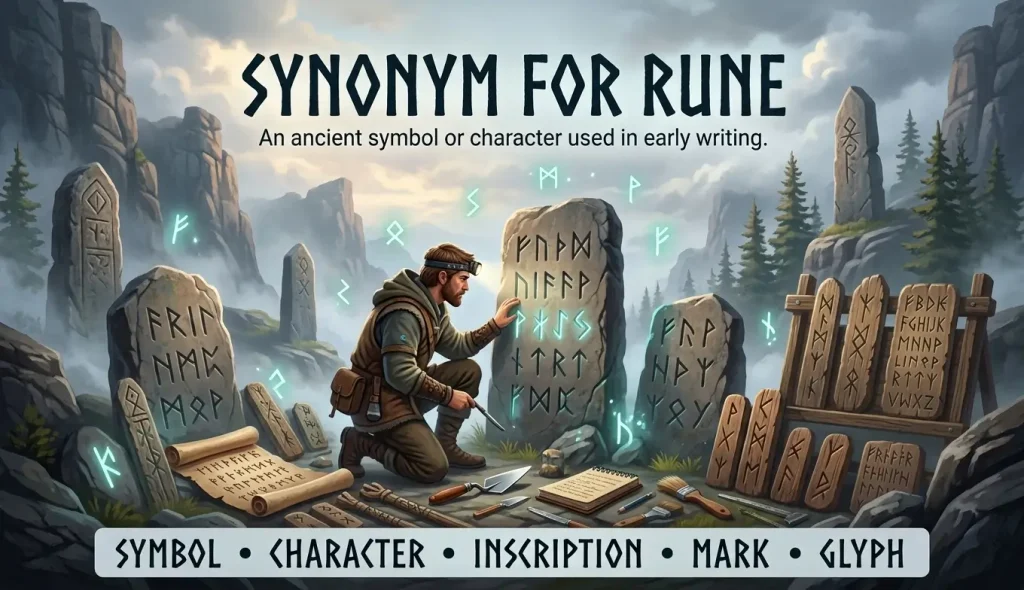
The best synonyms for rune include glyph, inscription, character, symbol, and cipher. Use glyph or character for visual or carved markings, inscription for historical monuments, and spell or cipher when exploring fantasy or mysterious contexts.
A synonym for rune is an essential search query when you want to describe ancient letters, mystical symbols, or secret characters without repeating the same historical noun across your text. Imagine writing a fantasy novel chapter or an archaeological blog post and using the same carving term in every single paragraph. Finding alternative words keeps your descriptive narrative fresh, engaging, and readable.
Writers search for a synonym for rune to add descriptive depth and precise context to historical reports, fantasy stories, and linguistic articles. Expanding your vocabulary helps you express encoded markings and mysterious inscriptions with absolute clarity.
This specific concept appears constantly in historical textbooks, fantasy fiction, archaeological journals, and mythic blogs. Knowing alternative terms keeps your writing engaging for modern readers.
Students, bloggers, content writers, and daily English users find this vocabulary exploration very useful. Precise word choices prevent writing from sounding repetitive. Using a synonym for rune ensures your articles truly shine.
Core Meaning: What Does “Rune” Really Mean?
Rune is a noun that means a letter of an ancient Germanic alphabet, traditionally carved on stone or wood and associated with magic or mystery. It denotes an inscribed symbol carrying hidden meaning.
Connotative Meaning
- Positive tone: Represents ancient wisdom, mythic heritage, poetic mystery, and artistic craftsmanship.
- Negative tone: Implies dark curses, obscure riddles, confusing symbols, or superstitious warnings.
- Neutral tone: Used in academic descriptions of historical Germanic epigraphy and alphabetic scripts. (Connotation refers to the emotional and cultural associations attached to a word beyond its literal dictionary definition.)
Etymology
- Source Language: Proto-Germanic rūnō (secret, mystery, or whispered consultation).
- Old English (450–1100): Used as rūn to denote a secret, mystery, or carved letter possessing esoteric power.
- Middle English (1100–1500): Shifted toward historical references of ancient Germanic alphabetic scripts found on monuments.
- Modern English (1500–Present): Standardized into the noun rune for historical, archaeological, and fantasy literary contexts.
Pronunciation & Syllables
- US: /ruːn/
- UK: /ruːn/
- Syllables: rune (1 syllable)
- Affixation Pattern: Monosyllabic root noun.
- Root: rune
- Prefix: None
- Suffix: None
Synonyms List
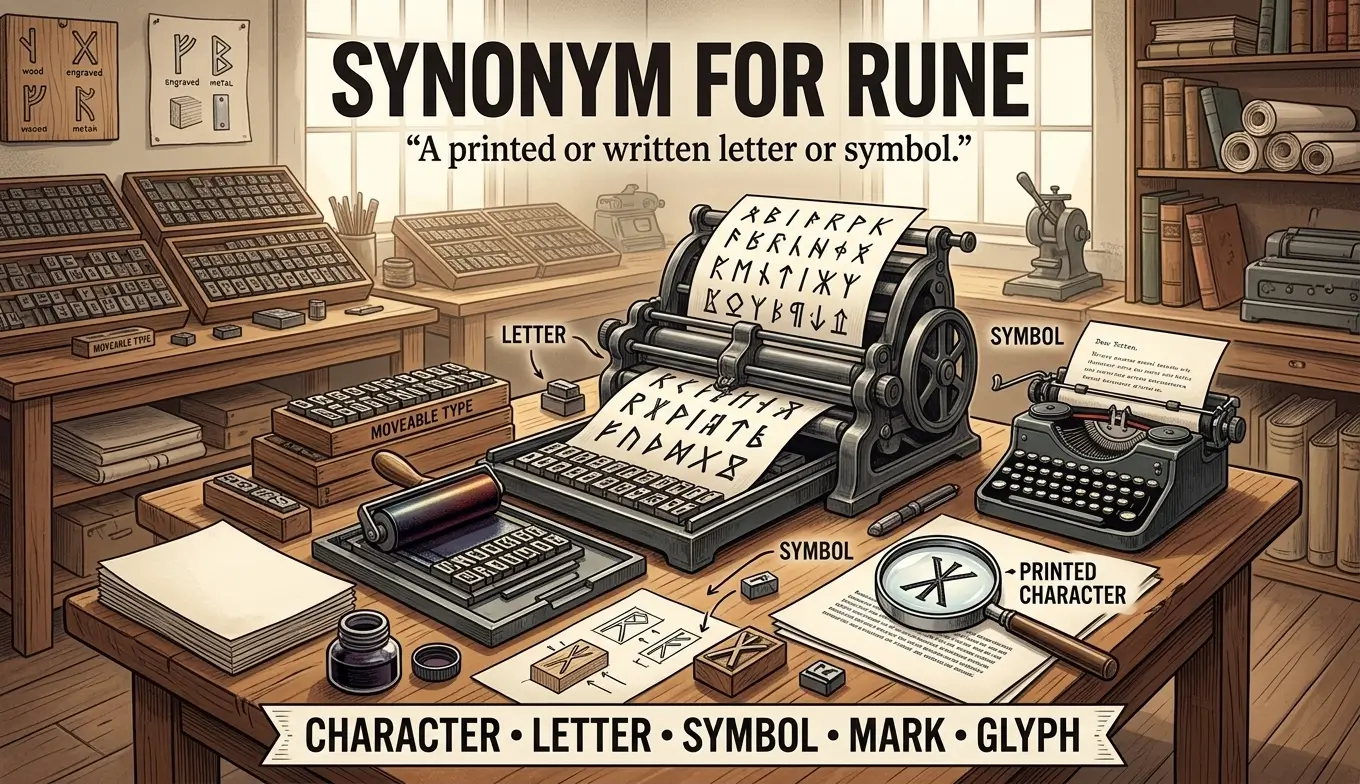
Character (Noun) — US: /ˈkærɪktər/ | UK: /ˈkarɪktə/
- Meaning: A printed or written letter or symbol.
- Tone/Register: Standard / Common
- Example: The ancient manuscript contained faded ink characters.
- Example: She typed special characters into her digital document.
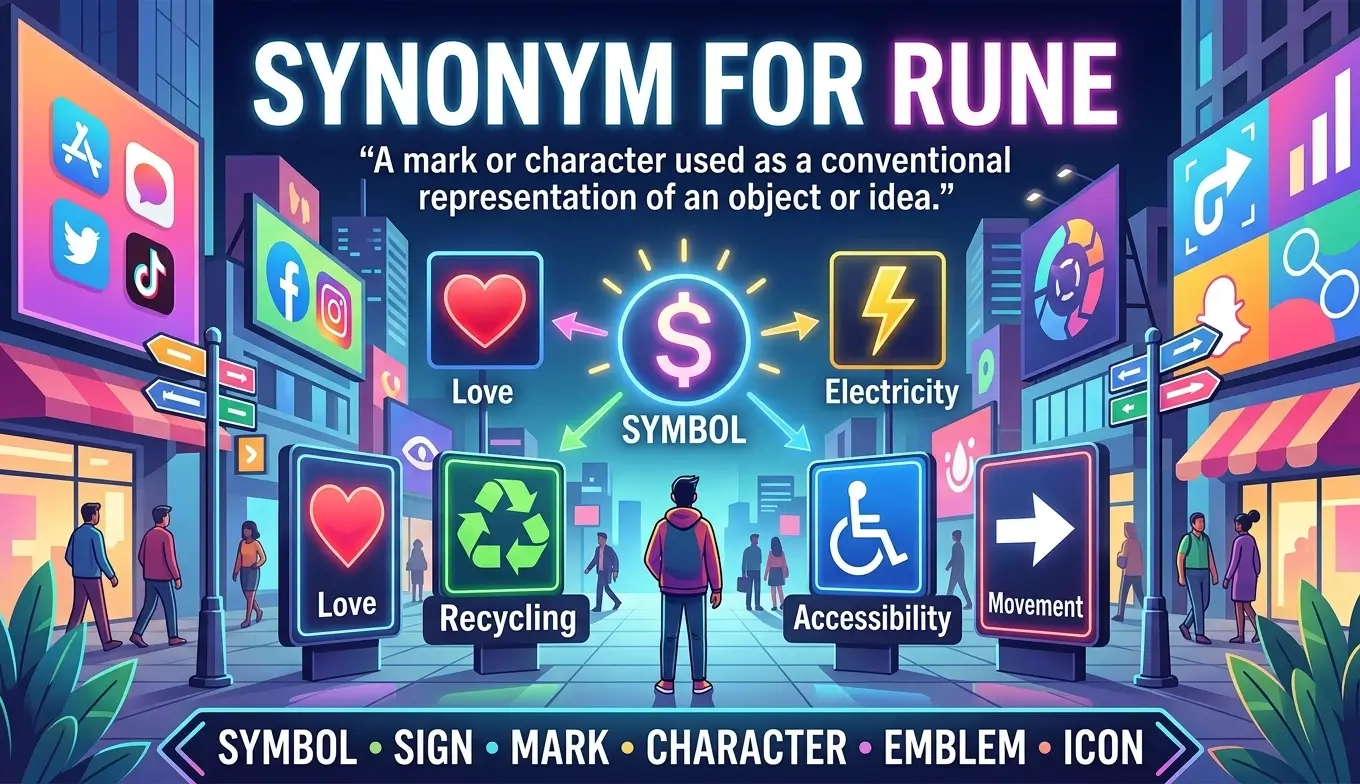
Symbol (Noun) — US: /ˈsɪmbəl/ | UK: /ˈsɪmbəl/
- Meaning: A mark or character used as a conventional representation of an object or idea.
- Tone/Register: Standard / Formal
- Example: The dove is a universal symbol of peace.
- Example: Mathematical symbols appeared on the classroom chalkboard.
Letter (Noun) — US: /ˈlɛtər/ | UK: /ˈlɛtə/
- Meaning: A written character representing a speech sound.
- Tone/Register: Standard / Common
- Example: He wrote each letter of the alphabet carefully.
- Example: The first letter of her name is glowing red.
Glyph (Noun) — US: /ɡlɪf/ | UK: /ɡlɪf/
- Meaning: A hieroglyphic character or inscribed mark.
- Tone/Register: Academic / Technical
- Example: Archaeologists deciphered the stone glyphs in the temple.
- Example: Digital screens display complex typographic glyphs.
Sign (Noun) — US: /saɪn/ | UK: /sʌɪn/
- Meaning: A symbol or mark with an intended meaning.
- Tone/Register: Standard / Common
- Example: A wooden sign pointed toward the forest trail.
- Example: She noticed a strange sign carved into the bark.
Mark (Noun) — US: /mɑːrk/ | UK: /mɑːk/
- Meaning: A small spot, scar, or written symbol on a surface.
- Tone/Register: Standard / Common
- Example: He left a chalk mark on the workshop wall.
- Example: Faint pencil marks outlined the drawing sketch.
Inscription (Noun) — US: /ɪnˈskrɪpʃən/ | UK: /ɪnˈskrɪpʃ(ə)n/
- Meaning: Words inscribed on a monument, stone, or book.
- Tone/Register: Formal / Historical
- Example: Historians read the Latin inscription on the tomb.
- Example: The ring bore a romantic wedding inscription.
Engraving (Noun) — US: /ɪnˈɡreɪvɪŋ/ | UK: /ɪnˈɡreɪvɪŋ/
- Meaning: A print made from an engraved plate or the carved design itself.
- Tone/Register: Artistic / Formal
- Example: The museum displayed silver plate engravings from history.
- Example: Detailed wood engravings decorated the cabin walls.
Carving (Noun) — US: /ˈkɑːrvɪŋ/ | UK: /ˈkɑːvɪŋ/
- Meaning: An object or design produced by carving material.
- Tone/Register: Artistic / Standard
- Example: Artisans sold wooden animal carvings at the market.
- Example: The temple pillars featured intricate stone carvings.
Etching (Noun) — US: /ˈɛtʃɪŋ/ | UK: /ˈɛtʃɪŋ/
- Meaning: A print produced by the process of etching.
- Tone/Register: Artistic / Formal
- Example: She framed a delicate copper etching of the harbor.
- Example: Fine glass etchings adorned the front doors.
Cipher (Noun) — US: /ˈsaɪfər/ | UK: /sʌɪfə/
- Meaning: A secret or disguised way of writing; a code.
- Tone/Register: Literary / Formal
- Example: Spies used a complex numerical cipher to communicate.
- Example: Scholars tried to solve the historical cipher.
Code (Noun) — US: /koʊd/ | UK: /kəʊd/
- Meaning: A system of words, letters, or figures substituted for other words.
- Tone/Register: Technical / Standard
- Example: Programmers wrote computer code for the new software.
- Example: Agents transmitted secret messages in code.
Secret (Noun) — US: /ˈsiːkrɪt/ | UK: /siːkrɪt/
- Meaning: Something kept secret or hidden from others.
- Tone/Register: Standard / Common
- Example: They shared a childhood secret behind the barn.
- Example: The recipe remained a family secret for years.
Mystery (Noun) — US: /ˈmɪstəri/ | UK: /ˈmɪstəri/
- Meaning: Something that is difficult or impossible to understand or explain.
- Tone/Register: Literary / Standard
- Example: The origin of the stone circles remains a mystery.
- Example: Detectives solved the murder mystery quickly.
Enigma (Noun) — US: /ɪˈnɪɡmə/ | UK: /ɪˈnɪɡmə/
- Meaning: A person or thing that is mysterious or puzzling.
- Tone/Register: Formal / Literary
- Example: Her sudden departure remained an unsolved enigma.
- Example: The ancient artifact was an enigma to scientists.
Riddle (Noun) — US: /ˈrɪdəl/ | UK: /ˈrɪdəl/
- Meaning: A statement or question having a double meaning, posed as a puzzle.
- Tone/Register: Literary / Common
- Example: The wise wizard asked travellers a difficult riddle.
- Example: Life often presents complex riddles to solve.
Spell (Noun) — US: /spɛl/ | UK: /spɛl/
- Meaning: A word or phrase supposed to have magic power.
- Tone/Register: Fantasy / Mythic
- Example: The witch cast a protective spell over the forest.
- Example: Wizards chanted ancient spells during the ritual.
Incantation (Noun) — US: /ˌɪnkænˈteɪʃən/ | UK: /ˌɪnkantˈeɪʃ(ə)n/
- Meaning: A series of words said as a magic spell or charm.
- Tone/Register: Formal / Literary
- Example: Monks chanted sacred incantation verses at dawn.
- Example: The sorcerer whispered a quiet incantation.
Charm (Noun) — US: /tʃɑːrm/ | UK: /tʃɑːm/
- Meaning: An object worn or kept intended to bring good luck or protection.
- Tone/Register: Standard / Common
- Example: She wore a silver horseshoe charm on her bracelet.
- Example: Sailors carried good luck charms on voyages.
Amulet (Noun) — US: /ˈæmjəlɪt/ | UK: /ˈamjʊlɪt/
- Meaning: An ornament or small piece of jewelry thought to give protection against evil.
- Tone/Register: Historical / Formal
- Example: Archaeologists found an Egyptian gold amulet in the tomb.
- Example: The traveler wore a protective jade amulet.
Talisman (Noun) — US: /ˈtælɪzmən/ | UK: /talɪzmən/
- Meaning: An object thought to have magic powers to bring good luck.
- Tone/Register: Literary / Formal
- Example: The hero carried a magical talisman into battle.
- Example: She treated her grandmother’s ring as a talisman.
Sigil (Noun) — US: /ˈsɪdʒɪl/ | UK: /ˈsɪdʒɪl/
- Meaning: An inscribed or painted symbol considered to have magical power.
- Tone/Register: Fantasy / Occult
- Example: Fantasy artists drew glowing magical sigils on the floor.
- Example: The secret society painted a protective sigil on doors.
Totem (Noun) — US: /ˈtoʊtəm/ | UK: /ˈtəʊtəm/
- Meaning: A natural object or animal believed by a particular society to have spiritual meaning.
- Tone/Register: Anthropological / Formal
- Example: Crews carved wooden animal totems outside longhouses.
- Example: The hawk served as a spiritual totem for the clan.
Relic (Noun) — US: /ˈrɛlɪk/ | UK: /ˈrɛlɪk/
- Meaning: An object surviving from an earlier time, especially one of historical interest.
- Tone/Register: Historical / Formal
- Example: Monks preserved holy relics in the stone cathedral.
- Example: Excavations uncovered ancient metal relics underground.
Artifact (Noun) — US: /ˈɑːrtɪfækt/ | UK: /ˈɑːtɪfakt/
- Meaning: An object made by a human being, typically an item of cultural or historical interest.
- Tone/Register: Academic / Museum
- Example: Museum curators displayed ancient Greek pottery artifacts.
- Example: Students studied prehistoric stone artifacts in class.
Antiquity (Noun) — US: /ænˈtɪkwɪti/ | UK: /anˈtɪkwɪti/
- Meaning: The ancient past, especially the period before the Middle Ages.
- Tone/Register: Academic / Historical
- Example: Historians studied classic texts from classical antiquity.
- Example: Statues from remote antiquity filled the gallery.
Monument (Noun) — US: /ˈmɑːnjumənt/ | UK: /ˈmɒnjʊmənt/
- Meaning: A statue, building, or other structure erected to commemorate a famous person or event.
- Tone/Register: Formal / Historical
- Example: Tourists visited the stone war memorial monument.
- Example: Ancient builders erected monolith monuments across fields.
Memorial (Noun) — US: /məˈmɔːriəl/ | UK: /məˈmɔːrɪəl/
- Meaning: An object established to remind people of a person or event.
- Tone/Register: Formal / Standard
- Example: Citizens gathered at the veterans memorial park.
- Example: A bronze plaque served as a memorial to founders.
Tablet (Noun) — US: /ˈtæblɪt/ | UK: /ˈtablɪt/
- Meaning: A flat slab of stone, clay, or wood used for an inscription.
- Tone/Register: Historical / Formal
- Example: Archaeologists translated ancient clay tablets from Sumer.
- Example: The commandment text was carved on stone tablets.
Stele (Noun) — US: /ˈstiːli/ or /ˈstiːl/ | UK: /ˈstiːli/
- Meaning: An upright stone or slab with an inscription or sculpture.
- Tone/Register: Archaeological / Formal
- Example: The museum exhibited a carved limestone funerary stele.
- Example: Scholars analyzed royal decrees carved on steles.
Monolith (Noun) — US: /ˈmɑːnəlɪθ/ | UK: /ˈmɒnəlɪθ/
- Meaning: A large single upright block of stone.
- Tone/Register: Geological / Historical
- Example: Prehistoric societies erected tall stone monoliths in circles.
- Example: A dark monolith stood alone on the grassy plain.
Pillar (Noun) — US: /ˈpɪlər/ | UK: /ˈpɪlə/
- Meaning: A heavy vertical column supporting a structure.
- Tone/Register: Architectural / Standard
- Example: Marble pillars held up the ancient temple roof.
- Example: He leaned against a stone porch pillar.
Post (Noun) — US: /poʊst/ | UK: /pəʊst/
- Meaning: A stout piece of timber or metal set upright in the ground.
- Tone/Register: Standard / Common
- Example: Workers secured wire fencing to wooden fence posts.
- Example: A heavy iron post blocked vehicle entry.
Column (Noun) — US: /ˈkɑːləm/ | UK: /ˈkɒləm/
- Meaning: An upright pillar supporting a structure or standing alone.
- Tone/Register: Architectural / Formal
- Example: Classical buildings feature ornate stone columns.
- Example: Smoke rose in a straight column into the sky.
Obelisk (Noun) — US: /ˈɑːbəlɪsk/ | UK: /ˈɒbəlɪsk/
- Meaning: A stone pillar, typically having a square or rectangular cross-section and a pyramidal top.
- Tone/Register: Architectural / Historical
- Example: A tall granite obelisk stood in the city square.
- Example: Ancient Egyptians erected sun obelisks near temples.
Hieroglyph (Noun) — US: /ˈhaɪərəˌɡlɪf/ | UK: /ˈhʌɪərəɡlɪf/
- Meaning: A stylized picture of an object representing a word, syllable, or sound.
- Tone/Register: Historical / Academic
- Example: Tourists admired painted hieroglyphs on tomb walls.
- Example: Egyptologists translated complex hieroglyph texts.
Ideogram (Noun) — US: /ˈɪdiəˌɡræm/ | UK: /ˈɪdɪəɡram/
- Meaning: A written character symbolizing the idea of a thing without indicating sounds.
- Tone/Register: Linguistic / Formal
- Example: Ancient scripts relied heavily on visual ideograms.
- Example: Traffic signs use universal ideograms for clarity.
Logogram (Noun) — US: /ˈlɔːɡəˌɡræm/ | UK: /ˈlɒɡəɡram/
- Meaning: A sign or character representing a word or phrase.
- Tone/Register: Linguistic / Academic
- Example: Chinese characters function partly as logograms.
- Example: Scribes wrote early commercial records using logograms.
Phonogram (Noun) — US: /ˈfoʊnəˌɡræm/ | UK: /ˈfəʊnəɡram/
- Meaning: A symbol representing a vocal sound.
- Tone/Register: Linguistic / Technical
- Example: Linguists studied phonetic phonograms in ancient scripts.
- Example: Alphabets evolved from early phonogram symbols.
Script (Noun) — US: /skrɪpt/ | UK: /skrɪpt/
- Meaning: Handwriting or written characters.
- Tone/Register: Standard / Formal
- Example: The old diary was written in cursive script.
- Example: Scholars deciphered an unknown ancient script.
Alphabet (Noun) — US: /ˈælfəˌbɛt/ | UK: /ˈalfəbɛt/
- Meaning: A set of letters or symbols in a fixed order.
- Tone/Register: Standard / Educational
- Example: Children learned the English alphabet song.
- Example: The Greek alphabet inspired modern writing systems.
Writing (Noun) — US: /ˈraɪtɪŋ/ | UK: /ˈrʌɪtɪŋ/
- Meaning: Activity or occupation of writing; written works.
- Tone/Register: Standard / Common
- Example: She pursued a professional career in creative writing.
- Example: Ancient cave writing predates modern history.
Text (Noun) — US: /tɛkst/ | UK: /tɛkst/
- Meaning: A book or other written or printed work.
- Tone/Register: Standard / Academic
- Example: Students analyzed the assigned literary text in class.
- Example: He read a historical text about northern Europe.
Document (Noun) — US: /ˈdɑːkjumənt/ | UK: /ˈdɒkjʊm(ə)nt/
- Meaning: A piece of written, printed, or electronic matter that provides information.
- Tone/Register: Professional / Formal
- Example: Lawyers reviewed the signed business contract document.
- Example: Archives preserved the original independence document.
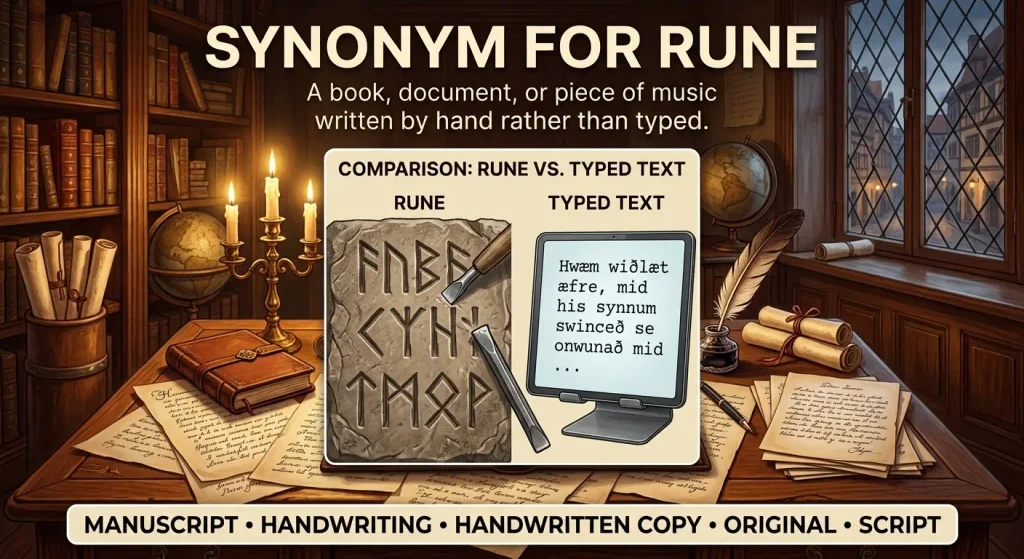
Manuscript (Noun) — US: /ˈmænyuˌskrɪpt/ | UK: /ˈmanyʊskrɪpt/
- Meaning: A book, document, or piece of music written by hand rather than typed.
- Tone/Register: Academic / Literary
- Example: Authors submitted book manuscripts to publishers.
- Example: Monks copied medieval illuminated manuscripts by hand.
Synonyms by Tone
- Positive / Mythic: Spell, Charm, Talisman, Incantation, Amulet.
- Neutral / Historical: Glyph, Inscription, Character, Script, Monument.
- Negative / Obscure: Riddle, Enigma, Cipher, Secret, Mystery.
Mini Comparison
Rune vs. Glyph vs. Inscription
- Rune: Refers specifically to letters of an ancient Germanic alphabet tied to mythic or mystical traditions.
- Glyph: A broader term for any carved, engraved, or painted symbol or hieroglyphic mark across ancient cultures.
- Inscription: Denotes any written words physically carved or etched onto solid monuments, stones, or metal objects.
Additional Rune, Runic, and Glyph Terms
Some searches related to rune focus on the plural form runes, the adjective runic, the related word glyph, and how the word is spelled in English. These terms are closely connected, but they do not all have exactly the same meaning.
What Does “Runes” Mean?
Runes is the plural form of rune. It refers to two or more characters from an ancient Germanic writing system. Historically, runes were used to write languages spoken by Germanic peoples and were commonly carved into materials such as stone, wood, bone, or metal.
For example:
- The archaeologists discovered several runes carved into the stone.
- The manuscript contained several ancient runes.
- Scholars studied the meaning of the runes found on the artifact.
In simple English, runes mean ancient Germanic letters or characters.
What Is a Synonym for “Runic”?
Runic is an adjective meaning related to runes or the ancient Germanic writing systems that used them. Because it is an adjective rather than a direct noun synonym for rune, the best alternative depends on the sentence.
Possible alternatives include:
- Runic: related to runes
- Rune-based: based on or using runes
- Germanic related to the Germanic peoples or languages, when the context supports it
- Ancient Germanic describing historical Germanic writing or culture
- Inscribed is appropriate when emphasizing writing carved onto a surface
For example:
Runic inscription → ancient Germanic inscription
Runic writing → rune-based writing
However, these alternatives are not interchangeable in every context. Runic is the most precise choice when you specifically mean something connected with runes.
What Are Synonyms for “Glyph”?
A glyph is a visual representation or written character. It is broader than rune, because a glyph can belong to many different writing systems and does not necessarily have a Germanic origin.
Depending on the context, alternatives for glyph include:
- Character: a written or printed symbol
- Symbol a mark representing an idea, object, or meaning
- Sign a mark used to communicate information
- Inscription writing carved or engraved onto a surface
- Mark a visible symbol or identifying sign
- Ideogram a written symbol representing an idea
- Logogram a written character representing a word or meaningful unit
- Hieroglyph a stylized pictorial character, especially in ancient Egyptian writing
For example:
The archaeologist examined the ancient glyph.
This could become:
The archaeologist examined the ancient character.
or:
The archaeologist examined the ancient symbol.
The best choice depends on whether you want to emphasize the written character, its meaning, its visual form, or its historical writing system.
How Do You Spell “Rune”?
The correct spelling is rune:
R-U-N-E
It has four letters and one syllable. It is pronounced /ruːn/, rhyming with words such as moon, soon, and tune.
The plural form is:
runes
The adjective is:
runic
Examples:
- Singular: rune
- Plural: runes
- Adjective: runic
A common mistake is adding an unnecessary extra vowel or changing the final e. The standard English spelling is simply rune.
“Runa” or “Runas” Spanish Meaning
Spanish searches such as runa sinonimo, runas sinonimo, and sinonimo de runa refer to the Spanish word runa, which corresponds to rune in English.
The Spanish plural is runas.
Depending on the sentence, Spanish alternatives may include words related to:
- símbolo symbol
- signo sign
- carácter character
- inscripción inscription
For English writing, however, the standard word is rune, with runes as its plural form.
“Rune Synonyme” French Meaning
The French search rune synonyme means “synonym for rune” or “rune synonym.” In French, rune is also used for a character belonging to ancient Germanic writing systems.
Depending on context, related French terms can include words corresponding to:
- symbole symbol
- caractère character
- signe sign
- inscription inscription
For English content, use rune, glyph, character, symbol, or inscription according to the exact meaning you want to express.
Rune, Runes, Runic, and Glyph: Quick Difference
| Word | Part of Speech | Simple Meaning |
|---|---|---|
| Rune | Noun | One ancient Germanic letter or character |
| Runes | Noun | Two or more ancient Germanic letters or characters |
| Runic | Adjective | Related to runes |
| Glyph | Noun | A visual or written character or symbol |
| Inscription | Noun | Words or characters carved or engraved on a surface |
| Symbol | Noun | A mark representing an idea, object, or meaning |
The key distinction is that rune identifies a specific type of historical character, while glyph is a broader term. Runic describes something related to runes, and inscription emphasizes writing carved or engraved onto a physical surface.
Context-Based Usage
- Daily Conversation: Use everyday words like symbol or character when discussing simple writing marks with friends.
- Writing or Blogging: Elevate historical or fantasy stories by replacing basic terms with glyph, inscription, or cipher.
- Professional or Academic Tone: Opt for formal vocabulary such as stele, logogram, or manuscript in scholarly research.
- Creative or Informal Use: Lean into atmospheric terms like spell, talisman, or enigma to build mysterious narrative tension.
Common Mistakes & Native Usage
- Confusing Rune with Hieroglyph: A rune specifically belongs to ancient Germanic alphabets, whereas hieroglyphs are Egyptian pictorial symbols.
- Overusing Mythic Terms: Avoid using magical words like spell when writing objective archaeological research papers about stone markers.
- Register Mismatch: Do not use casual slang when discussing formal historical manuscripts or museum artifacts.
Real-Life Mini Scenarios
- Workplace: The museum curator cataloged newly discovered archaeological inscriptions found on stone blocks.
- Social Situations: Fantasy book club members discussed the magical sigils featured in their latest reading.
- Media / Pop Culture: Video game developers designed glowing ancient glyphs for the fantasy temple floor.
- Writing or Storytelling: The novelist described a mysterious cipher hidden inside the medieval manuscript.
Conclusion
Expanding your vocabulary with precise alternatives transforms how you write historical essays, fantasy fiction, and archaeological reports. Exploring different words helps you convey exact nuances of ancient letters and mystical symbols across various publishing formats.
Integrating these terms into your daily messages makes your communication engaging and memorable. Thoughtful word choices elevate your articles far above standard, repetitive phrasing. Take time to practice these dynamic words in your emails, essays, and everyday conversations today.
Embracing a richer vocabulary unlocks new levels of confidence and clarity in your writing journey, ensuring your synonym for rune searches always lead to exceptional creative results.
Practice Exercise
- Which synonym best describes a letter of an ancient Germanic alphabet traditionally carved on stone?
- A) Rune
- B) Cloud
- C) Fog
- D) Noise
- What is the best technical term for an inscribed hieroglyphic mark or symbol?
- A) Glyph
- B) Brick
- C) Stone
- D) Wall
- Which noun denotes words inscribed on a monument, stone, or metal object?
- A) Inscription
- B) Tree
- C) River
- D) Mountain
- If you want a formal word to describe a secret or disguised way of writing in code, which option works best?
- A) Cipher
- B) Spoon
- C) Fork
- D) Plate
- Which word is most appropriate for describing a word or phrase supposed to have magical power?
- A) Spell
- B) Chair
- C) Table
- D) Lamp
- What term describes an ornament or small piece of jewelry thought to give magical protection?
- A) Amulet
- B) Bucket
- C) Shovel
- D) Hammer
- Which word captures an upright stone slab with an inscription or sculpture?
- A) Stele
- B) Puddle
- C) Leaf
- D) Cloud
- How would a historian describe a flat slab of stone or clay used for ancient writing?
- A) Tablet
- B) Shoe
- C) Hat
- D) Glove
- Which term describes a stylized picture representing a word or sound in ancient writing?
- A) Hieroglyph
- B) Window
- C) Door
- D) Floor
- What is a suitable academic term for a book or document written by hand?
- A) Manuscript
- B) Bicycle
- C) Engine
- D) Motor
Reflection Task:
Write one original sentence using the synonym inscription to describe writing carved on a monument.
Answer Key:
1: A | 2: A | 3: A | 4: A | 5: A | 6: A | 7: A | 8: A | 9: A | 10: A
FAQs
Why do fantasy authors search for alternatives to rune?
Fantasy authors search for alternatives because repeating terms like rune makes magical worldbuilding and narrative descriptions sound monotonous. Swapping basic terms for precise semantic variants improves overall literary style.
Is there a difference between rune and glyph in modern English?
Yes, a rune specifically refers to historic Germanic characters, whereas glyph is a general term for any carved symbol across various ancient global cultures.
How does understanding word connotation improve creative fiction writing?
Understanding connotation helps authors select nouns that reflect emotional depth accurately, distinguishing between dark magical spells and objective historical inscriptions.
Can I use casual words like secret in formal archaeological reports?
Informal expressions like secret sound too casual for scholarly or scientific texts. Professional writing prefers objective terms like cipher, inscription, or glyph.
What is the quickest way to remember new vocabulary for writing?
The most effective retention strategy is writing original personal sentences mirroring real-life historical or fantasy scenarios, helping you master tone, context, and register with ease.

Jameel Hassan is the founder and lead writer at SynonymsCloud.com, a trusted online platform dedicated to English vocabulary and effective communication. He is passionate about helping students, writers, professionals, and lifelong learners discover the right words to express their ideas with clarity, precision, and confidence.
At SynonymsCloud.com, every article is thoroughly researched and carefully written to provide accurate, practical, and easy-to-understand guidance on synonyms, antonyms, word meanings, idioms, and vocabulary. With a strong commitment to quality, real-world usage, and clear explanations, the website helps readers expand their vocabulary, improve their writing, and communicate more effectively in both academic and professional settings.