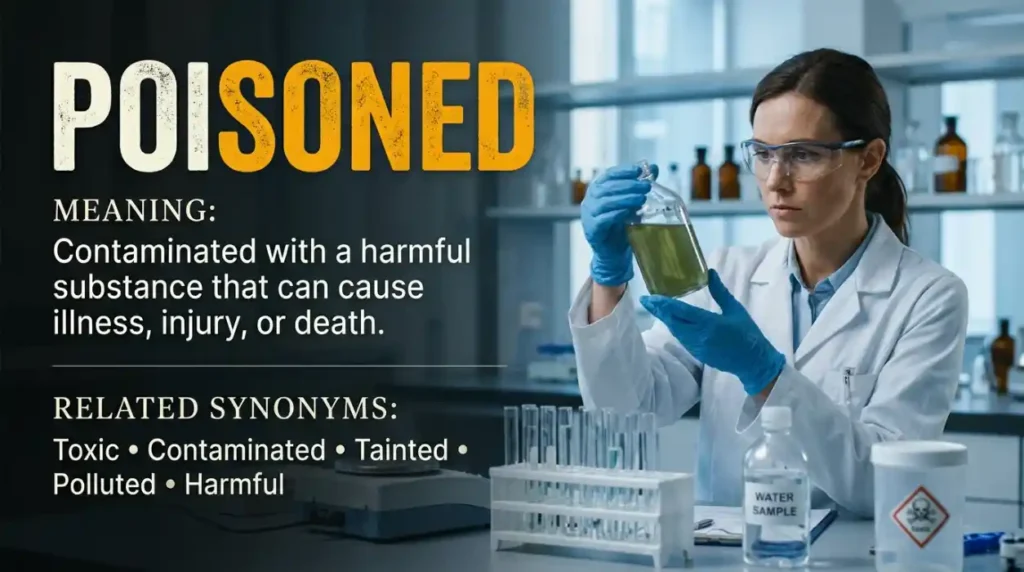
A synonym for poisoned is a word or phrase that describes something containing poison, affected by a harmful substance, or made dangerous through contamination. Common alternatives include toxic, contaminated, tainted, polluted, and poisonous. The best choice depends on the situation and the type of harm involved.
Imagine discovering that a bottle of drinking water contains a harmful chemical. You could describe it as poisoned, contaminated, or toxic. Although these words are related, each expresses a slightly different level or type of danger.
The word poisoned is commonly used when discussing unsafe food, chemicals, medicines, animals, and environmental pollution. It can also describe relationships, thoughts, or situations affected by negativity and harmful influences.
Learning a synonym for poisoned helps you explain dangerous substances and harmful conditions more accurately. Words like tainted, contaminated, toxic, and polluted can make your descriptions clearer and more specific.
Whether you are writing an essay, creating blog content, reporting an incident, or improving everyday English, finding the right synonym for poisoned can strengthen your vocabulary and make your communication more effective.
What Does “Poisoned” Really Mean?
Poisoned means affected, harmed, or made unsafe by a poisonous substance. Describes a person, animal, food, drink, or environment exposed to something that can cause injury, illness, or death.
It is the past participle and past-tense form of the verb poison. It can also function as an adjective.
For example:
- The dog was poisoned after eating the chemical.
- The investigators found poisoned water in the storage tank.
- Their friendship was poisoned by jealousy.
In the first two examples, the word describes physical exposure to a harmful substance. In the final example, it has a figurative meaning. It describes something damaged by negative emotions.
Native English speakers understand the exact meaning through context. In medical and safety discussions, it usually refers to exposure to a harmful substance. In emotional or creative writing, it can describe corruption, hostility, or damage.
Connotative Meaning
Connotation means the emotional feeling or association a word creates beyond its basic dictionary definition.
- Positive tone: Poisoned does not normally have a positive meaning. However, a sentence may describe someone successfully identifying or removing a poison.
- Negative tone: It strongly suggests danger, illness, contamination, damage, or corruption.
- Neutral tone: In scientific reports, the word can be used objectively to describe exposure to a toxic substance.
Etymology of Poisoned
The word poison entered English through Old French poison or poisun. It came from Latin potio, meaning a drink or potion, which is related to potare, meaning “to drink.”
Over time, the word developed a harmful meaning because certain drinks and mixtures could cause illness or death.
Old English (450–1100)
The modern word poison was not an established Old English term. English speakers used other expressions to describe harmful substances, venom, and deadly mixtures.
Middle English (1100–1500)
The word entered Middle English through Anglo-French forms such as poisun. It gradually became associated with substances that could cause injury or death when swallowed or otherwise introduced into the body.
Modern English (1500–Present)
The word developed into the familiar noun and verb poison. The form poisoned became the regular past-tense and past-participle form. Today, it also has figurative uses, such as describing poisoned relationships or poisoned public debate.
Pronunciation (US & UK – IPA)
- US: /ˈpɔɪ.zənd/
- UK: /ˈpɔɪ.zənd/
Syllables
poi-soned: 2 syllables
Affixation Pattern of Poisoned
- Root: poison
- Prefix: None
- Suffix: -ed
The suffix -ed forms the past tense and past participle of the verb poison. It can also help form the adjective poisoned, describing something affected by poison.
Synonyms List
The following list includes direct alternatives and context-specific expressions. Not every word can replace poisoned in every sentence. Always consider whether you are describing a poisonous substance, actual exposure, contamination, or figurative damage.
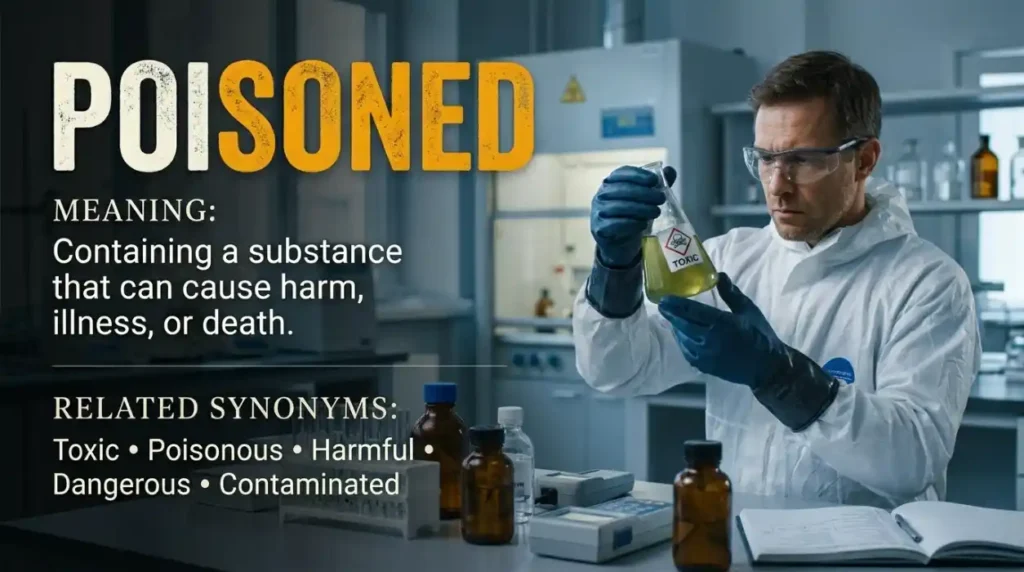
1. Toxic (Adjective) — US: /ˈtɑːk.sɪk/ | UK: /ˈtɒk.sɪk/
Meaning: Containing a substance that can cause harm, illness, or death.
Tone/Register: Neutral, scientific, formal.
Examples:
- The factory released toxic chemicals into the river.
- Keep toxic materials away from children.
2. Contaminated (Adjective) — US: /kənˈtæm.əˌneɪ.tɪd/ | UK: /kənˈtæm.ɪ.neɪ.tɪd/
Meaning: Made unsafe by unwanted or harmful substances.
Tone/Register: Formal, scientific, everyday.
Examples:
- The laboratory discovered contaminated drinking water.
- Several food products were contaminated during storage.
3. Tainted (Adjective) — US: /ˈteɪn.tɪd/ | UK: /ˈteɪn.tɪd/
Meaning: Spoiled or damaged by something harmful or undesirable.
Tone/Register: Neutral, formal, figurative.
Examples:
- The company recalled the tainted food.
- Their reputation was tainted by the scandal.
4. Polluted (Adjective) — US: /pəˈluː.tɪd/ | UK: /pəˈluː.tɪd/
Meaning: Made dirty or harmful through environmental contamination.
Tone/Register: Neutral, environmental, academic.
Examples:
- The polluted lake was unsafe for swimming.
- Residents complained about polluted air near the factory.
5. Poisonous (Adjective) — US: /ˈpɔɪ.zən.əs/ | UK: /ˈpɔɪ.zən.əs/
Meaning: Naturally or chemically capable of causing harm through a poisonous substance.
Tone/Register: Neutral, scientific, everyday.
Examples:
- Some poisonous mushrooms look harmless.
- The garden contains several poisonous plants.
6. Venomous (Adjective) — US: /ˈven.ə.məs/ | UK: /ˈven.ə.məs/
Meaning: Producing venom that can harm another animal through a bite or sting.
Tone/Register: Scientific, descriptive.
Examples:
- The handler carefully moved the venomous snake.
- A venomous spider was found inside the shed.
7. Toxicated (Adjective) — US: /ˈtɑːk.sɪˌkeɪ.tɪd/ | UK: /ˈtɒk.sɪˌkeɪ.tɪd/
Meaning: A rare and nonstandard-looking form that is not a recommended everyday substitute for poisoned.
Tone/Register: Avoid in ordinary writing.
Examples:
- Use poisoned when describing a person exposed to poison.
- Use toxic when describing a harmful substance.
8. Adulterated (Adjective) — US: /əˈdʌl.təˌreɪ.tɪd/ | UK: /əˈdʌl.tə.reɪ.tɪd/
Meaning: Made impure by adding an inferior, unwanted, or harmful substance.
Tone/Register: Formal, technical, food safety.
Examples:
- Inspectors found adulterated cooking oil in the market.
- The supplier was investigated for selling adulterated products.
9. Impure (Adjective) — US: /ɪmˈpjʊr/ | UK: /ɪmˈpjʊə/
Meaning: Not completely clean or pure because unwanted substances are present.
Tone/Register: Neutral, scientific.
Examples:
- The impure sample was sent for further testing.
- The filter removes impurities from drinking water.
10. Harmful (Adjective) — US: /ˈhɑːrm.fəl/ | UK: /ˈhɑːm.fəl/
Meaning: Capable of causing injury, illness, or damage.
Tone/Register: Neutral, everyday, formal.
Examples:
- The report identified harmful chemicals in the product.
- Too much exposure can be harmful to your health.
11. Dangerous (Adjective) — US: /ˈdeɪn.dʒɚ.əs/ | UK: /ˈdeɪn.dʒər.əs/
Meaning: Likely to cause injury, illness, or serious damage.
Tone/Register: Neutral, everyday.
Examples:
- The bottle contained a dangerous chemical.
- It is dangerous to consume unidentified liquids.
12. Injurious (Adjective) — US: /ɪnˈdʒʊr.i.əs/ | UK: /ɪnˈdʒʊə.ri.əs/
Meaning: Causing physical or mental harm.
Tone/Register: Formal, legal, academic.
Examples:
- The substance may have injurious effects on the skin.
- The study examined injurious chemical exposure.
13. Noxious (Adjective) — US: /ˈnɑːk.ʃəs/ | UK: /ˈnɒk.ʃəs/
Meaning: Extremely unpleasant or harmful, especially when referring to gases, fumes, or substances.
Tone/Register: Formal, scientific.
Examples:
- Noxious fumes spread through the warehouse.
- Workers left the area because of the noxious smell.
14. Deleterious (Adjective) — US: /ˌdel.əˈtɪr.i.əs/ | UK: /ˌdel.ɪˈtɪə.ri.əs/
Meaning: Causing damage or having a harmful effect.
Tone/Register: Academic, formal.
Examples:
- The chemical may have deleterious effects on wildlife.
- Researchers studied the deleterious impact of exposure.
15. Pernicious (Adjective) — US: /pɚˈnɪʃ.əs/ | UK: /pəˈnɪʃ.əs/
Meaning: Causing serious harm gradually or in a difficult-to-notice way.
Tone/Register: Formal, literary.
Examples:
- The report warned about the pernicious effects of pollution.
- A pernicious substance can cause damage over time.
16. Corrupted (Adjective) — US: /kəˈrʌp.tɪd/ | UK: /kəˈrʌp.tɪd/
Meaning: Damaged, spoiled, or made impure, especially in a figurative or technical sense.
Tone/Register: Neutral, formal, technical.
Examples:
- The chemical corrupted the stored sample.
- Their original plan was corrupted by dishonest motives.
17. Spoiled (Adjective) — US: /spɔɪld/ | UK: /spɔɪld/
Meaning: Made unfit for use or consumption, often through decay or contamination.
Tone/Register: Everyday, neutral.
Examples:
- The spoiled milk had an unpleasant smell.
- Throw away food that has spoiled.
18. Fouled (Adjective) — US: /faʊld/ | UK: /faʊld/
Meaning: Made dirty or polluted by an unwanted substance.
Tone/Register: Neutral, environmental.
Examples:
- Oil fouled the water near the harbor.
- The spill fouled the soil around the storage area.
19. Infested (Adjective) — US: /ɪnˈfes.tɪd/ | UK: /ɪnˈfes.tɪd/
Meaning: Overrun by harmful pests or unwanted organisms; not a direct synonym for chemical poisoning.
Tone/Register: Neutral, everyday.
Examples:
- The grain store was infested with insects.
- The building was infested with rats.
20. Infected (Adjective) — US: /ɪnˈfek.tɪd/ | UK: /ɪnˈfek.tɪd/
Meaning: Affected by harmful microorganisms, rather than necessarily by a poison.
Tone/Register: Medical, everyday.
Examples:
- The infected wound required medical attention.
- The doctor checked the infected area carefully.
21. Toxic-laden (Adjective) — US: /ˈtɑːk.sɪk ˌleɪ.dən/ | UK: /ˈtɒk.sɪk ˌleɪ.dən/
Meaning: Containing a significant amount of toxic material.
Tone/Register: Descriptive, journalistic.
Examples:
- The workers wore masks near the toxic-laden dust.
- The report described toxic-laden industrial waste.
22. Chemically contaminated (Adjective Phrase) — US: /ˈkem.ɪ.kəl.i kənˈtæm.əˌneɪ.tɪd/ | UK: /ˈkem.ɪ.kəl.i kənˈtæm.ɪ.neɪ.tɪd/
Meaning: Made unsafe by exposure to one or more chemicals.
Tone/Register: Scientific, formal.
Examples:
- The soil was chemically contaminated after the leak.
- Officials closed the chemically contaminated site.
23. Toxin-exposed (Adjective) — US: /ˈtɑːk.sɪn ɪkˈspoʊzd/ | UK: /ˈtɒk.sɪn ɪkˈspəʊzd/
Meaning: Exposed to a toxin, whether or not harmful effects have developed.
Tone/Register: Medical, scientific.
Examples:
- The toxin-exposed workers received medical checks.
- Researchers monitored the toxin-exposed animals.
24. Chemically affected (Adjective Phrase) — US: /ˈkem.ɪ.kəl.i əˈfek.tɪd/ | UK: /ˈkem.ɪ.kəl.i əˈfek.tɪd/
Meaning: Changed or harmed because of contact with a chemical.
Tone/Register: Neutral, technical.
Examples:
- The chemically affected material was removed.
- Investigators examined the chemically affected plants.
25. Toxic-contaminated (Adjective) — US: /ˈtɑːk.sɪk kənˈtæm.əˌneɪ.tɪd/ | UK: /ˈtɒk.sɪk kənˈtæm.ɪ.neɪ.tɪd/
Meaning: Contaminated with a toxic substance; a descriptive compound rather than a standard single-word synonym.
Tone/Register: Technical, descriptive.
Examples:
- The team isolated the toxic-contaminated material.
- Toxic-contaminated waste requires careful handling.
26. Polluted with toxins (Adjective Phrase) — US: /pəˈluː.tɪd wɪð ˈtɑːk.sɪnz/ | UK: /pəˈluː.tɪd wɪð ˈtɒk.sɪnz/
Meaning: Containing harmful substances that make an environment or material unsafe.
Tone/Register: Environmental, formal.
Examples:
- The river was polluted with toxins from the plant.
- Fish were found in water polluted with toxins.
27. Poison-infused (Adjective) — US: /ˈpɔɪ.zən ɪnˌfjuːzd/ | UK: /ˈpɔɪ.zən ɪnˌfjuːzd/
Meaning: Having poison introduced into something.
Tone/Register: Descriptive, literary.
Examples:
- The story revolves around a poison-infused drink.
- Investigators examined the poison-infused substance.
28. Poison-laced (Adjective) — US: /ˈpɔɪ.zən leɪst/ | UK: /ˈpɔɪ.zən leɪst/
Meaning: Deliberately mixed with poison.
Tone/Register: Journalistic, dramatic.
Examples:
- The police investigated a poison-laced meal.
- The novel features a poison-laced cup of tea.
29. Toxin-filled (Adjective) — US: /ˈtɑːk.sɪn fɪld/ | UK: /ˈtɒk.sɪn fɪld/
Meaning: Containing toxins or harmful biological substances.
Tone/Register: Descriptive, scientific.
Examples:
- The researchers identified toxin-filled algae.
- The water sample appeared to be toxin-filled.
30. Chemically poisoned (Adjective Phrase) — US: /ˈkem.ɪ.kəl.i ˈpɔɪ.zənd/ | UK: /ˈkem.ɪ.kəl.i ˈpɔɪ.zənd/
Meaning: Harmed or made unsafe by exposure to a poisonous chemical.
Tone/Register: Medical, scientific.
Examples:
- The patient was chemically poisoned during the incident.
- The investigation focused on chemically poisoned livestock.
31. Toxic-exposed (Adjective) — US: /ˈtɑːk.sɪk ɪkˈspoʊzd/ | UK: /ˈtɒk.sɪk ɪkˈspəʊzd/
Meaning: Exposed to a toxic substance; a technical descriptive expression.
Tone/Register: Technical, medical.
Examples:
- Toxic-exposed employees were assessed by specialists.
- The study followed toxic-exposed animals.
32. Venom-injected (Adjective) — US: /ˈven.əm ɪnˌdʒek.tɪd/ | UK: /ˈven.əm ɪnˌdʒek.tɪd/
Meaning: Injected with venom, usually through an animal bite or sting.
Tone/Register: Medical, scientific.
Examples:
- The venom-injected patient received urgent treatment.
- The team studied venom-injected tissue samples.
33. Chemically tainted (Adjective Phrase) — US: /ˈkem.ɪ.kəl.i ˈteɪn.tɪd/ | UK: /ˈkem.ɪ.kəl.i ˈteɪn.tɪd/
Meaning: Spoiled or made unsafe by unwanted chemicals.
Tone/Register: Formal, journalistic.
Examples:
- The chemically tainted batch was withdrawn.
- Officials tested the chemically tainted soil.
34. Toxin-tainted (Adjective) — US: /ˈtɑːk.sɪn ˌteɪn.tɪd/ | UK: /ˈtɒk.sɪn ˌteɪn.tɪd/
Meaning: Made harmful or impure by the presence of toxins.
Tone/Register: Scientific, descriptive.
Examples:
- The toxin-tainted seafood was removed from sale.
- Inspectors collected samples from the toxin-tainted area.
35. Unsanitary (Adjective) — US: /ʌnˈsæn.əˌter.i/ | UK: /ʌnˈsæn.ɪ.tər.i/
Meaning: Unclean and potentially harmful to health; it does not necessarily mean poisoned.
Tone/Register: Neutral, formal, everyday.
Examples:
- The food was prepared in unsanitary conditions.
- Inspectors ordered the unsanitary kitchen to close.
36. Unfit for consumption (Adjective Phrase) — US: /ʌnˈfɪt fər kənˈsʌmp.ʃən/ | UK: /ʌnˈfɪt fə kənˈsʌmp.ʃən/
Meaning: Not safe or suitable to eat or drink.
Tone/Register: Formal, food safety.
Examples:
- The meat was declared unfit for consumption.
- The laboratory found the water unfit for consumption.
37. Unsafe (Adjective) — US: /ʌnˈseɪf/ | UK: /ʌnˈseɪf/
Meaning: Not safe because of a possible risk or danger.
Tone/Register: Neutral, everyday.
Examples:
- The chemical made the drinking water unsafe.
- The warning told residents to avoid the unsafe area.
38. Hazardous (Adjective) — US: /ˈhæz.ɚ.dəs/ | UK: /ˈhæz.ə.dəs/
Meaning: Presenting a risk of harm, injury, or illness.
Tone/Register: Formal, professional, scientific.
Examples:
- The crew handled hazardous chemicals carefully.
- Hazardous waste was stored in a secure facility.
39. Carcinogenic (Adjective) — US: /ˌkɑːr.sɪ.noʊˈdʒen.ɪk/ | UK: /ˌkɑː.sɪ.nəˈdʒen.ɪk/
Meaning: Capable of causing cancer; it describes a specific type of health hazard, not all poisons.
Tone/Register: Medical, scientific.
Examples:
- The report identified a carcinogenic chemical.
- Workers received training about carcinogenic materials.
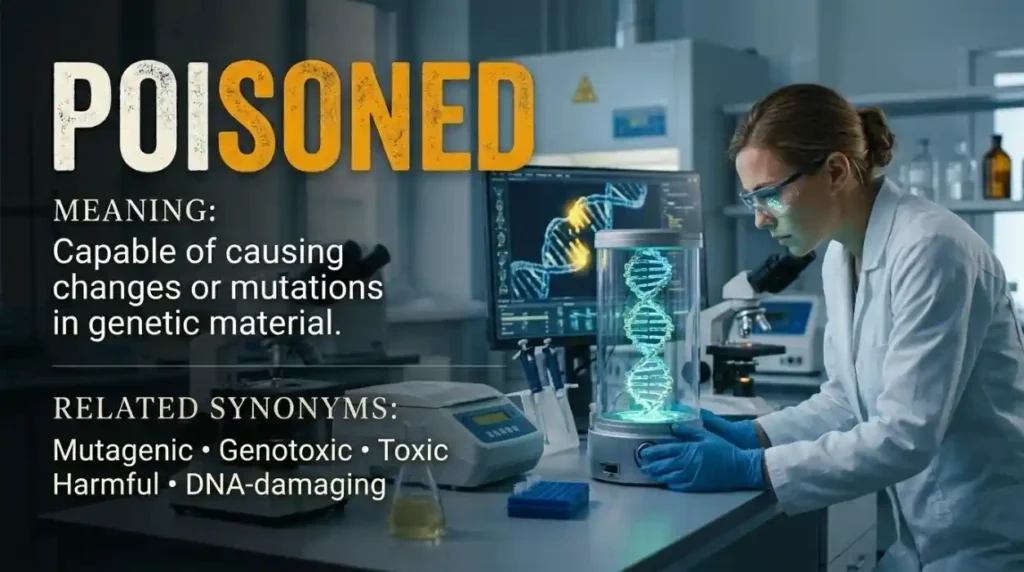
40. Mutagenic (Adjective) — US: /ˌmjuː.təˈdʒen.ɪk/ | UK: /ˌmjuː.təˈdʒen.ɪk/
Meaning: Capable of causing changes or mutations in genetic material.
Tone/Register: Scientific, medical.
Examples:
- Researchers investigated the mutagenic effects of the compound.
- The laboratory followed strict rules when handling mutagenic substances.
41. Biohazardous (Adjective) — US: /ˌbaɪ.oʊˈhæz.ɚ.dəs/ | UK: /ˌbaɪ.əʊˈhæz.ə.dəs/
Meaning: Presenting a biological danger to people, animals, or the environment.
Tone/Register: Scientific, professional.
Examples:
- The hospital placed biohazardous waste in special containers.
- Staff wore protective clothing near the biohazardous material.
42. Corrosive (Adjective) — US: /kəˈroʊ.sɪv/ | UK: /kəˈrəʊ.sɪv/
Meaning: Capable of chemically damaging or destroying materials and body tissue.
Tone/Register: Scientific, technical.
Examples:
- The corrosive liquid damaged the metal surface.
- Keep corrosive substances away from your skin.
43. Caustic (Adjective) — US: /ˈkɑː.stɪk/ | UK: /ˈkɔː.stɪk/
Meaning: Able to burn or damage living tissue through chemical action.
Tone/Register: Scientific, formal.
Examples:
- The caustic solution required special handling.
- A caustic chemical spilled inside the laboratory.
44. Lethal (Adjective) — US: /ˈliː.θəl/ | UK: /ˈliː.θəl/
Meaning: Capable of causing death.
Tone/Register: Formal, medical, dramatic.
Examples:
- Even a small amount of the substance could be lethal.
- The investigation examined a potentially lethal exposure.
45. Deadly (Adjective) — US: /ˈded.li/ | UK: /ˈded.li/
Meaning: Likely to cause death or extremely serious harm.
Tone/Register: Everyday, dramatic, journalistic.
Examples:
- The animal consumed a deadly chemical.
- The warning explained the risks of deadly toxins.
46. Fatal (Adjective) — US: /ˈfeɪ.t̬əl/ | UK: /ˈfeɪ.təl/
Meaning: Causing death or resulting in death.
Tone/Register: Formal, medical, journalistic.
Examples:
- The report described a fatal poisoning incident.
- A fatal dose of the substance was discovered in the case.
47. Toxic to the body (Adjective Phrase) — US: /ˈtɑːk.sɪk tə ðə ˈbɑː.di/ | UK: /ˈtɒk.sɪk tə ðə ˈbɒd.i/
Meaning: Harmful to the human or animal body.
Tone/Register: Medical, explanatory.
Examples:
- The chemical is toxic to the body when swallowed.
- The specialist explained why the substance is toxic to the body.
48. Damaged by toxins (Adjective Phrase) — US: /ˈdæm.ɪdʒd baɪ ˈtɑːk.sɪnz/ | UK: /ˈdæm.ɪdʒd baɪ ˈtɒk.sɪnz/
Meaning: Harmed as a result of exposure to toxins.
Tone/Register: Neutral, scientific.
Examples:
- The damaged-by-toxins tissue was examined.
- The study focused on organs damaged by toxins.
49. Poison-affected (Adjective) — US: /ˈpɔɪ.zən əˌfek.tɪd/ | UK: /ˈpɔɪ.zən əˌfek.tɪd/
Meaning: Affected by exposure to poison, without specifying the severity of the effects.
Tone/Register: Technical, descriptive.
Examples:
- The rescue team treated the poison-affected animal.
- Investigators examined the poison-affected plants.
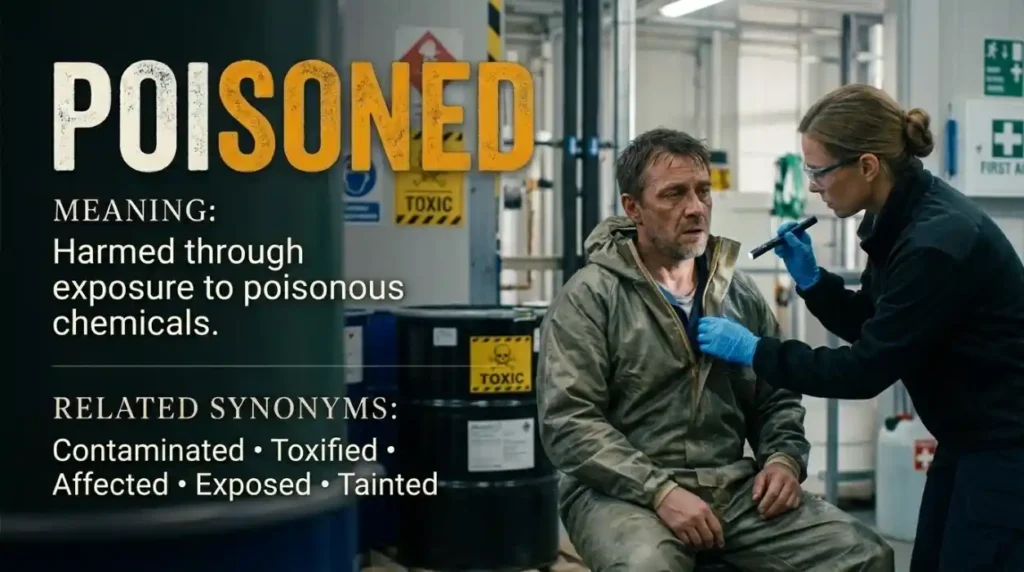
50. Poisoned by chemicals (Adjective Phrase) — US: /ˈpɔɪ.zənd baɪ ˈkem.ɪ.kəlz/ | UK: /ˈpɔɪ.zənd baɪ ˈkem.ɪ.kəlz/
Meaning: Harmed through exposure to poisonous chemicals.
Tone/Register: Neutral, medical, descriptive.
Examples:
- The workers were poisoned by chemicals in the storage room.
- The report described animals poisoned by chemicals.
Synonyms by Tone
Word choice matters because some alternatives sound scientific, while others feel conversational or dramatic. Choose a word that matches your audience and the seriousness of the situation.
Positive
There are no genuinely positive synonyms for poisoned. The word itself describes harm. In a positive sentence, you can describe the successful removal of danger instead.
- Decontaminated: Made free from harmful substances.
- Purified: Cleaned to remove unwanted or harmful material.
- Treated: Given a process to reduce or remove a harmful substance.
Neutral
These alternatives describe contamination or exposure without adding unnecessary emotional emphasis.
- Contaminated
- Tainted
- Polluted
- Toxic
- Chemically affected
- Impure
- Unsafe
Negative
These words emphasize danger, damage, or the possibility of severe consequences.
- Lethal
- Deadly
- Fatal
- Noxious
- Pernicious
- Hazardous
- Deleterious
Playful or Informal
There are few suitable playful alternatives when discussing actual poisoning because the subject can be serious. In fictional or figurative writing, expressions such as poison-laced may create a dramatic effect. Avoid joking about real poisoning incidents.
“Poisoned” vs. Close Alternatives
Some words look interchangeable but describe different situations. These distinctions help you choose accurately.
| Word | Main difference | Best use |
|---|---|---|
| Poisoned | A person, animal, or thing has been affected by poison. | Describing actual poisoning or figurative damage. |
| Toxic | Something contains or produces harmful substances. | Describing chemicals, materials, or environments. |
| Contaminated | Something has unwanted substances in it. | Describing food, water, soil, or surfaces. |
| Tainted | Something has been spoiled or damaged by an unwanted influence. | Describing food, reputation, trust, or relationships. |
Example comparison:
- The child was poisoned after swallowing a harmful substance.
- The chemical was toxic to humans.
- The drinking water was contaminated with chemicals.
- The scandal tainted the company’s reputation.
The words communicate related ideas, but they are not always interchangeable.
How “Poisoned” Changes by Context
Daily Conversation
In everyday speech, people often use poisoned, toxic, or contaminated to explain a safety concern.
For example, someone might say, “I think the food is contaminated,” when they suspect that something harmful has entered it.
Use simple, familiar words when speaking with friends or family.
Writing or Blogging
Writers can use alternatives such as tainted, polluted, toxic, and hazardous to avoid repeating the same word.
For example, an environmental article might describe a polluted river, toxic waste, or chemically contaminated soil.
Choose the word that accurately explains the source and type of danger.
Professional or Academic Tone
Scientific reports and professional documents often use precise expressions such as toxin-exposed, adulterated, carcinogenic, and chemically contaminated.
These terms help communicate specific risks. However, technical language should only be used when its meaning is accurate.
Creative or Informal Use
In stories, novels, and dramatic writing, expressions such as poison-laced, tainted, and poison-infused can create suspense.
For figurative writing, poisoned can describe trust, relationships, or public debate damaged by negativity.
Common Mistakes Learners Make
Confusing Poisonous and Poisoned
These words have different meanings.
- Poisonous: Capable of causing harm.
- Poisoned: Already affected by poison.
Example: A poisonous mushroom can cause a person to become poisoned.
Using Infected for Chemical Exposure
Infected usually describes harmful microorganisms entering the body or another living organism. It does not normally describe chemical poisoning.
Use poisoned or chemically contaminated when discussing exposure to harmful chemicals.
Treating Toxic and Poisoned as Identical
Toxic describes a harmful property or substance. Poisoned usually describes something or someone affected by poison.
For example, a toxic chemical can poison a person, but the chemical itself is not necessarily described as poisoned.
Using Dramatic Words Without Evidence
Words such as lethal, deadly, and fatal communicate severe danger. Do not use them as casual replacements unless the situation supports that meaning.
Register Notes
- Formal: Deleterious, pernicious, adulterated, carcinogenic.
- Informal: Spoiled, unsafe, dangerous.
- Scientific: Toxic, contaminated, mutagenic, corrosive.
- Spoken English: Poisoned, toxic, polluted, tainted.
- Written English: Chemically contaminated, toxin-exposed, hazardous.
If you are creating a related vocabulary article, you can also explore alternatives for toxic to understand how these terms differ.
Real-Life Mini Scenarios Using Poisoned
Workplace Scenario
A factory employee notices a strange smell near a chemical storage area. The safety officer reports that the air may be contaminated and asks everyone to leave.
Social Situation
A family discovers that a household product was stored incorrectly. They stop using it and contact the appropriate safety service.
Media and News
A news report describes a river contaminated by industrial chemicals. The article explains the possible risks to fish, wildlife, and nearby communities.
Writing and Storytelling
A mystery writer describes a poison-laced drink found at a dinner party. This phrase creates suspense without explaining every detail immediately.
Practice Exercise
Choose the best word or expression for each situation.
1. A river contains harmful chemicals from a factory. Which word fits best?
A. Cheerful
B. Polluted
C. Helpful
D. Fresh
2. A person becomes ill after swallowing a poisonous substance. Which word describes the person?
A. Poisoned
B. Poisonous
C. Pure
D. Harmless
3. A snake produces venom through its bite. Which adjective describes it?
A. Polluted
B. Adulterated
C. Venomous
D. Spoiled
4. Food becomes unsafe because unwanted substances have entered it. Which word is most suitable?
A. Contaminated
B. Beautiful
C. Comfortable
D. Delicious
5. A chemical is capable of causing cancer. Which term describes it?
A. Impure
B. Carcinogenic
C. Playful
D. Unsanitary
6. A substance can cause death. Which adjective communicates this meaning?
A. Gentle
B. Lively
C. Lethal
D. Ordinary
7. A company’s reputation suffers after a major scandal. Which word works best figuratively?
A. Tainted
B. Venomous
C. Corrosive
D. Infested
8. A kitchen is dirty and does not meet basic hygiene standards. Which word is most appropriate?
A. Fatal
B. Unsanitary
C. Poison-laced
D. Mutagenic
9. A laboratory studies a substance that can damage genetic material. Which term fits?
A. Spoiled
B. Deadly
C. Mutagenic
D. Impure
10. A harmful liquid can burn skin and damage metal. Which adjective is suitable?
A. Corrosive
B. Friendly
C. Pure
D. Playful
Answer Key:
1-B | 2-A | 3-C | 4-A | 5-B | 6-C | 7-A | 8-B | 9-C | 10-A
Reflection Task:
Write two original sentences using different alternatives for poisoned. Use one sentence about a real-life safety situation and another about a figurative situation, such as a damaged relationship or reputation.
FAQs
1. What is the difference between poison and poisoning?
Poison is a noun referring to a substance that can cause harm. It can also be a verb meaning to expose something or someone to poison. Poisoning describes the process or condition resulting from exposure. For example, “The substance is a poison” identifies the material, while “The patient experienced poisoning” describes the harmful event.
2. What is the opposite of poisoned?
The opposite depends on the context. Words such as unpoisoned, safe, clean, and uncontaminated can communicate the absence of harmful substances. In a figurative sentence, healthy, trusting, or unspoiled may work better. Choose an opposite that describes the actual condition rather than relying on one word in every situation.
3. Can poisoned describe a relationship or friendship?
Yes. Poisoned can have a figurative meaning when describing relationships, trust, or communication. It suggests that negative feelings or harmful behavior have damaged something. For example, “Their friendship was poisoned by jealousy” means jealousy gradually harmed their relationship. Alternatives such as tainted, damaged, and corrupted may also work.
4. Is toxic the same as poisonous?
The words are closely related, but their use can differ. Toxic is a broad term for something capable of causing harm through a substance or exposure. Poisonous commonly describes something that contains or produces poison. Both can describe dangerous materials, but the most accurate choice depends on the subject and context.
5. What is a formal word for poisoned?
There is no single formal replacement for every use of poisoned. In technical writing, expressions such as chemically contaminated, toxin-exposed, and toxic-substance exposure may be more precise. In a figurative context, tainted or corrupted may sound more suitable. Select the expression that describes the specific situation accurately.
6. How do you describe water that contains poison?
You can describe it as contaminated water, chemically contaminated water, or water polluted with toxins. If testing confirms that a poisonous substance is present, poisoned water may also be appropriate. The exact expression should reflect the evidence and the type of harmful substance involved.
7. What is the difference between venomous and poisonous?
A venomous animal produces venom and usually delivers it through a bite or sting. A poisonous organism can cause harm when another organism touches, eats, or absorbs its harmful substance. The terms describe different ways that toxins can affect living things, so they should not be used interchangeably.
8. How can I use synonyms for poisoned without changing the meaning?
First, identify what is being described. Use poisoned for something affected by poison, toxic for something capable of causing harm, and contaminated for something containing unwanted substances. For figurative meanings, consider tainted or corrupted. Checking the sentence context helps you avoid inaccurate substitutions.
Conclusion
Learning a synonym for poisoned helps you describe harmful substances, contamination, and dangerous situations with greater accuracy. Each alternative adds a slightly different meaning.
Words such as toxic, tainted, and contaminated are useful in everyday conversations, while scientific terms make formal writing more precise.
A wider vocabulary also improves essays, blogs, emails, and professional communication. It helps you explain difficult situations without repeating the same expressions.
Practice these alternatives in your own sentences and daily conversations. Start with familiar words, then explore more advanced choices as your confidence grows.
Suggested External Sources
For accurate definitions, pronunciation, and word history, consider linking to:
- Merriam-Webster: Definitions and usage examples.
- Cambridge Dictionary: British and American pronunciation.
- Oxford Learner’s Dictionaries: Learner-friendly meanings and examples.
- Online Etymology Dictionary: Historical word origins.
Editorial note: The 50-item list includes direct synonyms, technical terms, and contextual alternatives. Some expressions are descriptive phrases rather than exact substitutes. This distinction is important for linguistic accuracy, especially in medical and scientific writing.

Jameel Hassan is the founder and lead writer at SynonymsCloud.com, a trusted online platform dedicated to English vocabulary and effective communication. He is passionate about helping students, writers, professionals, and lifelong learners discover the right words to express their ideas with clarity, precision, and confidence.
At SynonymsCloud.com, every article is thoroughly researched and carefully written to provide accurate, practical, and easy-to-understand guidance on synonyms, antonyms, word meanings, idioms, and vocabulary. With a strong commitment to quality, real-world usage, and clear explanations, the website helps readers expand their vocabulary, improve their writing, and communicate more effectively in both academic and professional settings.