
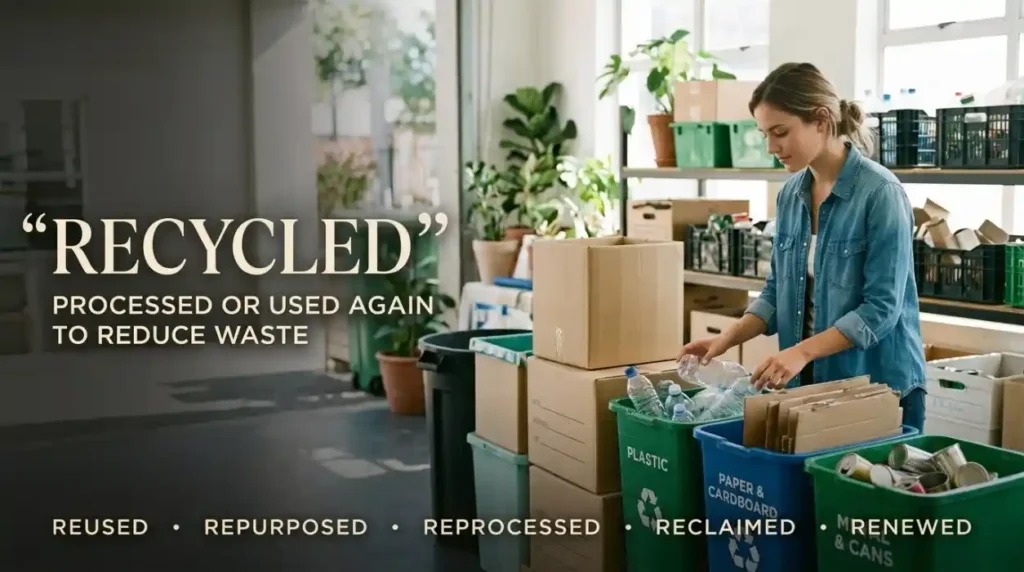
A synonym for recycled is a word that describes something used again, processed into a new product, or recovered for another purpose. Common alternatives include reused, repurposed, reclaimed, reprocessed, refurbished, and renewed. The best choice depends on whether an item is used again as it is or transformed into something new.
Imagine turning an empty glass jar into a storage container instead of throwing it away. You have reused the jar, while processing waste glass into a new bottle means it has been recycled.
Learning a synonym for recycled helps you describe sustainable choices accurately. Students can strengthen essays, bloggers can create engaging environmental content, and writers can avoid repeating the same words.
The term recycled appears in discussions about packaging, clothing, manufacturing, waste management, and environmental protection. It can also describe ideas, jokes, or information used again in a new context.
Exploring a synonym for recycled helps you choose suitable alternatives for different situations. This guide covers 50 useful words, US and UK pronunciations, clear definitions, and fresh examples. Understanding each synonym for recycled will help you communicate naturally in everyday conversations and professional writing.
What Does “Recycled” Really Mean?
Recycled means processed or treated so that a material can be used again, often to make a new product. It can also mean used again in its original form or repeated in a different context, depending on the sentence.
The word is the past tense and past participle of the verb recycle. It also functions as an adjective, as in “recycled paper” or “recycled plastic.”
Native English speakers commonly use it in these contexts:
- Environmental protection: Recycled paper, glass, metal, and plastic.
- Fashion: Clothing made from recovered or reprocessed materials.
- Manufacturing: Waste materials converted into useful products.
- Everyday life: Containers or objects used again instead of discarded.
- Ideas and media: An old argument, joke, or story presented again.
One important distinction is that recycling does not always mean using an object again in its original form. Sometimes the material is processed into something different.
Connotative Meaning of Recycled
(Connotation is the feeling or association a word carries beyond its literal meaning.)
- Positive tone: Recycled can suggest environmental responsibility, resource conservation, and sustainability.
- Negative tone: It can suggest something unoriginal, repetitive, or lacking fresh ideas, as in “a recycled joke.”
- Neutral tone: It can simply describe a material that has undergone recycling, without expressing approval or criticism.
The context determines the intended meaning. “Recycled aluminum” usually sounds practical and environmentally responsible, while “recycled content” in a movie review may suggest a lack of originality.
Etymology of Recycled
The word recycle combines the prefix re-, meaning “again,” with cycle, which comes through French from Latin cyclus and ultimately Greek kyklos, meaning “circle” or “ring.” The modern idea suggests putting materials back into a cycle of use.
Historical Development
- Old English (450–1100): The modern word recycle did not exist in Old English. Speakers used other words to express ideas such as using, returning, or restoring things.
- Middle English (1100–1500): English adopted many French and Latin-derived words related to cycles and repeated actions. However, recycle was not yet an established everyday term.
- Modern English (1500–present): Recycle developed in modern English, becoming increasingly important with industrial processing and the growth of organized waste recovery. Environmental awareness made recycling especially common in the twentieth century and beyond.
Pronunciation and Word Structure
- US pronunciation: /ˌriːˈsaɪ.kəld/
- UK pronunciation: /ˌriːˈsaɪ.kəld/
Syllables
re-cy-cled
Part of speech
Adjective; also the past tense and past participle of the verb recycle.
Affixation pattern
- Root/base: cycle
- Prefix: re-, meaning again or back.
- Suffix: -ed, marking the past tense or past participle and helping form the adjective recycled.
Related words include recycle, recycling, recyclable, and recyclability. Remember that recyclable means capable of being recycled, while recycled usually means that recycling has already occurred.
Synonyms List
Not every word below is an exact substitute in every sentence. Some describe using an object again, others describe processing materials, and a few apply mainly to reused ideas or products. Choose the alternative that preserves your intended meaning.
1. Reused (Adjective/Verb) — US: /ˌriːˈjuːzd/ | UK: /ˌriːˈjuːzd/
Meaning: Used again instead of being discarded after its first use.
Tone/Register: Neutral, everyday, environmental.
Examples:
- We reused the shopping bags for our weekly groceries.
- The school collected reused notebooks for its community program.
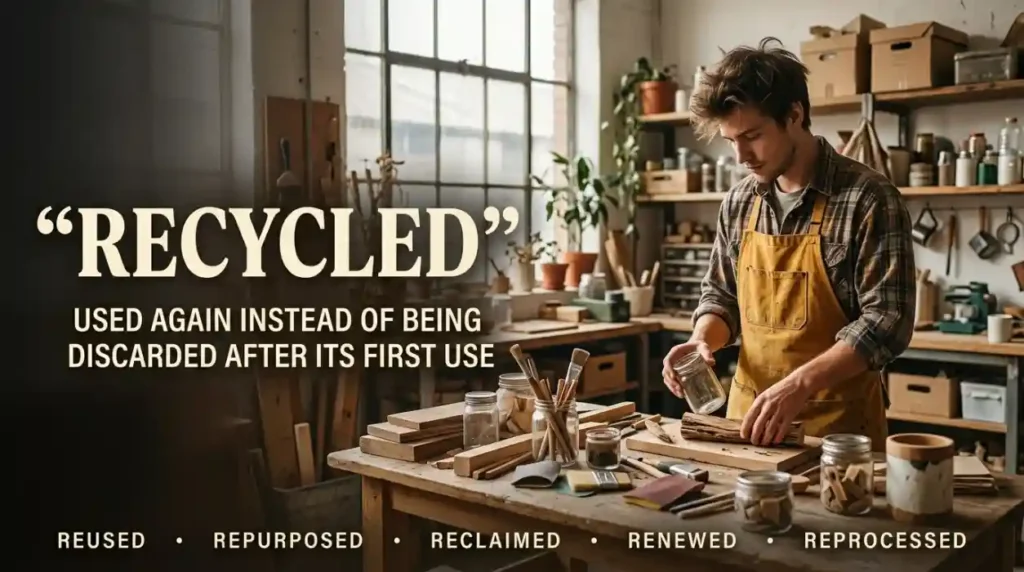
2. Repurposed (Adjective/Verb) — US: /ˌriːˈpɝː.pəst/ | UK: /ˌriːˈpɜː.pəst/
Meaning: Adapted for a new purpose different from the item’s original function.
Tone/Register: Neutral, creative, environmental.
Examples:
- She repurposed an old ladder as a bookshelf.
- The studio repurposed wooden pallets into garden furniture.
3. Reprocessed (Adjective/Verb) — US: /ˌriːˈprɑː.sest/ | UK: /ˌriːˈprəʊ.sest/
Meaning: Treated or processed again to prepare a material for further use.
Tone/Register: Technical, industrial, formal.
Examples:
- The factory uses reprocessed plastic in selected products.
- The waste material was reprocessed before production resumed.
4. Reclaimed (Adjective/Verb) — US: /ˌriːˈkleɪmd/ | UK: /ˌriːˈkleɪmd/
Meaning: Recovered from waste, disuse, or an unwanted source for useful purposes.
Tone/Register: Environmental, construction, formal.
Examples:
- The café installed tables made from reclaimed timber.
- Reclaimed metal became part of the artist’s latest sculpture.
5. Refurbished (Adjective/Verb) — US: /ˌriːˈfɝː.bɪʃt/ | UK: /ˌriːˈfɜː.bɪʃt/
Meaning: Repaired, cleaned, or improved to make an existing product usable or presentable again.
Tone/Register: Business, retail, technical.
Examples:
- He bought a refurbished laptop for his studies.
- The office donated refurbished computers to a local school.
6. Renewed (Adjective/Verb) — US: /rɪˈnuːd/ | UK: /rɪˈnjuːd/
Meaning: Made fresh, active, or effective again, sometimes through repair or replacement.
Tone/Register: Neutral, formal, general.
Examples:
- The park received renewed benches made from durable materials.
- The campaign brought renewed attention to waste reduction.
7. Recovered (Adjective/Verb) — US: /rɪˈkʌv.ɚd/ | UK: /rɪˈkʌv.əd/
Meaning: Retrieved or extracted from waste or a discarded source for further use.
Tone/Register: Technical, environmental, formal.
Examples:
- The process separates recovered metals from electronic waste.
- Recovered fibers were used to make insulation.
8. Recycled-Content (Adjective) — US: /ˌriːˈsaɪ.kəld ˈkɑːn.tent/ | UK: /ˌriːˈsaɪ.kəld ˈkɒn.tent/
Meaning: Describing a product that contains material recovered through recycling.
Tone/Register: Environmental, manufacturing.
Examples:
- The packaging contains recycled-content paper.
- The company increased the recycled-content share of its cartons.
9. Remanufactured (Adjective/Verb) — US: /ˌriːˌmæn.jəˈfæk.tʃɚd/ | UK: /ˌriːˌmæn.jəˈfæk.tʃəd/
Meaning: Rebuilt from used products or components to meet defined performance requirements.
Tone/Register: Technical, industrial, business.
Examples:
- The workshop sells remanufactured engine components.
- A remanufactured printer passed the company’s quality checks.
10. Reconditioned (Adjective/Verb) — US: /ˌriː.kənˈdɪʃ.ənd/ | UK: /ˌriː.kənˈdɪʃ.ənd/
Meaning: Restored to a satisfactory working condition through repair or servicing.
Tone/Register: Technical, business, everyday.
Examples:
- The mechanic installed a reconditioned alternator.
- They donated reconditioned bicycles to young riders.
11. Salvaged (Adjective/Verb) — US: /ˈsæl.vɪdʒd/ | UK: /ˈsæl.vɪdʒd/
Meaning: Rescued from damage or disposal so that the item or its parts can still be useful.
Tone/Register: Practical, construction, environmental.
Examples:
- The builders salvaged bricks from the demolished wall.
- She turned salvaged fabric into reusable gift bags.
12. Reutilized (Verb) — US: /ˌriːˈjuː.t̬əl.aɪzd/ | UK: /ˌriːˈjuː.tɪ.laɪzd/
Meaning: Put an existing material or object to use again.
Tone/Register: Formal, technical.
Examples:
- The laboratory reutilized suitable containers after approved cleaning.
- The project reutilized surplus materials to reduce waste.
13. Recycled Again (Verb Phrase) — US: /ˌriːˈsaɪ.kəld əˈɡen/ | UK: /ˌriːˈsaɪ.kəld əˈɡen/
Meaning: Processed through another recycling cycle after an earlier recycling stage.
Tone/Register: Neutral, technical.
Examples:
- The recovered plastic was recycled again after sorting.
- Some paper fibers can be recycled again, although fiber quality may decline.
14. Upcycled (Adjective/Verb) — US: /ˈʌpˌsaɪ.kəld/ | UK: /ˈʌpˌsaɪ.kəld/
Meaning: Turned into a product with a new or higher perceived value without conventional material recycling.
Tone/Register: Creative, environmental, informal.
Examples:
- He upcycled old denim into a sturdy backpack.
- The market displayed upcycled jewelry made from discarded materials.
15. Downcycled (Adjective/Verb) — US: /ˈdaʊnˌsaɪ.kəld/ | UK: /ˈdaʊnˌsaɪ.kəld/
Meaning: Converted into material or products of lower quality or value than the original.
Tone/Register: Technical, environmental.
Examples:
- Some mixed plastics are downcycled into lower-grade products.
- The report examined how textile waste was downcycled into filling material.
16. Recycled Material (Noun Phrase) — US: /ˌriːˈsaɪ.kəld məˈtɪr.i.əl/ | UK: /ˌriːˈsaɪ.kəld məˈtɪə.ri.əl/
Meaning: Material recovered and processed through a recycling system for use in products.
Tone/Register: Environmental, industrial.
Examples:
- The benches were manufactured from recycled material.
- The designer selected recycled material for the display panels.
17. Reused Material (Noun Phrase) — US: /ˌriːˈjuːzd məˈtɪr.i.əl/ | UK: /ˌriːˈjuːzd məˈtɪə.ri.əl/
Meaning: Material used again, often without being broken down or remade.
Tone/Register: Neutral, practical.
Examples:
- The art class created collages from reused material.
- Reused material helped the team limit construction waste.
18. Secondhand (Adjective) — US: /ˈsek.əndˌhænd/ | UK: /ˌsek.əndˈhænd/
Meaning: Previously owned or used by someone else.
Tone/Register: Everyday, retail, neutral.
Examples:
- She wore a secondhand jacket to the concert.
- The family furnished the room with secondhand chairs.
19. Preowned (Adjective) — US: /ˌpriːˈoʊnd/ | UK: /ˌpriːˈəʊnd/
Meaning: Owned by someone else before being offered to another buyer or user.
Tone/Register: Business, retail, neutral.
Examples:
- He chose a pre-owned bicycle in excellent condition.
- The shop specializes in pre-owned musical instruments.
20. Reusable (Adjective) — US: /ˌriːˈjuː.zə.bəl/ | UK: /ˌriːˈjuː.zə.bəl/
Meaning: Designed or suitable to be used multiple times.
Tone/Register: Everyday, environmental.
Examples:
- Carry a reusable bottle instead of buying disposable drinks.
- The kitchen switched to reusable food containers.
21. Recyclable (Adjective) — US: /ˌriːˈsaɪ.klə.bəl/ | UK: /ˌriːˈsaɪ.klə.bəl/
Meaning: Capable of being collected and processed into usable material through a recycling system.
Tone/Register: Environmental, technical, everyday.
Examples:
- Check whether your local service accepts recyclable cartons.
- The label identifies recyclable parts of the packaging.
22. Sustainable (Adjective) — US: /səˈsteɪ.nə.bəl/ | UK: /səˈsteɪ.nə.bəl/
Meaning: Designed or managed to reduce environmental harm and support long-term resource use.
Tone/Register: Environmental, academic, business.
Examples:
- The brand adopted sustainable packaging for its products.
- Sustainable manufacturing includes waste reduction and efficient resource use.
23. Eco-Friendly (Adjective) — US: /ˌiː.koʊˈfrend.li/ | UK: /ˌiː.kəʊˈfrend.li/
Meaning: Having a comparatively low environmental impact.
Tone/Register: Everyday, marketing, environmental.
Examples:
- The event used eco-friendly decorations made from durable materials.
- They chose an eco-friendly cleaning method for the studio.
24. Recycled-Fiber (Adjective) — US: /ˌriːˈsaɪ.kəld ˈfaɪ.bɚ/ | UK: /ˌriːˈsaɪ.kəld ˈfaɪ.bə/
Meaning: Made with fibers recovered from previously used materials.
Tone/Register: Textile, manufacturing, environmental.
Examples:
- The notebook cover uses recycled-fiber board.
- The company tested recycled-fiber insulation for its new range.
25. Regenerated (Adjective/Verb) — US: /rɪˈdʒen.ə.reɪ.t̬ɪd/ | UK: /rɪˈdʒen.ə.reɪ.tɪd/
Meaning: Formed or restored, often from recovered raw materials or through a specialized process.
Tone/Register: Technical, scientific, environmental.
Examples:
- The manufacturer developed fabric from regenerated cellulose.
- The process turned recovered oils into regenerated industrial material.
26. Reconstituted (Adjective/Verb) — US: /ˌriːˈkɑːn.stə.tuː.tɪd/ | UK: /ˌriːˈkɒn.stɪ.tjuː.tɪd/
Meaning: Formed again by combining components or restoring a material to a usable state.
Tone/Register: Technical, scientific, manufacturing.
Examples:
- The board was made from reconstituted wood fibers.
- The technician reconstituted the sample according to the instructions.
27. Reformed (Adjective/Verb) — US: /rɪˈfɔːrmd/ | UK: /rɪˈfɔːmd/
Meaning: Shaped or changed into a different form, sometimes through processing recovered material.
Tone/Register: Technical, general.
Examples:
- The recovered metal was reformed into new components.
- The workshop reformed plastic offcuts into useful sheets.
28. Remolded (Adjective/Verb) — US: /ˌriːˈmoʊl.dɪd/ | UK: /ˌriːˈməʊl.dɪd/
Meaning: Shaped again in a mold to create a new form.
Tone/Register: Manufacturing, technical.
Examples:
- The factory remolded selected rubber scraps into mats.
- The remolded components passed the initial inspection.
29. Rebuilt (Adjective/Verb) — US: /ˌriːˈbɪlt/ | UK: /ˌriːˈbɪlt/
Meaning: Constructed again using existing parts or replacement components.
Tone/Register: Technical, everyday, industrial.
Examples:
- The mechanic fitted a rebuilt transmission.
- The team rebuilt the machine using serviceable components.
30. Restored (Adjective/Verb) — US: /rɪˈstɔːrd/ | UK: /rɪˈstɔːd/
Meaning: Returned to a previous condition through repair, cleaning, or careful treatment.
Tone/Register: Neutral, professional, creative.
Examples:
- The museum displayed a restored wooden cabinet.
- Volunteers restored the old bicycle for community use.
31. Repaired (Adjective/Verb) — US: /rɪˈperd/ | UK: /rɪˈpeəd/
Meaning: Fixed after damage or failure so that an item can function again.
Tone/Register: Everyday, technical.
Examples:
- The repaired toaster was returned to its owner.
- The school repaired broken desks instead of replacing them.
32. Rejuvenated (Adjective/Verb) — US: /rɪˈdʒuː.və.neɪ.tɪd/ | UK: /rɪˈdʒuː.və.neɪ.tɪd/
Meaning: Made to feel or appear fresh, active, or renewed.
Tone/Register: Positive, descriptive.
Examples:
- A careful cleaning rejuvenated the old garden furniture.
- The renovation rejuvenated the neglected community space.
33. Revitalized (Adjective/Verb) — US: /ˌriːˈvaɪ.t̬əl.aɪzd/ | UK: /ˌriːˈvaɪ.təl.aɪzd/
Meaning: Given new energy, usefulness, or life.
Tone/Register: Positive, formal, creative.
Examples:
- The group revitalized the courtyard with repaired benches.
- The campaign revitalized interest in neighborhood repair events.
34. Reintroduced (Adjective/Verb) — US: /ˌriːˌɪn.trəˈduːst/ | UK: /ˌriːˌɪn.trəˈdjuːst/
Meaning: Brought something back into use or public attention after a period of absence.
Tone/Register: Neutral, professional.
Examples:
- The store reintroduced its durable refillable containers.
- The designer reintroduced an older pattern in a new collection.
35. Recycled Idea (Noun Phrase) — US: /ˌriːˈsaɪ.kəld aɪˈdiː.ə/ | UK: /ˌriːˈsaɪ.kəld aɪˈdɪə/
Meaning: An idea reused from an earlier source rather than developed as entirely new.
Tone/Register: Informal, sometimes critical.
Examples:
- The reviewer called the sequel a recycled idea.
- The proposal felt familiar because it relied on a recycled idea.
36. Rehashed (Adjective/Verb) — US: /ˌriːˈhæʃt/ | UK: /ˌriːˈhæʃt/
Meaning: Presented again with little meaningful change, often referring to information or ideas.
Tone/Register: Informal, critical.
Examples:
- The article offered rehashed advice without fresh evidence.
- Viewers complained that the episode repeated rehashed storylines.
37. Repeated (Adjective/Verb) — US: /rɪˈpiː.tɪd/ | UK: /rɪˈpiː.tɪd/
Meaning: Done or stated again, sometimes with little or no change.
Tone/Register: Neutral, sometimes critical.
Examples:
- The presenter avoided repeated examples in the new lesson.
- The report contained repeated claims from an earlier draft.
38. Replicated (Adjective/Verb) — US: /ˈrep.lə.keɪ.tɪd/ | UK: /ˈrep.lɪ.keɪ.tɪd/
Meaning: Copied or reproduced to create another version of something.
Tone/Register: Academic, technical, formal.
Examples:
- The lab replicated the experiment to confirm its results.
- The designer replicated the original pattern for a second display.
39. Recycled Content (Noun Phrase) — US: /ˌriːˈsaɪ.kəld ˈkɑːn.tent/ | UK: /ˌriːˈsaɪ.kəld ˈkɒn.tent/
Meaning: Material in a product that comes from previously recovered and recycled resources.
Tone/Register: Environmental, technical.
Examples:
- The packaging label explains the recycled content.
- Buyers asked how much recycled content the product contained.
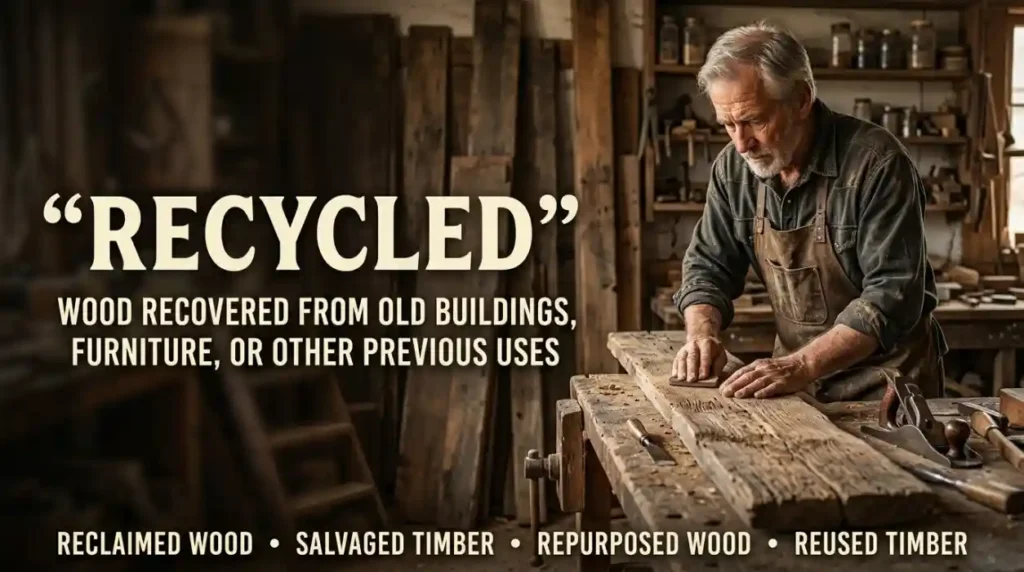
40. Reclaimed Wood (Noun Phrase) — US: /ˌriːˈkleɪmd wʊd/ | UK: /ˌriːˈkleɪmd wʊd/
Meaning: Wood recovered from old buildings, furniture, or other previous uses.
Tone/Register: Construction, design, environmental.
Examples:
- The restaurant built its counter from reclaimed wood.
- Reclaimed wood gave the shelves a distinctive appearance.
41. Recovered Plastic (Noun Phrase) — US: /rɪˈkʌv.ɚd ˈplæs.tɪk/ | UK: /rɪˈkʌv.əd ˈplæs.tɪk/
Meaning: Plastic collected from waste or other sources for potential further processing or use.
Tone/Register: Environmental, industrial.
Examples:
- The facility sorted recovered plastic by material type.
- The manufacturer tested recovered plastic for outdoor furniture.
42. Recycled Paper (Noun Phrase) — US: /ˌriːˈsaɪ.kəld ˈpeɪ.pɚ/ | UK: /ˌriːˈsaɪ.kəld ˈpeɪ.pə/
Meaning: Paper manufactured wholly or partly from recovered paper fibers.
Tone/Register: Everyday, academic, environmental.
Examples:
- The teacher printed the worksheets on recycled paper.
- The publisher increased its use of recycled paper for drafts.
43. Recycled Plastic (Noun Phrase) — US: /ˌriːˈsaɪ.kəld ˈplæs.tɪk/ | UK: /ˌriːˈsaɪ.kəld ˈplæs.tɪk/
Meaning: Plastic material processed from recovered plastic waste for use in products.
Tone/Register: Environmental, technical.
Examples:
- The outdoor seats contain recycled plastic.
- The company evaluated recycled plastic for protective packaging.
44. Recycled Textile (Noun Phrase) — US: /ˌriːˈsaɪ.kəld ˈtek.staɪl/ | UK: /ˌriːˈsaɪ.kəld ˈtek.staɪl/
Meaning: Fabric or textile material produced from recovered fibers or previously used textiles.
Tone/Register: Fashion, environmental, manufacturing.
Examples:
- The designer created a bag from recycled textile.
- Recycled textile helped reduce the need for some virgin fibers.
45. Waste-Derived (Adjective) — US: /ˈweɪst dɪˌraɪvd/ | UK: /ˈweɪst dɪˌraɪvd/
Meaning: Produced from waste material that has been recovered or processed.
Tone/Register: Technical, environmental, formal.
Examples:
- The project tested waste-derived materials for road construction.
- The report assessed waste-derived fuel for industrial use.
46. Circular (Adjective) — US: /ˈsɝː.kjə.lɚ/ | UK: /ˈsɜː.kjə.lə/
Meaning: Relating to a system that keeps materials and products in use for as long as practical.
Tone/Register: Environmental, business, academic.
Examples:
- The company adopted a circular design approach to reduce waste.
- Circular manufacturing encourages repair, reuse, and material recovery.
47. Resource-Efficient (Adjective) — US: /ˈriː.sɔːrs ɪˌfɪʃ.ənt/ | UK: /rɪˈzɔːs ɪˌfɪʃ.ənt/
Meaning: Using materials, energy, and other resources with minimal waste.
Tone/Register: Professional, environmental, technical.
Examples:
- The factory adopted resource-efficient production methods.
- Resource-efficient packaging reduced unnecessary material use.
48. Waste-Reduced (Adjective) — US: /ˈweɪst rɪˌduːst/ | UK: /ˈweɪst rɪˌdjuːst/
Meaning: Describing a process or product designed to generate less waste.
Tone/Register: Environmental, professional.
Examples:
- The café introduced waste-reduced food preparation practices.
- Waste-reduced packaging helped the company meet its sustainability goals.
49. Material-Recovered (Adjective) — US: /məˈtɪr.i.əl rɪˌkʌv.ɚd/ | UK: /məˈtɪə.ri.əl rɪˌkʌv.əd/
Meaning: Describing material collected or extracted from waste for further use.
Tone/Register: Technical, industrial.
Examples:
- The manufacturer tracked material-recovered inputs in its annual report.
- Material-recovered metals were sent for further processing.
50. Recycled and Reused (Adjective Phrase) — US: /ˌriːˈsaɪ.kəld ən ˌriːˈjuːzd/ | UK: /ˌriːˈsaɪ.kəld ən ˌriːˈjuːzd/
Meaning: Describing materials or products that have undergone recycling and have also been put to use again.
Tone/Register: Neutral, environmental.
Examples:
- The project featured recycled and reused materials throughout the display.
- Recycled and reused components helped reduce the need for new supplies.
Synonyms by Tone
Positive and Sustainability-Focused
These words emphasize environmental responsibility, creativity, and extending the life of materials:
- Repurposed
- Upcycled
- Reclaimed
- Renewed
- Recovered
- Sustainable
- Eco-friendly
- Revitalized
Use these terms when describing projects that make productive use of existing resources. Ensure the description matches what actually happened to the material.
Neutral and Technical
These alternatives describe specific processes without automatically suggesting that the result is better or worse:
- Reprocessed
- Remanufactured
- Reconditioned
- Reconstituted
- Reformed
- Rebuilt
- Repaired
- Recyclable
They work well in product descriptions, environmental reports, and technical explanations.
Negative or Critical
These terms can describe a lack of originality when recycled refers to ideas rather than physical materials:
- Rehashed
- Repeated
- Recycled idea
For example, “The article repeated old arguments” sounds more neutral than “The article recycled tired arguments,” which conveys criticism.
Informal and Everyday
Use simple expressions when talking to friends or explaining sustainability to a general audience:
- Reused
- Secondhand
- Preowned
- Repurposed
- Restored
Tone matters because the wrong alternative can confuse readers. A refurbished laptop has generally been repaired or restored, while a secondhand laptop has simply had a previous owner.
“Recycled” vs. Close Alternatives
| Word | Meaning difference | When to use it |
|---|---|---|
| Recycled | Material is processed for use again | Paper, glass, plastic, and metal |
| Reused | An object is used again, often without processing | Jars, bags, containers, and furniture |
| Repurposed | An object is adapted for a new function | Turning a ladder into a shelf |
| Upcycled | An item is creatively transformed into something with greater perceived value.e | Handmade accessories and furniture |
| Refurbished | A product is repaired or improved for further use | Computers, phones, and appliances |
| Reclaimed | Material is recovered from an earlier use or discarded source | Wood, metal, and building materials |
Quick tip: Use recycled when a material has been processed, reused when an object serves again, and repurposed when it has a new function.
How “Recycled” Changes by Context
Daily Conversation
In everyday English, reused, secondhand, and repurposed are often more natural when describing ordinary objects.
For example, “I reused an old jar for storing spices” clearly explains what happened without suggesting that the jar was processed into a new material.
Writing and Blogging
Environmental articles benefit from precise words such as reclaimed, recovered, and reprocessed. These terms help readers understand how materials move from waste streams into useful products.
Avoid calling every environmentally responsible product recycled. A reusable bottle may reduce waste, but it is not necessarily made from recycled material.
Professional and Academic Writing
In manufacturing reports, remanufactured, reprocessed, and reconstituted can describe different production methods. Use the exact term supported by the product’s process or technical documentation.
In research writing, recycled can also describe reused arguments or information. However, replicated is usually more suitable when discussing an experiment repeated to test its results.
Creative and Informal Writing
Writers sometimes use recycled metaphorically to criticize unoriginal content. Expressions such as rehashed plot or recycled joke suggest that something familiar has returned with little meaningful change.
For a positive description, reimagined or repurposed may be more suitable when an old object or concept receives a genuinely new function.
Common Mistakes and Native Usage
Confusing Recycled With Recyclable
These words describe different stages. Recyclable means a material can be recycled under suitable conditions. Recycled means it has already undergone recycling.
Example: “This package is recyclable” does not prove that the package contains recycled material.
Treating Reuse as Recycling
Using a glass bottle several times is reuse. Processing waste glass into material for manufacturing is recycling. Both can support waste reduction, but the processes are different.
Using “Eco-Friendly” as an Exact Synonym
Eco-friendly describes a comparatively low environmental impact. It does not confirm that a product is recycled, biodegradable, or made from recovered material.
Assuming Every Material Can Be Recycled Everywhere
Local collection rules and available processing facilities vary. A package may be technically recyclable but not accepted by a particular recycling program.
Overusing Synonyms for SEO
Using recycled, sustainable, and eco-friendly in every sentence can make an article repetitive or misleading. Explain the relevant differences instead of replacing the focus keyword mechanically.
Register Notes
- Formal: Reprocessed, remanufactured, recovered, and reconstituted.
- Informal: Reused, secondhand, and repurposed.
- Environmental writing: Recycled, reclaimed, recyclable, and sustainable.
- Critical writing: Rehashed or recycled, when describing unoriginal ideas.
For additional vocabulary practice, explore related synonym articles on your website about sustainable, reusable, and repurposed.
Real-Life Examples Using Recycled
Workplace Scenario
A manufacturer wants to reduce material waste. It introduces recycled plastic into selected products and documents the material’s source. In this case, reprocessed may describe a production step, while recycled describes the material.
Social Situation
A family uses glass jars to store spices and leftover food. The jars are reused rather than recycled because they remain intact and serve their original or a similar function.
Media and Pop Culture
A film reviewer criticizes a sequel for using the same plot as an earlier movie. The reviewer may call it a recycled storyline or a rehashed plot to suggest a lack of originality.
Writing and Storytelling
A blogger describes an old wooden door turned into a dining table. Repurposed is the most precise term because the door has been given a different function without necessarily being processed into raw material.
Practice Exercise
Choose the most suitable word for each situation. The questions test the difference between recycling, reuse, repair, and related terms.
1. An empty glass jar is used again to store spices. Which word fits best?
A. Reused
B. Reprocessed
C. Downcycled
2. Old wooden pallets are turned into a coffee table. What happened to them?
A. Repurposed
B. Recyclable
C. Repeated
3. Waste plastic is processed to make new products. Which word is most accurate?
A. Secondhand
B. Recycled
C. Refurbished
4. A used laptop is repaired, cleaned, and tested before sale. What is it?
A. Refurbished
B. Reclaimed
C. Upcycled
5. A discarded wooden beam is recovered for a building project. Which term fits?
A. Rehashed
B. Reclaimed
C. Recyclable
6. A material can be processed by a suitable recycling system, but has not yet been processed. It is…
A. Recycled
B. Recyclable
C. Remanufactured
7. An artist turns old denim into a fashionable backpack. Which term often fits?
A. Upcycled
B. Reconditioned
C. Reconstituted
8. A product is rebuilt from used parts to meet performance requirements. What is it?
A. Remanufactured
B. Secondhand
C. Repeated
9. A reviewer says a movie repeats an old plot with little originality. Which phrase fits?
A. Reclaimed plot
B. Rehashed plot
C. Recyclable plot
10. A company reduces waste and uses resources carefully over time. Which broad term fits?
A. Sustainable
B. Preowned
C. Repaired
Reflection Task:
Write two original sentences:
- One sentence about a material or object that has been reused, recycled, or repurposed.
- One sentence about an old idea or story that has been repeated.
Answer Key:
1. A | 2. A | 3. B | 4. A | 5. B | 6. B | 7. A | 8. A | 9. B | 10. A
Frequently Asked Questions
1. What is the best synonym for recycled in an environmental essay?
The best alternative depends on the process being described. Use reused for an object used again, reclaimed for material recovered from an earlier use, and reprocessed for material treated again. If the paragraph discusses environmental responsibility more broadly, sustainable may fit, but it does not mean the same thing as recycled.
2. What is another word for recycled plastic?
Useful alternatives include reprocessed plastic, recovered plastic, and recycled-content plastic, depending on the material and its production history. Reprocessed plastic emphasizes treatment, while recovered plastic emphasizes collection from a waste source. Check the manufacturer’s description before choosing a term because these phrases describe different stages of material recovery.
3. What is a synonym for recycled clothing?
Depending on the garment, you can use secondhand, preowned, upcycled, or made from recycled fibers. Secondhand and preowned clothing has had a previous owner. Upcycled clothing has been creatively transformed, while clothing made from recycled fibers contains material recovered and processed from earlier products.
4. What does recycled mean when describing an idea?
When describing an idea, recycled means that an earlier concept has been used again, often with limited changes. Related expressions include rehashed, repeated, and reused. The tone may be critical if the writer suggests that the idea lacks originality. For a neutral meaning, say that an idea was revisited or adapted.
5. What is the difference between recycled and upcycled?
Recycling generally involves processing recovered material so it can be used again, often in a new product. Upcycling transforms an existing item or material into something considered more valuable or useful without necessarily breaking it down into raw material. For example, processing plastic waste into pellets is recycling, while turning an old suitcase into a decorative table may be upcycling.
6. Is recycled the same as refurbished?
No. Recycled usually refers to material processed for further use. Refurbished describes a product that has been repaired, cleaned, or improved so it can be used again. A refurbished computer retains its identity as a computer, while a recycled computer may be dismantled so that some of its materials can be recovered.
7. What is a professional alternative to recycled materials?
In professional writing, recovered materials, reprocessed materials, and recycled-content materials can be suitable when they accurately describe the supply chain or production method. Use the specific term supported by technical documentation. Avoid calling materials sustainable or eco-friendly solely because they contain recycled content, since those broader claims require additional context.
Conclusion
Choosing a suitable synonym for recycled helps you explain environmental practices, describe creative projects, and discuss repeated ideas with greater precision. Words such as reused, reclaimed, and repurposed each have distinct meanings.
Students and content writers can use these alternatives to make essays, blogs, and reports more informative. Precise vocabulary also helps readers understand whether a material was processed, repaired, recovered, or simply used again.
Practice these words in emails, essays, product descriptions, and everyday conversations. Choose one alternative today and write an original sentence to build a stronger, more natural English vocabulary.
Recommended External Resources
For authoritative definitions and further vocabulary research, consult these established resources:
- Cambridge Dictionary Recycle: Meaning, pronunciation, and example sentences.
- U.S. Environmental Protection Agency Recycling Basics: Background on recycling, material recovery, and waste reduction.
These resources can help readers distinguish recycling from reuse and understand how recovered materials are processed.

Jameel Hassan is the founder and lead writer at SynonymsCloud.com, a trusted online platform dedicated to English vocabulary and effective communication. He is passionate about helping students, writers, professionals, and lifelong learners discover the right words to express their ideas with clarity, precision, and confidence.
At SynonymsCloud.com, every article is thoroughly researched and carefully written to provide accurate, practical, and easy-to-understand guidance on synonyms, antonyms, word meanings, idioms, and vocabulary. With a strong commitment to quality, real-world usage, and clear explanations, the website helps readers expand their vocabulary, improve their writing, and communicate more effectively in both academic and professional settings.