
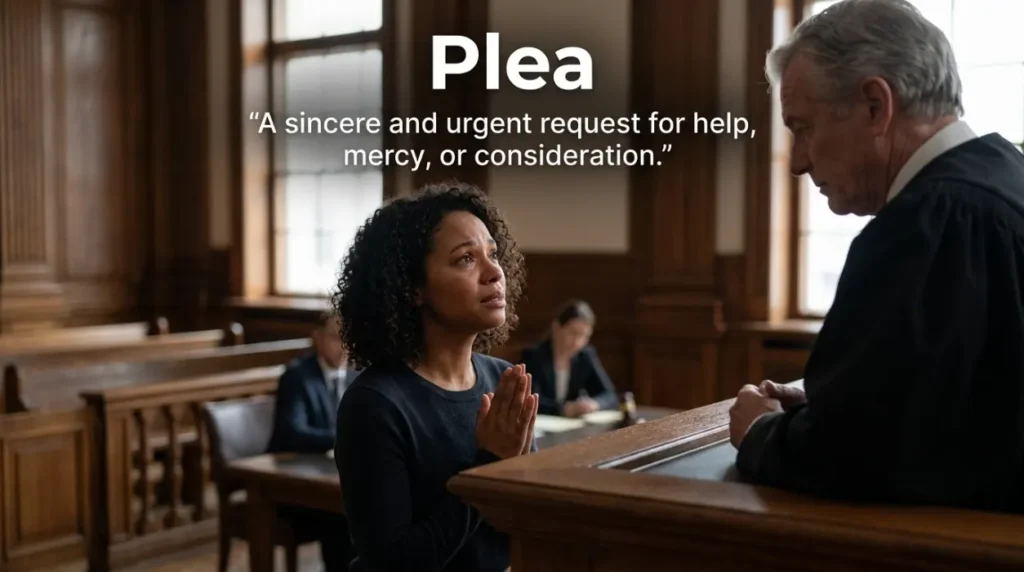
A synonym for plea can be request, appeal, entreaty, supplication, petition, or appeal for help, depending on context. In legal English, plea can also mean a defendant’s formal response to a criminal charge. The best alternative depends on whether the request sounds ordinary, emotional, urgent, formal, or legal.
A synonym for plea becomes useful when a simple request feels too plain. Imagine asking a friend for help and wanting your words to sound more sincere or urgent.
Synonym for plea options help students, bloggers, and writers express requests with greater precision and emotional depth.
A plea is common in speech, news, stories, and legal writing because it can show need, urgency, or emotion.
For daily English users, learning alternatives to plea makes emails, essays, conversations, and creative writing sound more natural.
What Does “Plea” Really Mean?
The noun plea refers to a serious or emotional request for help, action, mercy, or support.
For example, if someone says, “Please give me another chance,” that statement can be described as a plea when it carries strong emotion or urgency.
The word also has an important legal meaning. In criminal law, a plea is a defendant’s formal response to a charge, such as guilty, not guilty, or, in some jurisdictions, no contest.
Part of Speech
Plea is primarily a noun.
Simple definition:
Plea: an earnest request for something, especially help, mercy, understanding, or action.
In legal contexts, it can mean a formal answer to a criminal accusation.
How Native Speakers Understand “Plea”
Native speakers usually hear more emotion in plea than in the ordinary word request.
Compare:
- “She made a request for assistance.”
- “She made a plea for assistance.”
The second sentence suggests greater urgency or emotional importance.
Connotative Meaning
Connotation is the feeling or association a word carries beyond its basic dictionary meaning; it can make plea sound more powerful than simple alternatives.
Positive Tone
A plea can suggest sincerity, humility, compassion, or a genuine desire for help.
Negative Tone
Depending on context, it may suggest desperation, helplessness, pressure, or excessive emotional appeal.
Neutral Tone
In news reports, formal writing, and legal contexts, plea can simply describe a serious request or formal legal response without strong emotional judgment.
Etymology of “Plea”
The word plea entered English through Anglo-French, related to forms such as plai or plee. It ultimately traces to Latin placitum, meaning something agreed upon, a decision, or a judgment.
Old English: 450–1100
The modern word plea was not an ordinary Old English term. English speakers used native words connected with asking, requesting, praying, or begging. The later French-derived word entered English after the Norman Conquest.
Middle English: 1100–1500
During Middle English, forms related to plea became established through Anglo-French legal and administrative language. The word became strongly connected with legal arguments, claims, and formal responses.
Modern English: 1500–Present
Modern English developed both major senses of plea. It can describe an emotional or earnest request in everyday language and a formal legal response in legal contexts.
Pronunciation
- US: /pliː/
- UK: /pliː/
Syllables
plea
It has one syllable.
Affixation Pattern of “Plea”
- Root: plea
- Prefix: none
- Suffix: none
The word functions as a simple lexical noun rather than a word formed by adding a common English prefix or suffix.
Synonyms List
Because plea has more than one sense, the alternatives below include direct synonyms and highly useful context-specific alternatives. The legal terms are clearly identified so you can choose the right word for the situation.
1. Request (Noun) — US /rɪˈkwest/ | UK /rɪˈkwest/
Meaning: A request is an act of asking for something.
Tone/Register: Neutral, everyday.
Examples:
She sent a request for more information.
His request was answered the same afternoon.

2. Appeal (Noun) — US /əˈpiːl/ | UK /əˈpiːl/
Meaning: An appeal is an earnest request for help, support, mercy, or action.
Tone/Register: Formal, emotional.
Examples:
The family made an appeal for public support.
Her appeal encouraged several people to volunteer.
3. Entreaty (Noun) — US /ɪnˈtriːti/ | UK /ɪnˈtriːti/
Meaning: An entreaty is a strong and sincere request.
Tone/Register: Formal, literary.
Examples:
His entreaty finally softened her position.
The character answered the desperate entreaty with silence.
4. Supplication (Noun) — US /ˌsʌplɪˈkeɪʃən/ | UK /ˌsʌplɪˈkeɪʃən/
Meaning: Supplication is a humble or desperate request for help or mercy.
Tone/Register: Formal, religious, literary.
Examples:
Her supplication was directed toward those who could provide shelter.
The poem describes a soldier’s supplication for forgiveness.
5. Petition (Noun) — US /pəˈtɪʃən/ | UK /pəˈtɪʃən/
Meaning: A petition is a formal request made to an authority or organization.
Tone/Register: Formal, civic, legal.
Examples:
Residents submitted a petition against the proposed change.
The petition collected thousands of signatures.
6. Begging (Noun) — US /ˈbeɡɪŋ/ | UK /ˈbeɡɪŋ/
Meaning: Begging involves repeatedly or urgently asking for something.
Tone/Register: Informal, emotional.
Examples:
After hours of begging, he finally received permission.
Her begging showed how important the opportunity was.
7. Pleading (Noun) — US /ˈpliːdɪŋ/ | UK /ˈpliːdɪŋ/
Meaning: Pleading is an emotional act of asking someone to do or avoid something.
Tone/Register: Emotional, conversational.
Examples:
His pleading convinced his parents to reconsider.
She ignored their pleading and continued with the plan.
8. Implore (Verb) — US /ɪmˈplɔːr/ | UK /ɪmˈplɔːr/
Meaning: To implore means to ask someone earnestly and urgently.
Tone/Register: Formal, emotional.
Examples:
I implore you to think carefully before deciding.
The teacher implored the students to remain calm.
9. Beg (Verb) — US /beɡ/ | UK /beɡ/
Meaning: To beg means to ask strongly, urgently, or repeatedly.
Tone/Register: Everyday, emotional.
Examples:
She begged her brother to stay for dinner.
He begged the manager for another opportunity.
10. Entreat (Verb) — US /ɪnˈtriːt/ | UK /ɪnˈtriːt/
Meaning: To entreat means to ask someone earnestly or respectfully.
Tone/Register: Formal, literary.
Examples:
They entreated the leader to reconsider the decision.
She entreated him to listen before leaving.
11. Beseech (Verb) — US /bɪˈsiːtʃ/ | UK /bɪˈsiːtʃ/
Meaning: To beseech means to ask urgently and emotionally.
Tone/Register: Formal, literary, dramatic.
Examples:
The traveler beseeched the guard for protection.
She beseeched her friend not to give up.
12. Plead (Verb) — US /pliːd/ | UK /pliːd/
Meaning: To plead means to make an emotional or urgent request.
Tone/Register: Neutral to formal.
Examples:
He pleaded for another chance.
She pleaded with her team to remain patient.
13. Petitioning (Noun) — US /pəˈtɪʃənɪŋ/ | UK /pəˈtɪʃənɪŋ/
Meaning: Petitioning is the act of formally asking an authority to take action.
Tone/Register: Formal, civic, legal.
Examples:
The group began petitioning the council for safer roads.
Their petitioning continued throughout the summer.
14. Appeal for Mercy (Phrase) — US /əˈpiːl fər ˈmɜːrsi/ | UK /əˈpiːl fə ˈmɜːsi/
Meaning: An appeal for mercy asks someone to show kindness or reduce punishment.
Tone/Register: Formal, emotional.
Examples:
The defendant made an appeal for mercy.
The family issued an appeal for mercy before sentencing.
15. Appeal for Help (Phrase) — US /əˈpiːl fər help/ | UK /əˈpiːl fə help/
Meaning: An appeal for help is a serious request for assistance.
Tone/Register: Neutral, formal.
Examples:
The community issued an appeal for help after the storm.
Her appeal for help reached volunteers across the city.
16. Call (Noun) — US /kɔːl/ | UK /kɔːl/
Meaning: A call can be a public or serious request for action.
Tone/Register: Neutral, public-facing.
Examples:
The mayor made a call for greater cooperation.
The report included a call for immediate reform.
17. Call for Action (Phrase) — US /kɔːl fər ˈækʃən/ | UK /kɔːl fə ˈækʃən/
Meaning: A call for action urges people to do something about an issue.
Tone/Register: Formal, journalistic.
Examples:
The article ends with a call for action.
Her speech became a call for action on climate issues.
18. Urging (Noun) — US /ˈɜːrdʒɪŋ/ | UK /ˈɜːdʒɪŋ/
Meaning: Urging refers to strongly encouraging someone to act.
Tone/Register: Neutral, formal.
Examples:
His urging helped the committee reach a decision.
The doctor’s urging convinced her to seek advice.
19. Exhortation (Noun) — US /ˌeɡzɔːrˈteɪʃən/ | UK /ˌeɡzɔːˈteɪʃən/
Meaning: An exhortation is a strong statement encouraging someone to take action.
Tone/Register: Formal, rhetorical.
Examples:
The speech was an exhortation to protect local communities.
Her exhortation inspired the volunteers to continue.
20. Appeal for Support (Phrase) — US /əˈpiːl fər səˈpɔːrt/ | UK /əˈpiːl fə səˈpɔːt/
Meaning: An appeal for support asks people to provide assistance or encouragement.
Tone/Register: Formal, public.
Examples:
The charity made an appeal for support during the campaign.
His appeal for support brought new volunteers together.
21. Plea for Forgiveness (Phrase) — US /pliː fər fərˈɡɪvnəs/ | UK /pliː fə fəˈɡɪvnəs/
Meaning: A plea for forgiveness is a sincere request to be forgiven.
Tone/Register: Emotional, personal.
Examples:
He offered a heartfelt plea for forgiveness.
Her plea for forgiveness was accepted.
22. Plea for Mercy (Phrase) — US /pliː fər ˈmɜːrsi/ | UK /pliː fə ˈmɜːsi/
Meaning: A plea for mercy asks someone to respond with compassion rather than punishment.
Tone/Register: Formal, emotional.
Examples:
The prisoner made a plea for mercy.
The story ends with a quiet plea for mercy.
23. Plea for Help (Phrase) — US /pliː fər help/ | UK /pliː fə help/
Meaning: A plea for help is an urgent request for assistance.
Tone/Register: Neutral, emotional.
Examples:
The message sounded like a genuine plea for help.
Neighbors responded quickly to the plea for help.
24. Appeal to Authority (Phrase) — US /əˈpiːl tə əˈθɔːrəti/ | UK /əˈpiːl tə ɔːˈθɒrəti/
Meaning: An appeal to authority is a formal request directed toward someone with power or responsibility.
Tone/Register: Formal.
Examples:
The residents made an appeal to authority for protection.
Their appeal to authority received a written response.
25. Prayer (Noun) — US /prer/ | UK /preə/
Meaning: In some contexts, prayer can mean a humble or earnest request, especially toward a divine power.
Tone/Register: Religious, formal.
Examples:
The ceremony ended with a prayer for peace.
Her prayer expressed hope during a difficult time.
26. Supplication for Help (Phrase) — US /ˌsʌplɪˈkeɪʃən fər help/ | UK /ˌsʌplɪˈkeɪʃən fə help/
Meaning: This phrase describes a humble and urgent request for assistance.
Tone/Register: Formal, literary.
Examples:
The novel describes his supplication for help.
Her supplication for help revealed her vulnerability.
27. Appeal to Emotion (Phrase) — US /əˈpiːl tə ɪˈmoʊʃən/ | UK /əˈpiːl tə ɪˈməʊʃən/
Meaning: An appeal to emotion seeks a response by emphasizing feelings rather than only facts.
Tone/Register: Academic, analytical.
Examples:
The advertisement relies on an appeal to emotion.
The writer uses an appeal to emotion to build sympathy.
28. Request for Leniency (Phrase) — US /rɪˈkwest fər ˈliːniənsi/ | UK /rɪˈkwest fə ˈliːniənsi/
Meaning: A request for leniency asks for a less severe response or punishment.
Tone/Register: Formal, legal.
Examples:
The lawyer submitted a request for leniency.
The judge considered the request for leniency carefully.
29. Request for Clemency (Phrase) — US /rɪˈkwest fər ˈklɛmənsi/ | UK /rɪˈkwest fə ˈklemənsi/
Meaning: A request for clemency asks an authority to reduce or forgive a punishment.
Tone/Register: Formal, legal.
Examples:
The lawyer filed a request for clemency.
The family supported the request for clemency.
30. Application (Noun) — US /ˌæplɪˈkeɪʃən/ | UK /ˌæplɪˈkeɪʃən/
Meaning: An application can be a formal written request for permission, assistance, or consideration.
Tone/Register: Formal, administrative.
Examples:
She submitted an application for special permission.
The office reviewed every application carefully.
31. Submission (Noun) — US /səbˈmɪʃən/ | UK /səbˈmɪʃən/
Meaning: A submission can be a formal request or document presented for consideration.
Tone/Register: Formal, professional.
Examples:
The committee reviewed his submission.
Her submission included a detailed explanation.
32. Representation (Noun) — US /ˌreprɪzenˈteɪʃən/ | UK /ˌreprɪzenˈteɪʃən/
Meaning: In formal contexts, a representation can be a statement or request made to an authority on someone’s behalf.
Tone/Register: Formal, legal, professional.
Examples:
The lawyer made representations on behalf of the client.
The company submitted representations to the regulator.
33. Argument (Noun) — US /ˈɑːrɡjəmənt/ | UK /ˈɑːɡjʊmənt/
Meaning: In legal contexts, an argument is a reasoned position presented to persuade a court or decision-maker.
Tone/Register: Legal, academic.
Examples:
The lawyer presented a strong argument before the court.
Her argument focused on the available evidence.
34. Defense (Noun) — US /dɪˈfens/ | UK /dɪˈfens/
Meaning: A defense is a legal position used to respond to an accusation or claim.
Tone/Register: Legal, formal.
Examples:
The defense challenged the evidence.
His defense focused on the timeline of events.
35. Answer (Noun) — US /ˈænsər/ | UK /ˈɑːnsə/
Meaning: In legal usage, an answer can be a formal response to an allegation or claim.
Tone/Register: Legal, formal.
Examples:
The defendant filed an answer to the complaint.
The court received the answer before the deadline.
36. Response (Noun) — US /rɪˈspɑːns/ | UK /rɪˈspɒns/
Meaning: A response is an answer or reaction to a request, accusation, or situation.
Tone/Register: Neutral, professional.
Examples:
The agency issued a response to the public’s concerns.
His response addressed each major point.
37. Objection (Noun) — US /əbˈdʒekʃən/ | UK /əbˈdʒekʃən/
Meaning: An objection is a formal expression of opposition, especially in legal proceedings.
Tone/Register: Formal, legal.
Examples:
The attorney objected during the hearing.
The judge considered the objection before ruling.
38. Defense Pleading (Noun) — US /dɪˈfens ˈpliːdɪŋ/ | UK /dɪˈfens ˈpliːdɪŋ/
Meaning: A defense pleading is a formal legal document responding to allegations.
Tone/Register: Legal, highly formal.
Examples:
The solicitor prepared the defense pleading overnight.
The court examined the defense pleading before the hearing.
39. Legal Response (Noun) — US /ˈliːɡəl rɪˈspɑːns/ | UK /ˈliːɡəl rɪˈspɒns/
Meaning: A legal response is a formal reply to a legal accusation, claim, or proceeding.
Tone/Register: Legal, formal.
Examples:
The defendant submitted a legal response.
Her legal response addressed the allegations directly.
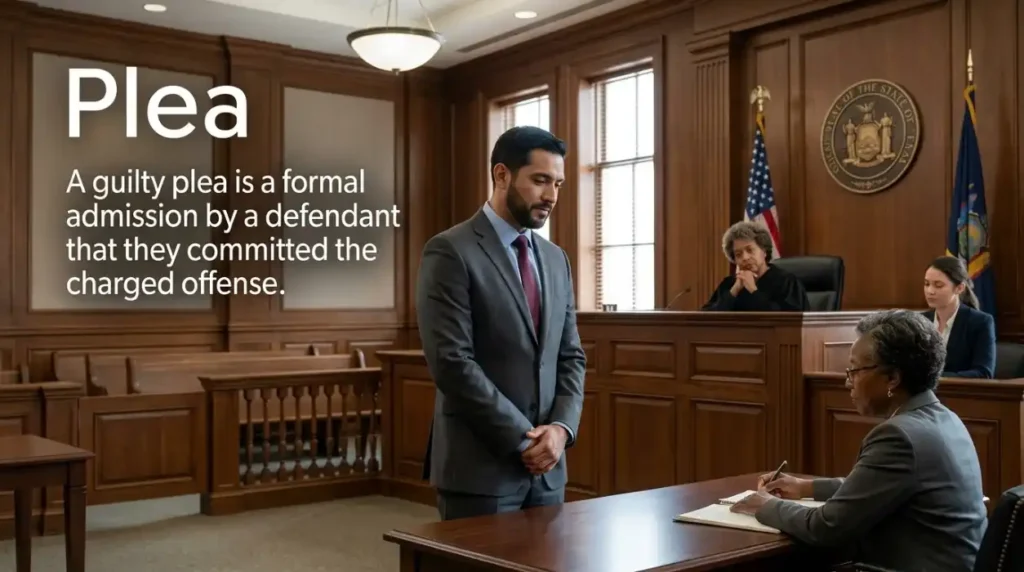
40. Guilty Plea (Phrase) — US /ˈɡɪlti pliː/ | UK /ˈɡɪlti pliː/
Meaning: A guilty plea is a formal admission by a defendant that they committed the charged offense.
Tone/Register: Legal.
Examples:
The defendant entered a guilty plea in court.
The guilty plea ended the need for a trial on that charge.
41. Admission (Noun) — US /ədˈmɪʃən/ | UK /ədˈmɪʃən/
Meaning: An admission is an acknowledgment that something is true or that one has done something.
Tone/Register: Neutral, formal.
Examples:
His admission changed the direction of the investigation.
She made an honest admission during the interview.
42. Acknowledgment (Noun) — US /əkˈnɑːlɪdʒmənt/ | UK /əkˈnɒlɪdʒmənt/
Meaning: An acknowledgment is recognition or acceptance of a fact, issue, or responsibility.
Tone/Register: Formal, professional.
Examples:
The statement included an acknowledgment of the mistake.
His acknowledgment helped rebuild trust.
43. Appeal for Understanding (Phrase) — US /əˈpiːl fər ˌʌndərˈstændɪŋ/ | UK /əˈpiːl fə ˌʌndəˈstændɪŋ/
Meaning: An appeal for understanding asks others to consider someone’s circumstances sympathetically.
Tone/Register: Polite, formal.
Examples:
She made an appeal for understanding after missing the deadline.
His appeal for understanding explained the difficult circumstances.
44. Request for Consideration (Phrase) — US /rɪˈkwest fər kənˌsɪdəˈreɪʃən/ | UK /rɪˈkwest fə kənˌsɪdəˈreɪʃən/
Meaning: A request for consideration asks someone to carefully review a situation before deciding.
Tone/Register: Formal, professional.
Examples:
The student submitted a request for consideration.
Her request for consideration included supporting details.
45. Urgent Request (Phrase) — US /ˈɜːrdʒənt rɪˈkwest/ | UK /ˈɜːdʒənt rɪˈkwest/
Meaning: An urgent request asks for something to happen quickly.
Tone/Register: Neutral, professional.
Examples:
The hospital sent an urgent request for supplies.
We received an urgent request from the field team.
46. Earnest Request (Phrase) — US /ˈɜːrnɪst rɪˈkwest/ | UK /ˈɜːnɪst rɪˈkwest/
Meaning: An earnest request is sincere, serious, and genuinely meant.
Tone/Register: Neutral, formal.
Examples:
His earnest request deserved a thoughtful reply.
She made an earnest request for another opportunity.
47. Humble Request (Phrase) — US /ˈhʌmbəl rɪˈkwest/ | UK /ˈhʌmbəl rɪˈkwest/
Meaning: A humble request is made politely without demanding anything.
Tone/Register: Polite, respectful.
Examples:
I have one humble request before we finish.
Her humble request was easy for the team to understand.
48. Desperate Appeal (Phrase) — US /ˈdespərət əˈpiːl/ | UK /ˈdespərət əˈpiːl/
Meaning: A desperate appeal is an extremely urgent request made when someone feels they have few options.
Tone/Register: Emotional, dramatic.
Examples:
The missing hiker’s family made a desperate appeal for information.
The report described a desperate appeal for immediate assistance.
49. Urgent Appeal (Phrase) — US /ˈɜːrdʒənt əˈpiːl/ | UK /ˈɜːdʒənt əˈpiːl/
Meaning: An urgent appeal is a serious request for immediate help or action.
Tone/Register: Formal, public-facing.
Examples:
Officials issued an urgent appeal for witnesses.
The organization made an urgent appeal for volunteers.
50. Heartfelt Appeal (Phrase) — US /ˈhɑːrtfelt əˈpiːl/ | UK /ˈhɑːtfelt əˈpiːl/
Meaning: A heartfelt appeal is a deeply sincere request that openly expresses emotion.
Tone/Register: Emotional, personal.
Examples:
She made a heartfelt appeal for reconciliation.
His heartfelt appeal moved everyone in the room.
Synonyms by Tone
Positive or Compassionate
These alternatives often communicate sincerity, humility, or emotional openness:
- Heartfelt appeal
- Earnest request
- Humble request
- Appeal for understanding
- Appeal for support
- Plea for forgiveness
They work well when you want to sound respectful rather than demanding.
Neutral
These choices are useful when emotion is not the main focus:
- Request
- Response
- Submission
- Application
- Answer
- Call
Use them in everyday communication, professional writing, and informational content.
Negative or Desperate
These expressions can suggest urgency, helplessness, or intense emotional pressure:
- Begging
- Desperate appeal
- Supplication
- Pleading
- Beseeching language
They are appropriate when the situation genuinely involves distress or desperation.
Formal or Legal
For official contexts, consider:
- Petition
- Legal response
- Defense
- Defense pleading
- Request for leniency
- Request for clemency
- Guilty plea
- Objection
Legal vocabulary should be chosen carefully because these terms do not all mean the same thing.
“Plea” vs. Close Alternatives
| Word | Main Difference | Typical Tone | Best Context |
|---|---|---|---|
| Plea | Serious or emotional request | Emotional/Formal | Personal appeals, news, legal language |
| Request | General act of asking | Neutral | Everyday and professional communication |
| Appeal | Strong request aimed at support or action | Formal | Public statements, campaigns, serious situations |
| Petition | Formal request to an authority | Formal | Government, organizations, legal settings |
| Entreaty | Deeply earnest request | Literary/Formal | Emotional or creative writing |
A useful rule is simple: choose request for ordinary situations, appeal for serious public or emotional situations, and petition when a formal authority is involved.
How “Plea” Changes by Context
Daily Conversation
In everyday conversation, plea usually sounds stronger than request.
For example, “I have one request” sounds ordinary. “I have one plea” sounds much more serious.
Use plea when the situation involves emotion, urgency, forgiveness, or an important personal need.
Writing and Blogging
Bloggers can use plea when describing emotional situations.
For example, a story might describe a parent’s plea for help or a community’s plea for support. In informational writing, request may sound more neutral.
Professional or Academic Writing
Professional writing often benefits from precise alternatives.
Use request, application, submission, or petition when the situation is administrative. Use appeal when describing a serious call for action.
Academic writers should avoid using plea simply to make an argument sound emotional.
Creative or Informal Writing
Creative writing gives plea more freedom.
A character can plead for forgiveness, make a desperate appeal, or whisper an emotional request. These choices can reveal personality without lengthy explanation.
Common Mistakes Learners Make
Mistake 1: Using “Plea” for Every Request
Not every request is a plea.
“Please send me the document” is a normal request. It does not automatically become a plea.
Mistake 2: Confusing “Plea” and “Petition”
A petition is usually a formal request directed toward an authority. A plea can be personal, emotional, public, or legal.
Mistake 3: Treating “Plea” as Only a Legal Word
Many learners first encounter plea in legal English. However, native speakers also use it in ordinary emotional situations.
Mistake 4: Confusing “Plea” and “Plead”
Plea is mainly a noun.
Plead is a verb.
For example:
- She made a plea for help.
- She pleaded for help.
Mistake 5: Overusing Emotional Alternatives
Words such as beseech, supplication, and entreaty can sound dramatic.
They should not replace request in every sentence.
Register Notes
Plea works in both spoken and written English, but its emotional strength changes with context.
For simple needs in everyday conversation, request is often the more natural choice.
When discussing public calls for information, donations, help, or action, journalism commonly uses the word appeal.
Within formal legal contexts, words such as plea, defense, petition, and objection can carry distinct and specialized meanings.
For creative writing, entreaty, beseech, and supplication can create a more dramatic voice.
For related vocabulary practice, you can also connect this topic with other synonym pages on your site through one relevant internal link.
Real-Life Mini Scenarios Using “Plea”

Workplace
An employee misses an important deadline because of an unexpected problem. Instead of demanding an exception, they make an earnest request for additional time.
Social Situation
A friend wants to repair a damaged relationship. Their sincere plea for forgiveness shows that the relationship matters to them.
Media and News
A public organization may issue an urgent appeal asking witnesses to share information about an event.
Writing and Storytelling
A novelist may write about a character who pleads for mercy during a difficult confrontation.
Why Choosing the Right Synonym Matters
Synonyms are not always interchangeable.
The basic idea may remain similar, but the emotional intensity, formality, and context can change significantly.
For example, request is broad and neutral. Appeal sounds more serious. Entreaty feels more literary. Supplication can sound humble or desperate.
Understanding these differences helps you write with greater control.
This is especially useful for students writing essays, bloggers creating readable articles, content writers choosing precise vocabulary, and English learners improving everyday communication.
Interactive Practice Quiz
Choose the word or phrase that best fits each situation.
1. Which word is most neutral for asking a colleague to send a file?
A. Supplication
B. Request
C. Beseeching
D. Desperate appeal
2. A community asks the government to change a policy through a formal document. Which word fits best?
A. Petition
B. Begging
C. Pleading
D. Prayer
3. Which expression best describes a deeply emotional request for forgiveness?
A. Application
B. Submission
C. Plea for forgiveness
D. Response
4. A defendant formally admits committing a crime in court. What is this called?
A. Guilty plea
B. Humble request
C. Call for action
D. Entreaty
5. Which word sounds more literary than “request”?
A. Response
B. Entreaty
C. Application
D. Answer
6. A public organization needs immediate volunteers. Which phrase fits best?
A. Urgent appeal
B. Casual request
C. Legal answer
D. Objection
7. Which word means to ask someone earnestly and urgently?
A. Allocate
B. Implore
C. Arrange
D. Submit
8. Which term is most appropriate for a formal request to reduce a punishment?
A. Request for leniency
B. Daily request
C. Display position
D. General answer
9. Which sentence uses “plea” naturally?
A. I made a plea for forgiveness.
B. Please plea the document.
C. She pleaded the email yesterday.
D. He plea the report.
10. Which alternative sounds most neutral?
A. Beseech
B. Supplication
C. Request
D. Desperate appeal
Answer Key:
1-B | 2-A | 3-C | 4-A | 5-B | 6-A | 7-B | 8-A | 9-A | 10-C
Reflection Task:
Write one sentence using plea, appeal, or request. Then rewrite the sentence with another synonym and explain how the tone changes.
Frequently Asked Questions
1. What is the best synonym for plea in everyday English?
Request is usually the best everyday alternative to plea because it is simple and neutral. However, the choice depends on the situation. Use appeal for a serious request, entreaty for a very earnest request, and petition for a formal request to an authority. If strong emotion is important, plea itself may be the most natural choice.
2. What is a good synonym for plea in formal writing?
Appeal, petition, submission, and request can work well in formal writing, depending on the context. Appeal often suggests a serious request for action or support. Petition usually involves an authority. Submission can refer to a formal document presented for consideration. Choose the word that matches the exact purpose of the request.
3. What is the difference between a plea and an appeal?
A plea often carries personal emotion, urgency, or desperation. An appeal can also be emotional, but it frequently refers to a public or formal request for support, action, or information. For example, someone may make a plea for forgiveness, while an organization may issue an appeal for volunteers.
4. Is “plea” a positive or negative word?
Plea is not inherently positive or negative. Its connotation depends on the situation. It can suggest sincerity, humility, and compassion when someone asks for help. In another context, it can suggest desperation or helplessness. In legal writing, it may be neutral and simply describe a defendant’s formal response to a charge.
5. What is the difference between plea and request?
A request is a broad and neutral act of asking for something. A plea usually suggests that the matter is more serious, emotional, urgent, or personally important. Saying “I made a request” sounds routine, while “I made a plea” suggests that the speaker strongly needs or wants a particular response.
6. Can plea be used in legal English?
Yes. Plea is an important legal term, particularly in criminal proceedings. A defendant may enter a guilty plea or a not-guilty plea, depending on the legal system and circumstances. Legal terminology can vary by jurisdiction, so specialized legal meanings should be interpreted within the relevant court or legal system.
7. What is the verb form of plea?
The related verb is plead. For example, “She made a plea for help” uses the noun, while “She pleaded for help” uses the verb. The verb can describe an emotional request and can also appear in legal contexts, such as when a defendant pleads guilty or not guilty.
Suggested External Link Source:
Cambridge Dictionary is useful for checking definitions, pronunciation, word forms, and example usage for plea and related vocabulary.
Conclusion
Learning a synonym for plea helps you express requests with greater accuracy, emotion, and confidence in essays, blogs, emails, and conversations.
Words such as request, appeal, petition, entreaty, and supplication each create a slightly different tone, so context should guide your choice.
For students and content writers, these distinctions make writing clearer. For daily speakers, they make emotional and formal communication feel more natural.
Keep practicing these words in emails, essays, stories, and conversations. A few new synonyms can make your English more precise, expressive, and confident.

Jameel Hassan is the founder and lead writer at SynonymsCloud.com, a trusted online platform dedicated to English vocabulary and effective communication. He is passionate about helping students, writers, professionals, and lifelong learners discover the right words to express their ideas with clarity, precision, and confidence.
At SynonymsCloud.com, every article is thoroughly researched and carefully written to provide accurate, practical, and easy-to-understand guidance on synonyms, antonyms, word meanings, idioms, and vocabulary. With a strong commitment to quality, real-world usage, and clear explanations, the website helps readers expand their vocabulary, improve their writing, and communicate more effectively in both academic and professional settings.