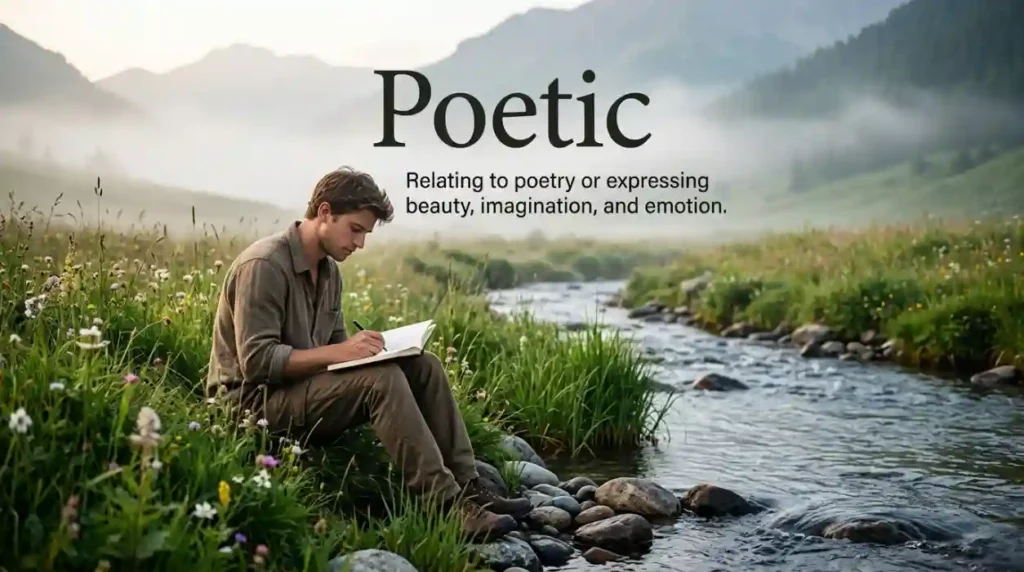
A synonym for poetic can be lyrical, expressive, evocative, artistic, imaginative, romantic, eloquent, or literary. The best choice depends on the quality you want to emphasize. Lyrical highlights musical language, evocative suggests strong imagery or emotion, while literary connects more directly with refined or artistic writing.
A synonym for poetic matters when a description feels flat. Imagine describing a sunset and wanting your words to feel as beautiful as the scene itself.
A synonym for poetic can make essays, stories, captions, and articles more expressive without sounding forced or overly dramatic.
The word poetic is common because it describes language, images, music, and moments that feel beautiful, emotional, or artistic.
For students, bloggers, content writers, and daily speakers, synonym for poetic choices add variety and help communicate subtle feelings.
What Does “Poetic” Really Mean?
Poetic describes something that has the qualities associated with poetry.
It can refer to language that sounds beautiful, imaginative, emotional, rhythmic, or rich in imagery. It does not have to appear in an actual poem.
For example:
“The moon painted a silver path across the lake.”
This sentence can be called poetic because it uses imaginative imagery rather than simply stating that moonlight appeared on the water.
Part of Speech
Poetic is primarily an adjective.
Simple definition:
Poetic: having the beauty, imagination, emotion, imagery, or expressive quality commonly associated with poetry.
How Native Speakers Understand “Poetic”
Native speakers often use poetic in two broad ways.
First, it can describe actual poetry or language that resembles poetry.
Second, it can describe something beautiful or emotionally meaningful in everyday life.
For example, someone might describe a quiet snowfall as “poetic” even though the snowfall itself contains no words.
Common Contexts
You may see poetic in:
- Literature
- Poetry
- Creative writing
- Music reviews
- Film descriptions
- Personal essays
- Social media captions
- Romantic descriptions
- Speeches
- Everyday conversations about beauty
Connotative Meaning
Connotation (the feeling, association, or emotional suggestion connected with a word beyond its basic definition) is important when choosing an alternative to poetic.
Positive Tone
Poetic often has a positive association with beauty, creativity, elegance, imagination, and emotional depth.
Negative Tone
In some situations, poetic can suggest language that is too decorative, vague, sentimental, or unrealistic.
For example, a reader might say that a business report sounds “too poetic” if it needs direct facts instead of emotional imagery.
Neutral Tone
In literary analysis, poetic can simply describe a particular style, technique, or quality without praising or criticizing it.
Etymology of “Poetic”
The word poetic comes through Latin and Greek traditions associated with poetry and creative composition.
It ultimately relates to Greek poietikos, meaning “creative” or “productive,” from poiein, meaning “to make” or “to create.”
Old English: 450–1100
The modern word poetic was not part of everyday Old English vocabulary. Old English had native words for poetry, verse, song, and artistic expression.
Middle English: 1100–1500
After the Norman Conquest, English absorbed many French and Latin literary terms. Scholarly vocabulary connected with poetry and classical literature became increasingly established.
Modern English: 1500–Present
During Modern English, poetic became a standard adjective for describing poetry and qualities associated with poetic expression. Its meaning later expanded into everyday descriptions of beauty, emotion, imagery, and artistic moments.
Pronunciation
- US: /poʊˈetɪk/
- UK: /pəʊˈetɪk/
Syllables
po-et-ic
It has three syllables.
Affixation Pattern of “Poetic”
- Root: poet
- Prefix: none
- Suffix: -ic
The suffix -ic forms an adjective meaning “relating to” or “characteristic of.”
Synonyms List
Some words below are direct synonyms, while others express a particular shade of the broader idea behind poetic. This distinction helps you choose words naturally instead of treating every alternative as interchangeable.
1. Lyrical (Adjective) — US /ˈlɪrɪkəl/ | UK /ˈlɪrɪkəl/
Meaning: Lyrical describes language that is expressive, musical, and emotionally flowing.
Tone/Register: Literary, artistic.
Examples:
Her lyrical description made the quiet garden feel alive.
The songwriter uses lyrical language to express longing.

2. Literary (Adjective) — US /ˈlɪtəreri/ | UK /ˈlɪtərəri/
Meaning: Literary describes language or style associated with imaginative and accomplished writing.
Tone/Register: Formal, academic.
Examples:
The novel has a rich literary style.
His literary description gave the scene unusual depth.
3. Expressive (Adjective) — US /ɪkˈspresɪv/ | UK /ɪkˈspresɪv/
Meaning: Expressive describes language that communicates feelings or ideas strongly.
Tone/Register: Neutral, artistic.
Examples:
Her expressive voice made the story memorable.
The painting uses expressive shapes to suggest movement.
4. Evocative (Adjective) — US /ɪˈvɑːkətɪv/ | UK /ɪˈvɒkətɪv/
Meaning: Evocative describes something that brings vivid feelings, memories, or images to mind.
Tone/Register: Literary, descriptive.
Examples:
The old photograph is deeply evocative.
His description was evocative of childhood summers.
5. Imaginative (Adjective) — US /ɪˈmædʒənətɪv/ | UK /ɪˈmædʒɪnətɪv/
Meaning: Imaginative describes language or ideas that show creative thinking.
Tone/Register: Neutral, creative.
Examples:
The child gave an imaginative explanation for the strange sound.
Her imaginative story transported readers to another world.
6. Artistic (Adjective) — US /ɑːrˈtɪstɪk/ | UK /ɑːˈtɪstɪk/
Meaning: Artistic describes something showing creativity or skill in the arts.
Tone/Register: Neutral, creative.
Examples:
The filmmaker chose an artistic way to show the character’s loneliness.
The room has several artistic details.
7. Romantic (Adjective) — US /roʊˈmæntɪk/ | UK /rəʊˈmæntɪk/
Meaning: Romantic can describe language or imagery that emphasizes love, beauty, or idealized emotion.
Tone/Register: Emotional, literary.
Examples:
The letter has a romantic quality without sounding exaggerated.
They chose a romantic setting for their anniversary dinner.
8. Eloquent (Adjective) — US /ˈeləkwənt/ | UK /ˈeləkwənt/
Meaning: Eloquent describes speech or writing that expresses ideas beautifully and effectively.
Tone/Register: Formal, polished.
Examples:
Her eloquent speech moved the audience.
The article gives an eloquent explanation of loss.
9. Rhapsodic (Adjective) — US /ræpˈsɑːdɪk/ | UK /ræpˈsɒdɪk/
Meaning: Rhapsodic describes highly enthusiastic, emotional, or expressive language.
Tone/Register: Literary, dramatic.
Examples:
The critic became rhapsodic when describing the performance.
His rhapsodic review captured the excitement of the concert.
10. Vivid (Adjective) — US /ˈvɪvɪd/ | UK /ˈvɪvɪd/
Meaning: Vivid describes language that creates a clear and strong mental picture.
Tone/Register: Neutral, descriptive.
Examples:
She gave a vivid account of the mountain journey.
The author uses vivid details to build tension.
11. Descriptive (Adjective) — US /dɪˈskrɪptɪv/ | UK /dɪˈskrɪptɪv/
Meaning: Descriptive language gives detailed information about how something looks, feels, sounds, or behaves.
Tone/Register: Neutral, academic.
Examples:
The travel article is highly descriptive.
His descriptive writing helped readers picture the village.
12. Figurative (Adjective) — US /ˈfɪɡjərətɪv/ | UK /ˈfɪɡjərətɪv/
Meaning: Figurative language uses images, comparisons, or meanings beyond literal wording.
Tone/Register: Academic, literary.
Examples:
The poem relies on figurative language to discuss grief.
Her figurative description compares time to a river.
13. Metaphorical (Adjective) — US /ˌmetəˈfɔːrɪkəl/ | UK /ˌmetəˈfɒrɪkəl/
Meaning: Metaphorical describes language that compares one thing with another to create meaning.
Tone/Register: Literary, academic.
Examples:
The writer gives the storm a metaphorical role in the story.
His metaphorical language makes the conflict easier to understand.
14. Flowery (Adjective) — US /ˈflaʊəri/ | UK /ˈflaʊəri/
Meaning: Flowery describes language that is highly decorative or elaborate.
Tone/Register: Informal, sometimes critical.
Examples:
The invitation uses flowery language throughout.
I prefer simple words instead of flowery expressions.
15. Musical (Adjective) — US /ˈmjuːzɪkəl/ | UK /ˈmjuːzɪkəl/
Meaning: Musical describes language that has a pleasing rhythm or sound.
Tone/Register: Literary, artistic.
Examples:
The poem has a musical quality when read aloud.
Her musical phrasing made the speech pleasant to hear.
16. Melodious (Adjective) — US /məˈloʊdiəs/ | UK /məˈləʊdiəs/
Meaning: Melodious describes something that has a pleasant and tuneful sound.
Tone/Register: Literary, descriptive.
Examples:
The poet chose melodious words for the final stanza.
His melodious reading held everyone’s attention.
17. Sonorous (Adjective) — US /ˈsɑːnərəs/ | UK /ˈsɒnərəs/
Meaning: Sonorous describes a rich, deep, or resonant sound.
Tone/Register: Formal, literary.
Examples:
The narrator has a sonorous voice.
His sonorous delivery gave the poem greater weight.
18. Rhythmic (Adjective) — US /ˈrɪðmɪk/ | UK /ˈrɪðmɪk/
Meaning: Rhythmic describes language that follows a noticeable and pleasing pattern of sound.
Tone/Register: Neutral, literary.
Examples:
The rhythmic sentences make the passage easy to remember.
The poet creates a rhythmic flow through repeated sounds.
19. Aesthetic (Adjective) — US /esˈθetɪk/ | UK /iːsˈθetɪk/
Meaning: Aesthetic describes something related to beauty, artistic appearance, or appreciation.
Tone/Registers: Academic, artistic.
Example:
The film has a distinct aesthetic style.
The designer focused on the room’s aesthetic appeal.
20. Beautiful (Adjective) — US /ˈbjuːtɪfəl/ | UK /ˈbjuːtɪfəl/
Meaning: Beautiful describes something that gives strong pleasure through appearance, sound, feeling, or quality.
Tone/Register: Neutral, everyday.
Examples:
She wrote a beautiful message for her grandmother.
The final scene was simple but beautiful.
21. Elegant (Adjective) — US /ˈeləɡənt/ | UK /ˈelɪɡənt/
Meaning: Elegant describes something graceful, refined, and pleasingly simple or stylish.
Tone/Register: Formal, polished.
Examples:
The author uses elegant language without adding unnecessary detail.
Her elegant description captured the mood perfectly.
22. Graceful (Adjective) — US /ˈɡreɪsfəl/ | UK /ˈɡreɪsfəl/
Meaning: Graceful describes language or expression that feels smooth, refined, and pleasing.
Tone/Register: Neutral, literary.
Examples:
His graceful writing made the difficult subject approachable.
The dancer moved with graceful precision.
23. Dreamlike (Adjective) — US /ˈdriːmlaɪk/ | UK /ˈdriːmlaɪk/
Meaning: Dreamlike describes something that feels unreal, magical, or similar to a dream.
Tone/Register: Creative, literary.
Examples:
The movie creates a dreamlike atmosphere.
Mist over the lake gave the morning a dreamlike quality.
24. Enchanting (Adjective) — US /ɪnˈtʃæntɪŋ/ | UK /ɪnˈtʃæntɪŋ/
Meaning: Enchanting describes something unusually charming, delightful, or captivating.
Tone/Register: Positive, literary.
Examples:
The storyteller created an enchanting world for young readers.
We found an enchanting little village near the coast.
25. Poeticized (Adjective) — US /poʊˈetɪsaɪzd/ | UK /pəʊˈetɪsaɪzd/
Meaning: Poeticized describes something presented in a more idealized or poetic manner.
Tone/Register: Literary, academic.
Examples:
The film poeticized the character’s memories.
The biography poeticized several ordinary moments.
26. Idealized (Adjective) — US /aɪˈdiːəlaɪzd/ | UK /aɪˈdɪəlaɪzd/
Meaning: Idealized describes something presented as more perfect or beautiful than reality.
Tone/Register: Neutral, analytical.
Examples:
The novel presents an idealized version of rural life.
The painting gives an idealized view of the past.
27. Sentimental (Adjective) — US /ˌsentəˈmentəl/ | UK /ˌsentɪˈmentəl/
Meaning: Sentimental describes language strongly influenced by tender or nostalgic feelings.
Tone/Register: Emotional, sometimes critical.
Examples:
The farewell scene is sentimental but sincere.
He kept the sentimental note in an old box.
28. Romanticized (Adjective) — US /roʊˈmæntəsaɪzd/ | UK /rəʊˈmæntɪsaɪzd/
Meaning: Romanticized describes something portrayed as more attractive, exciting, or ideal than it really is.
Tone/Register: Literary, analytical.
Examples:
The documentary avoids romanticized images of village life.
The novel presents a romanticized picture of the era.
29. Ornate (Adjective) — US /ɔːrˈneɪt/ | UK /ɔːˈneɪt/
Meaning: Ornate describes language or design containing many elaborate decorative details.
Tone/Register: Formal, descriptive.
Examples:
The poem uses ornate language and complex imagery.
The palace has an ornate interior.
30. Elaborate (Adjective) — US /ɪˈlæbərət/ | UK /ɪˈlæbərət/
Meaning: Elaborate describes something developed with considerable detail or complexity.
Tone/Register: Neutral, formal.
Examples:
The writer created an elaborate description of the city.
Her elaborate imagery fills the opening chapter.
31. Impressive (Adjective) — US /ɪmˈpresɪv/ | UK /ɪmˈpresɪv/
Meaning: Impressive describes something that strongly affects or attracts attention.
Tone/Register: Neutral.
Examples:
The speaker gave an impressive performance.
The final paragraph creates an impressive emotional effect.
32. Moving (Adjective) — US /ˈmuːvɪŋ/ | UK /ˈmuːvɪŋ/
Meaning: Moving describes something that produces strong emotional feelings.
Tone/Register: Emotional, everyday.
Examples:
Her letter was deeply moving.
The film ends with a moving tribute to the victims.
33. Touching (Adjective) — US /ˈtʌtʃɪŋ/ | UK /ˈtʌtʃɪŋ/
Meaning: Touching describes something that creates tender or sympathetic emotion.
Tone/Register: Emotional, everyday.
Examples:
His message was short but touching.
The reunion was a touching moment for everyone.
34. Soulful (Adjective) — US /ˈsoʊlfəl/ | UK /ˈsoʊlfəl/
Meaning: Soulful describes an expression that communicates deep feeling or emotional sincerity.
Tone/Register: Artistic, emotional.
Examples:
The singer delivered a soulful performance.
Her soulful writing reveals a deeply personal experience.
35. Introspective (Adjective) — US /ˌɪntrəˈspektɪv/ | UK /ˌɪntrəˈspektɪv/
Meaning: Introspective describes writing or expression that examines inner thoughts and feelings.
Tone/Register: Literary, academic.
Examples:
The memoir has an introspective tone.
His introspective essay explores the meaning of failure.
36. Reflective (Adjective) — US /rɪˈflektɪv/ | UK /rɪˈflektɪv/
Meaning: Reflective describes thoughtful language that considers experiences or ideas deeply.
Tone/Register: Academic, thoughtful.
Examples:
Her reflective essay discusses what she learned from the journey.
The final chapter has a calm, reflective mood.
37. Imaginative (Adjective) — US /ɪˈmædʒənətɪv/ | UK /ɪˈmædʒɪnətɪv/
Meaning: Imaginative describes creative expression that goes beyond ordinary ideas.
Tone/Register: Creative.
Examples:
The children’s book uses imaginative descriptions of space.
His imaginative approach made the lesson memorable.
38. Symbolic (Adjective) — US /sɪmˈbɑːlɪk/ | UK /sɪmˈbɒlɪk/
Meaning: Symbolic describes something that represents a deeper idea or feeling.
Tone/Register: Literary, academic.
Examples:
The broken clock has a symbolic role in the story.
The final image is symbolic of lost time.
39. Allusive (Adjective) — US /əˈluːsɪv/ | UK /əˈluːsɪv/
Meaning: Allusive describes language that indirectly refers to another idea, text, person, or event.
Tone/Register: Literary, academic.
Examples:
The poem is allusive and rewards careful reading.
Her allusive comment hinted at an earlier conversation.
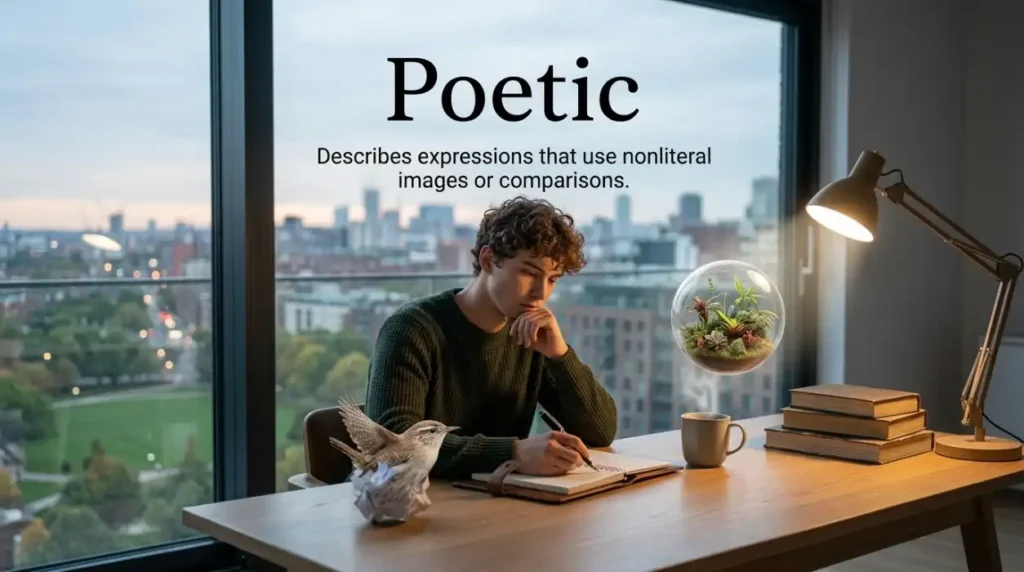
40. Figurative (Adjective) — US /ˈfɪɡjərətɪv/ | UK /ˈfɪɡjərətɪv/
Meaning: Figurative describes expressions that use nonliteral images or comparisons.
Tone/Register: Literary, academic.
Examples:
The author uses figurative language to describe fear.
His figurative comparison gives the scene a darker mood.
41. Romanticist (Adjective) — US /roʊˈmæntəsɪst/ | UK /rəʊˈmæntəsɪst/
Meaning: Romanticist relates to the Romantic tradition in art and literature.
Tone/Register: Academic, literary.
Examples:
The professor discussed the poet’s Romanticist influences.
The painting contains several Romanticist features.
42. Creative (Adjective) — US /kriˈeɪtɪv/ | UK /kriˈeɪtɪv/
Meaning: Creative describes original ideas or artistic expression.
Tone/Register: Neutral, professional.
Examples:
She found a creative way to describe the city.
The campaign uses creative storytelling to attract attention.
43. Artful (Adjective) — US /ˈɑːrtfəl/ | UK /ˈɑːtfəl/
Meaning: Artful describes something made with skill, cleverness, or artistic control.
Tone/Register: Literary, polished.
Examples:
The author makes an artful transition between past and present.
His artful use of silence strengthens the scene.
44. Colorful (Adjective) — US /ˈkʌlərfəl/ | UK /ˈkʌləfəl/
Meaning: Colorful can describe language that is vivid, lively, and rich in detail.
Tone/Register: Informal, descriptive.
Examples:
The guide gives a colorful account of the city’s history.
Her colorful storytelling kept the children interested.
45. Lush (Adjective) — US /lʌʃ/ | UK /lʌʃ/
Meaning: Lush describes language that is rich, abundant, and highly descriptive.
Tone/Register: Literary, descriptive.
Example:
The novel contains lush descriptions of the countryside.
The writer creates a lush world through sensory details.
46. Sensuous (Adjective) — US /ˈsenʃuəs/ | UK /ˈsenʃuəs/
Meaning: Sensuous describes language that strongly appeals to the senses.
Tone/Register: Literary, descriptive.
Examples:
The chef uses sensuous language to describe the dessert.
The poem creates a sensuous picture of summer rain.
47. Atmospheric (Adjective) — US /ˌætməsˈferɪk/ | UK /ˌætməsˈferɪk/
Meaning: Atmospheric describes something that strongly creates a particular mood or feeling.
Tone/Register: Literary, creative.
Examples:
The director creates an atmospheric opening scene.
The fog makes the old street feel atmospheric and mysterious.
48. Otherworldly (Adjective) — US /ˌʌðərˈwɜːrldli/ | UK /ˌʌðəˈwɜːldli/
Meaning: Otherworldly describes something that seems magical, strange, or beyond ordinary experience.
Tone/Register: Creative, literary.
Examples:
The northern lights created an otherworldly scene.
Her voice gave the song an otherworldly quality.
49. Inspiring (Adjective) — US /ɪnˈspaɪərɪŋ/ | UK /ɪnˈspaɪərɪŋ/
Meaning: Inspiring describes something that creates enthusiasm, hope, or a desire to act.
Tone/Register: Positive, everyday.
Examples:
The teacher shared an inspiring story with the class.
The mural carries an inspiring message about community.
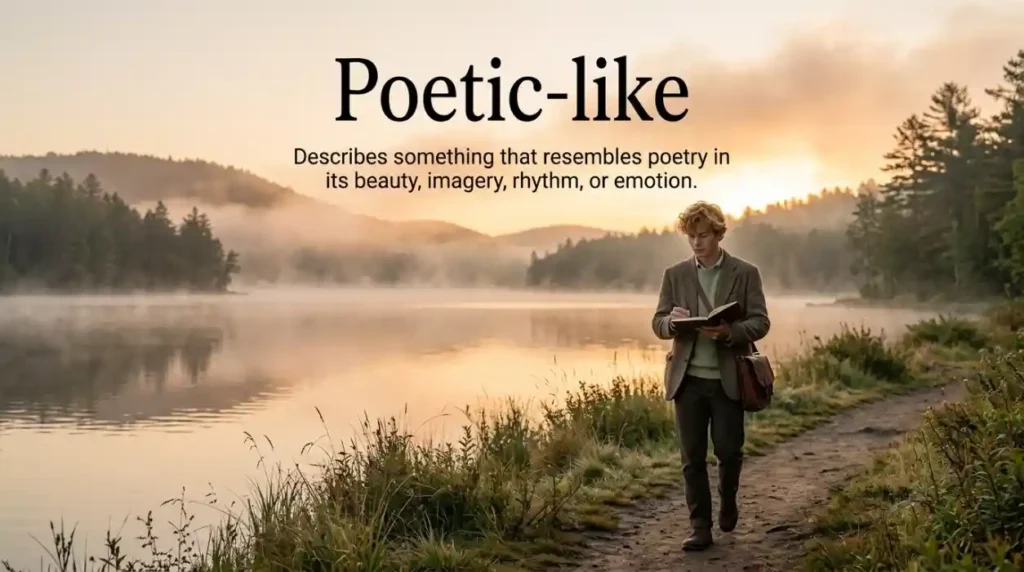
50. Poetic-Like (Adjective) — US /poʊˈetɪk laɪk/ | UK /pəʊˈetɪk laɪk/
Meaning: Poetic-like describes something that resembles poetry in its beauty, imagery, rhythm, or emotion.
Tone/Register: Informal, descriptive.
Examples:
The short film has a poetic-like quality.
Her diary entries often feel poetic-like and intimate.
Synonyms by Tone
Positive and Admiring
Use these when you want to praise someone’s expressive style:
- Lyrical
- Eloquent
- Evocative
- Enchanting
- Elegant
- Beautiful
- Soulful
- Inspiring
- Graceful
- Atmospheric
These words usually communicate appreciation rather than criticism.
Neutral
These alternatives describe a style without strongly judging it:
- Literary
- Expressive
- Descriptive
- Figurative
- Symbolic
- Creative
- Reflective
- Vivid
- Aesthetic
- Imaginative
They are useful in essays, reviews, classroom discussions, and content writing.
Potentially Negative or Critical
Some words can imply that the writing is excessively decorative:
- Flowery
- Ornate
- Sentimental
- Romanticized
- Elaborate
For example, flowery language often suggests that a writer uses more decoration than necessary.
Playful or Informal
For casual descriptions, these can work:
- Dreamlike
- Colorful
- Lush
- Otherworldly
- Poetic-like
Tone matters because choosing the wrong synonym can change your message. Calling a report flowery may criticize it, while calling the same report eloquent may praise it.
“Poetic” vs. Close Alternatives
Lyrical vs Poetic
Poetic is broad. It can describe beauty, imagery, emotion, or a poetic quality.
Lyrical focuses more strongly on musical, flowing, and emotionally expressive language.
Use poetic for a broad artistic quality. Use lyrical when rhythm and emotional flow are especially noticeable.
Eloquent vs. Poetic
Poetic emphasizes beauty and imagination.
Eloquent emphasizes effective and graceful communication.
A speech can be eloquent without being poetic.
Poetic vs. Flowery
Poetic is usually positive or neutral.
Flowery can suggest that language is excessively decorative.
Calling someone’s writing poetic can be praise. Calling it flowery may imply that the style needs simplification.
How “Poetic” Changes by Context
Daily Conversation
In casual English, poetic often describes something unexpectedly beautiful or emotionally meaningful.
You might say, “That moment was poetic,” after watching two old friends reunite.
Writing and Blogging
Bloggers use poetic to describe expressive language, vivid descriptions, and emotional storytelling.
However, informational content should remain clear. Adding too many decorative phrases can make practical information harder to understand.
Professional or Academic Tone
Academic writers may use terms such as literary, figurative, symbolic, metaphorical, or evocative when they need greater precision.
For example, a literature student can explain that an author’s language is “highly evocative” rather than simply calling it “nice.”
Creative or Informal Use
Creative writing welcomes words such as dreamlike, lush, lyrical, and otherworldly.
These choices can establish mood quickly and help readers imagine a scene.
Common Mistakes and Native Usage
Mistake 1: Treating Every Synonym as Identical
Not every alternative means the same thing.
Lyrical highlights musical language, while vivid focuses on clear mental imagery.
Mistake 2: Using “Poetic” for Any Beautiful Thing
Something can be beautiful without being poetic.
Native speakers often use poetic when the beauty also feels symbolic, expressive, emotional, or unusually meaningful.
Mistake 3: Confusing “Poetic” With “Poetry”
Poetry is a noun referring to a literary form or body of poems.
Poetic is an adjective describing something connected with poetry or possessing poetic qualities.
Mistake 4: Using “Flowery” as a Simple Positive Synonym
Flowery is not always praise.
It can suggest that writing contains too many decorative words.
Mistake 5: Overusing “Eloquent”
Eloquent is best when language communicates ideas effectively and beautifully.
It does not always mean imaginative or poetic.
Register Notes
Poetic works in casual speech, creative writing, literary criticism, and general descriptive English.
Lyrical, evocative, and rhapsodic are more literary.
Figurative, metaphorical, and symbolic are especially useful in academic analysis.
Flowery is more informal and can be critical.
Beautiful, creative, and vivid are flexible choices for everyday English.
For related vocabulary practice, one relevant synonym page can be used as an internal link without interrupting the reader’s flow.
Real-Life Mini Scenarios
Workplace
A designer presents a campaign that uses emotional storytelling. A manager might call the concept creative or expressive rather than simply poetic.
Social Situation
Two childhood friends meet again after many years. Someone watching the reunion might describe the moment as poetic or touching.
Media and Pop Culture
A reviewer describing a film’s visual style may call it dreamlike, atmospheric, cinematic, or evocative.
Writing and Storytelling
A novelist describing rain on an empty street might choose lyrical, sensuous, or vivid language to create a stronger mental image.
How to Choose the Right Synonym
When the language has musical rhythm and flowing expression, lyrical is a suitable choice.
For writing that forms a strong picture in the reader’s mind, consider vivid or evocative.
When the goal is to express ideas in a graceful and beautiful way, eloquent may fit better.
In cases where the language uses comparisons or meanings beyond the literal sense, choose figurative or metaphorical.
To describe words that build a strong emotional setting or mood, atmospheric can be more precise.
For language that feels overly decorative or excessively embellished, flowery may be the most accurate alternative.
This approach gives writers more control than simply replacing poetic with the first synonym they find.
Practice Exercise
Choose the best answer for each situation.
1. A poem has beautiful rhythm and emotional flow. Which word fits best?
A. Lyrical
B. Administrative
C. Technical
D. Literal
2. A writer creates a strong mental picture of a forest. Which word is most suitable?
A. Vivid
B. Legal
C. Formal
D. Ordinary
3. A speech communicates complex ideas beautifully and effectively. Which word fits best?
A. Eloquent
B. Flowery
C. Symbolic
D. Dreamlike
4. A business report contains too many decorative phrases. Which description may sound critical?
A. Flowery
B. Concise
C. Practical
D. Direct
5. A film creates a mysterious mood through lighting and sound. Which word fits best?
A. Atmospheric
B. Administrative
C. Numerical
D. Literal
6. A poem indirectly represents grief through a broken mirror. Which term is most suitable?
A. Symbolic
B. Ordinary
C. Practical
D. Casual
7. Which word best describes language connected with sensory experience?
A. Sensuous
B. Legal
C. Statistical
D. Administrative
8. A student analyzes comparisons that are not meant literally. Which term should they use?
A. Figurative
B. Casual
C. Practical
D. Technical
9. Which word suggests language with a musical quality?
A. Lyrical
B. Mechanical
C. Numerical
D. Direct
10. A writer examines personal thoughts and inner feelings. Which word fits?
A. Introspective
B. Commercial
C. Literal
D. Administrative
Answer Key:
1-A | 2-A | 3-A | 4-A | 5-A | 6-A | 7-A | 8-A | 9-A | 10-A
Reflection Task:
Choose one synonym from this article and write a sentence about a book, song, film, person, place, or memory. Then explain why that synonym fits.
Frequently Asked Questions
1. What is the best synonym for poetic in writing?
There is no single best replacement for poetic in every sentence. Lyrical works well for musical and emotional writing, evocative suits language that creates strong memories or images, and eloquent fits polished communication. If you mean imaginative language specifically, literary, figurative, or vivid may be more precise.
2. What is another word for poetic language?
Useful alternatives for poetic language include lyrical language, figurative language, expressive language, evocative language, and literary language. The best option depends on what makes the language poetic. For example, figurative emphasizes nonliteral expression, while lyrical emphasizes rhythm, musicality, and emotional flow.
3. What is a synonym for poetic that starts with L?
Lyrical is the strongest common alternative beginning with L. It describes language that is expressive, musical, and emotionally flowing. Another possible term is literary, although it has a broader meaning. Literary refers to qualities associated with serious or imaginative writing and does not necessarily imply the emotional or musical quality of poetic.
4. What is a synonym for poetic in a positive sense?
For a positive description, consider lyrical, eloquent, evocative, elegant, enchanting, graceful, soulful, or beautiful. These words can praise different qualities. For example, eloquent praises effective expression, while evocative praises the ability to create strong images or emotions. Choosing the precise word makes your compliment more meaningful.
5. What is the difference between poetic and lyrical?
Poetic is a broad adjective for qualities associated with poetry, including imagery, beauty, emotion, and symbolism. Lyrical is more specific and often emphasizes musicality, rhythm, emotional expression, and flowing language. A piece of writing can be poetic without being strongly lyrical, especially when its main strength is imagery or symbolism.
6. Can poetic be used to describe a person?
Yes, but the meaning depends on context. Calling someone’s speech or writing poetic suggests that they express ideas with beauty, imagery, emotion, or imagination. It can also describe someone’s way of seeing the world. However, if you mean that a person writes poems, say poet rather than poetic.
7. Is flowery a positive synonym for poetic?
Not always. Flowery describes language that is highly decorative or elaborate, and it can be critical. If you want to praise someone’s beautiful expression, lyrical, eloquent, or evocative is usually safer. Use flowery when you specifically want to suggest that the language contains more decoration than necessary.
Suggested External Link Source:
Cambridge Dictionary is useful for checking definitions, pronunciation, meanings, and examples for poetic and related vocabulary.
Conclusion
Learning a synonym for poetic gives your writing more color, feeling, and precision. It helps you describe beauty without relying on the same word again and again.
Words like lyrical, evocative, eloquent, vivid, and expressive highlight different qualities, making essays, blogs, stories, and conversations stronger.
Good vocabulary is not about using difficult words. It is about choosing the word that matches your exact meaning, mood, audience, and purpose.
Practice these alternatives in emails, essays, captions, and daily conversations. A few thoughtful word choices can make your English clearer, richer, and more memorable.

Jameel Hassan is the founder and lead writer at SynonymsCloud.com, a trusted online platform dedicated to English vocabulary and effective communication. He is passionate about helping students, writers, professionals, and lifelong learners discover the right words to express their ideas with clarity, precision, and confidence.
At SynonymsCloud.com, every article is thoroughly researched and carefully written to provide accurate, practical, and easy-to-understand guidance on synonyms, antonyms, word meanings, idioms, and vocabulary. With a strong commitment to quality, real-world usage, and clear explanations, the website helps readers expand their vocabulary, improve their writing, and communicate more effectively in both academic and professional settings.