Core synonyms for chronology include timeline, sequence, order, and progression. Use schedule or itinerary for organized plans, annals for historical records, continuum for ongoing development, and provenance for ownership history. For strategic planning, roadmap highlights future stages and milestones. Choose each term according to context and meaning.
Synonyms for chronology help you describe events, timelines, and historical records with greater clarity and precision. Whether you are explaining a project, documenting research, or sharing a personal story, the right time-related words can make your message easier to follow.
When you naturally discuss events in order, repeating the same terms can make your writing feel dull. Using varied vocabulary gives your sentences a smoother flow while helping readers understand when things happened and how each event connects.
Writers, students, researchers, and content creators can use synonyms for chronology to make detailed narratives more engaging. Words related to sequence, timeline, progression, and order provide useful alternatives for different writing situations.
Building a strong vocabulary with synonyms for chronology can improve both clarity and style. Choose precise terms that match your context, guide readers through events confidently, and make every timeline easier to understand.
What Does “Chronology” Really Mean?
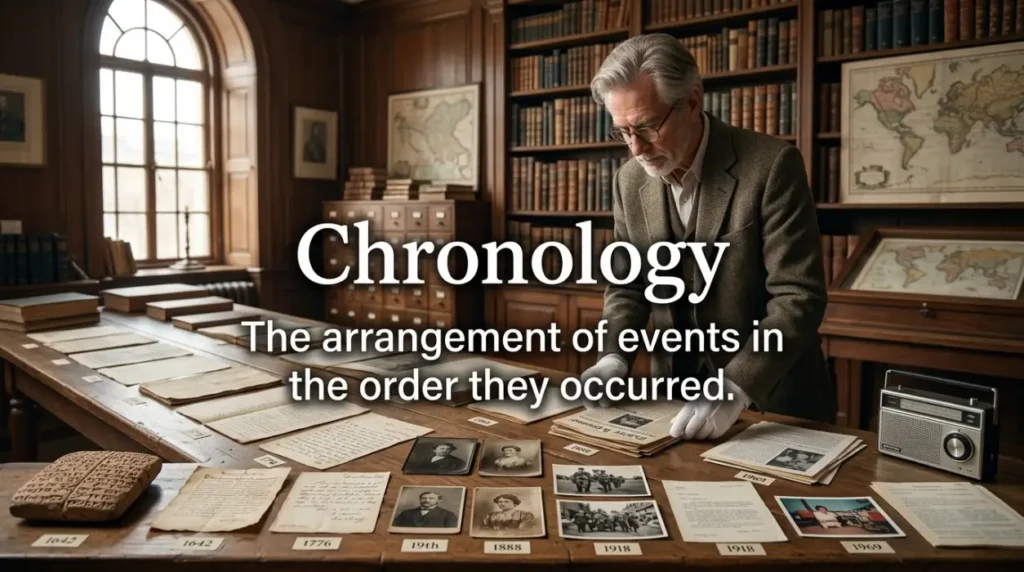
Chronology means the arrangement of events or dates in the order of their occurrence in time.
Native speakers use it for historical timelines, legal logs, and narrative pacing.
Part of Speech: Noun
Simple Definition: The science or arrangement of recording events in time order.
Connotative Meaning
Connotation is the emotional tone, cultural association, or implied feeling a word carries beyond its literal dictionary definition.
- Positive tone: Implies scholarly rigor, organized clarity, transparency, and methodical precision.
- Negative tone: Can feel rigid, bureaucratic, mechanical, or overly clinical when creative flow is needed.
- Neutral tone: Objective, factual sequence logging in archives, schedules, or police reports.
Etymology
- Origin: Greek khronologia, combining khronos (time) + logia (study of).
- Old English (450–1100): Absent; native English relied on descriptive temporal phrases like year-tale.
- Middle English (1100–1500): Latin/French academic scholarship introduced temporal tracking concepts.
- Modern English (1500–Present): Formalized into scientific, literary, and digital timeline terminology.
Syllables
chro-nol-o-gy
Affixation Pattern
- Root: Chron (time)
- Suffix: -logy (study of)
Synonyms List
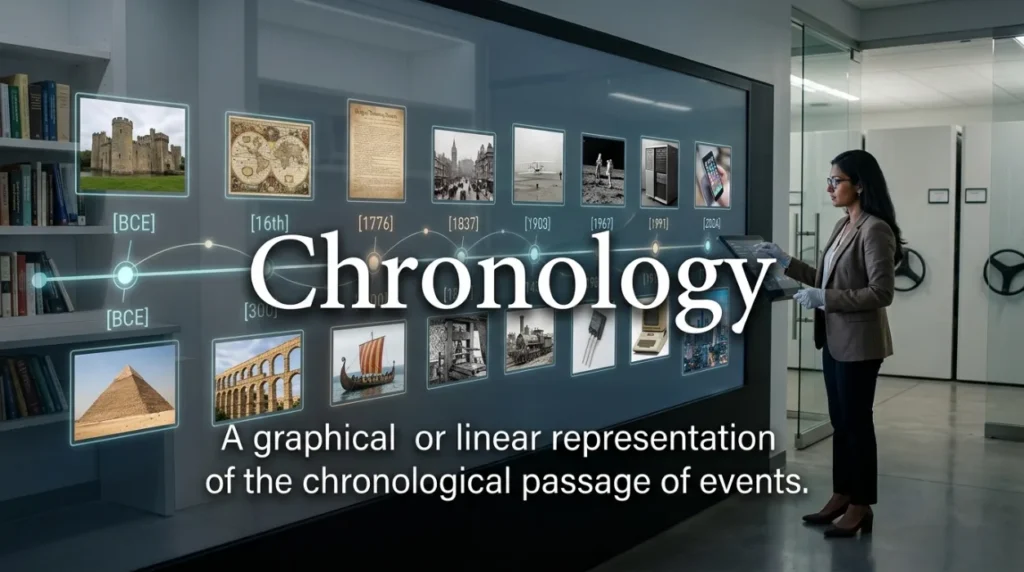
1. Timeline (Noun)
Meaning: A graphical or linear representation of the chronological passage of events.
Tone/Register: Standard / Digital
Example 1: Editor sketched a project delivery timeline on the whiteboard.
Example 2: Historian published an interactive online medieval conflict timeline.
2. Sequence (Noun)
Meaning: A particular order in which related events or things follow each other.
Tone/Register: Universal / Analytical
Example 1: A chemist verified the exact sequence of lab reagent mixing.
Example 2: The film director edited the chase scene sequence for high tension.
3. Progression (Noun)
Meaning: The gradual movement or advance toward a future developmental state.
Tone/Register: Formal / Academic
Example 1: Medical chart documented disease progression across twelve recovery weeks.
Example 2: Chord progression gave the jazz ballad a melancholic bridge.
4. Order (Noun)
Meaning: The arrangement of items or events according to a rule.
Tone/Register: Everyday / Standard
Example 1: Librarian filed rare manuscripts in alphabetical order.
Example 2: Chef plated dinner courses in traditional multi-plate order.
5. Progression line (Noun)
Meaning: An analytical tracking line marking sequential operational steps.
Tone/Register: Technical / Analytical
Example 1: Data analyst plotted software build stability on a progression line.
Example 2: Manufacturing audit inspected line assembly progression line metrics.
6. Timetable (Noun)
Meaning: A schedule listing specific times when events or transit occur.
Tone/Register: Practical / Daily
Example 1: Commuter checked morning train timetable on station display.
Example 2: Conference organizers posted speaker keynote timetables online.
7. Schedule (Noun)
Meaning: A plan for carrying out a process or procedure with target times.
Tone/Register: Business / Practical
Example 1: Contractor kept renovation work ahead of the projected schedule.
Example 2: Freelancer drafted a strict morning writing block schedule.
8. Program (Noun)
Meaning: A planned sequence of timed events, performances, or operations.
Tone/Register: Formal / Event
Example 1: Symphony program listed movement durations and composer notes.
Example 2: Training boot camp followed a structured daily fitness program.
9. Agenda (Noun)
Meaning: A prioritized list of timed items addressed during a meeting.
Tone/Register: Corporate / Official
Example 1: Board chair circulated meeting agenda forty-eight hours prior.
Example 2: Team skipped non-critical items to finish agenda early.
10. Annals (Noun plural)
Meaning: Historical records kept year by year in strict chronological order.
Tone/Register: Literary / Historical
Example 1: The Royal Academy recorded royal decrees in the ancient kingdom’s annals.
Example 2: Local sports club history entered championship victory annals.
11. Archives (Noun plural)
Meaning: A collection of historical documents organized by date or origin.
Tone/Register: Formal / Academic
Example 1: Archivist retrieved 19th century port registry ledger from basement archives.
Example 2: Photographer digitized family photo archives into cloud storage.
12. History (Noun)
Meaning: The continuous chronological record of past events connected to civilization.
Tone/Register: Universal / Narrative
Example 1: High school textbook covered European post-war history chapters.
Example 2: Family history book traced three generations of maritime trade.
13. Record (Noun)
Meaning: An official chronological account preserved in writing or digital files.
Tone/Register: Formal / Business
Example 1: The accounting department kept digital audit payment records.
Example 2: Pilot logged flight hours in official cockpit maintenance records.
14. Register (Noun)
Meaning: An official written sequential listing of items, transactions, or names.
Tone/Register: Administrative / Formal
Example 1: Parish church maintained baptismal register books dating back centuries.
Example 2: Cash register printed sequential daily sales receipt totals.
15. Calendar (Noun)
Meaning: A chart showing days, weeks, and months of a specific year cycle.
Tone/Register: Universal / Daily
Example 1: Project manager marked launch milestones on a wall calendar.
Example 2: Traditional lunar calendar guided seasonal farming planting cycles.
16. Annals log (Noun)
Meaning: A hybrid daily chronological tracking log of operational events.
Tone/Register: Operational / Technical
Example 1: Observatory night crew recorded stellar drift in an annals log.
Example 2: Security desk updated visitor entry timestamps inside the annals log.
17. Serial (Noun)
Meaning: A story, dataset, or broadcast presented in sequential installment order.
Tone/Register: Media / Literary
Example 1: A newspaper published a mystery thriller novel as a weekly serial.
Example 2: A podcast released investigative reporting in a five-part serial.
18. Continuum (Noun)
Meaning: A coherent continuous whole where elements blend sequentially without gaps.
Tone/Register: Philosophical / Academic
Example 1: Physicists study spacetime as a continuous four-dimensional continuum.
Example 2: Cultural traditions exist along a living historical continuum.
19. Succession (Noun)
Meaning: Several people or things sharing a specific sequential order.
Tone/Register: Formal / Standard
Example 1: Royal law defined the constitutional line of succession to the throne clearly.
Example 2: Rapid succession of spring showers greened hillside pastures.
20. Progression chain (Noun)
Meaning: Linked sequential dependencies driving multi-stage logistical execution.
Tone/Register: Logistics / Technical
Example 1: Supply team mapped cold chain vaccine delivery progression chain steps.
Example 2: Coding pipeline verified automated test progression chain clearance.
21. Data stream (Noun)
Meaning: Continuous chronological telemetry flow arriving from digital sensors.
Tone/Register: Digital / Technical
Example 1: Weather satellite beamed live atmospheric data stream telemetry down.
Example 2: Financial algorithmic trader monitored tick-by-tick market data stream.
22. Linear flow (Noun)
Meaning: Unbroken straight-line directional movement of chronological narrative or data.
Tone/Register: Analytical / Writing
Example 1: Technical manual preferred linear flow troubleshooting diagnostic steps.
Example 2: Director experimented outside traditional linear flow editing cuts.
23. Timeline grid (Noun)
Meaning: Multi-row project planning grid mapped against calendar intervals.
Tone/Register: Business / Management
Example 1: Producer synchronized VFX asset delivery using a timeline grid.
Example 2: Construction estimator color-coded foundation pours on a timeline grid.
24. Track (Noun)
Meaning: A parallel sequential path tracking competitive progress or asset movement.
Tone/Register: Practical / Sports-Tech
Example 1:An athletic coach timed runner laps around a stadium oval track.
Example 2: A logistics app kept a live GPS track of cross-border freight.
25. Serial order (Noun)
Meaning: Strictly indexed numerical arrangement of test items or experimental samples.
Tone/Register: Scientific / Formal
Example 1: Lab assistant arranged blood serum vials in exact serial order.
Example 2: Survey participants completed questionnaire items in randomized serial order.
26. Progression path (Noun)
Meaning: Career or developmental trajectory unfolding across time milestones.
Tone/Register: Career / Academic
Example 1: Junior designer mapped a five-year senior creative progression path.
Example 2: Academic advisor outlined doctoral thesis defense progression path.
27. Evolution (Noun)
Meaning: Gradual chronological development of species, ideas, or architectural styles.
Tone/Register: Academic / Descriptive
Example 1: Museum exhibit traced industrial sewing machine design evolution.
Example 2: Biologist lectured on avian skeletal evolution over deep time.
28. Unfolding (Noun)
Meaning: The gradual chronological revelation of plot twists or crisis facts.
Tone/Register: Literary / Narrative
Example 1: Reviewer praised courtroom drama for subtle plot unfolding pacing.
Example 2: Journalist tracked geopolitical treaty unfolding developments hourly.
29. Course (Noun)
Meaning: The sequential route or temporal duration through which events progress.
Tone/Register: Literary / Standard
Example 1: History proved turbulent over the course of the revolutionary decade.
Example 2: Captain adjusted ship course to avoid seasonal typhoon tracks.
30. Drift (Noun)
Meaning: Slow, unsupervised chronological migration of trends or linguistic terms.
Tone/Register: Linguistic / Analytical
Example 1: Lexicographers documented semantic drift in modern digital slang verbs.
Example 2: Compass heading showed slight magnetic drift over northern polar routes.
31. Roll call (Noun)
Meaning: Sequential chronological reading of roster names during formal assembly.
Tone/Register: Official / School Military
Example 1: Sergeant completed platoon morning roll call inspection on parade deck.
Example 2: Committee secretary took attendance via alphabetical roll call check.
32. Ledger (Noun)
Meaning: Book or digital spreadsheet recording financial transactions sequentially.
Tone/Register: Business / Accounting
Example 1: Merchant tallied daily cash revenue inside the leather ledger.
Example 2: Blockchain verifies miner transaction validity across a public ledger.
33. Day book (Noun)
Meaning: Traditional commercial journal noting daily transactions in order.
Tone/Register: Historical / Business
Example 1: Apothecary recorded herbal tonic sales inside an ink day book.
Example 2:An antique shop owner displayed an 1885 ironmonger day book counter.
34. Chronicle (Noun)
Meaning: A factual written account of historical events kept in temporal order.
Tone/Register: Literary / Historical
Example 1: Monk penned a detailed monastery chronicle covering parish harvests.
Example 2: Documentary served as a visual chronicle of urban renewal.
35. Narrative arc (Noun)
Meaning: The sequential emotional contour connecting story introduction to resolution.
Tone/Register: Creative / Writing
Example 1: Novelist structured protagonist growth across a three-act narrative arc.
Example 2: Pitch deck outlined startup survival across a dramatic narrative arc.
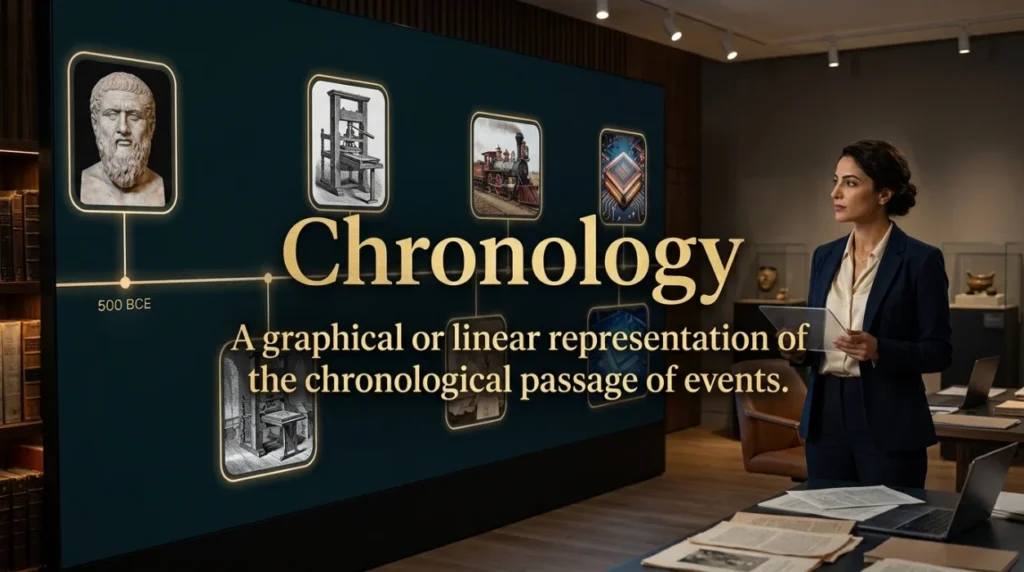
36. Epoch list (Noun)
Meaning: Geological or civilizational division table sorted by major era shifts.
Tone/Register: Scientific / Historical
Example 1: Geology text featured a color-coded Phanerozoic epoch list chart.
Example 2: Historian referenced imperial dynasty epoch list ruling dates.
37. Phase plan (Noun)
Meaning: Phased sequential implementation roadmap broken into temporal windows.
Tone/Register: Corporate / Engineering
Example 1: IT director deployed software migration via a four-month phase plan.
Example 2: City planners unveiled downtown pedestrianization phase plan milestones.
38. Stage gate (Noun)
Meaning: Sequential review gate halting project advance until time criteria are met.
Tone/Register: Corporate / R&D
Example 1: Drug research team cleared prototype toxicity stage gate review.
Example 2: Industrial hardware design passed thermal endurance stage gate testing.
39. Running order (Noun)
Meaning: Timed performance broadcast sequence for live television or concert shows.
Tone/Register: Media / Production
Example 1: Stage manager adjusted interview segment slots on evening running order.
Example 2: Festival coordinator printed set change times on backstage running order sheets.
40. Sequence map (Noun)
Meaning: Visual blueprint connecting sequential user interface screens or user journeys.
Tone/Register: UX / Digital
Example 1: Product designer mapped mobile onboarding taps onto a sequence map.
Example 2: Customer support trainer drafted call resolution decision sequence maps.
41. Flowchart (Noun)
Meaning: Diagram showing step-by-step sequential logic or operational decision trees.
Tone/Register: Technical / Business
Example 1: Engineer drew troubleshooting flowchart for hydraulic valve failures.
Example 2: HR onboarding deck featured employee benefit enrollment flowcharts.
42. Docket (Noun)
Meaning: Sequential list of legal cases scheduled for court hearing rooms.
Tone/Register: Legal / Official
Example 1: Clerk posted morning civil court docket outside judge’s chambers.
Example 2: Defense counsel reviewed trial motion order on daily docket.
43. Roster (Noun)
Meaning: List of personnel arranged in sequential operational rotation or duty order.
Tone/Register: Administrative / Workplace
Example 1: Fire station posted weekend holiday paramedic shift duty rosters.
Example 2: League coordinator published weekly tennis doubles player rosters.
44. Lineage (Noun)
Meaning: Sequential generational descent tracking family or intellectual pedigree.
Tone/Register: Genealogical / Formal
Example 1: Master artisan documented knife smithing lineage back four centuries.
Example 2: Thoroughbred registry verified horse pedigree bloodline lineage certificates.
45. Pedigree (Noun)
Meaning: Recorded chronological ancestry table validating purity or heritage quality.
Tone/Register: Formal / Animal Asset
Example 1: Auction catalog printed champion cattle health pedigree records.
Example 2: A violin appraiser checked the maker’s instrument workshop pedigree provenance.
46. Provenance (Noun)
Meaning: Chronological documentation tracking the ownership origin of art or artifacts.
Tone/Register: Fine-Art / Legal
Example 1: Gallery curator verified Renaissance painting provenance before acquisition.
Example 2: Rare book dealer confirmed signed first edition copy provenance chain.
47. Trail (Noun)
Meaning: Sequential physical or digital footprint left by past temporal movement.
Tone/Register: Detective / Digital
Example 1: Cyber forensic analysts followed server packet login trail logs.
Example 2: Tracker spotted fresh elk hoof prints along alpine mud trail.
48. Blueprint (Noun)
Meaning: Comprehensive sequential master plan detailing architectural or operational builds.
Tone/Register: Engineering / Business
Example 1: Founder presented three-year global expansion strategic blueprints.
Example 2: Architect unrolled foundation electrical wiring diagram blueprints.
49. Itinerary (Noun)
Meaning: Detailed chronological plan of a journey including travel stops and times.
Tone/Register: Travel / Practical
Example 1: Tourist printed multi-city bullet train rail tour itineraries.
Example 2: Expedition leader emailed daily basecamp glacier trek itineraries.
50. Roadmap (Noun)
Meaning: High-level strategic timeline chart mapping future product or policy goals.
Tone/Register: Corporate / Tech
Example 1: CTO published quarterly cloud security feature release roadmaps.
Example 2: Transport ministry shared national high-speed rail construction roadmaps.
51. Roll (Noun)
Meaning: Official historical parchment scroll recording tax rolls or court member rolls.
Tone/Register: Historical / Legal
Example 1: Medieval scholar examined parish tax assessment rolls in archives.
Example 2: Navy personnel answered name calls on active service rolls.
52. Registry (Noun)
Meaning: Official chronological repository database for property, births, or ships.
Tone/Register: Official / Legal
Example 1: Maritime authority updated commercial vessel flag registry listings.
Example 2: Municipal clerk processed newborn birth registry paperwork.
53. Catalog (Noun)
Meaning: Systematic chronological or categorical inventory list of museum or retail goods.
Tone/Register: Commercial / Academic
Example 1: Auction house printed autumn impressionist painting catalog brochures.
Example 2: University press published botanical specimen photo catalog books.
54. Directory (Noun)
Meaning: Alphabetical or sequential listing of names, organizations, or contact details.
Tone/Register: Administrative / Reference
Example 1: Campus desk distributed alphabetical faculty department office directories.
Example 2: Software compiled system DLL library path reference directories.
55. Index (Noun)
Meaning: Systematic chronological or alphabetical pointer table indexing archive contents.
Tone/Register: Academic / Reference
Example 1: Researcher searched book back index for specific treaty dates.
Example 2: Database index accelerated multi-column search query retrieval.
56. Register log (Noun)
Meaning: Compact daily shift log tracking equipment inspection timestamps.
Tone/Register: Industrial / Safety
Example 1: Crane operator signed safety check sign-off inside register logs.
Example 2: Kitchen manager recorded freezer temperature logs in daily register logs.
57. Footprint (Noun)
Meaning: Sequential historical or environmental impact legacy left across time.
Tone/Register: Environmental / Analytical
Example 1: Corporate report audited carbon emission reduction footprint trends.
Example 2: Archaeological trench revealed Bronze Age settlement hearth footprints.
58. Tracking log (Noun)
Meaning: Digital packet or parcel audit log recording sequential transit handoffs.
Tone/Register: Logistics / Digital
Example 1: Customer service rep checked parcel tracking log customs hold status.
Example 2: Server admin reviewed SSH login IP tracking log entries.
59. Step ladder (Noun)
Meaning: Metaphorical incremental sequential difficulty tiers guiding skill mastery.
Tone/Register: Educational / Figurative
Example 1: Language coach used a vocabulary step ladder from basic nouns to idioms.
Example 2: Guitar tutor designed a chord progression practice step ladder.
60. Continuum track (Noun)
Meaning: Continuous multi-year analytical trajectory tracking systemic growth.
Tone/Register: Academic / Strategic
Example 1: Demographers modeled urban housing density on a continuum track.
Example 2: Institutional investor reviewed twenty-year fund returns continuum tracks.
Synonyms by Tone
Tone grouping separates clinical compliance records from creative storytelling arcs or strategic business roadmaps.
| Tone Category | Synonyms for Chronology |
| Positive | Roadmap, Blueprint, Itinerary, Timeline, Progression |
| Neutral | Sequence, Order, Schedule, Register, Index, Record |
| Negative | Docket (litigation strain), Drift (uncontrolled loss), Bureaucratic Ledger |
| Playful / Informal | Step ladder, Running order, Day book, Trail |
Word choice shapes reader perception: framing project milestones as a roadmap inspires optimism, whereas calling them a docket implies legal friction.
Positive Tone
- Roadmap
- Blueprint
- Itinerary
- Timeline
- Progression
Neutral Tone
- Sequence
- Order
- Schedule
- Register
- Index
Negative Tone
- Docket
- Drift
- Registry bottleneck
Playful / Informal Tone
- Step ladder
- Running order
- Day book
- Trail
Mini Comparison: “Chronology” vs Close Alternatives
| Term | Core Meaning | Tone | Best Context To Use |
| Chronology | Strict timeline recording order of occurrence. | Formal / Academic | Historical research, biographical studies, investigative audits. |
| Roadmap | Strategic, future-oriented, multi-phase milestone guide. | Corporate / Tech | Product development decks, leadership strategy briefs. |
| Itinerary | Timed chronological travel stops or session schedule. | Practical / Travel | Conference schedules, tourist train trips, event days. |
Context-Based Usage
Daily Conversation
Speakers swap academic date science for handy nouns like schedule, itinerary, or running order.
Example: “Check our morning zoo visit itinerary before packing snacks.”
Writing or Blogging
Storytellers deploy narrative velocity terms like unfolding, narrative arc, or linear flow.
Example: “Chapter four accelerates the detective puzzle unfolding rhythm.”
Professional or Academic Tone
Analysts replace casual words with audit-grade terms like provenance, registry, or progression path.
Example: “Auditors certified rare manuscript chain-of-custody provenance.”
Creative or Informal Use
Fiction dialog highlights elapsed time grit via day book, trail, or step ladder.
Example: “Captain checked grease stained whaling voyage day book entries.”
Common Mistakes & Native Usage

Misuse Scenarios
- Confusing Chronology with Causality: Chronology proves sequence (A happened before B); it does not automatically prove cause (A caused B). Avoid writing “chronology proved the marketing campaign caused sales.”
- Overusing Formal Annals in Tech Decks: Calling an agile software sprint log “medieval annals” sounds overly archaic. Use roadmap or sprint timeline.
Register Notes
- Formal Written English: Prefer provenance, chronicle, registry, continuum, and progression.
- Spoken Informal English: Opt for schedule, running order, roadmap, and itinerary.
- Tip: Match temporal density strictly to reader cognitive load.
Real-Life Mini Scenarios
Workplace
Operations lead synced department holiday duty rosters onto a master team timetable.
Social Situations
Wedding planner distributed printed ceremony running order cards to ushers and musicians.
Media / Pop Culture
True crime documentary reconstructed crime scene timelines using digital phone tower data stream pings.
Writing & Storytelling
Historical fiction prologue introduced tribal migration waves across a multi-century continuum.
Conclusion
Mastering synonyms for chronology can sharpen your writing across historical research, project planning, product strategy, and storytelling. Precise vocabulary helps readers understand the order of events without confusion or unnecessary repetition. Choosing the right sequence-related terms also makes complex information easier to organize, especially when presenting detailed timelines, developments, or milestones.
Try incorporating fresh time-sequence words into your emails, essays, reports, presentations, and team briefings. Different contexts often require different expressions, so selecting a term that matches your exact meaning can make every sentence more natural and effective. This simple habit can also improve readability and keep your audience engaged.
Strong vocabulary choices build confidence and create polished communication over time. By using accurate sequence language, you can express ideas clearly, connect events smoothly, and give your writing a more professional and distinctive voice.
Practice Exercise
1. Which term fits best for a high-level corporate 3-year feature release plan?
A) Ledger
B) Roadmap
C) Docket
D) Day book
2. What formal term tracks an art piece’s historical ownership and custody chains?
A) Itinerary
B) Roll call
C) Flowchart
D) Provenance
3. Which practical noun lists hourly tour bus departure stops?
A) Pedigree
B) Itinerary
C) Lineage
D) Continuum
4. What analytical word describes unbroken directional narrative movement?
A) Registry
B) Roll
C) Linear flow
D) Docket
5. Which term describes official historical year-by-year monastic records?
A) Serial
B) Track
C) Flowchart
D) Annals
6. What corporate word describes meeting topic priorities in order?
A) Trail
B) Agenda
C) Drift
D) Footprint
7. Which technical term describes live continuous sensor telemetry output?
A) Docket
B) Roll call
C) Data stream
D) Day book
8. What noun tracks sequential animal bloodline purity records?
A) Timetable
B) Flowchart
C) Running order
D) Pedigree
9. Which informal label fits a broadcast live show sequence schedule?
A) Provenance
B) Running-order
C) Lineage
D) Continuum track
10. What term describes slow natural linguistic vocabulary shifts over time?
A) Agenda
B) Drift
C) Itinerary
D) Timetable
Answer Key:
1: B | 2: D | 3: B | 4: C | 5: D | 6: B | 7: C | 8: D | 9: B | 10: B
Application Task:
Write one original sentence describing your project task order or study plan using a roadmap, itinerary, or sequence.
FAQs
1. Is chronology the same as timeline?
A timeline is the visual display of dates, whereas chronology is the underlying science or structured order of those sequential occurrences.
2. When should I use provenance instead of chronology?
Use provenance specifically when tracking ownership history and authentication chains of physical art, antiques, or legal deeds.
3. Why avoid repeating “timeline” in long research essays?
Varying with progression, continuum, sequence, or chronicle prevents stylistic fatigue and adds academic precision.
4. Can roadmap replace chronology in business reports?
Yes, roadmap works better for future strategic planning, whereas chronology fits past historical record documentation.
5. Do AI retrieval engines reward specific sequence nouns?
Yes. Semantic search models favor exact domain nouns like provenance ledger or data stream timeline over generic filler words.

Jameel Hassan is the founder and lead writer at SynonymsCloud.com, a trusted online platform dedicated to English vocabulary and effective communication. He is passionate about helping students, writers, professionals, and lifelong learners discover the right words to express their ideas with clarity, precision, and confidence.
At SynonymsCloud.com, every article is thoroughly researched and carefully written to provide accurate, practical, and easy-to-understand guidance on synonyms, antonyms, word meanings, idioms, and vocabulary. With a strong commitment to quality, real-world usage, and clear explanations, the website helps readers expand their vocabulary, improve their writing, and communicate more effectively in both academic and professional settings.