
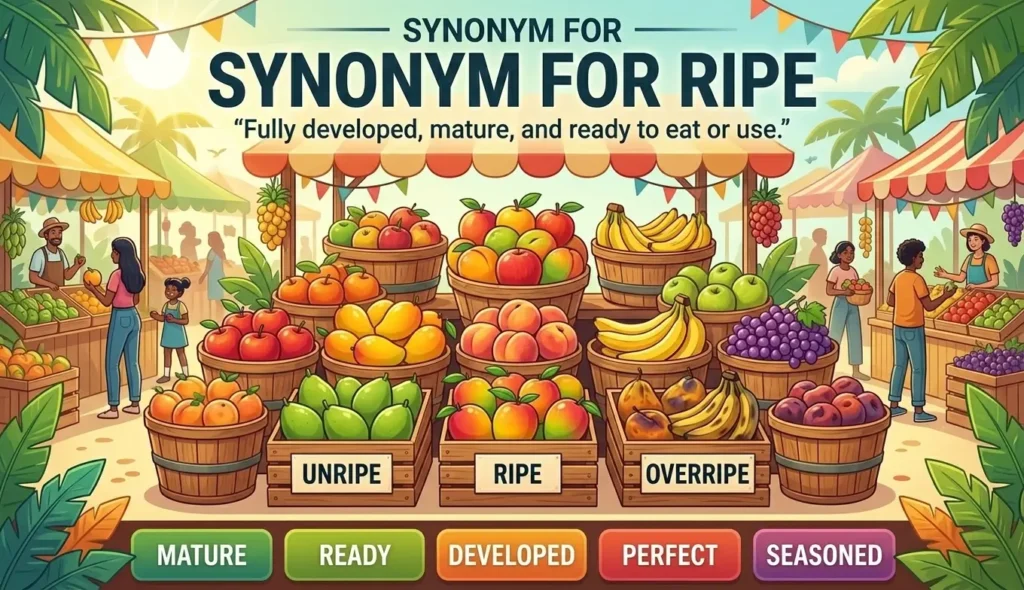
The best synonyms for ripe include mature, ready, mellow, seasoned, and prime. These alternatives describe produce, timing, or conditions at peak development or full preparation. Use mature for aged items or complex development, ready for immediate action or consumption, and mellow for soft, sweet flavor profiles.
Synonym for ripe is a helpful search query when you want to describe fully grown produce or prepared timing without repeating the exact same adjective. Imagine writing a culinary blog post about picking summer peaches and using the same descriptive term in every sentence. Finding alternative words makes your writing engaging.
Writers search for a synonym for ripe to add flavor and precise context to food writing and seasonal essays. Expanding your vocabulary helps you express agricultural maturity and optimal timing with absolute clarity.
This specific word appears constantly in culinary guides, agricultural reports, financial timelines, and literary metaphors. Knowing alternative terms keeps your writing fresh and engaging for modern readers.
Students, bloggers, content writers, and daily English users find this vocabulary exploration very useful. Precise word choices prevent writing from sounding flat or repetitive. Using a synonym for ripe ensures your articles truly shine.
Core Meaning: What Does “Ripe” Really Mean?
Ripe is an adjective that describes fruit or grain developed to the point of readiness for harvesting and eating. It also denotes a state of complete readiness or preparedness for action.
Connotative Meaning
- Positive tone: Represents optimal sweetness, peak harvest, readiness, maturity, and perfection.
- Negative tone: Can imply over-preparedness, spoiling, rotting, or unpleasant bodily odors.
- Neutral tone: Used in objective agricultural grading and timing assessments.
Etymology
- Source Language: Old English ripe (ready, mature), derived from Proto-Germanic roots connected to reaping.
- Old English (450–1100): Used to describe harvested crops and mature seasonal grain.
- Middle English (1100–1500): Expanded to describe fully developed skills and prepared human judgment.
- Modern English (1500–Present): Standardized for both agricultural produce and metaphorical timing.
Pronunciation & Syllables
- US: /raɪp/
- UK: /rʌɪp/
- Syllables: ripe (1 syllable)
- Affixation Pattern: Simple root adjective without prefixes or suffixes.
- Root: ripe
- Prefix: None
- Suffix: None
Synonyms List

Mature (Adjective) — US: /məˈtʊr/ | UK: /məˈtjʊə/
- Meaning: Fully developed physically or mentally; adult or aged to perfection.
- Tone/Register: Formal / Standard
- Example: The cheese was left in caves to become mature.
- Example: She showed mature judgment during the crisis.
Ready (Adjective) — US: /ˈrɛdi/ | UK: /ˈrɛdi/
- Meaning: Fully prepared for use, action, or consumption.
- Tone/Register: Common / Everyday
- Example: The tomatoes are ready to pick from the vine.
- Example: Dinner will be ready in ten minutes.
Mellow (Adjective) — US: /ˈmɛloʊ/ | UK: /ˈmɛləʊ/
- Meaning: Soft, sweet, and full-flavored from age or ripeness.
- Tone/Register: Literary / Warm
- Example: The apples developed a mellow flavor in storage.
- Example: He enjoyed a mellow evening by the fireplace.
Seasoned (Adjective) — US: /ˈsiːzənd/ | UK: /siːz(ə)nd/
- Meaning: Experienced, expert, or treated to improve flavor and usability.
- Tone/Register: Professional / Formal
- Example: Seasoned wood burns slowly and evenly in the stove.
- Example: She is a seasoned journalist with decades of experience.
Developed (Adjective) — US: /dɪˈvɛləpt/ | UK: /dɪˈvɛləpt/
- Meaning: Grown or caused to grow larger, more mature, or more advanced.
- Tone/Register: Formal / Academic
- Example: The grapes showed fully developed sugar levels.
- Example: The community has a well-developed public transit network.
Advanced (Adjective) — US: /ədˈvænst/ | UK: /ədˈvɑːnst/
- Meaning: Far on or ahead in development or progress.
- Tone/Register: Academic / Formal
- Example: The project reached an advanced stage of planning.
- Example: He takes advanced placement mathematics in school.
Prime (Adjective) — US: /praɪm/ | UK: /prʌɪm/
- Meaning: Of the best possible quality or at peak condition.
- Tone/Register: Professional / Standard
- Example: The strawberries were picked in prime condition.
- Example: Real estate in downtown is prime commercial property.
Optimal (Adjective) — US: /ˈɑːptɪməl/ | UK: /ˈɒptɪməl/
- Meaning: Best or most favorable; optimum.
- Tone/Register: Technical / Scientific
- Example: Farmers wait for optimal weather to harvest crops.
- Example: The software runs at optimal speed on new hardware.
Full-grown (Adjective) — US: /ˌfʊl ˈɡroʊn/ | UK: /ˌfʊl ˈɡrəʊn/
- Meaning: Having attained full growth and development.
- Tone/Register: Descriptive / Standard
- Example: The orchard produced full-grown peaches.
- Example: A full-grown oak tree provides ample shade.
Grown (Adjective) — US: /ɡroʊn/ | UK: /ɡrəʊn/
- Meaning: Having reached maturity in size and age.
- Tone/Register: Common / Standard
- Example: Grown sweet peppers filled the greenhouse baskets.
- Example: They sold locally grown organic vegetables.
Perfected (Adjective) — US: /pərˈfɛktɪd/ | UK: /pəˈfɛktɪd/
- Meaning: Made completely free from faults or defects.
- Tone/Register: Formal / Literary
- Example: She served a perfected vintage wine.
- Example: The chef presented a perfected pastry recipe.
Seasonable (Adjective) — US: /ˈsiːzənəbəl/ | UK: /ˈsiːzənəbəl/
- Meaning: Occurring at a convenient or appropriate time; timely.
- Tone/Register: Formal / Traditional
- Example: The region enjoyed seasonable autumn weather.
- Example: Farmers welcomed the seasonable rainfall.
Timely (Adjective) — US: /ˈtaɪmli/ | UK: /ˈtʌɪmli/
- Meaning: Done or occurring at a favorable or useful time.
- Tone/Register: Professional / Standard
- Example: We appreciated his timely advice on investments.
- Example: The mechanic performed timely maintenance checks.
Appropriate (Adjective) — US: /əˈproʊpriət/ | UK: /əˈprəʊpriət/
- Meaning: Suitable or proper in the circumstances.
- Tone/Register: Formal / Professional
- Example: Casual wear is not appropriate for the gala.
- Example: She chose an appropriate gift for the host.
Fit (Adjective) — US: /fɪt/ | UK: /fɪt/
- Meaning: Of a suitable quality, standard, or type to meet required purposes.
- Tone/Register: Standard / Common
- Example: The fruit was deemed fit for market sale.
- Example: He exercised daily to stay physically fit.
Suitable (Adjective) — US: /ˈsuːtəbəl/ | UK: /ˈsjuːtəbəl/
- Meaning: Right or appropriate for a particular person, purpose, or situation.
- Tone/Register: Standard / Formal
- Example: The soil is suitable for growing citrus trees.
- Example: They found a suitable apartment downtown.
Propitious (Adjective) — US: /prəˈpɪʃəs/ | UK: /prəˈpɪʃəs/
- Meaning: Giving or indicating a good chance of success; favorable.
- Tone/Register: Literary / Formal
- Example: Spring weather provided a propitious moment for planting seeds.
- Example: Market conditions were propitious for launching a startup.
Auspicious (Adjective) — US: /ɔːˈspɪʃəs/ | UK: /ɔːˈspɪʃəs/
- Meaning: Conducive to success; favorable.
- Tone/Register: Formal / Literary
- Example: The wedding took place on an auspicious date.
- Example: Their business venture had an auspicious beginning.
Favorable (Adjective) — US: /ˈfeɪvərəbəl/ | UK: /ˈfeɪvərəd(ə)l/
- Meaning: Expressing approval or presenting an advantage.
- Tone/Register: Standard / Professional
- Example: Critics published favorable reviews of the film.
- Example: The forecast predicts favorable sailing conditions.
Advantageous (Adjective) — US: /ˌædvənˈteɪdʒəs/ | UK: /ˌadvənˈteɪdʒəs/
- Meaning: Involving or creating favorable circumstances; useful.
- Tone/Register: Business / Formal
- Example: Signing the contract early proved advantageous.
- Example: Location is advantageous for retail businesses.

Beneficial (Adjective) — US: /ˌbɛnɪˈfɪʃəl/ | UK: /ˌbɛnɪˈfɪʃəl/
- Meaning: Resulting in good; favorable or advantageous.
- Tone/Register: Standard / Professional
- Example: Regular sleep is beneficial to overall health.
- Example: The partnership proved beneficial for both firms.
Golden (Adjective) — US: /ˈɡoʊldən/ | UK: /ˈɡəʊld(ə)n/
- Meaning: Highly favorable, advantageous, or prosperous.
- Tone/Register: Literary / Descriptive
- Example: They seized a golden opportunity to expand.
- Example: Sunset cast a golden light over the valley.
Blooming (Adjective) — US: /ˈbluːmɪŋ/ | UK: /ˈbluːmɪŋ/
- Meaning: Having flowers open; flourishing or thriving.
- Tone/Register: Descriptive / Warm
- Example: Roses were blooming brightly in the garden.
- Example: The local economy is blooming this year.
Flourishing (Adjective) — US: /ˈflɜːrɪʃɪŋ/ | UK: /ˈflʌrɪʃɪŋ/
- Meaning: Developing rapidly and successfully; thriving.
- Tone/Register: Formal / Standard
- Example: The nursery sells flourishing potted plants.
- Example: Small businesses are flourishing downtown.
Thriving (Adjective) — US: /ˈθraɪvɪŋ/ | UK: /ˈθrʌɪvɪŋ/
- Meaning: Prosperous and growing.
- Tone/Register: Standard / Professional
- Example: They built a thriving bakery business.
- Example: The ecosystem remains healthy and thriving.
Juicy (Adjective) — US: /ˈdʒuːsi/ | UK: /ˈdʒuːsi/
- Meaning: Full of juice; succulent.
- Tone/Register: Casual / Descriptive
- Example: She bit into a juicy, sweet peach.
- Example: Oranges must be juicy before juicing.
Succulent (Adjective) — US: /ˈsʌkjulənt/ | UK: /ˈsʌkjʊlənt/
- Meaning: Tender, juicy, and tasty.
- Tone/Register: Culinary / Formal
- Example: The chef roasted succulent lamb chops.
- Example: Cacti are succulent desert plants.
Luscious (Adjective) — US: /ˈlʌʃəs/ | UK: /ˈlʌʃəs/
- Meaning: Having a pleasingly rich, sweet taste or smell.
- Tone/Register: Literary / Descriptive
- Example: They tasted luscious tropical fruits.
- Example: The dessert featured luscious chocolate ganache.
Rich (Adjective) — US: /rɪtʃ/ | UK: /rɪtʃ/
- Meaning: Having a valuable quality or abundant flavor.
- Tone/Register: Common / Culinary
- Example: Soil in the valley is rich and dark.
- Example: The soup had a rich, creamy texture.
Full-flavored (Adjective) — US: /ˌfʊl ˈfleɪvərd/ | UK: /ˌfʊl ˈfleɪvəd/
- Meaning: Having a strong, distinct, and pleasant flavor.
- Tone/Register: Culinary / Descriptive
- Example: Heirloom tomatoes are wonderfully full-flavored.
- Example: He brewed a cup of full-flavored coffee.
Flavorful (Adjective) — US: /ˈfleɪvərfəl/ | UK: /ˈfleɪvəf(ə)l/
- Meaning: Having a pleasant and distinct flavor.
- Tone/Register: Standard / Food
- Example: The stew was hearty and flavorful.
- Example: Herbs make simple dishes much more flavorful.
Developed-taste (Adjective) — US: /dɪˈvɛləpt teɪst/ | UK: /dɪˈvɛləpt teɪst/
- Meaning: Exhibiting refined flavor profiles through aging.
- Tone/Register: Culinary / Formal
- Example: Fine wines offer a developed-taste profile.
- Example: Artisanal cheeses feature developed-taste notes.
Soft (Adjective) — US: /sɔːft/ | UK: /sɒft/
- Meaning: Yielding readily to touch; indicating fruit entering peak readiness.
- Tone/Register: Common / Everyday
- Example: The pears felt soft and sweet to the touch.
- Example: She preferred soft pillows for sleeping.
Tender (Adjective) — US: /ˈtɛndər/ | UK: /ˈtɛndə/
- Meaning: Easy to cut or chew; not tough.
- Tone/Register: Culinary / Standard
- Example: The melon flesh was tender and fragrant.
- Example: Slow cooking makes tough meat tender.
Mellowed (Adjective) — US: /ˈmɛloʊd/ | UK: /ˈmɛləʊd/
- Meaning: Having become smoother or more mellow over time.
- Tone/Register: Descriptive / Literary
- Example: The wine mellowed gracefully in oak casks.
- Example: His aggressive tone mellowed with age.
Seasoned-fruit (Adjective) — US: /ˈsiːzənd fruːt/ | UK: /siːz(ə)nd fruːt/
- Meaning: Fruit harvested at its proper seasonal peak.
- Tone/Register: Agricultural / Descriptive
- Example: Market stalls displayed fresh, seasonal fruit selections.
- Example: Bakers prefer seasoned fruit for authentic tarts.
Harvest-ready (Adjective) — US: /ˈhɑːrvɪst ˈrɛdi/ | UK: /ˈhɑːvɪst ˈrɛdi/
- Meaning: Prepared and suitable for immediate gathering from fields.
- Tone/Register: Agricultural / Professional
- Example: Corn stalks stood tall and harvest-ready.
- Example: The vineyard declared the grapes harvest-ready.
Crop-ready (Adjective) — US: /krɑːp ˈrɛdi/ | UK: /krɒp ˈrɛdi/
- Meaning: Reached maturity for agricultural collection.
- Tone/Register: Technical / Agricultural
- Example: Soybeans appeared crop-ready after summer rain.
- Example: Agronomists marked the fields crop-ready.
Fully-formed (Adjective) — US: /ˌfʊli ˈfɔːrmd/ | UK: /ˌfʊli ˈfɔːmd/
- Meaning: Having reached complete shape and development.
- Tone/Register: Formal / Standard
- Example: The pumpkin was large and fully-formed.
- Example: She presented a fully-formed business plan.
Completed (Adjective) — US: /kəmˈpliːtɪd/ | UK: /kəmˈpliːtɪd/
- Meaning: Finished; having all parts or elements included.
- Tone/Register: Professional / Formal
- Example: He submitted the completed assignment early.
- Example: Construction on the bridge is now completed.
Synonyms by Tone
- Positive / Culinary: Juicy, Succulent, Luscious, Mellow, Flavorful.
- Neutral / Agricultural: Mature, Ready, Harvest-ready, Developed, Seasoned.
- Intense / Literary: Propitious, Auspicious, Golden, Flourishing, Thriving.
Mini Comparison
Ripe vs. Mature vs. Ready
- Ripe: Specifically describes fruits, grains, or plants having reached peak development for harvesting or execution.
- Mature: Broadly denotes full physical, emotional, or intellectual development in humans, animals, or complex systems.
- Ready: Simply means prepared for immediate use or action right now, without implying biological growth.
Ripe Antonyms, Overripe Synonyms, and Related Expressions
The word ripe has several related forms and expressions, and the best alternative depends on whether you are describing fruit, age, timing, readiness, or a figurative situation. Understanding these distinctions can help you choose a more precise word.
What Is the Antonym of Ripe?
The most common antonyms of ripe are unripe, green, immature, and underripe when talking about fruit or crops.
- Unripe: not yet developed enough to be ready for eating or harvesting.
- Green is often used for fruit that has not yet reached full ripeness.
- Immature not fully developed.
- Underripe less ripe than desired or expected.
For example:
The peaches were still unripe, so we left them on the counter for several days.
In a figurative context, premature, unready, or undeveloped can contrast with ripe.
Ripe Opposite Word: What Should You Use?
There is no single opposite that works in every sentence.
For fruit, use unripe, green, or underripe.
For people or development, immature is usually more appropriate.
Timing: premature or not yet ready may be the better choice.
For example:
- Ripe fruit → unripe fruit
- A ripe decision → premature decision
- A ripe opportunity → untimely or premature opportunity
- A mature person → immature person
The context determines the most natural antonym.
What Is a Synonym for “Ripe For”?
The phrase ripe for usually means that something is ready or particularly suitable for a specific action, change, development, or result.
Depending on the sentence, alternatives include:
- Ready for
- Prepared for
- Suitable for
- Primed for
- Poised for
- Well-suited to
- Open to
- Likely to undergo
For example:
The industry is ripe for change.
You could write:
The industry is ready for change.
Or:
The industry is primed for change.
In formal writing, ready for, suitable for, or poised for can often replace ripe for, depending on the intended meaning.
What Does “Ripe With” Mean?
The expression ripe with generally means full of, rich in, or containing a large amount of something, especially an opportunity, possibility, quality, or feature.
Possible alternatives include:
- Full of
- Rich in
- Abundant in
- Filled with
- Brimming with
- Loaded with
- Teeming with
For example:
The region is ripe with opportunities.
Possible alternatives are:
The region is full of opportunities.
The region is rich in opportunities.
The phrase ripe with is often more literary or expressive than the simple phrase full of.
What Is a Synonym for “Ripe Age”?
The phrase ripe age refers to an advanced or appropriate stage of life, often suggesting maturity, experience, or a long life.
Depending on context, alternatives include:
- Advanced age
- Mature age
- Later life
- Old age
- Aging years
- Advanced years
- A venerable age
For example:
He continued working well into his ripe old age.
A more neutral version would be:
He continued working well into his advanced years.
The expression ripe old age is usually positive or respectful, particularly when emphasizing longevity.
What Is a Synonym for Overripe?
Overripe describes fruit or other produce that has developed beyond the ideal stage of ripeness.
Useful alternatives include:
- Past its prime
- Too ripe
- Overmature
- Softened
- Aged beyond its peak
- Past peak ripeness
- Spoiling when deterioration has begun
- Decaying when significant decomposition has occurred
For example:
The bananas were overripe and covered with dark spots.
You could also say:
The bananas were past their prime.
However, spoiling and decaying are not exact synonyms because they describe deterioration rather than simply being beyond the ideal stage of ripeness.
What Is a Synonym for “Ripeness”?
Ripeness is the noun form describing the condition or stage of being ripe.
Depending on context, related terms include:
- Maturity
- Readiness
- Full development
- Peak condition
- Peak maturity
- Fruit maturity
- Harvest readiness
For example:
Farmers carefully monitor the ripeness of grapes before harvesting.
In agricultural writing, maturity or harvest readiness may be more precise.
In everyday food writing, ripeness remains the most natural term.
Is Ripe a Synonym for Savory?
No. Ripe and savory describe different qualities.
Ripe generally describes the stage of development or readiness of fruit, vegetables, grains, or other produce. It can also describe something that is ready for a particular action in a figurative sense.
Savory describes a flavor that is typically salty, spicy, meaty, or non-sweet.
For example:
The peach is ripe.
This tells us about the peach’s stage of development.
The soup has a savory flavor.
This tells us about the soup’s taste.
A ripe tomato can be savory, but ripe does not mean savory.
What Is Another Word for “Before Ripe”?
When something has not yet reached the ripe stage, the most natural expressions are:
- Unripe
- Underripe
- Immature
- Green
- Not yet ripe
- Not fully mature
For example:
The mangoes were not yet ripe.
Or:
The mangoes were still green and underripe.
For fruit, unripe is generally the simplest and most natural choice.
What Does “Aging Like Fine Wine” Mean?
The expression aging like fine wine means that something appears to become better, more valuable, more attractive, or more impressive with age.
Related expressions include:
- Improving with age
- Getting better with age
- Maturing gracefully
- Growing more refined
- Becoming more valuable over time
- Aging gracefully
For example:
Her writing has been improving with age.
The expression is usually figurative and is commonly applied to people, skills, creative work, products, or experiences rather than literally describing fruit.
Ripe, Ripened, and Ripeness: What Is the Difference?
These related words have different grammatical functions:
| Word | Part of Speech | Meaning |
|---|---|---|
| Ripe | Adjective | Ready or fully developed |
| Ripened | Adjective / past participle | Made or become ripe |
| Ripeness | Noun | The condition or quality of being ripe |
For example:
The ripe peaches were ready to eat.
The peaches had ripened in the warm sunlight.
Their ripeness was checked before harvesting.
Using the correct form makes the sentence more natural and grammatically precise.
German Terms: “Reif” and “Reife”
The German word reif can correspond to ripe or mature, depending on context.
For example, reifes Obst refers to ripe fruit, while reif can also describe someone or something as mature.
The German noun Reife generally refers to maturity or ripeness, depending on the context.
Therefore, English alternatives for reif may include ripe, mature, or fully developed, while Reife may correspond to ripeness or maturity.
Spanish: “Maduro” for a Person
The Spanish word maduro can describe a mature person, particularly in terms of age, behavior, judgment, or emotional development.
Depending on the intended meaning, English alternatives include:
- Mature
- Adult
- Grown-up
- Experienced
- Responsible
- Emotionally mature
For example:
Es una persona madura.
This can be translated as:
He or she is a mature person.
When maduro describes fruit, however, ripe is usually the appropriate English translation.
Indonesian-Related Terms: “Matang” and “Pematangan”
The Indonesian word matang can refer to something ripe, mature, or fully developed, depending on context.
For fruit:
Buah matang → ripe fruit
For a person or idea, it can relate to:
Mature or fully developed
The related concept pematangan, refers to the process of maturation, ripening, or becoming fully developed.
Therefore, the best English equivalent depends on whether the context concerns fruit, personal development, or a broader maturation process.
Quick Guide to Related Ripe Words
| Expression | Best General Meaning |
|---|---|
| Ripe | Fully developed or ready |
| Unripe | Not yet ripe |
| Underripe | Less ripe than desired |
| Overripe | Beyond the ideal stage of ripeness |
| Ripeness | The state of being ripe |
| Ripened | Made or become ripe |
| Ripe for | Ready or especially suitable for something |
| Ripe with | Full of or rich in something |
| Ripe old age | Advanced or mature age |
| Mature | Fully developed or experienced |
| Premature | Happening before the appropriate time |
Context-Based Usage
- Daily Conversation: Use everyday words like ready or soft when talking about picking fruit with family members.
- Writing or Blogging: Elevate food essays by replacing repetitive words with luscious, succulent, or mellow.
- Professional or Academic Tone: Opt for formal vocabulary such as mature, optimal, or harvest-ready in agricultural reports.
- Creative or Informal Use: Lean into evocative terms like golden or flourishing to build rich atmospheric descriptions.
Common Mistakes & Native Usage

- Confusing Ripe with Mature: Ripe is typically used for produce and metaphorical timing, whereas mature is used for living beings and aged products like cheese or wine.
- Overusing Juicy: Avoid using juicy when describing non-food items like grains or strategic business plans where ready works better.
- Register Mismatch: Do not use overly formal terms like propitious in casual supermarket shopping conversations.
Real-Life Mini Scenarios
- Workplace: The marketing campaign was ready to launch for the holiday season.
- Social Situations: Guests selected juicy peaches from the backyard fruit basket.
- Media / Pop Culture: The agricultural documentary highlighted harvest-ready vineyards across the valley.
- Writing or Storytelling: The novel described a golden opportunity waiting for the protagonist.
Conclusion
Expanding your vocabulary with precise alternatives transforms how you write culinary guides, agricultural reports, and creative lifestyle articles. Synonym for ripe: Exploring different words helps you convey exact nuances of readiness across various publishing formats.
Integrating these terms into your daily messages makes your communication engaging and memorable. Thoughtful word choices elevate your essays and stories far above standard, repetitive phrasing.
Take time to practice these dynamic words in your emails, essays, and everyday conversations today. Embracing a richer vocabulary unlocks new levels of confidence and creative freedom in your writing journey, ensuring your ideas are always ripe for success.
Practice Exercise
- Which synonym best describes fruit or grain developed to the point of readiness for harvesting?
- A) Ripe
- B) Raw
- C) Green
- D) Rotten
- What is the best term when referring to fully developed physical or mental qualities or aged wine?
- A) Mature
- B) Juvenile
- C) Infant
- D) Childish
- Which adjective implies fully prepared for immediate use, action, or consumption?
- A) Ready
- B) Unprepared
- C) Delayed
- D) Lacking
- If you want a literary word to describe fruit that is soft, sweet, and full-flavored, which option works best?
- A) Mellow
- B) Bitter
- C) Sour
- D) Hard
- Which word is most appropriate for describing wood or professionals treated and experienced over time?
- A) Seasoned
- B) Fresh
- C) Untried
- D) Novice
- What term describes conditions that are best, most favorable, or optimum?
- A) Optimal
- B) Worst
- C) Subpar
- D) Poor
- Which word captures having attained full growth and size in plants or trees?
- A) Full-grown
- B) Seedling
- C) Sprout
- D) Budding
- How would an agricultural scientist describe fields prepared and suitable for immediate gathering?
- A) Harvest-ready
- B) Planted
- C) Flooded
- D) Barren
- Which term describes food having a pleasingly rich, sweet taste or smell?
- A) Luscious
- B) Bland
- C) Tasteless
- D) Dry
- What is a suitable formal term for giving or indicating a good chance of success?
- A) Propitious
- B) Disastrous
- C) Fatal
- D) Hopeless
Reflection Task:
Write one original sentence using the synonym mellow to describe the flavor of aged cheese or fruit.
Answer Key:
1: A | 2: A | 3: A | 4: A | 5: A | 6: A | 7: A | 8: A | 9: A | 10: A
FAQs
Why do culinary writers search for alternatives to words like ripe?
Writers search for alternatives because repeating words like ripe makes food blogs and agricultural articles sound monotonous. Swapping basic adjectives for precise semantic variants improves literary style.
Is there a difference between ripe and mature in modern English?
Yes, ripe specifically refers to produce or optimal timing reaching peak readiness, whereas mature applies broadly to human development, animal growth, or aged products like cheese and wine.
How does understanding word connotation improve food blogging?
Understanding connotation helps authors select adjectives that reflect flavor profiles accurately, distinguishing between sweet, luscious produce and overripe, spoiling fruit.
Can I use informal terms like soft in formal agricultural research papers?
Informal expressions like soft sound too casual for scholarly agricultural texts. Professional writing prefers objective terms like mature, optimal, or harvest-ready.
What is the quickest way to remember new vocabulary for culinary writing?
The most effective retention strategy is writing original personal sentences mirroring real-life cooking or grocery shopping scenarios, helping you master tone, context, and register with ease.

Jameel Hassan is the founder and lead writer at SynonymsCloud.com, a trusted online platform dedicated to English vocabulary and effective communication. He is passionate about helping students, writers, professionals, and lifelong learners discover the right words to express their ideas with clarity, precision, and confidence.
At SynonymsCloud.com, every article is thoroughly researched and carefully written to provide accurate, practical, and easy-to-understand guidance on synonyms, antonyms, word meanings, idioms, and vocabulary. With a strong commitment to quality, real-world usage, and clear explanations, the website helps readers expand their vocabulary, improve their writing, and communicate more effectively in both academic and professional settings.