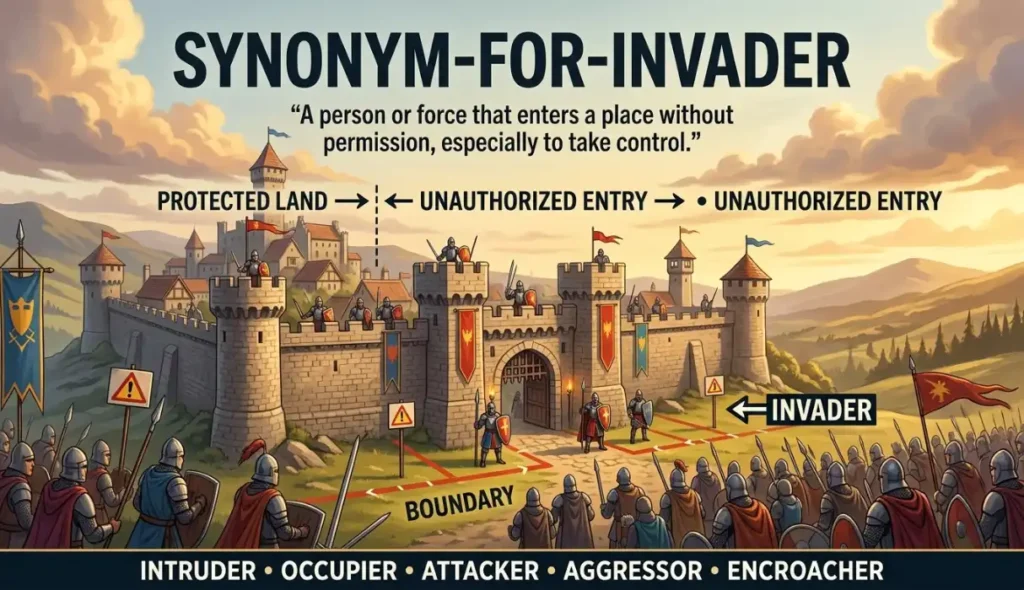
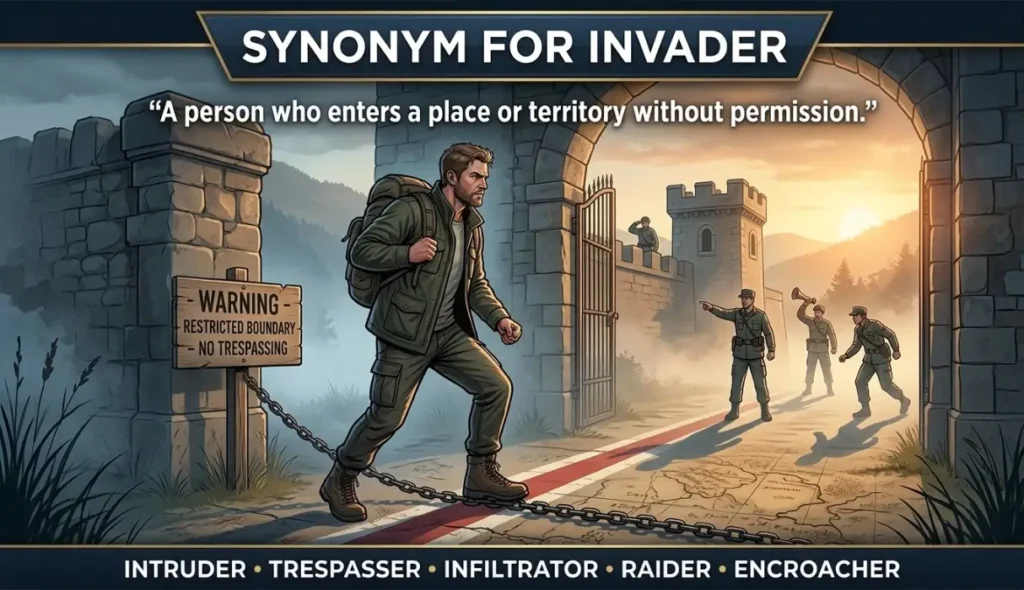
An invader is a hostile entity such as a person, military force, or organism that forcibly enters a territory without permission to conquer, damage, or disturb it. Originating from Latin invadere, common everyday synonyms include intruder for property break-ins, aggressor for political conflicts, and trespasser for legal property violations.
The synonym for invader is a useful search term for writers who need precise words to describe hostile forces, uninvited guests, or aggressive intruders. Choosing the right alternative helps avoid repetition and makes descriptions more powerful and accurate.
For example, a foreign army crossing a border may act as an invader, while an unwanted pest entering a garden can also fit the idea. A suitable synonym for invader depends on the situation, level of threat, and intended tone.
Using varied vocabulary can strengthen history essays, fantasy stories, blog posts, and everyday communication. Specific alternatives help readers understand whether someone intends to occupy, attack, disrupt, or simply enter without permission.
This guide explores useful alternatives with clear meanings, pronunciations, tone notes, and examples. Learning each synonym for invader can expand your vocabulary and improve confident writing.
What Does “Invader” Really Mean?
The word invader functions as a noun that describes a person, group, organism, or military force that enters a place by force, without permission, and with hostile intent.
Native speakers use it to describe historical armies breaching national borders, invasive plant or animal species disrupting an ecosystem, or uninvited intruders breaking into a private space.
Definition: An invader is an aggressive entity that enters a territory or space uninvited to conquer, damage, occupy, or disturb.
Connotative Meaning
(Connotation refers to the emotional feeling or implied association a word carries beyond its literal dictionary definition.)
- Positive tone: Rarely used positively, though occasionally used playfully to describe a cute pet invading a couch or a friendly surprise guest.
- Negative tone: Heavily negative, evoking feelings of danger, destruction, hostility, loss of control, and violation.
- Neutral tone: Used objectively in biology (e.g., invasive species) or military science to categorize incoming forces without emotional bias.
Etymology
The noun invader developed in the 1540s from the verb invade. The verb entered Late Middle English from the Latin invadere, which combines the prefix in- (“into”) with vadere (“to go, walk, or rush”).
- Old English (450–1100): Early speakers used Germanic terms like infeohtend (attacker) or heremann (soldier/raider).
- Middle English (1100–1500): Adopted from Anglo-French and Latin as invaden, describing forceful entry into a territory.
- Modern English (1500–Present): Evolved into the agent noun invader, expanding beyond military forces to include biological pests, computer viruses, and personal intruders.
Pronunciation (US & UK)
- US: /ɪnˈveɪ.dɚ/
- UK: /ɪnˈveɪ.də/
Syllables & Structure
Syllable Break: in-vad-er (3 syllables)
Affixation Pattern:
- Root: Vade (from Latin vadere, to go or walk)
- Prefix: In- (meaning into or inside)
- Suffix: -er (noun suffix denoting an agent who acts)
Synonyms List
Attacker (Noun) — US: /əˈtæk.ɚ/ | UK: /əˈtæk.ə/
Meaning: A person or group that initiates a violent physical or verbal assault.
Tone/Register: Neutral / General
Example 1: Guards repelled the sudden attacker at the main gate.
Example 2: The cybersecurity team blocked the online attacker quickly.
Aggressor (Noun) — US: /əˈɡres.ɚ/ | UK: /əˈɡres.ə/
Meaning: A nation or individual that starts a hostile action or conflict without provocation.
Tone/Register: Formal / Political
Example 1: International leaders condemned the foreign aggressor.
Example 2: She stood her ground against the workplace aggressor.
Intruder (Noun) — US: /ɪnˈtruː.dɚ/ | UK: /ɪnˈtruː.də/
Meaning: Someone who enters a private building or space without invitation or right.
Tone/Register: Everyday / Direct
Example 1: The house alarm alerted the police to a late-night intruder.
Example 2: A stray cat became an unexpected intruder in our kitchen.
Raider (Noun) — US: /ˈreɪ.dɚ/ | UK: /ˈreɪ.də/
Meaning: An armed actor who makes a swift, surprise attack to loot or destroy.
Tone/Register: Historical / Action
Example 1: Coastal villages fortified their walls against the sea raider.
Example 2: Corporate raiders attempted to buy out the struggling firm.
Trespasser (Noun) — US: /ˈtres.pəs.ɚ/ | UK: /ˈtres.pəs.ə/
Meaning: A person who enters another individual’s land or property illegally without permission.
Tone/Register: Legal / Everyday
Example 1: The farmer posted warning signs to keep out any trespasser.
Example 2: Security escorted the trespasser off the private facility.
Interloper (Noun) — US: /ˈɪn.t̬ɚ.loʊ.pɚ/ | UK: /ˈɪn.tə.ləʊ.pə/
Meaning: An unwanted person who becomes involved in a situation or place where they do not belong.
Tone/Register: Formal / Literary
Example 1: He felt like an awkward interloper at the exclusive party.
Example 2: Local businesses viewed the foreign corporation as an interloper.
Encroacher (Noun) — US: /ɪnˈkroʊ.tʃɚ/ | UK: /ɪnˈkrəʊ.tʃə/
Meaning: An entity that gradually advances beyond proper limits or onto another’s rights.
Tone/Register: Formal / Legal
Example 1: The building inspector faced an encroaching building over the property line.
Example 2: Over time, the growing city became an encroacher on wildlife habitats.
Assailant (Noun) — US: /əˈseɪ.lənt/ | UK: /əˈseɪ.lənt/
Meaning: A person who physically attacks another with force or weapons.
Tone/Register: Formal / Legal
Example 1: Police arrested the unknown assailant near the train station.
Example 2: The victim courageously defended herself against her assailant.
Marauder (Noun) — US: /məˈrɑː.dɚ/ | UK: /məˈrɔː.də/
Meaning: A plunderer who moves around in search of things to steal or destroy.
Tone/Register: Historical / Descriptive
Example 1: The village was burned by a band of desperate marauders.
Example 2: Hungry raccoons acted like night marauders in our trash cans.
Conqueror (Noun) — US: /ˈkɑːŋ.kɚ.ɚ/ | UK: /ˈkɒŋ.kər.ə/
Meaning: A person or army that successfully overcomes and takes control of a land by force.
Tone/Register: Historical / Formal
Example 1: Alexander the Great earned fame as a relentless conqueror.
Example 2: The foreign conqueror established new laws across the region.
Occupier (Noun) — US: /ˈɑː.kjə.paɪ.ɚ/ | UK: /ˈɒk.jʊ.paɪ.ə/
Meaning: A military force or authority that resides in and controls a conquered territory.
Tone/Register: Political / News
Example 1: Citizens staged silent protests against the military occupier.
Example 2: The occupying nation established strict curfews in the capital.
Plunderer (Noun) — US: /ˈplʌn.dɚ.ɚ/ | UK: /ˈplʌn.dər.ə/
Meaning: Someone who violently steals goods, valuables, or resources from a place.
Tone/Register: Descriptive / Historical
Example 1: Ancient tombs were looted by every greedy plunderer.
Example 2: The invading army acted more like a plunderer than a government.
Pillager (Noun) — US: /ˈpɪl.ɪ.dʒɚ/ | UK: /ˈpɪl.ɪ.dʒə/
Meaning: A hostile force that ransacks and steals property during wartime.
Tone/Register: Historical / Literary
Example 1: The historical manuscript described the arrival of the pillager.
Example 2: Villagers hid their valuables underground from the pillager.
Infiltrator (Noun) — US: /ˈɪn.fɪl.treɪ.t̬ɚ/ | UK: /ˈɪn.fɪl.treɪ.tə/
Meaning: Someone who secretly enters a group or place to gather information or cause harm.
Tone/Register: Military / Technical
Example 1: The counter-intelligence team captured the covert infiltrator.
Example 2: Software engineers patched the system against any digital infiltrator.
Gatecrasher (Noun) — US: /ˈɡeɪt.kræʃ.ɚ/ | UK: /ˈɡeɪt.kræʃ.ə/
Meaning: An uninvited guest who attends a private party or social event without permission.
Tone/Register: Casual / Informal
Example 1: An annoying gatecrasher ruined the wedding reception toasts.
Example 2: Security checked invitations to prevent any gatecrasher.
Squatter (Noun) — US: /ˈskwɑː.t̬ɚ/ | UK: /ˈskwɒt.ə/
Meaning: A person who unlawfully settles on uninhabited land or occupies an empty building.
Tone/Register: Legal / Everyday
Example 1: The landlord had to legally evict the stubborn squatter.
Example 2: A lone squatter transformed the abandoned warehouse into a shelter.
Infester (Noun) — US: /ɪnˈfes.tɚ/ | UK: /ɪnˈfes.tə/
Meaning: An organism or organism group that spreads destructively in large numbers.
Tone/Register: Biological / Descriptive
Example 1: Termites proved to be a persistent infester of the wooden frame.
Example 2: The agricultural expert treated the crops for a destructive pest infester.
Outsider (Noun) — US: /ˌaʊtˈsaɪ.dɚ/ | UK: /ˌaʊtˈsaɪ.də/
Meaning: A person who does not belong to a particular group, organization, or community.
Tone/Register: Neutral / General
Example 1: As an outsider, she brought fresh perspectives to the project.
Example 2: The quiet town was slow to trust any visiting outsider.
Encroacher on Privacy (Noun Phrase) — US: /ɪnˈkroʊ.tʃɚ ɑːn ˈpraɪ.və.si/ | UK: /ɪnˈkrəʊ.tʃə ɒn ˈprɪv.ə.si/
Meaning: An individual or technology that intrudes upon personal boundaries or secrets.
Tone/Register: Modern / Legal
Example 1: Telemarketers act as an annoying encroacher on privacy.
Example 2: New tracking software acts as an unwanted encroacher on privacy.
Despoiler (Noun) — US: /dɪˈspɔɪ.lɚ/ | UK: /dɪˈspɔɪ.lə/
Meaning: Someone who steals, damages, or strips a place of its beauty or resources.
Tone/Register: Literary / Dramatic
Example 1: Loggers were viewed as the despoilers of the virgin forest.
Example 2: The war turned peace into chaos through every brutal despoiler.
Violator (Noun) — US: /ˈvaɪ.ə.leɪ.t̬ɚ/ | UK: /ˈvaɪ.ə.leɪ.tə/
Meaning: A person who breaks a law, rule, agreement, or boundary.
Tone/Register: Legal / Formal
Example 1: The company faced heavy fines as an environmental rule violator.
Example 2: Guards detained the safety rule violator at the checkpoint.
Assaulter (Noun) — US: /əˈsɑːl.t̬ɚ/ | UK: /əˈsɔːl.tə/
Meaning: An actor who launches a direct physical attack.
Tone/Register: Formal / Direct
Example 1: The store clerk courageously fought off the masked assaulter.
Example 2: The police report detailed the identity of the primary assaulter.
Hostile (Noun) — US: /ˈhɑː.stəl/ | UK: /ˈhɒs.taɪl/
Meaning: An enemy combatant or aggressive individual in a tactical scenario.
Tone/Register: Military / Technical
Example 1: Soldiers spotted an armed hostile approaching the perimeter.
Example 2: Security officers neutralized the hostile before anyone was hurt.
Enemy (Noun) — US: /ˈen.ə.mi/ | UK: /ˈen.ə.mi/
Meaning: A person or nation actively opposed or hostile to another.
Tone/Register: General / Direct
Example 1: The two nations had been bitter enemies for decades.
Example 2: Fear can often become a person’s worst internal enemy.
Foe (Noun) — US: /foʊ/ | UK: /fəʊ/
Meaning: An adversary, opponent, or enemy in a fight or contest.
Tone/Register: Literary / Dramatic
Example 1: The knight prepared to face his deadliest foe in combat.
Example 2: Political leaders united against a common economic foe.
Adversary (Noun) — US: /ˈæd.vɚ.ser.i/ | UK: /ˈæd.və.sər.i/
Meaning: An opponent or rival in a conflict, dispute, or competition.
Tone/Register: Formal / Academic
Example 1: The skilled lawyer respected her legal adversary in court.
Example 2: The chess champion analyzed every move of his adversary.
Opponent (Noun) — US: /əˈpoʊ.nənt/ | UK: /əˈpəʊ.nənt/
Meaning: Someone who competes against or opposes another in a contest or debate.
Tone/Register: Neutral / General
Example 1: Her political opponent delivered a strong counter-argument.
Example 2: The boxer shook hands with his opponent after the match.
Competitor (Noun) — US: /kəmˈpet̬.ə.t̬ɚ/ | UK: /kəmˈpet.ɪ.tə/
Meaning: A person or business striving to outdo another for a goal or market share.
Tone/Register: Business / General
Example 1: The new tech startup became a major competitor to established brands.
Example 2: Every competitor trained hard for the upcoming Olympic trials.
Rival (Noun) — US: /ˈraɪ.vəl/ | UK: /ˈraɪ.vəl/
Meaning: A person or group competing for the same object, position, or superiority.
Tone/Register: Neutral / Conversational
Example 1: The two sports teams have been fierce rivals for years.
Example 2: She congratulated her primary rival on winning the award.
Encroach (Verb/Noun construct) — US: /ɪnˈkroʊtʃ/ | UK: /ɪnˈkrəʊtʃ/
Meaning: To intrude gradually upon another’s territory, rights, or personal space.
Tone/Register: Formal / Legal
Example 1: Rising sea levels threaten to encroach upon coastal cities.
Example 2: We must not let work tasks encroach on family time.

Inroader (Noun) — US: /ˈɪn.roʊ.dɚ/ | UK: /ˈɪn.rəʊ.də/
Meaning: One who makes a sudden hostile entry or raid into a territory.
Tone/Register: Historical / Rare
Example 1: The castle walls held firm against the fierce inroader.
Example 2: Historical accounts recorded the swift destruction caused by the inroader.
Overrunner (Noun) — US: /ˈoʊ.vɚ.rʌn.ɚ/ | UK: /ˈəʊ.və.rʌn.ə/
Meaning: A force that spreads over and takes control of a land rapidly.
Tone/Register: Military / Descriptive
Example 1: The invading battalion acted as an unstoppable overrunner.
Example 2: Pest control cleared the house of the insect overrunner.
Usurper (Noun) — US: /juːˈzɝː.pɚ/ | UK: /juːˈzɜː.pə/
Meaning: Someone who seizes an office, power, or throne illegally or by force.
Tone/Register: Formal / Historical
Example 1: The prince fought to reclaim his throne from the usurper.
Example 2: Citizens refused to obey the commands of the military usurper.
Arrogate (Agent construct) — US: /ˈær.ə.ɡeɪt/ | UK: /ˈær.ə.ɡeɪt/
Meaning: One who takes or claims something without justification or right.
Tone/Register: Academic / Formal
Example 1: The executive acted as an arrogator of company resources.
Example 2: History views the dictator as a ruthless arrogator of power.
Trespassing Pest (Noun Phrase) — US: /ˈtres.pəs.ɪŋ pest/ | UK: /ˈtres.pəs.ɪŋ pest/
Meaning: An animal or insect that enters a garden or property illegally to cause damage.
Tone/Register: Casual / Practical
Example 1: Deer became a daily trespassing pest in our vegetable garden.
Example 2: Traps were set to capture the trespassing pest in the attic.
Stranger (Noun) — US: /ˈstreɪn.dʒɚ/ | UK: /ˈstreɪn.dʒə/
Meaning: A person whom one does not know or who is unfamiliar with a place.
Tone/Register: Everyday / Neutral
Example 1: A polite stranger helped her pick up her dropped groceries.
Example 2: Children are taught not to take candy from any stranger.
Foreigner (Noun) — US: /ˈfɔːr.ə.nɚ/ | UK: /ˈfɒr.ə.nə/
Meaning: A person born in or coming from a country other than one’s own.
Tone/Register: Neutral / Direct
Example 1: As a traveler, the foreigner enjoyed discovering local foods.
Example 2: The international hostel welcomed every visiting foreigner.
Alien (Noun) — US: /ˈeɪ.li.ən/ | UK: /ˈeɪ.li.ən/
Meaning: A foreign-born resident, or a creature from another world/environment.
Tone/Register: Legal / Sci-Fi
Example 1: Customs officials processed the travel visa for the resident alien.
Example 2: Science fiction movies often depict a terrifying alien invader.
Immigrant (Noun) — US: /ˈɪm.ə.ɡrənt/ | UK: /ˈɪm.ɪ.ɡrənt/
Meaning: A person who comes to live permanently in a foreign country.
Tone/Register: Neutral / Legal
Example 1: My grandfather was a hardworking immigrant who started a small shop.
Example 2: The city celebrated its diverse heritage created by every immigrant family.
Newcomer (Noun) — US: /ˈnuː.kʌm.ɚ/ | UK: /ˈnjuː.kʌm.ə/
Meaning: A person who has recently arrived in a place, group, or activity.
Tone/Register: Friendly / Neutral
Example 1: Neighbors brought a pie to welcome the newcomer to the block.
Example 2: As a newcomer to coding, he practiced every single day.
Colonizer (Noun) — US: /ˈkɑː.lə.naɪ.zɚ/ | UK: /ˈkɒl.ə.naɪ.zə/
Meaning: A nation or group that establishes control over indigenous people and land.
Tone/Register: Historical / Academic
Example 1: History textbooks detail the impact of the European colonizer.
Example 2: Indigenous communities resisted the rule of the foreign colonizer.
Subduer (Noun) — US: /səbˈdjuː.ɚ/ | UK: /səbˈdʒuː.ə/
Meaning: Someone who brings a country, people, or force under control by power.
Tone/Register: Formal / Literary
Example 1: The king was remembered as a firm subduer of regional rebellions.
Example 2: Courageous leaders acted as a subduer of public panic.
Overlord (Noun) — US: /ˈoʊ.vɚ.lɔːrd/ | UK: /ˈəʊ.və.lɔːd/
Meaning: A person who has supreme authority, power, or dominance over others.
Tone/Register: Dramatic / Historical
Example 1: The local ruler pledged allegiance to the powerful overlord.
Example 2: Tech companies must ensure they do not become a digital overlord.
Intruder on Land (Noun Phrase) — US: /ɪnˈtruː.dɚ ɑːn lænd/ | UK: /ɪnˈtruː.də ɒn lænd/
Meaning: A person or animal entering private land without legal authority.
Tone/Register: Legal / Rural
Example 1: The park ranger warned every intruder on land about protected wildlife areas.
Example 2: Ranchers posted boundary markers to deter an intruder on land.
Cyber Attacker (Noun Phrase) — US: /ˈsaɪ.bɚ əˈtæk.ɚ/ | UK: /ˈsaɪ.bər əˈtæk.ə/
Meaning: A hacker or entity that attempts to breach computer systems or networks.
Tone/Register: Modern / Technical
Example 1: The banking system successfully repelled a skilled cyber attacker.
Example 2: IT security monitors networks 24/7 to catch any cyber attacker.
Pest (Noun) — US: /pest/ | UK: /pest/
Meaning: A destructive insect, animal, or annoying person that causes trouble.
Tone/Register: Everyday / Conversational
Example 1: The gardener sprayed natural soap to remove every plant pest.
Example 2: Little brothers can sometimes act like a total pest.
Parasite (Noun) — US: /ˈper.ə.saɪt/ | UK: /ˈpær.ə.saɪt/
Meaning: An organism or person that lives off another organism/person without giving back.
Tone/Register: Biological / Critical
Example 1: Ticks are a common parasite found in tall grass.
Example 2: He realized his lazy roommate had become a financial parasite.
Infection (Noun Agent construct) — US: /ɪnˈfek.ʃən/ | UK: /ɪnˈfek.ʃən/
Meaning: A harmful biological agent or pathogen invading a host body.
Tone/Register: Medical / Scientific
Example 1: Antibiotics helped the patient’s body fight off the bacterial infection.
Example 2: The doctor treated the skin infection before it spread further.
Pathogen (Noun) — US: /ˈpæθ.ə.dʒən/ | UK: /ˈpæθ.ə.dʒən/
Meaning: A bacterium, virus, or microorganism that causes disease in a body.
Tone/Register: Scientific / Formal
Example 1: Hand washing helps prevent a deadly pathogen from spreading.
Example 2: Researchers studied how the airborne pathogen entered lung cells.
Bio-invader (Noun) — US: /ˈbaɪ.oʊ ɪnˈveɪ.dɚ/ | UK: /ˈbaɪ.əʊ ɪnˈveɪ.də/
Meaning: An alien species introduced into a non-native ecosystem that harms native life.
Tone/Register: Scientific / Environmental
Example 1: The invasive zebra mussel is a notorious bio-invader in American lakes.
Example 2: Environmentalists work hard to contain every destructive bio-invader.
Infiltrator of Networks (Noun Phrase) — US: /ˈɪn.fɪl.treɪ.t̬ɚ ʌv ˈnet.wɝːks/ | UK: /ˈɪn.fɪl.treɪ.tə ɒv ˈnet.wɜːks/
Meaning: A malicious software program or hacker penetrating digital databases.
Tone/Register: Tech / Cyber
Example 1: Firewalls blocked an unauthorized infiltrator of networks.
Example 2: The company hired ethical hackers to simulate an infiltrator of networks.
Offender (Noun) — US: /əˈfen.dɚ/ | UK: /əˈfen.də/
Meaning: A person who commits an illegal act or violates social norms.
Tone/Register: Legal / Formal
Example 1: The judge handed down a community service sentence to the first-time offender.
Example 2: Repeat offenders face stricter penalties under state law.
Encroaching Force (Noun Phrase) — US: /ɪnˈkroʊ.tʃɪŋ fɔːrs/ | UK: /ɪnˈkrəʊ.tʃɪŋ fɔːs/
Meaning: A slowly advancing group or influence that consumes a surrounding area.
Tone/Register: Military / Formal
Example 1: The army halted the encroaching force at the riverbank.
Example 2: Urban development acts as an encroaching force on green spaces.
Ransacker (Noun) — US: /ˈræn.sæk/.ɚ/ | UK: /ˈræn.sæk.ə/
Meaning: Someone who searches through a place violently and thoroughly to steal things.
Tone/Register: Descriptive / Action
Example 1: Homeowners returned home to find the work of a destructive ransacker.
Example 2: The museum lost precious artifacts to an unknown ransacker.
Boundary Breaker (Noun Phrase) — US: /ˈbaʊn.də.ri ˈbreɪ.kɚ/ | UK: /ˈbaʊn.dər.i ˈbreɪ.kə/
Meaning: An individual or entity that crosses physical, personal, or legal limits.
Tone/Register: Expressive / Modern
Example 1: She refused to tolerate any boundary breaker in her personal relationships.
Example 2: The trespasser acted as a clear boundary breaker on private land.
Synonyms by Tone
Choosing the right synonym for invader depends heavily on tone. Using a term that is too weak or too intense can confuse readers or misrepresent a situation.
Positive Tone
- Newcomer / Immigrant / Visitor: Words that reframe an incoming entity as peaceful, legal, or welcome rather than hostile.
Neutral Tone
- Outsider / Foreigner / Opponent: Clear, objective terms suitable for legal documents, sports coverage, or general reporting.
- Pathogen / Bio-invader: Scientific terms used to state biological facts without added personal emotion.
Negative Tone
- Aggressor / Plunderer / Marauder: Emphasizes violent destruction, illegal looting, war crimes, or deep hostility.
- Intruder / Trespasser / Assaulter: Highlights legal violations, property break-ins, or physical attacks.
Playful / Informal Tone
- Gatecrasher / Pest / Stray: Used in casual speech to describe minor social annoyances, uninvited party guests, or cheeky pets taking over a room.
“Invader” vs Close Alternatives
| Word | Specific Meaning | Best Use Case | Tone |
| Invader | An entity entering a place by force to conquer or control. | Military history, biological invasions, fiction. | Serious / Formal |
| Intruder | Someone entering a private home or space illegally. | Home security, personal privacy, police reports. | Direct / Everyday |
| Aggressor | The person or nation that starts an unprovoked attack. | Global news, political debates, legal complaints. | Formal / Political |
How “Invader” Changes by Context
Daily Conversation
In everyday speech, people prefer simpler, direct terms over heavy Latinate words.
- “A gatecrasher showed up at our backyard barbecue.”
- “Set the security system so no intruder gets in.”
Writing or Blogging
Bloggers and content creators choose evocative terms to paint vivid pictures for readers.
- “Digital tracking tools act like a silent encroacher on privacy.”
- “Don’t let burnout become a constant enemy to your productivity.”
Professional or Academic Tone
Formal essays, legal briefs, and business reports require precise, neutral vocabulary.
- “The court identified the defendant as a property trespasser.”
- “The company defended its software against an international cyber attacker.”
Creative or Informal Use
Novelists and storytellers use rich, dramatic synonyms to build tension and set the scene.
- “The ancient fortress fell to a ruthless marauder.”
- “A dark overlord ruled over the conquered valley.”
Common Mistakes & Native Usage

Misuse Scenarios
- Calling Immigrants “Invaders”: Referring to peaceful, legal newcomers or immigrants as “invaders” carries an unwarranted hostile tone. Save invader for genuine security threats, military force, or destructive biological pests.
- Confusing “Intruder” with “Aggressor”: An intruder breaks into a place (like a home) silently, while an aggressor actively initiates an attack or fight.
Register Notes
- Spoken English: Prefer intruder, pest, gatecrasher, or attacker.
- Written/Formal English: Prefer invader, aggressor, encroacher, or assailant.
Related Words for Invader and Intruder
Searchers often use related phrases such as intruder synonym, another word for intruder, invader antonym, and invade privacy synonym when looking for a more precise alternative. The best word depends on whether the situation involves physical entry, military aggression, personal boundaries, property, or competition.
What Is Another Word for an Intruder?
A common synonym for intruder is trespasser, especially when someone enters private property without permission. Other useful alternatives include invader, interloper, unwelcome guest, gatecrasher, and encroacher.
The best choice depends on the situation:
- Trespasser: someone who enters private land or property without permission.
- Unwelcome guest: someone present where they are not wanted, usually in a social setting.
- Gatecrasher: an uninvited person who attends a party or event.
- Interloper: someone who becomes involved in a place or situation where they do not belong.
- Encroacher: someone or something that gradually crosses a boundary or limit.
- Invader: a hostile person, force, or entity entering territory with the intention of taking control or causing harm.
For example, someone breaking into a house is more naturally called an intruder or trespasser, while an army crossing a national border may be described as an invader.
What Are the Synonyms of Intruder?
Common intruder synonyms include trespasser, interloper, invader, encroacher, gatecrasher, unwelcome guest, and trespasser.
However, these words are not always interchangeable. An intruder usually enters a private or restricted place without permission. A trespasser specifically violates property rights, while an interloper may simply become involved in a situation where they are not wanted.
What Is the Difference Between an Invader and an Intruder?
An invader usually suggests a more serious or hostile entry, particularly into territory that someone intends to conquer, occupy, or disrupt. An intruder usually refers to someone entering a private place without permission.
For example:
- Invader: The army crossed the border and attempted to occupy the region.
- Intruder: The homeowner called the police after discovering an intruder inside the house.
Therefore, an invader can be an intruder in some contexts, but an intruder is not necessarily an invader.
What Is a Synonym for Invade Privacy?
Common alternatives to invade privacy include intrude on someone’s privacy, violate someone’s privacy, breach someone’s privacy, interfere with someone’s private life, and encroach on someone’s privacy.
Each expression has a slightly different emphasis:
- Intrude on privacy: enter someone’s personal affairs without invitation.
- Violate privacy: break someone’s right to keep personal information or activities private.
- Breach privacy: improperly access or disclose confidential information.
- Encroach on privacy: gradually cross personal boundaries.
- Interfere with someone’s private life: become unnecessarily involved in personal matters.
For example, “The tracking software breached users’ privacy” is more precise in a technology context than simply calling the software an invader.
What Is a Synonym for Enemy Territory?
Depending on context, alternatives to enemy territory include hostile territory, opposing territory, hostile land, enemy-held territory, contested territory, and adversary-controlled territory.
These expressions are not exact equivalents in every situation. Hostile territory emphasizes danger, while enemy-held territory specifically means land controlled by an opposing force. Contested territory is broader and describes land whose control is disputed by two or more sides.
What Is the Antonym of Invader?
There is no single antonym of invader that works in every context. The opposite depends on what the invader is doing.
Useful opposites include:
- Defender: someone protecting a place against an attack.
- Protector: someone who keeps people, property, or territory safe.
- Guardian: someone responsible for protecting a person or place.
- Resident: someone who legitimately lives in a particular place.
- Inhabitant: a person or animal that naturally occupies a place.
- Ally: a person, group, or nation supporting another rather than attacking it.
For example, if an invader attacks a country, the defender is the most direct opposite. If the focus is simply on someone who belongs in a place rather than entering it aggressively, resident or inhabitant may be more appropriate.
What Does “Forcely” Mean?
Forcely is generally not the natural standard-English word to use when describing an action done with force. Native speakers normally use forcibly, by force, or another context-specific expression.
For example:
- Incorrect or unnatural: “The army entered the city forcely.”
- Natural: “The army entered the city forcibly.”
- Natural: “The army entered the city by force.”
- Natural: “The soldiers forced their way into the city.”
Forcibly means using physical power, coercion, or force. It is the better choice when describing how an invader enters a place.
What Is the Meaning of Invasor?
Invasor is the Spanish word for invader. It refers to a person, group, army, or other entity that enters a territory by force, usually with hostile intentions.
Common Spanish synonyms or related expressions include agresor (aggressor), atacante (attacker), intruso (intruder), ocupante (occupier), and conquistador (conqueror), depending on the context.
For example, “invasor” is appropriate for a military force entering another country’s territory, while “intruso” is more suitable for someone entering a private place without permission.
What Are the Synonyms of “Invasores” in Spanish?
Invasores is the plural form of Spanish invasor. Depending on the context, related words include:
- Agresores aggressors
- Atacantes attackers
- Intrusos intruders
- Ocupantes occupiers
- Conquistadores conquerors
- Asaltantes attackers or raiders
The exact choice depends on whether the context involves military invasion, unlawful entry, occupation, or direct attack.
What Is the Spanish Synonym for “Invader”?
The most direct Spanish translation of invader is invasor. Depending on meaning, alternatives may include agresor, atacante, intruso, ocupante, or conquistador.
For example:
- Invader → invasor
- Aggressor → agresor
- Attacker → atacante
- Intruder → intruso
- Occupier → ocupante
- Conqueror → conquistador
These terms should not be treated as perfect synonyms because each one highlights a different type of hostile or unauthorized entry.
What Is Another Word for Invader?
Depending on the context, another word for invader can be aggressor, attacker, intruder, raider, conqueror, occupier, marauder, pillager, infiltrator, or trespasser.
For military contexts, aggressor, occupier, conqueror, and raider can be especially precise. For private-property situations, intruder or trespasser is usually more natural. Biological contexts: bio-invader, invasive species, or pest may be more suitable.
Quick Context Guide
| Situation | Best Word |
|---|---|
| Someone secretly enters your home | Intruder |
| Someone enters private land without permission | Trespasser |
| A nation starts an unprovoked attack | Aggressor |
| An army enters another country by force | Invader |
| A force takes control of conquered land | Occupier |
| Someone attacks another person | Assailant / Attacker |
| Someone steals during a raid | Raider / Plunderer |
| Someone attends a party without an invitation | Gatecrasher |
| A person secretly enters a group or system | Infiltrator |
| A non-native organism damages an ecosystem | Bio-invader / Invasive species |
| Someone protects territory from an attack | Defender |
The key is to choose a word that describes the type of entry, intention, and level of hostility. This makes your writing more accurate than simply replacing invader with any similar-looking word.
Real-Life Mini Scenarios
- Workplace: An IT department responds to a breach: “Security software successfully blocked an unauthorized cyber attacker from accessing user data.”
- Social Situations: A host managing a party: “We had to ask a gatecrasher to leave because they didn’t have an invitation.”
- Media & Pop Culture: A journalist reporting on wildlife conservation: “Ecologists are fighting a foreign bio-invader that threatens local bird species.”
- Writing & Storytelling: A fantasy novelist describing a siege: “The castle guards braced themselves as the marauder reached the outer gates.”
Conclusion
Expanding your vocabulary with synonyms for invader helps you describe conflicts, intrusions, and unwanted visitors with greater precision. The right word can clearly show whether someone attacks, occupies, enters without permission, or causes disruption.
Choosing specific terms prevents repetitive phrasing and strengthens your writing. It also helps readers understand the exact severity, purpose, and context of your message. Students, bloggers, writers, and professionals can all benefit from using varied vocabulary.
Try using two or three new alternatives in your next essay, blog post, or workplace document. Create original sentences with each word and explore different contexts. Regular practice improves your vocabulary, sharpens your writing style, and makes your communication more natural, clear, and confident.
Practice Exercise
Test your understanding of synonyms for invader with these practical scenario questions:
- Which synonym for invader is most appropriate for someone breaking into a private house at night?
A) Immigrant
B) Intruder
C) Newcomer
D) Opponent - What is the best formal term for a nation that starts an unprovoked war?
A) Gatecrasher
B) Aggressor
C) Squatter
D) Stranger - If an uninvited guest shows up at a private party, what informal word fits best?
A) Gatecrasher
B) Overlord
C) Pathogen
D) Pillager - Which term is used in biology to describe non-native species causing ecological damage?
A) Competitor
B) Bio-invader
C) Adversary
D) Usurper - What does the Latin prefix in- mean in the word invader?
A) Away
B) Into
C) Against
D) Without - Which synonym specifically describes someone who illegally seizes a king’s throne?
A) Usurper
B) Trespasser
C) Parasite
D) Newcomer - What legal term best fits someone walking across marked private farm property without permission?
A) Assaulter
B) Trespasser
C) Enemy
D) Overrunner - Which word carries a neutral tone suitable for sports writing?
A) Marauder
B) Opponent
C) Pillager
D) Plunderer - What is a key mistake to avoid when using the word invader?
A) Using it as a noun
B) Using hostile military terms for peaceful immigrants
C) Using it in historical essays
D) Capitalizing it at the start of a sentence - In cybersecurity, an unauthorized entity attempting to breach a database is called a:
A) Cyber attacker
B) Gatecrasher
C) Squatter
D) Colonizer
Application Task:
Write one short sentence describing an uninvited backyard animal using either intruder or pest.
Answer Key:
1-B, 2-B, 3-A, 4-B, 5-B, 6-A, 7-B, 8-B, 9-B, 10-A
FAQs
1. What is the most common synonym for invader in daily speech?
The most common everyday synonym is intruder (for home or personal space break-ins) or attacker (for physical assaults). People use these terms in regular conversation because they are direct and universally understood.
2. Is there a difference between an invader and an intruder?
Yes. An invader typically refers to a large force or entity entering a territory to conquer, occupy, or dominate. An intruder usually refers to a single person breaking into a private building or personal space.
3. What formal synonym for invader works best in legal writing?
In legal contexts, trespasser (for property violations), encroacher (for boundary line disputes), or assaulter (for physical violence) are preferred. These words convey objective legal definitions without overly dramatic language.
4. Can invader be used in biological or environmental contexts?
Yes. Biologists frequently use invader or bio-invader to describe non-native plants, animals, or insects that enter a new ecosystem and disrupt local wildlife.
5. What is a strong literary synonym for invader in fiction writing?
In creative writing, terms like marauder, pillager, plunderer, or usurper add vivid historical imagery and emotional tension to stories involving war or fantasy realms.
6. Why is it important to choose the right tone when using synonyms for invader?
Tone dictates how readers perceive the threat level. Using harsh military terms like marauder for minor inconveniences sounds overly dramatic, while using neutral terms like newcomer for a hostile breach downplays real danger.

Jameel Hassan is the founder and lead writer at SynonymsCloud.com, a trusted online platform dedicated to English vocabulary and effective communication. He is passionate about helping students, writers, professionals, and lifelong learners discover the right words to express their ideas with clarity, precision, and confidence.
At SynonymsCloud.com, every article is thoroughly researched and carefully written to provide accurate, practical, and easy-to-understand guidance on synonyms, antonyms, word meanings, idioms, and vocabulary. With a strong commitment to quality, real-world usage, and clear explanations, the website helps readers expand their vocabulary, improve their writing, and communicate more effectively in both academic and professional settings.