
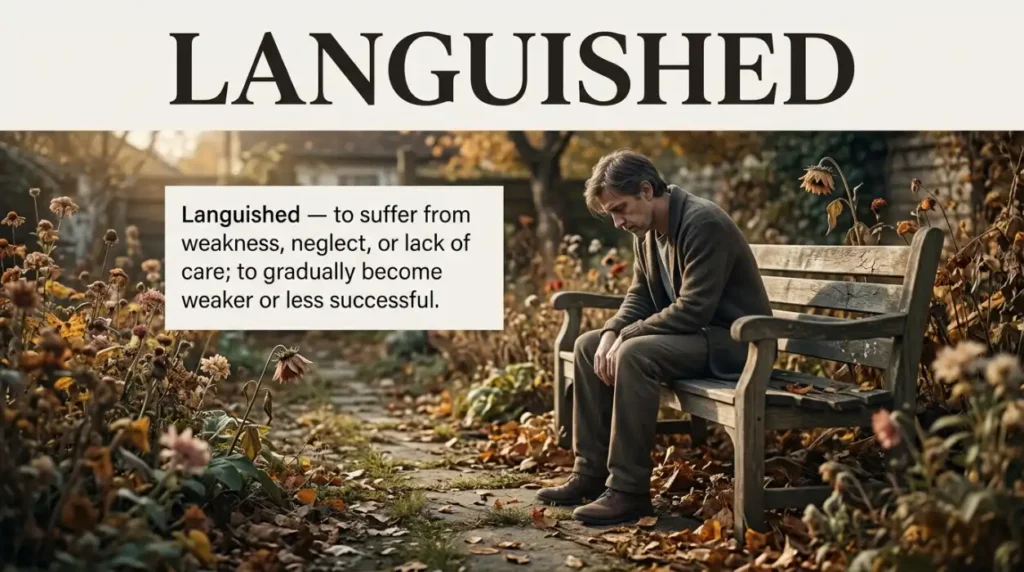
A synonym for languished varies based on your intended context. To express a lack of progress or neglect, use stagnated, sat idle, or gathered dust. To describe fading health, strength, or physical vitality, choose deteriorated, withered, weakened, or declined. For emotional suffering or longing, options like pined, moped, or suffered fit best.
A synonym for languished is what you need when a project sits forgotten, or a plant droops without water. Imagine submitting a great proposal, only to watch it sit in an inbox for months. The idea languished while waiting for approval.
Finding a fitting synonym for languished helps you describe fading energy, neglect, or slow decay with precision. Repeating the same verb drains emotional impact from your writing. Varying your verbs brings real atmosphere to your stories and essays.
Native speakers use this past-tense verb to describe neglected plans, failing health, or stagnating careers. Using a precise synonym for languished allows you to set the exact emotional tone you want.
This guide helps students, bloggers, content writers, and ESL learners express loss, neglect, and inactivity clearly. Expanding your command of these terms will make your daily English sound fluid and expressive.
What Does “Languished” Really Mean?
“Languished” is the past-tense form of the verb languish, meaning to lose vigor, vitality, or progress, or to exist in a state of neglect and forced inactivity.
It conveys a somber, weary, or sorrowful attitude. Native speakers understand it as suffering from prolonged neglect, weakness, or stagnation. It often appears in news reporting, literature, historical accounts, and personal reflection.
- Part of Speech: Verb (Past Tense)
- Simple Definition: Suffered from weakness, neglect, fading energy, or a lack of progress over time.
Connotative Meaning
(Connotation is the emotional feeling or cultural association attached to a word beyond its strict dictionary definition.)
- Positive tone: Rested (when describing quiet waiting), hibernated (when preparing for growth).
- Negative tone: Rotted, decayed, suffered, withered, pined, stagnated.
- Neutral tone: Remained, waited, lingered, stayed, paused.
Etymology
“Languished” comes from Old French languir (to languish or droop), which derives from Vulgar Latin languire, from Latin languere (to be weak or faint).
- Old English (450–1100): English used Germanic terms like aswintan (to fade away) or seocnian (to fall sick).
- Middle English (1100–1500): The French term languiss- entered Middle English in the 14th century as languishen, meaning to faint or lose strength.
- Modern English (1500–Present): The word evolved to describe not just physical weakness, but also emotional sorrow and stagnant institutional progress.
Pronunciation (US & UK)
- US: /ˈlæŋ.ɡwɪʃt/
- UK: /ˈlæŋ.ɡwɪʃt/
Syllables & Structure
- Syllables: lan-guished (2 syllables)
- Root: langu- (from Latin languere, to be weak)
- Prefix: None
- Suffix: -ed (past-tense verbal suffix)
Synonyms List
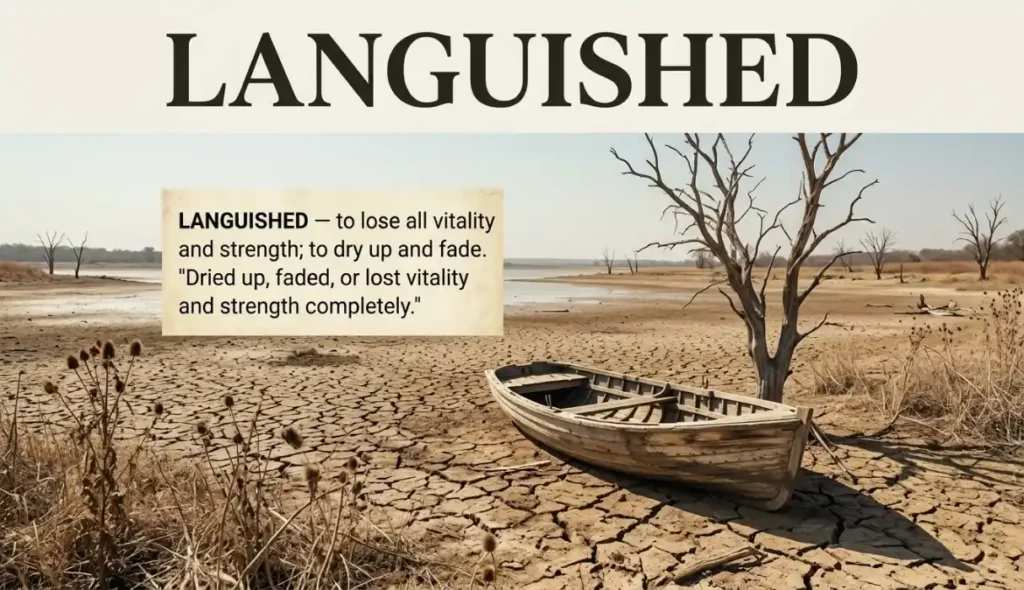
Withered (Verb) — US: /ˈwɪð.ɚd/ | UK: /ˈwɪð.əd/
- Meaning: Dried up, faded, or lost vitality and strength completely.
- Tone/Register: Descriptive, Literary
- Example 1: The unattended flowers withered quickly under the intense heat.
- Example 2: Her initial enthusiasm withered after months of harsh criticism.
Stagnated (Verb) — US: /ˈstæɡ.neɪ.t̬ɪd/ | UK: /stæɡˈneɪ.tɪd/
- Meaning: Ceased to flow, develop, advance, or make active progress.
- Tone/Register: Formal, Business
- Example 1: The local economy stagnated after the major factory closed down.
- Example 2: His career stagnated because he avoided taking on new challenges.
Declined (Verb) — US: /dɪˈklaɪnd/ | UK: /dɪˈklaɪnd/
- Meaning: Diminished in health, quality, power, or operational strength over time.
- Tone/Register: Neutral, Professional
- Example 1: Overall sales declined steadily during the final financial quarter.
- Example 2: The patient’s health declined rapidly during the harsh winter.
Deteriorated (Verb) — US: /dɪˈtɪr.i.ə.reɪ.t̬ɪd/ | UK: /dɪˈtɪə.ri.ə.reɪ.tɪd/
- Meaning: Became progressively worse in quality, condition, or physical health.
- Tone/Register: Formal, Clinical
- Example 1: The old wooden bridge deteriorated after years of severe storms.
- Example 2: Relations between the two neighboring companies deteriorated quickly.
Weakened (Verb) — US: /ˈwiː.kənd/ | UK: /ˈwiː.kənd/
- Meaning: Lost physical, moral, or structural power, force, or intensity.
- Tone/Register: General, Neutral
- Example 1: The storm weakened as it moved further inland across the hills.
- Example 2: The wall weakened over time due to persistent water damage.
Faded (Verb) — US: /ˈfeɪ.dɪd/ | UK: /ˈfeɪ.dɪd/
- Meaning: Gradually lost brightness, color, vigor, or clear memory.
- Tone/Register: Expressive, Literary
- Example 1: The bright colors on the old poster faded under the sunlight.
- Example 2: His hope faded as the final deadline passed without news.
Drooped (Verb) — US: /druːpt/ | UK: /druːpt/
- Meaning: Bent or hung downward from exhaustion, weakness, or sorrow.
- Tone/Register: Casual, Descriptive
- Example 1: The heavy wet leaves drooped toward the muddy ground.
- Example 2: His shoulders drooped after working a grueling twelve-hour shift.
Flagged (Verb) — US: /flæɡd/ | UK: /flæɡd/
- Meaning: Became tired, weaker, or less enthusiastic during a long task.
- Tone/Register: General, Everyday
- Example 1: The marathon runners flagged noticeably during the final two miles.
- Example 2: Interest in the new community project flagged after several weeks.
Pined (Verb) — US: /paɪnd/ | UK: /paɪnd/
- Meaning: Suffered intense emotional distress and longing for someone or something lost.
- Tone/Register: Emotional, Literary
- Example 1: She pined for her old hometown after moving to the big city.
- Example 2: The lonely dog pined near the door while its owner was away.
Rotted (Verb) — US: /ˈrɑː.t̬ɪd/ | UK: /ˈrɒt.ɪd/
- Meaning: Decayed naturally through neglect or exposure to bad environmental conditions.
- Tone/Register: Informal, Harsh
- Example 1: Unharvested apples rotted slowly on the orchard ground.
- Example 2: Unused equipment rotted away inside the abandoned damp warehouse.
Stewed (Verb) — US: /stuːd/ | UK: /stjuːd/
- Meaning: Remained trapped in uncomfortable heat, worry, or unaddressed anger.
- Tone/Register: Informal, Figurative
- Example 1: He stewed in his tiny office while waiting for news about the promotion.
- Example 2: She stewed over the rude remark for several days straight.
Lingered (Verb) — US: /ˈlɪŋ.ɡɚd/ | UK: /ˈlɪŋ.ɡəd/
- Meaning: Stayed in one place longer than expected due to reluctance to leave.
- Tone/Register: Neutral, Descriptive
- Example 1: A mild scent of rain lingered in the air throughout the evening.
- Example 2: The patient lingered in a weak state before making a full recovery.
Slumped (Verb) — US: /slʌmpt/ | UK: /slʌmpt/
- Meaning: Underwent a sudden or prolonged drop in activity, value, or energy.
- Tone/Register: General, Informal
- Example 1: Housing sales slumped following the sudden rise in interest rates.
- Example 2: He slumped into the armchair after a long day of physical labor.
Stalled (Verb) — US: /stɑːld/ | UK: /stɔːld/
- Meaning: Came to a sudden or frustrating halt in progress or movement.
- Tone/Register: Business, Workplace
- Example 1: Contract negotiations stalled over disagreement regarding payment terms.
- Example 2: The car engine stalled right in the middle of heavy traffic.
Vegetated (Verb) — US: /ˈvedʒ.ə.teɪ.t̬ɪd/ | UK: /ˈvedʒ.ə.teɪ.tɪd/
- Meaning: Lived a dull, inactive life with little mental or physical stimulation.
- Tone/Register: Informal, Critical
- Example 1: He vegetated on the couch all weekend watching old television reruns.
- Example 2: Without challenging work, employees often feel they have vegetated.
Sunk (Verb) — US: /sʌŋk/ | UK: /sʌŋk/
- Meaning: Dropped down to a lower level, state of mind, or quality.
- Tone/Register: General, Descriptive
- Example 1: Her spirits sank when she read the rejection letter.
- Example 2: The small fishing boat sank slowly beneath the choppy waves.
Decayed (Verb) — US: /dɪˈkeɪd/ | UK: /dɪˈkeɪd/
- Meaning: Rotted or decomposed through natural chemical or biological processes.
- Tone/Register: Academic, Scientific
- Example 1: The ancient wooden beam decayed after decades of damp exposure.
- Example 2: Organic matter decayed into rich compost over the rainy season.
Wilted (Verb) — US: /ˈwɪl.t̬ɪd/ | UK: /ˈwɪl.tɪd/
- Meaning: Lost freshness, drooped, or caved under pressure or heat.
- Tone/Register: General, Visual
- Example 1: The potted fern wilted because nobody watered it while she was away.
- Example 2: The speaker wilted under intense questioning from reporters.
Stifled (Verb) — US: /ˈstaɪ.fəld/ | UK: /ˈstaɪ.fəld/
- Meaning: Suffered from a lack of air, freedom, expression, or development.
- Tone/Register: Emotional, Professional
- Example 1: Creative ideas were stifled by strict corporate rules.
- Example 2: She felt stifled in the small room without open windows.
Smothered (Verb) — US: /ˈsmʌð.ɚd/ | UK: /ˈsmʌð.əd/
- Meaning: Overwhelmed or suppressed so that growth and air were cut off.
- Tone/Register: Descriptive, General
- Example 1: Small plants were smothered under the heavy layer of fallen autumn leaves.
- Example 2: Local initiative was smothered by endless bureaucratic paperwork.
Moped (Verb) — US: /moʊpt/ | UK: /məʊpt/
- Meaning: Wandered around in a gloomy, listless, or unhappy state of mind.
- Tone/Register: Informal, Casual
- Example 1: He moped around the house after his best friend moved away.
- Example 2: Instead of practicing, the player moped about being benched.
Brooded (Verb) — US: /ˈbruː.dɪd/ | UK: /ˈbruː.dɪd/
- Meaning: Dwelled moodily or sullenly on dark or troubling thoughts.
- Tone/Register: Literary, Serious
- Example 1: The author brooded over his unfinished manuscript for weeks.
- Example 2: She brooded in silence after losing the high-stakes match.
Sulked (Verb) — US: /sʌlkt/ | UK: /sʌlkt/
- Meaning: Remained silent, morose, and ill-humored out of resentment.
- Tone/Register: Casual, Slightly Negative
- Example 1: The teenager sulked in her bedroom after being denied permission to travel.
- Example 2: He sulked all evening because his favorite team lost.
Despaired (Verb) — US: /dɪˈsperd/ | UK: /dɪˈspeəd/
- Meaning: Lost all hope or confidence in a good outcome.
- Tone/Register: Emotional, Serious
- Example 1: Stranded travelers despaired as the storm blocked every exit route.
- Example 2: She despaired of ever finding her lost gold ring in the sand.
Agonized (Verb) — US: /ˈæɡ.ə.naɪzd/ | UK: /ˈæɡ.ə.naɪzd/
- Meaning: Suffered great physical pain or extreme mental anguish over time.
- Tone/Register: Intense, Serious
- Example 1: The executive agonized over the difficult decision to lay off workers.
- Example 2: Parents agonized while waiting for news from the hospital room.
Languished Away (Verb Phrase) — US: /ˈlæŋ.ɡwɪʃt əˈweɪ/ | UK: /ˈlæŋ.ɡwɪʃt əˈweɪ/
- Meaning: Slowly wasted away or faded out of existence through neglect.
- Tone/Register: Emphatic, Literary
- Example 1: The political prisoner languished away in a remote desert cell.
- Example 2: Old traditions languished away as modern technology took over.
Sat Idle (Verb Phrase) — US: /sæt ˈaɪ.dəl/ | UK: /sæt ˈaɪ.dəl/
- Meaning: Remained completely inactive, unused, or unemployed.
- Tone/Register: Professional, Practical
- Example 1: Expensive factory machinery sat idle during the trade strike.
- Example 2: Thousands of fleet vehicles sat idle throughout the holiday season.
Gathered Dust (Verb Phrase) — US: /ˈɡæð.ɚd dʌst/ | UK: /ˈɡæð.əd dʌst/
- Meaning: Remained unused and forgotten on a shelf or in storage for a long time.
- Tone/Register: Idiomatic, Casual
- Example 1: His acoustic guitar gathered dust in the corner of the attic.
- Example 2: The thick reference manual gathered dust once software went online.
Sunk Into Oblivion (Verb Phrase) — US: /sʌŋk ˈɪn.tuː əˈblɪv.i.ən/ | UK: /sʌŋk ˈɪn.tə əˈblɪv.i.ən/
- Meaning: Faded away until completely forgotten by the public or history.
- Tone/Register: Dramatic, Academic
- Example 1: The ancient city sank into oblivion after the river changed its course.
- Example 2: Once-famous pop songs slowly sank into oblivion over the decades.
Stagnated Away (Verb Phrase) — US: /ˈstæɡ.neɪ.t̬ɪd əˈweɪ/ | UK: /stæɡˈneɪ.tɪd əˈweɪ/
- Meaning: Slowly lost vitality or usefulness by remaining completely still.
- Tone/Register: Descriptive, Formal
- Example 1: The quiet village stagnated away as younger generations moved to cities.
- Example 2: Unused ideas stagnated away inside corporate filing cabinets.

Waste Away (Verb) — US: /weɪst əˈweɪ/ | UK: /weɪst əˈweɪ/
- Meaning: Became progressively thinner and weaker from illness or grief.
- Tone/Register: Emotional, Serious
- Example 1: Without proper nutrients, patients can waste away quickly.
- Example 2: The tragic hero seemed to waste away inside his drafty castle.
Dwindled (Verb) — US: /ˈdwɪn.dəld/ | UK: /ˈdwɪn.dəld/
- Meaning: Diminished gradually in size, amount, strength, or numbers.
- Tone/Register: Neutral, Analytical
- Example 1: Water supplies dwindled during the three-month summer drought.
- Example 2: Public support for the law dwindled after new reports emerged.
Ebbed (Verb) — US: /ebd/ | UK: /ebd/
- Meaning: Receded, weakened, or flowed away like a falling tide.
- Tone/Register: Literary, Gentle
- Example 1: Her physical strength ebbed away as night fell over the valley.
- Example 2: Confidence ebbed among investors after the market crash.
Fainted (Verb) — US: /ˈfeɪn.t̬ɪd/ | UK: /ˈfeɪn.tɪd/
- Meaning: Lost consciousness briefly due to physical weakness or lack of air.
- Tone/Register: General, Physical
- Example 1: Several soldiers fainted while standing in the hot afternoon sun.
- Example 2: She nearly fainted from exhaustion after running the mountain trail.
Sunk Low (Verb Phrase) — US: /sʌŋk loʊ/ | UK: /sʌŋk ləʊ/
- Meaning: Reached a miserable, degraded, or deeply unhappy condition.
- Tone/Register: Descriptive, Serious
- Example 1: His morale sank low after missing three major project targets.
- Example 2: The fallen hero had sunk low before finding a second chance.
Lived in Limbo (Verb Phrase) — US: /lɪvd ɪn ˈlɪm.boʊ/ | UK: /lɪvd ɪn ˈlɪm.bəʊ/
- Meaning: Existed in an uncertain, undecided, or waiting state without progress.
- Tone/Register: Informal, Workplace
- Example 1: Visa applicants lived in limbo while waiting for policy updates.
- Example 2: The team lived in limbo during the corporate restructuring process.
Stood Still (Verb Phrase) — US: /stʊd stɪl/ | UK: /stʊd stɪl/
- Meaning: Made zero progress, remaining frozen in place or time.
- Tone/Register: General, Descriptive
- Example 1: Time seemed to have stood still inside the preserved historic house.
- Example 2: Production stood still while technicians repaired the power grid.
Hit a Wall (Verb Phrase) — US: /hɪt ə wɑːl/ | UK: /hɪt ə wɔːl/
- Meaning: Reached a point where no further progress could be made due to fatigue.
- Tone/Register: Informal, Idiomatic
- Example 1: Research teams hit a wall when funding was abruptly reduced.
- Example 2: I hit a wall after studying complex math for six hours straight.
Stagnated in Place (Verb Phrase) — US: /ˈstæɡ.neɪ.t̬ɪd ɪn pleɪs/ | UK: /stæɡˈneɪ.tɪd ɪn pleɪs/
- Meaning: Remained stuck in a fixed position without personal growth or change.
- Tone/Register: Professional, Analytical
- Example 1: The project stagnated in place while awaiting board approval.
- Example 2: Her career stagnated in place for five years at that firm.
Remained Inactive (Verb Phrase) — US: /rɪˈmeɪnd ɪnˈæk.tɪv/ | UK: /rɪˈmeɪnd ɪnˈæk.tɪv/
- Meaning: Stayed in a state of doing nothing or producing no work.
- Tone/Register: Formal, Technical
- Example 1: The volcano remained inactive for over three centuries.
- Example 2: User accounts remained inactive for six consecutive months.
Slumped Down (Verb Phrase) — US: /slʌmpt daʊn/ | UK: /slʌmpt daʊn/
- Meaning: Collapsed or sat down heavily due to extreme tiredness or despair.
- Tone/Register: Casual, Visual
- Example 1: Exhausted firefighters slumped down on the curb to drink water.
- Example 2: She slumped down against the wall after receiving the news.
Drooped Away (Verb Phrase) — US: /druːpt əˈweɪ/ | UK: /druːpt əˈweɪ/
- Meaning: Slowly withered or fell away due to lack of support or vitality.
- Tone/Register: Descriptive, Literary
- Example 1: Garden vines drooped away as winter frost arrived early.
- Example 2: His lively spirit drooped away under constant financial stress.
Remained Forgotten (Verb Phrase) — US: /rɪˈmeɪnd fɚˈɡɑː.tən/ | UK: /rɪˈmeɪnd fəˈɡɒt.ən/
- Meaning: Stayed out of sight and unremembered by people over time.
- Tone/Register: Serious, Literary
- Example 1: The historical manuscript remained forgotten in a dusty archive.
- Example 2: The quiet pioneer remained forgotten despite her major discoveries.
Suffered Neglect (Verb Phrase) — US: /ˈsʌf.ɚd nɪˈɡlekt/ | UK: /ˈsʌf.əd nɪˈɡlekt/
- Meaning: Experienced poor condition or pain due to a lack of proper care.
- Tone/Register: Clinical, Legal
- Example 1: Historic landmarks suffered neglect during periods of economic crisis.
- Example 2: Animals on the abandoned farm had suffered severe neglect.
Marked Time (Verb Phrase) — US: /mɑːrkt taɪm/ | UK: /mɑːkt taɪm/
- Meaning: Went through routine motions without making real forward progress.
- Tone/Register: Workplace, Idiomatic
- Example 1: Employees felt they were just marking time until retirement.
- Example 2: The committee marked time for months without making decisions.
Faded Out (Verb Phrase) — US: /ˈfeɪ.dɪd aʊt/ | UK: /ˈfeɪ.dɪd aʊt/
- Meaning: Disappeared or lost strength slowly until no longer present.
- Tone/Register: General, Casual
- Example 1: The quiet background music faded out as the scene ended.
- Example 2: Public interest in the story faded out after a few weeks.
Sunk in Despair (Verb Phrase) — US: /sʌŋk ɪn dɪˈsper/ | UK: /sʌŋk ɪn dɪˈspeər/
- Meaning: Fell into a deep state of hopelessness and sorrow.
- Tone/Register: Dramatic, Literary
- Example 1: The defeated leader sank in despair inside his quiet study.
- Example 2: Entire towns sank in despair following the severe flooding.
Stood Dormant (Verb Phrase) — US: /stʊd ˈdɔːr.mənt/ | UK: /stʊd ˈdɔː.mənt/
- Meaning: Lay in an inactive or sleeping state, capable of future action.
- Tone/Register: Academic, Technical
- Example 1: The old steel factory stood dormant for nearly two decades.
- Example 2: Seeds stood dormant in dry soil until heavy rains arrived.
Slowed to a Crawl (Verb Phrase) — US: /sloʊd tuː ə krɑːl/ | UK: /sləʊd tʊ ə krɔːl/
- Meaning: Decreased in speed or progress until almost completely stopped.
- Tone/Register: Informal, Expressive
- Example 1: Highway traffic slowed to a crawl during peak rush hour.
- Example 2: Software development slowed to a crawl during office renovations.
Drooped in Vigor (Verb Phrase) — US: /druːpt ɪn ˈvɪɡ.ɚ/ | UK: /druːpt ɪn ˈvɪɡ.ər/
- Meaning: Showed a clear decrease in natural energy, vitality, or strength.
- Tone/Register: Formal, Descriptive
- Example 1: If possible, animals drooped in vigor as winter temperatures dropped.
- Example 2: The team drooped in vigor during the third hour of play.
Stagnated in Neglect (Verb Phrase) — US: /ˈstæɡ.neɪ.t̬ɪd ɪn nɪˈɡlekt/ | UK: /stæɡˈneɪ.tɪd ɪn nɪˈɡlekt/
- Meaning: Deteriorated steadily because no one cared for or maintained it.
- Tone/Register: Analytical, Formal
- Example 1: The public park stagnated in neglect after budget cuts.
- Example 2: Valuable databases stagnated in neglect without regular updates.
Faded into the Background (Verb Phrase) — US: /ˈfeɪ.dɪd ˈɪn.tuː ðə ˈbæk.ɡraʊnd/ | UK: /ˈfeɪ.dɪd ˈɪn.tə ðə ˈbæk.ɡraʊnd/
- Meaning: Lost prominent status and became unnoticed or unimportant.
- Tone/Register: Descriptive, General
- Example 1: The former star faded into the background as new actors emerged.
- Example 2: Old policy issues faded into the background during election year.
Lay Unused (Verb Phrase) — US: /leɪ ʌnˈjuːzd/ | UK: /leɪ ʌnˈjuːzd/
- Meaning: Remained in a place without being put to any practical purpose.
- Tone/Register: Practical, Neutral
- Example 1: Thousands of medical supplies lay unused in regional clinics.
- Example 2: Fertile farmland lay unused while legal battles continued.
Suffered Decay (Verb Phrase) — US: /ˈsʌf.ɚd dɪˈkeɪ/ | UK: /ˈsʌf.əd dɪˈkeɪ/
- Meaning: Underwent physical or structural decomposition due to time or environment.
- Tone/Register: Academic, Scientific
- Example 1: Ancient stone carvings suffered decay from acidic rainfall.
- Example 2: The vacant estate suffered decay throughout the long isolation.
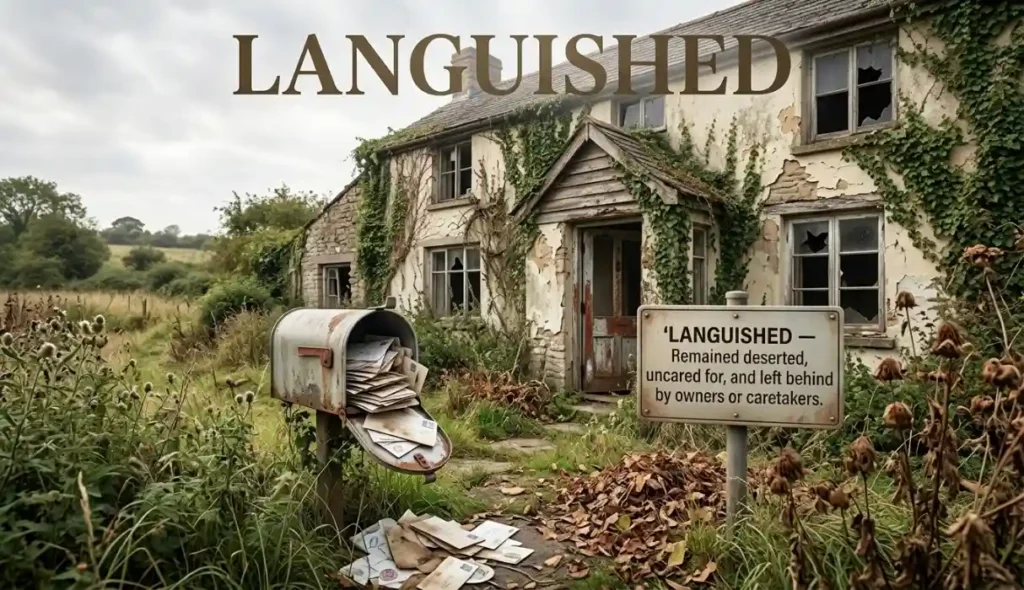
Lay Abandoned (Verb Phrase) — US: /leɪ əˈbæn.dənd/ | UK: /leɪ əˈbæn.dənd/
- Meaning: Remained deserted, uncared for, and left behind by owners or caretakers.
- Tone/Register: Visual, Literary
- Example 1: The old ghost town lay abandoned deep in the desert valley.
- Example 2: Broken ships lay abandoned along the rocky coastline.
Synonyms by Tone
| Tone Group | Synonyms Included | Why Tone Matters |
| Positive | Rested, stood dormant, Hibernated, Stood ready | Positive terms reframe stillness as temporary rest or preparation for future work. |
| Neutral | Remained, Delayed, Lingered, Lay unused, Dwindled, Stalled | Neutral options report lack of progress factually without intense emotional bias. |
| Negative | Rotted, Decayed, Suffered neglect, Withered, Despaired, Sunk | Negative words highlight tragic decay, painful suffering, or severe waste. |
| Playful / Informal | Gathered dust, Vegetated, Sat idle, Moped, Hit a wall | Informal options bring vivid imagery and lighthearted exaggeration to everyday talk. |
Selecting the right tone prevents misunderstandings. Describing a project as “standing dormant” suggests potential revival, whereas saying it “rotted away” implies complete failure.
Mini Comparison: “Languished” vs Close Alternatives
Languished vs. Stagnated
- Meaning Difference: “Languished” implies suffering, fading strength, or emotional pain during forced inactivity. “Stagnated” focuses strictly on a lack of motion, growth, or progress without necessarily implying suffering.
- Tone Difference: “Languished” is emotional, poetic, and dramatic. “Stagnated” is clinical, technical, and business-oriented.
- When to Use Each: Use “languished” for neglected people, suffering prisoners, or forgotten dreams. Use “stagnated” for economic metrics, sales figures, or water pools.
Languished vs. Withered
- Meaning Difference: “Languished” describes a prolonged state of suffering or lingering decay. “Withered” focuses on physical drying up, shrinking, or losing moisture and life directly.
- Tone Difference: “Languished” carries temporal depth (suffering over time). “Withered” offers sharp visual imagery of physical decay.
- When to Use Each: Use “languished” for someone stuck in a dull job for years. Use “withered” for plants, drying crops, or failing muscles.
How “Languished” Changes by Context
- Daily Conversation: English speakers pick visual idioms like “gathered dust,” “sat idle,” or “hit a wall” when discussing projects or hobbies.
- Writing & Blogging: Content creators reach for expressive verbs like “wilted,” “faded,” “stalled,” or “moped” to build atmospheric narrative scenes.
- Professional or Academic Tone: Professionals use precise, formal terms such as “stagnated,” “declined,” “deteriorated,” or “remained inactive.”
- Creative or Informal Use: Creative writers use poetic language like “pined,” “brooded,” “sunk into oblivion,” or “suffered decay” to evoke emotional depth.
Common Mistakes & Native Usage
Mistakes Learners Make
- Confusing “Languished” with “Languished For”: Using “languished” alone implies fading or suffering. Adding “for” changes the meaning toward romantic longing or yearning (similar to pined for).
- Confusing “Languished” with “Laughed”: Mispronouncing or misspelling languished (/ˈlæŋ.ɡwɪʃt/) as laughed (/læft/) creates confusion.
- Overusing “Languished” in Business Reports: Using “languished” in formal corporate reports can sound overly dramatic. Use “stagnated” or “declined” instead.
Register Notes
- Spoken English: Casual expressions like “sat around,” “gathered dust,” and “stalled out” are favored in spoken English.
- Written English: Formal verbs like “deteriorated,” “languished,” “stagnated,” and “dwindled” appear regularly in journalism, literature, and history essays.
Real-Life Mini Scenarios
- Workplace: “The software proposal languished in committee for six months.” (Languished emphasizes how the proposal sat forgotten without decision.)
- Social Situations: “He moped at home all weekend after his concert was canceled.” (Moped describes gloomy, inactive behavior around friends or family.)
- Media / Pop Culture: “The movie sequel languished in development hell for a decade.” (Languished highlights long delays in studio production.)
- Writing or Storytelling: “The abandoned castle languished under centuries of thick ivy.” (Languished paints a picture of slow decay.)
Conclusion
Expanding your vocabulary with a synonym for languished helps you describe decay, neglect, and inactivity with real precision. Choosing the right verb ensures your writing captures the exact emotional atmosphere you intend.
Practicing these varied expressions in daily essays, emails, and storytelling will build your fluency over time. Dynamic vocabulary keeps your prose engaging and memorable for any audience.
Try incorporating two or three of these new alternatives into your writing today to sharpen your vocabulary skills!
Practice Exercise
Test your understanding of synonyms for languished across different contexts.
- Which synonym best describes an economic metric that stopped growing without moving down?
a) Stagnated
b) Rotted
c) Pined
d) Brooded - What is the best literary term for someone suffering emotionally from intense longing?
a) Pined
b) Sat idle
c) Hit a wall
d) Gathered dust - “The unwatered tomato plants __________ under the intense July sun.”
a) Wilted
b) Stagnated
c) Lived in limbo
d) Marked time - Which phrase is an informal idiom for an unused guitar sitting in a closet?
a) Gathered dust
b) Suffered decay
c) Sunk into oblivion
d) Drooped in vigor - What formal word best describes a patient’s health getting progressively worse?
a) Deteriorated
b) Moped
c) Sulked
d) Vegetated - Choose the best term for sports players losing energy in the final minutes of a game:
a) Flagged
b) Rotted
c) Smothered
d) Execrated - Which verb implies sitting on the couch doing nothing mentally stimulating?
a) Vegetated
b) Inveighed
c) Stifled
d) Fulminated - What is a high-formal phrase for an old legal case sitting unresolved?
a) Lived in limbo
b) Slumped down
c) Faded out
d) Slowed to a crawl - “The historic manuscript __________ in a dark vault before being rediscovered.”
a) Lay unused
b) Pitched a fit
c) Sounded off
d) Air grievances - Select the word that describes water supplies shrinking gradually during a drought:
a) Dwindled
b) Sulked
c) Brooded
d) Nitpicked
Application Task:
Write a 2-sentence mini-story about a forgotten hobby or project using one synonym (such as stagnated, gathered dust, or withered) correctly.
Answer Key:
1-a, 2-a, 3-a, 4-a, 5-a, 6-a, 7-a, 8-a, 9-a, 10-a
FAQs
1. What is the most common synonym for languished in general English?
The most common everyday synonyms for languished are declined, faded, stagnated, and deteriorated. For physical items, phrases like sat idle or gathered dust are used most frequently.
2. Can languished be used positively?
While languished almost always carries a negative or gloomy tone, neutral or gentle alternatives like rested, stood dormant, or lingered can frame inactivity in a peaceful or restorative light.
3. What is the difference between languished and stagnated?
Languished implies suffering, fading vitality, or neglect over time. Stagnated focuses on a lack of movement, progress, or development, and is commonly used in business or economics.
4. What is a good literary synonym for languished?
In poetry and creative literature, evocative synonyms include withered, pined, ebbed, brooded, and sunk into oblivion. These words heighten emotional and visual impact.
5. How do you use languished correctly in a sentence?
You use languished as a past-tense verb to describe something fading or neglected: “The bill languished in Congress for months,” or “The abandoned garden languished without water.”

Jameel Hassan is the founder and lead writer at SynonymsCloud.com, a trusted online platform dedicated to English vocabulary and effective communication. He is passionate about helping students, writers, professionals, and lifelong learners discover the right words to express their ideas with clarity, precision, and confidence.
At SynonymsCloud.com, every article is thoroughly researched and carefully written to provide accurate, practical, and easy-to-understand guidance on synonyms, antonyms, word meanings, idioms, and vocabulary. With a strong commitment to quality, real-world usage, and clear explanations, the website helps readers expand their vocabulary, improve their writing, and communicate more effectively in both academic and professional settings.