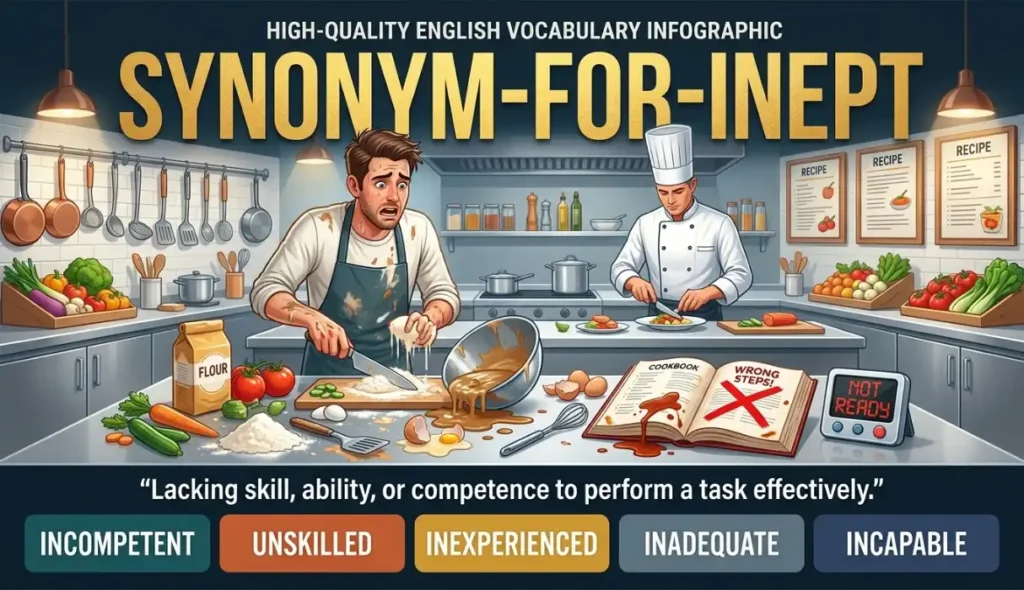
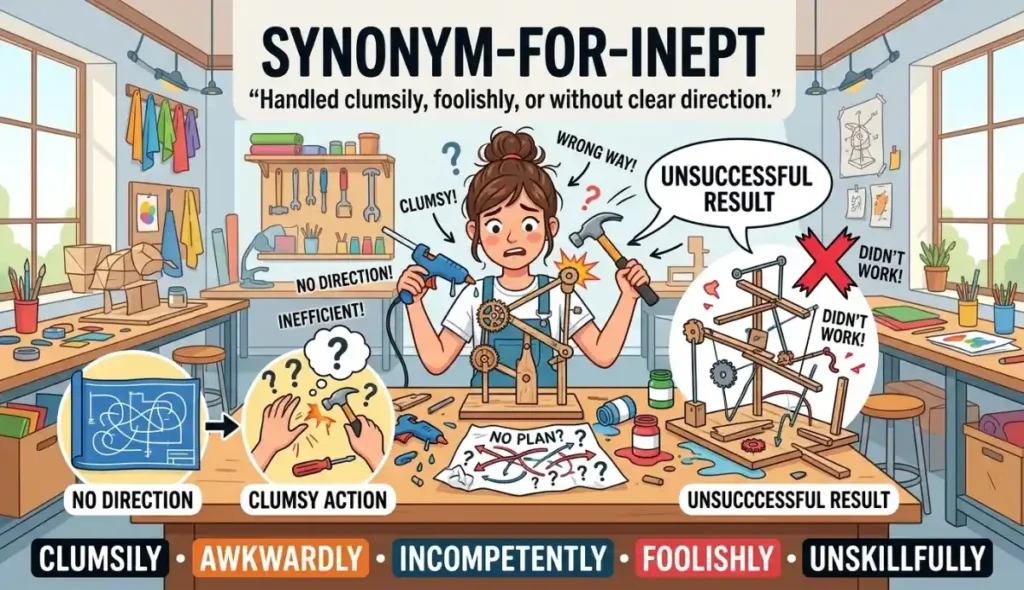
A direct synonym for inept includes incompetent, clumsy, awkward, or unskilled. Use maladroit or inexpert in formal writing, and clueless or all thumbs in casual speech. Choose inept specifically when describing a severe lack of skill, judgment, or physical coordination needed to execute a task effectively.
A synonym for inept helps you describe a lack of skill or clumsy execution with exact accuracy. Imagine watching someone try to assemble flat-pack furniture without reading the instructions, ending up with leftover parts and a crooked table.
For instance, Tom felt completely inept when he accidentally deleted the entire team presentation five minutes before the meeting. Using a vivid synonym for inept captures this exact moment of incompetence.
Expanding your vocabulary with a synonym for inept prevents repetitive language in your writing. It replaces generic words like “bad” or “clumsy” with targeted words that match specific contexts and registers.
This guide provides students, bloggers, content writers, and everyday speakers with clear, natural synonyms for inept. Learning these terms elevates your communication, making your spoken and written English far more persuasive.
What Does “Inept” Really Mean?
Inept describes a severe lack of skill, judgment, or suitability for a specific task. Native speakers use it when someone shows poor execution or lacks the required ability to succeed.
- Part of Speech: Adjective
- Simple English Definition: Lacking skill, ability, or fitness for a task; clumsy or incompetent.
- Emotional Tone: Critical, disappointed, or mockingly observational.
Connotative Meaning
Connotation is the emotional, cultural, or social association attached to a word beyond its strict dictionary definition.
- Positive Tone: Rarely positive, but sometimes used self-deprecatingly to show modesty or humility.
- Negative Tone: Harsh criticism indicating total failure, severe incompetence, or professional negligence.
- Neutral Tone: Objective observation of a skill gap or lack of training.
Etymology and History
- Source Language: Latin (ineptus meaning “unsuited, absurd, or foolish”).
- Old English (450–1100): Not present in Old English; Germanic roots like uncræftig were used instead.
- Middle English (1100–1500): Adopted through Middle French and Latin legal texts.
- Modern English (1500–Present): Formally entered Modern English in the early 17th century to describe unskillful actions.
Pronunciation (IPA)
- US: /ɪnˈept/
- UK: /ɪnˈept/
Syllables & Structure
- Syllables: in-ept
- Root: ept (variant of apt, meaning fit or suitable)
- Prefix: in- (not)
- Suffix: None
Synonyms List
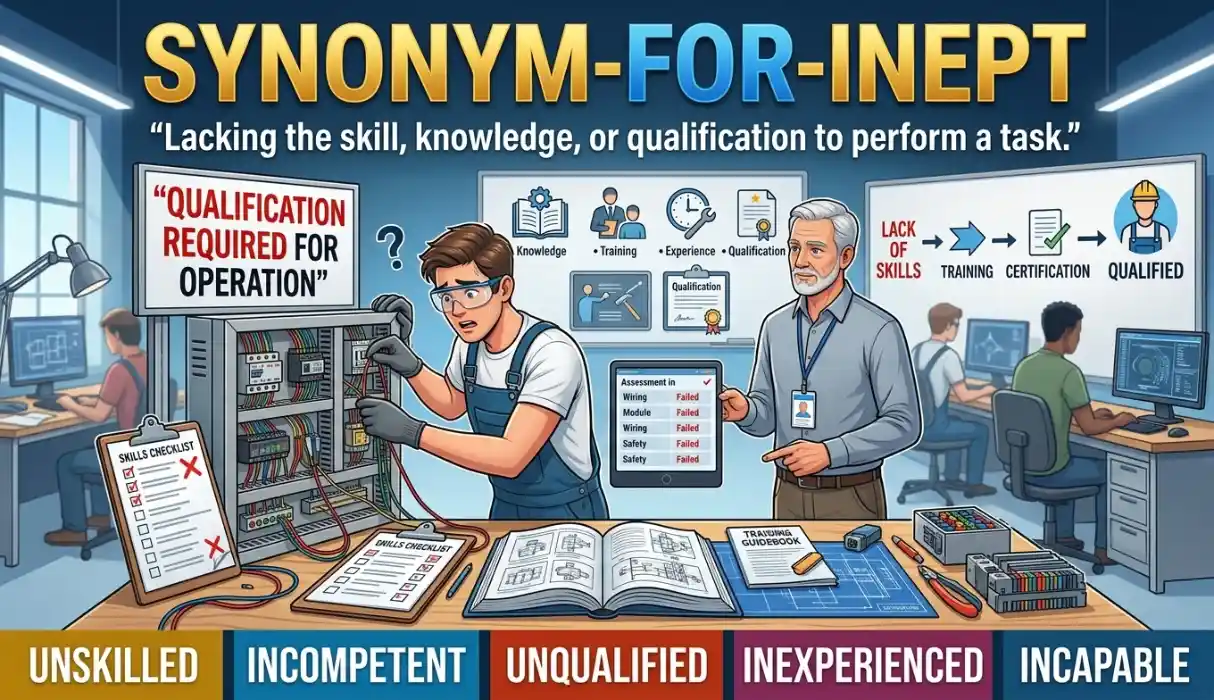
Incompetent (Adjective) — US: /ɪnˈkɑːm.pə.t̬ənt/ | UK: /ɪnˈkɒm.pɪ.tənt/
- Meaning: Lacking the necessary skill, knowledge, or qualification to perform a task.
- Tone/Register: Formal / Business
- Example 1: The incompetent contractor left the roof unfinished before the storm arrived.
- Example 2: An incompetent manager can quickly damage team morale and overall productivity.
Clumsy (Adjective) — US: /ˈklʌm.zi/ | UK: /ˈklʌm.zi/
- Meaning: Lacking physical grace, coordination, or delicacy.
- Tone/Register: Informal / General
- Example 1: He made a clumsy attempt to catch the falling glass vase.
- Example 2: Her clumsy phrasing in the email confused the client.
Awkward (Adjective) — US: /ˈɑːk.wɚd/ | UK: /ˈɔː.kwəd/
- Meaning: Lacking social ease, physical dexterity, or graceful movement.
- Tone/Register: General / Conversational
- Example 1: He felt awkward standing alone in the crowded networking room.
- Example 2: She handled the delicate negotiation in an awkward manner.
Bungling (Adjective) — US: /ˈbʌŋ.ɡəl.ɪŋ/ | UK: /ˈbʌŋ.ɡəl.ɪŋ/
- Meaning: Making frequent, foolish, or clumsy mistakes during a process.
- Tone/Register: Informal / Expressive
- Example 1: The bungling burglars accidentally set off the security alarm immediately.
- Example 2: A bungling official misdirected the shipment to the wrong city.
Blundering (Adjective) — US: /ˈblʌn.dɚ.ɪŋ/ | UK: /ˈblʌn.dər.ɪŋ/
- Meaning: Acting stupidly, carelessly, or without clear direction.
- Tone/Register: General / Descriptive
- Example 1: The blundering assistant spilled hot coffee across the conference table.
- Example 2: A blundering response from the press office worsened the company scandal.
Clueless (Adjective) — US: /ˈkluː.ləs/ | UK: /ˈkluː.ləs/
- Meaning: Having no knowledge, understanding, or awareness of a situation.
- Tone/Register: Informal / Colloquial
- Example 1: He was completely clueless about how to operate the new machinery.
- Example 2: She walked into the exam feeling totally clueless.
Unskilled (Adjective) — US: /ʌnˈskɪld/ | UK: /ʌnˈskɪld/
- Meaning: Lacking specialized training, technical expertise, or practice.
- Tone/Register: Professional / Business
- Example 1: The company hired unskilled labor to complete the basic manual tasks.
- Example 2: Unskilled workers often require extra supervision during initial training.
Incapable (Adjective) — US: /ɪnˈkeɪ.pə.bəl/ | UK: /ɪnˈkeɪ.pə.bəl/
- Meaning: Lacking the physical or mental ability to perform a required action.
- Tone/Register: Formal / Academic
- Example 1: He seemed incapable of understanding the complex accounting formulas.
- Example 2: She proved incapable of managing a large creative team.
Inexpert (Adjective) — US: /ɪnˈek.spɝːt/ | UK: /ɪnˈek.spɜːt/
- Meaning: Lacking the high skill or specialized knowledge of a professional.
- Tone/Register: Formal / Business
- Example 1: The inexpert repair job caused the engine to leak oil.
- Example 2: Her inexpert handling of the media created extra confusion.
Maladroit (Adjective) — US: /ˌmæl.əˈdrɔɪt/ | UK: /ˌmæl.əˈdrɔɪt/
- Meaning: Lacking tact, diplomacy, or physical skill in handling situations.
- Tone/Register: Formal / Literary
- Example 1: His maladroit attempt at humor offended several dinner guests.
- Example 2: The politician gave a maladroit response to the direct question.
Unhandy (Adjective) — US: /ʌnˈhæn.di/ | UK: /ʌnˈhæn.di/
- Meaning: Lacking mechanical ability or skill with hands and tools.
- Tone/Register: Informal / Conversational
- Example 1: He is completely unhandy when it comes to fixing household appliances.
- Example 2: An unhandy carpenter will waste expensive building materials.
Heavy-handed (Adjective) — US: /ˌhev.iˈhæn.dɪd/ | UK: /ˌhev.iˈhæn.dɪd/
- Meaning: Lacking delicacy, sensitivity, or subtle judgment.
- Tone/Register: General / Political
- Example 1: The police faced backlash for their heavy-handed response to the protest.
- Example 2: His heavy-handed editing ruined the natural flow of the essay.
Gauche (Adjective) — US: /ɡoʊʃ/ | UK: /ɡəʊʃ/
- Meaning: Lacking social grace, manners, or awareness of cultural etiquette.
- Tone/Register: Formal / Sophisticated
- Example 1: It was considered gauche to talk about personal wealth at dinner.
- Example 2: His gauche behavior made everyone in the room uncomfortable.
Graceless (Adjective) — US: /ˈɡreɪs.ləs/ | UK: /ˈɡreɪs.ləs/
- Meaning: Lacking elegance, charm, or refined physical movement.
- Tone/Register: Literary / General
- Example 1: He made a graceless exit by slamming the conference room door.
- Example 2: Her graceless speech failed to inspire the waiting audience.
Uncouth (Adjective) — US: /ʌnˈkuːθ/ | UK: /ʌnˈkuːθ/
- Meaning: Lacking good manners, refinement, or polite cultivation.
- Tone/Register: Formal / Literary
- Example 1: His uncouth dining habits shocked his prospective in-laws.
- Example 2: She ignored his uncouth remarks and walked away quietly.
Heavy-footed (Adjective) — US: /ˌhev.iˈfʊt.ɪd/ | UK: /ˌhev.iˈfʊt.ɪd/
- Meaning: Moving awkwardly, loudly, or without physical lightness.
- Tone/Register: Descriptive / Informal
- Example 1: The heavy-footed dancer struggled to stay on rhythm.
- Example 2: I could hear his heavy-footed steps coming down the hall.
All thumbs (Adjective) — US: /ɔːl ˈθʌmz/ | UK: /ɔːl ˈθʌmz/
- Meaning: Clumsy and awkward with manual actions using the fingers.
- Tone/Register: Idiomatic / Informal
- Example 1: I am all thumbs today and keep dropping my silverware.
- Example 2: Don’t ask him to sew that button because he is all thumbs.
Butter-fingered (Adjective) — US: /ˈbʌt̬.ɚˌfɪŋ.ɡɚd/ | UK: /ˈbʌt.əˌfɪŋ.ɡəd/
- Meaning: Prone to dropping things easily due to carelessness or poor grip.
- Tone/Register: Informal / Playful
- Example 1: The butter-fingered outfielder dropped an easy catch during the game.
- Example 2: I am feeling butter-fingered today after dropping my phone twice.
Ham-fisted (Adjective) — US: /ˌhæmˈfɪs.tɪd/ | UK: /ˌhæmˈfɪs.tɪd/
- Meaning: Clumsy, crude, or heavy-handed in execution.
- Tone/Register: Informal / Expressive
- Example 1: His ham-fisted negotiation strategy alienated the partner company.
- Example 2: She made a ham-fisted attempt to fix the delicate clock.
Wooden (Adjective) — US: /ˈwʊd.ən/ | UK: /ˈwʊd.ən/
- Meaning: Lacking flexibility, expressiveness, or natural movement.
- Tone/Register: General / Critical
- Example 1: The actor gave a wooden performance that bored the audience.
- Example 2: His wooden body language showed how nervous he was.
Stiff (Adjective) — US: /stɪf/ | UK: /stɪf/
- Meaning: Not relaxed, natural, or fluid in movement or manner.
- Tone/Register: General / Conversational
- Example 1: He gave a stiff greeting before sitting at his desk.
- Example 2: Her stiff writing style made the blog post dull to read.
Uncoordinated (Adjective) — US: /ˌʌn.koʊˈɔːr.də.neɪ.t̬ɪd/ | UK: /ˌʌn.kəʊˈɔː.dɪ.neɪ.tɪd/
- Meaning: Lacking smooth physical synchronization between eyes and limbs.
- Tone/Register: General / Technical
- Example 1: The uncoordinated athlete struggled on the obstacle course.
- Example 2: Lack of sleep left him feeling uncoordinated and slow.
Unpolished (Adjective) — US: /ʌnˈpɑː.lɪʃt/ | UK: /ʌnˈpɒl.ɪʃt/
- Meaning: Lacking sophistication, refinement, or final professional finishing.
- Tone/Register: Business / Creative
- Example 1: The draft was unpolished but contained several promising ideas.
- Example 2: His unpolished presentation style needed work before the pitch.
Crude (Adjective) — US: /kruːd/ | UK: /kruːd/
- Meaning: Constructed or executed in a basic, rough, or unskillful way.
- Tone/Register: General / Critical
- Example 1: He drew a crude map on a napkin to show the directions.
- Example 2: The tool was a crude instrument made from scrap metal.
Raw (Adjective) — US: /rɑː/ | UK: /rɔː/
- Meaning: Lacking experience, training, or professional refinement.
- Tone/Register: General / Conversational
- Example 1: The raw recruit had talent but lacked basic field training.
- Example 2: Her raw talent was obvious, though her execution was messy.
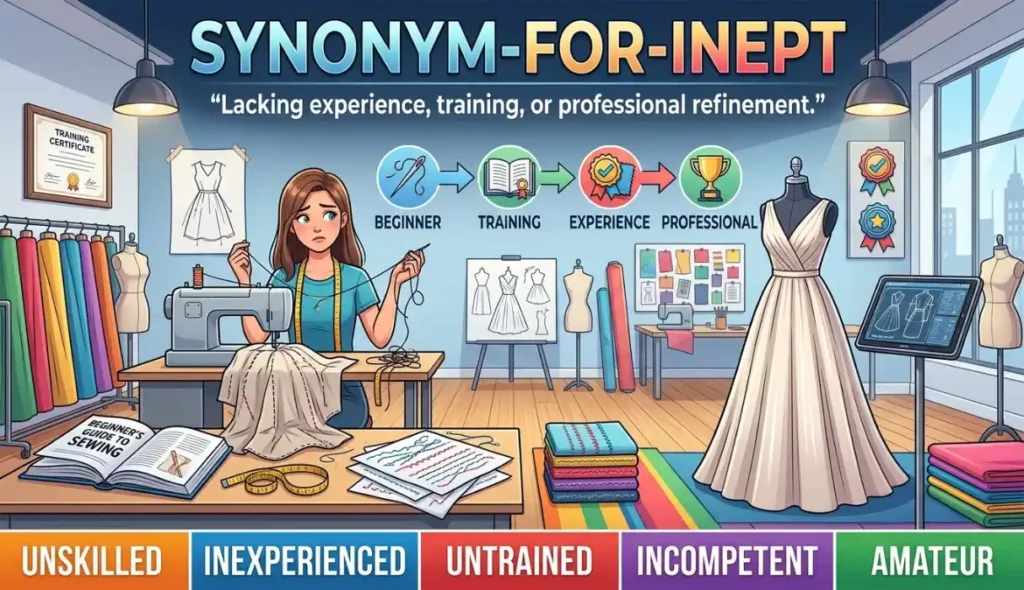
Green (Adjective) — US: /ɡriːn/ | UK: /ɡriːn/
- Meaning: Inexperienced, naive, or new to a particular job or role.
- Tone/Register: Informal / Business
- Example 1: The new intern is a bit green, so guide him through the task.
- Example 2: She was too green to handle such a complex client account.
Callous (Adjective) — US: /ˈkæl.əs/ | UK: /ˈkæl.əs/
- Meaning: Lacking sensitivity or skill in handling emotional matters.
- Tone/Register: Formal / Critical
- Example 1: His callous disregard for company policy led to his firing.
- Example 2: She gave a callous response to a sensitive employee problem.
Naive (Adjective) — US: /naɪˈiːv/ | UK: /naɪˈiːv/
- Meaning: Showing a lack of experience, wisdom, or practical judgment.
- Tone/Register: General / Academic
- Example 1: It was naive to think the complex project would finish early.
- Example 2: Her naive approach to business left her vulnerable to scams.
Ignorant (Adjective) — US: /ˈɪɡ.nɚ.ənt/ | UK: /ˈɪɡ.nər.ənt/
- Meaning: Lacking knowledge or information about a specific topic.
- Tone/Register: General / Critical
- Example 1: He made an ignorant statement about a subject he had not studied.
- Example 2: Being ignorant of local customs can cause unwanted misunderstandings.
Untrained (Adjective) — US: /ʌnˈtreɪnd/ | UK: /ʌnˈtreɪnd/
- Meaning: Lacking instruction or systematic practice in a trade or skill.
- Tone/Register: Business / Technical
- Example 1: An untrained worker should not operate heavy industrial machinery.
- Example 2: Her untrained voice was powerful but lacked pitch control.
Unqualified (Adjective) — US: /ʌnˈkwɑː.lə.faɪd/ | UK: /ʌnˈkwɒl.ɪ.faɪd/
- Meaning: Lacking the necessary official credentials, experience, or skills.
- Tone/Register: Formal / Business
- Example 1: The board found him completely unqualified for the executive position.
- Example 2: She felt unqualified to speak on such an advanced panel topic.
Unfitted (Adjective) — US: /ʌnˈfɪt.ɪd/ | UK: /ʌnˈfɪt.ɪd/
- Meaning: Not suited, adapted, or qualified for a specific duty.
- Tone/Register: Formal / Literary
- Example 1: His nervous nature rendered him unfitted for high-stakes leadership.
- Example 2: The old building was unfitted for modern office requirements.
Unprepared (Adjective) — US: /ˌʌn.prɪˈperd/ | UK: /ˌʌn.prɪˈpeəd/
- Meaning: Not equipped or ready to deal with a specific task or situation.
- Tone/Register: General / Business
- Example 1: The team arrived unprepared for the intense questioning.
- Example 2: She was caught unprepared when the system crashed suddenly.
Ineffective (Adjective) — US: /ˌɪn.əˈfek.tɪv/ | UK: /ˌɪn.ɪˈfek.tɪv/
- Meaning: Producing no intended result or lacking the capability to succeed.
- Tone/Register: Formal / Business
- Example 1: The old policy proved ineffective at lowering operational costs.
- Example 2: His leadership was ineffective during times of sudden change.
Inefficient (Adjective) — US: /ˌɪn.ɪˈfɪʃ.ənt/ | UK: /ˌɪn.ɪˈfɪʃ.ənt/
- Meaning: Wasting time, energy, or resources due to poor skills or systems.
- Tone/Register: Formal / Business
- Example 1: An inefficient workflow delayed the product launch by three months.
- Example 2: The manual data entry process was slow and inefficient.
Unproductive (Adjective) — US: /ˌʌn.prəˈdʌk.tɪv/ | UK: /ˌʌn.prəˈdʌk.tɪv/
- Meaning: Failing to produce positive results, useful work, or progress.
- Tone/Register: Formal / Business
- Example 1: They held an unproductive meeting that lasted over two hours.
- Example 2: Spending time arguing over minor details is completely unproductive.
Substandard (Adjective) — US: /ˌsʌbˈstæn.dɚd/ | UK: /ˌsʌbˈstæn.dəd/
- Meaning: Falling below an established or acceptable level of quality.
- Tone/Register: Professional / Technical
- Example 1: The audit revealed substandard safety practices at the facility.
- Example 2: He delivered substandard code that required major revisions.
Deficient (Adjective) — US: /dɪˈfɪʃ.ənt/ | UK: /dɪˈfɪʃ.ənt/
- Meaning: Lacking a necessary element, skill, or standard of quality.
- Tone/Register: Formal / Academic
- Example 1: The report was deficient in statistical evidence and key research.
- Example 2: His execution of the strategy proved deficient in several areas.
Flawed (Adjective) — US: /flɑːd/ | UK: /flɔːd/
- Meaning: Marked by defects, errors, or weaknesses in execution.
- Tone/Register: General / Academic
- Example 1: Their plan was fundamentally flawed from the very beginning.
- Example 2: She presented a flawed argument that was easy to challenge.
Defective (Adjective) — US: /dɪˈfek.tɪv/ | UK: /dɪˈfek.tɪv/
- Meaning: Imperfect, faulty, or not functioning correctly due to poor skill.
- Tone/Register: Technical / Formal
- Example 1: The technician replaced the defective wiring in the system.
- Example 2: A defective process led to numerous manufacturing errors.
Faulty (Adjective) — US: /ˈfɑːl.ti/ | UK: /ˈfɔːl.ti/
- Meaning: Containing mistakes, defects, or unsound reasoning.
- Tone/Register: General / Conversational
- Example 1: The decision was based on faulty assumptions about the market.
- Example 2: A faulty connection caused the device to shut down unexpectedly.
Worthless (Adjective) — US: /ˈwɝːθ.ləs/ | UK: /ˈwɜːθ.ləs/
- Meaning: Having no real value, use, or competence.
- Tone/Register: Informal / Harsh
- Example 1: The advice he gave turned out to be completely worthless.
- Example 2: Her unverified claims were worthless during the trial.
Useless (Adjective) — US: /ˈjuːs.ləs/ | UK: /ˈjuːs.ləs/
- Meaning: Incapable of producing any useful result; entirely ineffective.
- Tone/Register: Informal / Conversational
- Example 1: He felt useless when he couldn’t help change the flat tire.
- Example 2: This outdated manual is useless for solving modern software issues.
Futile (Adjective) — US: /ˈfjuː.t̬əl/ | UK: /ˈfjuː.taɪl/
- Meaning: Pointless or incapable of producing any useful outcome.
- Tone/Register: Formal / Literary
- Example 1: Their futile attempts to fix the broken generator failed.
- Example 2: It is futile to argue with someone who refuses to listen.
Hapless (Adjective) — US: /ˈhæp.ləs/ | UK: /ˈhæp.ləs/
- Meaning: Unfortunate, unlucky, and constantly suffering bad outcomes.
- Tone/Register: Literary / Expressive
- Example 1: The hapless commuter lost his wallet and missed his morning train.
- Example 2: She tried to help the hapless puppy trapped in the yard.
Ill-fitted (Adjective) — US: /ˌɪlˈfɪt.ɪd/ | UK: /ˌɪlˈfɪt.ɪd/
- Meaning: Poorly suited or unsuitable for a specific position or duty.
- Tone/Register: Formal / Academic
- Example 1: He was ill-fitted for the quiet life of an archivist.
- Example 2: The current software is ill-fitted for handling high data traffic.
Ill-equipped (Adjective) — US: /ˌɪl.ɪˈkwɪpt/ | UK: /ˌɪl.ɪˈkwɪpt/
- Meaning: Lacking the necessary ability, resources, or preparation.
- Tone/Register: Professional / Business
- Example 1: The team was ill-equipped to deal with a major cyberattack.
- Example 2: She felt ill-equipped to answer such complex technical questions.
Ill-suited (Adjective) — US: /ˌɪlˈsuː.t̬ɪd/ | UK: /ˌɪlˈsuː.tɪd/
- Meaning: Not suitable or appropriate for a particular function or role.
- Tone/Register: Formal / General
- Example 1: His aggressive style was ill-suited for mediation work.
- Example 2: The damp climate is ill-suited for storing rare paper documents.
Inapt (Adjective) — US: /ɪnˈæpt/ | UK: /ɪnˈæpt/
- Meaning: Not suitable or appropriate for a specific context or purpose.
- Tone/Register: Formal / Academic
- Example 1: His inapt choice of words created unnecessary tension in the meeting.
- Example 2: The metaphor was entirely inapt for explaining quantum physics.
Unapt (Adjective) — US: /ʌnˈæpt/ | UK: /ʌnˈæpt/
- Meaning: Lacking natural tendency, skill, or suitability.
- Tone/Register: Literary / Formal
- Example 1: He was unapt to learn complex coding frameworks quickly.
- Example 2: The comparison proved unapt upon closer examination.
Improper (Adjective) — US: /ɪmˈprɑː.pɚ/ | UK: /ɪmˈprɒp.ər/
- Meaning: Not meeting accepted standards of correctness, skill, or decorum.
- Tone/Register: Formal / Business
- Example 1: Improper handling of confidential files led to a security breach.
- Example 2: His improper technique damaged the delicate instrument.
Unseemly (Adjective) — US: /ʌnˈsiːm.li/ | UK: /ʌnˈsiːm.li/
- Meaning: Not proper, polite, or suitable for a given situation.
- Tone/Register: Formal / Literary
- Example 1: It was unseemly for executives to argue publicly during the event.
- Example 2: She found his loud laughter unseemly at the memorial service.
Mismanaged (Adjective) — US: /ˌmɪsˈmæn.ɪdʒd/ | UK: /ˌmɪsˈmæn.ɪdʒd/
- Meaning: Handled or directed incompetently, leading to poor outcomes.
- Tone/Register: Professional / Business
- Example 1: The mismanaged project quickly ran over its allocated budget.
- Example 2: A mismanaged transition caused major delays for all clients.
Botched (Adjective) — US: /bɑːtʃt/ | UK: /bɒtʃt/
- Meaning: Ruined, spoiled, or carried out poorly due to clumsiness.
- Tone/Register: Informal / Descriptive
- Example 1: They made a botched effort to repair the leaky pipe.
- Example 2: The botched release of the app led to negative online reviews.
Bumbled (Adjective) — US: /ˈbʌm.bəld/ | UK: /ˈbʌm.bəld/
- Meaning: Handled clumsily, stupidly, or without direction.
- Tone/Register: Informal / Conversational
- Example 1: He bumbled his way through the introduction without notes.
- Example 2: The bumbled response showed how unprepared the team was.
Synonyms by Tone
Tone plays a critical role when selecting a synonym for inept. Choosing the correct term ensures your criticism fits the context without causing unintended offense.
- Positive / Self-Deprecating Tone: Green, Raw, Unpolished. These terms highlight a temporary lack of experience rather than permanent incompetence.
- Neutral Tone: Unskilled, Untrained, Ineffective, Inexpert. These terms provide objective evaluations without harsh personal judgment.
- Negative / Severe Tone: Incompetent, Incapable, Worthless, Substandard. These terms convey harsh disapproval, severe failure, or serious neglect.
- Playful / Informal Tone: All thumbs, Butter-fingered, Bungling, Clueless. These terms work well in casual conversations, stories, or lighthearted writing.
Mini Comparison: Inept vs. Close Alternatives
| Word | Key Shade of Meaning | Tone | Best Context |
| Inept | General lack of skill, judgment, or physical grace | Formal / Critical | Describing poor execution or clumsy behavior |
| Incompetent | Lacking qualifications or professional capability | Professional / Severe | Workplace evaluations, legal complaints, or formal reviews |
| Clumsy | Lacking physical dexterity, coordination, or tact | Informal / Conversational | Physical slips, dropping items, or awkward phrasing |
How “Inept” Changes by Context
Daily Conversation
In casual speech, native speakers rarely use formal words like maladroit. They opt for accessible idioms like all thumbs or simple adjectives like clumsy or clueless.
Writing & Blogging
Writers use inept to create immediate character dynamics or tension. Describing an antagonist as inept adds humor or highlights their vulnerability without lengthy descriptions.
Professional & Academic Tone
In professional settings, stick to objective terms like ineffective, unqualified, or substandard. These words provide clear feedback without resorting to personal insults.
Common Mistakes & Native Usage
Misuse Scenarios
- Confusing “Inept” with “Inapt”: Inept refers to a person’s lack of skill or ability. Inapt refers to something unsuitable for a specific context, like an inappropriate remark.
- Confusing “Inept” with “Adept”: Adept is the exact opposite of inept, meaning highly skilled or proficient.
Register Notes
Native speakers reserve inept for situations where poor performance causes clear problems. For physical mishaps, clumsy is preferred. For professional failure, incompetent carries more legal and formal weight.
Real-Life Mini Scenarios
- Workplace: An employee attempts to manage a project without training, missing every milestone. The executive team calls the management inept.
- Social Situations: A guest drops a tray of glasses while serving drinks. They laugh off their clumsy hands.
- Media & Pop Culture: Critics review a film with bad dialogue and choppy editing, labeling the direction bungling.
Conclusion
Mastering a new synonym for inept gives you the precision needed to describe poor performance with exact clarity and style.
Using targeted word choices helps students earn higher marks, enables bloggers to engage readers, and helps professionals write clear reports.
Try choosing three new synonyms from this list today and craft your own example sentences. Daily practice builds strong, natural vocabulary skills for life.
Practice Exercise
- Which synonym best describes an employee who lacks official credentials for a job?
A) All thumbs
B) Unqualified
C) Gauche
D) Heavy-footed - If someone keeps dropping their coffee cup because of poor hand grip, they are:
A) Inapt
B) Butter-fingered
C) Uncouth
D) Futile - What is the main difference between inept and incompetent?
A) Inept covers general clumsiness; incompetent implies professional failure.
B) Inept is always positive; incompetent is always negative.
C) Inept is used in legal cases; incompetent is casual slang.
D) There is no functional difference. - Choose the formal word best suited for an academic critique of an improper metaphor:
A) Clueless
B) Inapt
C) Ham-fisted
D) Butter-fingered - Which word suggests a temporary lack of experience rather than permanent inability?
A) Worthless
B) Green
C) Defective
D) Substandard - If a politician makes a socially awkward comment that lacks diplomacy, it is:
A) Maladroit
B) Heavy-footed
C) Deficient
D) Flawed - What tone does the phrase all thumbs carry?
A) Formal and academic
B) Harsh and legal
C) Informal and idiomatic
D) Highly technical - Identify the correct usage sentence:
A) “She was so adept that she failed every simple task.”
B) “His inept handling of the software led to data loss.”
C) “The food was completely inept and tasted great.”
D) “He felt inept after winning the gold medal.” - Which word means lacking physical grace or coordination?
A)Uncouth
B) Clumsy
C) Ineffective
D) Substandard
Reflection Task:
Write a 2-sentence scenario describing a character making a mistake. Use at least two synonyms from this article.
Answer Key:
1: B | 2: B | 3: A | 4: B | 5: B | 6: A | 7: C | 8: B | 9: B
FAQs
1. What is the most common synonym for inept in everyday speech?
The most common casual synonyms are clumsy, clueless, or awkward. In everyday speech, native speakers frequently say someone is “bad at something” or “not good with their hands” rather than using formal adjectives.
2. Is there a difference between inept and inapt?
Yes. Inept describes a person or action lacking skill, ability, or dexterity. Inapt means unsuitable, inappropriate, or out of place for a specific context, such as an inapt comment during a ceremony.
3. What is the exact opposite of inept?
The direct antonyms of inept are adept, competent, skillful, proficient, and capable. Using these antonyms helps create sharp contrasts when comparing performance levels.
4. Can inept be used to describe non-human objects?
While inept usually describes people, actions, or management, it can describe systems, policies, or organizations. However, physical objects are better described as defective, faulty, or substandard.
5. What prefix and root make up the word inept?
The word combines the Latin prefix in- (meaning “not”) with ept (a variant of apt, meaning “fit” or “suited”). Literally translated, it means “not suited” for a task.

Jameel Hassan is the founder and lead writer at SynonymsCloud.com, a trusted online platform dedicated to English vocabulary and effective communication. He is passionate about helping students, writers, professionals, and lifelong learners discover the right words to express their ideas with clarity, precision, and confidence.
At SynonymsCloud.com, every article is thoroughly researched and carefully written to provide accurate, practical, and easy-to-understand guidance on synonyms, antonyms, word meanings, idioms, and vocabulary. With a strong commitment to quality, real-world usage, and clear explanations, the website helps readers expand their vocabulary, improve their writing, and communicate more effectively in both academic and professional settings.