

The most common synonym for larger is bigger. For physical spaces or dimensions, words like roomier, spacier, or wider work best. In formal or academic writing, choose greater, more substantial, or more extensive. To emphasize extreme scale, use massive, colossal, or immense.
A synonym for larger is essential when describing physical sizes, expanding data, or growing ambitions without repeating simple words. Imagine ordering coffee and needing a bigger cup, or editing an essay where every paragraph repeats the same basic comparative adjective.
Using a precise synonym for larger helps you paint vivid mental pictures for your readers. Repeating basic terms weakens your prose. Picking dynamic alternatives makes your sentences sharper and more engaging.
Native English speakers choose specific size descriptors based on context, emotion, and scale. Finding the right synonym for larger ensures your message carries the exact weight and tone.
This guide helps students, bloggers, content writers, and ESL learners describe scale with confidence. Learning these terms will instantly improve your speaking and writing fluency.
What Does “Larger” Really Mean?
“Larger” is the comparative form of the adjective large, meaning greater in size, extent, quantity, capacity, or scope when compared to something else.
It carries a descriptive, objective attitude. Native speakers understand it as a relative measurement of physical dimensions, physical volume, numerical amounts, or conceptual scales. It frequently appears in everyday conversations, academic papers, news reports, and shopping contexts.
- Part of Speech: Comparative Adjective
- Simple Definition: Greater in physical size, amount, volume, or degree compared to another item.
Connotative Meaning
(Connotation is the emotional feeling or cultural association attached to a word beyond its strict dictionary definition.)
- Positive tone: Generous, grand, expanded, roomier, upgraded.
- Negative tone: Oversized, bloated, unwieldy, bulky, swollen.
- Neutral tone: Bigger, broader, greater, wider, extensive.
Etymology
“Larger” comes from the Middle English word large (meaning ample, broad, or generous), borrowed from Old French large, which originates from the Latin term largus (meaning abundant, plentiful, or bountiful).
- Old English (450–1100): Early English relied on Germanic roots like māra (more) or geat (great) to express relative size before French influence took hold.
- Middle English (1100–1500): Following the Norman Conquest, large entered the language in the 12th century, originally emphasizing generosity and physical breadth.
- Modern English (1500–Present): The comparative suffix “-er” was added, solidifying “larger” as the standard everyday term for comparative physical or abstract scale.
Pronunciation (US & UK)
- US: /ˈlɑːr.dʒɚ/
- UK: /ˈlɑː.dʒə/
Syllables & Structure
- Syllables: lar-ger (2 syllables)
- Root: large (from Latin largus, abundant)
- Prefix: None
- Suffix: -er (comparative adjective suffix)
Synonyms List
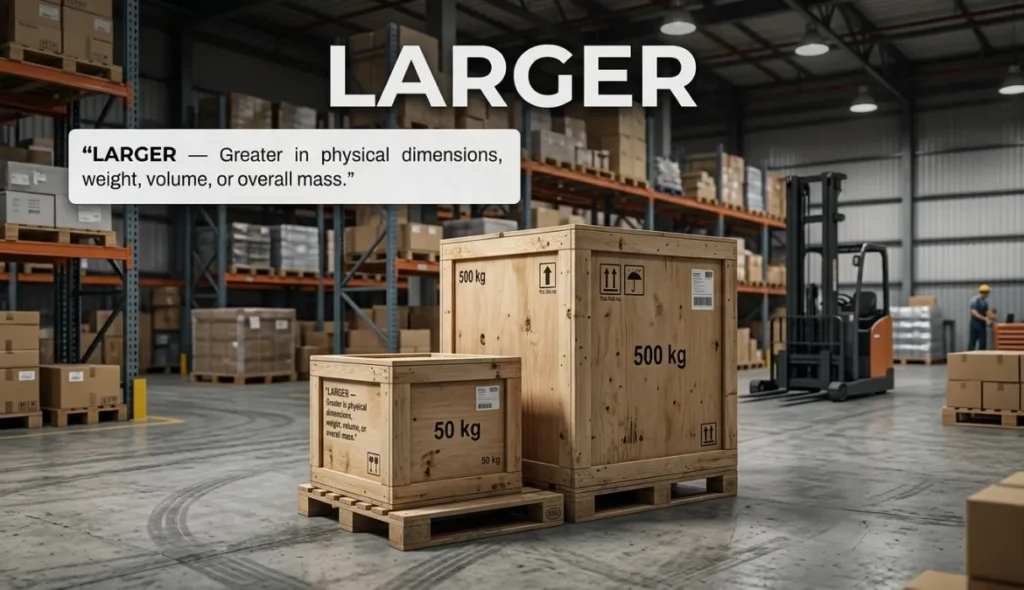
Bigger (Comparative Adjective) — US: /ˈbɪɡ.ɚ/ | UK: /ˈbɪɡ.ə/
- Meaning: Greater in overall physical dimensions, weight, volume, or general mass.
- Tone/Register: Informal, Everyday
- Example 1: We need a bigger table to fit our whole family for dinner.
- Example 2: She bought a bigger backpack for her hiking trip.
Greater (Comparative Adjective) — US: /ˈɡreɪ.t̬ɚ/ | UK: /ˈɡreɪ.tə/
- Meaning: More significant in quantity, degree, importance, or abstract measure.
- Tone/Register: Formal, Academic
- Example 1: The team achieved greater success this year than last year.
- Example 2: A greater number of students attended the evening lecture.
Broader (Comparative Adjective) — US: /ˈbrɑː.d̬ɚ/ | UK: /ˈbrɔː.də/
- Meaning: Having a wider extent across surfaces, distances, or ranges of topics.
- Tone/Register: General, Descriptive
- Example 1: The updated study takes a broader look at environmental issues.
- Example 2: He has broader shoulders than his younger brother.
Wider (Comparative Adjective) — US: /ˈwaɪ.d̬ɚ/ | UK: /ˈwaɪ.də/
- Meaning: Measuring more from side to side than another comparable object.
- Tone/Register: Neutral, Physical
- Example 1: They moved to a wider street with better parking options.
- Example 2: The river grew wider as it approached the open sea.
Grander (Comparative Adjective) — US: /ˈɡræn.d̬ɚ/ | UK: /ˈɡræn.də/
- Meaning: More impressive, magnificent, or imposing in scale and appearance.
- Tone/Register: Literary, Elevated
- Example 1: The palace has grander architecture than any building in town.
- Example 2: She unveiled an even grander plan for her new business venture.
Vastly Superior (Adjective Phrase) — US: /ˈvæst.li suːˈpɪr.i.ɚ/ | UK: /ˈvɑːst.li suːˈpɪə.ri.ə/
- Meaning: Much larger in scale, quality, or capability than another option.
- Tone/Register: Formal, Emphatic
- Example 1: The new venue offers vastly superior seating for large audiences.
- Example 2: Their updated software showed vastly superior processing speed.
Bulkier (Comparative Adjective) — US: /ˈbʌl.ki.ɚ/ | UK: /ˈbʌl.ki.ə/
- Meaning: Taking up more physical space due to an awkward or thick shape.
- Tone/Register: Casual, Descriptive
- Example 1: Heavy winter coats are much bulkier than light summer jackets.
- Example 2: Old computer monitors were bulkier than modern flat screens.
Heftier (Comparative Adjective) — US: /ˈhef.ti.ɚ/ | UK: /ˈhef.ti.ə/
- Meaning: Considerably larger in weight, size, or financial cost.
- Tone/Register: Informal, Conversational
- Example 1: He was hit with a heftier fine for missing the deadline.
- Example 2: She picked up the heftier toolbox from the garage shelf.
Roomier (Comparative Adjective) — US: /ˈruː.mi.ɚ/ | UK: /ˈruː.mi.ə/
- Meaning: Providing more physical space, capacity, or freedom of movement inside.
- Tone/Register: Casual, Practical
- Example 1: The family rented a roomier apartment near the public park.
- Example 2: These boots feel roomier around the toes than my old pair.
Spacier (Comparative Adjective) — US: /ˈspeɪ.si.ɚ/ | UK: /ˈspeɪ.si.ə/
- Meaning: Having more open interior space or room to move around comfortably.
- Tone/Register: Informal, Casual
- Example 1: The renovated kitchen feels much spacier now without that center wall.
- Example 2: They upgraded to a spacier vehicle for long family road trips.
Substantial (Adjective Phrase) — US: /səbˈstæn.ʃəl/ | UK: / səbˈstæn.ʃəl/
- Meaning: Larger in size, value, strength, importance, or solid reality.
- Tone/Register: Professional, Formal
- Example 1: The board requested a more substantial report on quarterly expenses.
- Example 2: After a light snack, he prepared a more substantial meal.
Extensive (Adjective Phrase) — US: /ɪkˈsten.sɪv/ | UK: /ɪkˈsten.sɪv/
- Meaning: Covering a greater area, scope, range, or amount of detail.
- Tone/Register: Academic, Business
- Example 1: The university boasts a more extensive library than the local college.
- Example 2: Repairs will require more extensive work than we first thought.
Expansive (Adjective Phrase) — US: /ɪkˈspæn.sɪv/ | UK: /ɪkˈspæn.sɪv/
- Meaning: Covering a wide continuous area or showing an open, broad character.
- Tone/Register: Literary, Formal
- Example 1: The hotel balcony offers a more expansive view of the coast.
- Example 2: He shared a more expansive vision for the company’s future growth.
Immense (Adjective Phrase) — US: / ɪˈmens/ | UK: /ɪˈmens/
- Meaning: Exceptionally larger in scale, volume, physical size, or boundaries.
- Tone/Register: Dramatic, Descriptive
- Example 1: Ocean waves looked more immense from the deck of the small boat.
- Example 2: The stadium felt more immense as fans filled every single seat.
Colossal (Adjective Phrase) — US: / kəˈlɑː.səl/ | UK: /kəˈlɒs.əl/
- Meaning: Exceedingly greater in physical size, scale, or overall structure.
- Tone/Register: Emphatic, Descriptive
- Example 1: The museum unveiled a more colossal statue in the central hall.
- Example 2: Construction workers tackled an even more colossal structure downtown.
Massive (Adjective Phrase) — US: / ˈmæs.ɪv/ | UK: /ˈmæs/.ɪv/
- Meaning: Possessing greater solid mass, weight, scale, or structural volume.
- Tone/Register: General, Visual
- Example 1: The new dam is a more massive structure than the old wooden one.
- Example 2: Researchers discovered a more massive galaxy deep in space.
Gigantic (Adjective Phrase) — US: /dʒaɪˈɡæn.t̬ɪk/ | UK: /dʒaɪˈɡæn.tɪk/
- Meaning: Much larger than normal, resembling a giant in comparative size.
- Tone/Register: Expressive, Informal
- Example 1: The parade featured a more gigantic balloon than last year.
- Example 2: They planted a species that grows into a more gigantic tree.
Huge (Adjective Phrase) — US: /hjuːdʒ/ | UK: /hjuːdʒ/
- Meaning: Noticeably greater in physical size, extent, or degree.
- Tone/Register: Casual, Conversational
- Example 1: They moved into a house with a much bigger yard for their dogs.
- Example 2: The company announced a much bigger discount for holiday shoppers.
More Enormous (Adjective Phrase) — US: /əˈnɔːr. məs/məs/ | UK: /ɪˈnɔː.məs/
- Meaning: Extraordinarily larger in size, capacity, or overall dimensions.
- Tone/Register: Descriptive, General
- Example 1: The ship carried an enormous load of freight across the ocean.
- Example 2: Winning the prize brought an even more enormous responsibility.
Mammoth (Adjective Phrase) — US: /ˈmæm.əθ/ | UK: /ˈmæm.əθ/
- Meaning: Far larger in scale, task difficulty, or physical volume.
- Tone/Register: Informal, Dramatic
- Example 1: Clearing the mountain road was a more mammoth effort than expected.
- Example 2: They built a more mammoth warehouse to store industrial equipment.
Gargantuan (Adjective Phrase) — US: /ɡɑːrˈɡæn.tʃu.ən/ | UK: /ɡɑːˈɡæn.tʃu.ən/
- Meaning: Tremendously larger in physical size or appetite capacity.
- Tone/Register: Literary, Humorous
- Example 1: The restaurant served a more gargantuan portion of pasta tonight.
- Example 2: The film budget expanded into a more gargantuan sum over time.
Titanic (Adjective Phrase) — US: /taɪˈtæn.ɪk/ | UK: /taɪˈtæn.ɪk/
- Meaning: Possessing much greater physical force, scale, or structural power.
- Tone/Register: Formal, Dramatic
- Example 1: The two companies engaged in a more titanic struggle for market dominance.
- Example 2: The storm unleashed a more titanic wave along the shore.
Monolithic (Adjective Phrase) — US: /ˌmɑː.nəˈlɪθ.ɪk/ | UK: / ˌmɒn.əˈlɪθ.ɪk/
- Meaning: Appearing much larger, massive, solid, and uniform in structure.
- Tone/Register: Academic, Architecture
- Example 1: Modern office towers present a more monolithic presence on the skyline.
- Example 2: The government agency felt like a more monolithic organization.
Monumental (Adjective Phrase) — US: /ˌmɑː.njəˈmen.t̬əl/ | UK: /ˌmɒn.jəˈmen.təl/
- Meaning: Larger in historical importance, structural size, or physical grandeur.
- Tone/Register: Elevated, Formal
- Example 1: Building the nationwide railway was a more monumental achievement.
- Example 2: The museum entrance features a more monumental archway.
Sizable (Adjective Phrase) — US: /saɪ.zə.bəl/ | UK: / ˈsaɪ.zə.bəl/
- Meaning: Fairly or considerably larger in physical dimensions or quantity.
- Tone/Register: Professional, Business
- Example 1: They received a more sizable donation from a private sponsor.
- Example 2: The farmer managed a more sizable herd of cattle this season.
Ample (Adjective Phrase) — US: /ˈæm.pəl/ | UK: /ˈæm.pəl/
- Meaning: Providing a larger, fully sufficient, or generous amount of space or goods.
- Tone/Register: Formal, Polite
- Example 1: The new theater provides more ample legroom between rows.
- Example 2: We have more ample time to complete the project now.
Plentiful (Adjective Phrase) — US: / ˈplen.t̬i.fəl/ | UK: / ˈplen.tɪ.fəl/
- Meaning: Existing in a larger quantity, supply, or measure than required.
- Tone/Register: General, Descriptive
- Example 1: Fresh fruits are more plentiful during the warm summer season.
- Example 2: Job opportunities became more plentiful after the new factory opened.
Bountiful (Adjective Phrase) — US: /ˈbaʊn.t̬i.fəl/ | UK: / ˈbaʊn.tɪ.fəl/
- Meaning: Producing or providing a larger, highly abundant quantity of resources.
- Tone/Register: Literary, Warm
- Example 1: Farmers celebrated a more bountiful harvest following gentle spring rains.
- Example 2: The orchard produced a more bountiful supply of red apples.
Abundant (Adjective Phrase) — US: / əˈbʌn.dənt/ | UK: / rəˈbʌn.dənt/
- Meaning: Present in a noticeably larger amount or supply than normal.
- Tone/Register: Academic, Natural
- Example 1: Wildlife was more abundant in the protected mountain valley.
- Example 2: Clean water resources are more abundant in northern regions.
Copious (Adjective Phrase) — US: /ˈkoʊ.pi.əs/ | UK: /ˈkəʊ.pi.əs/
- Meaning: Yielding or containing a much larger amount of written data or detail.
- Tone/Register: Formal, Academic
- Example 1: She took more copious notes during the advanced physics seminar.
- Example 2: The author provided more copious research references in the second edition.
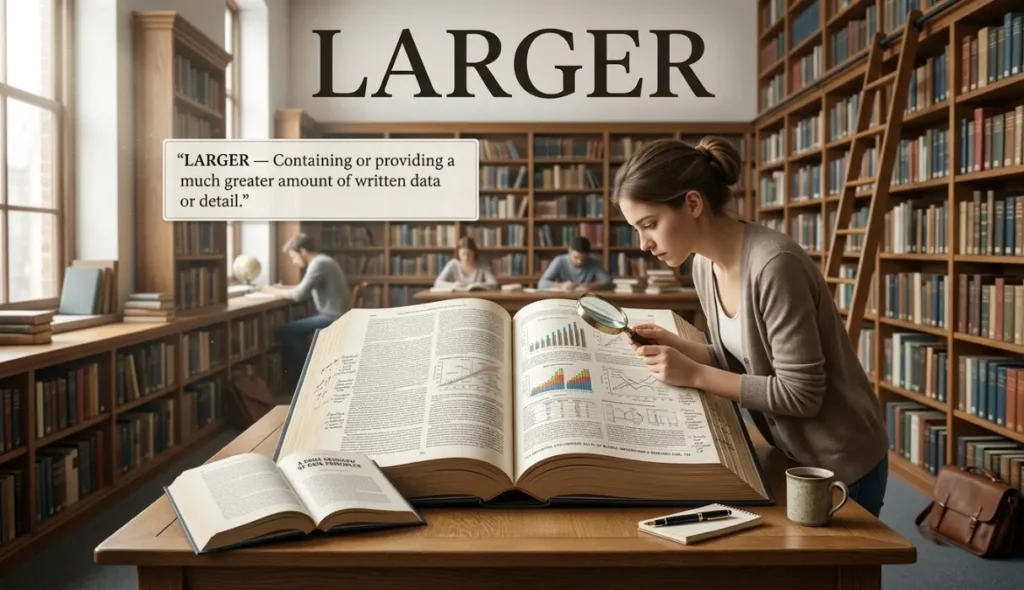
Generous (Adjective Phrase) — US: /ˈdʒen.ər.əs/ | UK: / ˈdʒen.ər.əs/
- Meaning: Larger than strictly necessary in portion, size, or spirit.
- Tone/Register: Friendly, Hospitality
- Example 1: The café serves more generous portions of soup on cold days.
- Example 2: They offered a more generous severance package to departing workers.
Capacious (Adjective Phrase) — US: / kəˈpeɪ.ʃəs/ | UK: /kəˈpeɪ.ʃəs/
- Meaning: Having a much larger internal volume or holding capacity.
- Tone/Register: Formal, Descriptive
- Example 1: She carried a more capacious handbag that fit her laptop easily.
- Example 2: The cargo trunk is far more capacious in the new SUV model.
Commodious (Adjective Phrase) — US: /kəˈmoʊ.di.əs/ | UK: /kəˈməʊ.di.əs/
- Meaning: Offering larger, roomier, and more comfortable living or seating space.
- Tone/Register: Elegant, Formal
- Example 1: Guests were shown into a more commodious dining hall for the banquet.
- Example 2: The old cruise ship featured more commodious passenger cabins.
Voluminous (Adjective Phrase) — US: /vəˈluː.mə.nəs/ | UK: / vəˈljuː.mɪ.nəs/
- Meaning: Occupying or containing a much larger space, volume, or quantity of text.
- Tone/Register: Academic, Expressive
- Example 1: The historical archives contain more voluminous records than expected.
- Example 2: Her ballgown featured a more voluminous skirt made of silk.
Expansive in Scope (Phrase) — US: /ɪkˈspæn.sɪv ɪn skoʊp/ | UK: /ɪkˈspæn.sɪv ɪn skəʊp/
- Meaning: Covering a significantly larger variety of topics or goals.
- Tone/Register: Business, Strategic
- Example 1: The updated law takes a more expansive in-scope approach to conservation.
- Example 2: Their market strategy became more expansive in scope this quarter.
Expanded (Adjective Phrase) — US: / ɪkˈspæn.dɪd/ | UK: / rɪkˈspæn.dɪd/
- Meaning: Increased or stretched out to cover a larger surface area or range.
- Tone/Register: Neutral, Technical
- Example 1: The bookstore opened an expanded section for educational games.
- Example 2: A more expanded version of the textbook includes video links.
Extended (Adjective Phrase) — US: /ɪkˈsten.dɪd/ | UK: /ɪkˈsten.dɪd/
- Meaning: Lengthened or made larger in duration, reach, or physical span.
- Tone/Register: Professional, General
- Example 1: The museum introduced more extended operating hours during the holiday.
- Example 2: The bird spread its wings to reveal a more extended wingspan.
Broadened (Adjective Phrase) — US: / ˈbrɑː.dənd/ | UK: /ˈbrɔː.dənd/
- Meaning: Expanded to include a larger width, variety, or range of choices.
- Tone/Register: General, Academic
- Example 1: Traveling gave her a broader perspective on international art.
- Example 2: The company introduced a broader line of organic snacks.
Enlarged (Adjective Phrase) — US: / ɪnˈlɑːrdʒd/ | UK: /ɪnˈlɑːdʒd/
- Meaning: Made larger in physical dimensions, photo scale, or biological size.
- Tone/Register: Technical, Medical
- Example 1: The doctor examined a more enlarged view of the tissue sample.
- Example 2: They printed a more enlarged photograph to hang above the mantel.
Inflated (Adjective Phrase) — US: /ɪnˈfleɪ.t̬ɪd/ | UK: /ɪnˈfleɪ.tɪd/
- Meaning: Filled with gas or air to become physically larger, or artificially raised.
- Tone/Register: Critical, Financial
- Example 1: The tire looked more inflated after stopping at the service station.
- Example 2: Prices felt more inflated at the airport souvenir shop.
More Swollen (Adjective Phrase) — US: /mɔːr ˈswoʊ.lən/ | UK: /mɔː ˈswəʊ.lən/
- Meaning: Enlarged beyond normal limits due to fluid, pressure, or water flow.
- Tone/Register: Medical, Descriptive
- Example 1: His ankle looked more swollen the morning after the basketball game.
- Example 2: The river became more swollen after three days of continuous rainfall.
Bloated (Adjective Phrase) — US: /ˈbloʊ.t̬ɪd/ | UK: / ˈbləʊ.tɪd/
- Meaning: Uncomfortably or undesirably larger due to excess fluid, gas, or waste.
- Tone/Register: Casual, Critical
- Example 1: I felt more bloated after drinking two carbonated sodas quickly.
- Example 2: The software felt more bloated after the latest unnecessary update.
Oversized (Adjective Phrase) — US: / ˈoʊ.vɚ.saɪzd/ | UK: / ˈəʊ.və.saɪzd/
- Meaning: Intentionally or unintentionally larger than standard manufactured sizes.
- Tone/Register: Informal, Fashion
- Example 1: She prefers wearing a more oversized sweater on chilly mornings.
- Example 2: The delivery truck carried a more oversized package that blocked the doorway.
Unwieldy (Adjective Phrase) — US: / ʌnˈwiːl.di/ | UK: / ʌnˈwiːl/.di/
- Meaning: Larger and harder to manage, carry, or operate due to size or weight.
- Tone/Register: Practical, Descriptive
- Example 1: The old wooden ladder felt more unwieldy than the aluminum model.
- Example 2: The committee became more unwieldy after adding ten new members.
Outsized (Adjective Phrase) — US: / ˈaʊt.saɪzd/ | UK: / ˈaʊt.saɪzd/
- Meaning: Exceptionally larger in proportion, influence, or impact than average.
- Tone/Register: Journalism, Analytical
- Example 1: Small startups can have a more outsized impact on technology trends.
- Example 2: He played a more outsized role in negotiating the peace agreement.
Towering (Adjective Phrase) — US: /ˈtaʊ.ɚ.ɪŋ/ | UK: /ˈtaʊ.ə.rɪŋ/
- Meaning: Standing much higher or larger than surrounding objects or people.
- Tone/Register: Expressive, Visual
- Example 1: The downtown center features a more towering skyscraper than neighboring towns.
- Example 2: He reached a more towering presence in the field of modern physics.
High-Capacity (Adjective Phrase) — US: / haɪ kəˈpæs.ə.t̬i/ | UK: / haɪ kəˈpæs.ə.ti/
- Meaning: Engineered to store, carry, or hold a much larger volume or load.
- Tone/Register: Technical, Commercial
- Example 1: The server rack relies on a higher-capacity battery backup system.
- Example 2: They installed a higher-capacity water heater for the hotel.
Astronomical (Adjective Phrase) — US: ˌæs.trəˈnɑː.mɪ.kəl/ | UK: /æs.trəˈnɒm.ɪ.kəl/
- Meaning: Extremely large in numeric quantity, financial cost, or spatial distance.
- Tone/Register: Informal, Emphatic
- Example 1: Housing costs in capital cities reached an astronomical level.
- Example 2: The telescope calculated a more astronomical distance between stars.
Substantial in Size (Phrase) — US: /səbˈstæn.ʃəl ɪn saɪz/ | UK: /səbˈstæn.ʃəl ɪn saɪz/
- Meaning: Possessing noticeably greater physical weight, height, or width.
- Tone/Register: Formal, Practical
- Example 1: The new shipping containers are more substantial in size than older models.
- Example 2: She ordered a desk that was more substantial in size for her workspace.
Greater in Scale (Phrase) — US: /ˈɡreɪ.t̬ɚ ɪn skeɪl/ | UK: /ˈɡreɪ.tə rɪn skeɪl/
- Meaning: Involving a larger geographical area, economic investment, or scope.
- Tone/Register: Business, Academic
- Example 1: The clean energy project was greater in scale than local efforts.
- Example 2: Urban development plans became greater in scale over the decade.
In Volume (Phrase) — US: /ˈ ɪn ˈvɑːl.juːm/ | UK: /ˈɪn ˈvɒl.juːm/
- Meaning: Occupying or producing a larger physical space or acoustic sound level.
- Tone/Register: Scientific, Technical
- Example 1: Liquid shipments were greater in volume during the spring quarter.
- Example 2: The choir output was greater in volume with thirty extra singers.
In Scope (Phrase) — US: /ˈ ɪn skoʊp/ | UK: /ˈɪn skəʊp/
- Meaning: Encompassing a larger variety of topics, duties, or objectives.
- Tone/Register: Corporate, Formal
- Example 1: The audit was greater in scope than standard annual reviews.
- Example 2: Her managerial role became greater in scope after the merger.
Wide-Ranging (Adjective Phrase) — US: /waɪd ˈreɪn.dʒɪŋ/ | UK: / waɪd ˈreɪn.dʒɪŋ/
- Meaning: Covering a larger selection of topics, subjects, or areas.
- Tone/Register: Academic, Professional
- Example 1: The committee launched a more wide-ranging investigation into safety rules.
- Example 2: He possesses a more wide-ranging knowledge of European history.
Far-Reaching (Adjective Phrase) — US: /fɑːr ˈriː.tʃɪŋ/ | UK: / fɑː ˈriː.tʃɪŋ/
- Meaning: Having a larger, broader, or longer-lasting effect across space and time.
- Tone/Register: Analytical, Political
- Example 1: The court ruling will have a more far-reaching impact on privacy laws.
- Example 2: Economic reforms led to more far-reaching changes in rural areas.
Broad-Scale (Adjective Phrase) — US: /brɑːd skeɪl/ | UK: / brɔːd skeɪl/
- Meaning: Involving or affecting a larger, wider area or group of people.
- Tone/Register: Business, Strategic
- Example 1: The government launched a broader-scale vaccination program.
- Example 2: Company leaders approved a broader-scale restructuring plan.
Synonyms by Tone
| Tone Group | Synonyms Included | Why Tone Matters |
| Positive | Grander, Roomier, More commodious, More generous, More bountiful | Positive terms highlight comfort, luxury, abundance, and attractive space. |
| Neutral | Bigger, Greater, Wider, Broader, More sizable, More extensive | Neutral terms state physical size or mathematical comparisons objectively. |
| Negative | Bulkier, More swollen, More bloated, More unwieldy, More inflated | Negative terms emphasize awkwardness, physical pain, excess mass, or inconvenience. |
| Playful / Informal | Heftier, Spacier, More gigantic, More mammoth, More gargantuan | Informal options add vivid imagery, hyperbole, and humor to everyday conversations. |
Selecting the correct tone avoids confusing your audience. Calling an office “roomier” praises its open design, whereas calling it “bulkier” criticizes its awkward layout.
Mini Comparison: “Larger” vs Close Alternatives
Larger vs. Bigger
- Meaning Difference: “Larger” and “bigger” describe greater physical dimensions. “Larger” often extends to abstract concepts like scale, scope, and capacity. “Bigger” focuses heavily on physical size and mass.
- Tone Difference: “Larger” sounds slightly more refined, formal, and academic. “Bigger” is conversational, casual, and universally understood.
- When to Use Each: Use “larger” in essays, corporate presentations, and research papers. Use “bigger” in everyday conversations, casual stories, or direct spoken requests.
Larger vs. Greater
- Meaning Difference: “Larger” usually compares physical size, dimensions, or physical volume. “Greater” compares abstract quantities, power, historical importance, quality, or numerical amounts.
- Tone Difference: “Larger” is visual and descriptive. “Greater” is formal, elevated, and serious.
- When to Use Each: Use “larger” when talking about shoes, boxes, rooms, or physical territories. Use “greater” when discussing effort, numbers, impact, or financial value.
How “Larger” Changes by Context
- Daily Conversation: English speakers favor simple comparative adjectives like “bigger,” “roomier,” “heftier,” or “spacier” when talking about home items, clothing, or cars.
- Writing & Blogging: Bloggers use expressive terms like “grander,” “more expansive,” “more massive,” or “towering” to create descriptive scenes and hold reader interest.
- Professional or Academic Tone: Academics and executives choose precise terms such as “greater,” “more substantial,” “more extensive,” or “more capacious.”
- Creative or Informal Use: Novelists use imaginative language like “gargantuan,” “colossal,” “titanic,” or “unwieldy” to emphasize epic scale or awkward weight.
Another Word for Larger: More Synonyms and Examples
Finding another word for larger depends on what you want to describe. Some alternatives refer to physical size, while others express greater quantity, importance, scope, or improvement. Choosing the right word helps make your English more natural and precise.
What Is Another Word for Larger?
The most common synonym for larger is bigger. Other alternatives include greater, wider, broader, more extensive, more substantial, roomier, and more sizable.
Consider these examples:
- The new office is roomier than the previous one.
- The second company has a larger customer base.
- The revised report provides a more extensive analysis.
- The project requires a greater investment.
- The new storage facility offers more capacity than the old one.
Use bigger for everyday conversations, roomier for interior space, greater for abstract quantities, and more extensive for a wider range or scope.
Better Words for Larger in an Essay
In essays and academic assignments, replacing larger with a more precise alternative can improve clarity. The best choice depends on the noun and the comparison being made.
| Alternative | Best use | Example |
|---|---|---|
| Greater | Amount, degree, or importance | The results showed a greater difference between the groups. |
| More substantial | Size, value, or importance | The second study provided more substantial evidence. |
| More extensive | Research, work, or coverage | The team conducted a more extensive investigation. |
| Broader | Range, perspective, or coverage | The essay presents a broader perspective on education. |
| Considerably larger | A noticeable difference in size | The new facility is considerably larger than the original building. |
| More significant | Importance or measurable effect | The researchers observed a more significant change. |
For formal writing, avoid replacing every occurrence of larger with the same word. Instead, select an alternative that accurately describes the comparison. For instance, greater importance sounds more natural than larger importance.
What Is a Synonym for Much Larger?
When something exceeds another object or amount by a considerable margin, ordinary words such as bigger may not fully express the difference. These alternatives can help emphasize the scale:
- Considerably larger: A noticeably greater size.
- Substantially larger: A significant increase in size or amount.
- Far larger: A direct way to emphasize a big difference.
- Significantly larger: Useful for reports, research, and measurable comparisons.
- Vastly greater: Suitable for substantial differences in quantity, degree, or influence.
- Enormous: Describes an exceptionally large size, although it does not independently establish a comparison.
Examples:
- The new warehouse is substantially larger than the old building.
- The second dataset contains considerably more information.
- The updated stadium is far larger than the original venue.
Choose a comparative expression when directly comparing two things. Words such as enormous emphasize size but do not automatically communicate how two objects differ.
What Is a Synonym for Much Bigger?
Much bigger is a natural expression in everyday English. Depending on the context, you can replace it with considerably bigger, significantly larger, substantially larger, or far bigger.
For example:
- Everyday conversation: We need a considerably bigger table for the family dinner.
- Professional writing: The company moved into a significantly larger office.
- Academic writing: The second sample was substantially larger than the first.
- Descriptive writing: A far bigger wave approached the shore.
Although bigger and larger are often interchangeable, larger may sound more appropriate in formal reports and academic essays.
What Is an Even Bigger Synonym?
The expression even bigger emphasizes that something is larger than an earlier example or expectation. Suitable alternatives include larger still, even greater, considerably bigger, and larger than before.
Examples:
- The team developed an even bigger plan for the next season.
- The revised project requires an even greater investment.
- The second building is larger still.
- The company expects a considerably bigger audience this year.
Use even greater when discussing abstract quantities, importance, or influence. For physical dimensions, even bigger or larger still will often sound more natural.
What Is Another Word for Bigger and Better?
Bigger and better combines two ideas: increased size or scale and improved quality, performance, or value. A suitable replacement should preserve both meanings.
Possible alternatives include:
- Larger and improved: Suitable when a product or facility has increased in size and undergone improvements.
- Expanded and enhanced: Useful for services, programs, features, and projects.
- Greater in scale and quality: Appropriate for formal descriptions.
- More extensive and effective: Suitable when discussing work, plans, or activities.
Examples:
- Everyday: The company introduced a bigger and better model.
- Professional: The company launched an expanded and enhanced version.
- Formal: The organization developed a larger project with improved performance.
Remember that larger alone does not mean better. If you want to communicate both increased size and improved quality, include language that expresses each idea.
Synonym for Size Up: Meaning and Usage
The phrasal verb size up has a different meaning from larger. It generally means to assess, evaluate, or form an opinion about a person, situation, or object. Therefore, it should not be used as a direct synonym for larger when describing physical dimensions.
Depending on the context, alternatives include assess, evaluate, appraise, judge, gauge, and estimate.
Examples:
- The manager assessed the team’s performance before making a decision.
- She evaluated the situation before accepting the offer.
- The builder estimated the amount of material required.
- The interviewer sized up the candidate’s experience and communication skills.
Use size up when discussing evaluation or judgment. Use larger, bigger, or more substantial when comparing dimensions, quantities, or scale.
Larger Synonyms in English: A Quick Reference
English offers several alternatives for larger, but each word suits a different context.
| Meaning | Useful alternatives |
|---|---|
| Physical size | Bigger, larger, more sizable |
| Width or range | Wider, broader |
| Interior space | Roomier, more spacious |
| Quantity or degree | Greater, considerably more |
| Scope or coverage | More extensive, wide-ranging |
| Exceptional size | Huge, immense, colossal |
| Formal comparisons | Substantially larger, significantly larger |
These alternatives can help students, bloggers, writers, and English learners express comparisons more accurately. Always consider the meaning of the sentence before selecting a synonym.
Common Mistakes & Native Usage

Mistakes Learners Make
- Double Comparatives: Saying “more larger” or “more bigger” is a common error. Always use “larger” or “bigger” on their own, or pair “more” with multi-syllable adjectives like “more extensive.”
- Confusing “Larger” with “Greater”: Using “larger” to describe concepts like “a larger importance” sounds awkward. Use “greater importance” instead.
- Overusing “Bigger” in Academic Papers: Relying only on “bigger” in formal essays weakens writing style. Switch to “larger,” “more substantial,” or “greater.”
Register Notes
- Spoken English: Casual expressions like “bigger,” “heftier,” “spacier,” and “oversized” dominate everyday speech.
- Written English: Formal adjectives such as “greater,” “more substantial,” “more commodious,” and “more capacious” belong in literature and research writing.
Real-Life Mini Scenarios
- Workplace: “We switched to a more capacious storage facility to hold our holiday inventory.” (More capacious emphasizes physical holding capacity.)
- Social Situations: “Our host gave us a roomier table so everyone could sit together.” (Roomier describes comfortable interior space.)
- Media / Pop Culture: “The movie studio approved an even more colossal budget for the sequel.” (More colossal highlights massive financial investment.)
- Writing or Storytelling: “The adventurer looked up at a more towering peak standing against the morning sky.” (More towering creates strong vertical imagery.)
Conclusion
Mastering a synonym for larger expands your vocabulary and makes your writing clear, precise, and visually engaging. Choosing the right comparative term helps you describe physical objects, spaces, and ideas with exact detail.
Practicing these varied options in daily conversations, emails, essays, and stories will build your communication confidence over time. Dynamic size descriptions keep your audience engaged.
Try using two or three of these new size descriptors in your next writing project to elevate your vocabulary!
Practice Exercise
Test your understanding of synonyms for larger across different contexts.
- Which synonym best fits an official corporate report discussing financial investments?
a) More substantial
b) Spacier
c) Heftier
d) Bulkier - What is the most natural term to use in daily speech when asking for a coat that fits loosely?
a) Bigger
b) More titanic
c) More monolithic
d) More copious - “The host showed us to a dining booth that fit our entire group easily.”
a) Roomier
b) More bloated
c) More unwieldy
d) More swollen - Which term works best to describe a student taking detailed, lengthy lecture notes?
a) More copious
b) Bulkier
c) More swollen
d) More gargantuan - What formal word best describes a house offering generous, comfortable living areas?
a) More commodious
b) More bloated
c) Heftier
d) Spacier - Choose the best adjective for a box that is awkward and difficult to carry downstairs:
a) More unwieldy
b) More bountiful
c) More plentiful
d) Wider - Which term implies an excessively large tire filled with air to high pressure?
a) More inflated
b) More commodious
c) Spacier
d) More generous - What is the best word to describe an economic impact extending across a whole nation?
a) More far-reaching
b) Bulkier
c) Heftier
d) Spacier - “The team celebrated a harvest after months of hard agricultural work.”
a) More bountiful
b) More bloated
c) More unwieldy
d) More swollen - Select the comparative word that best describes an abstract mathematical number:
a) Greater
b) Bulkier
c) Spacier
d) Roomier
Application Task:
Write a 2-sentence story about moving into a new home or office using one synonym (such as roomier, more substantial, or more expansive) correctly.
Answer Key:
1-a, 2-a, 3-a, 4-a, 5-a, 6-a, 7-a, 8-a, 9-a, 10-a
FAQs
1. What is the most common synonym for larger in everyday speech?
The most common everyday synonym for larger is bigger. For physical spaces like rooms, apartments, or vehicles, native speakers frequently use roomier or spacier.
2. Is there a difference between using larger and greater?
Yes. Larger generally applies to physical measurements, dimensions, or physical volume. Greater is preferred for abstract ideas, numbers, degrees of importance, power, or non-physical quantities.
3. Which synonym for larger works best in academic writing?
In formal or academic contexts, terms like more substantial, more extensive, greater, more capacious, or more wide-ranging convey precision and a professional tone.
4. Can larger be used to describe non-physical things?
Yes, larger can describe scope, target audiences, or budgets. However, pairing abstract nouns like “impact” or “importance” with greater often sounds more natural in English.
5. How do I avoid double comparative errors with synonyms for larger?
Never combine “more” with single-syllable comparative adjectives (e.g., say “larger” or “bigger,” not “more larger”). Use “more” only with multi-syllable adjectives like “more extensive” or “more substantial.”

Jameel Hassan is the founder and lead writer at SynonymsCloud.com, a trusted online platform dedicated to English vocabulary and effective communication. He is passionate about helping students, writers, professionals, and lifelong learners discover the right words to express their ideas with clarity, precision, and confidence.
At SynonymsCloud.com, every article is thoroughly researched and carefully written to provide accurate, practical, and easy-to-understand guidance on synonyms, antonyms, word meanings, idioms, and vocabulary. With a strong commitment to quality, real-world usage, and clear explanations, the website helps readers expand their vocabulary, improve their writing, and communicate more effectively in both academic and professional settings.