
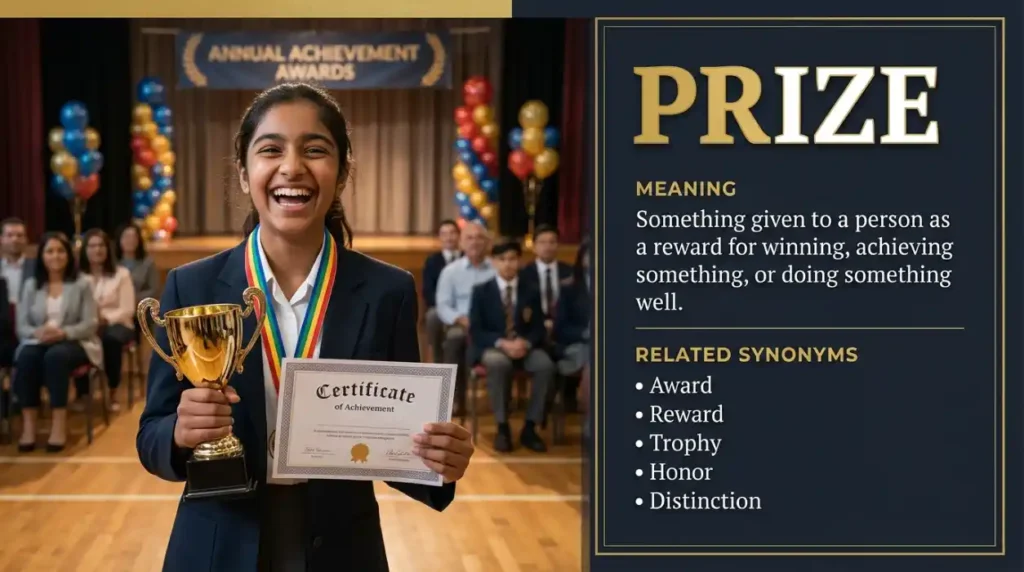
A synonym for prize is award, reward, trophy, medal, or accolade. The right word depends on what someone receives and why. A trophy celebrates victory, an award recognizes achievement, and a reward is given in return for an action or result.
Winning a competition brings excitement and pride. You might receive a trophy, medal, certificate, or cash reward for your performance. Each reward represents achievement and gives you a reason to celebrate your success.
A synonym for prize helps you describe rewards in different ways. It also makes your writing more engaging by allowing you to choose words that match the situation.
The word synonym for prize commonly appears in school competitions, sports events, games, and award ceremonies. It can also describe something precious that a person values deeply, such as a cherished memory or meaningful achievement.
Learning each synonym for prize can strengthen your vocabulary and improve your English. Whether you describe a competition reward or something valuable, the right word makes your meaning clearer and more precise. A synonym for prize can make your sentences sound more natural.
What Does “Prize” Really Mean?
A prize is something valuable given to someone or won through success, skill, luck, or achievement. It can be money, an object, or another benefit.
The word prize has two main grammatical uses:
- Noun: Something won or awarded. Example: “Lena won a prize for her painting.”
- Verb: To value something highly. Example: “I prize the time I spend with my family.”
Native speakers commonly use prize when discussing competitions, raffles, sports, school events, and achievements. As a verb, it expresses how much someone values a person, object, or experience.
Connotative Meaning
(Connotation is the feeling or association a word creates beyond its basic dictionary meaning.)
- Positive: Prize can suggest success, happiness, recognition, or something valuable.
- Negative: In certain situations, it can suggest greed or treating a person as an object to be won.
- Neutral: It can simply describe something offered to a contest winner.
Etymology of “Prize”
The word prize entered English through Old French pris, meaning “value” or “worth.” It is related to Latin pretium, meaning “price” or “value.”
Over time, the word developed the familiar meaning of something won or awarded. The verb to prize also came to mean valuing something highly.
Historical Development
- Old English (450–1100): The modern word prize was not commonly used in its current form. English speakers expressed ideas of worth and reward through other words.
- Middle English (1100–1500): French influence helped establish forms related to prize and the ideas of value and worth.
- Modern English (1500–present): Prize became widely used for competition winnings, awards, and things considered especially valuable.
Pronunciation, Syllables, and Word Formation
US pronunciation: /praɪz/
UK pronunciation: /praɪz/
Syllables
prize one syllable
Affixation pattern
- Root: prize
- Prefix: None
- Suffix: None in the base word
Related forms include prized, meaning valued highly, and prize-winning, meaning having won a prize.
Synonyms List
Some words below are direct synonyms. Others are suitable alternatives only in particular situations. The distinction matters because a medal, a cash reward, and public recognition are not the same thing.
1. Award (Noun) — US: /əˈwɔːrd/ | UK: /əˈwɔːd/
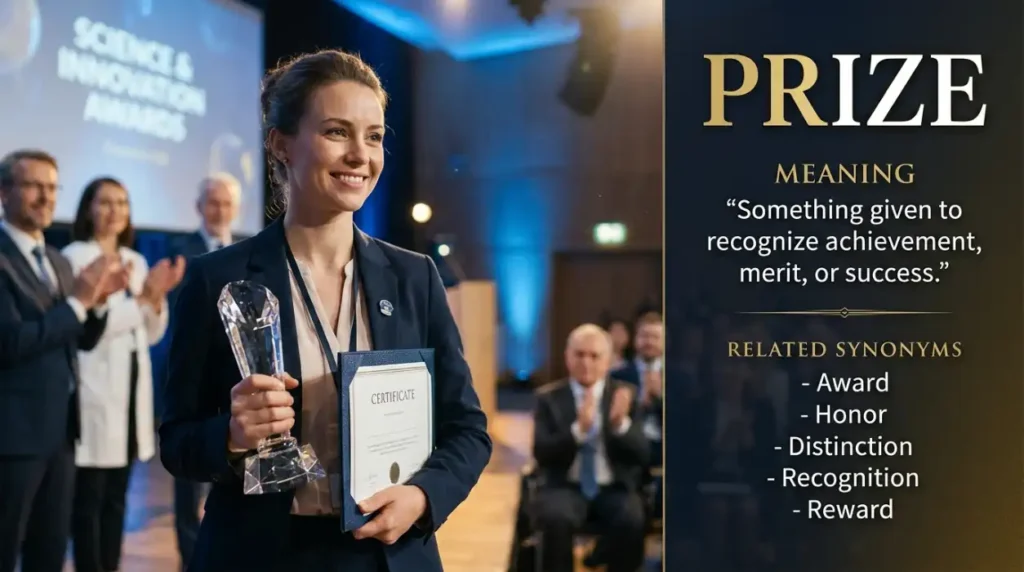
Meaning: Something given to recognize achievement, merit, or success.
Tone/Register: Neutral, formal, professional.
Examples:
- Maya received an award for her outstanding science project.
- The organization presented an award to the community’s youngest volunteer.
2. Reward (Noun) — US: /rɪˈwɔːrd/ | UK: /rɪˈwɔːd/
Meaning: Something given in return for effort, good behavior, service, or a successful action.
Tone/Register: Neutral, everyday, professional.
Examples:
- The family offered a reward for finding their missing dog.
- Finishing the difficult course felt like a reward for months of hard work.
3. Trophy (Noun) — US: /ˈtroʊfi/ | UK: /ˈtrəʊfi/
Meaning: An object awarded as a symbol of victory or achievement, especially in sports.
Tone/Register: Neutral, celebratory.
Examples:
- Our school displayed the football trophy near the main entrance.
- Daniel lifted the trophy while his teammates cheered.
4. Medal (Noun) — US: /ˈmedəl/ | UK: /ˈmedəl/
Meaning: A metal object awarded for achievement, bravery, or success in a competition.
Tone/Register: Formal, celebratory.
Examples:
- Aisha earned a medal at the regional swimming championship.
- The athlete wore her medal proudly during the interview.
5. Accolade (Noun) — US: /ˈækəˌleɪd/ | UK: /ˈækəleɪd/
Meaning: An award or expression of praise for an important achievement.
Tone/Register: Formal, literary, professional.
Examples:
- The director received an accolade for her powerful documentary.
- His latest novel earned several literary accolades.
6. Honor (Noun) — US: /ˈɑːnər/ | UK: /ˈɒnə/
Meaning: Recognition given for exceptional achievement, service, or character.
Tone/Register: Formal, respectful.
Examples:
- Representing her country was the greatest honor of her career.
- The committee gave him an honor for his years of public service.
7. Prize money (Noun) — US: /ˈpraɪz ˌmʌni/ | UK: /ˈpraɪz ˌmʌni/
Meaning: Money awarded to a winner in a contest or competition.
Tone/Register: Neutral, sports, business.
Examples:
- The chess champion donated his prize money to a local school.
- The finalists divided the prize money according to the competition rules.
8. Cash prize (Noun) — US: /ˈkæʃ ˌpraɪz/ | UK: /ˈkæʃ ˌpraɪz/
Meaning: A prize awarded in money rather than as an object or title.
Tone/Register: Neutral, everyday.
Examples:
- Her photograph earned a cash prize at the town festival.
- The quiz winner used the cash prize to buy new books.
9. Gift (Noun) — US: /ɡɪft/ | UK: /ɡɪft/
Meaning: Something given to someone, sometimes as a prize, although it does not always require winning.
Tone/Register: Friendly, informal, neutral.
Examples:
- Every child received a gift at the community celebration.
- The lucky contestant chose a gift from the display table.
10. Present (Noun) — US: /ˈprezənt/ | UK: /ˈprezənt/
Meaning: Something given to someone, often to celebrate an occasion or recognize an achievement.
Tone/Register: Everyday, friendly.
Examples:
- Her classmates prepared a present to celebrate her success.
- The winner opened his present after the final round.
11. Distinction (Noun) — US: /dɪˈstɪŋkʃən/ | UK: /dɪˈstɪŋkʃən/
Meaning: Special recognition for excellent performance or achievement.
Tone/Register: Formal, academic.
Examples:
- Hamza graduated with distinction in computer science.
- Her excellent examination results earned her a distinction.
12. Commendation (Noun) — US: /ˌkɑːmənˈdeɪʃən/ | UK: /ˌkɒmənˈdeɪʃən/
Meaning: Formal praise for good work, service, or conduct.
Tone/Register: Formal, professional.
Examples:
- The firefighter received a commendation for rescuing two residents.
- Her manager wrote a commendation recognizing her excellent work.
13. Citation (Noun) — US: /saɪˈteɪʃən/ | UK: /saɪˈteɪʃən/
Meaning: A formal statement recognizing someone’s achievement, service, or bravery.
Tone/Register: Formal, official.
Examples:
- The officer received a citation for exceptional bravery.
- The ceremony included a citation describing the volunteer’s achievements.
14. Plaque (Noun) — US: /plæk/ | UK: /plæk/
Meaning: A flat plate bearing an inscription, sometimes presented as an award.
Tone/Register: Neutral, ceremonial.
Examples:
- The retiring coach received an engraved plaque from the club.
- A plaque honoring the winning team now hangs in the sports hall.
15. Certificate (Noun) — US: /sərˈtɪfɪkət/ | UK: /səˈtɪfɪkət/
Meaning: An official document confirming achievement, completion, or recognition.
Tone/Register: Formal, educational, professional.
Examples:
- Every participant received a certificate after completing the course.
- She framed the certificate she won at the writing competition.
16. Ribbon (Noun) — US: /ˈrɪbən/ | UK: /ˈrɪbən/
Meaning: A strip of fabric awarded as a mark of achievement, especially at shows or competitions.
Tone/Register: Neutral, traditional.
Examples:
- Their garden won a blue ribbon at the flower show.
- The young rider attached her winning ribbon to the noticeboard.
17. Rosette (Noun) — US: /roʊˈzet/ | UK: /rəʊˈzet/
Meaning: A decorative arrangement of ribbon presented or worn as an award.
Tone/Register: Traditional, specialized.
Examples:
- The dog received a colorful rosette at the county show.
- A blue rosette marked the champion horse’s achievement.
18. Championship (Noun) — US: /ˈtʃæmpiənˌʃɪp/ | UK: /ˈtʃæmpiənʃɪp/
Meaning: A competition or title that establishes someone as a champion; it is not always a physical prize.
Tone/Register: Sports, competitive.
Examples:
- The club celebrated its first national championship.
- Years of training helped the team secure the regional championship.
19. Title (Noun) — US: /ˈtaɪtəl/ | UK: /ˈtaɪtəl/
Meaning: A position or designation earned through victory or achievement.
Tone/Register: Neutral, competitive, professional.
Examples:
- She defended her chess title against a strong opponent.
- The club claimed the league title after a tense final match.
20. Recognition (Noun) — US: /ˌrekəɡˈnɪʃən/ | UK: /ˌrekəɡˈnɪʃən/
Meaning: Acknowledgment of someone’s effort, ability, or achievement, with or without a physical award.
Tone/Register: Neutral, professional.
Examples:
- His volunteer work finally gained recognition across the city.
- The team received recognition for improving workplace safety.
21. Acclaim (Noun) — US: /əˈkleɪm/ | UK: /əˈkleɪm/
Meaning: Strong public praise for someone’s work or achievement.
Tone/Register: Formal, journalistic.
Examples:
- The singer received widespread acclaim for her latest album.
- The film earned critical acclaim at an international festival.
22. Commendation award (Noun Phrase) — US: /ˌkɑːmənˈdeɪʃən əˌwɔːrd/ | UK: /ˌkɒmənˈdeɪʃən əˌwɔːd/
Meaning: An award given to formally recognize praiseworthy service or performance.
Tone/Register: Formal, institutional.
Examples:
- The nurse received a commendation award for her dedication.
- The department created a commendation award for exceptional public service.
23. Merit award (Noun Phrase) — US: /ˈmerɪt əˌwɔːrd/ | UK: /ˈmerɪt əˌwɔːd/
Meaning: An award recognizing ability, effort, or high-quality work.
Tone/Register: Formal, educational, professional.
Examples:
- He earned a merit award for his engineering design.
- The school presented a merit award to a consistently helpful student.
24. Achievement award (Noun Phrase) — US: /əˈtʃiːvmənt əˌwɔːrd/ | UK: /əˈtʃiːvmənt əˌwɔːd/
Meaning: An award recognizing a notable accomplishment.
Tone/Register: Formal, positive.
Examples:
- The organization gave her an achievement award for years of service.
- His achievement award celebrated a breakthrough in research.
25. Grand prize (Noun Phrase) — US: /ˌɡrænd ˈpraɪz/ | UK: /ˌɡrænd ˈpraɪz/
Meaning: The most important or valuable prize in a competition.
Tone/Register: Neutral, competitive.
Examples:
- The grand prize was a weeklong educational trip.
- Her short film won the grand prize at the youth festival.
26. Consolation prize (Noun Phrase) — US: /kənˈsoʊˌleɪʃən ˌpraɪz/ | UK: /kənˈsəʊˌleɪʃən ˌpraɪz/
Meaning: A smaller prize given to someone who does not win the main competition.
Tone/Register: Neutral, supportive.
Examples:
- Although he missed the final, he received a consolation prize.
- Every young participant was offered a small consolation prize.
27. Runner-up prize (Noun Phrase) — US: /ˌrʌnər ˈʌp ˌpraɪz/ | UK: /ˌrʌnər ˈʌp ˌpraɪz/
Meaning: A prize given to a person or team finishing in a runner-up position.
Tone/Register: Neutral, competitive.
Examples:
- The runner-up prize included a book collection and a certificate.
- Their team earned the runner-up prize after a close final.
28. Bonus (Noun) — US: /ˈboʊnəs/ | UK: /ˈbəʊnəs/
Meaning: Something extra given in addition to what is normally expected, sometimes for success.
Tone/Register: Neutral, business, everyday.
Examples:
- The top salesperson earned a bonus for excellent results.
- The teacher gave the class a bonus activity after their successful project.
29. Incentive (Noun) — US: /ɪnˈsentɪv/ | UK: /ɪnˈsentɪv/
Meaning: Something offered to encourage a person to act or achieve a goal.
Tone/Register: Business, educational, neutral.
Examples:
- The teacher offered a book voucher as an incentive for reading.
- The company introduced an incentive for meeting its safety targets.
30. Perk (Noun) — US: /pɜːrk/ | UK: /pɜːk/
Meaning: An additional benefit or advantage, sometimes offered as a reward.
Tone/Register: Informal, workplace.
Examples:
- An extra day off was a welcome perk for the winning team.
- Meeting the guest author was an unexpected perk of the contest.
31. Jackpot (Noun) — US: /ˈdʒækˌpɑːt/ | UK: /ˈdʒækpɒt/
Meaning: A large prize, usually money, won in a game of chance or lottery.
Tone/Register: Informal, entertainment.
Examples:
- One lucky ticket holder won the enormous jackpot.
- Finding the rare first edition felt like hitting the jackpot.
32. Bounty (Noun) — US: /ˈbaʊnti/ | UK: /ˈbaʊnti/
Meaning: A reward, often money, offered for completing a task or achieving a specified result.
Tone/Register: Formal, historical, specialized.
Examples:
- Officials offered a bounty for information about the stolen painting.
- The explorer was promised a bounty for recovering the missing artifact.
33. Windfall (Noun) — US: /ˈwɪndˌfɔːl/ | UK: /ˈwɪndfɔːl/
Meaning: An unexpected gain, often money, that was not planned.
Tone/Register: Neutral, financial.
Examples:
- An unexpected inheritance proved to be a welcome windfall.
- The charity received a windfall from an unplanned donation.
34. Spoils (Noun, usually plural) — US: /spɔɪlz/ | UK: /spɔɪlz/
Meaning: Valuable things gained through victory or success, sometimes in conflict.
Tone/Register: Informal, historical, sometimes negative.
Examples:
- The winners divided the spoils after the tournament.
- The victory brought the team fame and other spoils of success.
35. Treasure (Noun) — US: /ˈtreʒər/ | UK: /ˈtreʒə/
Meaning: Something very valuable or deeply cherished; it may be a prize but often refers to personal or material worth.
Tone/Register: Warm, figurative, neutral.
Examples:
- The children searched the beach for buried treasure.
- She considered her grandmother’s letters a greater treasure than any medal.
36. Keepsake (Noun) — US: /ˈkiːpˌseɪk/ | UK: /ˈkiːpseɪk/
Meaning: An object kept to remember a person, event, or experience; it may be given as a commemorative prize.
Tone/Register: Personal, sentimental.
Examples:
- Every finalist received a keepsake from the organizers.
- He kept the small cup as a keepsake of his first race.
37. Memento (Noun) — US: /məˈmentoʊ/ | UK: /məˈmentəʊ/
Meaning: An object that reminds someone of a particular experience or occasion.
Tone/Register: Neutral, sentimental.
Examples:
- Each volunteer received a memento of the anniversary event.
- The engraved medal became a memento of her remarkable season.
38. Boon (Noun) — US: /buːn/ | UK: /buːn/
Meaning: A helpful benefit or blessing, not necessarily something won in a competition.
Tone/Register: Formal, literary.
Examples:
- The scholarship was a boon to the student and her family.
- Reliable transport proved a boon for the festival volunteers.
39. Benefit (Noun) — US: /ˈbenəfɪt/ | UK: /ˈbenɪfɪt/
Meaning: An advantage or helpful outcome someone receives; it can function as a reward in some contexts.
Tone/Register: Neutral, professional.
Examples:
- The main benefit of winning was the chance to study abroad.
- One benefit of entering the contest was meeting experienced writers.
40. Fellowship (Noun) — US: /ˈfel.oʊˌʃɪp/ | UK: /ˈfel.əʊ.ʃɪp/
Meaning: A funded position or special opportunity awarded for study, research, or professional development.
Tone/Register: Academic, professional.
Examples:
- She won a fellowship to research renewable energy.
- The fellowship gave him time to complete his first book.

41. Scholarship (Noun) — US: /ˈskɑːlərˌʃɪp/ | UK: /ˈskɒləʃɪp/
Meaning: Financial support awarded to a student, often based on achievement, need, or eligibility.
Tone/Register: Educational, formal.
Examples:
- He earned a scholarship for his outstanding academic record.
- The debate contest offered a scholarship to its top student.
42. First place (Noun Phrase) — US: /ˌfɜːrst ˈpleɪs/ | UK: /ˌfɜːst ˈpleɪs/
Meaning: The highest position in a competition, often associated with a prize.
Tone/Register: Neutral, competitive.
Examples:
- Her science project took first place at the school fair.
- The runner secured first place with a strong final sprint.
43. Blue ribbon (Noun Phrase) — US: /ˌbluː ˈrɪbən/ | UK: /ˌbluː ˈrɪbən/
Meaning: A ribbon awarded as a mark of top achievement, especially at shows and fairs.
Tone/Register: Traditional, celebratory.
Examples:
- Their homemade pie won a blue ribbon at the county fair.
- The young gardener proudly displayed her blue ribbon.
44. Special recognition (Noun Phrase) — US: /ˌspeʃəl ˌrekəɡˈnɪʃən/ | UK: /ˌspeʃəl ˌrekəɡˈnɪʃən/
Meaning: Particular acknowledgment given for an achievement or contribution.
Tone/Register: Neutral, professional.
Examples:
- The volunteers received special recognition for their weekend work.
- Her teacher gave her special recognition for helping new students.
45. Public honor (Noun Phrase) — US: /ˌpʌblɪk ˈɑːnər/ | UK: /ˌpʌblɪk ˈɒnə/
Meaning: Recognition presented openly before a community or audience.
Tone/Register: Formal, respectful.
Examples:
- The city gave the retired doctor a public honor.
- The ceremony became a public honor for the entire rescue team.
46. Prize-winning award (Noun Phrase) — US: /ˈpraɪzˌwɪnɪŋ əˌwɔːrd/ | UK: /ˈpraɪzˌwɪnɪŋ əˌwɔːd/
Meaning: An award associated with winning a competition; the phrase is descriptive rather than a separate synonym.
Tone/Register: Neutral, descriptive.
Examples:
- The prize-winning award was presented at the closing ceremony.
- She displayed the award she had won for her short story.
47. Financial reward (Noun Phrase) — US: /faɪˈnænʃəl rɪˈwɔːrd/ | UK: /faɪˈnænʃəl rɪˈwɔːd/
Meaning: Money or another financial benefit given in return for effort, achievement, or a result.
Tone/Register: Business, formal.
Examples:
- The research team received a financial reward for its discovery.
- Completing the project ahead of schedule brought a financial reward.
48. Prize package (Noun Phrase) — US: /ˈpraɪz ˌpækɪdʒ/ | UK: /ˈpraɪz ˌpækɪdʒ/
Meaning: A collection of items or benefits offered together as a competition prize.
Tone/Register: Neutral, promotional.
Examples:
- The winning family received a prize package of books and games.
- The contest’s prize package included a weekend cultural trip.
49. Grand award (Noun Phrase) — US: /ˌɡrænd əˈwɔːrd/ | UK: /ˌɡrænd əˈwɔːd/
Meaning: A major award recognizing the leading achievement in an event; the exact usage depends on the organization.
Tone/Register: Formal, ceremonial.
Examples:
- The jury presented the grand award to the young filmmaker.
- Her design received the event’s grand award for originality.
50. Token of appreciation (Noun Phrase) — US: /ˈtoʊkən əv əˌpriːʃiˈeɪʃən/ | UK: /ˈtəʊkən əv əˌpriːʃiˈeɪʃən/
Meaning: A small gift or gesture expressing gratitude; it is a related alternative only when the prize serves that purpose.
Tone/Register: Polite, professional, warm.
Examples:
- The organizers gave each volunteer a token of appreciation.
- The coach received a framed photograph as a token of appreciation.
Accuracy note:
The strongest direct alternatives are award, reward, trophy, medal, and accolade. Other entries are context-specific words or phrases, so use them only when their meanings fit.
Synonyms by Tone
Positive
- Award: Recognizes achievement.
- Accolade: Expresses praise for success.
- Honor: Emphasizes respect.
- Distinction: Highlights excellent performance.
- Achievement award: Celebrates an accomplishment.
- Merit award: Recognizes ability or effort.
Neutral
- Prize: A general term for something won.
- Reward: Something received in return for an action.
- Trophy: An object symbolizing victory.
- Medal: A physical award.
- Certificate: Written proof of recognition.
- Cash prize: Money awarded to a winner.
Context-Sensitive
- Jackpot: A large prize associated with chance.
- Windfall: An unexpected gain.
- Spoils: Valuable things gained through victory.
- Bounty: A reward offered for a particular result.
Informal
- Gift: Something given to someone.
- Bonus: An extra benefit.
- Perk: An additional advantage.
- Treasure: Something deeply valued.
Tone matters because it tells the reader whether the item represents achievement, money, appreciation, or luck. Choose the alternative that matches both the situation and your intended meaning.
Prize vs. Award vs. Reward
| Word | Meaning | Example |
|---|---|---|
| Prize | Something won, often in a contest | He won a prize in the quiz. |
| Award | Recognition for achievement | She received an award for her research. |
| Reward | Something given for an action or result | They offered a reward for the lost bag. |
Use prize when someone wins something. Award when achievement or recognition is central. Use reward when the item is given in return for effort, behavior, or a result.
How to Use “Prize” in Different Contexts
Daily conversation
Use prize, gift, reward, or bonus for familiar situations. “I won a prize at the fair” sounds natural and clear.
Writing and blogging
Choose award, accolade, or recognition when discussing someone’s work. These words help avoid repetition while adding detail.
Professional and academic writing
Merit award, scholarship, and fellowship are useful when the context involves education or professional achievement.
Creative writing
Jackpot, treasure, and windfall can make a story more vivid. However, they describe different types of gains and should not be used interchangeably.
Common Mistakes and Native Usage

Mistake 1: Treating Every Alternative as an Exact Synonym
A medal is a physical object. Recognition may be verbal or public. A scholarship provides educational support. All can be connected to prizes, but they do not mean the same thing.
Mistake 2: Confusing a Prize With an Incentive
A prize is usually something won or awarded. An incentive is offered to encourage an action.
Correct: The winner received a prize.
Correct: The teacher offered a reward as an incentive to finish the project.
Mistake 3: Using Formal Words in Casual Situations
Accolade and commendation suit formal contexts. In everyday conversation, award, prize, or praise may sound more natural.
Mistake 4: Replacing “Prize” Every Time
Do not change a word just to avoid repetition. Repeating prize is better than choosing an alternative that changes the meaning.
Register Notes
- Formal: accolade, commendation, distinction.
- Everyday: prize, reward, gift.
- Academic: scholarship, fellowship, merit award.
- Sports: trophy, medal, championship.
For further vocabulary practice, you can also read an article about synonyms for reward or achievement.
Real-Life Mini Scenarios
Workplace
An employee completes a major project and receives an award for excellent performance.
Social situation
A child wins a prize at a community fair and proudly shows it to friends.
Media and entertainment
A film earns acclaim after receiving an award at an international festival.
Writing and storytelling
A character wins a scholarship, allowing them to pursue an education they once thought impossible.
Practice Exercise
Choose the best answer for each situation.
1. A football team receives a silver object after winning a tournament. What is it?
A. Trophy
B. Fellowship
C. Compliment
2. A student receives financial support to attend university. What is it?
A. Rosette
B. Scholarship
C. Applause
3. An employee gets extra money for excellent performance. What might it be?
A. Bonus
B. Citation
C. Keepsake
4. An officer receives formal praise for bravery. Which word fits best?
A. Jackpot
B. Commendation
C. Treasure
5. Someone unexpectedly receives money from an inheritance. What is this gain called?
A. Windfall
B. Medal
C. Title
6. A student finishes first in a competition. Which phrase describes the result?
A. First place
B. Consolation prize
C. Memento
7. Someone receives money for returning a lost wallet. Which word is most suitable?
A. Reward
B. Championship
C. Acclaim
8. A small object reminds someone of a memorable event. What is it?
A. Incentive
B. Keepsake
C. Bounty
9. A scientist receives formal praise for excellent research. Which word fits?
A. Accolade
B. Spoils
C. Jackpot
10. A contestant does not win the main competition but receives a smaller prize. What is it?
A. Grand prize
B. Consolation prize
C. Medal of honor
Reflection task:
Write two sentences about an achievement. Use prize in one sentence and a suitable alternative, such as award or reward, in the other.
Answer key:
1-A, 2-B, 3-A, 4-B, 5-A, 6-A, 7-A, 8-B, 9-A, 10-B
Frequently Asked Questions
1. What is the best synonym for prize in academic writing?
Award is often the best choice when discussing formal recognition for academic performance. For example, “She received an award for her research.” If the benefit supports education, scholarship may be more accurate. A funded research opportunity may be called a fellowship. Choose the word that identifies what the person actually received.
2. What is another word for a prize won in a competition?
The best alternative depends on the prize itself. Use trophy for an object symbolizing victory, medal for a metal award, and cash prize for money. Grand prize describes the most important offering in a contest. These terms give readers more information than the general word prize.
3. What is the difference between a prize and an incentive?
A prize is something someone wins or receives, often after a competition. An incentive is offered to encourage a particular action or behavior. For example, a writing contest may give its winner a prize, while a teacher may offer extra credit as an incentive for completing optional work.
4. What is a formal word for prize or reward?
Accolade, commendation, and distinction can suit formal writing when the context involves recognition or achievement. Award is a versatile formal alternative. However, these words are not interchangeable in every sentence. Money given for completing a task is more naturally called a reward than an accolade.
5. What is the opposite of prize?
There is no single exact opposite of prize because the word has several meanings. In a competition, loss or defeat may contrast with winning. In a reward-based situation, penalty may describe an unfavorable outcome. The best opposite depends on whether you mean the object, the recognition, or the result.
6. Can “gift” be used as a synonym for prize?
Sometimes. A gift can serve as a prize when it is presented to a winner, but gifts are also given for birthdays, holidays, and personal occasions. “She won a gift basket in the raffle” is natural. In a formal contest, award or prize may communicate the situation more clearly.
7. What is the difference between a prize, a trophy, and a medal?
A prize is the broad term for something won or awarded. A trophy is usually an object that symbolizes victory, while a medal is a small metal award given for achievement, service, or performance. A competition might award all three, but the words describe different things and should not automatically replace one another.
Conclusion
Learning synonyms for prize helps you describe achievements with greater accuracy. Words such as award, reward, trophy, and medal make your writing more specific.
For students and bloggers, varied vocabulary makes essays, articles, and stories more engaging. For everyday English users, it helps conversations sound more natural.
You do not need to memorize all 50 alternatives at once. Start with the most common words, understand their differences, and practice using them in short sentences.
Choose three new words today and use them in an email, an essay, or a daily conversation. Regular practice will help you build confidence and communicate more clearly.
Suggested External Sources
- Cambridge Dictionary: Prize
- Merriam-Webster: Prize
- Oxford Learner’s Dictionaries: Prize

Jameel Hassan is the founder and lead writer at SynonymsCloud.com, a trusted online platform dedicated to English vocabulary and effective communication. He is passionate about helping students, writers, professionals, and lifelong learners discover the right words to express their ideas with clarity, precision, and confidence.
At SynonymsCloud.com, every article is thoroughly researched and carefully written to provide accurate, practical, and easy-to-understand guidance on synonyms, antonyms, word meanings, idioms, and vocabulary. With a strong commitment to quality, real-world usage, and clear explanations, the website helps readers expand their vocabulary, improve their writing, and communicate more effectively in both academic and professional settings.