
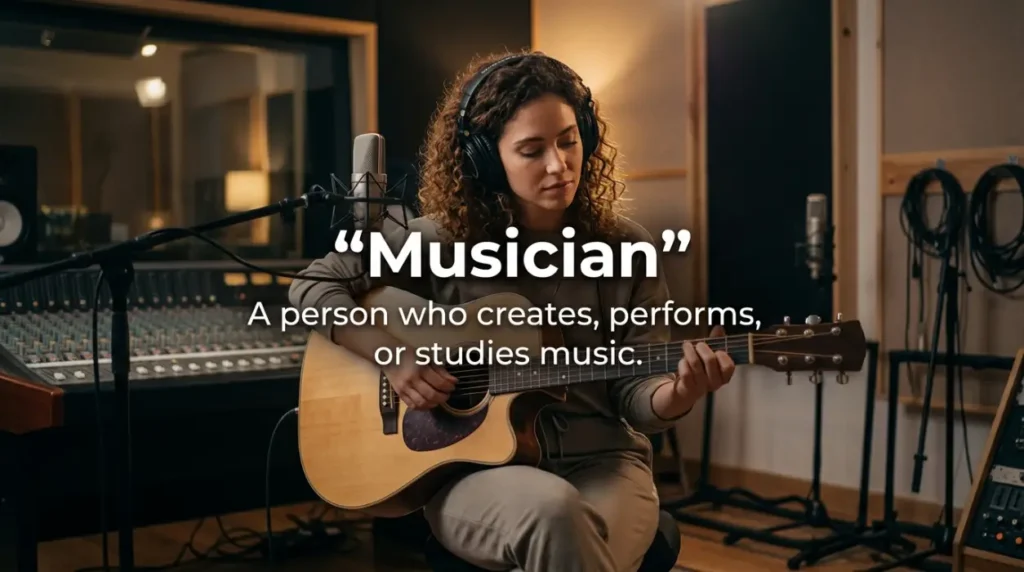
Top synonyms for musician include instrumentalist, performer, virtuoso, maestro, and vocalist. Choose instrumentalist for technical instrumental players, performer for live stage entertainers, virtuoso for exceptional artistic skill, maestro for distinguished conductors or master artists, and vocalist for singers. These precise terms enhance your writing across both classical and contemporary contexts.
A synonym for musician helps you describe a talented artist with greater precision and variety. Whether you are writing about a street violinist, skilled guitarist, or professional performer, the right word can make your description more vivid and engaging.
Words such as maestro, virtuoso, instrumentalist, and performer can add depth to everyday speech and creative writing. Choosing a suitable synonym for musician also helps you avoid repetition while matching the artist’s skills, role, and musical style.
People often search for a synonym for musician when writing essays, music reviews, stories, or social media content. Using fresh vocabulary can make descriptions sound more natural while keeping your ideas clear and interesting.
Students, bloggers, content writers, and everyday English speakers can use these alternatives to describe musical talent confidently. The right vocabulary adds variety to your writing and helps readers better understand the artist you are describing.
What Does “Musician” Really Mean?
The word musician refers to anyone who writes, sings, conducts, or plays musical instruments with skill or professional focus.
Native English speakers understand a musician as a creative person who transforms sound into art, emotion, or entertainment.
You will encounter this word in concert announcements, music journalism, album credits, film reviews, and everyday arts discussions.
Part of Speech: Noun
Simple Definition: A person who makes, performs, or composes music.
Connotative Meaning
Connotation is the emotional, cultural, or secondary meaning that a word carries beyond its literal dictionary definition.
- Positive tone: Implies artistic genius, passion, dedication, and cultural enrichment (e.g., “maestro,” “virtuoso”).
- Negative tone: Implies arrogance, difficulty, or erratic behavior when used in critical contexts (e.g., “prima donna”).
- Neutral tone: Identifies a professional role without emotional judgment (e.g., “instrumentalist,” “performer”).
Etymology
- Origin: Derived from Old French musicien, which comes from Medieval Latin musica (the art of the Muses).
- Old English (450–1100): Early Anglo-Saxons used terms like gliwman (gleeman) or sangere (singer) before Latin loanwords entered the language.
- Middle English (1100–1500): The term musicien was adopted in the 14th century as formal musical education developed in Europe.
- Modern English (1500–Present): “Musician” became the standard umbrella term for instrumental players, singers, and classical composers.
Pronunciation & Syllables
- US: /mjuːˈzɪʃ.ən/
- UK: /mjuːˈzɪʃ.ən/
- Syllables: mu-si-cian (3 syllables)
- Affixation Pattern: Root music + suffix -ian
- Root: Music
- Prefix: None
- Suffix: -ian
Synonyms List

1. Instrumentalist (Noun)
Meaning: A person who plays a musical instrument with technical skill.
Tone/Register: Formal / General
Example:
- The symphony hired a talented instrumentalist for the violin solo.
- She practiced daily to become a respected instrumentalist.
2. Performer (Noun)
Meaning: An artist who entertains an audience through music or acting.
Tone/Register: General / Casual
Example:
- The energetic performer captivated the crowd all night.
- Every stage performer needs confidence under bright lights.
3. Composer (Noun)
Meaning: A creator who writes original musical pieces or film scores.
Tone/Register: Academic / Professional
Example:
- The film composer wrote a breathtaking orchestral soundtrack.
- Wolfgang Amadeus Mozart remains a famous classical composer.
4. Virtuoso (Noun)
Meaning: An individual who displays exceptional technical skill in music.
Tone/Register: Elevating / Respectful
Example:
- The young piano virtuoso played the complex piece effortlessly.
- Audiences marveled at the guitar virtuoso during his solo.
5. Maestro (Noun)
Meaning: A distinguished musician or conductor of great skill.
Tone/Register: Formal / Prestigious
Example:
- The maestro raised his baton to signal the orchestra.
- Critics praised the maestro for a flawless concert season.
6. Vocalist (Noun)
Meaning: A musician who uses their voice as their primary instrument.
Tone/Register: Professional / General
Example:
- The jazz band is searching for a new lead vocalist.
- Her powerful range makes her a standout vocalist.
7. Musical Artist (Noun)
Meaning: A broad term for anyone creating or performing music professionally.
Tone/Register: Modern / Industry
Example:
- The indie record label signed three new musical artists today.
- Digital streaming platforms allow any musical artist to reach listeners.
8. Singer (Noun)
Meaning: A person who sings songs for entertainment or art.
Tone/Register: General / Everyday
Example:
- The pop singer performed her top hits on TV.
- He works as a wedding singer on weekends.
9. Songwriter (Noun)
Meaning: An artist who crafts the lyrics and melodies of songs.
Tone/Register: Creative / Industry
Example:
- The country songwriter wrote hits for famous pop stars.
- She received an award for her work as a songwriter.
10. Arranger (Noun)
Meaning: A musician who adapts a musical composition for performance.
Tone/Register: Technical / Professional
Example:
- The jazz arranger reworked the pop song into a swing tune.
- An experienced arranger balanced the brass and string sections.
11. Conductor (Noun)
Meaning: A leader who directs an orchestra or choir during performances.
Tone/Register: Formal / Classical
Example:
- The conductor guided the choir with precise hand gestures.
- She became the orchestra’s youngest guest conductor.
12. Minstrel (Noun)
Meaning: A medieval singer or musician who sang verse to harp accompaniment.
Tone/Register: Historical / Literary
Example:
- The traveling minstrel entertained royalty in castle halls.
- Old legends depict the minstrel singing folk tales.
13. Troubadour (Noun)
Meaning: A lyric poet or musician who sings romantic songs.
Tone/Register: Literary / Poetic
Example:
- The modern troubadour played acoustic guitar in small cafés.
- His songs carry the poetic style of a classic troubadour.
14. Busker (Noun)
Meaning: A musician who performs in public places for voluntary donations.
Tone/Register: Informal / Casual
Example:
- The street busker played flute near the subway entrance.
- Commuters stopped to give coins to the acoustic busker.
15. Soloist (Noun)
Meaning: A performer who plays or sings a complete musical section alone.
Tone/Register: Professional / Classical
Example:
- The opera soloist stepped forward to deliver a powerful aria.
- She will feature as the cello soloist tonight.
16. Accompanist (Noun)
Meaning: A musician who plays alongside a lead singer or soloist.
Tone/Register: Professional / Academic
Example:
- The pianist served as a reliable accompanist for the vocal competition.
- A good accompanist supports the soloist without overpowering them.
17. Session Musician (Noun)
Meaning: An instrumental player hired to perform in recording studios.
Tone/Register: Industry / Professional
Example:
- He earns a steady living as a studio session musician.
- Top pop albums rely on skilled session musicians for backing tracks.
18. Sideman (Noun)
Meaning: A professional musician hired to play in a band led by someone else.
Tone/Register: Industry / Casual
Example:
- The veteran trumpet player spent decades working as a sideman.
- He stepped out of his role as a sideman to release a solo album.
19. Songsmith (Noun)
Meaning: A skilled writer of popular songs and catchy melodies.
Tone/Register: Literary / Creative
Example:
- The legendary songsmith crafted timeless radio hits in the 1970s.
- Every music critic admired the young songsmith’s poetic lyrics.
20. Bard (Noun)
Meaning: A traditional poet-musician who recited epic stories and verse.
Tone/Register: Historical / Literary
Example:
- Fantasy novels often feature a traveling bard with a lute.
- The ancient bard sang stories of brave warriors around the fire.
21. Balladeer (Noun)
Meaning: A singer who specializes in performing slow, storytelling ballads.
Tone/Register: Expressive / Descriptive
Example:
- The folk balladeer sang tales of love and loss.
- Audiences loved the soothing voice of the romantic balladeer.
22. Chorister (Noun)
Meaning: A singer who performs as part of a choir or church chorus.
Tone/Register: Formal / Religious
Example:
- The young chorister sang beautifully during the holiday service.
- Choir directors train every chorister to blend their vocal tone.
23. Chanteuse (Noun)
Meaning: A female singer who performs in nightclubs or cabaret venues.
Tone/Register: Sophisticated / Stylish
Example:
- The French chanteuse captivated patrons in the intimate jazz club.
- She wore a glamorous gown as the venue’s lead chanteuse.
24. Crooner (Noun)
Meaning: A singer who performs soft, sentimental popular songs smoothly.
Tone/Register: Retro / Informal
Example:
- The classic crooner filled the lounge with smooth vocal tunes.
- Frank Sinatra remains the most famous American crooner.
25. Diva (Noun)
Meaning: A highly celebrated female opera or pop singer.
Tone/Register: Expressive / Dramatic
Example:
- The opera diva earned a standing ovation for her dramatic performance.
- Fans gathered outside to see the famous pop diva.
26. Bandleader (Noun)
Meaning: The musician who organizes and directs a musical group or big band.
Tone/Register: Professional / General
Example:
- The jazz bandleader counted off the tempo for his horn section.
- Duke Ellington was a famous big bandleader in American history.
27. Concertmaster (Noun)
Meaning: The lead first violinist and assistant leader in an orchestra.
Tone/Register: Formal / Classical
Example:
- The concertmaster tuned the orchestra right before the show started.
- Becoming a concertmaster requires decades of intense classical training.
28. Prodigy (Noun)
Meaning: A young child who exhibits extraordinary musical talent naturally.
Tone/Register: Elevating / Academic
Example:
- The child prodigy learned complex piano sonatas at age six.
- News outlets covered the story of the violin prodigy.
29. Serenader (Noun)
Meaning: A musician who performs romantic music outdoors for a specific person.
Tone/Register: Romantic / Informal
Example:
- A night serenader played acoustic guitar beneath her balcony.
- The street serenader sang love songs to couples passing by.
30. Hymnodist (Noun)
Meaning: A composer or writer who creates sacred songs and religious hymns.
Tone/Register: Academic / Religious
Example:
- The 18th-century hymnodist composed songs still sung today.
- Scholars studied the poetry of the famous hymnodist.
31. Lyricist (Noun)
Meaning: A creator who writes the words for songs, musicals, or operas.
Tone/Register: Professional / Creative
Example:
- The composer worked alongside a talented lyricist on the new musical.
- She won an award for her clever work as a theater lyricist.
32. Beatmaker (Noun)
Meaning: A modern creator who produces electronic instrumental tracks.
Tone/Register: Informal / Modern
Example:
- The hip-hop beatmaker uploaded his latest instrumental online.
- Many young producers start their careers as digital beatmakers.
33. Music Producer (Noun)
Meaning: A creative director who guides audio recording and song creation.
Tone/Register: Business / Industry
Example:
- The music producer shaped the band’s raw studio sound.
- She won a Grammy for her work as an executive music producer.
34. Multi-instrumentalist (Noun)
Meaning: A musician who plays several different instruments proficiently.
Tone/Register: Technical / Respectful
Example:
- Prince was a famous multi-instrumentalist who played guitar, bass, and keys.
- The multi-instrumentalist switched between saxophone and flute on stage.
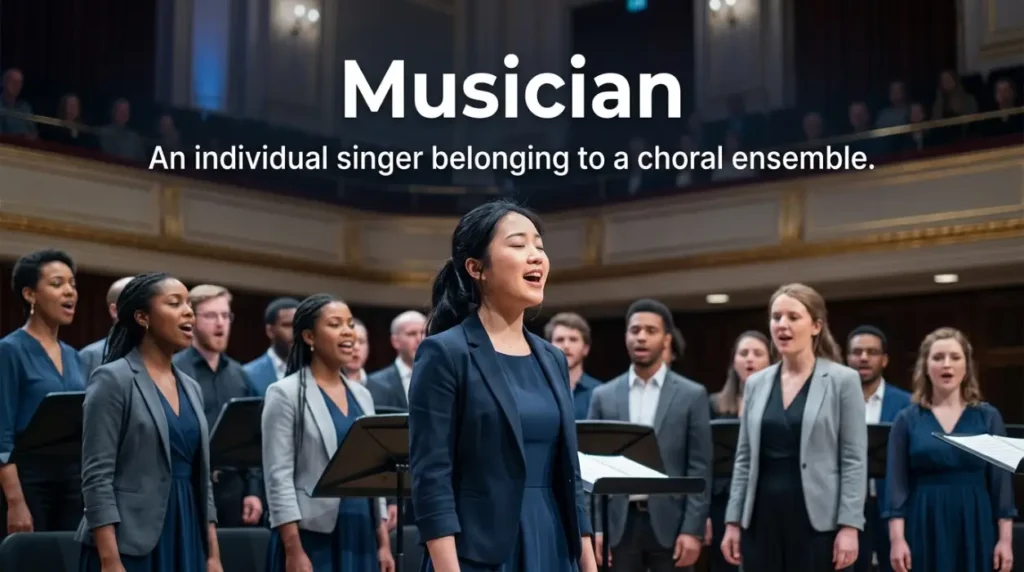
35. Choralist (Noun)
Meaning: An individual singer belonging to a choral ensemble.
Tone/Register: Formal / Academic
Example:
- Every choralist adjusted their pitch to match the choir director.
- The university choir accepted thirty new choralists this semester.
36. Pianist (Noun)
Meaning: A musician who plays the piano professionally or recreationally.
Tone/Register: General / Standard
Example:
- The classical pianist performed a Chopin concerto at the hall.
- He works as a jazz pianist in a downtown restaurant.
37. Guitarist (Noun)
Meaning: An individual who plays the acoustic, bass, or electric guitar.
Tone/Register: General / Popular
Example:
- The rock guitarist played an exciting solo on stage.
- She started taking lessons to become a rhythm guitarist.
38. Violinist (Noun)
Meaning: A performer who plays the violin in classical or folk settings.
Tone/Register: General / Classical
Example:
- The guest violinist tuned her strings before entering the stage.
- A street violinist played classical tunes in the park.
39. Drummer (Noun)
Meaning: A musician who plays drums and percussion to maintain rhythm.
Tone/Register: General / Informal
Example:
- The band’s drummer kept a steady beat throughout the concert.
- He practiced drumming rudiments on his practice pad.
40. Cellist (Noun)
Meaning: An instrumental player who specializes in playing the cello.
Tone/Register: General / Classical
Example:
- The cellist played a warm, low melody during the string quartet.
- Yo-Yo Ma is a world-renowned classical cellist.
41. Flutist (Noun)
Meaning: A musician who plays the flute in woodwind or orchestral groups.
Tone/Register: General / Classical
Example:
- The flutist carried a light, airy melody above the orchestra.
- She served as principal flutist in her high school band.
42. Saxophonist (Noun)
Meaning: An instrumental player who performs on the saxophone.
Tone/Register: General / Jazz
Example:
- The jazz saxophonist improvised a smooth solo.
- John Coltrane remains a legendary American saxophonist.
43. Trumpeter (Noun)
Meaning: A musician who plays the trumpet in brass bands or orchestras.
Tone/Register: General / Classical
Example:
- The brass section featured a solo by the lead trumpeter.
- Miles Davis transformed modern jazz as a trumpeter.
44. Organist (Noun)
Meaning: A musician who plays the pipe organ or electronic organ.
Tone/Register: Formal / Religious
Example:
- The church organist played majestic music during the ceremony.
- Playing the pipe organ requires an organist to use hands and feet.
45. Harpist (Noun)
Meaning: An instrumental player who performs on the harp.
Tone/Register: Formal / Classical
Example:
- The harpist plucked delicate notes for the ballet performance.
- An orchestral harpist must adjust pedals to change pitch accurately.
46. Piper (Noun)
Meaning: A musician who plays bagpipes or wind pipes in traditional music.
Tone/Register: Traditional / Cultural
Example:
- A lone piper played traditional Scottish songs at the parade.
- The bagpiper wore traditional highland dress during the festival.
47. Fiddler (Noun)
Meaning: A musician who plays folk or country styles on the violin.
Tone/Register: Informal / Folk
Example:
- The country fiddler played fast dance tunes at the barn dance.
- Bluegrass bands rely heavily on an energetic fiddler.
48. Bassist (Noun)
Meaning: A musician who plays the bass guitar or double bass.
Tone/Register: General / Popular
Example:
- The bassist held down the low end of the rhythm section.
- She plays upright bass in a regional jazz trio.
49. Chamber Musician (Noun)
Meaning: A performer who plays classical music in small ensemble groups.
Tone/Register: Academic / Formal
Example:
- The chamber musician rehearsed with her string quartet all morning.
- Performing as a chamber musician requires close communication without a conductor.
50. Recitalist (Noun)
Meaning: A musician who gives formal solo musical recitals regularly.
Tone/Register: Academic / Formal
Example:
- The guest recitalist performed solo piano works by Liszt.
- She travels internationally as an acclaimed organ recitalist.
51. Cantor (Noun)
Meaning: A chief singer who leads religious chants and vocal prayers.
Tone/Register: Formal / Religious
Example:
- The cantor led the congregation in solemn chanting.
- Becoming a synagogue cantor requires extensive liturgical vocal training.
52. Songster (Noun)
Meaning: A traditional or informal singer of popular or folk songs.
Tone/Register: Archaic / Informal
Example:
- Old blues songsters traveled from town to town with guitars.
- The folk festival celebrated early American songsters.
53. Street Performer (Noun)
Meaning: An artist who entertains pedestrians in outdoor public spaces.
Tone/Register: Casual / Everyday
Example:
- A talented street performer gathered a large crowd in the plaza.
- Cities often issue permits for street performers in tourist areas.
54. Headliner (Noun)
Meaning: The star musician or band featured as the main attraction.
Tone/Register: Industry / Casual
Example:
- Fans cheered wildly when the festival headliner stepped onto the stage.
- The concert headliner performed a two-hour set of hit songs.
55. Concert Artist (Noun)
Meaning: A high-level musician who performs in formal concert halls.
Tone/Register: Formal / Prestigious
Example:
- The international concert artist booked a multi-city tour.
- Classical managers represent elite concert artists worldwide.
56. Sound Artist (Noun)
Meaning: A modern creator who uses audio as an artistic medium.
Tone/Register: Modern / Academic
Example:
- The sound artist designed an immersive audio museum exhibit.
- Experimental sound artists combine found audio with instruments.
57. Kapellmeister (Noun)
Meaning: A director or master of music for a choir or orchestra.
Tone/Register: Historical / Academic
Example:
- Johann Sebastian Bach served as a famous chapel Kapellmeister.
- The historic royal court appointed a new Kapellmeister.
58. Prima Donna (Noun)
Meaning: The chief female singer in an opera company.
Tone/Register: Formal / Dramatic
Example:
- The prima donna received bouquets of roses after her vocal aria.
- The opera house hired an acclaimed European prima donna.
59. Bandmaster (Noun)
Meaning: A conductor or director of a military or brass band.
Tone/Register: Formal / Military
Example:
- The military bandmaster led the parade down the main street.
- He retired after twenty years of service as a naval bandmaster.
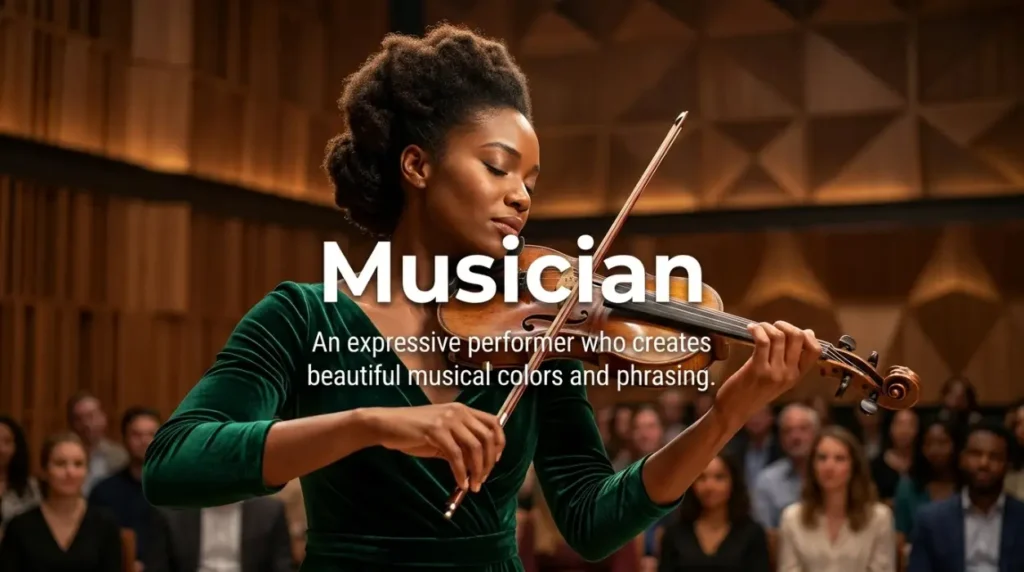
60. Tone Artist (Noun)
Meaning: An expressive performer who creates beautiful musical colors and phrasing.
Tone/Register: Poetic / Literary
Example:
- Music critics described the cellist as a true tone artist.
- Her gentle touch made her a master tone artist on the piano.
Synonyms by Tone
Selecting the appropriate synonym depends heavily on your setting and emotional context.
Positive / Elevating Tone
- Virtuoso
- Maestro
- Prodigy
- Concertmaster
- Concert Artist
Neutral / Professional Tone
- Instrumentalist
- Performer
- Vocalist
- Session Musician
- Soloist
Negative / Critical Tone
- Prima Donna (when used to imply difficult behavior)
- Busker (when used dismissively by critics)
Playful / Informal Tone
- Beatmaker
- Crooner
- Fiddler
- Songsmith
- Jammer
Why Tone Matters: Word choice creates clear mental images. Calling a violinist a “busker” highlights informal street playing, while calling them a “virtuoso” emphasizes extraordinary world-class skill.
Mini Comparison
| Word | Core Meaning Focus | Tone & Register | Ideal Usage Context |
| Musician | General umbrella term for anyone making or playing music | Neutral / General | Everyday talk, broad music topics, general articles |
| Instrumentalist | Focuses specifically on playing a physical instrument | Professional / Formal | Orchestra reviews, classical concerts, technical skill discussions |
| Virtuoso | Highlights exceptional, world-class technical skill and genius | Elevating / Respectful | High praise reviews, classical solos, master performances |
Context-Based Usage
Daily Conversation
In casual talk, keep descriptions clear and simple. Words like singer, player, performer, or drummer sound natural when chatting with friends.
Writing or Blogging
Bloggers engage readers by using colorful terms. Using beatmaker, troubadour, songsmith, or headliner makes music reviews dynamic and engaging.
Professional or Academic Tone
Formal essays and music reviews require precise vocabulary. Terms like instrumentalist, composer, concertmaster, or recitalist suit academic standards.
Creative Writing
Storytellers build vivid scenes using poetic vocabulary. Words like bard, minstrel, chanteuse, or tone artist create rich historical atmospheres.
Common Mistakes & Native Usage
Misuse Scenarios
- Calling a Lyricist an Instrumentalist: A lyricist writes song words, while an instrumentalist plays a physical instrument.
- Using Prima Donna as a Compliment: While historically meaning lead singer, modern usage often implies an arrogant or difficult person.
- Confusing Conductor with Composer: A composer writes the music score, whereas a conductor directs the live performance.
Register Notes
- Use formal titles (maestro, kapellmeister) in classical program guides.
- Use modern terms (beatmaker, session musician) in pop or hip hop music journalism.
- To expand your vocabulary further, explore our guide on synonyms for artist.
Real-Life Mini Scenarios
- Workplace: The studio manager booked a skilled session musician to record bass tracks for the commercial project.
- Social Situations: My friend works as an acoustic busker in the city square every weekend afternoon.
- Media / Pop Culture: Entertainment reporters interviewed the festival headliner right before the main stage show.
- Writing & Storytelling: The fantasy chapter opened with a traveling bard singing old tales inside a noisy tavern.
Conclusion
Expanding your vocabulary with descriptive alternatives can make your writing more vivid and engaging. Choosing precise terms allows you to describe musicians, performances, and musical styles with greater clarity. A synonym for musician can also add personality and depth to music reviews, essays, stories, and personal experiences.
Using varied vocabulary helps prevent repetition across blogs, articles, and academic writing. The right word can help readers picture a performance, understand an artist’s role, and connect with your description more easily. It also gives you greater flexibility when discussing different types of musicians and their talents.
Start practicing these creative alternatives in your everyday conversations and writing. Try adding two or three new terms to your next review, paragraph, or story. With regular practice, you can build stronger vocabulary, express your ideas confidently, and make your writing more interesting and memorable.
Practice Exercise
Test your vocabulary knowledge with this practical scenario-based quiz.
1. Which term best describes a musician with world-class technical skill?
A) Busker
B) Virtuoso
C) Sideman
D) Chorister
2. What is the correct title for a leader directing an orchestra?
A) Conductor
B) Lyricist
C) Beatmaker
D) Hymnodist
3. Which term refers specifically to a singer in a nightclub or cabaret?
A) Chanteuse
B) Instrumentalist
C) Kapellmeister
D) Organist
4. What word describes a child showing extraordinary musical talent early?
A) Prodigy
B) Busker
C) Accompanist
D) Piper
5. Which informal term fits a creator producing hip-hop instrumental tracks?
A) Maestro
B) Beatmaker
C) Concertmaster
D) Cantor
6. What term refers to a musician hired specifically for studio recordings?
A) Session musician
B) Minstrel
C) Bard
D) Serenader
7. Which historical word describes a medieval singing poet?
A) Troubadour
B) Crooner
C) Headliner
D) Flutist
8. What term describes a lead violinist assisting the conductor?
A) Concertmaster
B) Balladeer
C) Songsmith
D) Busker
9. Which word describes a singer specializing in smooth, sentimental pop songs?
A) Crooner
B) Kapellmeister
C) Piper
D) Organist
10. What term fits a musician playing for tips in public spaces?
A) Busker
B) Maestro
C) Virtuoso
D) Recitalist
Reflection Task:
Write two original sentences describing your favorite musical artist using two new synonyms learned in this guide.
Answer Key:
1B | 2A | 3A | 4A | 5B | 6A | 7A | 8A | 9A | 10A
Frequently Asked Questions
1. What is the most formal synonym for musician?
In classical and academic contexts, “instrumentalist,” “virtuoso,” “maestro,” or “concert artist” serve as the most formal synonyms. These terms highlight specialized classical training, exceptional technical skill, and professional performance standards.
2. How does an instrumentalist differ from a musician?
A musician is an umbrella term for anyone making music, including singers, composers, and conductors. An instrumentalist refers specifically to someone playing a physical musical instrument like a violin, piano, or flute.
3. What is a good casual synonym for musician in daily conversation?
In everyday English, informal and conversational terms like “player,” “performer,” “singer,” or specific instrument roles like “guitarist” sound natural and friendly during casual talks.
4. Which synonym for musician works best in music blogging?
Music bloggers often use expressive terms like “musical artist,” “headliner,” “songsmith,” “beatmaker,” or “vocalist” to keep album reviews and artist interviews engaging and descriptive for readers.
5. Can “diva” be used as a neutral synonym for a female singer?
Historically, “diva” referred respectfully to a celebrated female opera singer. In modern usage, however, it can carry negative connotations of arrogant behavior, so use it carefully depending on context.

Jameel Hassan is the founder and lead writer at SynonymsCloud.com, a trusted online platform dedicated to English vocabulary and effective communication. He is passionate about helping students, writers, professionals, and lifelong learners discover the right words to express their ideas with clarity, precision, and confidence.
At SynonymsCloud.com, every article is thoroughly researched and carefully written to provide accurate, practical, and easy-to-understand guidance on synonyms, antonyms, word meanings, idioms, and vocabulary. With a strong commitment to quality, real-world usage, and clear explanations, the website helps readers expand their vocabulary, improve their writing, and communicate more effectively in both academic and professional settings.