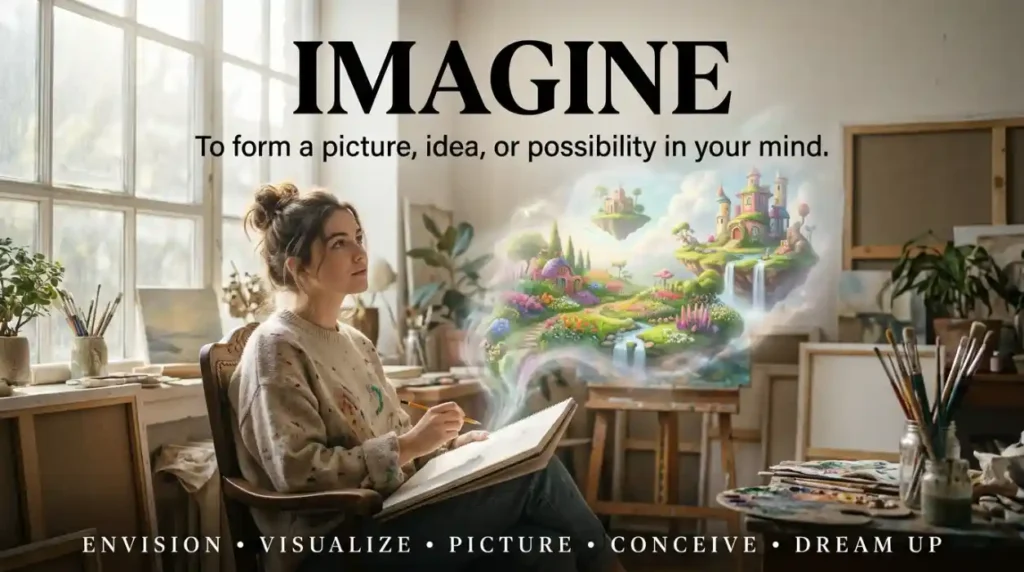
A synonym for imagine is a word or phrase that means forming a picture, idea, or possibility in your mind. Common alternatives include envision, visualize, picture, conceive, dream, suppose, and fancy. The best choice depends on whether you are describing creativity, mental images, or a possible situation.
A synonym for imagine helps you express ideas, describe possibilities, and share creative thoughts without repeating the same word. Whether you are talking about a dream career, planning a future goal, or creating an interesting story, the right alternative makes your language more engaging.
For example, you might say, “I imagine living near the ocean.” You can also say, “I envision living near the ocean.” Both sentences describe a picture formed in your mind.
Learning a synonym for imagine can improve your everyday conversations, essays, stories, and professional writing. Words such as envision, picture, visualize, and conceive offer different ways to communicate your thoughts.
In this guide, you will discover useful synonyms for imagine, their simple meanings, and natural examples. These alternatives will help students, bloggers, content writers, and English learners build confidence and express ideas more clearly.
What Does “Imagine” Really Mean?
Imagine means to create a picture, idea, or situation in your mind without experiencing it directly. It can involve visual images, creative thoughts, memories, or possible future events.
For example, when you imagine a holiday on a quiet island, you mentally picture its beaches, weather, and surroundings.
Imagine is commonly used as a verb. It can describe several mental activities:
- Creating a picture in your mind.
- Thinking about something that may happen.
- Forming an idea without having direct evidence.
- Considering an unusual or fictional situation.
- Guessing or supposing something to be true.
Native English speakers use imagine in both casual and formal communication. Its meaning changes slightly according to the sentence.
For instance, “Imagine winning the competition” invites someone to picture a possibility. “I imagine she is busy” expresses a personal assumption.
Connotative Meaning of Imagine
Connotation means the feeling or association a word creates beyond its basic dictionary definition.
Positive tone: Imagine can suggest creativity, hope, ambition, inspiration, and exciting possibilities.
Negative tone: It can sometimes suggest unrealistic thinking, unsupported assumptions, or an idea that is difficult to believe.
Neutral tone: It can simply describe forming a mental picture or considering a possible situation.
The word itself is generally neutral. Its emotional effect depends on the context and the speaker’s intention.
Etymology of Imagine
The word imagine comes through Old French imaginer, from Latin imaginari, meaning “to form a mental picture” or “to picture.”
Its history is connected to the Latin word imago, meaning “image” or “likeness.” This connection explains why imagine is closely associated with mental pictures and creative thought.
Old English Period (450–1100)
The modern word imagine was not commonly established in Old English. People used other expressions to describe mental pictures, thoughts, and ideas.
The Old English word ġesceap and related vocabulary could describe forms, creations, or things shaped in the mind. The modern word entered English later through French influence.
Middle English Period (1100–1500)
After the Norman Conquest, French and Latin vocabulary strongly influenced English. Forms related to imagining appeared in Middle English.
The word was used for forming mental images, conceiving ideas, and representing something in the mind.
Modern English Period (1500–Present)
Imagine became an established and widely used English verb. Its meaning expanded across literature, education, everyday conversation, science, and creative communication.
Today, it can describe visual thinking, hypothetical situations, creative invention, and personal assumptions.
Pronunciation of Imagine (US & UK)
- US: /ɪˈmædʒɪn/
- UK: /ɪˈmædʒɪn/
Syllables
im-ag-ine: 3 syllables.
Affixation Pattern of Imagine
- Root: Image (historically connected through Latin imago)
- Prefix: None in the modern word.
- Suffix: The ending -ine is part of the inherited word form, not a productive suffix that can be freely added to create the verb.
Related word forms include
- Imagination: The ability to form ideas or mental pictures.
- Imaginative: Showing creativity or originality.
- Imaginary: Existing in the mind rather than in reality.
- Imaginatively: Creatively or originally.
Synonyms List
The following alternatives cover the main meanings of imagine. Some focus on mental pictures, while others describe creative thinking, assumptions, or possibilities. They are not interchangeable in every sentence.
1. Envision (Verb) — US: /ɪnˈvɪʒən/ | UK: /ɪnˈvɪʒən/
Meaning: To picture a possible future, situation, or result in your mind.
Tone/Register: Neutral, professional, aspirational.
Examples:
- She envisions a successful career in medicine.
- We envision a greener future for our city.

2. Visualize (Verb) — US: /ˈvɪʒuəlaɪz/ | UK: /ˈvɪʒuəlaɪz/
Meaning: To form a clear mental picture of something.
Tone/Register: Neutral, educational, professional.
Examples:
- Visualize the finished room before choosing furniture.
- He visualized himself crossing the finish line.
3. Picture (Verb) — US: /ˈpɪktʃər/ | UK: /ˈpɪktʃə/
Meaning: To create a mental image of a person, place, or situation.
Tone/Register: Neutral, conversational.
Examples:
- Picture a small cottage beside a lake.
- I can picture your new office already.
4. Conceive (Verb) — US: /kənˈsiːv/ | UK: /kənˈsiːv/
Meaning: To form an idea or concept in your mind.
Tone/Register: Formal, academic.
Examples:
- She conceived a fresh approach to the problem.
- It is difficult to conceive such a major change.
5. Dream (Verb) — US: /driːm/ | UK: /driːm/
Meaning: To think about something desirable or possible, often with hope.
Tone/Register: Emotional, creative, informal.
Examples:
- He dreams of opening his own restaurant.
- They dream about traveling across Europe.
6. Suppose (Verb) — US: /səˈpoʊz/ | UK: /səˈpəʊz/
Meaning: To consider something as possibly true for the sake of discussion.
Tone/Register: Neutral, conversational, academic.
Examples:
- Suppose you had one extra day each week.
- I suppose the meeting will finish early.
7. Fancy (Verb) — US: /ˈfænsi/ | UK: /ˈfænsi/
Meaning: To imagine or picture something, often playfully or informally.
Tone/Register: Informal, conversational, especially common in British English.
Examples:
- Fancy living in a house surrounded by trees?
- I fancied a quiet evening by the sea.
8. Contemplate (Verb) — US: /ˈkɑːntəmpleɪt/ | UK: /ˈkɒntəmpleɪt/
Meaning: To think carefully about a possibility or idea.
Tone/Register: Formal, reflective.
Examples:
- She contemplated moving to another country.
- He contemplated the idea before responding.
9. Visualise (Verb) — US: /ˈvɪʒuəlaɪz/ | UK: /ˈvɪʒuəlaɪz/
Meaning: The British spelling of visualize, meaning to form a mental picture.
Tone/Register: Neutral, educational, professional.
Examples:
- Try to visualise the route before leaving.
- The architect visualised the building in detail.
10. Conjure (Verb) — US: /ˈkɑːndʒər/ | UK: /ˈkʌndʒə/
Meaning: To bring an image, memory, or idea into your mind.
Tone/Register: Creative, literary.
Examples:
- The music conjured memories of childhood.
- Her description conjured a peaceful village.
11. Dream Up (Phrasal Verb) — US: /driːm ʌp/ | UK: /driːm ʌp/
Meaning: To invent or imagine an idea, plan, or story.
Tone/Register: Informal, creative.
Examples:
- The children dreamed up a game for the weekend.
- We dreamed up a theme for the school event.
12. Think Up (Phrasal Verb) — US: /θɪŋk ʌp/ | UK: /θɪŋk ʌp/
Meaning: To create an idea, answer, or solution through thought.
Tone/Register: Informal, conversational.
Examples:
- Can you think up a better name for the project?
- She thought up a clever excuse.
13. Form an Image (Phrase) — US: /fɔːrm ən ˈɪmɪdʒ/ | UK: /fɔːm ən ˈɪmɪdʒ/
Meaning: To create a mental picture of someone or something.
Tone/Register: Neutral, descriptive.
Examples:
- I formed an image of the place from his story.
- Readers form an image of the character through small details.
14. Conceptualize (Verb) — US: /kənˈsɛptʃuəlaɪz/ | UK: /kənˈsɛptʃuəlaɪz/
Meaning: To develop an idea or plan in your mind.
Tone/Register: Formal, academic, professional.
Examples:
- The team conceptualized a new learning program.
- She conceptualized the design before creating it.
15. Envisage (Verb) — US: /ɪnˈvɪzɪdʒ/ | UK: /ɪnˈvɪzɪdʒ/
Meaning: To imagine a possible future or outcome.
Tone/Register: Formal, especially common in British English.
Examples:
- They envisage a major improvement next year.
- I cannot envisage working in that environment.
16. Fantasize (Verb) — US: /ˈfæntəsaɪz/ | UK: /ˈfæntəsaɪz/
Meaning: To imagine enjoyable, unusual, or unrealistic situations.
Tone/Register: Informal, creative.
Examples:
- She fantasizes about living on a tropical island.
- He sometimes fantasizes about becoming a famous musician.
17. Daydream (Verb) — US: /ˈdeɪdriːm/ | UK: /ˈdeɪdriːm/
Meaning: To let your thoughts wander toward pleasant or imaginary situations.
Tone/Register: Informal, relaxed.
Examples:
- I started to daydream during the long lecture.
- He daydreamed about his next vacation.
18. Visual Representation (Noun Phrase) — US: /ˈvɪʒuəl ˌrɛprɪzenˈteɪʃən/ | UK: /ˈvɪʒuəl ˌreprɪzenˈteɪʃən/
Meaning: A mental or visible form that represents an idea or object.
Tone/Register: Academic, descriptive.
Examples:
- The diagram gave students a visual representation of the process.
- She created a visual representation of the imagined city.
19. Picture in Your Mind (Phrase) — US: /ˈpɪktʃər ɪn jʊr maɪnd/ | UK: /ˈpɪktʃə ɪn jɔː maɪnd/
Meaning: To mentally see or understand a person, place, or event.
Tone/Register: Neutral, conversational.
Examples:
- Picture in your mind a quiet street after rainfall.
- I can picture in my mind the house you described.
20. Dream Of (Phrase) — US: /driːm əv/ | UK: /driːm əv/
Meaning: To imagine or hope for something you would like to experience.
Tone/Register: Emotional, informal.
Examples:
- She dreams of studying abroad.
- We dream of a home with a beautiful garden.
21. Speculate (Verb) — US: /ˈspɛkjəleɪt/ | UK: /ˈspekjʊleɪt/
Meaning: To consider possible explanations or outcomes without complete information.
Tone/Register: Formal, analytical.
Examples:
- Experts speculate about the cause of the unusual event.
- We should not speculate before hearing the facts.
22. Hypothesize (Verb) — US: /haɪˈpɑːθəsaɪz/ | UK: /haɪˈpɒθəsaɪz/
Meaning: To suggest a possible explanation that can be examined or tested.
Tone/Register: Scientific, academic.
Examples:
- Researchers hypothesized that the treatment might help.
- Students hypothesized why the plant stopped growing.
23. Assume (Verb) — US: /əˈsuːm/ | UK: /əˈsjuːm/
Meaning: To accept something as true without having complete proof.
Tone/Register: Neutral, conversational, professional.
Examples:
- I assumed you already knew about the change.
- Do not assume everyone shares your opinion.
24. Presume (Verb) — US: /prɪˈzuːm/ | UK: /prɪˈzjuːm/
Meaning: To believe something is likely true based on available information.
Tone/Register: Formal, polite.
Examples:
- I presume the guests will arrive soon.
- We should not presume that the answer is obvious.
25. Expect (Verb) — US: /ɪkˈspɛkt/ | UK: /ɪkˈspekt/
Meaning: To think something is likely to happen or be true.
Tone/Register: Neutral, everyday.
Examples:
- I expect the weather to improve tomorrow.
- They expect the new building to open soon.
26. Anticipate (Verb) — US: /ænˈtɪsəpeɪt/ | UK: /ænˈtɪsɪpeɪt/
Meaning: To think ahead about something that may happen.
Tone/Register: Formal, professional.
Examples:
- We anticipate a busy afternoon at the office.
- She anticipated several questions from the audience.
27. Guess (Verb) — US: /ɡɛs/ | UK: /ɡes/
Meaning: To form an answer or opinion without knowing for certain.
Tone/Register: Informal, conversational.
Examples:
- Guess what happened on my way home.
- I guessed that he would choose the blue jacket.
28. Believe (Verb) — US: /bɪˈliːv/ | UK: /bɪˈliːv/
Meaning: To think that something is true or possible.
Tone/Register: Neutral, personal.
Examples:
- I believe she will achieve her goal.
- He believes a better solution is possible.
29. Wonder (Verb) — US: /ˈwʌndər/ | UK: /ˈwʌndə/
Meaning: To think curiously about something or consider what might happen.
Tone/Register: Neutral, conversational.
Examples:
- I wonder what life was like a hundred years ago.
- She wondered whether the plan would succeed.
30. Muse (Verb) — US: /mjuːz/ | UK: /mjuːz/
Meaning: To think deeply or quietly about an idea or possibility.
Tone/Register: Literary, reflective.
Examples:
- He mused about the choices that shaped his life.
- She mused over a possible ending for her novel.
31. Reflect (Verb) — US: /rɪˈflɛkt/ | UK: /rɪˈflekt/
Meaning: To think carefully about an idea, experience, or possible situation.
Tone/Register: Neutral, formal, thoughtful.
Examples:
- She reflected on how the project might develop.
- I reflected on the future during my walk.
32. Create (Verb) — US: /kriˈeɪt/ | UK: /kriˈeɪt/
Meaning: To bring an original idea, image, or concept into existence.
Tone/Register: Neutral, creative, professional.
Examples:
- The artist created a new world in her painting.
- They created a fictional character for the story.
33. Invent (Verb) — US: /ɪnˈvɛnt/ | UK: /ɪnˈvent/
Meaning: To develop something original through creative thinking.
Tone/Register: Neutral, practical, creative.
Examples:
- He invented a character for his school play.
- The team invented a simple way to organize the files.
34. Devise (Verb) — US: /dɪˈvaɪz/ | UK: /dɪˈvaɪz/
Meaning: To think out and plan a method, idea, or solution.
Tone/Register: Formal, professional.
Examples:
- We devised a plan for the community event.
- She devised a new way to explain the lesson.
35. Formulate (Verb) — US: /ˈfɔːrmjəleɪt/ | UK: /ˈfɔːmjʊleɪt/
Meaning: To develop an idea, plan, or statement carefully.
Tone/Register: Formal, academic, professional.
Examples:
- The students formulated an answer after discussion.
- He formulated a clear strategy for the presentation.
36. Generate (Verb) — US: /ˈdʒɛnəreɪt/ | UK: /ˈdʒenəreɪt/
Meaning: To produce ideas, possibilities, or solutions through thinking.
Tone/Register: Neutral, business, academic.
Examples:
- The discussion generated several useful ideas.
- She generated possible themes for the campaign.
37. Brainstorm (Verb) — US: /ˈbreɪnˌstɔːrm/ | UK: /ˈbreɪnˌstɔːm/
Meaning: To think of many ideas, often with other people.
Tone/Register: Informal, professional.
Examples:
- Let’s brainstorm ideas for the class presentation.
- The writers brainstormed possible titles together.
38. Dream About (Phrase) — US: /driːm əˈbaʊt/ | UK: /driːm əˈbaʊt/
Meaning: To think about or experience an imagined situation, often while sleeping or wishing.
Tone/Register: Neutral, informal.
Examples:
- I dreamed about visiting Japan last night.
- She dreams about becoming a published author.
39. Picture Yourself (Phrase) — US: /ˈpɪktʃər jərˈsɛlf/ | UK: /ˈpɪktʃə jɔːˈself/
Meaning: To imagine yourself in a particular situation or role.
Tone/Register: Conversational, motivational.
Examples:
- Picture yourself speaking confidently in front of the class.
- He pictured himself running his own business.
40. See in Your Mind (Phrase) — US: /siː ɪn jʊr maɪnd/ | UK: /siː ɪn jɔː maɪnd/
Meaning: To mentally visualize something that is not physically present.
Tone/Register: Neutral, descriptive.
Examples:
- I can see the whole scene in my mind.
- She saw the finished garden in her mind.
41. Make Believe (Verb Phrase) — US: /ˈmeɪk bɪˈliːv/ | UK: /ˈmeɪk bɪˈliːv/
Meaning: To pretend that something is real when it is imaginary.
Tone/Register: Playful, informal.
Examples:
- The children made believe they were explorers.
- He used make-believe stories to entertain his little sister.
42. Fabricate (Verb) — US: /ˈfæbrɪkeɪt/ | UK: /ˈfæbrɪkeɪt/
Meaning: To invent information or a story, often with the intention to deceive.
Tone/Register: Formal, negative.
Examples:
- He fabricated an excuse for missing the appointment.
- The report exposed the details he had fabricated.
43. Dream Up (Phrasal Verb) — US: /driːm ʌp/ | UK: /driːm ʌp/
Meaning: To invent an unusual or creative idea.
Tone/Register: Informal, imaginative.
Examples:
- She dreamed up a fantasy world for her book.
- The children dreamed up funny names for their toys.
44. Imagine as (Phrase) — US: /ɪˈmædʒɪn æz/ | UK: /ɪˈmædʒɪn æz/
Meaning: To think of someone or something in a particular role or form.
Tone/Register: Neutral, descriptive.
Examples:
- I imagine him as a confident public speaker.
- They imagined the empty room as a small library.
45. Consider (Verb) — US: /kənˈsɪdər/ | UK: /kənˈsɪdə/
Meaning: To think about a possibility or situation carefully.
Tone/Register: Neutral, professional, academic.
Examples:
- Consider how the story might end.
- She considered a different career path.
46. Entertain (Verb) — US: /ˌentərˈteɪn/ | UK: /ˌentəˈteɪn/
Meaning: To allow an idea or possibility to occupy your thoughts.
Tone/Register: Formal, thoughtful.
Examples:
- He entertained the possibility of moving abroad.
- The committee entertained several suggestions.
47. Postulate (Verb) — US: /ˈpɑːstʃəleɪt/ | UK: /ˈpɒstjʊleɪt/
Meaning: To suggest an idea or possibility as a basis for reasoning.
Tone/Register: Academic, formal.
Examples:
- The researcher postulated a different explanation.
- The theory postulates that the two events are connected.
48. Hypothesize About (Phrase) — US: /haɪˈpɑːθəsaɪz əˈbaʊt/ | UK: /haɪˈpɒθəsaɪz əˈbaʊt/
Meaning: To develop a possible explanation about a subject that can be tested.
Tone/Register: Scientific, academic.
Examples:
- The class hypothesized about the source of the sound.
- Scientists hypothesize about how the species adapted.
49. Dreamily Envision (Phrase) — US: /ˈdriːmɪli ɪnˈvɪʒən/ | UK: /ˈdriːmɪli ɪnˈvɪʒən/
Meaning: To picture something in a hopeful, romantic, or imaginative way.
Tone/Register: Literary, expressive.
Examples:
- She dreamily envisioned a quiet life in the countryside.
- He dreamily envisioned the day of their reunion.
50. Conjure Up (Phrasal Verb) — US: /ˈkɑːndʒər ʌp/ | UK: /ˈkʌndʒə ʌp/
Meaning: To bring an image, memory, or idea into your thoughts.
Tone/Register: Creative, conversational, literary.
Examples:
- The old photograph conjured up memories of school.
- His words conjured up a picture of a distant village.
Synonyms by Tone
Choosing an alternative based on tone makes your English sound more natural. A word that works in a friendly conversation may feel too casual in an academic essay.
Positive Synonyms
These alternatives often communicate creativity, ambition, hope, or inspiration:
- Envision
- Visualize
- Dream
- Fantasize
- Dream of
- Picture yourself
- Dream up
Example: “I envision a future where every child has access to education.”
Neutral Synonyms
These words are useful for everyday communication and general writing:
- Imagine
- Picture
- Suppose
- Assume
- Expect
- Believe
- Wonder
- Consider
- Reflect
Example: “Suppose we take a different route.”
Negative or Cautionary Synonyms
These alternatives can suggest unsupported thinking or deliberately invented information:
- Fabricate
- Assume
- Presume
- Speculate
- Fantasize
Example: “Do not fabricate details to make the story sound more interesting.”
These words are not always negative. Their tone depends on how they are used.
Playful and Informal Synonyms
Use these in casual conversations, creative writing, or friendly storytelling:
- Fancy
- Daydream
- Dream up
- Make believe
- Think up
- Picture
Example: “Fancy spending the weekend in a mountain cabin?”
Imagine vs. Close Alternatives
Several words have similar meanings but communicate different types of thinking. Understanding these differences helps you choose accurately.
| Word | Main difference | Best use |
|---|---|---|
| Imagine | General mental creation or consideration | Everyday conversation and creative writing |
| Envision | Focuses on a possible future or outcome | Goals, plans, and ambitions |
| Visualize | Focuses on forming a mental picture | Learning, sports, and descriptions |
| Conceive | Focuses on developing an idea or concept | Academic and professional writing |
| Suppose | Considers a possibility for discussion | Questions and hypothetical situations |
Imagine vs. Envision
Imagine is broad and can describe almost any mental picture or possibility. Envision usually focuses on a future situation or desired result.
- Imagine a world without traffic.
- We envision a city with cleaner public transport.
Imagine vs. Visualize
Imagine can involve ideas, feelings, and situations. Visualize specifically emphasizes mental images.
- Imagine how the meeting might go.
- Visualize the room after the renovation.
Imagine vs. Suppose
Imagine often invites a mental picture. Suppose introduces a possible condition or assumption.
- Imagine living beside the ocean.
- Suppose the train arrives late.
How Imagine Changes by Context
Daily Conversation
In everyday speech, people often use imagine, picture, suppose, guess, and wonder. These words make conversations sound natural and relaxed.
For example, “I imagine you are tired after that long journey” expresses an assumption. “Picture this” invites someone to imagine a situation.
Writing and Blogging
Writers use envision, visualize, conceive, and picture to avoid repetition. These alternatives can make descriptions more engaging.
For example, a travel blogger might write, “Envision a peaceful beach with clear blue water.” This creates a stronger sense of place.
Professional and Academic English
In formal communication, consider, conceptualize, formulate, hypothesize, and postulate can be more appropriate.
For example, “The researchers hypothesized that the results would improve.” This is more precise than using imagine in a scientific report.
Creative and Informal Use
Creative writing often benefits from conjure, dream up, fantasize, daydream, and make believe.
For example, a novelist might say, “The storyteller conjured up an unforgettable kingdom.” This gives the sentence a more expressive style.
Common Mistakes Learners Make

Using Every Synonym in the Same Way
Not all alternatives have identical meanings. Visualize focuses on mental images, while speculate focuses on possible explanations.
Better approach: Choose the word that matches the exact idea you want to express.
Confusing Imagine With Assume
Imagine can describe a fictional or possible situation. Assume means accepting something as true without complete proof.
Incorrect: “I imagined he was at home” when you mean you believed he was actually there.
More natural: “I assumed he was at home.”
Using Formal Words in Casual Conversation
Words such as postulate, conceptualize, and formulate may sound unnatural in simple daily conversations.
Better approach: Use picture, think, suppose, or guess when speaking casually.
Treating Fabricate as a Positive Alternative
Fabricate usually means inventing information, often to mislead someone. It is not a suitable replacement when you mean creative visualization.
Better approach: Use dream up or create for positive creative ideas.
Overusing the Same Alternative
Replacing imagine with envision in every sentence does not improve writing. It can make your vocabulary repetitive in a different way.
Better approach: Select alternatives according to meaning, tone, and context.
Register Notes: Formal vs. Informal
Formal English
Conceptualize, contemplate, envisage, hypothesize, postulate, formulate, and speculate are suitable for academic or professional contexts.
Informal English
Picture, fancy, daydream, dream up, think up, and guess work well in everyday conversations.
Spoken English
Imagine, suppose, picture, and wonder are common in natural speech.
Written English
Envision, conceive, contemplate, and conceptualize can add precision to essays, reports, and articles.
For related vocabulary, explore other English synonym guides to develop a more flexible writing style.
Real-Life Mini Scenarios Using Imagine
Workplace
A manager wants employees to think about a new office layout. She says, “Visualize how this space could look after the renovation.”
Social Situations
A friend describes a surprise birthday party. You respond, “I can picture everyone’s reaction already.”
Media and Pop Culture
A film reviewer describes a fictional world. They write, “The director conjures up a mysterious atmosphere through lighting and music.”
Writing and Storytelling
A novelist wants to create an original character. She spends the afternoon dreaming up a character with an unusual background.
Practice Exercise
Test your understanding with these practical questions. Choose the alternative that best fits each sentence.
1. You want to describe a clear mental picture of a future home. Which word fits best?
A. Fabricate
B. Visualize
C. Assume
2. A researcher suggests a possible explanation that can be tested. Which word is most suitable?
A. Hypothesize
B. Daydream
C. Fancy
3. Your friend asks you to consider a situation that may happen. Which word sounds natural?
A. Conjure
B. Suppose
C. Fabricate
4. A writer creates an unusual fantasy story. Which phrase fits best?
A. Dream up
B. Presume
C. Expect
5. You want to describe a company’s long-term goals. Which word is most appropriate?
A. Daydream
B. Envision
C. Guess
6. Someone makes up false information to deceive others. Which word describes this action?
A. Visualize
B. Contemplate
C. Fabricate
7. A student thinks quietly about a possible career change. Which word is suitable?
A. Contemplate
B. Make believe
C. Conjure up
8. You are asking someone to imagine a relaxing beach scene. Which expression sounds natural?
A. Postulate a beach
B. Picture a beach
C. Formulate a beach
9. A team develops several ideas together during a meeting. What are they doing?
A. Brainstorming
B. Presuming
C. Fabricating
10. You are thinking about what might happen tomorrow without knowing for certain. Which word fits?
A. Invent
B. Wonder
C. Formulate
Answer Key:
1-B | 2-A | 3-B | 4-A | 5-B | 6-C | 7-A | 8-B | 9-A | 10-B
Reflection Task:
Write three original sentences using envision, visualize, and suppose. Try using each word in a different situation, such as a personal goal, a mental picture, and a hypothetical question.
FAQs
1. What is the best synonym for imagine in everyday English?
Picture is one of the most natural alternatives to imagine when describing a mental image. For example, “Picture yourself on a quiet beach” sounds friendly and conversational. You can also use suppose when discussing a possible situation or wonder when expressing curiosity. The best choice depends on the meaning of your sentence.
2. What is a more sophisticated word for imagine?
Envision, conceive, and conceptualize are useful alternatives in more sophisticated writing. Envision often describes a possible future, while conceive refers to forming an idea. Conceptualize is common in academic and professional contexts. Choose the word that communicates your intended meaning instead of selecting a formal word only to sound impressive.
3. What is a synonym for imagine in an essay?
For an essay, consider using envision, contemplate, conceive, visualize, or hypothesize. Envision works well when discussing future possibilities. Contemplate describes careful thought, while hypothesize is suitable for proposing a testable explanation. Avoid using these words interchangeably because each one communicates a different type of thinking.
4. What is another word for imagine a future?
Envision and envisage are strong alternatives when describing a future possibility. For example, “She envisions a career in environmental science” communicates a future goal. Anticipate is another option when you mean expecting something to happen. Use envision for a mental picture and anticipate for an expected event.
5. What is the difference between imagine, visualize, and envision?
Imagine is the broadest term and covers mental pictures, ideas, and hypothetical situations. Visualize specifically means creating a mental image. Envision usually focuses on a future possibility or desired result. For example, you can imagine a new lifestyle, visualize its details, and envision how it could become your reality.
6. Can picture be used instead of imagine?
Yes. Picture can replace imagine when you mean forming a mental image. “I imagine a quiet village” and “I picture a quiet village” have similar meanings. However, picture does not always replace imagine naturally. When you are considering an assumption or hypothetical situation, suppose or imagine may be more appropriate.
7. What is the difference between imagine and fantasize?
Imagine is a general word for forming mental pictures, ideas, or possible situations. Fantasize usually describes imagining something especially exciting, unusual, romantic, or unrealistic. For example, you might imagine your next holiday, but fantasize about becoming a famous actor. Fantasize often carries a stronger sense of escape or wishful thinking.
8. How can I avoid repeating the word imagine in my writing?
First, identify what you mean in each sentence. Use visualize for mental pictures, envision for future goals, contemplate for careful thought, and suppose for hypothetical situations. You can also restructure a sentence to avoid unnecessary repetition. This approach makes your writing more precise instead of simply replacing one repeated word with another.
Conclusion
Learning a synonym for imagine helps you express thoughts with greater variety. Words such as envision, picture, and visualize make your descriptions more specific.
Different alternatives communicate different shades of meaning. Some express creative ideas, while others describe assumptions, plans, or possible explanations.
A stronger vocabulary improves essays, blogs, emails, conversations, and professional communication. It also helps you understand how native speakers choose words naturally.
Practice these alternatives in your daily conversations and writing. Start with one new word each day, create your own examples, and keep exploring English vocabulary.
Suggested External Sources for Further Learning
For accurate definitions, pronunciation, word origins, synonyms, and practical examples, readers can explore these reliable language resources:
- 1. Merriam-Webster Dictionary
Provides detailed definitions, synonyms, antonyms, pronunciation guides, and example sentences. It helps readers understand different meanings of imagine and choose suitable alternatives for everyday and formal writing. - 2. Cambridge Dictionary
Offers simple definitions, British and American pronunciations, grammar guidance, and natural usage examples. It is particularly useful for English learners who want to understand how words such as visualize, suppose, and picture are used in different situations. - 3. Oxford Learner’s Dictionaries
Includes learner-friendly explanations, word forms, collocations, pronunciation recordings, and practical examples. It helps students and writers understand how to use imagination-related vocabulary naturally and correctly.
These references help readers compare similar words, improve vocabulary, check pronunciation, understand word history, and select appropriate alternatives to imagine in academic, creative, and everyday writing.

Jameel Hassan is the founder and lead writer at SynonymsCloud.com, a trusted online platform dedicated to English vocabulary and effective communication. He is passionate about helping students, writers, professionals, and lifelong learners discover the right words to express their ideas with clarity, precision, and confidence.
At SynonymsCloud.com, every article is thoroughly researched and carefully written to provide accurate, practical, and easy-to-understand guidance on synonyms, antonyms, word meanings, idioms, and vocabulary. With a strong commitment to quality, real-world usage, and clear explanations, the website helps readers expand their vocabulary, improve their writing, and communicate more effectively in both academic and professional settings.