
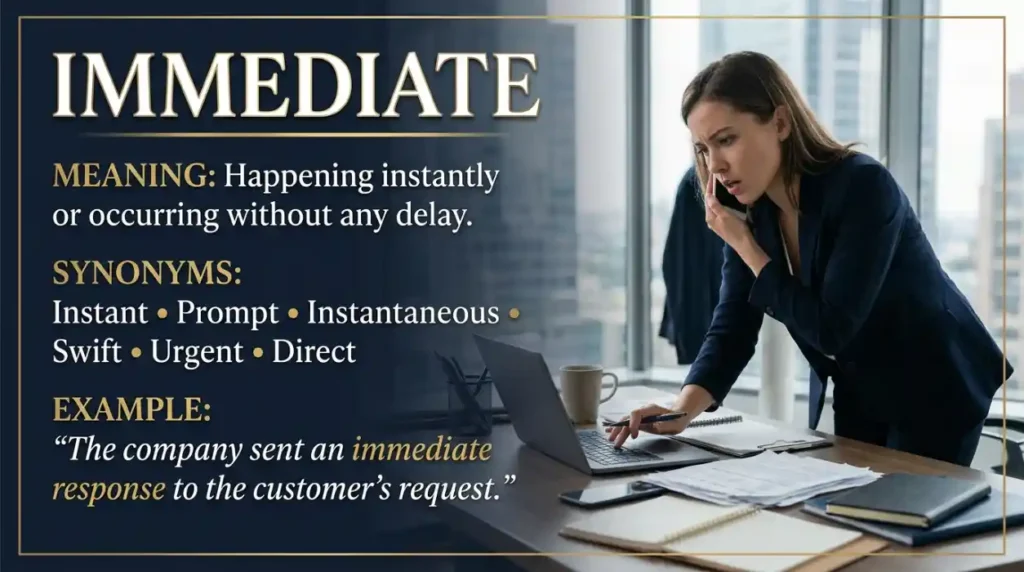
A synonym for immediate is a word that describes something happening, needed, or available without delay. Common alternatives include instant, prompt, urgent, direct, current, and instantaneous. The best choice depends on whether you mean something happening right away, requiring quick attention, or having a direct connection.
A synonym for immediate helps you describe actions, decisions, or events that happen without delay. Whether you are waiting for an important email, requesting quick assistance, or discussing an urgent task, choosing the right alternative makes your message clearer and more effective.
For example, you might write, “We need an immediate decision.” You could also say, “We need a prompt decision.” Both expressions communicate the need for a quick response, but each has a slightly different tone.
Learning a synonym for immediate expands your vocabulary and helps you choose suitable words for everyday conversations, workplace messages, academic writing, and professional communication.
In this guide, you will discover 50 useful synonyms for immediate, along with their meanings, pronunciations, and practical examples. These alternatives will help students, bloggers, content writers, and English learners express ideas naturally and confidently.
What Does “Immediate” Really Mean?
Immediate means happening, occurring, or being done without delay. It can also describe something directly connected to another thing or something that is nearest in time or place.
For example:
- An immediate response arrives without waiting.
- An immediate danger requires attention right away.
- An immediate family member is someone closely related to you.
- An immediate effect happens directly after an action.
Part of Speech
Immediate is primarily an adjective. It describes a noun by explaining when something happens, how quickly it happens, or how directly it is connected.
It can appear in several common expressions:
- Immediate action: Action needed without delay.
- Immediate response: A reply given right away.
- Immediate family: Close family members.
- Immediate effect: A result that occurs directly.
- Immediate surroundings: The area directly around someone.
Native speakers understand immediate according to the situation. In a workplace, it may communicate urgency. In family discussions, it can describe close relationships.
Connotative Meaning of Immediate
Connotation means the feeling or association a word creates beyond its basic dictionary meaning.
Positive tone: Immediate can suggest efficiency, quick support, fast results, and helpful action.
Negative tone: It can communicate pressure, emergency, impatience, or a demanding situation.
Neutral tone: It can simply describe something that happens directly or without a time gap.
The word itself is generally neutral. Its emotional effect depends on the situation and the speaker’s intention.
Etymology of Immediate
The word immediate comes from Late Latin immediatus, meaning “without anything in between.” It developed through Medieval Latin and French before becoming part of English.
Its structure is connected to the Latin elements in- (meaning “not”) and mediatus (related to being in the middle). The central idea is that nothing comes between two things.
Old English Period (450–1100)
The modern word immediate was not established in Old English. People used native English expressions to describe something happening at once or without delay.
Words and expressions related to directness, nearness, and quick action communicated similar ideas.
Middle English Period (1100–1500)
French and Latin influenced English vocabulary during the Middle English period. Forms related to immediacy entered English through learned and literary usage.
The word developed the meaning of something having no intervening person, object, or period of time.
Modern English Period (1500–Present)
Immediate became widely used in formal and everyday English. Its meanings expanded to include urgency, direct relationships, close surroundings, and events occurring without delay.
Today, it appears in expressions such as immediate attention, immediate response, immediate family, and immediate effect.
Pronunciation of Immediate (US & UK – IPA)
- US: /ɪˈmiːdiət/
- UK: /ɪˈmiːdiət/
Syllables
im-me-di-ate: 4 syllables.
Affixation Pattern of Immediate
- Root: Related to Latin medius, meaning “middle.”
- Prefix: im- a form of the negative prefix in- before certain sounds.
- Suffix: -ate is part of the inherited word formation; it is not a freely added suffix in this adjective.
Related word forms include
- Immediately: Without delay.
- Immediacy: The quality of being immediate.
- Immediateness: The state of being immediate, though less common.
Synonyms List
The following alternatives cover different meanings of immediate. Some describe speed, others express urgency, directness, or closeness. They are not interchangeable in every sentence, so choose according to context.
1. Instant (Adjective) — US: /ˈɪnstənt/ | UK: /ˈɪnstənt/
Meaning: Happening or available at once, with almost no waiting time.
Tone/Register: Neutral, conversational, professional.
Examples:
- The new app provides instant feedback.
- We received an instant reply from the support team.

2. Prompt (Adjective) — US: /prɑːmpt/ | UK: /prɒmpt/
Meaning: Done quickly and without unnecessary delay.
Tone/Register: Professional, polite, formal.
Examples:
- Thank you for your prompt response.
- The manager requested prompt action on the issue.
3. Urgent (Adjective) — US: /ˈɜːrdʒənt/ | UK: /ˈɜːdʒənt/
Meaning: Requiring immediate attention because something important may happen if action is delayed.
Tone/Register: Serious, professional, formal.
Examples:
- The hospital received an urgent call.
- Please send an urgent update to the team.
4. Instantaneous (Adjective) — US: /ˌɪnstənˈteɪniəs/ | UK: /ˌɪnstənˈteɪniəs/
Meaning: Happening at the same moment, with virtually no noticeable time gap.
Tone/Register: Technical, scientific, formal.
Examples:
- The camera captures instantaneous changes in light.
- The reaction appeared almost instantaneous.
5. Direct (Adjective) — US: /dəˈrekt/ | UK: /daɪˈrekt/
Meaning: Happening through a straight connection without an intermediate step or person.
Tone/Register: Neutral, professional.
Examples:
- The director gave us a direct instruction.
- There is a direct link between the two events.
6. Immediate-Effect (Adjective Phrase) — US: /ɪˈmiːdiət ɪˈfekt/ | UK: /ɪˈmiːdiət ɪˈfekt/
Meaning: Describing something that produces a result without a noticeable delay.
Tone/Register: Technical, descriptive.
Examples:
- The medicine produced an immediate effect.
- The new rule had an immediate effect on attendance.
7. Promptly (Adverb) — US: /ˈprɑːmptli/ | UK: /ˈprɒmptli/
Meaning: In a quick and timely manner, without unnecessary delay.
Tone/Register: Formal, professional.
Examples:
- Please respond promptly to the invitation.
- The technician promptly fixed the problem.
8. Straightaway (Adverb) — US: /ˌstreɪtəˈweɪ/ | UK: /ˌstreɪtəˈweɪ/
Meaning: At once or without waiting.
Tone/Register: Informal, conversational, especially common in British English.
Examples:
- I will call you straightaway.
- She started the assignment straightaway.
9. At Once (Adverbial Phrase) — US: /ət ˈwʌns/ | UK: /ət ˈwʌns/
Meaning: Without delay or as soon as possible.
Tone/Register: Neutral, conversational.
Examples:
- The staff responded at once.
- Please leave the building at once.
10. Right Away (Adverbial Phrase) — US: /raɪt əˈweɪ/ | UK: /raɪt əˈweɪ/
Meaning: Immediately or very soon after something happens.
Tone/Register: Informal, everyday.
Examples:
- I will send the documents right away.
- The teacher answered my question right away.
11. Forthwith (Adverb) — US: /ˌfɔːrθˈwɪθ/ | UK: /ˌfɔːθˈwɪθ/
Meaning: Without delay, often used in official instructions.
Tone/Register: Very formal, legal, administrative.
Examples:
- The notice instructed residents to leave forthwith.
- The payment must be made forthwith.
12. Expeditious (Adjective) — US: /ˌekspəˈdɪʃəs/ | UK: /ˌekspəˈdɪʃəs/
Meaning: Done quickly and efficiently, without wasting time.
Tone/Register: Formal, professional.
Examples:
- The office promised an expeditious review.
- We appreciate your expeditious handling of the request.
13. Swift (Adjective) — US: /swɪft/ | UK: /swɪft/
Meaning: Happening or completed quickly.
Tone/Register: Neutral, professional, descriptive.
Examples:
- The rescue team made a swift decision.
- A swift response helped prevent further damage.
14. Speedy (Adjective) — US: /ˈspiːdi/ | UK: /ˈspiːdi/
Meaning: Taking a short amount of time to happen or finish.
Tone/Register: Informal, neutral.
Examples:
- We hope for a speedy recovery.
- The company offered a speedy solution.
15. Rapid (Adjective) — US: /ˈræpɪd/ | UK: /ˈræpɪd/
Meaning: Happening or developing at a fast rate.
Tone/Register: Neutral, scientific, professional.
Examples:
- The patient showed rapid improvement.
- Rapid changes affected the local economy.
16. Quick (Adjective) — US: /kwɪk/ | UK: /kwɪk/
Meaning: Happening or completed in a short time.
Tone/Register: Informal, everyday, neutral.
Examples:
- We need a quick answer before lunch.
- She made a quick phone call to her brother.
17. Immediate-Need (Noun Phrase) — US: /ɪˈmiːdiət niːd/ | UK: /ɪˈmiːdiət niːd/
Meaning: A requirement that must be addressed without delay.
Tone/Register: Formal, descriptive.
Examples:
- Food and shelter were the family’s immediate needs.
- The report identifies the immediate needs of the community.
18. Pressing (Adjective) — US: /ˈpresɪŋ/ | UK: /ˈpresɪŋ/
Meaning: Important and requiring attention soon.
Tone/Register: Formal, professional, serious.
Examples:
- We have a pressing deadline this week.
- Housing remains a pressing concern for the city.
19. Imminent (Adjective) — US: /ˈɪmɪnənt/ | UK: /ˈɪmɪnənt/
Meaning: Likely to happen very soon.
Tone/Register: Formal, serious, descriptive.
Examples:
- Dark clouds suggested that a storm was imminent.
- The company announced an imminent leadership change.
20. Near (Adjective) — US: /nɪr/ | UK: /nɪə/
Meaning: Close in time, distance, or relationship.
Tone/Register: Neutral, everyday.
Examples:
- The near future may bring new opportunities.
- We discussed the nearest available appointment.
21. Current (Adjective) — US: /ˈkɜːrənt/ | UK: /ˈkʌrənt/
Meaning: Belonging to or happening in the present time.
Tone/Register: Neutral, professional.
Examples:
- Please check the current schedule before arriving.
- The current situation requires careful planning.
22. Present (Adjective) — US: /ˈprezənt/ | UK: /ˈprezənt/
Meaning: Existing or happening now rather than in the past or future.
Tone/Register: Neutral, formal.
Examples:
- Our present circumstances require patience.
- The present arrangement will remain unchanged.
23. Existing (Adjective) — US: /ɪɡˈzɪstɪŋ/ | UK: /ɪɡˈzɪstɪŋ/
Meaning: Already in place or currently available.
Tone/Register: Neutral, professional.
Examples:
- We should improve the existing system.
- The existing agreement covers both departments.
24. Following (Adjective) — US: /ˈfɑːloʊɪŋ/ | UK: /ˈfɒləʊɪŋ/
Meaning: Coming directly after something else in a sequence.
Tone/Register: Neutral, formal.
Examples:
- The following chapter explains the main findings.
- We will discuss this issue at the following meeting.
25. Next (Adjective) — US: /nekst/ | UK: /nekst/
Meaning: Coming immediately after the present one in order or sequence.
Tone/Register: Neutral, conversational.
Examples:
- The next available train leaves at noon.
- Please read the next section carefully.
26. Consecutive (Adjective) — US: /kənˈsekjətɪv/ | UK: /kənˈsekjətɪv/
Meaning: Following one after another without interruption.
Tone/Register: Formal, academic, professional.
Examples:
- She worked three consecutive days.
- The team won four consecutive matches.
27. Uninterrupted (Adjective) — US: /ˌʌnˌɪntəˈrʌptɪd/ | UK: /ˌʌnˌɪntəˈrʌptɪd/
Meaning: Continuing without a break or interruption.
Tone/Register: Neutral, professional.
Examples:
- I need uninterrupted time to finish this report.
- The service continued without interruption.
28. Continuous (Adjective) — US: /kənˈtɪnjuəs/ | UK: /kənˈtɪnjuəs/
Meaning: Continuing without stopping or having a break.
Tone/Register: Neutral, technical, formal.
Examples:
- The machine requires continuous monitoring.
- Continuous support helped the students improve.
29. Consequent (Adjective) — US: /ˈkɑːnsəkwənt/ | UK: /ˈkɒnsɪkwənt/
Meaning: Happening as a result of something that came before.
Tone/Register: Formal, academic.
Examples:
- The policy change and its consequent effects were discussed.
- The delay caused consequent problems for the project.
30. Directly Following (Phrase) — US: /dəˈrektli ˈfɑːloʊɪŋ/ | UK: /daɪˈrektli ˈfɒləʊɪŋ/
Meaning: Coming immediately after another event or item.
Tone/Register: Neutral, descriptive.
Examples:
- The announcement came directly following the meeting.
- The instructions appear directly following the introduction.
31. Closest (Adjective) — US: /ˈkloʊsɪst/ | UK: /ˈkləʊsɪst/
Meaning: Nearest in distance, time, or relationship.
Tone/Register: Neutral, everyday.
Examples:
- Her closest relatives attended the ceremony.
- The closest station is a short walk away.
32. Nearest (Adjective) — US: /ˈnɪrɪst/ | UK: /ˈnɪərɪst/
Meaning: Located at the shortest distance or closest point.
Tone/Register: Neutral, conversational.
Examples:
- Where is the nearest pharmacy?
- We chose the nearest entrance to the parking area.
33. Close (Adjective) — US: /kloʊs/ | UK: /kləʊs/
Meaning: Having a short distance or strong connection.
Tone/Register: Neutral, everyday.
Examples:
- She has a close relationship with her aunt.
- The hotel is close to the airport.
34. Immediate Family (Noun Phrase) — US: /ɪˈmiːdiət ˈfæməli/ | UK: /ɪˈmiːdiət ˈfæməli/
Meaning: The closest family members, usually parents, children, siblings, and a spouse.
Tone/Register: Neutral, formal, personal.
Examples:
- Only immediate family attended the private gathering.
- He shared the news with his immediate family first.
35. Primary (Adjective) — US: /ˈpraɪmeri/ | UK: /ˈpraɪməri/
Meaning: Most important or first in importance.
Tone/Register: Formal, professional, academic.
Examples:
- Safety is our primary concern.
- The primary objective is to complete the project.
36. First (Adjective) — US: /fɜːrst/ | UK: /fɜːst/
Meaning: Coming before all others in time, order, or position.
Tone/Register: Neutral, everyday.
Examples:
- The first step is to check the application.
- Her first response was a polite refusal.
37. Initial (Adjective) — US: /ɪˈnɪʃəl/ | UK: /ɪˈnɪʃəl/
Meaning: Happening at the beginning of a process or sequence.
Tone/Register: Formal, professional.
Examples:
- The initial review revealed several errors.
- We received an initial response from the school.
38. Immediate Successor (Noun Phrase) — US: /ɪˈmiːdiət səkˈsesər/ | UK: /ɪˈmiːdiət səkˈsesə/
Meaning: A person or thing that directly follows another in position, role, or order.
Tone/Register: Formal, descriptive.
Examples:
- The immediate successor took charge the next morning.
- The report identifies the immediate successor to the former director.
39. Unmediated (Adjective) — US: /ˌʌnˈmiːdieɪtɪd/ | UK: /ˌʌnˈmiːdieɪtɪd/
Meaning: Happening directly without an intermediary or intervening process.
Tone/Register: Academic, technical, formal.
Examples:
- The study examined unmediated communication between participants.
- They wanted unmediated access to the original documents.
40. Unprompted (Adjective) — US: /ʌnˈprɑːmptɪd/ | UK: /ʌnˈprɒmptɪd/
Meaning: Happening without being requested, encouraged, or reminded.
Tone/Register: Neutral, professional.
Examples:
- She offered an unprompted apology.
- The student gave an unprompted explanation.
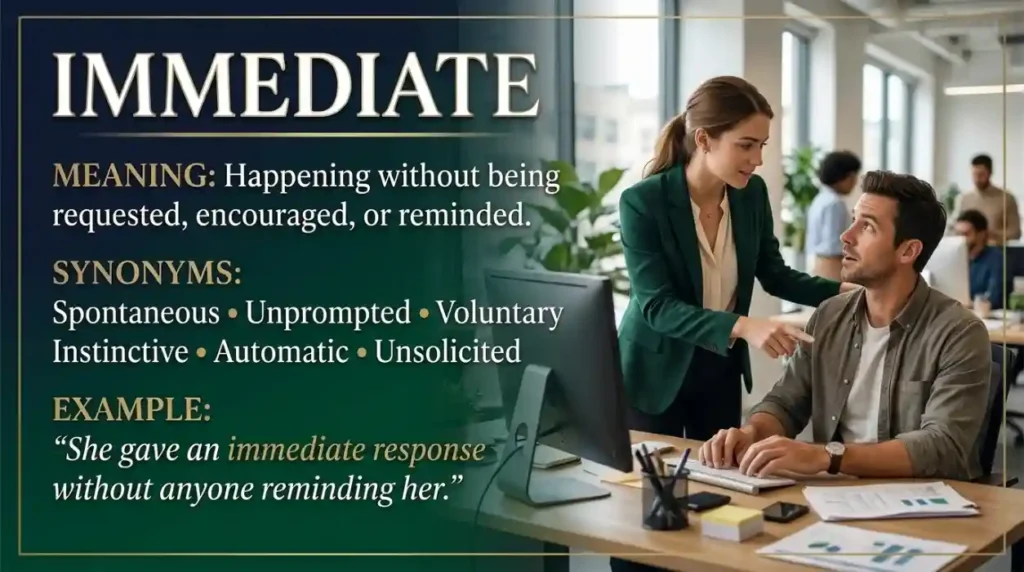
41. Spontaneous (Adjective) — US: /spɑːnˈteɪniəs/ | UK: /spɒnˈteɪniəs/
Meaning: Happening naturally without being planned or arranged beforehand.
Tone/Register: Neutral, informal, descriptive.
Examples:
- We made a spontaneous decision to visit the coast.
- His spontaneous reaction surprised everyone.
42. Abrupt (Adjective) — US: /əˈbrʌpt/ | UK: /əˈbrʌpt/
Meaning: Happening suddenly and unexpectedly, often in a way that feels rude or unpleasant.
Tone/Register: Negative, formal.
Examples:
- The meeting came to an abrupt end.
- Her abrupt reply caught me off guard.
43. Sudden (Adjective) — US: /ˈsʌdən/ | UK: /ˈsʌdən/
Meaning: Happening unexpectedly or quickly, often without warning.
Tone/Register: Neutral, descriptive.
Examples:
- A sudden change in temperature surprised us.
- The sudden announcement created excitement.
44. Immediate Response (Noun Phrase) — US: /ɪˈmiːdiət rɪˈspɑːns/ | UK: /ɪˈmiːdiət rɪˈspɒns/
Meaning: A reply or reaction given without delay.
Tone/Register: Neutral, professional.
Examples:
- The customer expected an immediate response.
- Her immediate response was to ask for more details.
45. Instantaneous Response (Noun Phrase) — US: /ˌɪnstənˈteɪniəs rɪˈspɑːns/ | UK: /ˌɪnstənˈteɪniəs rɪˈspɒns/
Meaning: A reaction or reply that occurs virtually at the same moment as an event.
Tone/Register: Technical, descriptive.
Examples:
- The system produced an instantaneous response to the signal.
- The device is designed for instantaneous response.
46. On-the-Spot (Adjective/Adverbial Phrase) — US: /ˌɑːn ðə ˈspɑːt/ | UK: /ˌɒn ðə ˈspɒt/
Meaning: Happening or being done at the place and time of an event.
Tone/Register: Informal, conversational, professional.
Examples:
- The manager made an on-the-spot decision.
- The reporter asked questions on the spot.
47. Without Delay (Adverbial Phrase) — US: /wɪˈðaʊt dɪˈleɪ/ | UK: /wɪˈðaʊt dɪˈleɪ/
Meaning: Immediately, without waiting or postponing an action.
Tone/Register: Formal, neutral.
Examples:
- Please report the damage without delay.
- The staff handled the complaint without delay.
48. As Soon As Possible (Adverbial Phrase) — US: /əz suːn əz ˈpɑːsəbəl/ | UK: /əz suːn əz ˈpɒsəbəl/
Meaning: At the earliest time that circumstances allow.
Tone/Register: Neutral, polite, professional.
Examples:
- Please send the completed form as soon as possible.
- I will arrange a meeting as soon as possible.
49. Forthcoming (Adjective) — US: /ˈfɔːrθˌkʌmɪŋ/ | UK: /ˈfɔːθˌkʌmɪŋ/
Meaning: About to happen or appear soon.
Tone/Register: Formal, neutral.
Examples:
- The forthcoming announcement has attracted attention.
- We are preparing for the forthcoming school event.
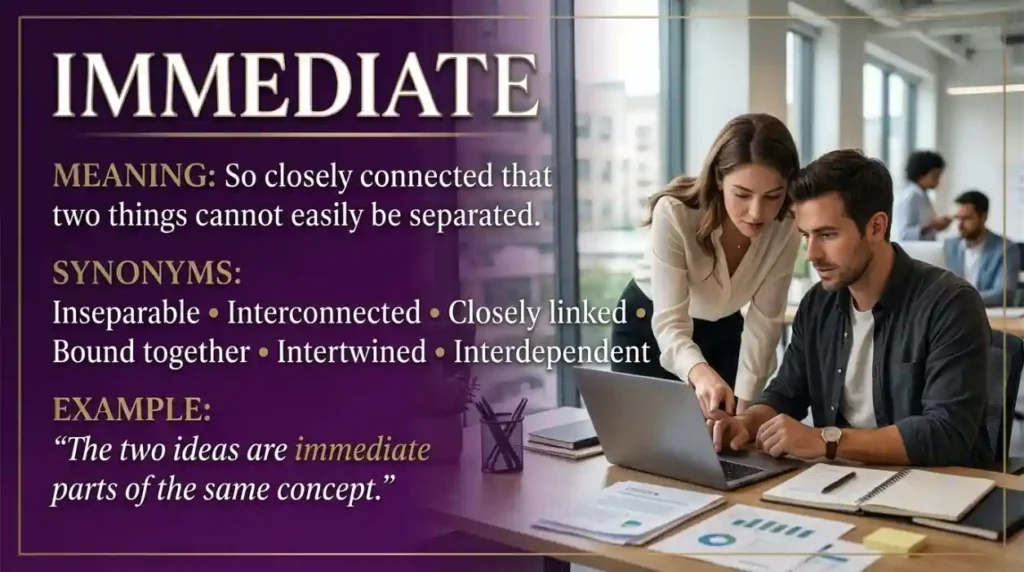
50. Inseparable (Adjective) — US: /ɪnˈsepərəbəl/ | UK: /ɪnˈsepərəbəl/
Meaning: So closely connected that two things cannot easily be separated.
Tone/Register: Neutral, descriptive.
Examples:
- The two issues are inseparable in this discussion.
- Their personal and professional lives became inseparable.
Synonyms by Tone
The right alternative depends on the feeling you want to communicate. A word that sounds efficient in a workplace email may sound demanding in a personal conversation.
Positive Synonyms
These words can communicate efficiency, quick support, or helpful action:
- Prompt
- Swift
- Speedy
- Expeditious
- Instant
- Unprompted
Example: “Thank you for your prompt assistance.”
Neutral Synonyms
These alternatives describe timing, sequence, or closeness without adding strong emotion:
- Instant
- Quick
- Current
- Present
- Next
- Initial
- Direct
- Near
- At once
Example: “Please check the current schedule.”
Negative or Serious Synonyms
These words can communicate pressure, sudden change, or a serious situation:
- Urgent
- Pressing
- Imminent
- Abrupt
- Sudden
- Forthwith
Example: “The hospital needs an urgent response.”
Informal and Conversational Alternatives
These expressions work well in everyday conversations:
- Right away
- Straightaway
- At once
- Quick
- On the spot
- As soon as possible
Example: “I’ll send you the details right away.”
Immediate vs. Close Alternatives
Some words seem similar to immediate but have important differences. The following comparison can help you choose the right expression.
| Word | Main meaning | Best use |
|---|---|---|
| Immediate | Happening without delay or directly connected | General and professional writing |
| Instant | Happening almost at once | Fast results or responses |
| Prompt | Done quickly and appropriately | Emails, requests, and service |
| Urgent | Requiring quick attention because of importance | Emergencies and serious matters |
| Imminent | Likely to happen very soon | Events and expected changes |
| Direct | Having no intermediary or intervening step | Connections and communication |
Immediate vs. Instant
Immediate generally means without delay. Instant emphasizes that something happens almost at once.
- We need an immediate decision.
- The machine provides instant results.
Immediate vs. Prompt
Immediate can suggest no waiting at all. Prompt means quick and timely, but it does not always mean that something happens at once.
- The patient requires immediate attention.
- Thank you for your prompt reply.
Immediate vs. Urgent
Immediate describes timing or directness. Urgent emphasizes the importance of acting quickly.
- The immediate effect was a change in temperature.
- The issue requires urgent attention.
How Immediate Changes by Context
Daily Conversation
In everyday speech, people often use right away, straightaway, quick, and at once. These expressions sound natural and easy to understand.
For example, “I’ll call you right away” is a friendly way to promise a quick response.
Writing and Blogging
Writers can use prompt, instant, current, direct, and sudden to avoid repeating immediate.
For example, “The sudden change surprised readers” is more precise when the change was unexpected rather than simply quick.
Professional and Academic English
Formal writing often uses expeditious, pressing, initial, consecutive, and unmediated.
For example, “The committee requested an expeditious review of the application.” This sounds more formal than “The committee wanted a quick review.”
Creative and Informal Use
Creative writing may use sudden, abrupt, spontaneous, or on-the-spot to describe events and reactions.
For example, “A spontaneous decision turned an ordinary afternoon into an adventure.”
Common Mistakes Learners Make
Confusing Immediate With Imminent
Immediate usually describes something happening without delay. Imminent describes something expected to happen very soon.
Incorrect: “The danger is immediate tomorrow.”
Better: “The danger is imminent.”
Using Urgent for Every Quick Action
Urgent suggests that something is important and needs attention quickly. It is stronger than quick or prompt.
Better approach: Use prompt for a timely reply and urgent for a serious matter requiring attention.
Treating Instant and Immediate as Identical
These words overlap, but instant often emphasizes an almost unnoticeable time gap. Immediate can also describe direct relationships.
Better approach: Use immediate family, not instant family.
Using Immediate When You Mean Current
Immediate and current have different meanings. Current refers to the present time, while immediate often means without delay or directly connected.
Better approach: Say “current information” when referring to information available now.
Overusing Formal Alternatives
Words such as forthwith, expeditious, and unmediated may sound unnatural in casual conversation.
Better approach: Use right away, quick, or straightaway in everyday speech.
Register Notes: Formal vs. Informal
Formal English
Expeditious, forthwith, pressing, imminent, unmediated, and consecutive are useful in official or academic communication.
Informal English
Right away, straightaway, quick, and on the spot are natural in everyday conversations.
Spoken English
Instant, quick, right away, and at once are common choices.
Written English
Prompt, immediate, current, initial, and expeditious can make professional writing more precise.
For more vocabulary practice, explore related English synonym guides and compare how similar words work in different sentences.
Real-Life Mini Scenarios Using Immediate
Workplace
A supervisor receives a report about a technical problem. She asks the team to take immediate action and provide a prompt update.
Social Situations
A friend sends a message about a change in meeting plans. You reply right away to confirm the new time.
Media and News
A news report describes an imminent storm approaching a coastal town. Residents are advised to follow official safety instructions.
Writing and Storytelling
A writer describes a sudden discovery that changes the direction of a story. The unexpected event creates an immediate effect on the main character.
Practice Exercise
Test your understanding with these practical questions. Select the word or phrase that best fits each situation.
1. A hospital needs a response without any delay. Which word fits best?
A. Current
B. Immediate
C. Consecutive
D. Forthcoming
2. You want to thank someone for replying quickly to your email. Which word sounds most appropriate?
A. Prompt
B. Imminent
C. Abrupt
D. Existing
3. Dark clouds suggest that a storm will happen very soon. Which word describes this situation?
A. Current
B. Primary
C. Imminent
D. Uninterrupted
4. A computer gives results almost instantly. Which word is most suitable?
A. Instantaneous
B. Consecutive
C. Initial
D. Pressing
5. A manager needs an important problem handled quickly. Which word communicates this need?
A. Near
B. Urgent
C. Present
D. Following
6. You promise to send a document without waiting. Which expression sounds natural?
A. Right away
B. Inseparable
C. Existing
D. Consequent
7. A project review must be completed quickly and efficiently. Which formal adjective fits best?
A. Spontaneous
B. Expeditious
C. Abrupt
D. Closest
8. A student describes the chapter that comes directly after the introduction. Which word fits?
A. Next
B. Urgent
C. Instant
D. Primary
9. A person decides without planning. Which word is most appropriate?
A. Continuous
B. Spontaneous
C. Imminent
D. Current
10. A company wants to describe information that belongs to the present time. Which word should it use?
A. Immediate
B. Current
C. Abrupt
D. Forthwith
Answer Key:
1-B | 2-A | 3-C | 4-A | 5-B | 6-A | 7-B | 8-A | 9-B | 10-B
Reflection Task:
Write three original sentences using prompt, instant, and urgent. Use one in a workplace message, one in a daily conversation, and one in a situation that requires quick attention.
Conclusion
Learning a synonym for immediate helps you describe speed, urgency, timing, and direct connections more accurately. Words such as prompt, instant, and swift add variety to your vocabulary.
Each alternative has a slightly different meaning. Choosing carefully makes your writing clearer and helps you avoid confusing urgency with speed or closeness.
A wider vocabulary improves essays, blogs, emails, and everyday conversations. It also helps you communicate professionally without repeating the same expressions.
Practice these alternatives in your daily messages and writing. Try one new word in an email, essay, or conversation, and notice how it changes your meaning.
FAQs
1. What is the best synonym for immediate in a professional email?
Prompt is often a suitable alternative in professional emails when you mean a quick and timely response. For example, “Thank you for your prompt attention to this matter” sounds polite and professional. Use urgent when the matter requires special attention, and use immediate when there should be no delay.
2. What is another word for immediate action?
Urgent action, prompt action, and swift action are common alternatives. Urgent action emphasizes importance and the need to respond quickly. Prompt action focuses on avoiding unnecessary delay. Swift action highlights speed. The best expression depends on whether you want to communicate seriousness, efficiency, or quick movement.
3. What is the difference between immediate and imminent?
Immediate usually means happening without delay or being directly connected to something. Imminent means likely to happen very soon. For example, an immediate response happens right away, while an imminent event is expected shortly. The two words are not interchangeable, especially in formal writing and news reports.
4. What is a synonym for immediate effect?
Instant effect is a common alternative when a result occurs almost at once. You can also use immediate result or instantaneous effect in suitable contexts. For example, “The announcement had an instant effect on public opinion.” Use instantaneous when you want to emphasize an extremely short time gap.
5. How do you say immediate in a polite way?
Use prompt, at your earliest convenience, or as soon as possible, depending on the situation. For example, “I would appreciate your prompt response” sounds professional and respectful. If the matter is genuinely urgent, explain the deadline clearly rather than using overly demanding language.
6. What is the opposite of immediate?
Common opposites include delayed, late, eventual, and gradual. Delayed describes something that happens later than expected. Eventual refers to something that happens after some time. Gradual describes a change that develops slowly rather than happening all at once.
7. Can immediate mean close family?
Yes. In the expression immediate family, immediate refers to the closest family relationships rather than speed or timing. It usually includes parents, children, siblings, and a spouse. The exact definition can vary depending on legal, workplace, or institutional rules, so check the relevant policy when precision matters.
8. Is immediate more formal than instant?
Immediate and instant are both common in everyday and professional English. However, instant often emphasizes something happening almost at once, while immediate can also describe direct relationships or something requiring action without delay. For example, “instant results” is natural, while “immediate family” is the established expression.
Suggested External Sources
For a deeper understanding of the word immediate and its synonyms, readers can explore these well-known dictionaries and language resources. They provide reliable information about word meanings, pronunciation, grammatical usage, example sentences, and historical origins.
- Merriam-Webster Dictionary: This trusted American dictionary provides clear definitions, pronunciation guides, word origins, and example sentences. It is especially helpful for understanding how immediate and its alternatives are used in modern American English.
- Cambridge Dictionary: Cambridge offers simple explanations, British and American pronunciations, audio recordings, and practical usage examples. English learners can use it to understand the differences between words such as instant, urgent, prompt, and immediate.
- Oxford Learner’s Dictionaries: This resource is designed for English learners and provides easy-to-understand definitions, IPA pronunciation, grammar patterns, and natural example sentences. It helps readers choose the right synonym for different speaking and writing situations.
Using these references together can help you build a stronger vocabulary, understand subtle differences between synonyms, and choose the most accurate alternative to immediate in academic writing, professional communication, and everyday conversations.

Jameel Hassan is the founder and lead writer at SynonymsCloud.com, a trusted online platform dedicated to English vocabulary and effective communication. He is passionate about helping students, writers, professionals, and lifelong learners discover the right words to express their ideas with clarity, precision, and confidence.
At SynonymsCloud.com, every article is thoroughly researched and carefully written to provide accurate, practical, and easy-to-understand guidance on synonyms, antonyms, word meanings, idioms, and vocabulary. With a strong commitment to quality, real-world usage, and clear explanations, the website helps readers expand their vocabulary, improve their writing, and communicate more effectively in both academic and professional settings.