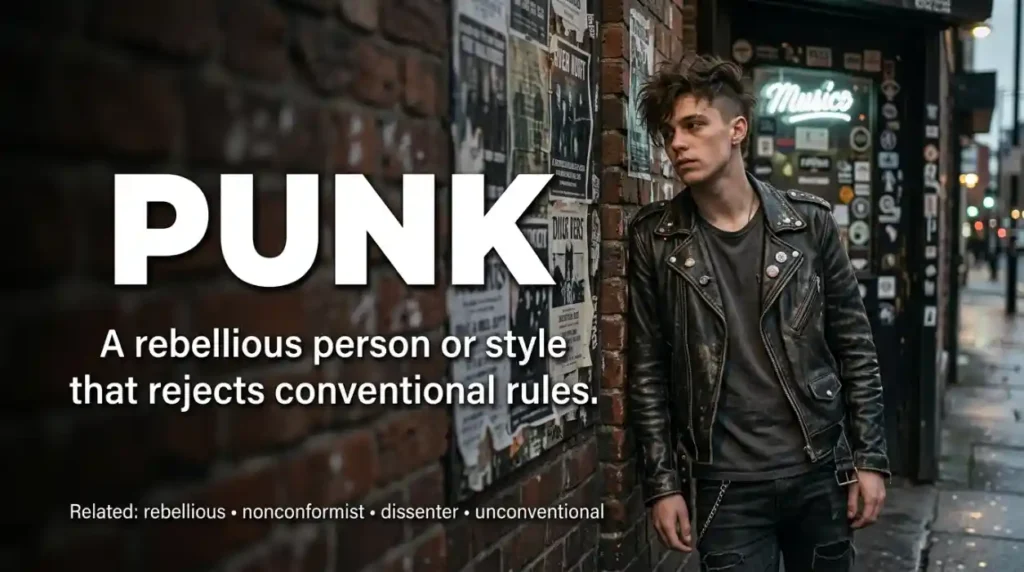
A synonym for punk can be troublemaker, delinquent, rebel, hoodlum, thug, brat, misfit, rogue, rascal, or nonconformist, depending on context. For a rude or troublesome person, troublemaker is a natural choice; for someone who rejects authority, rebel fits better.
A synonym for punk depends on the meaning intended. For a disrespectful or troublesome young person, alternatives include delinquent, hoodlum, troublemaker, rebel, tough, and misfit. In music, punk may refer to a punk rocker or punk musician.
Synonym for punk can change meaning with context. Imagine someone calling a rude teenager a “punk.” The word sounds insulting and informal, so a softer alternative may work better.
In music, punk has a completely different sense. A writer may describe a band as rebellious, raw, edgy, or underground. The right synonym adds clearer detail.
Learning alternatives to punk helps students, bloggers, and content writers avoid repetition. Daily English users can also choose words that match the exact tone they want.
What Does “Punk” Really Mean?
The word punk has several meanings in modern English. Its meaning depends heavily on context, speaker attitude, and the situation.
When used for a person, punk can describe someone viewed as young, inexperienced, disrespectful, troublesome, or insignificant. It is usually informal and can sound insulting.
For example:
“That punk tried to steal my bike.”
Here, punk expresses contempt. The speaker does not respect the person.
The word also describes a musical and cultural movement. Punk can refer to a style of rock music known for its fast sound, simple structures, rebellious attitude, and anti-establishment themes.
It can also work as an adjective, as in punk music, punk culture, or punk fashion.
Part of Speech
Punk can function as:
- Noun: “That punk caused trouble.”
- Adjective: “She loves punk music.”
- Verb: In some informal uses, punk can mean to deceive, defeat, or humiliate someone, although this use is less common in everyday standard English.
Simple Definition
Punk can mean a disrespectful or troublesome person, especially a young person, or it can refer to a rebellious style of music and culture.
Native speakers usually understand the intended meaning from context.
Connotative Meaning
Connotation (the emotional feeling or association a word carries beyond its basic dictionary meaning) matters greatly with punk.
Positive Tone
In music and culture, punk can carry a positive sense of independence, creativity, courage, rebellion, and originality.
Negative Tone
When used for a person, punk is often negative. It may suggest disrespect, weakness, foolishness, youth, or troublemaking.
Neutral Tone
In phrases such as punk rock or punk music, the word can be largely neutral. It simply identifies a musical style or cultural movement.
Etymology of “Punk”
The exact history of punk is complicated because the word developed through several earlier slang uses.
The term appeared in English long before its modern association with punk rock. Historical uses included meanings connected with prostitution, young people, and something inferior or worthless. Some of these meanings later influenced American slang.
Old English: 450–1100
There is no established Old English word punk carrying the modern meanings discussed today. The word should not be presented as an ordinary Old English vocabulary item.
Middle English: 1100–1500
Historical forms and slang related to punk developed later than the Middle English period. The modern word’s complicated slang history makes a direct Old English-to-modern progression inaccurate.
Modern English: 1500–Present
By the nineteenth and twentieth centuries, punk had acquired several slang meanings. In the 1970s, it became strongly associated with punk rock, a rebellious music and cultural movement.
Today, the word can describe a person, a musical genre, an aesthetic, or a broader rebellious attitude.
Pronunciation of “Punk”
- US: /pʌŋk/
- UK: /pʌŋk/
Syllables
punk
It is a one-syllable word.
Affixation Pattern of “Punk”
Root: punk
Prefix: none
Suffix: none
The word is a simple lexical form rather than a modern word built from a productive English prefix and suffix.
Synonyms List
Important note: Punk is polysemous, so no 50 words are exact synonyms in every situation. The list below includes direct synonyms, close alternatives, and context-specific terms for its different meanings.
1. Delinquent (Noun)
US: /dɪˈlɪŋkwənt/
UK: /dɪˈlɪŋkwənt/
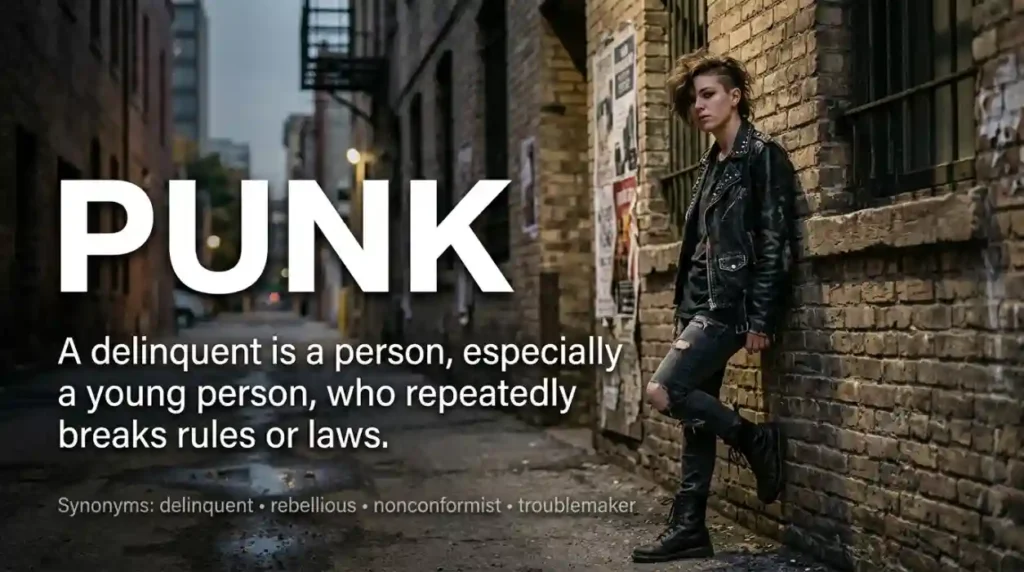
Meaning: A delinquent is a person, especially a young person, who repeatedly breaks rules or laws.
Tone/Register: Negative; formal to neutral.
Examples:
“The police questioned the young delinquent.”
“His parents worried about his delinquent behavior.”
2. Troublemaker (Noun)
US: /ˈtrʌbəlˌmeɪkər/
UK: /ˈtrʌbəlˌmeɪkə/
Meaning: A troublemaker is someone who regularly creates problems or conflict.
Tone/Register: Informal; negative.
Examples:
“Everyone knew Jake was a troublemaker.”
“The teacher moved the troublemaker to another seat.”
3. Hoodlum (Noun)
US: /ˈhʊdləm/
UK: /ˈhʊdləm/
Meaning: A hoodlum is a person involved in violent, criminal, or antisocial behavior.
Tone/Register: Informal; strongly negative.
Examples:
“The neighborhood had problems with local hoodlums.”
“The movie follows a group of young hoodlums.”
4. Thug (Noun)
US: /θʌɡ/
UK: /θʌɡ/
Meaning: A thug is a violent or aggressive person who uses intimidation or force.
Tone/Register: Informal; strongly negative.
Examples:
“The thug threatened the shop owner.”
“Security removed the violent thug.”
5. Punker (Noun)
US: /ˈpʌŋkər/
UK: /ˈpʌŋkə/
Meaning: A punker can refer to someone associated with punk culture or punk style.
Tone/Register: Informal; cultural.
Examples:
“The club attracted young punkers.”
“She dressed like a punker for the concert.”
6. Rebel (Noun)
US: /ˈrɛbəl/
UK: /ˈrɛbəl/
Meaning: A rebel is someone who resists authority, rules, or accepted ideas.
Tone/Register: Neutral to positive.
Examples:
“The young rebel refused to follow the unfair rule.”
“Her rebellious attitude made her popular with the group.”
7. Misfit (Noun)
US: /ˈmɪsˌfɪt/
UK: /ˈmɪsˌfɪt/
Meaning: A misfit is someone who feels different from or does not easily belong to a group.
Tone/Register: Informal; often sympathetic.
Examples:
“He felt like a misfit at his new school.”
“The story follows a group of social misfits.”
8. Outlaw (Noun)
US: /ˈaʊtˌlɔː/
UK: /ˈaʊtˌlɔː/
Meaning: An outlaw is someone who operates outside the law.
Tone/Register: Neutral to dramatic.
Examples:
“The western hero once lived as an outlaw.”
“The novel features a famous outlaw.”
9. Rogue (Noun)
US: /roʊɡ/
UK: /rəʊɡ/
Meaning: A rogue is a dishonest, unpredictable, or mischievous person.
Tone/Register: Informal; often playful.
Examples:
“That little rogue hid my keys.”
“The film centers on a charming rogue.”
10. Scoundrel (Noun)
US: /ˈskaʊndrəl/
UK: /ˈskaʊndrəl/
Meaning: A scoundrel is a dishonest or morally unpleasant person.
Tone/Register: Informal; literary.
Examples:
“That scoundrel cheated his business partner.”
“The novel’s villain is a clever scoundrel.”
11. Rascal (Noun)
US: /ˈræskəl/
UK: /ˈrɑːskəl/
Meaning: A rascal is a mischievous person, often described with playful rather than serious criticism.
Tone/Register: Playful; informal.
Examples:
“That rascal stole another cookie.”
“Her little brother is a lovable rascal.”
12. Brat (Noun)
US: /bræt/
UK: /bræt/
Meaning: A brat is a badly behaved or spoiled child or young person.
Tone/Register: Informal; negative.
Examples:
“The spoiled brat refused to apologize.”
“Don’t act like a brat at the party.”
13. Tough (Noun)
US: /tʌf/
UK: /tʌf/
Meaning: As a noun, tough can describe a person believed to be physically strong, aggressive, or intimidating.
Tone/Register: Informal.
Examples:
“The neighborhood tough challenged him.”
“He looked like a tough from an old crime movie.”
14. Bully (Noun)
US: /ˈbʊli/
UK: /ˈbʊli/
Meaning: A bully is someone who repeatedly intimidates, threatens, or mistreats others.
Tone/Register: Neutral to negative.
Examples:
“The school suspended the bully.”
“She finally stood up to the class bully.”
15. Menace (Noun)
US: /ˈmɛnəs/
UK: /ˈmɛnəs/
Meaning: A menace is a person or thing that causes danger, trouble, or annoyance.
Tone/Register: Informal to formal.
Examples:
“That kid is a real menace.”
“The dog became a menace to passing cyclists.”
16. Lout (Noun)
US: /laʊt/
UK: /laʊt/
Meaning: A lout is a rude, badly behaved, or uncultured person.
Tone/Register: Informal; negative.
Examples:
“Some lout left trash on the sidewalk.”
“Don’t behave like a lout in public.”
17. Oaf (Noun)
US: /oʊf/
UK: /əʊf/
Meaning: An oaf is a clumsy, foolish, or insensitive person.
Tone/Register: Informal; mildly insulting.
Examples:
“That oaf knocked over the lamp.”
“He apologized after realizing he had behaved like an oaf.”
18. Punk Rocker (Noun)
US: /ˈpʌŋk ˌrɑːkər/
UK: /ˈpʌŋk ˌrɒkə/
Meaning: A punk rocker is a person who performs or strongly identifies with punk rock music.
Tone/Register: Informal; cultural.
Examples:
“The punk rocker wore a leather jacket.”
“She became a punk rocker in college.”
19. Punk Musician (Noun)
US: /ˈpʌŋk mjuˈzɪʃən/
UK: /ˈpʌŋk mjuˈzɪʃən/
Meaning: A punk musician is an artist who performs punk music.
Tone/Register: Neutral.
Examples:
“The punk musician writes energetic songs.”
“He became a respected punk musician.”
20. Rocker (Noun)
US: /ˈrɑːkər/
UK: /ˈrɒkə/
Meaning: A rocker is someone involved in rock music, including punk-related rock scenes.
Tone/Register: Informal; musical.
Examples:
“The young rocker played guitar all night.”
“She has been a rocker since her teenage years.”
21. Nonconformist (Noun)
US: /ˌnɑːnkənˈfɔːrmɪst/
UK: /ˌnɒnkənˈfɔːmɪst/
Meaning: A nonconformist is someone who deliberately rejects conventional behavior or ideas.
Tone/Register: Neutral to formal.
Examples:
“He was a nonconformist who questioned every tradition.”
“Her nonconformist style attracted attention.”
22. Iconoclast (Noun)
US: /aɪˈkɑːnəklæst/
UK: /aɪˈkɒnəklæst/
Meaning: An iconoclast challenges established beliefs, customs, or respected institutions.
Tone/Register: Formal; often positive.
Examples:
“The writer became known as an iconoclast.”
“Her iconoclastic ideas changed the discussion.”
23. Radical (Noun)
US: /ˈrædɪkəl/
UK: /ˈrædɪkəl/
Meaning: A radical supports major or fundamental changes to established systems.
Tone/Register: Neutral; political or intellectual.
Examples:
“The young radical questioned the old system.”
“His ideas were considered radical at the time.”
24. Maverick (Noun)
US: /ˈmævərɪk/
UK: /ˈmævərɪk/
Meaning: A maverick is an independent person who does not follow conventional methods or expectations.
Tone/Register: Informal to neutral; often positive.
Examples:
“She is a maverick in the fashion industry.”
“The maverick refused to copy his competitors.”
25. Dissenter (Noun)
US: /dɪˈsɛntər/
UK: /dɪˈsentə/
Meaning: A dissenter is someone who openly disagrees with an accepted opinion or authority.
Tone/Register: Formal.
Examples:
“The dissenter challenged the committee’s decision.”
“Several dissenters spoke during the meeting.”
26. Agitator (Noun)
US: /ˈædʒəteɪtər/
UK: /ˈædʒɪteɪtə/
Meaning: An agitator is someone who actively encourages opposition or public protest.
Tone/Register: Formal; political.
Examples:
“The activist was labeled an agitator.”
“The agitator organized a public demonstration.”
27. Firebrand (Noun)
US: /ˈfaɪərbrænd/
UK: /ˈfaɪəbrænd/
Meaning: A firebrand is a passionate and outspoken person who strongly promotes change.
Tone/Register: Formal to journalistic.
Examples:
“The young firebrand criticized the traditional system.”
“She became a political firebrand.”
28. Hothead (Noun)
US: /ˈhɑːtˌhɛd/
UK: /ˈhɒtˌhed/
Meaning: A hothead is someone who becomes angry or reacts aggressively very quickly.
Tone/Register: Informal.
Examples:
“Everyone knows he’s a hothead.”
“The hothead walked out after the argument.”
29. Smart-Aleck (Noun)
US: /ˈsmɑːrt əˌlɛk/
UK: /ˈsmɑːt əˌlek/
Meaning: A smart-aleck is someone who behaves as though they are clever, often in an irritating way.
Tone/Register: Informal; American English.
Examples:
“Don’t be such a smart-aleck.”
“The smart-aleck made another sarcastic comment.”
30. Wiseguy (Noun)
US: /ˈwaɪzɡaɪ/
UK: /ˈwaɪzɡaɪ/
Meaning: A wiseguy is a person who makes clever or disrespectful remarks.
Tone/Register: Informal; American English.
Examples:
“The wiseguy kept interrupting the discussion.”
“Don’t get smart with me, wiseguy.”
31. Delinquent Youth (Noun Phrase)
US: /dɪˈlɪŋkwənt juːθ/
UK: /dɪˈlɪŋkwənt juːθ/
Meaning: This phrase describes a young person involved in persistent antisocial or unlawful behavior.
Tone/Register: Formal to journalistic.
Examples:
“The program supports delinquent youth.”
“The report examined causes of youth delinquency.”
32. Juvenile Delinquent (Noun)
US: /ˈdʒuːvənəl dɪˈlɪŋkwənt/
UK: /ˈdʒuːvənaɪl dɪˈlɪŋkwənt/
Meaning: A juvenile delinquent is a young person who has committed an offense.
Tone/Register: Formal; legal.
Examples:
“The court offered counseling to the juvenile delinquent.”
“The old term appears in many crime stories.”
33. Street Tough (Noun)
US: /striːt tʌf/
UK: /striːt tʌf/
Meaning: A street tough is an aggressive person associated with rough urban environments.
Tone/Register: Informal; dramatic.
Examples:
“The movie features a street tough with a soft side.”
“He grew up around street toughs.”
34. Young Hood (Noun)
US: /jʌŋ hʊd/
UK: /jʌŋ hʊd/
Meaning: A young hood is an informal term for a young person involved in crime or street trouble.
Tone/Register: Informal; slang.
Examples:
“The film follows a young hood trying to change his life.”
“The character begins as a young hood.”
35. Gang Member (Noun)
US: /ɡæŋ ˈmɛmbər/
UK: /ɡæŋ ˈmɛmbə/
Meaning: A gang member belongs to an organized group involved in criminal or territorial activity.
Tone/Register: Neutral to negative.
Examples:
“The gang member was questioned by detectives.”
“The documentary explores how young people enter gangs.”
36. Street Kid (Noun)
US: /striːt kɪd/
UK: /striːt kɪd/
Meaning: A street kid is an informal term for a young person strongly associated with street life.
Tone/Register: Informal; context-sensitive.
Examples:
“The novel follows a street kid searching for his family.”
“The character is portrayed as a tough street kid.”
37. Rebel Kid (Noun Phrase)
US: /ˈrɛbəl kɪd/
UK: /ˈrɛbəl kɪd/
Meaning: A rebel kid is an informal description of a young person who resists rules or expectations.
Tone/Register: Informal; often playful.
Examples:
“He was the rebel kid in his class.”
“The rebel kid eventually became a successful artist.”
38. Bad Boy (Noun)
US: /bæd bɔɪ/
UK: /bæd bɔɪ/
Meaning: A bad boy is an informal term for a male who behaves badly or presents himself as rebellious.
Tone/Register: Informal; sometimes playful.
Examples:
“The movie portrays him as a charming bad boy.”
“She likes the character’s rebellious bad-boy image.”
39. Badass (Noun)
US: /ˈbædæs/
UK: /ˈbædæs/
Meaning: Badass describes someone viewed as tough, fearless, impressive, or rebellious.
Tone/Register: Very informal; slang.
Examples:
“She played a badass detective in the series.”
“He looked like a badass on stage.”
40. Hell-Raiser (Noun)
US: /ˈhɛlˌreɪzər/
UK: /ˈhelˌreɪzə/
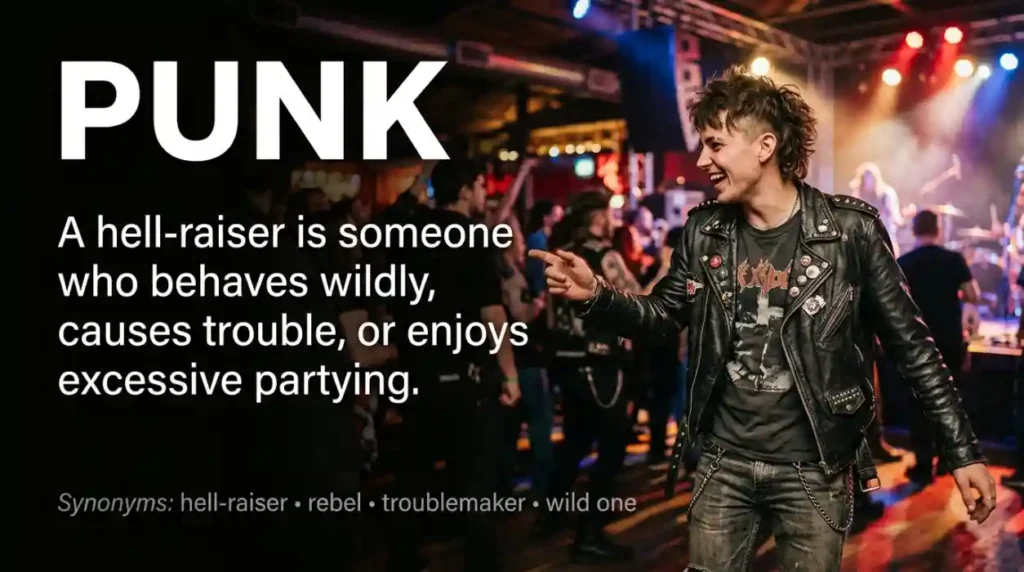
Meaning: A hell-raiser is someone who behaves wildly, causes trouble, or enjoys excessive partying.
Tone/Register: Informal.
Examples:
“He had a reputation as a hell-raiser.”
“The singer was famous for his hell-raising youth.”
41. Wild One (Noun Phrase)
US: /waɪld wʌn/
UK: /waɪld wʌn/
Meaning: A wild one is an informal description of someone energetic, unpredictable, or difficult to control.
Tone/Register: Informal; often playful.
Examples:
“Her youngest son is a wild one.”
“He was known as the wild one in the band.”
42. Rebel Without a Cause (Noun Phrase)
US: /ˈrɛbəl wɪˈðaʊt ə kɔːz/
UK: /ˈrɛbəl wɪˈðaʊt ə kɔːz/
Meaning: This phrase describes a rebellious person who appears to resist authority without a clear reason.
Tone/Register: Literary; cultural.
Examples:
“The character is portrayed as a rebel without a cause.”
“His behavior made him seem like a rebel without a cause.”
43. Antihero (Noun)
US: /ˌæntiˈhɪroʊ/
UK: /ˌæntiˈhɪərəʊ/
Meaning: An antihero is a central character who lacks traditional heroic qualities but may still attract sympathy.
Tone/Register: Literary; neutral.
Examples:
“The punk-inspired antihero rejects social expectations.”
“The story gives its antihero a complicated personality.”
44. Outsider (Noun)
US: /aʊtˈsaɪdər/
UK: /aʊtˈsaɪdə/
Meaning: An outsider is someone who does not belong to or identify with a particular group.
Tone/Register: Neutral.
Examples:
“He always felt like an outsider at school.”
“The band’s music appealed to outsiders.”
45. Nonconformist (Adjective/Noun)
US: /ˌnɑːnkənˈfɔːrmɪst/
UK: /ˌnɒnkənˈfɔːmɪst/
Meaning: Nonconformist describes someone or something that rejects conventional styles, ideas, or behavior.
Tone/Register: Neutral to formal.
Examples:
“Her nonconformist fashion stood out.”
“He became known as a nonconformist artist.”
46. Rebellious (Adjective)
US: /rɪˈbɛljəs/
UK: /rɪˈbeljəs/
Meaning: Rebellious describes behavior that resists authority, rules, or social expectations.
Tone/Register: Neutral.
Examples:
“He had a rebellious attitude at school.”
“The song has a rebellious energy.”
47. Edgy (Adjective)
US: /ˈɛdʒi/
UK: /ˈedʒi/
Meaning: Edgy describes something unconventional, provocative, or deliberately outside mainstream style.
Tone/Register: Informal; contemporary.
Examples:
“The band has an edgy sound.”
“Her edgy fashion reflects punk influences.”
48. Underground (Adjective)
US: /ˈʌndərɡraʊnd/
UK: /ˈʌndəɡraʊnd/
Meaning: Underground describes music, art, or culture that exists outside mainstream popularity.
Tone/Register: Informal to neutral.
Examples:
“The group became popular in the underground music scene.”
“He writes about underground punk culture.”
49. Counterculture (Noun)
US: /ˈkaʊntərˌkʌltʃər/
UK: /ˈkaʊntəˌkʌltʃə/
Meaning: Counterculture refers to a social or cultural movement that rejects dominant values.
Tone/Register: Academic; cultural.
Examples:
“Punk became an influential counterculture.”
“The documentary examines the movement’s counterculture roots.”
50. Punk Rocker (Noun)
US: /ˈpʌŋk ˌrɑːkər/
UK: /ˈpʌŋk ˌrɒkə/
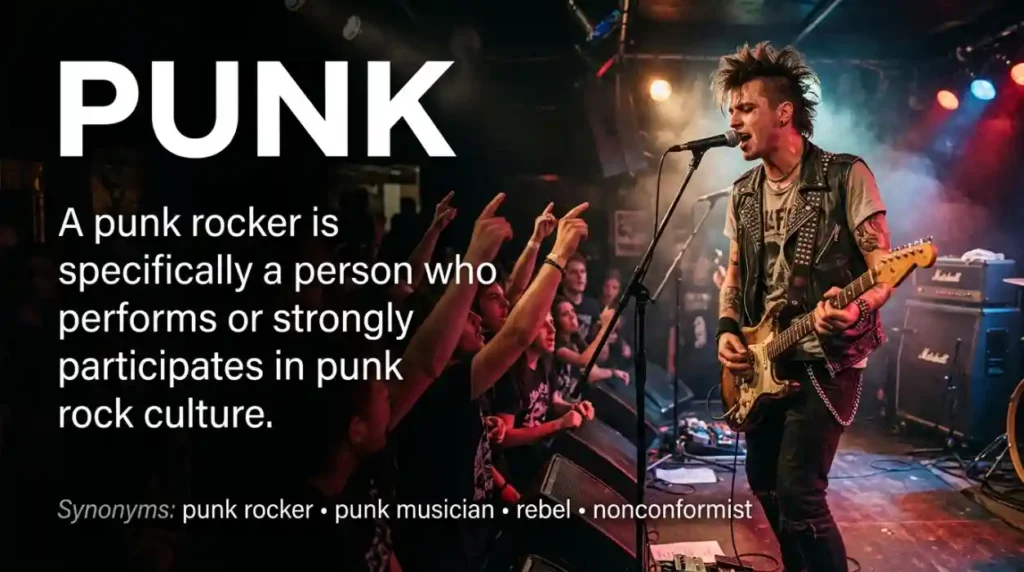
Meaning: A punk rocker is specifically a person who performs or strongly participates in punk rock culture.
Tone/Register: Informal; musical.
Examples:
“The punk rocker performed at a small venue.”
“Many young punk rockers created their own fashion.”
Synonyms by Tone
Because punk can be insulting or cultural, tone matters more than it does with many ordinary nouns.
Positive or Admiring
- Rebel
- Maverick
- Nonconformist
- Iconoclast
- Firebrand
- Badass
- Antihero
These words can highlight independence, courage, creativity, or originality.
Neutral
- Outsider
- Delinquent
- Dissenter
- Rocker
- Punk musician
- Punk rocker
- Counterculture
- Underground
These choices work when you want to describe a person or cultural idea without adding unnecessary insult.
Negative
- Troublemaker
- Hoodlum
- Thug
- Bully
- Brat
- Lout
- Oaf
- Menace
- Scoundrel
These words emphasize poor behavior, aggression, disrespect, or social problems.
Playful or Informal
- Rascal
- Rogue
- Wild one
- Bad boy
- Smart-aleck
- Wiseguy
- Hell-raiser
These can soften the criticism or make it humorous, depending on context.
“Punk” vs. Close Alternatives
| Word | Meaning | Tone | Best Use |
|---|---|---|---|
| Punk | A disrespectful person or someone linked with punk culture | Informal | Slang, dialogue, music |
| Troublemaker | Someone who creates problems | Negative | Everyday descriptions |
| Rebel | Someone who resists authority or convention | Neutral/positive | Social, cultural, personal |
| Delinquent | A person who breaks rules or laws | Negative/formal | Legal or social contexts |
| Maverick | An independent person who rejects convention | Positive | Professional or creative contexts |
| Rascal | A mischievous person | Playful | Friendly or humorous situations |
The key difference is attitude. Calling someone a punk can sound confrontational. Calling the same person a rebel may sound admiring.
How “Punk” Changes by Context
Daily Conversation
In everyday speech, punk is usually informal. When aimed at a person, it can sound insulting.
For example, someone might say, “That punk took my seat.” A more neutral version would be, “That guy took my seat.”
If you want to describe behavior rather than insult someone, troublemaker or bully may be clearer.
Writing and Blogging
Bloggers should choose alternatives based on the exact meaning.
A music article might use punk rocker, punk musician, underground artist, or counterculture figure.
A story about youth behavior may instead need delinquent, rebel, or troublemaker.
Specific vocabulary makes writing more informative.
Professional or Academic Tone
Avoid punk when a formal explanation is required unless you are discussing the word itself or punk culture.
Instead, use precise terms such as delinquent, nonconformist, dissenter, or counterculture movement, depending on the subject.
Professional writing should describe behavior rather than rely on slang.
Creative and Informal Use
Fiction gives punk more freedom.
A character might say, “Get out of here, punk!” This sounds natural in heated dialogue.
A narrator could instead write, “The young troublemaker disappeared into the crowd.” The second version sounds more descriptive and less slang-heavy.
Common Mistakes Learners Make
Mistake 1: Treating Every Synonym as Identical
Punk, rebel, delinquent, and maverick are not interchangeable in every sentence.
A delinquent breaks rules. A rebel resists authority. A maverick works independently. The differences matter.
Mistake 2: Using “Punk” in Formal Writing
Calling someone a punk can sound rude or childish.
In an academic essay, describe the person’s behavior more precisely.
Mistake 3: Confusing Punk the Person With Punk the Music
The sentence “He is a punk” may describe a person or cultural identity.
The sentence “He listens to punk” normally refers to music.
Context makes the difference clear.
Mistake 4: Assuming “Rebel” Is Always Negative
Rebel can be positive. It may describe someone courageous enough to challenge an unfair system.
Therefore, rebel is not always a direct emotional replacement for the insulting sense of punk.
Register Notes
Punk is strongly informal when used as an insult.
When writing in a formal context, terms such as delinquent, nonconformist, or dissenter can provide a more precise description, depending on the intended meaning.
In music-related writing, expressions like punk rock, punk musician, and punk rocker sound more natural and clearly identify the musical context.
For a playful or informal tone, rascal or rogue can be suitable when you want to describe someone mischievous without suggesting serious hostility.
Readers looking for more vocabulary guidance can also explore a relevant synonym or word-choice article elsewhere on your site.
Real-Life Mini Scenarios
Workplace
A manager would usually avoid saying, “That employee is a punk.”
A professional description would be clearer: “The employee repeatedly behaved disrespectfully toward colleagues.”
Social Situation
A friend might jokingly say, “You little punk!” after someone plays a harmless prank.
The phrase can sound affectionate among close friends, but it can also sound aggressive between strangers.
Media and Pop Culture
A music journalist might describe an artist as a punk rocker, nonconformist, or counterculture figure.
The best word depends on whether the article focuses on music, personality, fashion, or social influence.
Writing and Storytelling
A novelist can use punk to create realistic dialogue.
For example, a character might challenge another person with a short insult. The slang immediately creates a rough, confrontational atmosphere.
Practice Exercise
Choose the best answer for each situation.
1. Which word best describes a person who repeatedly causes problems?
A. Troublemaker
B. Maverick
C. Rocker
D. Outsider
2. Which alternative is best for someone who resists conventional ideas?
A. Brat
B. Rebel
C. Oaf
D. Hoodlum
3. Which word has a playful meaning for a mischievous person?
A. Delinquent
B. Thug
C. Rascal
D. Menace
4. Which term best fits a person who breaks laws as a young offender?
A. Maverick
B. Juvenile delinquent
C. Rocker
D. Firebrand
5. Which word best suits formal academic writing about someone who rejects convention?
A. Punk
B. Brat
C. Nonconformist
D. Wiseguy
6. Which term relates specifically to punk music?
A. Punk rocker
B. Lout
C. Oaf
D. Bully
7. Which word describes someone who acts independently from accepted methods?
A. Thug
B. Maverick
C. Delinquent
D. Brat
8. Which word describes someone who quickly becomes angry?
A. Hothead
B. Outsider
C. Rocker
D. Rascal
9. Which word best describes someone who intimidates other people repeatedly?
A. Bully
B. Iconoclast
C. Maverick
D. Dissenter
10. Which alternative can describe a person outside a particular social group?
A. Outsider
B. Thug
C. Delinquent
D. Hothead
Answer Key:
1-A | 2-B | 3-C | 4-B | 5-C | 6-A | 7-B | 8-A | 9-A | 10-A
Reflection Task:
Write one sentence using punk, rebel, troublemaker, maverick, or rascal. Then explain whether your sentence sounds positive, negative, neutral, or playful.
FAQs
1. What is the best synonym for punk when describing a rude person?
The best choice depends on the behavior. Troublemaker works for someone who creates problems, while delinquent suits someone who repeatedly breaks rules or laws. Brat can describe a badly behaved young person. If the speaker wants a stronger insult, hoodlum or thug may fit, although those words suggest more serious behavior.
2. What is a polite synonym for punk?
There is no single polite replacement because punk can be insulting. Young person, outsider, or nonconformist can provide more neutral descriptions. If the person is simply independent or unconventional, rebel or maverick may work. Choose the word according to the person’s actual behavior rather than replacing the insult with another unnecessarily harsh term.
3. What is a synonym for punk in music?
For the musical meaning, natural alternatives include punk rocker, punk musician, and rocker. However, these terms are not perfect replacements in every sentence. Punk rock identifies the genre, while punk rocker identifies a person associated with that genre. Counterculture describes the broader social and cultural movement rather than the music itself.
4. Is rebel a synonym for punk?
Rebel can be a close alternative when punk describes someone who resists authority or social expectations. However, the emotional tone differs. Punk often sounds insulting, while rebel can sound neutral or even admiring. Use rebel when resistance or independence is the main idea rather than disrespectful behavior.
5. Is punk a negative word?
Punk is often negative when it describes a person. It can suggest disrespect, troublemaking, or insignificance. However, the word becomes much more neutral in terms such as punk music, punk rock, and punk culture. Among friends, punk can also appear playfully, so the speaker’s relationship and tone strongly influence its meaning.
6. What is a good synonym for punk in informal English?
For informal English, troublemaker, brat, rascal, rogue, rebel, and bad boy may work depending on the situation. Rascal is usually playful, while troublemaker is more clearly negative. Rebel emphasizes independence. Avoid choosing based only on dictionary similarity because each word creates a different impression.
7. What is a formal synonym for punk?
There is no universal formal synonym for punk. The best formal word depends on the intended meaning. Delinquent can describe someone who breaks rules or laws. Nonconformist suits someone who rejects conventional ideas. Dissenter describes someone who openly disagrees with an authority. In formal writing, precise description is usually better than replacing slang with another vague word.
Conclusion
Choosing a synonym for punk becomes easier when you first identify the meaning. The word may describe a troublemaker, a rebel, or a music and culture identity.
Strong vocabulary helps writers express attitude more accurately. Words such as delinquent, rebel, maverick, rascal, and nonconformist each create a different impression.
Students, bloggers, and content writers can use these distinctions to make their work clearer. Daily English speakers can also sound more natural by matching vocabulary to tone.
Keep practicing these alternatives in emails, essays, stories, and everyday conversations. The more you use precise synonyms, the more confident your English becomes.
Suggested External Source
For pronunciation, definitions, usage examples, and additional meanings, Cambridge Dictionary is a useful external reference.
You can add Oxford Learner’s Dictionaries as another strong external source for definitions, pronunciation, and usage examples.

Jameel Hassan is the founder and lead writer at SynonymsCloud.com, a trusted online platform dedicated to English vocabulary and effective communication. He is passionate about helping students, writers, professionals, and lifelong learners discover the right words to express their ideas with clarity, precision, and confidence.
At SynonymsCloud.com, every article is thoroughly researched and carefully written to provide accurate, practical, and easy-to-understand guidance on synonyms, antonyms, word meanings, idioms, and vocabulary. With a strong commitment to quality, real-world usage, and clear explanations, the website helps readers expand their vocabulary, improve their writing, and communicate more effectively in both academic and professional settings.