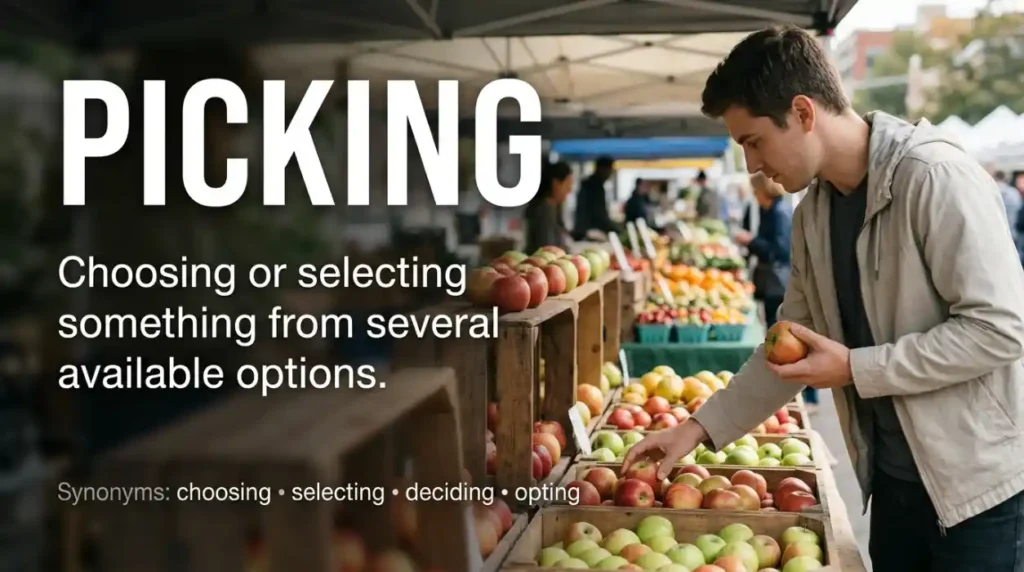
A synonym for picking depends on the intended meaning. For making a choice, use choosing, selecting, opting, deciding, or electing. For taking fruit or flowers, use plucking, gathering, collecting, or harvesting.
Synonyms for picking become important when the same word appears too often. A student may be picking a topic, while a farmer may be picking fruit from a tree.
The word “picking” is common because it describes simple actions in everyday English. Learning alternatives helps students, bloggers, writers, and speakers express those actions more precisely.
Imagine saying, “I am picking a topic.” That sounds natural, but “I am selecting a research topic” may sound more suitable in academic writing.
A good synonym for picking can make an email, essay, blog, or conversation clearer. The best choice depends on what is actually happening.
What Does “Picking” Really Mean?
Picking is the -ing form of the verb “pick.” It can describe several different actions.
The most common meanings include:
- Choosing something or someone
- Removing something with the fingers
- Taking fruit or flowers from a plant
- Collecting or gathering something
- Examining options and making a careful selection
For example:
- “She is picking a dress.” = She is choosing a dress.
- “They are picking strawberries.” = They are taking strawberries from plants.
- “He is picking lint from his jacket.” = He is removing small pieces.
- “We are picking a topic.” = We are choosing a topic.
Cambridge identifies both the choice sense and the removal or fruit-gathering sense, so the best synonym changes with context.
Part of Speech
Picking can work as:
- Present participle: “They are picking flowers.”
- Gerund: “Picking the right topic takes time.”
- Noun: “Fruit picking is seasonal.”
The exact grammatical role depends on how the sentence is constructed.
Connotative Meaning
Connotation means the feeling or association a word can carry beyond its basic dictionary meaning.
Positive Tone
“Picking” can have a positive tone when it suggests careful judgment.
Example: “She is picking the best candidates.”
Neutral Tone
The word is usually neutral when it describes a basic action.
Example: “They are picking apples.”
Negative Tone
Some expressions with pick can become negative.
For example, picking on someone suggests repeatedly criticizing, teasing, or treating that person unfairly.
Therefore, the emotional meaning usually comes from the context rather than from “picking” itself.
Etymology of “Picking”
The modern word picking comes from pick + -ing.
The history of pick is complex. Etymological sources connect the verb with Old English forms such as pician and pīcian, and with Old Norse pikka, meaning roughly “to prick” or “to peck.”
Old English: 450–1100
Old English had related forms associated with pricking or piercing. One recorded form is pīcung, referring to a piercing or pricking action.
Middle English: 1100–1500
Middle English developed forms such as piken, picken, and related spellings. The word gained meanings connected with working with a pointed tool, plucking, gathering, and removing.
Modern English: 1500–Present
The meaning expanded significantly. By the late fourteenth century, pick could describe carefully choosing or sorting through things. The fruit-gathering sense had already developed earlier.
Today, pick and picking have many everyday uses, including choosing, gathering, removing, selecting, and several phrasal verbs.
Pronunciation
Picking
- US: /ˈpɪkɪŋ/
- UK: /ˈpɪkɪŋ/
Syllables
pick-ing
Affixation Pattern
Root: pick
Prefix: none
Suffix: -ing
The -ing ending creates the present participle and gerund form.
Synonyms List
Important linguistic note: There are not 50 perfect one-word synonyms for picking in every sentence. The following list covers its major meanings accurately. Cambridge’s thesaurus groups pick with words such as choose, select, opt, decide, elect, pluck, gather, collect, and harvest according to context.
1. Choosing (Verb/Gerund) — US: /ˈtʃuːzɪŋ/ | UK: /ˈtʃuːzɪŋ/
Meaning: Choosing means deciding which person or thing you want from several possibilities.
Tone/Register: Neutral, everyday
Examples:
She is choosing a dress for the wedding.
We spent ten minutes choosing a restaurant.

2. Selecting (Verb/Gerund) — US: /sɪˈlɛktɪŋ/ | UK: /sɪˈlɛktɪŋ/
Meaning: Selecting means carefully choosing something from a group.
Tone/Register: Neutral, formal
Examples:
The editor is selecting articles for publication.
The teacher is selecting three students for the project.
3. Opting (Verb/Gerund) — US: /ˈɑːptɪŋ/ | UK: /ˈɒptɪŋ/
Meaning: Opting means choosing one possibility instead of another.
Tone/Register: Neutral
Examples:
I am opting for the earlier train.
She is opting to study from home.
4. Deciding (Verb/Gerund) — US: /dɪˈsaɪdɪŋ/ | UK: /dɪˈsaɪdɪŋ/
Meaning: Deciding means reaching a choice after considering possibilities.
Tone/Register: Neutral
Examples:
He is deciding which course to take.
We are deciding where to spend the weekend.
5. Electing (Verb/Gerund) — US: /ɪˈlɛktɪŋ/ | UK: /ɪˈlɛktɪŋ/
Meaning: Electing means choosing someone for an official position, usually by voting.
Tone/Register: Formal, political
Examples:
Citizens are electing a new mayor.
The members are electing their committee chair.
6. Appointing (Verb/Gerund) — US: /əˈpɔɪntɪŋ/ | UK: /əˈpɔɪntɪŋ/
Meaning: Appointing means officially choosing someone for a position.
Tone/Register: Formal, professional
Examples:
The board is appointing a new director.
The company is appointing her as team leader.
7. Nominating (Verb/Gerund) — US: /ˈnɑːməneɪtɪŋ/ | UK: /ˈnɒmɪneɪtɪŋ/
Meaning: Nominating means formally proposing someone for an award, position, or role.
Tone/Register: Formal
Examples:
The committee is nominating two candidates.
Fans are nominating their favorite performer.
8. Designating (Verb/Gerund) — US: /ˈdɛzɪɡneɪtɪŋ/ | UK: /ˈdezɪɡneɪtɪŋ/
Meaning: Designating means officially assigning or selecting something for a particular purpose.
Tone/Register: Formal
Examples:
The manager is designating a room for interviews.
The city is designating the building as a landmark.
9. Naming (Verb/Gerund) — US: /ˈneɪmɪŋ/ | UK: /ˈneɪmɪŋ/
Meaning: Naming can mean choosing someone for a particular position or role.
Tone/Register: Neutral
Examples:
The coach is naming a new captain.
The committee is naming the scholarship winner.
10. Preferring (Verb/Gerund) — US: /prɪˈfɜːrɪŋ/ | UK: /prɪˈfɜːrɪŋ/
Meaning: Preferring means favoring one option over another.
Tone/Register: Neutral
Examples:
She is preferring tea this morning.
Many readers prefer shorter articles.
11. Handpicking (Verb/Gerund) — US: /ˈhændˌpɪkɪŋ/ | UK: /ˈhændˌpɪkɪŋ/
Meaning: Handpicking means choosing something personally and with special care.
Tone/Register: Neutral, emphatic
Examples:
The chef is handpicking fresh vegetables.
She handpicked every guest for the event.
12. Shortlisting (Verb/Gerund) — US: /ˈʃɔːrtˌlɪstɪŋ/ | UK: /ˈʃɔːtˌlɪstɪŋ/
Meaning: Shortlisting means reducing a large group to a smaller group for further consideration.
Tone/Register: Business, professional
Examples:
The panel is shortlisting five applicants.
We are shortlisting topics for the conference.
13. Screening (Verb/Gerund) — US: /ˈskriːnɪŋ/ | UK: /ˈskriːnɪŋ/
Meaning: Screening means examining people or things to decide which meet specific requirements.
Tone/Register: Professional
Examples:
The company is screening applicants today.
The editor is screening submissions for quality.
14. Evaluating (Verb/Gerund) — US: /ɪˈvæljuˌeɪtɪŋ/ | UK: /ɪˈvæljuˌeɪtɪŋ/
Meaning: Evaluating means judging the quality or suitability of available choices.
Tone/Register: Academic, professional
Examples:
The committee is evaluating the proposals.
Students are evaluating different research methods.
15. Appraising (Verb/Gerund) — US: /əˈpreɪzɪŋ/ | UK: /əˈpreɪzɪŋ/
Meaning: Appraising means carefully assessing the value or quality of something.
Tone/Register: Formal
Examples:
The expert is appraising the painting.
The manager is appraising each proposal.
16. Settling On (Verb Phrase) — US: /ˈsɛtəlɪŋ ɑːn/ | UK: /ˈsɛtəlɪŋ ɒn/
Meaning: Settling on means finally choosing an option after considering alternatives.
Tone/Register: Neutral
Examples:
We are settling on Friday for the meeting.
The couple finally settled on a name.
17. Picking Out (Verb Phrase) — US: /ˈpɪkɪŋ aʊt/ | UK: /ˈpɪkɪŋ aʊt/
Meaning: Picking out means choosing one person or thing from several options.
Tone/Register: Informal, everyday
Examples:
She is picking out a birthday card.
I am picking out shoes for the trip.
18. Going For (Verb Phrase) — US: /ˈɡoʊɪŋ fɔːr/ | UK: /ˈɡəʊɪŋ fɔː/
Meaning: Going for means choosing or deciding in favor of an option.
Tone/Register: Informal
Examples:
I am going for the chocolate cake.
He is going for the larger apartment.
19. Settling Upon (Verb Phrase) — US: /ˈsɛtəlɪŋ əˈpɑːn/ | UK: /ˈsɛtəlɪŋ əˈpɒn/
Meaning: Settling upon means making a final choice after consideration.
Tone/Register: Formal, literary
Examples:
The team is settling upon a final design.
The author settled upon a simple title.
20. Single Out (Verb Phrase) — US: /ˈsɪŋɡəl aʊt/ | UK: /ˈsɪŋɡəl aʊt/
Meaning: Singling out means selecting one person or thing from a larger group.
Tone/Register: Neutral
Examples:
The judge singled out one performance.
The report singled out two major concerns.
21. Gathering (Verb/Gerund) — US: /ˈɡæðərɪŋ/ | UK: /ˈɡæðərɪŋ/
Meaning: Gathering means bringing things together from different places.
Tone/Register: Neutral
Examples:
The children are gathering flowers.
Researchers are gathering information for the study.
22. Collecting (Verb/Gerund) — US: /kəˈlɛktɪŋ/ | UK: /kəˈlɛktɪŋ/
Meaning: Collecting means bringing objects, information, or materials together.
Tone/Register: Neutral
Examples:
She is collecting shells at the beach.
The team is collecting survey responses.
23. Harvesting (Verb/Gerund) — US: /ˈhɑːrvəstɪŋ/ | UK: /ˈhɑːvɪstɪŋ/
Meaning: Harvesting means gathering mature crops from plants or fields.
Tone/Register: Agricultural
Examples:
Farm workers are harvesting wheat.
The family is harvesting oranges this week.
24. Plucking (Verb/Gerund) — US: /ˈplʌkɪŋ/ | UK: /ˈplʌkɪŋ/
Meaning: Plucking means pulling something away with the fingers.
Tone/Register: Neutral
Examples:
She is plucking herbs from the garden.
He carefully plucked a rose from the stem.
25. Gleaning (Verb/Gerund) — US: /ˈɡliːnɪŋ/ | UK: /ˈɡliːnɪŋ/
Meaning: Gleaning means collecting useful information or gathering what remains after a larger collection.
Tone/Register: Formal, literary
Examples:
The journalist is gleaning facts from old records.
Workers were gleaning leftover grain after harvest.
26. Reaping (Verb/Gerund) — US: /ˈriːpɪŋ/ | UK: /ˈriːpɪŋ/
Meaning: Reaping means cutting and gathering a mature crop.
Tone/Register: Agricultural, literary
Examples:
Farmers are reaping the wheat fields.
The workers began reaping before sunrise.
27. Pulling Off (Verb Phrase) — US: /ˈpʊlɪŋ ɔːf/ | UK: /ˈpʊlɪŋ ɒf/
Meaning: Pulling off can mean removing something by pulling it away.
Tone/Register: Informal
Examples:
He is pulling off the loose label.
She is pulling off dead leaves from the plant.
28. Pulling Out (Verb Phrase) — US: /ˈpʊlɪŋ aʊt/ | UK: /ˈpʊlɪŋ aʊt/
Meaning: Pulling out means removing something from where it is attached or placed.
Tone/Register: Neutral
Examples:
She is pulling out weeds from the soil.
He carefully pulled out a loose thread.
29. Detaching (Verb/Gerund) — US: /dɪˈtætʃɪŋ/ | UK: /dɪˈtætʃɪŋ/
Meaning: Detaching means separating something from what it is connected to.
Tone/Register: Formal, technical
Examples:
The worker is detaching the damaged part.
She is detaching the label from the package.
30. Removing (Verb/Gerund) — US: /rɪˈmuːvɪŋ/ | UK: /rɪˈmuːvɪŋ/
Meaning: Removing means taking something away from a place or object.
Tone/Register: Neutral
Examples:
She is removing weeds from the garden.
He is removing loose threads from his coat.
31. Extracting (Verb/Gerund) — US: /ɪkˈstræktɪŋ/ | UK: /ɪkˈstræktɪŋ/
Meaning: Extracting means taking something out from within another thing.
Tone/Register: Formal, technical
Examples:
The dentist is extracting a damaged tooth.
The program is extracting data from the document.
32. Peeling (Verb/Gerund) — US: /ˈpiːlɪŋ/ | UK: /ˈpiːlɪŋ/
Meaning: Peeling means removing an outer layer from something.
Tone/Register: Neutral
Examples:
She is peeling an orange for lunch.
He spent the afternoon peeling potatoes.
33. Separating (Verb/Gerund) — US: /ˈsɛpəreɪtɪŋ/ | UK: /ˈsepəreɪtɪŋ/
Meaning: Separating means taking one thing or group away from another.
Tone/Register: Neutral, formal
Examples:
Workers are separating damaged fruit.
The machine is separating metal from plastic.
34. Sifting (Verb/Gerund) — US: /ˈsɪftɪŋ/ | UK: /ˈsɪftɪŋ/
Meaning: Sifting means examining a large amount of material to identify useful or suitable items.
Tone/Register: Neutral, formal
Examples:
The journalist is sifting through old files.
She spent hours sifting through applications.
35. Sorting (Verb/Gerund) — US: /ˈsɔːrtɪŋ/ | UK: /ˈsɔːrtɪŋ/
Meaning: Sorting means separating things into groups according to type, quality, or suitability.
Tone/Register: Neutral
Examples:
She is sorting clothes for donation.
The assistant is sorting the documents by date.
36. Rounding Up (Verb Phrase) — US: /ˈraʊndɪŋ ʌp/ | UK: /ˈraʊndɪŋ ʌp/
Meaning: Rounding up means gathering people, animals, or things into one group.
Tone/Register: Neutral
Examples:
The teacher is rounding up the students.
Farmers are rounding up the sheep.
37. Scooping Up (Verb Phrase) — US: /ˈskuːpɪŋ ʌp/ | UK: /ˈskuːpɪŋ ʌp/
Meaning: Scooping up means gathering something quickly with a hand or tool.
Tone/Register: Informal
Examples:
The child is scooping up sand.
Workers were scooping up spilled grain.
38. Amassing (Verb/Gerund) — US: /əˈmæsɪŋ/ | UK: /əˈmæsɪŋ/
Meaning: Amassing means collecting a large quantity over time.
Tone/Register: Formal
Examples:
The museum is amassing rare manuscripts.
The researcher is amassing evidence.
39. Accumulating (Verb/Gerund) — US: /əˈkjuːmjəleɪtɪŋ/ | UK: /əˈkjuːmjəleɪtɪŋ/
Meaning: Accumulating means gradually collecting or increasing the amount of something.
Tone/Register: Academic, formal
Examples:
The scientist is accumulating data.
Dust is accumulating on the shelves.
40. Acquiring (Verb/Gerund) — US: /əˈkwaɪərɪŋ/ | UK: /əˈkwaɪərɪŋ/
Meaning: Acquiring means obtaining something through effort, learning, purchase, or selection.
Tone/Register: Formal, professional
Examples:
She is acquiring new language skills.
The library is acquiring rare books.

41. Obtaining (Verb/Gerund) — US: /əbˈteɪnɪŋ/ | UK: /əbˈteɪnɪŋ/
Meaning: Obtaining means successfully getting something that is needed or wanted.
Tone/Register: Formal
Examples:
He is obtaining permission from the manager.
The team is obtaining fresh evidence.
42. Procuring (Verb/Gerund) — US: /prəˈkjʊrɪŋ/ | UK: /prəˈkjʊərɪŋ/
Meaning: Procuring means obtaining something through an organized or official process.
Tone/Register: Business, formal
Examples:
The hospital is procuring new equipment.
The department is procuring materials for the project.
43. Securing (Verb/Gerund) — US: /sɪˈkjʊrɪŋ/ | UK: /sɪˈkjʊərɪŋ/
Meaning: Securing means successfully obtaining something desired or needed.
Tone/Register: Professional
Examples:
She is securing a place at the conference.
The team is securing approval for the proposal.
44. Curating (Verb/Gerund) — US: /kjʊˈreɪtɪŋ/ | UK: /kjʊˈreɪtɪŋ/
Meaning: Curating means carefully selecting and organizing items for presentation.
Tone/Register: Professional, creative
Examples:
The museum is curating a new exhibition.
She is curating photographs for her portfolio.
45. Cherry-Picking (Verb/Gerund) — US: /ˈtʃɛri ˌpɪkɪŋ/ | UK: /ˈtʃeri ˌpɪkɪŋ/
Meaning: Cherry-picking means selectively choosing the most favorable items while ignoring others.
Tone/Register: Informal, often negative
Examples:
The article is cherry-picking statistics.
Critics accused the speaker of cherry-picking evidence.
46. Filtering (Verb/Gerund) — US: /ˈfɪltərɪŋ/ | UK: /ˈfɪltərɪŋ/
Meaning: Filtering means removing unsuitable choices so that only relevant ones remain.
Tone/Register: Neutral, technical
Examples:
The editor is filtering weak submissions.
The system is filtering irrelevant results.
47. Weighing (Verb/Gerund) — US: /ˈweɪɪŋ/ | UK: /ˈweɪɪŋ/
Meaning: Weighing means carefully considering different options before making a decision.
Tone/Register: Neutral, formal
Examples:
The committee is weighing several proposals.
I am weighing my options before responding.
48. Deliberating (Verb/Gerund) — US: /dɪˈlɪbəreɪtɪŋ/ | UK: /dɪˈlɪbəreɪtɪŋ/
Meaning: Deliberating means thinking carefully about alternatives before reaching a decision.
Tone/Register: Formal
Examples:
The jury is deliberating over the verdict.
The board spent hours deliberating over the proposal.
49. Favoring (Verb/Gerund) — US: /ˈfeɪvərɪŋ/ | UK: /ˈfeɪvərɪŋ/
Meaning: Favoring means showing a preference for one option over another.
Tone/Register: Neutral, formal
Examples:
The committee is favoring the second proposal.
Voters appear to be favoring the younger candidate.
50. Curating Carefully (Verb Phrase) — US: /kjʊˈreɪtɪŋ ˈkɛrfəli/ | UK: /kjʊˈreɪtɪŋ ˈkeəfəli/
Meaning: Curating carefully describes making a deliberate selection while considering quality, relevance, and presentation.
Tone/Register: Professional, editorial
Examples:
The writer is curating carefully before publishing the collection.
The editor is curating carefully to keep the final list focused.
Synonyms by Tone
Use handpicking, selecting, curating, evaluating, appraising, and weighing when you want to suggest care and judgment.
Positive
These words work especially well when the person making the choice has a clear reason for doing so.
Neutral
The most neutral options include choosing, picking, selecting, gathering, collecting, removing, sorting, and deciding.
These are useful in everyday conversation and general writing.
Formal
For academic and professional contexts, use selecting, evaluating, screening, shortlisting, appointing, designating, procuring, deliberating, or acquiring.
They sound more precise than casual “picking.”
Negative or Critical
Cherry-picking can have a negative meaning when someone chooses only evidence that supports a preferred argument.
For example, a researcher should not be accused of cherry-picking evidence unless the evidence selection is genuinely selective or misleading.
Playful or Informal
Picking out, going for, handpicking, and scooping up can sound conversational.
The right word depends on the action, not simply on how informal you want to sound.
“Picking” vs Close Alternatives
Choosing VS Picking
Picking and choosing can be interchangeable when someone decides between options.
“Picking” is especially common in casual speech.
Example: “Pick a movie.”
“Choosing” is equally natural and slightly more neutral.
Example: “Choose a movie.”
Picking vs Selecting
Selecting suggests a more deliberate or systematic decision.
“Pick one answer” sounds natural in everyday speech.
“Select one answer” sounds more suitable for instructions, forms, tests, and formal writing.
Picking vs Gathering
These words describe different actions.
Picking can mean removing fruit or flowers from a plant.
Gathering emphasizes bringing multiple things together.
Compare:
- “She is picking strawberries.”
- “She is gathering strawberries into a basket.”
How “Picking” Changes by Context
Daily Conversation
In casual English, picking and choosing are the most natural alternatives.
You might say:
“I’m picking a movie.”
“Pick any seat.”
“She picked the blue one.”
These sentences sound simple and conversational.
Writing and Blogging
Bloggers should select words according to their exact meaning.
Use choosing for general decisions. Selecting for careful choices. Use curating when organizing content.
For example, “The writer is curating useful examples” is more precise than repeating “The writer is picking examples.”
Professional and Academic Writing
Formal contexts benefit from more specific vocabulary.
A hiring manager might screen applicants.
A committee might shortlist candidates.
Researchers might select participants.
A board might appoint a director.
These choices make professional writing more precise.
Creative and Informal Writing
Creative writing can use vivid verbs.
Plucking creates a physical image.
Handpicking emphasizes care.
Sifting suggests searching through many possibilities.
These alternatives can make descriptions more expressive.
Common Mistakes and Native Usage
Mistake 1: Using “harvesting” for every type of picking
Harvesting is strongly connected with crops, plants, agricultural products, and systematic collection.
Say:
“She is picking a dress.”
Not:
“She is harvesting a dress.”
Mistake 2: Using “selecting” in every casual situation
“Selecting” is correct, but it can sound formal.
Natural conversation:
“Pick a color.”
Formal instruction:
“Select a color.”
Mistake 3: Confusing “picking” and “picking up”
These expressions are not interchangeable.
Pick can mean choosing or removing something.
Pick up commonly means lifting something with your hands.
Cambridge specifically distinguishes the two uses.
Mistake 4: Confusing picking with plucking
Plucking focuses on physically pulling something away.
Choosing focuses on making a decision.
“She is plucking flowers” and “She is choosing flowers” describe different actions.
Mistake 5: Using “cherry-picking” positively
Cherry-picking often suggests selective behavior that ignores less favorable information.
It is not a neutral replacement for “selecting.”
Real-Life Mini Scenarios

Workplace
A hiring team is screening applications and shortlisting candidates for interviews.
Social Situation
Friends are choosing a restaurant and picking out meals from the menu.
Farming
Workers are harvesting tomatoes and gathering them into baskets.
Media and Journalism
A journalist is sifting through documents and selecting the strongest evidence.
Blogging
A content writer is curating examples before publishing a vocabulary article.
Storytelling
A character may spend an afternoon plucking flowers while thinking about an important decision.
Practice Exercise
1. Which word is most suitable for a formal instruction?
A. Picking
B. Selecting
C. Going for
D. Scooping up
2. Which word best describes collecting mature crops?
A. Screening
B. Harvesting
C. Appointing
D. Naming
3. Which phrase means choosing one item from several options?
A. Picking out
B. Pulling out
C. Rounding up
D. Peeling off
4. Which word means officially choosing someone for a position?
A. Gathering
B. Appointing
C. Plucking
D. Sifting
5. Which word suggests especially careful personal selection?
A. Handpicking
B. Removing
C. Separating
D. Pulling
6. Which word fits a researcher collecting information gradually?
A. Gleaning
B. Peeling
C. Naming
D. Electing
7. Which sentence sounds most natural in casual conversation?
A. I am procuring a movie.
B. I am designating a movie.
C. I am picking a movie.
D. I am appointing a movie.
8. Which word means examining applicants before deciding who continues?
A. Screening
B. Plucking
C. Harvesting
D. Peeling
9. Which word best describes removing a flower from its stem?
A. Evaluating
B. Plucking
C. Electing
D. Shortlisting
10. Which phrase means finally choosing an option?
A. Settling on
B. Rounding up
C. Scooping up
D. Pulling out
Reflection Task:
Write two sentences using different alternatives for picking.
Then explain how the meaning changes when you replace picking with selecting, plucking, gathering, harvesting, or curating.
Answer Key:
1-B | 2-B | 3-A | 4-B | 5-A | 6-A | 7-C | 8-A | 9-B | 10-A
Frequently Asked Questions
1. What is the best synonym for picking when choosing something?
The best everyday synonym is usually choosing. Selecting is another strong option, especially in formal or professional writing. For example, “I’m choosing a dress” sounds natural in conversation, while “The committee is selecting a candidate” sounds more formal. The best alternative depends on the situation and the level of precision required.
2. What is another word for picking fruit?
Common alternatives include harvesting, gathering, collecting, plucking, and reaping. Harvesting is especially appropriate for agricultural contexts. Plucking emphasizes the physical action of removing fruit from a plant. Gathering focuses more on bringing the collected fruit together. Cambridge lists pluck, gather, collect, and harvest among alternatives for the relevant sense of pick.
3. What is a formal synonym for picking?
Selecting is one of the most useful formal alternatives. Depending on the situation, evaluating, screening, shortlisting, appointing, designating, or deliberating may be more precise. For example, “The panel is selecting candidates” is suitable for professional writing, while “Pick a candidate” sounds much more conversational.
4. Is picking the same as choosing?
Often, yes. Both can describe deciding between two or more possibilities. However, picking is generally more conversational, while choosing is neutral and widely suitable. Selecting often sounds more deliberate or formal. Cambridge directly lists choose and select as alternatives to pick in the choice sense.
5. What is the difference between picking and picking up?
Picking can mean choosing something or removing something from a plant or surface. Picking up commonly means lifting something with your hands. For example, “She is picking flowers” means removing flowers from plants, while “She is picking up the flowers” means lifting flowers that are already somewhere else.
6. What is another word for picking flowers?
The most useful alternatives are plucking, gathering, collecting, and harvesting. Use plucking when emphasizing the physical act of removing flowers from stems. Use gathering when emphasizing the collection of several flowers. Harvesting is better when flowers are treated as an agricultural crop.
7. What is a synonym for picking someone for a team?
Useful alternatives include selecting, choosing, electing, nominating, and appointing, but the correct word depends on the process. Selecting is general. Electing usually involves voting. Appointing means officially assigning a role. Nominating means proposing someone for consideration rather than necessarily making the final choice.
8. What is a good synonym for picking in academic writing?
Selecting is usually the safest choice. Other possibilities include evaluating, screening, shortlisting, assessing, and considering. For example, “The researchers are selecting participants” sounds precise and professional. Choose the alternative that explains the actual process instead of replacing picking automatically.
Conclusion
Learning a synonym for picking gives you more control over your vocabulary. Choosing, selecting, and opting can describe decisions with different levels of formality.
Words such as gathering, collecting, plucking, and harvesting make physical actions clearer. This precision helps readers understand exactly what you mean.
For students and writers, varied vocabulary makes essays, blogs, and emails smoother. In conversation, natural alternatives also help you sound confident without forcing difficult words.
Practice these alternatives in your own sentences, emails, essays, and daily conversations. Start with one new word today and notice where it fits naturally.
Suggested External Sources
For definitions, pronunciation, grammar, and usage examples, Cambridge Dictionary is a strong reference. Its thesaurus specifically distinguishes choice-related and fruit-gathering meanings of pick.
For etymology and historical development, Online Etymology Dictionary provides useful background on the development of pick and its related forms.

Jameel Hassan is the founder and lead writer at SynonymsCloud.com, a trusted online platform dedicated to English vocabulary and effective communication. He is passionate about helping students, writers, professionals, and lifelong learners discover the right words to express their ideas with clarity, precision, and confidence.
At SynonymsCloud.com, every article is thoroughly researched and carefully written to provide accurate, practical, and easy-to-understand guidance on synonyms, antonyms, word meanings, idioms, and vocabulary. With a strong commitment to quality, real-world usage, and clear explanations, the website helps readers expand their vocabulary, improve their writing, and communicate more effectively in both academic and professional settings.