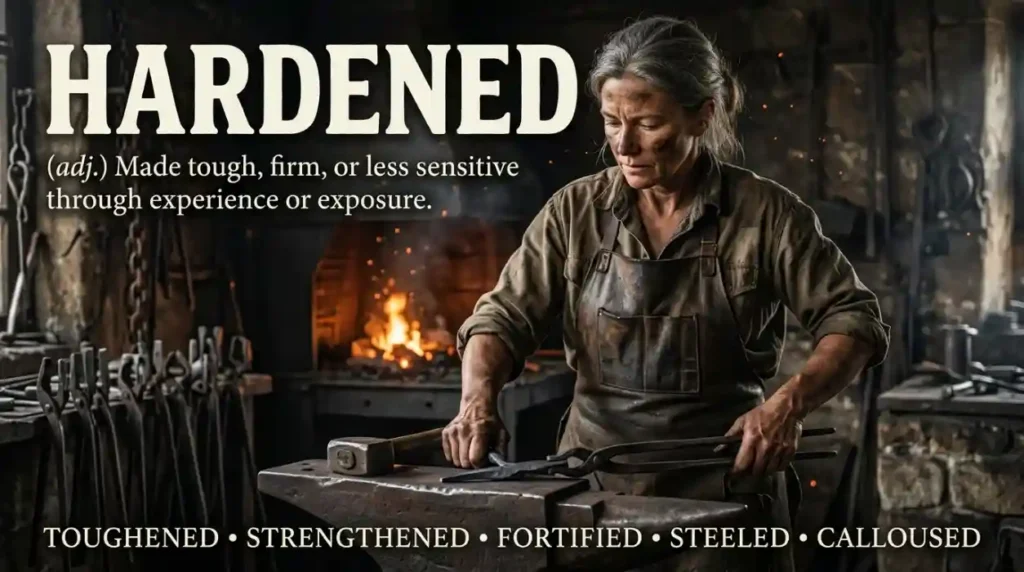
A synonym for hardened depends on the situation. Words such as toughened, strengthened, solidified, hardened, calloused, and resilient can describe something physically firm, emotionally less sensitive, or more resistant to damage.
Imagine a metal surface exposed to extreme heat until it becomes solid and firm. You might describe it as solidified or strengthened. A synonym for hardened helps explain physical changes more clearly.
When a person becomes emotionally stronger after facing difficult experiences, words such as resilient or toughened may be more suitable. Choosing the right synonym for hardened makes your writing more natural and meaningful.
The word hardened appears in science, construction, psychology, everyday conversations, and storytelling. Its meaning depends on the context and subject being described.
Students, bloggers, content writers, and English learners can explore each synonym for hardened to expand their vocabulary, avoid repetition, and express ideas with greater precision.
What Does “Hardened” Really Mean?
Hardened means made or become hard, firm, strong, or resistant. It can describe a physical material that becomes less soft or a person who becomes emotionally less sensitive after difficult experiences.
It is commonly used as an adjective and as the past tense or past participle of the verb harden.
Native speakers understand the word according to its context. For example:
- Physical: Hardened concrete becomes firm and solid.
- Emotional: A hardened person may show little sympathy or emotion.
- Practical: Hardened security protects a system against attacks.
- Experiential: A hardened criminal has extensive experience with crime.
The word can communicate strength and durability, but it can also suggest emotional coldness or a lack of compassion.
Connotative Meaning of Hardened
Connotation means the emotional feeling or association that a word creates beyond its basic dictionary meaning.
Positive tone: Hardened can suggest strength, resilience, durability, and the ability to survive difficult conditions. For example, a hardened athlete may be physically prepared for demanding competition.
Negative tone: It can describe someone who has become cold, insensitive, cruel, or unwilling to feel sympathy.
Neutral tone: In technical contexts, it simply describes a material or surface that has become firm, solid, or more resistant.
Etymology of Hardened
The word hardened comes from the verb harden, formed from the adjective hard and the suffix -en. The suffix creates a verb meaning “to make hard” or “to become hard.”
The Old English word heard meant firm, solid, difficult, or strong. Its Germanic roots are related to similar words in other Germanic languages.
Old English (450–1100)
The Old English form heard described something firm, strong, or difficult to bend. It could also describe a person who was brave or strong.
Middle English (1100–1500)
During Middle English, forms of hard continued to develop. The verb harden became established as a way to describe making something firm or becoming less soft.
Modern English (1500–Present)
In Modern English, hardened developed several common uses. It describes solid materials, strengthened surfaces, emotional changes, experienced individuals, and systems made more resistant to threats.
Pronunciation of Hardened
- US: /ˈhɑːr.dənd/
- UK: /ˈhɑː.dənd/
Syllables
har-dened: 2 syllables.
Affixation Pattern of Hardened
- Root: Hard
- Prefix: None
- Suffix: -en + -ed
- Word formation: Hard + -en = harden; harden + -ed = hardened.
The suffix -en forms a verb meaning to make or become hard. The ending -ed marks the past tense or past participle.
Synonyms List
The best replacement depends on whether hardened describes a material, a person’s emotions, a physical condition, or pressure resistance. Some alternatives below are direct synonyms, while others fit specific contexts.
1. Toughened (Adjective/Verb) — US /ˈtʌf.ənd/ | UK /ˈtʌf.ənd/
Meaning: Made stronger or more resistant to physical damage, pressure, or difficult conditions.
Tone/Register: Neutral, positive.
Examples:
Years of training toughened her muscles.
The new treatment toughened the glass.

2. Strengthened (Adjective/Verb) — US /ˈstreŋk.θənd/ | UK /ˈstreŋk.θənd/
Meaning: Made stronger, more powerful, or better able to withstand pressure.
Tone/Register: Neutral, formal.
Examples:
The repairs strengthened the old bridge.
Their friendship was strengthened by shared challenges.
3. Solidified (Adjective/Verb) — US /səˈlɪd.ə.faɪd/ | UK /səˈlɪd.ɪ.faɪd/
Meaning: Changed into a solid or firm state, especially from a liquid or soft condition.
Tone/Register: Neutral, scientific.
Examples:
The melted wax solidified as it cooled.
The mixture solidified inside the container.
4. Firmed (Verb) — US /fɝːmd/ | UK /fɜːmd/
Meaning: Became or was made more firm and less soft.
Tone/Register: Neutral.
Examples:
The ground firmed after several dry days.
The cream firmed the skin’s appearance.
5. Hardened-Up (Informal Expression) — US /ˌhɑːr.dənd ˈʌp/ | UK /ˌhɑː.dənd ˈʌp/
Meaning: Became tougher, more confident, or less easily affected by difficult experiences.
Tone/Register: Informal.
Examples:
He hardened up after several demanding seasons.
The team hardened up during the competition.
6. Fortified (Adjective/Verb) — US /ˈfɔːr.t̬ə.faɪd/ | UK /ˈfɔː.tɪ.faɪd/
Meaning: Strengthened or protected against damage, attack, or weakness.
Tone/Register: Formal, technical.
Examples:
The builders fortified the walls against storms.
The fortified structure survived the heavy winds.
7. Reinforced (Adjective/Verb) — US /ˌriː.ɪnˈfɔːrst/ | UK /ˌriː.ɪnˈfɔːst/
Meaning: Made stronger by adding support or extra protection.
Tone/Register: Neutral, technical.
Examples:
Workers reinforced the roof with steel beams.
The reinforced door resisted the impact.
8. Rigid (Adjective) — US /ˈrɪdʒ.ɪd/ | UK /ˈrɪdʒ.ɪd/
Meaning: Stiff, firm, and difficult to bend or change.
Tone/Register: Neutral, technical.
Examples:
The rigid plastic kept its original shape.
A rigid frame supported the heavy equipment.
9. Stiffened (Adjective/Verb) — US /ˈstɪf.ənd/ | UK /ˈstɪf.ənd/
Meaning: Became stiff, firm, or less flexible.
Tone/Register: Neutral.
Examples:
The fabric stiffened after washing.
His shoulders stiffened when he heard the noise.
10. Solid (Adjective) — US /ˈsɑː.lɪd/ | UK /ˈsɒl.ɪd/
Meaning: Firm and stable rather than soft, liquid, or easily broken.
Tone/Register: Neutral.
Examples:
The workers placed the machine on solid ground.
The solid surface supported the heavy boxes.
11. Resilient (Adjective) — US /rɪˈzɪl.jənt/ | UK /rɪˈzɪl.i.ənt/
Meaning: Able to recover quickly from difficulties or withstand pressure without giving up.
Tone/Register: Positive, formal.
Examples:
The resilient community recovered after the flood.
She remained resilient during a difficult year.
12. Calloused (Adjective) — US /ˈkæl.əst/ | UK /ˈkæl.əst/
Meaning: Having thick, rough skin because of repeated friction or pressure; it can also describe someone emotionally insensitive.
Tone/Register: Neutral or negative, depending on context.
Examples:
His calloused hands showed years of hard work.
Repeated disappointments left her emotionally calloused.
13. Thickened (Adjective/Verb) — US /ˈθɪk.ənd/ | UK /ˈθɪk.ənd/
Meaning: Became thicker, denser, or less fluid.
Tone/Register: Neutral, scientific.
Examples:
The sauce thickened while it simmered.
The skin thickened around the affected area.
14. Cured (Adjective/Verb) — US /kjʊrd/ | UK /kjʊəd/
Meaning: Treated so that a material becomes firm, durable, or ready for use.
Tone/Register: Technical, neutral.
Examples:
The cured concrete was ready for inspection.
The leather was cured using a traditional process.
15. Tempered (Adjective/Verb) — US /ˈtem.pɚd/ | UK /ˈtem.pəd/
Meaning: Made stronger or more resistant through a controlled treatment or process.
Tone/Register: Technical, formal.
Examples:
The factory produced tempered glass for the windows.
The tempered metal could withstand higher temperatures.
16. Hardened-Off (Adjective/Verb) — US /ˌhɑːr.dənd ˈɔːf/ | UK /ˌhɑː.dənd ˈɒf/
Meaning: Gradually adapted to outdoor conditions, especially when describing young plants.
Tone/Register: Horticultural, technical.
Examples:
The gardener hardened off the seedlings before planting.
The hardened-off plants handled the cooler weather.
17. Weathered (Adjective/Verb) — US /ˈweð.ɚd/ | UK /ˈweð.əd/
Meaning: Worn or changed by exposure to weather, age, or difficult experiences.
Tone/Register: Neutral, descriptive.
Examples:
The weathered wooden door looked decades old.
His weathered face reflected years of outdoor work.
18. Seasoned (Adjective) — US /ˈsiː.zənd/ | UK /ˈsiː.zənd/
Meaning: Experienced and familiar with demanding situations.
Tone/Register: Positive, professional.
Examples:
A seasoned manager handled the crisis calmly.
The seasoned athlete knew how to manage pressure.
19. Battle-Hardened (Adjective) — US /ˈbæt̬.əl ˌhɑːr.dənd/ | UK /ˈbæt.əl ˌhɑː.dənd/
Meaning: Made tough through repeated exposure to conflict, danger, or difficult experiences.
Tone/Register: Dramatic, descriptive.
Examples:
The battle-hardened reporter remained calm in dangerous situations.
A battle-hardened leader guided the team through the crisis.
20. Desensitized (Adjective/Verb) — US /diːˈsen.sə.taɪzd/ | UK /diːˈsen.sɪ.taɪzd/
Meaning: Made less emotionally or physically responsive to something through repeated exposure.
Tone/Register: Psychological, often negative.
Examples:
Constant exposure to violent images desensitized some viewers.
He became desensitized to the repeated criticism.
21. Unfeeling (Adjective) — US /ʌnˈfiː.lɪŋ/ | UK /ʌnˈfiː.lɪŋ/
Meaning: Showing little or no sympathy, kindness, or emotional concern.
Tone/Register: Negative.
Examples:
His unfeeling response upset the entire group.
The character seemed unfeeling toward other people’s problems.
22. Callous (Adjective) — US /ˈkæl.əs/ | UK /ˈkæl.əs/
Meaning: Emotionally insensitive and unwilling to care about other people’s suffering.
Tone/Register: Strongly negative.
Examples:
The callous remark hurt her deeply.
His callous attitude made the situation worse.
23. Emotionally Numb (Adjective Phrase) — US /ɪˈmoʊ.ʃən.əl.i nʌm/ | UK /ɪˈməʊ.ʃən.əl.i nʌm/
Meaning: Unable to feel or express emotions normally, often after stress or trauma.
Tone/Register: Psychological, descriptive.
Examples:
She felt emotionally numb after the sudden loss.
He remained emotionally numb for several days.
24. Cold-Hearted (Adjective) — US /ˌkoʊldˈhɑːr.t̬ɪd/ | UK /ˌkəʊldˈhɑː.tɪd/
Meaning: Lacking warmth, kindness, or sympathy toward others.
Tone/Register: Negative, informal.
Examples:
The cold-hearted decision shocked the employees.
The story’s villain appeared cold-hearted and cruel.
25. Unyielding (Adjective) — US /ʌnˈjiːl.dɪŋ/ | UK /ʌnˈjiːl.dɪŋ/
Meaning: Refusing to bend, weaken, or change despite pressure.
Tone/Register: Formal, strong.
Examples:
The unyielding material resisted heavy pressure.
Her unyielding determination helped her reach the goal.
26. Inflexible (Adjective) — US /ɪnˈflek.sə.bəl/ | UK /ɪnˈflek.sə.bəl/
Meaning: Unable or unwilling to bend, adapt, or change easily.
Tone/Register: Neutral or negative.
Examples:
The inflexible plastic cracked under pressure.
The manager’s inflexible rules frustrated the staff.
27. Durable (Adjective) — US /ˈdʊr.ə.bəl/ | UK /ˈdjʊə.rə.bəl/
Meaning: Able to last a long time without becoming damaged or worn out.
Tone/Register: Positive, technical.
Examples:
The durable material survived years of use.
They selected durable flooring for the busy hallway.
28. Sturdy (Adjective) — US /ˈstɝː.di/ | UK /ˈstɜː.di/
Meaning: Strongly built and unlikely to break or collapse.
Tone/Register: Neutral, positive.
Examples:
The sturdy table supported the heavy equipment.
She wore sturdy boots for the long hike.
29. Hardened-Hearted (Adjective) — US /ˌhɑːr.dənd ˈhɑːr.t̬ɪd/ | UK /ˌhɑː.dənd ˈhɑː.tɪd/
Meaning: Having little sympathy or emotional softness toward other people.
Tone/Register: Negative, literary.
Examples:
The hardened-hearted ruler ignored the villagers’ suffering.
His hardened-hearted behavior damaged their relationship.
30. Inured (Adjective/Verb) — US /ɪˈnʊrd/ | UK /ɪˈnjʊəd/
Meaning: Accustomed to something unpleasant through repeated exposure.
Tone/Register: Formal, literary.
Examples:
The nurses became inured to the hospital’s demanding routine.
Years of criticism had inured him to negative comments.
31. Tough (Adjective) — US /tʌf/ | UK /tʌf/
Meaning: Strong enough to withstand pressure, damage, or difficult conditions.
Tone/Register: Neutral, informal.
Examples:
The tough material resisted scratches.
She developed a tough attitude after years of competition.
32. Hardened-Set (Adjective) — US /ˌhɑːr.dənd ˈset/ | UK /ˌhɑː.dənd ˈset/
Meaning: Firmly set or solidified, especially when describing a material.
Tone/Register: Technical, descriptive.
Examples:
The hardened-set plaster covered the wall evenly.
Workers removed the hardened-set mixture from the tools.
33. Crusted (Adjective/Verb) — US /ˈkrʌs.tɪd/ | UK /ˈkrʌs.tɪd/
Meaning: Covered with or formed into a hard outer layer.
Tone/Register: Descriptive, neutral.
Examples:
The old paint crusted around the metal frame.
A crusted layer formed on the surface.
34. Congealed (Adjective/Verb) — US /kənˈdʒiːld/ | UK /kənˈdʒiːld/
Meaning: Became thick, sticky, or solid, especially when a liquid cooled.
Tone/Register: Scientific, descriptive.
Examples:
The sauce congealed after sitting in the refrigerator.
The oil congealed in the cold weather.
35. Coagulated (Adjective/Verb) — US /koʊˈæɡ.jə.leɪ.tɪd/ | UK /kəʊˈæɡ.jə.leɪ.tɪd/
Meaning: Changed from a liquid into a thicker or semi-solid mass.
Tone/Register: Scientific, medical.
Examples:
The blood coagulated around the small wound.
The laboratory observed how the substance coagulated.
36. Crystallized (Adjective/Verb) — US /ˈkrɪs.təl.aɪzd/ | UK /ˈkrɪs.təl.aɪzd/
Meaning: Formed into crystals or became solid through crystallization.
Tone/Register: Scientific, descriptive.
Examples:
The sugar crystallized along the edge of the jar.
Minerals crystallized inside the rock.
37. Compact (Adjective) — US /kəmˈpækt/ | UK /kəmˈpækt/
Meaning: Closely packed together, making something dense and firm.
Tone/Register: Neutral, technical.
Examples:
The compact soil made digging difficult.
A compact layer formed beneath the surface.
38. Compressed (Adjective/Verb) — US /kəmˈprest/ | UK /kəmˈprest/
Meaning: Pressed together so that something becomes denser or takes up less space.
Tone/Register: Technical, neutral.
Examples:
The compressed material became dense and firm.
Workers compressed the soil before laying the pavement.
39. Hardened-By-Experience (Adjective Phrase) — US /ˈhɑːr.dənd baɪ ɪkˈspɪr.i.əns/ | UK /ˈhɑː.dənd baɪ ɪkˈspɪə.ri.əns/
Meaning: Made emotionally tougher or more experienced through difficult events.
Tone/Register: Descriptive, neutral.
Examples:
She was hardened by experience but remained fair.
The journalist had been hardened by years of reporting.
40. Inflexibly Set (Adjective Phrase) — US /ɪnˈflek.sə.bli set/ | UK /ɪnˈflek.sə.bli set/
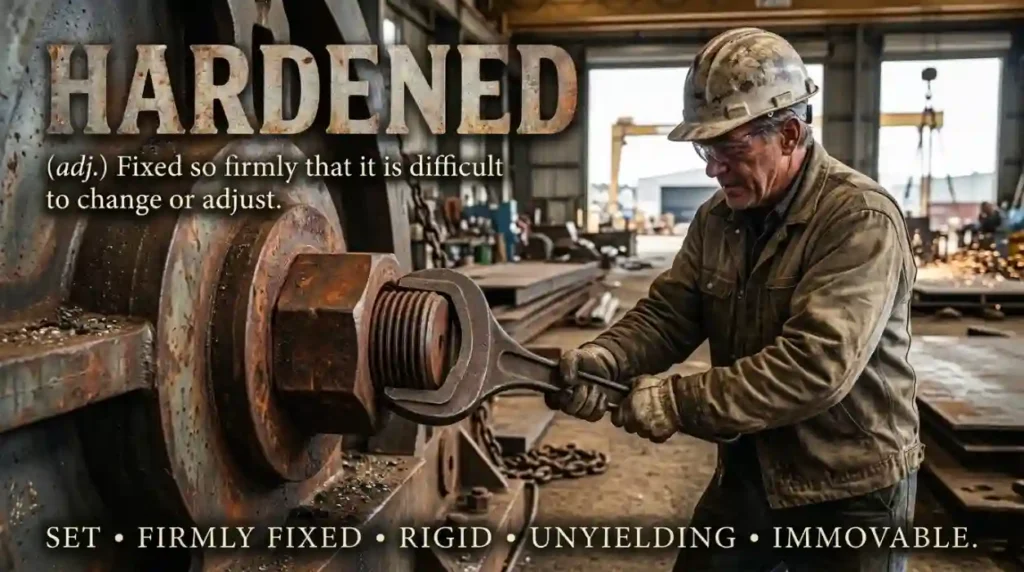
Meaning: Fixed so firmly that it is difficult to change or adjust.
Tone/Register: Formal, descriptive.
Examples:
The rules became inflexibly set after the policy change.
His opinions were inflexibly set despite new evidence.
41. Steeled (Adjective/Verb) — US /stiːld/ | UK /stiːld/
Meaning: Made mentally stronger or more determined to face a difficult situation.
Tone/Register: Positive, literary.
Examples:
She steeled herself before delivering the difficult news.
The experience steeled his determination to succeed.
42. Impenetrable (Adjective) — US /ɪmˈpen.ə.trə.bəl/ | UK /ɪmˈpen.ɪ.trə.bəl/
Meaning: Impossible or extremely difficult to pass through, enter, or understand.
Tone/Register: Formal, technical.
Examples:
The impenetrable barrier protected the facility.
Dense fog formed an almost impenetrable wall.
43. Impervious (Adjective) — US /ɪmˈpɝː.vi.əs/ | UK /ɪmˈpɜː.vi.əs/
Meaning: Not affected or damaged by a particular substance, influence, or condition.
Tone/Register: Formal, technical.
Examples:
The coating made the surface impervious to water.
He seemed impervious to public criticism.
44. Hardened-Grade (Adjective Phrase) — US /ˈhɑːr.dənd ɡreɪd/ | UK /ˈhɑː.dənd ɡreɪd/
Meaning: Describes a material classified or manufactured for a particular level of hardness.
Tone/Register: Technical.
Examples:
The engineer selected a hardened-grade steel component.
The manufacturer tested the hardened-grade material for strength.
45. Inflexibly Tough (Adjective Phrase) — US /ɪnˈflek.sə.bli tʌf/ | UK /ɪnˈflek.sə.bli tʌf/
Meaning: Extremely resistant to bending or changing, sometimes suggesting excessive rigidity.
Tone/Register: Descriptive.
Examples:
The inflexibly tough coating resisted repeated pressure.
His inflexibly tough attitude made teamwork difficult.
46. Uncompromising (Adjective) — US /ʌnˈkɑːm.prə.maɪ.zɪŋ/ | UK /ʌnˈkɒm.prə.maɪ.zɪŋ/
Meaning: Refusing to weaken standards, principles, or demands.
Tone/Register: Formal, strong.
Examples:
The uncompromising coach expected complete commitment.
Her uncompromising standards improved the team’s performance.
47. Steadfast (Adjective) — US /ˈsted.fæst/ | UK /ˈsted.fɑːst/
Meaning: Firmly committed and unlikely to change in the face of difficulty.
Tone/Register: Positive, formal.
Examples:
He remained steadfast during the difficult negotiations.
Her steadfast support encouraged the entire team.
48. Unbreakable (Adjective) — US /ʌnˈbreɪ.kə.bəl/ | UK /ʌnˈbreɪ.kə.bəl/
Meaning: So strong that it cannot easily be broken or damaged.
Tone/Register: Positive, descriptive.
Examples:
The manufacturer designed an unbreakable storage container.
Their unbreakable bond survived years apart.
49. Hardened-Surface (Adjective Phrase) — US /ˈhɑːr.dənd ˈsɝː.fɪs/ | UK /ˈhɑː.dənd ˈsɜː.fɪs/
Meaning: Describes an outer layer that has become firm, solid, or resistant to wear.
Tone/Register: Technical, descriptive.
Examples:
The hardened-surface coating protected the metal.
A hardened surface prevented the material from wearing quickly.
50. Inflexible-Hearted (Adjective Phrase) — US /ɪnˈflek.sə.bəl ˈhɑːr.t̬ɪd/ | UK /ɪnˈflek.sə.bəl ˈhɑː.tɪd/
Meaning: Describes someone who is emotionally rigid or unwilling to show sympathy.
Tone/Register: Negative, literary.
Examples:
The inflexible-hearted character refused to forgive anyone.
His inflexible-hearted response surprised his friends.
Synonyms by Tone
The emotional effect of a synonym matters. A word that sounds positive in one situation may sound negative in another.
Positive Synonyms
- Resilient
- Strengthened
- Toughened
- Fortified
- Reinforced
- Durable
- Sturdy
- Steadfast
- Seasoned
- Steeled
Use these words when you want to communicate strength, preparation, durability, or the ability to overcome difficulties.
Neutral Synonyms
- Solidified
- Firmed
- Stiffened
- Solid
- Thickened
- Tempered
- Cured
- Compressed
- Congealed
- Crystallized
These alternatives are useful when describing physical changes, materials, or processes without suggesting a strong emotional judgment.
Negative Synonyms
- Callous
- Unfeeling
- Cold-hearted
- Desensitized
- Emotionally numb
- Hardened-hearted
- Inflexible
These words are appropriate when describing emotional distance, a lack of sympathy, or an unwillingness to change.
Informal or Descriptive Alternatives
- Tough
- Weathered
- Battle-hardened
- Hardened up
- Seasoned
These choices can make everyday conversations and storytelling sound more natural.
Hardened vs. Close Alternatives
| Word | Main difference | Best use |
|---|---|---|
| Hardened | Describes becoming hard, tough, or emotionally less sensitive. | Materials, people, and experiences. |
| Toughened | Emphasizes increased strength or resistance. | Physical training, materials, and difficult experiences. |
| Solidified | Emphasizes a change into a solid or firm state. | Liquids, mixtures, and materials. |
| Callous | Specifically suggests a lack of sympathy or sensitivity. | Negative descriptions of behavior. |
Hardened vs. Toughened
Both can describe increased strength. Toughened usually emphasizes improved resistance, while hardened can also suggest a loss of softness or sensitivity.
Hardened vs. Solidified
Hardened has a broad range of meanings. Solidified is more specific and usually describes a physical change from a liquid or soft state into a solid one.
Hardened vs. Callous
Hardened can be neutral or negative. Callous is usually negative because it describes a lack of concern for other people’s feelings.
How Hardened Changes by Context
Daily Conversation
In everyday speech, tough, toughened, and seasoned are useful when discussing people who have become stronger through experience.
For example, you might say, “Working in a busy restaurant made him tougher.”
Writing and Blogging
Writers can choose resilient, weathered, or callous to create a more precise description.
For example, “The years of hardship left the character emotionally numb” communicates more than simply saying the character was hardened.
Professional and Academic English
In technical writing, use words such as reinforced, tempered, solidified, and compressed when describing materials or processes.
For example, “The reinforced structure resisted the pressure during testing.”
Creative and Informal English
Storytellers can use battle-hardened, cold-hearted, or steeled to create a stronger emotional impression.
For example, “The battle-hardened soldier returned home with a different outlook on life.”
Common Mistakes Learners Make

Using Every Synonym in the Same Situation
Not every alternative can replace hardened in every sentence. For example, solidified works for a cooling liquid, but it does not naturally describe an emotionally distant person.
Confusing Strength With Insensitivity
A resilient person can remain kind and compassionate. A callous person shows little concern for others. These meanings are not interchangeable.
Choosing Technical Words for Casual Conversations
Words such as coagulated and crystallized are suitable for scientific or material descriptions. They may sound unnatural in ordinary discussions about personality.
Ignoring Grammar
Some alternatives are adjectives, while others are verbs or phrases. Check the sentence structure before replacing the original word.
For example:
- Correct: The concrete hardened overnight.
- Correct: The concrete became solid overnight.
- Incorrect: The concrete became solidified overnight.
A better version is: “The concrete solidified overnight.”
Register Notes
Formal: Reinforced, fortified, impervious, inured, unyielding.
Informal: Tough, toughened, cold-hearted, hardened up.
Technical: Tempered, coagulated, compressed, crystallized, solidified.
Spoken English: Tough, strong, seasoned, and resilient are common choices.
For more vocabulary practice, explore related articles on synonyms for resilient and callous to understand the differences between physical strength and emotional toughness.
Real-Life Mini Scenarios Using Hardened
Workplace
A construction manager explains that the hardened concrete is ready for inspection. In this situation, solidified or cured may also work, depending on the process.
Social Situations
A friend becomes less sensitive after repeated disappointments. You might describe the person as emotionally numb or callous, depending on the behavior.
Media and Pop Culture
A movie character survives several dangerous missions. The writer may describe the character as battle-hardened or seasoned.
Writing and Storytelling
A novelist describes an old sailor whose face has changed after years at sea. The word weathered creates a more vivid picture than hardened.
Practice Exercise
Choose the most suitable word for each situation. The questions test meaning, tone, and everyday usage.
1. The concrete became firm after several days. Which word fits best?
A. Callous
B. Solidified
C. Unfeeling
D. Seasoned
2. Someone shows little sympathy for people in trouble. Which word describes this behavior?
A. Durable
B. Resilient
C. Callous
D. Tempered
3. A person recovers quickly after difficult experiences. Which word is most suitable?
A. Resilient
B. Rigid
C. Congealed
D. Crusted
4. A glass panel has been specially treated to improve its strength. Which word fits?
A. Weathered
B. Tempered
C. Inured
D. Steadfast
5. A person has become accustomed to unpleasant working conditions. Which word describes this?
A. Sturdy
B. Inured
C. Solid
D. Unbreakable
6. A building’s walls have extra support to prevent damage. Which word is best?
A. Reinforced
B. Emotionally numb
C. Cold-hearted
D. Weathered
7. A liquid becomes thick after cooling. Which word fits best?
A. Steeled
B. Congealed
C. Unyielding
D. Calloused
8. Someone becomes less emotionally responsive after repeated exposure to disturbing events. Which word is appropriate?
A. Durable
B. Desensitized
C. Sturdy
D. Fortified
9. A person refuses to change their decision despite strong pressure. Which word fits?
A. Unyielding
B. Thickened
C. Cured
D. Crystallized
10. An experienced manager handles a difficult situation calmly. Which word describes the manager?
A. Seasoned
B. Coagulated
C. Rigid
D. Crusted
Answer Key
1-B | 2-C | 3-A | 4-B | 5-B | 6-A | 7-B | 8-B | 9-A | 10-A
Reflection Task
Write two original sentences using hardened and one suitable synonym. Use one sentence about a physical material and another about a person’s emotional response.
FAQs
1. What is another word for hardened in a sentence about concrete?
Solidified, cured, and strengthened may work, depending on what happened to the concrete. Use solidified when describing a change into a solid state. Use cured when referring to the process that allows concrete to develop strength. These words describe different stages, so choose the one that matches the actual process.
2. What is a synonym for emotionally hardened?
Useful alternatives include callous, desensitized, emotionally numb, unfeeling, and cold-hearted. These words describe different levels of emotional distance. For example, emotionally numb suggests difficulty feeling emotions, while callous suggests a lack of sympathy for other people.
3. What is the opposite of hardened?
The opposite depends on the context. For physical materials, possible opposites include soft, flexible, and pliable. For emotional descriptions, compassionate, sensitive, and sympathetic may express the opposite meaning. Consider the sentence before choosing an antonym.
4. Is hardened a positive or negative word?
Hardened can have a positive, negative, or neutral meaning. It may describe a strong and durable material, a resilient person, or someone who has become emotionally insensitive. The surrounding words and situation determine its tone.
5. What is the difference between hardened and hardened off?
Hardened generally means made firm, tough, or less sensitive. Hardened off is a gardening expression that describes gradually adapting young plants to outdoor conditions before planting them permanently. The second expression has a specific horticultural meaning.
6. What does hardened mean when describing a person?
When describing a person, hardened often means that someone has become emotionally tougher or less sensitive after difficult experiences. It can suggest resilience, but it may also imply reduced sympathy or emotional distance. The context determines whether the description sounds positive or negative.
7. Can hardened describe a computer system or network?
Yes. In cybersecurity, hardened describes a system that has been made more secure against attacks. A hardened network may use stronger access controls, updated software, and reduced security weaknesses. In this technical context, secured or reinforced may sometimes communicate a similar idea.
Conclusion
Learning a synonym for hardened helps you describe physical strength, emotional changes, and resistance with greater accuracy. The best alternative depends on the situation.
Words such as toughened, reinforced, and solidified explain physical changes. Alternatives like callous and desensitized describe emotional changes.
A stronger vocabulary improves essays, blogs, professional writing, and everyday conversations. It also helps you communicate your ideas with greater confidence.
Practice these alternatives in emails, essays, and daily conversations. Choose one new word today and write your own sentence to make its meaning easier to remember.
Suggested External Sources
For accurate definitions, pronunciation, word origins, and examples, these trusted dictionaries and language resources can help you understand how words are used in different contexts.
- Merriam-Webster Dictionary: Provides clear word definitions, synonyms, pronunciation guides, and usage examples. It is useful for understanding the different meanings and contexts of English words.
- Cambridge Dictionary: Offers simple explanations, British and American pronunciations, grammar information, and practical example sentences. It is especially helpful for English learners.
- Oxford Learner’s Dictionaries: Helps readers understand word meanings, pronunciation, parts of speech, and common usage patterns through learner-friendly definitions and examples.
- Online Etymology Dictionary: Explains the history and origins of English words, including how their meanings and forms have changed over time.

Jameel Hassan is the founder and lead writer at SynonymsCloud.com, a trusted online platform dedicated to English vocabulary and effective communication. He is passionate about helping students, writers, professionals, and lifelong learners discover the right words to express their ideas with clarity, precision, and confidence.
At SynonymsCloud.com, every article is thoroughly researched and carefully written to provide accurate, practical, and easy-to-understand guidance on synonyms, antonyms, word meanings, idioms, and vocabulary. With a strong commitment to quality, real-world usage, and clear explanations, the website helps readers expand their vocabulary, improve their writing, and communicate more effectively in both academic and professional settings.