

A migrant is a person who moves from one region to another to live or find work, often temporarily. Top synonyms include itinerant, traveler, seasonal worker, transient, nomad, and newcomer. Use immigrant for permanent relocation, refugee for forced displacement due to safety concerns, and expatriate for professionals living abroad.
A synonym for migrant gives you more ways to describe someone who moves between places for work, safety, family, study, or other reasons. Selecting the right term helps communicate the person’s situation without creating an unintended meaning.
Consider a worker who leaves their hometown for temporary employment in another region. Calling that person a seasonal worker, traveler, newcomer, or resident may highlight a specific part of their experience and provide more context.
Writers often look for a synonym for migrant when preparing articles, essays, reports, news content, or personal narratives. Different words can suit formal, academic, descriptive, or conversational writing.
Learning a synonym for migrant can strengthen your vocabulary and improve how you discuss movement and relocation. Students, bloggers, journalists, and English learners can use these alternatives to make their writing clearer and more precise.
What Does “Migrant” Really Mean?
The word migrant describes an individual or animal that moves from one region to another. Most often, this movement aims to find work, improved living conditions, or safer environments.
Native English speakers understand “migrant” as a neutral and descriptive word. It applies to people shifting across borders or moving within the same country for seasonal jobs.
Part of Speech: Noun / Adjective
Simple Definition: A person or animal that moves from one place to another to live or work.
Connotative Meaning
Connotation is the emotional, cultural, or secondary meaning that a word carries beyond its literal dictionary definition.
- Positive tone: Connotes ambition, courage, and new beginnings (e.g., “pioneer,” “newcomer”).
- Negative tone: Implies instability, displacement, or social friction in certain political contexts (e.g., “drifter,” “vagrant”).
- Neutral tone: Focuses purely on physical movement without judgment (e.g., “traveler,” “itinerant”).
Etymology
- Origin: Derived from the Latin word migrantem, the present participle of migrare, which means “to move from one place to another.”
- Old English (450–1100): Early Germanic terms like faran (to travel) and eardstapa (wanderer) were used before Latin influences took root.
- Middle English (1100–1500): Words related to travel developed through Anglo-French interactions, setting the stage for formal Latin borrowings.
- Modern English (1500–Present): The specific term “migrant” entered common usage in the 17th century to describe moving workers and migratory birds.
Pronunciation & Syllables
- IPA: /ˈmaɪ.ɡrənt/
- Syllables: mi-grant (2 syllables)
- Affixation Pattern: Root verb migrate + suffix -ant
- Root: Migrate
- Prefix: None
- Suffix:– ant
Synonyms List

1. Traveler (Noun)
Meaning: A person who is making a journey or traveling between places.
Tone/Register: Neutral / General
Examples:
- The tired traveler rested at a small countryside inn.
- She met a friendly traveler during her flight to Rome.
2. Wanderer (Noun)
Meaning: A person who travels aimlessly without a fixed destination.
Tone/Register: Literary / Informal
Examples:
- The lone wanderer explored the mountain trails all afternoon.
- He lived as a wanderer, moving from city to city.
3. Newcomer (Noun)
Meaning: A person who has recently arrived in a place or community.
Tone/Register: Warm / Welcoming
Examples:
- The neighborhood hosted a potluck to welcome every newcomer.
- As a newcomer to the office, she asked many helpful questions.
4. Wayfarer (Noun)
Meaning: A person who travels on foot from place to place.
Tone/Register: Formal / Literary
Examples:
- The old story tells of a wayfarer seeking shelter from the rain.
- The cottage offered warm soup to any passing wayfarer.
5. Itinerant (Noun)
Meaning: A worker who travels from place to place to perform jobs.
Tone/Register: Formal / Academic
Examples:
- The fruit harvest relies heavily on itinerant farm labor.
- He worked as an itinerant carpenter across the state.
6. Transient (Noun)
Meaning: A person who stays or works in a place for only a short time.
Tone/Register: Formal / Objective
Examples:
- The coastal town sees a large population of transients in summer.
- Temporary housing was built to support transient workers.
7. Nomad (Noun)
Meaning: A member of a community that moves regularly from place to place.
Tone/Register: Neutral / Cultural
Examples:
- The desert nomad guided the group across the rolling dunes.
- Many modern digital nomads work online while traveling the world.
8. Immigrant (Noun)
Meaning: A person who comes to live permanently in a foreign country.
Tone/Register: Legal / Professional
Examples:
- Her grandfather was an immigrant who built a successful shop.
- The city provides language classes for every new immigrant.
9. Emigrant (Noun)
Meaning: A person who leaves their own country to settle permanently in another.
Tone/Register: Formal / Demographics
Examples:
- The museum honors emigrants who departed during the famine.
- Ships once carried thousands of emigrants across the ocean.
10. Expatriate (Noun)
Meaning: A person who lives outside their native country, often for work.
Tone/Register: Business / Professional
Examples:
- The company assigned several expatriates to manage the new branch.
- She joined a local book club for expatriates in Tokyo.
11. Settler (Noun)
Meaning: A person who moves to a new area to establish a home.
Tone/Register: Historical / General
Examples:
- Early settlers built wooden cabins near the riverbank.
- The museum displays tools used by pioneer settlers.
12. Refugee (Noun)
Meaning: A person forced to leave their country to escape war or persecution.
Tone/Register: Serious / Legal
Examples:
- Relief agencies provided clean water to the refugee camp.
- The family was granted safety as recognized refugees.
13. Exile (Noun)
Meaning: A person banished or forced to live away from their native country.
Tone/Register: Dramatic / Historical
Examples:
- The overthrown leader lived out his final years in exile.
- Many political exiles wrote inspiring poetry about their homeland.
14. Voyager (Noun)
Meaning: A person who undertakes a long journey, especially by sea or space.
Tone/Register: Literary / Adventurous
Examples:
- The brave voyager sailed across uncharted ocean waters.
- Space voyagers prepare for long missions to distant planets.
15. Roamer (Noun)
Meaning: A person who moves about without a clear purpose or plan.
Tone/Register: Informal / Descriptive
Examples:
- The young roamer spent his summer hiking across the hills.
- She was a restless roamer who rarely stayed anywhere long.
16. Rover (Noun)
Meaning: A person who spends time traveling from place to place.
Tone/Register: Literary / Classic
Examples:
- The old folk song tells the tale of an ocean rover.
- He remained a free-spirited rover throughout his youth.
17. Drifter (Noun)
Meaning: A person who moves continually from place to place without aim or job.
Tone/Register: Informal / Slightly Negative
Examples:
- The stranger was a drifter who took odd jobs in town.
- He lived as a quiet drifter along the western coast.
18. Sojourner (Noun)
Meaning: A person who resides temporarily in a place that is not home.
Tone/Register: Formal / Literary
Examples:
- The traveler felt like a peaceful sojourner in the mountain village.
- Historical records describe the sojourners who visited the port.
19. Pilgrim (Noun)
Meaning: A person who journeys to a sacred or special place for reflection.
Tone/Register: Spiritual / Formal
Examples:
- Thousands of pilgrims walked to the ancient temple.
- The pilgrim found peace after completing the long trek.
20. Globetrotter (Noun)
Meaning: A person who travels regularly and widely around the world.
Tone/Register: Informal / Enthusiastic
Examples:
- As a passionate globetrotter, she has visited fifty countries.
- The travel writer lived the exciting life of a globetrotter.
21. Hiker (Noun)
Meaning: A person who walks long distances across nature trails or countryside.
Tone/Register: Casual / Recreational
Examples:
- The tired hiker reached the summit right at sunrise.
- Park rangers reminded every hiker to stay on marked paths.
22. Explorer (Noun)
Meaning: A person who travels to unknown areas to discover new facts.
Tone/Register: Positive / Historical
Examples:
- The brave explorer mapped uncharted regions of the jungle.
- Young explorers searched the forest floor for unusual insects.
23. Pioneer (Noun)
Meaning: A person among the first to explore or settle a new country.
Tone/Register: Inspiring / Historical
Examples:
- The pioneers crossed rugged plains in covered wagons.
- She was a true pioneer in environmental conservation efforts.
24. Foreigner (Noun)
Meaning: A person belonging to a country other than the one spoken of.
Tone/Register: Direct / Neutral
Examples:
- The local guide was very polite to every visiting foreigner.
- Learning basic phrases helps a foreigner feel comfortable.
25. Outsider (Noun)
Meaning: A person who does not belong to a particular group or place.
Tone/Register: Neutral / Social
Examples:
- As an outsider, he noticed details that locals took for granted.
- The close-knit town slowly accepted the new outsider.
26. Visitor (Noun)
Meaning: A person visiting a person, place, or country temporarily.
Tone/Register: Polite / Universal
Examples:
- The museum welcomed over a thousand visitors this morning.
- Our overseas visitor enjoyed tasting local home-cooked meals.
27. Arrival (Noun)
Meaning: A person who has recently reached a destination point.
Tone/Register: Objective / Administrative
Examples:
- Airport staff assisted the late arrivals with their luggage.
- Hotel staff greeted every new arrival with cool drinks.
28. Displaced person (Noun)
Meaning: A person forced to leave home due to conflict or disaster.
Tone/Register: Formal / Humanitarian
Examples:
- The government set up camps to aid displaced persons.
- Charities collected food and blankets for displaced persons.
29. Asylee (Noun)
Meaning: A person granted political protection in a foreign country.
Tone/Register: Legal / Formal
Examples:
- The court granted her status as an official asylee.
- The organization helps asylees find housing and work.
30. Commuter (Noun)
Meaning: A person who travels a distance to work on a daily basis.
Tone/Register: Business / Everyday
Examples:
- The morning train was packed with sleepy commuters.
- Heavy rain delayed thousands of highway commuters today.
31. Seasonal worker (Noun)
Meaning: An employee hired to work during specific times of the year.
Tone/Register: Business / Descriptive
Examples:
- The farm hires seasonal workers to pick apples in autumn.
- Ski resorts employ seasonal workers throughout the winter.
32. Day laborer (Noun)
Meaning: A worker hired and paid on a day-to-day basis.
Tone/Register: Practical / Economic
Examples:
- Day laborers gathered early at the construction supply yard.
- He found steady work as a day laborer during the summer.
33. Expat (Noun)
Meaning: A short form for an expatriate living outside their home country.
Tone/Register: Informal / Business
Examples:
- Many foreign expats live in the downtown apartment district.
- She writes a popular blog sharing advice for expats in Spain.
34. Colonist (Noun)
Meaning: A settler who helps establish a colony in a new territory.
Tone/Register: Historical / Academic
Examples:
- Early colonists faced tough winters and scarce supplies.
- The museum displays artifacts made by 18th-century colonists.
35. Journeyer (Noun)
Meaning: A person who undertakes a trip or long passage.
Tone/Register: Literary / Expressive
Examples:
- The weary journeyer rested under the shade of an oak tree.
- Every journeyer on the trail shared stories around the fire.

36. Pathfinder (Noun)
Meaning: A person who discovers a way through unexplored regions.
Tone/Register: Inspiring / Historical
Examples:
- The skilled pathfinder led the group safely through the pass.
- She acted as a pathfinder for women entering corporate tech.
37. Backpacker (Noun)
Meaning: A low-budget traveler carrying belongings in a backpack.
Tone/Register: Casual / Recreational
Examples:
- Budget hostels are popular among young international backpackers.
- The backpacker hiked through several national parks in July.
38. Nomad worker (Noun)
Meaning: A professional who works remotely while moving between locations.
Tone/Register: Modern / Business
Examples:
- As a digital nomad worker, he needs only a laptop and Wi-Fi.
- The coffee shop caters specifically to remote nomad workers.
39. Sightseer (Noun)
Meaning: A tourist who visits famous or interesting sights.
Tone/Register: General / Tourism
Examples:
- Eager sightseers took photos of the historic palace gate.
- The double-decker bus carried sightseers across the city center.
40. Tourer (Noun)
Meaning: A person who travels around visiting various places of interest.
Tone/Register: British / Descriptive
Examples:
- The tourers parked their camper van near the scenic lake.
- Bicycle tourers rode across the scenic countryside roads.
41. Non native (Noun)
Meaning: A person not original to or born in a specific country or region.
Tone/Register: Academic / Linguistic
Examples:
- As a non native, learning local customs took time and effort.
- The class supports non native speakers with English pronunciation.
42. Incomer (Noun)
Meaning: A person who comes to live in a community from elsewhere.
Tone/Register: Regional / Informal
Examples:
- Long-time villagers were curious about the new incomers.
- Incomers brought fresh energy to the rural farming town.
43. Transmigrant (Noun)
Meaning: A person who migrates through one country to settle in another.
Tone/Register: Academic / Demographics
Examples:
- Border towns often support transmigrants passing through quickly.
- Demographers study the pathways used by global transmigrants.
44. Rover worker (Noun)
Meaning: A flexible laborer moving between sites based on demand.
Tone/Register: Practical / Industry
Examples:
- The utility company employs rover workers for emergency repairs.
- She works as a rover worker across multiple regional clinics.
45. Field hand (Noun)
Meaning: A farm worker employed outdoors in crop production.
Tone/Register: Rural / Traditional
Examples:
- Field hands worked diligently before the rainstorm arrived.
- The farmer hired extra field hands for the wheat harvest.
46. Harvester (Noun)
Meaning: A person who gathers crops when they become ripe.
Tone/Register: Agricultural / Descriptive
Examples:
- Grape harvesters started picking early in the cool morning air.
- The orchard relies on skilled harvesters every autumn season.
47. Fruit picker (Noun)
Meaning: A seasonal laborer who picks mature fruit from trees or vines.
Tone/Register: Specific / Everyday
Examples:
- Fruit pickers filled heavy wooden crates with ripe peaches.
- Students took summer jobs as fruit pickers on the coast.
48. Drifting worker (Noun)
Meaning: An informal employee moving continuously to find temporary labor.
Tone/Register: Descriptive / Social
Examples:
- The booming factory town attracted many drifting workers.
- Drifting workers found housing in temporary boarding homes.
49. Moving worker (Noun)
Meaning: A laborer who changes locations to follow available job contracts.
Tone/Register: Direct / General
Examples:
- Infrastructure projects rely on thousands of moving workers.
- Moving workers often stay in mobile housing units near work sites.
50. Land-loper (Noun)
Meaning: An old-fashioned term for a wanderer or vagrant over land.
Tone/Register: Archaic / Literary
Examples:
- Old storybooks describe the land-loper walking dusty highways.
- The village guard questioned the solitary land-loper at sunset.
51. Tramp (Noun)
Meaning: A person who travels on foot, taking odd jobs or begging.
Tone/Register: Dated / Stigmatized
Examples:
- Classic literature often features a cheerful wandering tramp.
- He walked along the train tracks like a traditional tramp.
52. Vagabond (Noun)
Meaning: A person who wanders from place to place without a permanent home.
Tone/Register: Literary / Expressive
Examples:
- The charming vagabond shared tales of adventure by the fire.
- She lived as a romantic vagabond, exploring coastal towns.
53. Vagrant (Noun)
Meaning: A person without a settled home or regular work who wanders.
Tone/Register: Legal / Negative
Examples:
- City ordinances prohibited vagrants from sleeping on park benches.
- Shelter staff offered warm food and assistance to the vagrant.
54. Outlander (Noun)
Meaning: A foreigner or stranger from a distant, unfamiliar land.
Tone/Register: Fantasy / Historical
Examples:
- The mountain groups looked warily upon the visiting outlander.
- An outlander brought foreign spices and fabrics to the market.
55. Alien (Noun)
Meaning: A foreign-born resident who is not a naturalized citizen.
Tone/Register: Legal / Official
Examples:
- The law protects the rights of resident aliens living in the state.
- She filed paperwork to renew her legal alien status.
56. Stranger (Noun)
Meaning: A person whom one does not know or who is new to a place.
Tone/Register: Universal / Common
Examples:
- A polite stranger returned the wallet I dropped on the street.
- When moving to a new city, everyone feels like a stranger initially.
57. Homeless person (Noun)
Meaning: An individual living without a fixed or regular dwelling place.
Tone/Register: Sensitive / Social
Examples:
- The community shelter provides warm meals for homeless persons.
- Volunteers distributed winter coats to local homeless persons.
58. Evacuee (Noun)
Meaning: A person removed from a place of danger to a safer area.
Tone/Register: Emergency / Official
Examples:
- Evacuees rested safely in the school gymnasium after the flood.
- Red Cross teams registered every incoming wildfire evacuee.
59. Returnee (Noun)
Meaning: A person returning to their country or region after living away.
Tone/Register: Formal / Official
Examples:
- The nation welcomed home hundreds of overseas returnees.
- Programs help returnees rebuild their careers in their homeland.
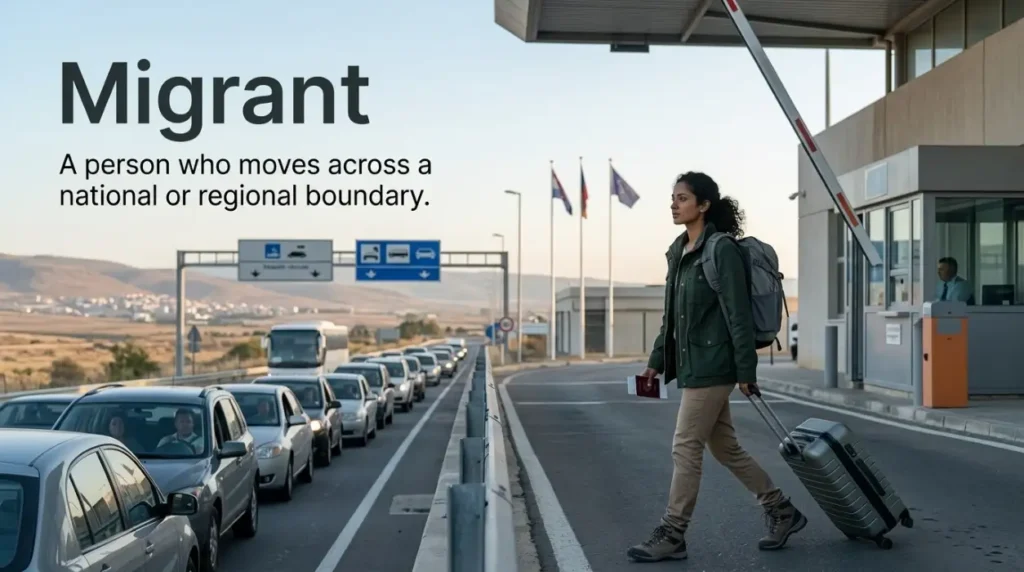
60. Border crosser (Noun)
Meaning: A person who moves across a national or regional boundary.
Tone/Register: Descriptive / Political
Examples:
- Border patrol officials checked the credentials of border crossers.
- Thousands of daily border crossers travel here for commerce.
Synonyms by Tone
Selecting the appropriate term depends heavily on the emotional context of your topic.
Positive Tone
- Pioneer
- Explorer
- Newcomer
- Wayfarer
- Pathfinder
Neutral Tone
- Traveler
- Itinerant
- Transient
- Immigrant
- Commuter
Negative / Stigmatized Tone
- Vagrant
- Drifter
- Tramp
- Alien
- Outlander
Playful / Informal Tone
- Globe-trotter
- Backpacker
- Expat
- Roamer
Why Tone Matters: Choosing the wrong word distorts your meaning. Calling a skilled professional worker a “vagrant” is offensive, while calling a forced refugee a “globe-trotter” trivializes their hardship.
Mini Comparison
| Word | Core Meaning Focus | Tone & Register | Ideal Usage Context |
| Migrant | Person moving to work or live elsewhere, often temporarily | Neutral / Objective | News reports, agricultural discussions, general movement |
| Immigrant | Person moving to a new country with the intent to settle permanently | Formal / Legal | Legal documents, civic discussions, permanent residency |
| Refugee | Person forced to flee home due to war, persecution, or disaster | Serious / Humanitarian | International news, emergency aid, asylum discussions |
Context-Based Usage
Daily Conversation
In casual talk, keep descriptions friendly and direct. Using words like traveler, newcomer, or backpacker sounds natural and clear.
Writing or Blogging
Blog writers can enrich narrative prose by using varied options like wanderer, globe-trotter, or expat to keep readers engaged.
Professional or Academic Tone
Formal reports require objective accuracy. Terms like itinerant worker, transient population, or seasonal worker fit scholarly guidelines.
Creative Writing
Storytellers build atmosphere using evocative vocabulary. Terms like wayfarer, outlander, sojourner, or pathfinder craft memorable characters.
Common Mistakes & Native Usage
Misuse Scenarios
- Confusing Migrant and Immigrant: Remember that a migrant moves (often temporarily), whereas an immigrant moves to stay permanently.
- Confusing Emigrant and Immigrant: An emigrant leaves a country (departing), while an immigrant enters a country (arriving).
- Using Dated Slang: Avoid terms like tramp or land-loper in modern professional writing as they carry negative stereotypes.
Register Notes
- Use legal terms (asylee, resident alien) in formal policy texts.
- Use human-centered language (seasonal worker, displaced person) in news writing.
- To expand your language skills further, explore our guide on synonyms for journey.
Real-Life Mini Scenarios
- Workplace: The farm supervisor organized housing schedules for incoming seasonal workers during the peak apple harvest.
- Social Situations: Our block party committee made sure every newcomer felt welcomed and included.
- Media / Pop Culture: The documentary followed digital nomads who run online businesses while living in foreign beach towns.
- Writing & Storytelling: The fantasy novel opens with a mysterious wayfarer entering an ancient mountain village.
Conclusion
Learning a synonym for migrant helps you describe people, travel, relocation, and movement with greater clarity and respect. Choosing the right term can make your message more accurate while avoiding unnecessary repetition.
Using words such as newcomer, itinerant, traveler, or pioneer can add variety to your writing across academic papers, professional emails, blog posts, and creative stories. Each alternative can provide a slightly different meaning or tone.
A stronger vocabulary also builds confidence when expressing ideas in everyday English. Try using two or three new terms from this guide in your next essay, article, or conversation. Regular practice can sharpen your word choice, improve your writing style, and help you communicate ideas more naturally.
Practice Exercise
Test your understanding of meaning, tone, and register with this short quiz.
1. Which term best describes a person moving to another country to settle permanently?
A) Itinerant
B) Immigrant
C) Commuter
D) Wayfarer
2. What is the most respectful term for someone hired specifically during crop harvests?
A) Vagrant
B) Seasonal worker
C) Drifter
D) Tramp
3. Which word carries a strong spiritual or religious connotation?
A) Pilgrim
B) Commuter
C) Expat
D) Day laborer
4. What term fits a remote professional who works online while traveling the world?
A) Exile
B) Evacuee
C) Digital nomad
D) Colonist
5. Which word specifically describes someone forced to leave home due to war?
A) Sightseer
B) Refugee
C) Backpacker
D) Tourer
6. What is the correct term for a person leaving their native country to go elsewhere?
A) Emigrant
B) Arrival
C) Incomer
D) Settler
7. Which informal option describes an enthusiastic international traveler?
A) Asylee
B) Globetrotter
C) Transmigrant
D) Outlander
8. Which word has a formal or administrative tone used in housing or census reports?
A) Wanderer
B) Roamer
C) Transient
D) Rover
9. What term refers to someone who travels daily between home and work?
A) Commuter
B) Sojourner
C) Pathfinder
D) Exile
10. Which literary term means a person traveling on foot?
A) Wayfarer
B) Alien
C) Day laborer
D) Evacuee
Answer Key:
1B | 2B | 3A | 4C | 5B | 6A | 7B | 8C | 9A | 10A
Reflection Task:
Write two original sentences describing a person moving to a new city, using two new synonyms learned in this article.
Frequently Asked Questions
1. What is the main difference between a migrant and a refugee?
A migrant moves primarily by choice for work, education, or better living conditions and can safely return home. A refugee is forced to flee across borders to escape war, violence, or severe persecution and cannot safely return.
2. What is the best legal synonym for migrant in official documents?
In official or governmental contexts, common terms include “itinerant worker,” “transient worker,” “foreign national,” or “resident alien,” depending on their specific visa and employment status in the host country.
3. Is “expat” the same thing as a migrant?
While both live outside their native country, “expat” (expatriate) usually describes skilled professionals living abroad temporarily for corporate assignments or lifestyle choices, whereas “migrant” often refers to economic or seasonal workers.
4. Which synonym for migrant works best in casual conversation?
In casual everyday speech, words like “newcomer,” “traveler,” “seasonal worker,” or “visitor” sound natural, respectful, and easy for listeners to understand.
5. What does the term “itinerant worker” mean?
An itinerant worker is an employee who travels regularly from place to place to perform short-term jobs, especially in agriculture, construction, or seasonal service industries.

Jameel Hassan is the founder and lead writer at SynonymsCloud.com, a trusted online platform dedicated to English vocabulary and effective communication. He is passionate about helping students, writers, professionals, and lifelong learners discover the right words to express their ideas with clarity, precision, and confidence.
At SynonymsCloud.com, every article is thoroughly researched and carefully written to provide accurate, practical, and easy-to-understand guidance on synonyms, antonyms, word meanings, idioms, and vocabulary. With a strong commitment to quality, real-world usage, and clear explanations, the website helps readers expand their vocabulary, improve their writing, and communicate more effectively in both academic and professional settings.